
International Research Journal of Engineering and Technology (IRJET) e-ISSN: 2395-0056
Volume: 13 Issue: 04 | Apr 2026 www.irjet.net p-ISSN: 2395-0072
International Research Journal of Engineering and Technology (IRJET) e-ISSN: 2395-0056
Volume: 13 Issue: 04 | Apr 2026 www.irjet.net p-ISSN: 2395-0072
A.Thanmay Teja Reddy1, D.Ruthik Reddy2, D.Arunmai3,E.Keerthi Reddy4,CH.Subba Reddy5
1,2,3,4UG Students,Department of Computer Science and Engineering ,JBREC,Hyderabad,India 5Associate Professor,Department of Computer Science and Engineering,JBREC,Hyderabad,India
Abstract - In today's digital era, there is an increasing demand for contactless and efficient human-computer interactions. Traditional calculators require manual input, which may not be practical in situations where touch-free operation is essential, such as in healthcare, laboratories, or public systems. A virtual calculator addresses these needs by enabling gesture-based calculations through AI and machine learning technologies. Problem Definition: There is a need for an intelligent system that allows users to perform mathematical calculations without physical contact. Conventional calculators are limited in accessibility for people with disabilities and do not cater to the growing demand for touchless digital interfaces. Objective: The objective of this project is to develop an AI-powered virtual calculator capable of accurately detecting and interpreting finger movements inrealtime,enablingseamless,touch-free mathematical operations. Proposed Solution: This project integrates Artificial Intelligence (AI), Machine Learning (ML), and computer vision technologies to track hand and finger gestures through a camera. Using frameworks like MediaPipe and OpenCV, gestures are processed to recognize numerical inputs and operations, while a dynamic virtual interface displays the process and results instantly. The system ensures ease of use, high accuracy, and responsiveness. Deliverable: The final deliverable includes a functional virtual calculator prototype demonstrating realtime gesture recognition, source code with documentation, and a comprehensive project report and presentation for submission
Key Words: Virtual Calculator,Machine Learning,Open cv,MediaPipe,Hand Tracking,Image Processing
The primary objective of this project is to design and develop an AI-powered virtual calculator that enables users to perform mathematical calculations through hand gestures without any physical contact. The system utilizes computer vision and machine learning techniques to detect, track, and interpret finger movements in real time using a webcamor camera.
Another important objective is to ensure high accuracy and fast response by recognizing different hand gestures as numerical inputs and arithmetic operations. By integrating advanced frameworks like MediaPipe and OpenCV, the system provides a smooth and interactive user experience
with a dynamic virtual interface that displays inputs and resultsinstantly.
The project also aims to improve accessibility for users with physical disabilities who may find traditional input devices difficult to use. It supports touchless interaction, making it highly suitable for environments such as hospitals, laboratories, and public systems where hygiene and safety areimportant.
Furthermore, the objective includes promoting modern human-computer interaction techniques by replacing conventional input methods with intelligent gesture-based systems. The project also focuses on scalability and future enhancements, such as adding support for complex mathematical operations, multi-user interaction, and integrationwithothersmart systems.
Traditionalcalculatorsandinputsystemsrequirephysical interaction, which may not always be convenient or hygienic. These systems also lack natural and intuitive waysofinteraction.
To address this, the project aims to develop a virtual calculator that allows users to perform calculations using hand gestures through a webcam, enabling a contactless and more interactive user experience using AI and computervisiontechniques.
Before you begin to format your paper, first write and savethecontentasaseparatetextfile.Keepyourtextand graphic files separate until after the text has been formattedandstyled.Donotusehardtabs,andlimituseof hardreturns toonly one return at the endofa paragraph. Do not add any kind of paginationanywhere in the paper. Donotnumbertextheads-thetemplatewilldothatforyou.
Finally, complete content and organizational editing before formatting. Please take note of the following items whenproofreadingspellingandgrammar:
Recent advancements in Artificial Intelligence and computer vision have led to the development of gesturebased interaction systems. Various studies have explored the use of hand gesture recognition for controlling digital
International Research Journal of Engineering and Technology (IRJET) e-ISSN: 2395-0056
Volume: 13 Issue: 04 | Apr 2026 www.irjet.net p-ISSN: 2395-0072
applications without physical contact. Technologies such asOpenCVandMediaPipehavebeenwidelyusedforrealtime hand tracking and landmark detection due to their accuracyandefficiency.
Previous research highlights the use of vision-based modelstoreplacetraditionalinputdevices,enablingmore natural human-computer interaction. Gesture-controlled systems have been successfully applied in areas like virtual keyboards, gaming, and smart interfaces. These studies demonstrate that hand gesture recognition is a reliable and effective approach for developing contactless applications.
Based on these developments, this project implements a virtual calculator using real-time hand gesture detection, contributing to the growing field of touchless and interactivesystems.
The system is developed using Python by integrating OpenCV and MediaPipe for real-time hand gesture recognition.Awebcamcaptureslivevideo,andMediaPipe detects and tracks hand landmarks such as fingertips. Based on finger positions and movements, gestures are identified and mapped to calculator inputs. OpenCV is usedtodisplaythevirtualcalculatorinterfaceandprocess userinteractions.Whentheusertapsvirtualbuttonsusing finger gestures, the system interprets the input and performs the corresponding arithmetic operations, displayingtheresultinstantly.
The system architecture consists of a webcam input module, hand detection module, gesture recognition module,andoutputdisplaymodule.Thewebcamcaptures real-time video, which is processed using MediaPipe to detect hand landmarks. These landmarks are analyzed to recognize finger gestures, which are then mapped to specific calculator functions. OpenCV is used to generate the virtual calculator interface and display the results. All components work together in a sequential manner to provide a smooth and contactless user interaction experience.
The system is a desktop-based application that usesawebcamtocapturereal-timevideoinput,processed usingOpenCV.MediaPipeisusedtodetectandtrackhand landmarksfor recognizingfingergestures.These gestures aremappedtocalculatorinputs,andthesystemperforms the required operations. The results are displayed on a virtual calculator interface, ensuring a smooth and contactlessuserexperience.
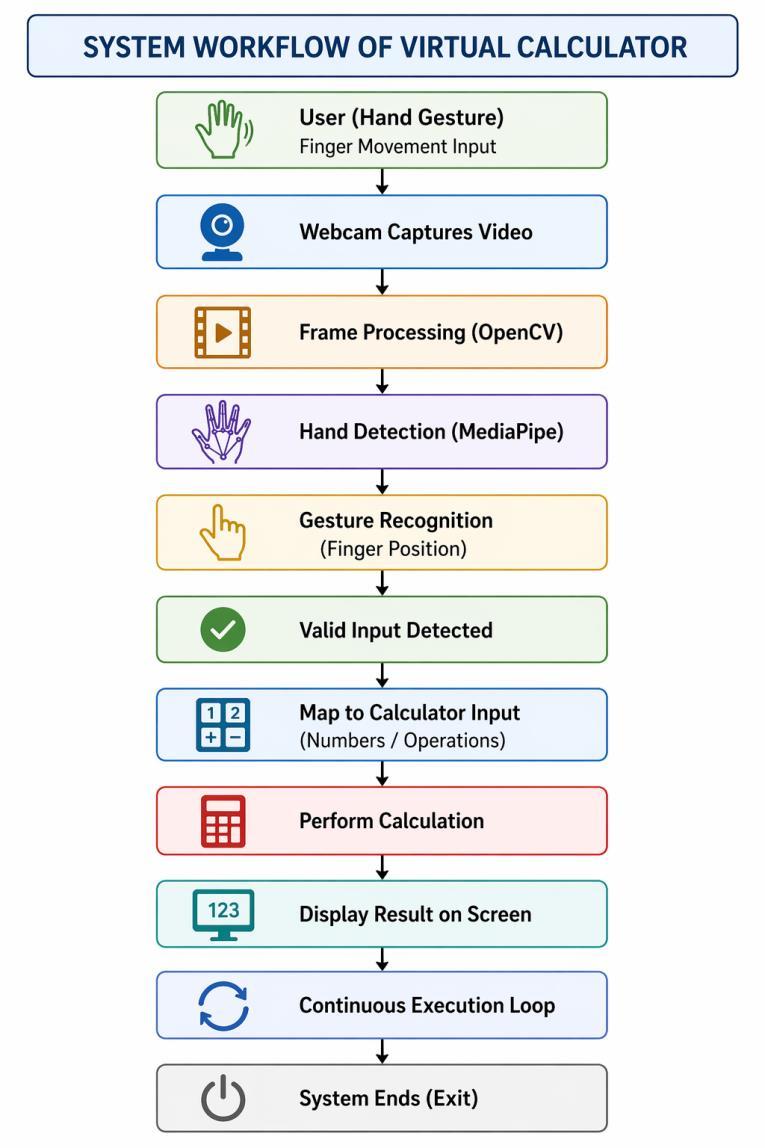
Thesystemstartsbyinitializingthewebcamandrequired librariessuchasOpenCVandMediaPipe.Itcapturesvideo framescontinuouslyanddetectsthehandusingMediaPipe. The hand landmarks are then identified, and fingertip positions are tracked. Based on these positions, gestures are recognized and validated. The detected gestures are mapped to corresponding calculator inputs, and the system performs the required arithmetic operations. Finally, the result is displayed on the virtual calculator interface, and the process repeats continuously until the programisterminated.
Algorithm-1
Input: Handgestureinput(fingerpositions), Webcamvideoframes
Output: Calculatorinputselection,Displayed resultonscreen
Step 1: Initializethesystemandactivatethe webcam.
International Research Journal of Engineering and Technology (IRJET) e-ISSN: 2395-0056
Volume: 13 Issue: 04 | Apr 2026 www.irjet.net p-ISSN: 2395-0072
Step 2: Continuouslycapturevideoframes.
Step 3: ProcesseachframeusingOpenCV.
Step 4: DetecthandusingMediaPipe.
Step 5: Identifyandtrackhandlandmarks (fingertips).
Step 6: Analyzefingerpositionstorecognize gestures.
Step 7: Checkifthegesturematchespredefined calculatorinputs.
Step 8: Ifvalid,mapthegesturetoaspecific numberoroperation.
Step 9: Performthecorrespondingarithmetic calculation.
Step 10: Displayinputandresultonthevirtual calculatorinterface.
Step 11: Repeattheprocessuntilthesystemis terminated.
The system begins by activating the webcam to capture real-time video input. Each frame is processed using OpenCV, and MediaPipe is used to detect and track hand landmarks. The system then analyzes finger positions to recognize specific gestures. Once a valid gesture is detected,itismappedtoacorrespondingcalculatorinput such as numbers or operations. The system performs the required calculation and displays the result on the virtual calculator interface. This workflow continues in a loop, ensuringsmoothandreal-timecontactlessinteraction.
The system starts by activating the webcam to capture real-time hand gesture input from the user. Each video frame is processed using OpenCV to ensure smooth and accurate image handling. MediaPipe is then used to detect the hand and track key landmarks such as fingertips.Basedontheselandmarks,thesystemanalyzes fingerpositionstorecognizespecificgestures.Onceavalid gesture is identified, it is converted into a corresponding calculator input like numbers or arithmetic operations. The system then performs the required calculation and displays the result on a virtual calculator interface. This entire process runs continuously in a loop, enabling seamless and real-time contactless interaction until the userexitsthesystem.
This presents the system workflow: User performs hand gestures → Webcam captures real-time video → OpenCV processes video frames → MediaPipe detects hand and trackslandmarks→ System recognizes finger positions → Valid gesture is identified → Gesture is mapped to calculator input → System performs arithmetic operation →Resultisdisplayedonthevirtualcalculatorinterface→ Processrepeatscontinuouslyuntilthesystemisexited.
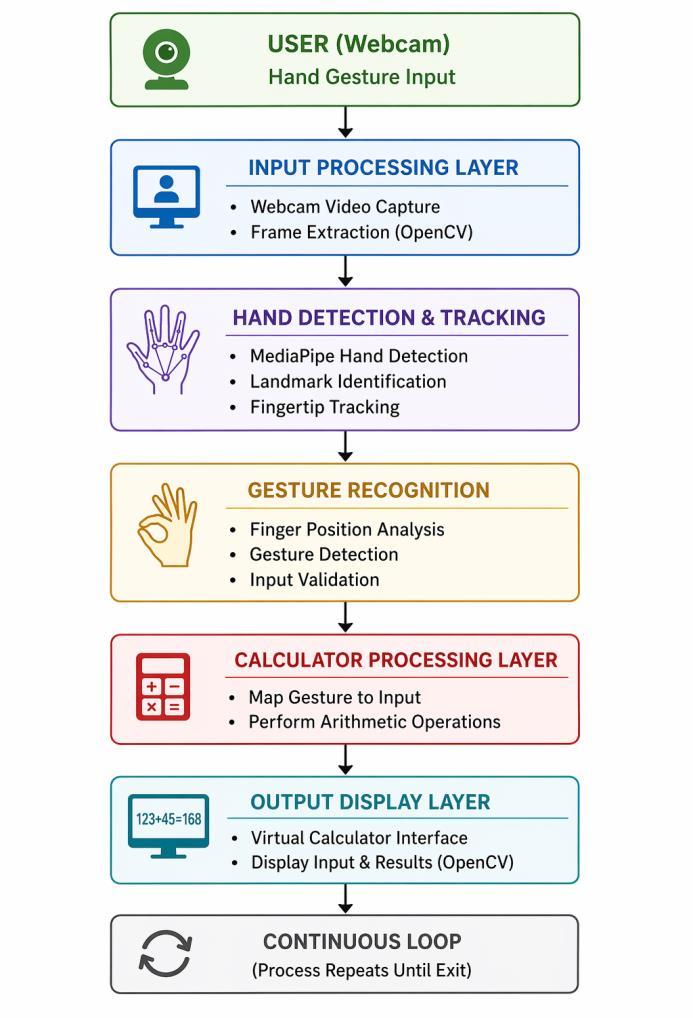
The system is implemented using Python by integrating OpenCV and MediaPipe for real-time hand gesture recognition. The webcam captures live video input, and MediaPipe is used to detect and track hand landmarks suchasfingertips.OpenCVprocessesthevideoframesand displaysavirtualcalculatorinterfaceonthescreen.Based onfingermovementsandpositions,gesturesareidentified andmappedtocorrespondingcalculatorinputs.
The system produces accurate and real-time results by performing arithmetic operations based on the detected gestures. It provides a smooth and responsive user experiencewithoutrequiringphysicalcontact.Theresults demonstrate that the system effectively recognizes hand gestures and performs calculations efficiently, validating thepracticalityoftheproposedapproach.
This project does not use a traditional pre-collected dataset,asitisbasedonreal-timehandgesturedetection. Theinputdataisobtaineddynamicallythroughawebcam,
International Research Journal of Engineering and Technology (IRJET) e-ISSN: 2395-0056
Volume: 13 Issue: 04 | Apr 2026 www.irjet.net p-ISSN: 2395-0072
which continuously captures video frames of the user’s hand movements. MediaPipe processes these frames to extract hand landmarks, including fingertip positions and jointcoordinates.
Thesedetectedlandmarksactastheinputdataforgesture recognition. The system relies on predefined gesture patterns rather than trained machine learning models, making it lightweight and efficient. This real-time data approacheliminatestheneedforlargedatasetswhilestill ensuringaccurateandresponsiveperformance.
The system interface consists of a virtual calculator displayedonthescreenusingOpenCV,designedsimilarto a standard calculator for easy interaction. It includes buttons for numbers, arithmetic operations, and control functions, allowing users to perform calculations using handgestures.
Theoutputisdisplayedinrealtimeontheinterfaceasthe user provides input through gestures. The system accurately processes the inputs and shows the corresponding results instantly, ensuring a smooth and responsive contactless user experience.The virtual calculatorinterfaceusedinthesystemisshownbelow.
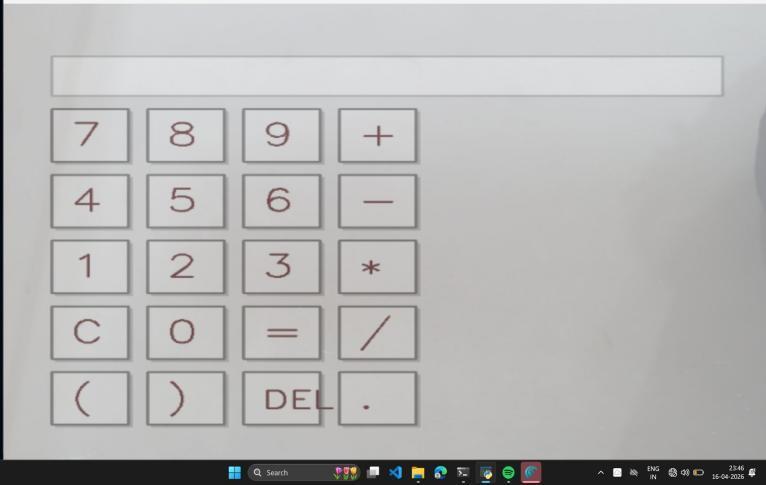
The figure showsthe basiclayoutof the virtual calculator interface developed using OpenCV. It consists of buttons for numbers, arithmetic operations, and control functions such as clear and delete. The interface is designed similar to a standard calculator for easy understanding and user interaction.
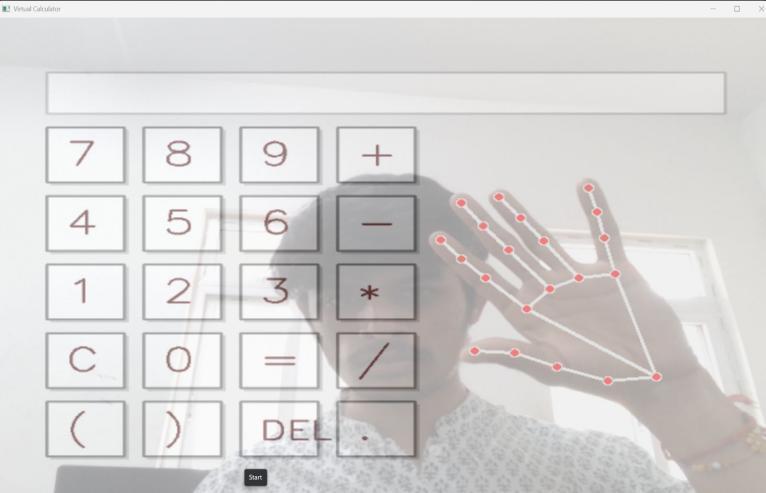
The figure illustrates the hand gesture detection process using MediaPipe. The system tracks hand landmarks and fingertip positions in real time. These detected points are used to identify user gestures, which act as inputs for selectingbuttonsonthevirtualcalculator.
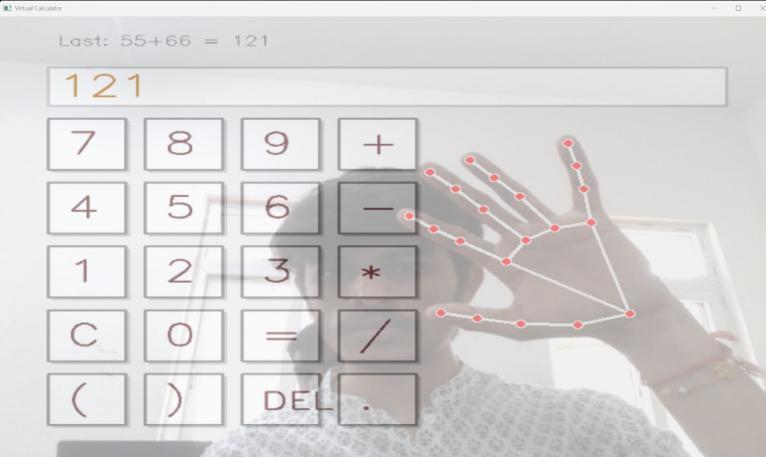
The figure shows the system performing a calculation based on user gestures. The entered values and the computed result are displayed on the screen in real time. Thisdemonstratestheaccuracyandresponsivenessofthe systeminexecutingarithmeticoperations.
International Research Journal of Engineering and Technology (IRJET) e-ISSN: 2395-0056
Volume: 13 Issue: 04 | Apr 2026 www.irjet.net p-ISSN: 2395-0072
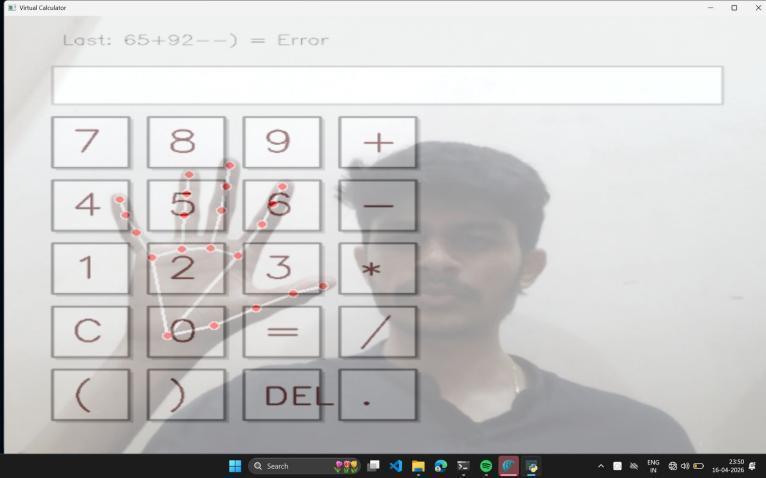
Thefigurerepresentsascenariowhereaninvalidinputor incorrect sequence of operations is detected. The system displays an error message, ensuring that the user is informed about improper inputs and improving the reliabilityoftheapplication.
The performance of the system is evaluated based on accuracy, response time, and usability. The system demonstrates good accuracy in detecting hand gestures and mapping them to corresponding calculator inputs under proper lighting conditions. MediaPipe efficiently tracks hand landmarks, enabling precise gesture recognition.
The response time of the system is fast, as it processes video frames in real time and displays results instantly. The interface is user-friendly and easy to operate, providing a smooth contactless experience. However, performance may vary slightly due to factors suchaslightingconditions,backgroundnoise,andcamera quality.Overall,thesystemperformsefficientlyandmeets theexpectedobjectives.
The Virtual Calculator using AI and ML successfully demonstrates a contactless method of performing arithmetic operations using hand gestures. By integrating OpenCV and MediaPipe, the system efficiently detects hand movements and maps them to calculator inputs in real time. The project provides a user-friendly and interactive interface, eliminating the need for physical inputdevices.
The results show that the system is accurate, responsive, and practical for real-world applications, especially in environments where touchless interaction is preferred. Overall, the project highlights the potential of computer
vision in enhancing human-computer interaction and developinginnovativesolutions.
Bradski, G., & Kaehler, A. (2008). Learning OpenCV: ComputerVisionwiththeOpenCVLibrary O’ReillyMedia.
· OpenCVOfficialDocumentation. Available:https://docs.opencv.org/ ·MediaPipebyGoogle.Available:https://developers.google.c om/mediapipe LinkedInresearch
· Python, OpenCV, Mediapipe, NumPy, DeepLearning Documentations.