
International Research Journal of Engineering and Technology (IRJET) e-ISSN: 2395-0056
Volume: 12 Issue: 03 | Mar 2025 www.irjet.net p-ISSN: 2395-0072
International Research Journal of Engineering and Technology (IRJET) e-ISSN: 2395-0056
Volume: 12 Issue: 03 | Mar 2025 www.irjet.net p-ISSN: 2395-0072
Pawar Sakshi Vijay 1 , Salunkhe Pramila Subhash2 , Shinde Shubhangi Vasant3 , Mane
Bhagyashri Dhanaji4, Suryawanshi Gayatri Ramesh5 , Vrunda Jayant Kulkarni6 .
1Pawar Sakshi Vijay, Computer Technology, Karmyogi Institute of Technology, Maharashtra, India
2Pramila Subhash Salunkhe, Computer Technology, Karmyogi Institute of Technology, Maharashtra, India
3Suryawanshi Gayatri Ramesh, Computer Technology, Karmyogi Institute of Technology, Maharashtra, India
4Shinde Shubhangi Vasant, Technology, Karmyogi Institute of Technology, Maharashtra, India
5Mane Bhagyashri Dhanaji, Technology, Karmyogi Institute of Technology, Maharashtra, India
6 Vrunda Jayant Kulkarni, Computer Technology, Karmyogi Institute of Technology, Maharashtra, India
Abstract - The Village Development System (VDS) is a comprehensive approach to rural development. It includes economic empowerment, infrastructure development, and community involvement. It encourages governance, health, and education to support sustainable development. It provides interfaces that are easy to use for stakeholders, administrators, and members of the community. VDS provides platforms for community involvement encourage feedback and inclusive participation. It also provides venues for community involvement, governance assistance, and health initiatives. For those involved in rural development, VDS is an effective instrument. Information regarding cultural events, government services, temples, schools and colleges, economic growth, etc., is provided via the Village Development System. We facilitate more communication among the villagers. This software was created to link everyone in the village network. This technology will lessen the amount of human labour required for each task that villagers complete to obtain government services. This app will take the lead in improving services, such as providing details about the village's many assets. The Village Development System makes it simple for users to learn about all the Sarpanch/Gramsevak projects. We are offering villages an easy-to-understand link between government policies and themselves. For the benefit of the students who are part of the community and its future, this app will also provide information about schools and colleges. Gramsabha refers to the meetings that take place in villages, and we notify the residents about them in order to reduce the human labour required to personally assemble all the locals. The Village Development System's digital system can offer greater improvement and efficiency. By posting issues on this app, the feedback system ensures that troublesome issues can be addressed and resolved. Visitors will better comprehend the traditions we have been honouring since our ancestors if they are informed about cultural events. To assist villages, we offer modules such as meeting information, health, education, temples, programs, postproblems, post-schemes, economic growth, and the ability to send and read feedback. Villagers may save time and human effort by using this app's services. If a villager finds themselves in a difficult situation, they can use the Village
Development System to report the issue and receive suggestions for solutions.
Key Words: Village Development System (VDS), Admin (Gramsevak, Sarpanch)
1. V. Nair, A. B. Nellippallil, J. K. Allen and F. Mistree, "Speculating a successful and relevant global development enterprise in the year 2035", 2019.
From the standpoint of a rural community, sustainable development must address how the residents make enough money to preserve their rural way of life. Sustainabledevelopmentistypicallydescribedintermsof environmentalfactors.
In those cases where jobs are discussed in relation to sustainability, they are all too frequently viewed as permanent positions. But the fact of contemporary rural andurbanlivingisthateconomicconditionsshiftquickly. As a result, any debate about sustainable employment must take place in a dynamic environment where various job kinds vary in tandem with shifting economic conditions.
2. L. T. Gwaka, "Digital technologies and youth mobility in rural zimbabwe", Electron. J. Inf. Syst. DevelopingCountries, vol. 84, no. 3, May 2018.
In India majority of the population still lives in villages. A lot of work needs to be done in making the villages clean. There are different aspects of clean village such as: water supply, sanitation, indoor air quality, solid waste management and renewable energy etc. All these aspects have different alternatives with the associated merits demerits. In some aspects such as water supply, consider ableworkisdonewhereasinsomeareaslikesanitaction lot of work is required to be done. We can learn lot of lessons based on success and failure in adopting different alternatives.Keepingintouchwithtechnologycleanvillage projects should integrate technology and digital design, which will make the village not only clean but also smart.
International Research Journal of Engineering and Technology (IRJET) e-ISSN: 2395-0056
Volume: 12 Issue: 03 | Mar 2025 www.irjet.net p-ISSN: 2395-0072
The paper discusses all these aspects with reference to Maharashtra.
3.Village-level solar power in Africa: Accelerating access to electricity services through a socio-technical design in Kenya 2014:
Village-level solar power supply represents a promising potential for access to electricity services. Increased knowledgeisneededforthedevelopmentofsolutionsthat workfortheuserandareviableinthelongrun.
This article analyzes a solar power model developed and tested through action research in collaboration between a community in Kenya and a team of social scientists and technicalexperts.
The analysis includes the reasons for its socio-technical design, and the actual functioning of the model. There searchshowsthatanenergycentermodel cancoverbasic electricity needs in areas with dispersed settlement patterns, where mini-grid based system as well as conventionalgridextensionmeetsignificantchallenges.
2. EXISTING SYSTEM:
InthestateofMaharashtra,the Gram Panchayat App was launchedtodigitalizethefunctioningofover12,000Gram Panchayats across the state. It provides the Panchayats with tools for monitoring government schemes, collecting data on various parameters, and improving transparency. Additionally, it supports local leaders in managing their responsibilities more efficiently and helps residents stay informedandparticipatesinlocalgovernance.
Challenges and Limitations:
Digital Literacy: A significant challenge is the low levels of digital literacy in rural areas. For the app to be effective, rural residents must be trained in using smartphoneandmobileapplications.
Internet Access: In some remote areas, internet connectivity might be limited, hindering the effective useoftheapp.
Maintenance and Updates: Constant updates and maintenance of the app are necessary to ensure its smoothfunctioningandthesecurityofdata.
Language Barriers: The app needs to be available in multiple regional languages to cater to the diverse populationacrossruralareas.
3. PROPOSED SYSTEM:
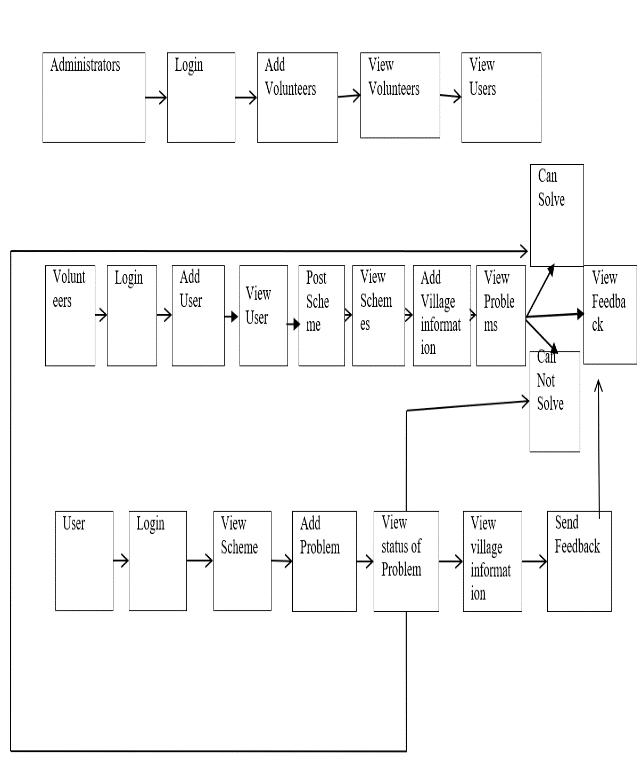
The administrator of the suggested system offers eight different kinds of modules, including information on education, economic development, government schemes, sending acknowledgements, event information, hospital, meetingdetails,andtempleinformation.
Ineverymodule,theadministratorhastheabilityto post, update,anddeletethedata. All posted information can be accessed by the user. Problems can be posted by the user. After it is resolved, theusercangiveratingsandprovidefeedback.
1. Education information module include :
Schoolname
Scheduleofschool
Schooleventsinformation
Teachercontacts
Studentscount
2. Economic development module include :
Nameoftheproject
Nameoftheadmin
Contacts
Nameofthescheme
Location
3. Government scheme module include :
Nameofthescheme
Applicableto
Listofrequireddocuments
Wecanunabletouploaded file(PDF)
4. Send acknowledgement module include :
Sendtheacknowledgment
Viewproblems
Viewfeedback
5. Event information module include :
Nameoftheevent
Descriptionofevents
Scheduleofevent
Uploadtheimages
6. Hospital module include :
Nameofthehospital
Nameofthedoctor
Contactofdoctor
Hospitaldetails
Nameofthescheme
Schemeinformation
7. Meeting details module include :
Nameofthemeeting
Shortdescriptionofmeeting
Scheduleofthemeeting
8. Temple information module include :
Nameofthetemple
Scheduleoftemple
Templeevents
Contact
International Research Journal of Engineering and Technology (IRJET) e-ISSN: 2395-0056
Volume: 12 Issue: 03 | Mar 2025 www.irjet.net p-ISSN: 2395-0072
5. SYSTEM ARCHITECTURE:
6. OBJECTIVES:
1. Enhance Governance: Promote transparency, accountability, and efficiency in village-level governance.
2. Foster Economic Growth: Support local entrepreneurship, skill development, and incomegeneratingactivities.
3. Improve Infrastructure: Develop and maintain essential infrastructure,suchasroads,sanitation,and electricity.
4. Empower Communities: Encourage active participationindecision-makingandfostera senseof ownership.
5. Promote Education and Health: Enhance access to qualityeducationandhealthcareservices.
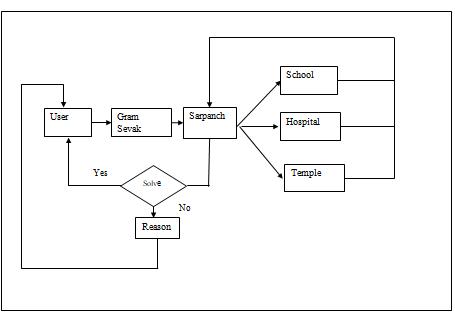
We created the VDS (Village Development System) Androidapp,whichisprimarilyfocusedongivingvillagers a platform to learn about the various services offered in their villages, comprehend and utilize those services and facilities, such as health, education, social functions, and village-related meetings (Gramsabha). If you have any issues,villagers postthembyusingthisplatform,andthe Sarpanch, the village government, can resolve them. In order to foster stronger relationships among the villagers and enable them to work together to develop the village, we have given them a platform to submit problems pertainingtosociety,facilities,andvillage-relatedmatters.
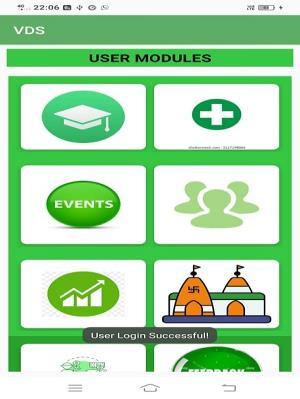
Fig 7 1 This is the User Module which contains 8 sub modules named as Hospital, Education, Event, Meetings, Economic Development, Temple, Government, and Feedback Module in which the user can be able to see the information, images and schedule posted by the admin and can be able to send feedback to admin
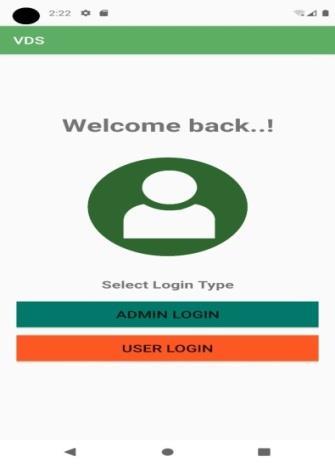
Fig 7.2 This is Login Page where admin and user can select their login type and when we click on admin login then we
International Research Journal of Engineering and Technology (IRJET) e-ISSN: 2395-0056
Volume: 12 Issue: 03 | Mar 2025 www.irjet.net p-ISSN: 2395-0072
redirect to Admins login page and same when we click on user login then we redirect to users login page and then they can be able to login also user can register itself.
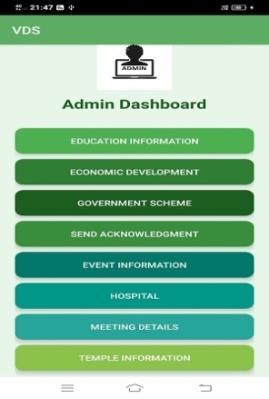
Fig 7.3 This is the Admin Module which contains 8 sub modules named as Hospital, Education, Event, Meetings, Economic Development, Temple, Government, and Feedback Module in which the Admin can be able to post the information, images and schedule which is visible to user in users module and also to admin in admin’s module can be able to send feedback to user. Also admin have ability to post ,delete and update the sended information.
The Village Development System is an essential framework for promoting holistic growth and sustainabilityinruralareas.Byfocusingoninfrastructure, education,healthcare,andeconomicopportunities,itaims to uplift villages and bridge the gap between urban and rural living conditions. An effective village development system addresses both basic and advanced needs of the community, fostering inclusive development that empowersresidents.
Moreover, education plays a pivotal role in the system by increasing literacy levels, providing skill development. Healthcare initiatives are crucial for reducing infant mortality, diseases, and promoting overall well-being. Improved healthcare services result in a healthier and moreproductiveworkforce.
Economic growth in villages is also a critical component, and the system often includes initiatives for agricultural development, rural entrepreneurship, and the promotion of small and medium-sized enterprises. Village development systems encouragelocal resourceutilization whilepreservingtheenvironment.
Social empowerment is another key factor. Encouraging participation in decision-making processes ensures that villagers have a voice in matters affecting their lives, promotingsocialcohesionandunity.
The Village Development System offers a robust framework for addressing the multifaceted challenges faced by rural communities. By integrating modern technologies with participatory governance, the VDS can drivesustainabledevelopmentandimprovethequalityof life in villages. Future enhancements, such as AI-powered analyticsandIoTintegration,canfurtheroptimizesystem performanceandimpact.
It is with profound sense of gratitude that I acknowledge the constant help and encouragement from our hon. Principal Dr.A.B.KANASE, Karmayogi Institute of technology, Shelve-Pandharpur, HOD of Computer Technology department and our mentor Ms.Kulkarni.V.J forguidance&wholeheartedthankstomyfamily.Thisis to acknowledge and thanks to all individuals who played definingroleincreatingthiswork.
[1] V. Nairetal, "Speculating a successful and relevant global development enterprise in the year 2035,"2019.
[2]L.T.Gwaka,"Digitaltechnologiesandyouthmobilityin rural Zimbabwe,” 2018. .
[3] V. Zavratnik et al., "Smart villages: Comprehensive review of initiatives and practices," Sustainability, 2018.
[4]Village-level solarpower inAfrica:Acceleratingaccess toelectricityservices,2014.
[5] C. Markowitz, "Harnessing the 4IR in SADC: Roles for policymakers,"2019.
BIOGRAPHIES


Ms.SakshiVijayPawar,Currently Studying in Karmyogi institute of technology,ShelvePandharpur.

Ms. Pramila Subhash Salunkhe, Currently Studying in Karmyogi institute of technology, Shelve Pandharpur.


Ms.GayatriRameshSuryawanshi, CurrentlyStudyinginKarmyogi instituteoftechnology,Shelve Pandharpur.
International Research Journal of Engineering and Technology (IRJET) e-ISSN: 2395-0056
Volume: 12 Issue: 03 | Mar 2025 www.irjet.net p-ISSN: 2395-0072

Ms. Shinde Shubhangi Vasant, Currently Studying in Karmyogi institute of technology, Shelve Pandharpur.

Ms. Bhagyashri Dhanaji Mane, Currently Studying in Karmyogi institute of technology, Shelve Pandharpur

Ms. Vrunda Jayant Kulkarni is currently working as Lecturer in Karmayogi Institute of Technology ShelvePandharpur. She pursued postgraduation degree M.E (Computer) from Savitribai Phule Pune University, Pune, and Maharashtra, India -411028. Her area of interest is Information and Cyber Security,CloudComputing,Networking.