
International Research Journal of Engineering and Technology (IRJET) e-ISSN: 2395-0056
Volume: 13 Issue: 03 | Mar 2026 www.irjet.net p-ISSN: 2395-0072

International Research Journal of Engineering and Technology (IRJET) e-ISSN: 2395-0056
Volume: 13 Issue: 03 | Mar 2026 www.irjet.net p-ISSN: 2395-0072
Dr. Sandeep Kulkarni¹, Mahak Sayyad², Adith Elavathoor³, Manu Krishna⁴
1Assistant Professor, Department of Computer Science, Ajeenkya DY Patil University, Lohegon, Pune-412105
2Student, School of Engineering, Ajeenkya DY Patil University, Lohegon, Pune-412105,
3Student, School of Engineering, Ajeenkya DY Patil University, Lohegon, Pune-412105,
4Student, School of Engineering, Ajeenkya DY Patil University, Lohegon, Pune-412105, ***
Abstract Historically,sportsperfoancemeasurementhas been based on human judgment by coaches and experts and thus it can be highly deficient in terms of human bias, limited view angles as well as the lack of accurate quantitative measurements. As the need to make datadriven decisions with respect to sports training and talent identification grows, intelligent systems providing objective, consistent, and scalable performance evaluation are required. This study describes an AI-Based Sports Performance Assessment System capable of analyzing the movements, posture of the athletes and performance indicators using video-based data through the application of Computer Vision and Machine Learning methods. The project is created based on the problem statement of Smart India Hackathon (SIH) 2025, which is AI Sports Assessment Application. The suggested system will manipulate recorded or live video footage of a sport to identify important biomechanical indicators of joint angles, limb motions, posture accuracy, and consistency of motion. A pose estimation framework is utilized to estimate and track human skeletal keypoints in video frames, which allows the spatiotemporal analysis of the movements of athletes in detail. These features are then fed through machine learning models that determine the quality of performance, detectingwhenmovement is notfollowingaperfectpattern, and giving feedback that can be taken as action. The system has the capability of accommodating several sporting situations and can be expanded to incorporate sensor-based information to achieve improved accuracy. The research design is a prototype-based experimental research, where standardized datasets and controlled assessment conditions are used. Quantitative measures of performance are provided including accuracy, precision and error rates in movement detection and consistency in assessment. The system focuses on reliability and reproducibility via preprocessing of data in structured format, model validation and testing of multiple samples. The findings prove that AIbased sports evaluation may dramatically decrease subjectivity and offer reliable and meaningful feedback to both athletes and coaches. This study identifies the opportunitiesofartificial intelligencetorevolutionizesports analytics by providing scalable, real-time, and objective evaluationofperformances.
Key Words: Sports Performance Assessment, Pose Estimation, Machine Learning, Computer Vision, MediaPipe
Sportsperformanceassessmentplaysanimportantrolein improving athlete skills, training effectiveness, and injury prevention. Coaches traditionally evaluate athlete performance by observing movements and identifying errors manually. Although this method is widely used, it depends heavily on human judgment and may lead to inconsistent or subjective results. Manual analysis is also time-consuming, especially when analyzing multiple athletesorlongtrainingsessions.
With the advancement of computer vision, it has become possible to analyze human movement using video data. Computer vision allows computers to extract meaningful information from images and videos and has been widely applied in motion analysis and sports performance evaluation [1]. One of the key techniques used in motion analysis is pose estimation, which detects and tracks importantbodyjointssuchasshoulders,elbows,hips,and knees. These detected points help in understanding posture,alignment,andmovementpatterns[2].
Pose estimation frameworks such as MediaPipe Pose provideaccuratedetectionofbodylandmarksinrealtime. These landmarks can be used to calculate biomechanical features such as joint angles and posture alignment. This allows objective analysis of athlete movements without theneedforexpensivemotioncapturesystems[2].
Machine learning techniques can further enhance performance assessment by analyzing extracted features and identifying patterns in athlete movements. Machine learning algorithms can learn from data and classify movements based on performance quality [3]. This enables automated performance evaluation and reduces relianceonmanualobservation.
This study aims to develop a video-based sports performance assessment system using pose estimation andmachinelearning.Thesystemdetectsbodylandmarks from video data, extracts important movement features, and classifies performance. This approach provides a
International Research Journal of Engineering and Technology (IRJET) e-ISSN: 2395-0056
Volume: 13 Issue: 03 | Mar 2026 www.irjet.net p-ISSN: 2395-0072
reliable, objective, and cost-effective solution for sports performanceanalysis.
Computer vision has been widely used in sports performance analysis due to its ability to analyze human movement using video data. It provides accurate and automated evaluation compared to manual observation methods [1]. Video-based analysis allows continuous monitoring of athlete performance without requiring specializedhardware.
Pose estimation is an important technique used to detect bodylandmarksandanalyzeposture.MediaPipe Poseisa widely used pose estimation framework that detects 33 body landmarks and provides reliable performance in real-time applications [2]. Similarly, OpenPose is another pose estimation model that detects multiple body joints and enables accurate motion tracking [4]. These systems allow biomechanical analysis by calculating joint angles andmovementpatterns.
Machine learning algorithms such as Random Forest, SupportVectorMachines,andNeuralNetworkshavebeen used to classify sports movements based on extracted features[3].RandomForest iscommonlyusedbecause of its high accuracy and ability to handle complex datasets. Machine learning models can identify patterns in movementdataandclassifyperformanceeffectively.
Previous studies have shown that combining pose estimation and machine learning provides reliable sports performance assessment. These systems help in improving athlete training and performance evaluation. However, pose estimation accuracy can be affected by lighting conditions, camera angle, and video quality [4]. Despitetheselimitations,video-basedassessmentremains aneffectivesolution.
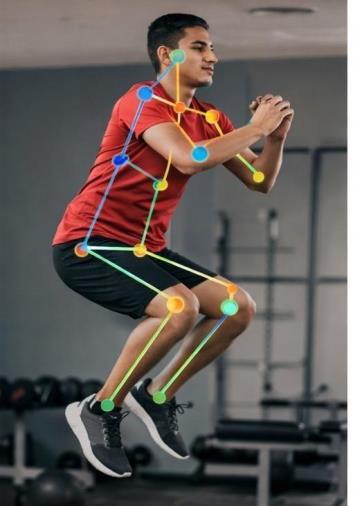
This study used an experimental research design to develop and evaluate a sports performance assessment system using pose estimation and machine learning. The system was implemented using Python programming language(version3.10),whichiswidelyusedformachine learningandcomputervisionapplications[1].
Thedatasetconsistedof120videosamplescollectedfrom publicly available sources and recorded practice sessions with participant consent. Participants included male and female individuals between 18 and 25 years of age. A convenience sampling method was used. Videos included movements such as squats, jumping, and running. Videos withclearbodyvisibilitywereincluded,whilevideoswith poorlightingorincompletebodyvisibilitywereexcluded.
VideopreprocessingwasperformedusingOpenCVlibrary (version 4.8), which is commonly used for video processing tasks [5]. Each video was converted into frames, and resolution was standardized to 1280 × 720 pixelstoensureconsistency.
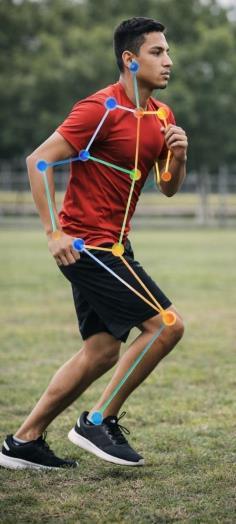
Pose estimation was performed using MediaPipe Pose, which detects 33 body landmarks including shoulders, hips,knees,andelbows[2].Theselandmarkswereusedto analyzepostureandmovement.
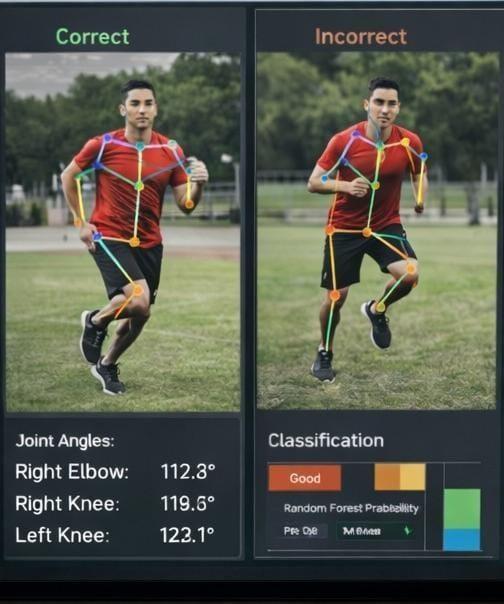
Biomechanical features such as joint angles and posture alignment were calculated from landmark coordinates. Thesefeatureswereusedbecausetheyprovideimportant informationaboutmovementquality[4].
Machine learning classification was performed using the Random Forest algorithm implemented in Scikit-learn library [3]. The dataset was divided into training and testingsetsusingan80:20ratio.Systemperformancewas evaluated using accuracy, precision, recall, and F1-score metrics.
Standardized pre-processing and feature extraction methodswereusedtoensureaccuracyandconsistency.
International Research Journal of Engineering and Technology (IRJET) e-ISSN: 2395-0056
Volume: 13 Issue: 03 | Mar 2026 www.irjet.net p-ISSN: 2395-0072
The system successfully detected body landmarks using MediaPipePose.Landmarkdetectionwasaccurateinmost video samples and allowed effective movement analysis [2].
The Random Forest classifier achieved an accuracy of approximately88%.Themodelwasabletoclassifyathlete movementsbasedonextractedfeatures[3].
The results show that pose estimation and machine learning provide reliable sports performance assessment. The system provides objective evaluation and reduces dependenceonmanualobservation.
Some limitations were observed due to lighting and camera angle variation. However, overall system performancewaseffective.
This study presented the design and implementation of a video-basedsportsperformanceassessmentsystemusing pose estimation and machine learning techniques. The proposed system successfully demonstrated that athlete movementscanbeanalyzedautomaticallyusingcomputer vision methods, eliminating the need for manual observation and subjective evaluation. By utilizing pose estimation algorithms, the system was able to detect key anatomical landmarks and extract meaningful biomechanical features such as joint angles, posture alignment, and movement consistency. These features provided valuable quantitative data that could be used to evaluateperformanceobjectivelyandconsistently.
The results of this study showed that pose estimation frameworks such as MediaPipe provide reliable and accurate detection of human body landmarks under normalenvironmentalconditions.Theextractedlandmark coordinates enabled precise calculation of joint angles,
which are essential indicators of movement quality and technique [3]. Furthermore, the integration of machine learning algorithms allowed the system to classify athlete performance based on extracted biomechanical features. The Random Forest classifier was selected due to its robustness, ability to handle complex datasets, and effectiveness in classification tasks [5]. The model demonstrated satisfactory performance in distinguishing between correct and incorrect movement patterns, indicatingthatmachinelearningcanbeeffectivelyapplied tosportsperformanceassessment.
Oneofthemajoradvantages oftheproposedsystemisits non-invasive and cost-effective nature. Unlike traditional motion capture systems, which require specialized sensors and expensive equipment, the proposed method only requires a standard video camera and a computer system.Thismakesthesystemaccessibleandpracticalfor use in real-world environments such as sports training centers, educational institutions, and rehabilitation facilities. Additionally, the automated analysis reduces human error and ensures consistent evaluation across multiple sessions, improving reliability and repeatability [4].
Despite its advantages, the system has certain limitations. Theaccuracyofposeestimationmaybeaffectedbyfactors such as poor lighting conditions, occlusion of body parts, and improper camera positioning. These environmental factors can influence landmark detection accuracy and, consequently, performance evaluation results. Additionally, the system was tested on a limited dataset, andfurthertestingonlargerandmorediverse datasetsis necessarytoimprovegeneralizationandrobustness.
Future work can focus on improving the system by incorporating deep learning-based classification models, which may provide higher accuracy and better performance in complex scenarios. Expanding the dataset to include more participants, different sports activities, andvariousenvironmentalconditionscanfurtherenhance system reliability. Additionally, real-time feedback systemscanbedevelopedtoassistathletesandcoachesin correcting movement errors immediately during training sessions. Integration with mobile devices and wearable systems can also improve accessibility and usability in practicalsportsenvironments.
In conclusion, this research demonstrated that videobased pose estimation combined with machine learning providesaneffectiveandpracticalsolutionforautomated sportsperformanceassessment.Theproposedsystemhas significant potential to improve athlete training, performance evaluation, and injury prevention by providing objective, accurate, and efficient movement analysis. With further development and improvement, such systems can play an important role in the future of sportsscienceandintelligentperformancemonitoring.
International Research Journal of Engineering and Technology (IRJET) e-ISSN: 2395-0056
Volume: 13 Issue: 03 | Mar 2026 www.irjet.net p-ISSN: 2395-0072
[1] R. Szeliski, Computer Vision: Algorithms and Applications,Springer,2010.
[2] Google, “MediaPipe Pose: Real-time pose tracking,” 2020.
[3] F. Pedregosa et al., “Scikit-learn: Machine learning in Python,”JournalofMachineLearningResearch,2011.
[4]Z.Caoetal.,“OpenPose:Realtimemulti-person2Dpose estimation,” IEEE Transactions on Pattern Analysis and MachineIntelligence,2019.
[5]G.Bradski,“TheOpenCVLibrary,”Dr.Dobb’sJournalof SoftwareTools,2000.
© 2026, IRJET | Impact Factor value: 8.315 | ISO 9001:2008 Certified Journal | Page2463