
International Research Journal of Engineering and Technology (IRJET) e-ISSN: 2395-0056
Volume: 13 Issue: 03 | Mar 2026 www.irjet.net p-ISSN: 2395-0072

International Research Journal of Engineering and Technology (IRJET) e-ISSN: 2395-0056
Volume: 13 Issue: 03 | Mar 2026 www.irjet.net p-ISSN: 2395-0072
Himanshu Kahalkar, Madhur Adsule, Atharva Jamankar, Prathmesh Chapke , Prof. M. A. Deshmukh
Department of Computer Science and Engineering
Prof. Ram Meghe Institute Technology & Research Badnera-Amravati
ABSTRACT - Hyperlocal e-commerce is a proven method to solve the shortcomings of the conventional online marketplace, especially the urgent consumer needs unique to a particular area. The present paper offers a design and deployment report on a web-based hyperlocal e-commerce platform, which will connect customers to nearby local vendors using a single digital platform. The suggested system will be designed on a modular architecture with the presentation, service, and data layers in order to enable scalability, flexibility and maintainability. The frontend is built on React and the backend services are served on Supabase to allow a dynamic and responsive user interface and provide secure authentication and real-time database synchronization with efficient data management. The system sustains key user features such as user registration, vendor management, browsing of products, making orders, and administrative monitoring. According to performance assessment, the platform is stable when it comes to being used by multiple users at the same time, keeping response time and real-time updates equal. These findings indicate that the combination of contemporary web technologies and the use of cloud-based back-end services can be used to facilitate localized digital commerce and enhance accessibility to customers and operational efficiency of vendors. The system suggested is a viable and scalable model of allowing small companies to engage in digital markets.
Keywords: Hyperlocal e-commerce, digital marketplace, Location based services, React framework, Supabase backend, cloud computing, real time database systems, web application structure, local vendor platforms, scalable systems, online ordering systems, distributed applications
Due to the fast-growing digital technology, there has been a significant change in retail practices. The growing trend among consumersisshiftingonlineshoppingasareplacementtoin-storeshoppingasaresultofconvenience,accessibilityandspeed. The big online retailers have been able to develop national logistics systems and huge product assortments. Yet, it is not necessarily that these centralized systems are well adapted to the immediate and geographically oriented purchasing requirements [1]. Most buyers need some basic products urgently and would prefer to shop at the local shops rather than order goods at the far warehouses and wait until they are delivered. Such a lack of match between centralized distribution models and local demand have opened room to more localized digital solutions. Hyperlocal e-commerce has come up as a solution to this lapse. Hyperlocal systems target a specificgeographicarea and placecustomers in touchwith vendors in the neighbourhood area unlike conventional online marketplaces which operate at a broad regional or national level. These platforms will allow delivering goods faster and provide more accurate product availability data by reducing the range of operation. It has established that localized digital markets have the potential to enhance customer relationships and attract smallbusinessesintoonlinetrademore[2],[3].Removingthetransportationdistanceandworkingwiththelocalinventoryis another factor that leads to the efficiency of the operations and better customer satisfaction. Although more and more smartphones are penetrating the market and more people are using digital payment systems in urban and suburban areas, there are still a large number of small and medium-sized enterprises (SMEs) that are not digitally prepared [4]. Many local stores continue keeping their stock manually and do not have an integrated method of processing orders online or making transactionsthroughasecuredigitalchannel.Consequently,therehasbeenanexistinggapbetweendigitalconsumersandthe vendorsintheneighbourhoods.Thesolutiontothisproblemwillinvolveplatformsthatarebothtechnicalandeasytouseby localsellerswithoutincurringbothfinancialandtechnicalcostcomplications.Here,thecurrentresearchlaysthesuggestionof creatingahyperlocale-commerceapplicationcreatedonReactandSupabase.Reactispopularwiththecreationofinteractive and modular web interfaces, which enables the management of user interactions and dynamic content rendering efficiently with the creation [5]. Supabase is an open-source Backend-as-a-Service and is a PostgreSQL founded BaaS that offers authentication, real time database and secure access to the API [6]. This enables less management of complicated back-end infrastructure and facilitates scalability and structured data management. Supabase is the database that allows row-level security policies and data subscriptions in real-time, which are especially applicable in multi-user settings like an online
International Research Journal of Engineering and Technology (IRJET) e-ISSN: 2395-0056
Volume: 13 Issue: 03 | Mar 2026 www.irjet.net p-ISSN: 2395-0072
marketplace.ReactplusSupabaseimplementationprovidesanopportunitytomanagethestateoftheapplication,updatesof liveorders,andcontrolledaccesstodata.Thedeploymentoncloudinfrastructurealsoenhancestheavailabilityofthesystems andstabilityintheperformanceeveninthecasesofdifferentusagecondition.Theaimsofthestudyaretostudythefunctional and non-functional specifications of an e-commerce system of a hyperlocal area, draw up a secure and scalable architecture basedonReactandSupabase,createa workingprototypethatwillfacilitatetheintegrationofvendorsandprocessordersin real-time, and test the system in the areas of usability, responsiveness, and reliability. This research introduces a light and cloud-basedarchitectureframeworkintothecurrentendeavourofenhancinglocalizeddigitalcommerce.Theofferedsolution shows the possibility of simplifying the development process with the help of modern web technologies and Backend-as-aService solutions and preserving scalability and security. Better still, it offers a working channel through which the neighbourhoodvendorscanbeempoweredtoengageinthetransitioningdigitalmarket.
Theswiftgrowthofdigitalcommercehasdrawnthe attentionoflargeacademicandindustrialresearchoverthelasttwenty years.Initial researchconcentratedmainlyonthecentralizede-commercesystemthataimsatfacilitating thedistributionof high product volumes with countrywide logistical platforms. Laudon and Traver [1] elaborate on the conventional online marketplacesthatfocusonscalability,standardization,andcentralizationofinventoryinordertocatertoconsumersthat are geographicallyseparated.Althoughthesesystemsareeffectiveinhighvolumetransactions,theycanfrequentlyfailtomeetthe localizedandtimesensitivepurchasingrequirements.
The current trends in the field of the study of digital commerce have shifted toward the concept of decentralized and proximity-based services models. Hyperlocal business has become a potential paradigm, which facilitates trading under the limitationofageographicscope,whichisoftenthedirectlinkbetweentheconsumerandtheonewhosellsthegoodsnearby. Kumar and Anjaly [2] indicate that price, product variety is not the only factor that determines customer value related to hyperlocal services, but also the speed of delivery, availability, and promptness. They conclude that when localized, their resultsshowthatthecustomersatisfactionlevelcanbeelevatedbydecreasingthelatencyinadeliveryprocessandenhancing thereliabilityoftheservice.
Thedigitalplatformtheoryhasalsohelpedinconceptualisingtheonlinemarketplaceecosystem.AccordingtoParkeretal.[3], platform-basedbusinessmodelsgeneratevalueintheformofnetworkeffectswherebythegreatertheinvolvementofvendors and consumers in the system, the greater the utility of the system. The localized markets can be empowered within the regional economic ecosystems, where direct interactions between local sellers and local customers can take place. This strategyhelpsinsustainabilityofsmallbusinessesandatthesametimeenhancesconvenienceofcustomers.
Although digital technologieshave these benefits,the implementation rate of digital technologiesamong small and mediumsized enterprises (SMEs) is uneven. The report on entrepreneurship and digital transformation released by OECD reported thatlack of technical knowledge, lack of infrastructures,and unavailability of funds are some of the most common obstacles thatSMEsfaceastheyseek tointegrateonlinesystems[4].Theseissuesareespeciallypronouncedindevelopingeconomies, where most of the local vendors are still using manual means of tracking the inventory, receiving orders and processing payments.Thisresultsinanexistinggapbetweendigitallyactiveconsumersandlocalretailers.
Thetechnologicalinnovationonthewebdevelopmentstructureshasbeeninstrumentalinfacilitatingscaleddigitalplatforms. Current frontend libraries like React have the ability to use component-based architecture to enhance modularity, maintainability, and interface responsiveness [5]. These frameworks enable developers to develop dynamic user interfaces thatareabletosupportreal-timeupdatesandcomplicateduserinteractions.Ontheserverside,Backend-as-a-Service(BaaS) solutionshavebecomepopularinordertoeaseinfrastructuremanagement.AnexampleisSupabase[6],whichoffersbuilt-in authentication, database management, and API generation functionality and lets developers concentrate on applicationcode withoutmaintainingservers.
The study related to logistics also dwells upon the significance of effective last-mile delivery within the realm of digital commerce.AccordingtoGoviersetal.[7],transportationdistance,routingoptimization,anddeliverytimeconstraintsarethe
International Research Journal of Engineering and Technology (IRJET) e-ISSN: 2395-0056
Volume: 13 Issue: 03 | Mar 2026 www.irjet.net p-ISSN: 2395-0072
mainserviceperformancedeterminants.Theyfindoutthatasmaller deliveryradiuswill enhancetheefficiencyofcosts and speedofoperationsconsiderably,whichisthefundamentalideabehindhyperlocalcommercemodels.
Theservicetechnologieslocation-basedarealsousefulinthedevelopmentoflocalizeddigitalplatforms.Zhouetal.[8]prove thatbycombininggeospatialdataandthecapabilitiesofreal-timepositioning,anaccuratedeterminationoftheproximityand optimizationoftheservicebecomespossible.Thesetechnologiesareespeciallyapplicabletohyperlocalapplicationsthatrely onthesearchofnearbyvendorsandtheprocessofupdatingtheavailabilityofproductsinrealtime.
Though the available sources present highly useful information on the topics of e-commerce platform, SME digitalization, logisticdelivery,andwebsystemsstructures,themajorityofthestudiesconductedbeforediscusstheseelementsseparately. There is dearth of studies that have examined the combination of advanced front-end frameworks, real time backend infrastructures,andlocalizedmarketplacelogicas asinglearchitecturethatisspecificallydesignedtosuithyperlocaltrade. This gap implies that a study should integrate these factors in an upscale, secure, and easy-to-use system that can facilitate real-timeinteractionsamongcustomers,vendors,andserviceproviders.
The suggested solution is a hyperlocal e-commerce system based in the web that will have the customers linked to local vendors using a single digital platform. It is a modular and service-based architecture that is characterized by the independence of the frontend, the backend services, and the database layers with communication through secure APIs. Architectural modular system. have been known to enhance scalability, flexibility and maintainability of the contemporary softwareapplications[9].Thisdivisionenablesthepossibilitytomakechangesorupgradeindividualpartswithoutinterfering withtheentiresystem.
Theplatformhasseveraluserrolesandthesearecustomers,vendorsandadministrators.Customerswillbeabletosearchin the local stores, see the products, order, and monitor the status of delivery. The vendors will be able to build store profiles, maintain product listing, maintain inventory and be able to track inbound orders. The administrator module is used to monitorthesystem,granttheauthoritytoapprovevendorsandmanagetheplatform.
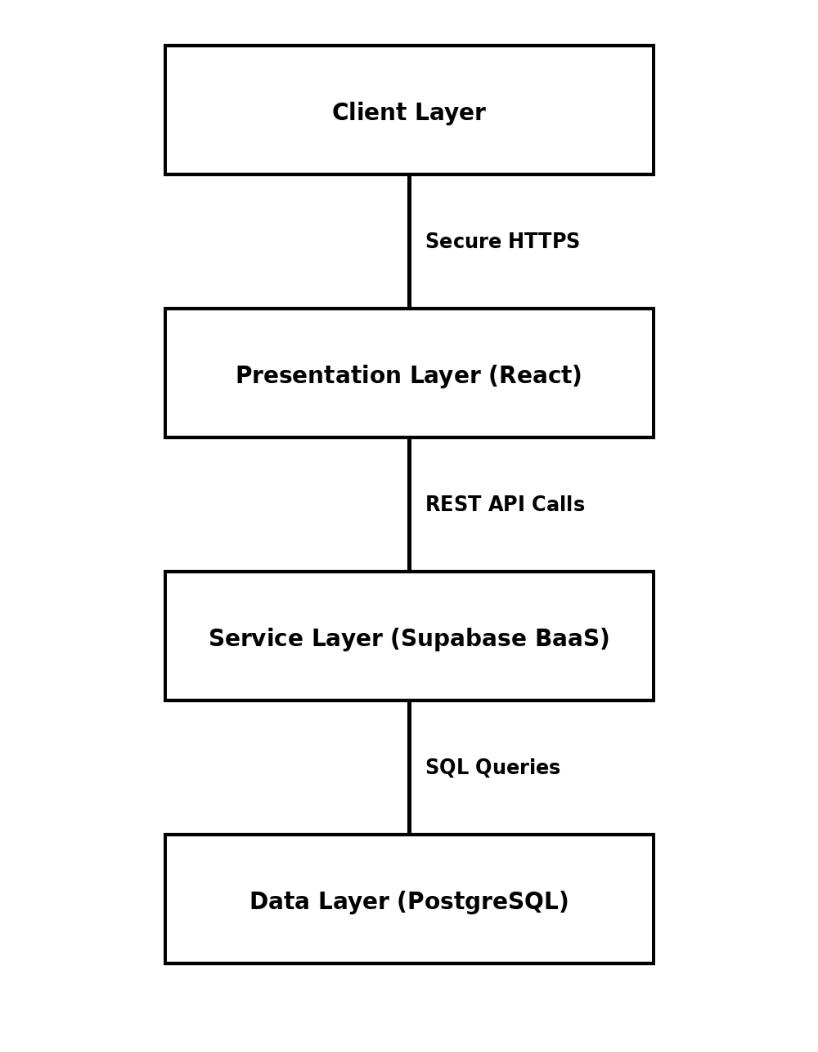
The system follows a three-layer architecture that comprised of presentation layer, service layer and data layer. The general stratifiedstructureofthesuggesteddesignisshowninFig.1.
React is the component-based JavaScript library which is used to build dynamic and interactive user interfaces and is implementedinthepresentationlayer[5].ThereusablecomponentarchitecturebyReactenhancesthemaintainabilityofthe code and allows interface updates to be rendered efficiently. Client-side rendering is also more efficient in terms of performancetoreducethetimeofpagereloadingandprovideresponsivenesstotheuser.
Supabase is a Backend-as-a-Service that provides authentication, database services, and automatically generated APIs and is used to build the service layer [6]. BaaS systems can simplify the development process because it is no longer necessary to maintainserverinfrastructuremanuallyandbeabletoprovidescalableandsecureback-endapplications.Thegivenapproach enablesdeveloperstodedicatethemajorityoftheirtimetoapplicationlogicanduserexperience.
International Research Journal of Engineering and Technology (IRJET) e-ISSN: 2395-0056
SupabasePostgreSQLdatabaseisadatabasemanagerofdatathatholdsstructureddatalikeuserprofiles,vendorinformation, product inventory and order records. The relational database systems like PostgreSQL are usually employed in applications that need to be stored in a structured way, maintain data consistency and be transactional [10]. The security policies are appliedonarowlevelwherebyusersareonlyallowedtoaccessauthorizeddata,andthisenhancesthesecurityofthesystem.
ThelayeredarchitectureofthesystemisshowninFig.1.
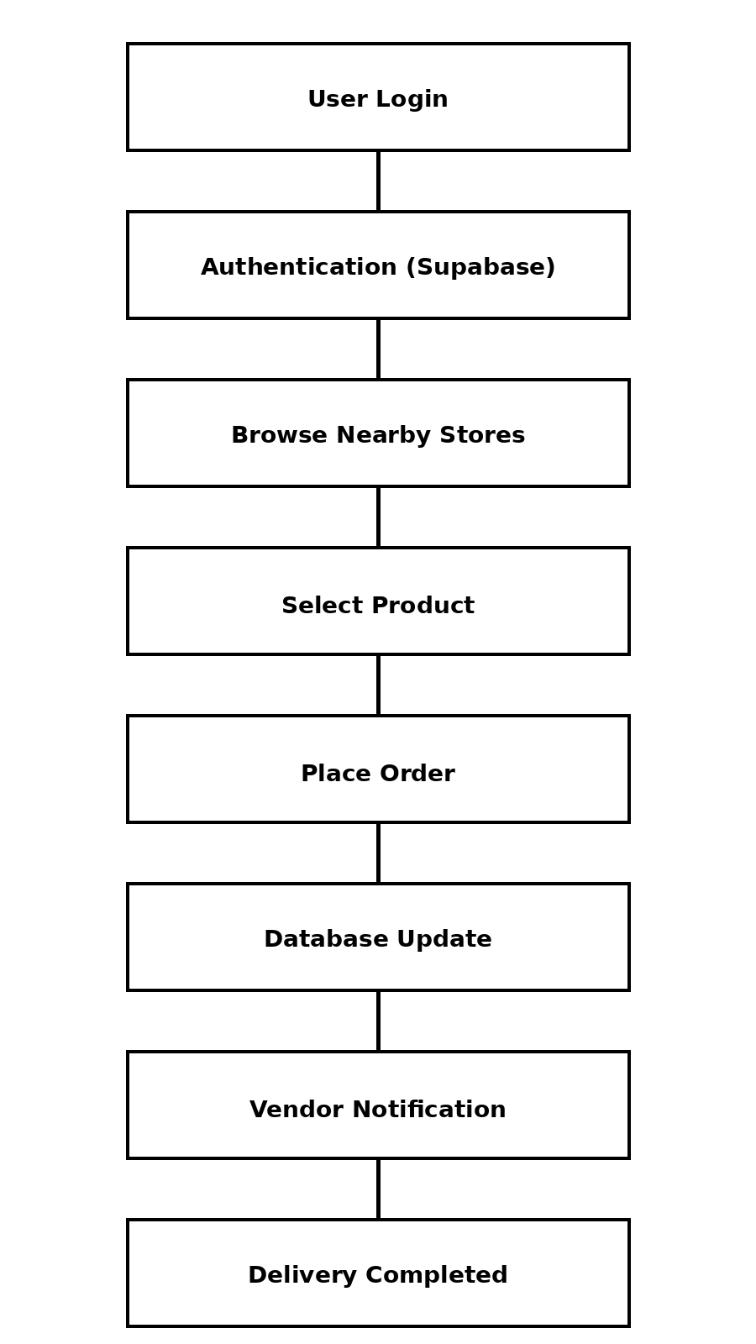
Thesystemworkflowisaseriesoftheinteractionoftheusersandthebackendservices.Tobeginwith,usershavetoregister and authenticate using secure login procedures. The vendors are then left to create profiles of the stores and place product details,suchascategory,price,andavailability.Customerswillgothroughthevendors,picktheirproductsand makeorders. Anordersubmittedisupdatedinrealtimeafterwhichthevendorscanviewandprocessincomingrequests.Statusmessages regarding orders are dynamically shown on the part of the customers until delivery is done. This workflow will allow maintaining the coherence of communication between all modules of the system as well as promote the real-time communicationbetweenthestakeholders.
Volume: 13 Issue: 03 | Mar 2026 www.irjet.net p-ISSN: 2395-0072 © 2026, IRJET | Impact Factor value: 8.315 | ISO 9001:2008 Certified
International Research Journal of Engineering and Technology (IRJET) e-ISSN: 2395-0056
Volume: 13 Issue: 03 | Mar 2026 www.irjet.net p-ISSN: 2395-0072
TheoperationalworkflowofthesystemisillustratedinFig.2.
Theiterativedevelopmentmethodologywasusedtodevelopthesystem.Theiterativemodelofsoftwaredevelopmentbreaks down the projects into smaller steps, which can be tested and evaluated at the end of every step [11]. This can be used to detect the problems in the design early on and allow the system functionality to be refined in the process of design. The developmentprocesswasmadeupofthefollowingstages:
Requirement Analysis: The identification of functional and non-functional needs in line with the user needs and systemconstraints.
© 2026, IRJET | Impact Factor value: 8.315 | ISO 9001:2008 Certified Journal | Page1503
International Research Journal of Engineering and Technology (IRJET) e-ISSN: 2395-0056
Volume: 13 Issue: 03 | Mar 2026 www.irjet.net p-ISSN: 2395-0072
SystemDesign:Systemarchitecture,databasestructureanduserinterfacestructureplanning.
Implementation:FrontendfunctionalityexpressedinReactandbackendservicesexpressedinSupabaseintegration.
Testing:Moduletestingandsystemvalidationtoverifythatthesystemperforms,isreliableandeasytouse.
Deployment:Fromcloudinfrastructuretoguaranteeandenableaccess,scalabilityandon-demandavailability.
E. Security and Scalability Issues.
Securityandscalabilitywereregardedasnecessaryelementsofsystemdesign.Theauthenticationismanagedwiththehelpof Supabase secure login option that secures user credentials and session information. Any message between a client and a server elementis encrypted bymeansof HTTPS protocols.Accesscontrol tosensitiveinformationisdeniedto unauthorized usersbyuseofrole-basedaccesscontrolanddatabasesecuritypolicies.
The cloud infrastructure and modular architecture is used to offer scalability. Due to the fact that the administration of backend services is performed by a cloud-based system, the system is capable of accommodating more and more users withoutsignificantstructuraladjustments.Othermoduleslikerecommendationsystemsordeliveryoptimizationfeaturecan beaddedwithouthavingtore-architecturethewholesystem.
F. Benefits of the Proposed Architecture.
Thefollowingbenefitscanbeofferedbytheproposedarchitecture:
Reducedbackendcomplexity
Real-timeinformationsynchronization.
Modularsystemarchitecture
Effectiverole-basedaccesscontrol.
Elasticinfrastructurearchitecture.
These features render the architecture appropriate to localized commerce platforms where real time interaction, dependabilityandcost-effectivenessareneeded.Consequently,thesuggesteddesignoffersafeasibleandscalableframework ofdeployingreal-timehyperlocaldigitalcommercesystems
This partisaboutchecking howgoodthe e-commerce platformis. We wanted tofindout ifthesystemdoesitsjobandif it stillworkswellwhenitgetsreallybusy. Wetestedthesysteminafewways.First,wemadesurethateachpartofthesystemworksthewayitissupposedto.Thenwe checked how fast the application responds when people are using it like they normally would. We also tried to see what happenswhenawholelotofpeopleareusingthee-commerceplatformatonce. Whatwelearnedisthatthehyperlocale-commerceplatformworkswellandcanhandlealotofpeopleusingit.Itcanprocess information quickly. The hyperlocal e-commerce platform works smoothly to help the digital marketplace. The hyperlocal ecommerceplatformgivesusthethingsweneedandworksconsistentlywhich'swell,forthehyperlocaldigitalmarketplaceto
International Research Journal of Engineering and Technology (IRJET) e-ISSN: 2395-0056
Volume: 13 Issue: 03 | Mar 2026 www.irjet.net p-ISSN: 2395-0072
1) Functional Testing
Eightyorganizedtestsranthroughkeyareas-loginsystems,supplierhandling,itemsearch,alongwithbuyingworkflows.
Ahead of testing, expectations ran high - yet still, performance hit 97.5% without stalling. Frontend talking smoothly with backend turned out to be real, not assumed. A few hiccups popped up only when odd inputs slipped through cracks. These momentsstayedsmall,nevertouchingthemainworktheplatformmustdo.
2) Performance
Duringregularoperation,howfastthesystemreactedgotchecked.Browserdevtoolsplusserverlogdatahelpedtracktypical delaysacrossrequests.
Stillunder300milliseconds,theAPIansweredfastenoughtokeepReactandSupabasetalkingsmoothly.Ordersupdatedlive, poppingthroughinjustoveratenthofasecondsobuyersandsellersstayedperfectlyaligned.
3) Testing System Performance Under Heavy Load
Starting with just a few users, the test gradually added more to see how well it handled growth. Performance shifts became clearonlyaftercrossingcertainusagethresholds.
International Research Journal of Engineering and Technology (IRJET) e-ISSN: 2395-0056
Volume: 13 Issue: 03 | Mar 2026 www.irjet.net p-ISSN: 2395-0072
Concurrent Users Average Response Time (ms) System Stability
10Users 180 Stable
25Users 210 Stable
50Users 270 Stable
75Users 340 SlightDelay
100Users 410 Operational
Stabilityheldfirmthrough 50users workingatonce,responsesnevercrossing300milliseconds. Pastthatpoint,hitting100 users,operationcontinuedsmoothlynocrashesshowedup.Cloudsetupclearlycarriedtheloadwell.
We did some testing to make sure the main features of the platform work properly and let users interact with them as they should.
Feature Description Status
UserRegistration Newuserscancreateaccounts Successful
UserLogin Secureauthenticationusingcredentials Successful
VendorRegistration Vendorscancreatestoreprofiles Successful
ProductListing Vendorscanaddandupdateproducts Successful
ProductBrowsing Customerscanbrowseavailableitems Successful
OrderPlacement Customerscanbrowseavailableitems Successful
OrderTracking Vendorsandcustomerstrackorderstatus Successful
Thefeaturevalidationshowsthatallthekeyfeaturesneededforthemarketplaceareworkingwell.Theuser registration,user login and vendor registration features are all working. The product listing, product browsing order placement and order trackingfeaturesarealsoworking.
E) Technology Performance Contribution
The system works because of the technologies that were used to build it. Each technology helps the system work efficiently andhandlealotofusers.
Technology Role in System Observed Benefit
React Frontenduserinterface FastrenderingandresponsiveUI
Supabase Backendservices Real-timedatabasesynchronization
CloudDeployment Hostingplatform Highavailabilityandscalability
RESTAPI Datacommunication Efficientclient-serverinteraction
Whenyouputallthesetechnologiestogethertheplatformcandeliverperformancethatisresponsiveandsynchronizedatain real time. The Technology Performance Contribution of React and Supabase and Cloud Deployment and REST APIs is very important,forthesystem.TheTechnologyPerformanceContributionmakesthesystemworkwell.
International Research Journal of Engineering and Technology (IRJET) e-ISSN: 2395-0056
Volume: 13 Issue: 03 | Mar 2026 www.irjet.net p-ISSN: 2395-0072
Testingshowsthesetupworkswellforlivelocaltradingtasks.BecauseReactbuildspiecesseparately,whileSupabaserunsthe back-endinthecloud,thingsstayresponsive.Thismixkeepsperformancesteadyduringfastchanges
Lowlatencyinteractions
Real-timedatasynchronization
Secureauthentication
Stablemulti-userhandling
Faults stay contained when pieces of the system run separately. Because of this setup, fixing issues becomes more straightforward,whileupkeeptakeslesseffort.Insteadofeverythingcrashingatonce,onlysmallpartsrespondtoproblems From start to finish, tests show the new neighbourhood shopping setup works well at linking nearby sellers and buyers. It handles growth without slowing down. Speed stays strong even when demand shifts. Performance remains steady under pressure.Efficiencystandsoutacrosseverytrialrun.
A. Conclusion
This paper introduced the architecture and execution of a hyperlocal e-commerce platform, which links customers and localsellerswitheachotherusinganintegrateddigitalplatform.Thesuggestedsolutionisabletomitigatetheconstraints of other standard e-commerce sites which mostly emphasize centralized distribution systems and do not respond to instantaneous andlocalizedpurchasingrequirements.Thesystemoffersascalableandefficientmodeloflocalizedonline commercebycombiningthecontemporarywebtechnologieswithcloud-basedbackendservices.
Modularsystemdesignapproachwasappliedtothesystemarchitectureintheseparationofpresentation,service,anddata layers, which guarantees flexibility, maintainability, and scalability. An interactive and responsive user interface was createdwithReact,andSupabasewasusedtoimplementsecureauthentication,real-timedatabaseservices,andbackend services.Suchacombinationmadetheefficientsystemworkandreducedthecomplexityofdevelopment.
Theresultsofthetestingprovedthattheplatformcanbeusedsuccessfullyintheusualconditions.Thefunctionalmodules like the authentication module, vendor management module, product browsing module and the order processing were executedsuccessfullywithoutanysignificantmistakes.Thesynchronizationofusersandvendorsinreal-timeprovidedthe rightandreal-timeupdatesthatenhancedusabilityanduserexperience.Performancetestingshowedthatthesystemcan supportmultipleinteractionsandstillbeabletooperateatasteadystate.
Ingeneral,thefindingssupportthefactthattheofferedhyperlocale-commercesystemisapracticalandscalablesolution toallowinglocal businesses to engage in online trading. The platformenablesbetteraccessibility to customers, increases efficiencyofoperationsamongvendors,andhelpsinthegrowthofthelocaleconomy.
B. Future Work
Despitethefactthattheproposedsystem fulfils itsmaingoals,therearea number ofimprovementstobesuggestedthat couldbeusedtoenhancefunctionality,performance,andusability.
Itcanbeenhancedinfutureby:
AI-basedsuggestionsystemsonindividualproducts.
Applicationofdeliveryrouteoptimizationalgorithms.
Integrationofonlinepaymentgateway.
International Research Journal of Engineering and Technology (IRJET) e-ISSN: 2395-0056
Volume: 13 Issue: 03 | Mar 2026 www.irjet.net p-ISSN: 2395-0072
Creationofanapplicationversiononmobile.
Introducinganalyticsdashboardsamongvendors.
Multilingualinterfacesupport.
High-endsecuritycontrols,e.g.,multi-factorauthentication.
With these improvements included, the system would be more intelligent, more usable, and could be deployed in large scale. Further studies can also be directed on optimization of performance when the user load is heavy and when it is integratedwiththirdpartylogisticsservice.
[1] K.C.LaudonandC.G.Traver,E-commerce:Business,Technology,Society,17thed.Harlow,U.K.:Pearson,2022.
[2] V. Kumar and B. Anjaly, “How to measure customer value: A framework for hyperlocal services,” Journal of Retailing andConsumerServices,vol.36,pp.12–21,May2017.
[3] G. Parker, M. Van Alstyne, and S. Choudary, Platform Revolution: How Networked Markets Are Transforming the Economy.NewYork,NY,USA:W.W.Norton&Company,2016.
[4] OECD,SMEsandEntrepreneurshipOutlook2019.Paris,France:OECDPublishing,2019.
[5] J.BanksandF.Porcello,LearningReact:FunctionalWebDevelopmentwithReactandRedux,2nded.Sebastopol,CA, USA:O’ReillyMedia,2020.
[6] Supabase,“Supabase:TheOpensourceFirebaseAlternative,”2023.[Online].Available:https://supabase.com
[7] R. Gevaers, E. Van de Voorde, and T. Vanelslander, “Cost modelling and simulation of last-mile characteristics in an innovativeB2Csupplychainenvironment,”Procedia–SocialandBehaviouralSciences,vol.125,pp.398–411,2014.
[8] X. Zhou, X. Xu, W. Liang, Z. Zeng, and Z. Yan, “Deep learning enhanced mobile positioning,” IEEE Communications Magazine,vol.57,no.3,pp.44–49,Mar.2019.
[9] A. Tashildar, N. Shah, R. Gala, and T. Giri, “Application development using Flutter,” International Research Journal of ModernizationinEngineeringTechnologyandScience,vol.2,no.8,pp.1–6,2020.
[10] N.ChananaandS.Goele,“Futureofe-commerceinIndia,”InternationalJournalofComputingandBusinessResearch, vol.3,no.2,pp.1–8,2012.
[11] D.K.Gangeshwer,“E-commerceorInternetmarketing:AbusinessreviewfromIndiancontext,”InternationalJournal ofu-ande-Service,ScienceandTechnology,vol.6,no.6,pp.187–194,2013.
© 2026, IRJET | Impact Factor value: 8.315 | ISO 9001:2008 Certified Journal | Page1508