
International Research Journal of Engineering and Technology (IRJET) e-ISSN: 2395-005
Volume: 13 Issue: 04 | Apr 2026


International Research Journal of Engineering and Technology (IRJET) e-ISSN: 2395-005
Volume: 13 Issue: 04 | Apr 2026

p-ISSN: 2395-0072
Bukka Charitha Reddy1 , Bodramoni Eshika2 , J. Bhanu Teja Manikanta3 , K. Shravan Kumar4
1Student, Dept. of Electronics and Communication Engineering, MVSR Engineering College, Hyderabad, India
2Student, Dept. of Electronics and Communication Engineering, MVSR Engineering College, Hyderabad, India
3Student, Dept. of Electronics and Communication Engineering, MVSR Engineering College, Hyderabad, India
4Assistant Professor, Dept. of Electronics and Communication Engineering, MVSR Engineering College, Hyderabad, India
Abstract-ThisworkintroducesVarnaOnyx,anOCRbasedsystemthatintegratesDigitalSignalProcessingtechniques to enhance text extraction from both scanned and handwritten documents. Conventional OCR approaches tend to produce lower accuracy when dealing with noisy or degraded input images. To address this, the proposed system applies preprocessing techniques such as grayscale conversion, noise filtering, and contrast enhancement before recognitionusingtheTesseractOCRengine.Theproposedmethodenhancestextvisibilityandimprovesrecognition accuracy while keeping the processing pipeline efficient. The system also provides a user-friendly interface for uploadingimagesandobtainingeditabletext.Experimentalresultsdemonstrateimprovedperformancecomparedto directOCRonrawimages.
Key Words: Text Extraction, Optical Character Recognition (OCR), Document Parsing, Scanned Documents, Digital Documents, Large Language Models (LLMs)
In recent years, the need for transforming physical documents into digital formats has increased significantly duetothegrowthofdigitalsystemsanddata-drivenapplications. OpticalCharacterRecognition(OCR)playsa key role in this transformation by enabling the extraction of textual information from images, scanned documents, and handwritten notes. This decreases manual data entry and improves efficiency in document management.
Despite advancements in OCR technologies, accurately recognizing text from real-world documents remains a challenge.Factorssuch asnoise,lowresolution,unevenlighting, skewed text, and complexbackgroundsoften affect recognition performance. Traditional OCR systems tend to perform well on clean, printed text but strugglewhenappliedtodegradedorhandwritteninputs.
As a solution to these challenges, this paper explains VarnaOnyx, an enhanced OCR system that integrates Digital Signal Processing (DSP) techniques with the Tesseract OCR engine. The system focuses on improving input image quality through preprocessing methods suchas filtering, noise reduction, and contrast enhancement before performing text recognition. By combining preprocessing techniques with OCR, the proposedapproachaimstoimproveaccuracywhilemaintainingasimpleandefficientworkflow.Thesystemis designed to handle both scanned and digitally generated documents, making it suitable for variousreal-world applicationsincludingacademic,administrative,andarchivaluse.
Optical Character Recognition (OCR) refers to the process of converting textual content from images or scanned documents into editable digital text. OCR systems have evolved with the integration of machine learning techniques, improving their ability to recognize characters. However, their effectiveness is still influenced by the quality of the uploaded image. Issues such as noise, poor lighting, distortions, and background interference often reduce recognition accuracy, making preprocessing an important stage in OCR systems.
Previous studies have emphasized the role of preprocessing in enhancing OCR performance. One such work exploredtheuseoftechniqueslikesmoothingfiltersandadaptivebinarizationtoimprovetextvisibilitybefore
International Research Journal of Engineering and Technology (IRJET) e-ISSN: 2395-005
Volume: 13 Issue: 04 | Apr 2026
p-ISSN: 2395-0072
recognition. Thestudy demonstrated thatrefiningimage quality priorto OCR significantlyincreases accuracy, particularlywhendealingwithdegradedorlow-resolutioninputs.
Anotherresearcheffortintroducedacombinedapproachwhereimageenhancementmethodswereintegrated with conventional OCR engines. Techniques such as edge sharpening, contrast adjustment, and morphological processing were applied to better isolate textual regions. Although this method improved recognition results forcompleximages,italsoaddedadditionalcomputationaloverhead.
A further study examined OCR systems that incorporate both preprocessing and post processing stages, including error correction using linguistic models. While this approach resulted in higher recognition rates, it requiredmore processing power and was less efficient for lightweight applications. These observations signal that maintainig a balance between accuracy and system efficiency remains an important challenge in OCR systemdesign.
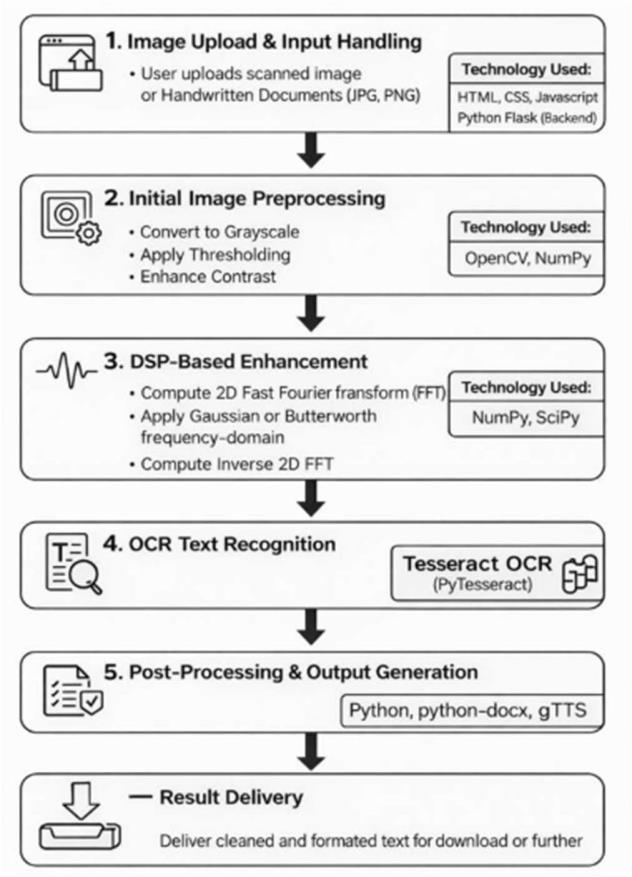
The methodology of The VarnaOnyx system is a step-by step processing pipeline designed to convert input documents into accurate, machine readable text. The system emphasizes improving input quality before recognitionandensuringefficientextractionoftextualinformation.
The VarnaOnyx system presents an effective approach to document digitization by integrating Digital Signal Processing (DSP) techniques with an OCR engine. The proposed framework enhances input image quality through preprocessing steps such as noise reduction, filtering, and contrast improvement, which significantly improvestextrecognitionaccuracy.BycombiningthesetechniqueswiththeTesseractOCR engine,thesystem
© 2026, IRJET | Impact Factor value: 8.315 | ISO 9001:2008 Certified Journal | Page783
International Research Journal of Engineering and Technology (IRJET) e-ISSN: 2395-005
Volume: 13 Issue: 04 | Apr 2026
p-ISSN: 2395-0072
isabletohandleavarietyofdocumenttypes,includingscanned,handwritten,anddigitallygeneratedinputs. The implementation of a web-based interface further improves usability, allowing users to easily upload documentsandobtaineditabletext.Experimentalobservationsdemonstratethatthepreprocessingstageplays acrucialroleinreducingrecognitionerrorsandimprovingoutputqualitycompared todirectOCRprocessing. Despite itseffectiveness, the system hascertain limitations when deling with highly complex handwriting and heavily degraded documents. Future work can focus on integrating deep learning-based OCR models, incorporating language- based error correction, and extending support for multiple languages. Additionally, optimizing the system for real-time processing and mobile platforms can further enhance its practical applicability.
In conclusion, VarnaOnyx provides a balanced and efficient solution for OCR based document processing, offering improved accuracy, flexibility, and usability for real-world applications. The process starts with data acquisition, where the user uploads documents in the form ofimages or PDFs through a web-based interface. Theseinputsmayincludescanneddocuments,handwrittennotes,ordigitallygeneratedfiles.
Once the input is received, it undergoes a preprocessing stage aimed at enhancing image quality. This step includes grayscale conversion, noise reduction, filtering, and contrast enhancement. Digital Signal Processing (DSP) techniques such as Gaussian and Butterworth filtering are applied to reduce noise and improve clarity. Additionally, operations like binarization and skew correction help in aligning the text and improving readability.
After preprocessing, the refined input is passed to the text extraction stage. For image-based inputs, the Tesseract OCR engine is used to recognize and convert text into editable format. For digitally generated documents, parsing techniques are used to directly extract textual content. This approach ensures that both scannedanddigitaldocumentsarehandledefficiently.
The extracted text is then subjected to post-processing, where minor refinements are applied to improve readability and formatting. This includes the removal of unwanted characters and basic structuring of the output text. Finally, the system produces an output stage, where the processed text is displayed to the user through the interface. The user can review, edit, and export the text for further use. This structured workflow ensuresimprovedaccuracywhileminimizingmanualeffort.
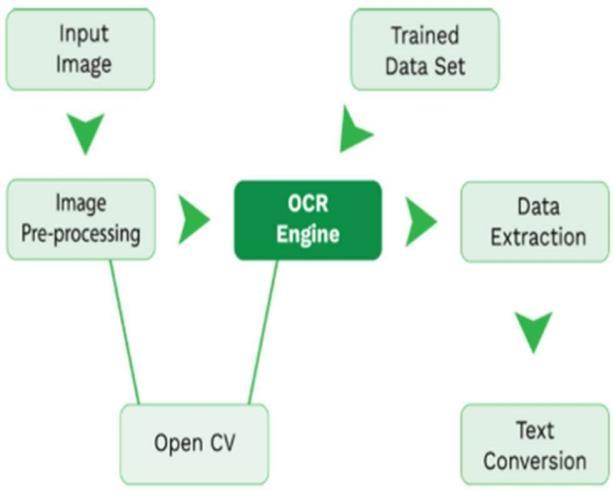
The VarnaOnyx system is designed using a modular and layered architecture to ensure efficient processing, scalability, and improved accuracy. The overall framework is divided into four main components: the Input Module, Image Preprocessing Module, OCR Engine Module, and Output Module. These components work together in asequential pipeline to transform various document formats into machine-readable text, as illustratedinFig.1.
Theprocessstartswith theInput Module,whereusersuploaddocumentsinformatssuchasJPG, PNG,or PDF through a web-based interface. The system can handle both scanned documents, including handwritten and printedtext,aswellasdigitallygeneratedfiles.Thisflexibilityallowsthesystemtobeappliedacrossdifferent typesofdocumentsources.
TheuploadedinputisthenpassedtotheImagePreprocessingModule,wherethequalityofthefileisenhanced beforetextextraction.Forscannedinputs,techniquessuchasbinarization,noiseremoval,andskewcorrection areappliedtoimprovereadability.
Additionally,DigitalSignalProcessing(DSP)methods,includingGaussianandButterworthfiltering,areusedto reduce noise and enhance clarity. For digitally generated documents, parsing and cleaning operations are performedtopreparethecontentforextraction. Following preprocessing, the refined data is processed in the OCR Engine Module. The system utilizes the TesseractOCRenginetoconvertimage-basedtextintoeditableformat.Fordigitaldocuments,parsingtoolsare used to directly extract textual content and metadata. The outputs from both OCR and parsing processes are combinedintoaunifiedrawtextformatforfurtherrefinement.
International Research Journal of Engineering and Technology (IRJET) e-ISSN: 2395-005
Volume: 13 Issue: 04 | Apr 2026 © 2026, IRJET | Impact Factor value: 8.315 | ISO 9001:2008 Certified Journal | Page785
p-ISSN: 2395-0072
Finally, the processed text ishandled by the Output Module, whereitisstructured anddisplayedonto theUI. Basicpostprocessingisappliedsoastoimprovereadabilityandremoveunwantedelements.Thefinaloutput ispresentedthroughtheinterface,encouraginguserstoedit,save,orexporttheextractedtext.Thisstructured workflowmakessureofefficientdocumentdigitizationwhileminimizingmanualintervention.
To understand the performance of The VarnaOnyx system, a series of experiments were conducted using various types of document inputs, including scanned images, handwritten notes, and digitally generated PDFs. The goal of the evaluation was to analyze the effectiveness of the preprocessing techniques and the overall accuracyoftextextraction.
The technologies used in the system were Python, with libraries like OpenCV for image processing and Tesseract OCR for text recognition. A web-based interface was developed using Flask along with HTML, CSS, and JavaScript to allow users to upload documents and view extracted text. The experiments were performed onstandardcomputinghardwaretoensurepracticalapplicability.
TheevaluationprocessinvolvedcomparingOCRresultsofrawinputimageswiththoseprocessedthroughthe VarnaOnyx preprocessing pipeline. Key preprocessing techniques applied include grayscale conversion, noise removal, Gaussian filtering, Butterworth filtering, and thresholding. The steps were analyzed for their impact onimprovingtextclarityandrecognitionaccuracy.
Performance was assessed based on qualitative observations such as readability of extracted text, reduction in recognition errors, and overall output consistency. The results showed that preprocessing significantly improvedOCRperformance,especiallyfornoisyandlow-qualityinputs Thesystemwasabletoproducemore accurateandstructuredtextcomparedtodirectOCRprocessing. Additionally,thesystemdemonstratedflexibilityinhandlingbothscannedanddigitaldocumentsbycombining OCRandparsingtechniques.Thishybridapproachreducedprocessingerrorsandimprovedefficiency.Overall, the obtained experimental outcomes confirm that the integrated DSP-based preprocessing with OCR leads to betteraccuracyandusabilityinreal-worlddocumentdigitizationtasks.
International Research Journal of Engineering and Technology (IRJET) e-ISSN: 2395-005
Volume: 13 Issue: 04 | Apr 2026
p-ISSN: 2395-0072
The VarnaOnyx system is a web-based application to provide an interactive and user-friendly platform for documentprocessing.ThefrontendwasdevelopedusingtechnologieslikeHTML,CSS,andJavaScript,whilethe backend was connected using the Flask framework in Python. This setup enables users to upload documents andviewextractedtextefficientlythroughabrowserinterface.
The system accepts input files in formats such as JPG and PDF. Once uploaded, the document is processed throughthepreprocessingpipeline,followedbyOCR-basedtextextraction.Theextractedtextisthendisplayed ontheinterface,allowinguserstoreviewandmakeeditsifnecessary.
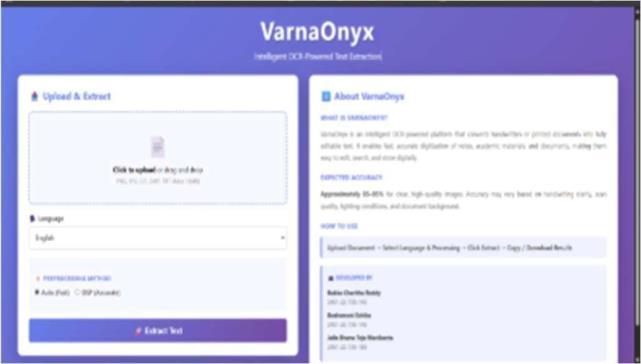
ItshowsthehomepageoftheVarnaOnyxsystem,whereusersuploaddocuments.Theinterfaceis designedtobesimpleandaccessible,ensuringeaseofuse.

The results demonstrate that preprocessing techniques significantly improve text clarity and reduce recognition errors. Compared to direct OCR on raw input, the processed output is more accurate and structured.
The system was tested on different types of inputs, including handwritten notes, printed text, and low-quality scannedimages.TheresultsindicatethatDSP-basedpreprocessingenhancesOCRperformance,particularlyfor noisyanddistorteddocuments.
Overall,theimplementationvalidatesthatVarnaOnyx providesaneffectiveandpracticalsolutionfordocument digitizationwithimprovedaccuracyandusability.
International Research Journal of Engineering and Technology (IRJET) e-ISSN: 2395-005
Volume: 13 Issue: 04 | Apr 2026
p-ISSN: 2395-0072
The VarnaOnyx system presents an effective approach to document digitization by integrating Digital Signal Processing (DSP) techniques with an OCR engine. The proposed framework enhances input image quality through preprocessing steps such as noise reduction, filtering, and contrast improvement, which significantly improvestextrecognitionaccuracy.Bycombiningthesetechniqueswith the TesseractOCRengine,thesystem isabletohandleavarietyofdocumenttypes,includingscanned,handwritten,anddigitallygeneratedinputs. The implementation of a web-based interface further improves usability, allowing users to easily upload documentsandobtaineditabletext.Experimentalobservationsdemonstratethatthepreprocessingstageplays an important role in reducing recognition errors and improving output quality compared to direct OCR processing.
Despiteitseffectiveness,thesystemhasfewdisadvantageswhendealingwithhighlycomplexhandwritingand heavily degraded documents. Future work can focus on integratin deep learning-based OCR models, incorporating language- based error correction, and extending support for multiple languages. Additionally, optimizing the system for real- time processing and mobile platforms can further improve its practical applicability.
In conclusion, VarnaOnyx provides a balanced and efficient solution for OCR based document processing, offeringimprovedaccuracy,flexibility,andusabilityforreal-worldapplications.
The authors would like to express their sincere thanks to Mr. K. Shravan Kumar, Assistant Professor at MVSR EngineeringCollege,forhisguidance,support,andvitalsuggestionsthroughoutthiswork.Hisinsightsplayeda significantroleinshapingthedirectionandqualityofthestudy. The author also extends thanks to the faculty and staff of the Department of Electronics and Communication Engineeringforprovidingthenecessaryresourcesandassistance. Additionally, appreciation is conveyed to the researchers and developers whose work in OCR, NLP, and documentprocessinghascontributedtothefoundationofthisproject.
[1] Anakpluek, N., Pasanta, W., Chantharasukha, L., Chokratansombat, P., Kanjanakaew, P., & Siriborvornratanakul, T., “Improved Tesseract Optical Character Recognition Performance on Thai DocumentDatasets,”BigDataResearch,Vol.39,2025.
[2] Guan, S., Lin, M., Xu, C., Liu, X., Zhao, J., Fan, J., Xu, Q., &Greene, D., “PreP-OCR: A Complete Pipeline for DocumentImageRestorationandEnhancedOCRAccuracy,”arXivpreprint,2025.
[3] Sinha, R., & Rekha, B. S., “Digitization of Document and Information Extraction using OCR,” International Conference/JournalonInformationScienceandEngineering,RVCollegeofEngineering,Bangalore, India.
[4] Smith,R.,“AnOverviewoftheTesseractOCREngine,”ProceedingsoftheNinthInternationalConferenceon DocumentAnalysisandRecognition(ICDAR),IEEE,2007.
[5] Gonzalez,R.C.,&Woods,R.E.,“DigitalImageProcessing,”PearsonEducation,4thEdition,2018.
[6] Jain,A.K.,Duin,R.P.W.,&Mao,J.,“StatisticalPatternRecognition:AReview,”IEEETransactionsonPattern AnalysisandMachineIntelligence,Vol.22,No.1, 2000.
[7] Otsu,N.,“AThresholdSelectionMethodfromGrayLevelHistograms,”IEEE TransactionsonSystems, Man, andCybernetics,Vol.9,No.1,1979.