
International Research Journal of Engineering and Technology (IRJET) e-ISSN: 2395-0056
Volume: 12 Issue: 08 | Aug 2025 www.irjet.net p-ISSN: 2395-0072
International Research Journal of Engineering and Technology (IRJET) e-ISSN: 2395-0056
Volume: 12 Issue: 08 | Aug 2025 www.irjet.net p-ISSN: 2395-0072
Ajay Kumar R
PG Student (M tech), Department of Civil Engineering, Dr. Ambedkar Institute of Technology, Karnataka, India
Abstract - This study examines M25 concrete where natural fine aggregate is partially substituted with spent coffee grounds (SCG) at 12%, 15%, and 18% by weight. Mechanical performance was evaluatedviacompressive,flexural,andsplit tensile strength at 7, 14, and 28 days. Outcomes indicate a small improvement at 12% and decreasing strengths at 15% and 18%. The approach valorizes SCG while conserving natural river sand and manufactured sand
Key Words: spent coffee grounds, fine aggregate replacement,M25Concrete,compressivestrength,flexural strength,splittensile,sustainableconcrete
1.INTRODUCTION
Concrete production relies heavily on natural sand and manufactured sand, the extraction and manufacturing process of which challenges environmental sustainability. Simultaneously, global, and Local coffee consumption generates substantial spent coffee grounds (SCG). IncorporatingSCGintoconcreteoffersadualbenefitthatis wastediversionintoconvertingintousefulrawmaterialand naturalresourceconservationasitisafiniteelement
Senol (2024) [1] This studyexplores mortars with cement partiallysubstitutedbyincineratedcoffeewasteat2.5%,5%, and7.5%.Workabilityandstrengthtestswereconductedand evaluations revealed that 2.5% replacement preserved adequate satisfying performance, but higher percentages sharp suddenly reduced mechanical properties. The study highlightedcarefulandneedfuldosagecontrolasessentialto maintainingbothdurabilityandusabilityofallmixes.
Almeida et al. (2023) [2] Thisstudyevaluatessandconcrete withnaturalsandwhichispartiallyreplacedby5%ofspent coffeegrounds.Compressivestrengthtestingdemonstrated slight improvement due to finding denser particle packing andreducedvoidsinmicrostructurelevel.Atthisdosageof spent coffee grounds, the material retained its mechanical integrity and strength while reducing reliance on natural sand,offeringbothsustainabilityandefficiencybenefitsfor industryandsustainability
Charai et al. (2022) [3] Inthisstudyinvestigatedbyreplacing cement with pyrolysed ash derived from spent coffee grounds in mortar. Thermal and mechanical performance
assessmentsshowedthata5%substitutionachievedthebest balance in mixes and composures, lowering thermal conductivity by far more than 70% while preserving acceptablegoodstrength.Beyondthisproportionofmixes, thermal conductivity benefits continued but strength droppednotablybyfurther
Lachheb et al. (2019) [4] Thisstudyexplainsandexamined plastermaterialcompositeswherefineaggregatesandwas replaced by 2 and 6% by spent coffee grounds. Testing thermalconductivityandenergydemandforthemixshowed conductivityanddecreasedfrom0.50to0.31W/m·Kat6% inaddition.Thistranslatedintoa20%reductioninheating and cooling loads, with minor compromise to structural behavioroftheconcrete
Limited focus on structural-grade concrete:Moststudies emphasizemortars,plasters,orlaboratory-scalemixes,with scarce evaluation of SCG use in structural M25 or highergradeconcrete.
Narrow range of mechanical testing:Priorresearchoften concentrates on compressive strength, while flexural and splittensilestrengthsarelessexploredindetail.
Lack of optimization window: Though many report declinesathigherpercentages,fewstudiesclearlyestablish theoptimumsubstitutionlevelforfineaggregate.
Durability aspects underexplored: Long-term performance indicators such as sorptivity, chloride penetration, shrinkage, and microstructural effects have receivedminimalattention.
Sustainability assessment gap: Life-cycle analysis and economic feasibility of SCG substitution remain largely unquantifiedinexistingliterature.
(Limited focus on structural concrete, less work on mechanical parameters, less exposure to durability parameters)
To investigate the feasibility studies of utilizing spent coffee grounds (SCG) asapartial replacementfornatural
International Research Journal of Engineering and Technology (IRJET) e-ISSN: 2395-0056
Volume: 12 Issue: 08 | Aug 2025 www.irjet.net p-ISSN: 2395-0072
fine aggregate sand in M25grade concrete, thereby which will help in reducing environmental impact and sand dependencyforconstruction
To determine the optimum and optimized replacement percentage of SCG byconductingcompressivetests,flexural tests, and split tensile strength tests at different curing periods(7,14,and28days).
To analyze the effect of SCG incorporation and same on the mechanical parametric performance of concrete identifyingstrengthvariationsatlowdosagesormixessuch as (12%15,18%) and evaluating performance at higher proportions
To establish and secure the practical applicable limits of SCG dosage in structural concrete whileensuringsamefor mechanical performance of concrete remains within acceptablestandardsasperguidelines
Tocontributetowardssustainableconstructionpractices by valorizing or utilizing coffee waste that is spent coffee grounds, reducing landfill disposal of organic wastes, and promoting and the use of partial replacement for natural applicable river sand with an eco-friendly substitute as alternative
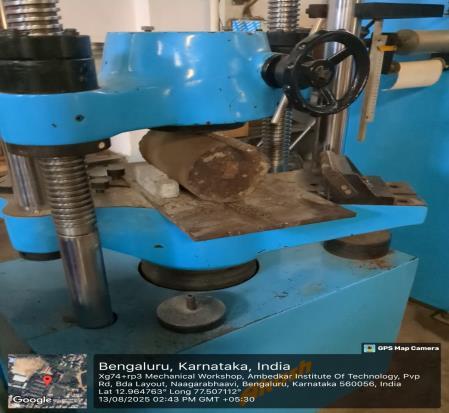
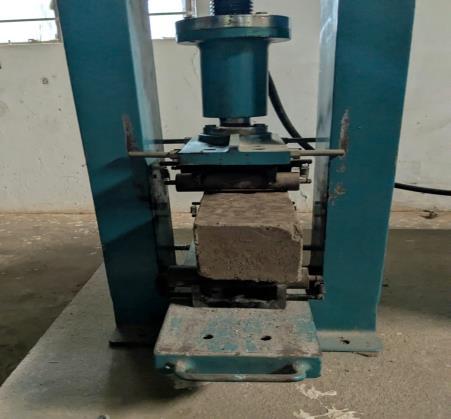
OPC (ordinary Portland cement) 43 grade, Zone II River sand, and 20 mm crushed granite is been used. SCG from cafesandcoffeeshopslocallywasprocuredandwasovendriedat105°Cfor24handsievedtopass4.75mmsieve.A control mix of M25 grade as per IS 10262-2019 by employingw/c=0.45.TheSCGreplacedfineaggregatesand byweightat12%,15%,and18%.TheSpecimensofsize:150 mm cubes (compressive), 100×100×500 mm prisms (flexural), and 150×300 mm cylinders (split tensile) were used. The Curing was conducted in water to test curing period. Tests followed according to IS 516 and IS 5816 standardcodes
The compressive strength tests were conducted and the resultsindicatethattheconcretewith12%SCGreplacement level showed a slightly higher but not more than that of controlmixvaluesthecontrolmixatallcuringperiodicages, confirmingthatthebetterpackingorfilingandbondingat thismixforreplacementlevel.However,thebeyond12%,the strengthvaluesdeclinedason,with18%SCGshowingthe largerthatothershowedthereduction.Thissuggestsexcess organic content such as spent coffee grounds and weaker bonding give rise to the negatively affect load-bearing capacityofthestructuralconcrete.
Table -1: CompressiveStrengthStatistics
Table -2: FlexuralStrengthStatistics
Table -3: SplitTensileStrengthStatistics
TheFlexuralstrengthfollowedasimilartrend,with12%SCG achieving the best performance as per the test results, especially noticeable at 28 days where it surpassed the control mix. Higher proportions (15% and 18%) caused a gradual loss in bending resistance for the concrete. This demonstrates thatthemoderate use of SCGaddition helps resist cracking, but excessive use weakens the matrix of concreteandinterfacialtransitionzonefortheconcrete
TheSplittensilestrengthalsoimprovedatthereplacement level of 12% SCG across all curing ages, indicating better resistancetocrack initiationandpropagation.At15%and 18% replacement, strength values consistently dropped, showingtheadverseinfluenceofexcessSCG.Overall,thedata confirmthat12%isthemosteffectivedosageforenhancing tensile behavior while ensuring structural integrity of the concrete
International Research Journal of Engineering and Technology (IRJET) e-ISSN: 2395-0056
Volume: 12 Issue: 08 | Aug 2025 www.irjet.net p-ISSN: 2395-0072
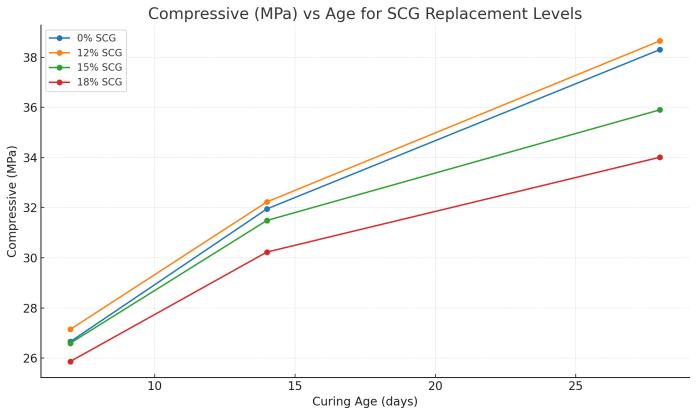
Chart -1:CompressivestrengthvsageforSCG replacementlevels
This graph shows how compressive strength (MPa) of SCG concrete changes with curing age (7, 14, 28 days) for different levels of Spent Coffee Grounds (SCG) replacement.
12% SCG consistently gives the highest compressive strength.
0% SCG (control) also performs well, slightly below 12% SCG.
15% SCG has moderate strength values.
18%SCG hasthelowest strength, indicatingtoo much SCG reduces concrete strength
Conclusion: Replacing cement with 12% SCG gives the best compressive strength, while higher percentage reduce performance of the concrete.
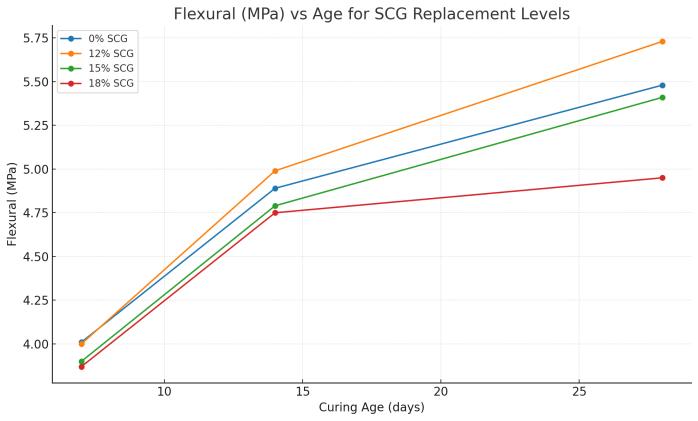
Chart -2:FlexuralstrengthvsageforSCGreplacement levels
Thisgraphshowsthevariationofflexuralstrength(MPa)of SCGconcretewithcuringage(7,14,28days)atdifferentSCG (SpentCoffeeGrounds)replacementlevels.
12% SCG replacement consistently shows the highestflexuralstrength.
0%SCG(control)performswellbutisslightlylower than12%.
15% SCG shows moderate strength, slightly improvingwithtime.
18%SCGhasthelowestflexuralstrength,especially atlaterages.
Conclusion:12%SCGisthemosteffectivelevelforenhancing flexuralstrength.HigherSCGlevelsbeyondthispointreduce performance.
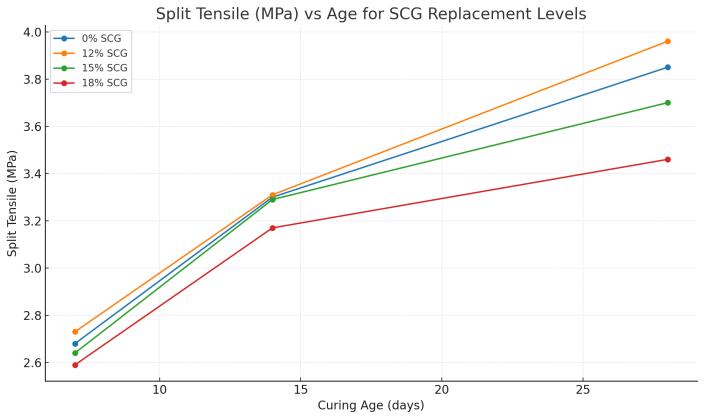
-3:SplittensilestrengthvsageforSCGreplacement levels
The graph shows how the split tensile strength of SCG concretechangesovertime(7,14,28days)withdifferent levelsofSpentCoffeeGrounds(SCG)replacement.
12%SCGgivesthehigheststrengthatallages,even morethanthecontrol(0%SCG).
15%SCGshowsmoderatestrength.
18% SCG has the lowest strength, suggesting too muchSCGweakenstheconcrete.
Strengthincreaseswithcuringageforallmixes.
Conclusion: 12% SCG is the optimal replacement level for improvingsplittensilestrength.
The Compressive strength trends indicate an optimum at 12% SCG replacement level The Flexural and split tensile strengthsfollowwaysimilarbehavior,theydemonstrating thesensitivityofcrack-bridgingandinterfacialbondingto theSCGcontentintheconcrete TheDifferencesamplifyby 28 days as microstructure develops from within the structuralconcrete
International Research Journal of Engineering and Technology (IRJET) e-ISSN: 2395-0056
Volume: 12 Issue: 08 | Aug 2025 www.irjet.net p-ISSN: 2395-0072

SCGintegrationwillreduces thewastegoingtolandfilling andnaturalsandormanufacturedsandusage.Considering typicalregionalpricing,sandcostreductionsof10–15%are plausible at 12% replacement if SCG is sourced only at minimal cost. Drying energy must be minimized through possible renewable sources such as solar or waste-heat optionstomaximizeenvironmentalbenefit.
ForM25concrete,12%SCGisapracticalandpossibleupper limit for maintaining mechanical performance intact The Higherreplacementsreducecompressivestrength,flexural strength, and split tensile strengths. Proper drying and gradationarecriticalconsiderations
Futureworkscanbecarriedouttoevaluatethedurability (sorptivity,chloridepenetration,sulphateattack),long-term deformation (shrinkage/creep), and microstructural featuresviaSEM,XRD,RDX,etc.Quantifylife-cycleimpacts and pilot real-world paving or block applications can be doneaspertheimplications.
[1]Bui,N.K.,Satomi,T.,&Takahashi,H.,“CoffeeWasteasa Potential Partial Sand Replacement in Concrete,” ConstructionandBuildingMaterials,vol.171,pp.916–926, 2018.
[2]Roychand,R.,etal.,“TransformingSpentCoffeeGrounds intoaValuableResourcefortheEnhancementofConcrete Strength,” Journal of Cleaner Production, vol. 419, art. 138205,Sept.2023.
[3]Charai,M.,etal.,“SpentCoffeeGroundsasaSubstitutefor Cement in the Production of Mortar,” Journal of Building Engineering,vol.57,105021,2022.
[4]Almeida,A.,etal.,“EffectofUsingSpentCoffeeGrounds WastesasAggregatesonPhysicalandThermalPropertiesof SandConcrete,”AlgerianJournalofEnvironmentalScience andTechnology,vol.9,no.2,pp.2120–2128,2023.
[5] Lachheb, M., et al., “Use of Coffee Grounds Waste in Plaster Composites: Thermal and Energy Performance,” EnergyandBuildings,vol.183,pp.1–11,2019.
[6] Şenol, M., “Incorporation of Incinerated Spent Coffee GroundsintoMortars:EffectsonWorkabilityandStrength,” JournalofMaterialsinCivil Engineering,vol.36,no.2,pp. 04024005,2024.