
International Research Journal of Engineering and Technology (IRJET) e-ISSN: 2395-0056
Volume: 12 Issue: 04 | Apr 2025 www.irjet.net p-ISSN: 2395-0072
International Research Journal of Engineering and Technology (IRJET) e-ISSN: 2395-0056
Volume: 12 Issue: 04 | Apr 2025 www.irjet.net p-ISSN: 2395-0072
Greeshma Boda1 , Rumana Farooqui2 , Chandana Sainabarapu3 , CH. Lakshmi Madhuri4
1B.E Student, Electrical and Electronics Engineering, Stanley College of Engineering and Technology for Women, Telangana, India
2B.E Student, Electrical and Electronics Engineering, Stanley College of Engineering and Technology for Women, Telangana, India
3B.E Student, Electrical and Electronics Engineering, Stanley College of Engineering and Technology for Women, Telangana, India
4Assistant Professor , Electrical and Electronics Engineering, Stanley College of Engineering and Technology for Women, Telangana, India
Abstract - As there is an increase in the usage of ecofriendly energy solutions, hybrid systems become more efficient and cost-effective. This research paper focuses on using these integrated hybrid power systems for home applications. Specifically, this paper examines how solar panels and wind turbines can be integrated with smart home technology to create efficient, self-sustaining residential automation systems. The proposed system integrates solar and wind energy for power generation and stores it in battery banks for efficient power management and distribution to various smart home devices and appliances. A microcontroller-based application is designed to monitor and control the entire system's operation. Home automation applications include a DC fan, and water pump thattriggerswhensoilmoisturesensorisdry.
Key Words: Solar Energy, Wind Power, Smart Home Automation, Sustainable Residential Systems, Microcontroller Applications, Hybrid Power Generation, BatteryStorage.
Intoday’sworld,risingpowerconsumptionhasledtoan increased reliance on fossil fuels, causing significant environmental concerns and a pressing need for sustainable alternatives. Renewable energy sources, such assolarandwindpower,offeracleanerandmoreefficient way to meet household energy demands while reducing carbonfootprints.
This project proposes a hybrid energy system that integrates solar and wind power generation with IoTbased home automation. A microcontroller is used to manage and optimize power distribution, ensuring efficient utilization of renewable energy sources. By implementingthissystem,householdscanachieve energy savings, reduced dependence on the grid, and enhanced automation, contributing to a more sustainable and ecofriendlyfuture.
The primary objective of this project is to integrate solar and wind energy sources into a smart home automation system for efficient power management. The keyobjectivesinclude:
Implementation of the hybrid system:
Design and implement a hybrid power generation system that combines solar panels and wind turbines for a continuouspowersupply.
Smart home application:
Develop and implement smart home automation features that control lighting, fans, and water pumps through IoTenableddevicesandinterfaces
Energy Storage:
Design and implement an efficient battery storage system to store excess energy generated from the hybrid system for later use during peak demand or low generation periods.
The literature review examines recent studies and developments in hybrid energy systems for residential applications, focusing on integration methods, efficiency improvements,andsmartautomationtechnologies.
R. Kumar et al. (2018) developed an IoT-based home automation using only source energy generated by solar cells. The system is developed for wireless connection, which can be controlled through a web application or smartphone app. It also demonstrated 20-30% of energy savingsbyoptimizingitsconsumption[1].
International Research Journal of Engineering and Technology (IRJET) e-ISSN: 2395-0056
Volume: 12 Issue: 04 | Apr 2025 www.irjet.net p-ISSN: 2395-0072
2.2 Wind energy for small-scale power usage:
M. Hassen et al. (2017) investigated the type of wind turbine suitable for small-scale applications, such as in urban areas. Vertical-axis wind turbines are found to be more reliable due to space efficiency and an increase in overall power efficiency. The limitation of the research is that it is conducted in one particular urban area, and the typeofturbineisdependentonwindspeeddata[2]
J. Park et al. (2021) reported that hybrid solar-wind systems increase energy availability by 40% compared to standalone solar or wind systems, making them a more efficientandsustainablesolution[3]
2.4 Optimal Management of Smart Home Appliances Considering Stochastic Behaviour of Wind Turbine:
Masoud Alilou et al. (2023) studied optimizing power usage with and without a wind turbine. For the study, a smart grid with home automation is developed, and research is carried out in two phases. In the first phase, theelectricitycostismonitoredwiththesmartgridalone, andinthesecondphase,a locallyrenownedwindturbine is used while balancing grid power usage. The second phase is cost-effective and able to optimize the power usage[4]
2.5 An IoT-Based Home Automation Integrated Approach:
S. Rao et al. (2023) This paper is a successful implementation of an IoT-based home automation approach integrated with renewable energy resources to optimize energy consumption. Power generation from various resources such as geothermal, solar cells, and windturbinesisintegratedforhomeautomation[5]
3. PROPOSED SYSTEM
Theproposed system isa hybrid renewable energy-based home automation setup that utilizes solar and wind energy to power essential appliances in a household. The systemisdesignedtooperateindependentlyofthepower grid,promotingsustainabilityandenergyefficiency.
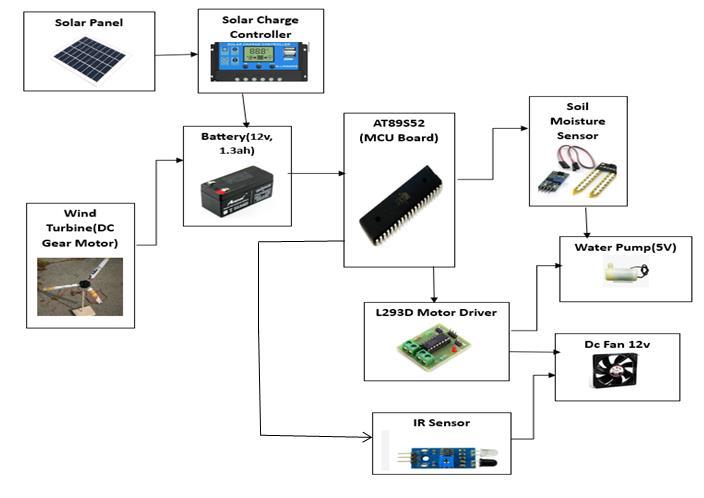
The system consists of hardware and software components. The hardware includes solar panels, wind turbines, batteries, and control units for efficient power management. The software involves microcontroller programming and sensor integration to automate home appliances.
4.1 Power generation management:
It includes the integration of a solar panel with a wind turbine connected to a battery. It also consists of a solar charge controller to prevent overcharging of the battery andavoltagecontrollertoensuretheconstantDCsupply.
4.2 Home automation control:
The microcontroller (AT89S52) is programmed and connected to relays and sensors to control automation. A DC fan and a moisture sensor are integrated into the system, where the fan is activated based on IR sensor inputs. The moisture sensor detects soil dryness and triggers the water pump through a relay mechanism, ensuringefficientautomationandenergyutilization.
4.3 Software implementation:
It involves programming a microcontroller to control the automation based on the sensor inputs. The code is written in C language and is interfaced through the Keil platform.
4.4 Working:
Solar panel and wind turbines generate electricity based on resource availability, storing the energy in a battery. Whenthebatteryswitchisturnedon,itsuppliespowerto
International Research Journal of Engineering and Technology (IRJET) e-ISSN: 2395-0056
Volume: 12 Issue: 04 | Apr 2025 www.irjet.net p-ISSN: 2395-0072
the microcontroller, which then activates the automation system. The microcontroller processes sensor inputs and controls connected devices such as the DC fan and water pump.TheIRsensordetectsmotiontoturnonthefanand while the moisture sensor monitors soil dryness and triggersthewaterpumpviaarelay.
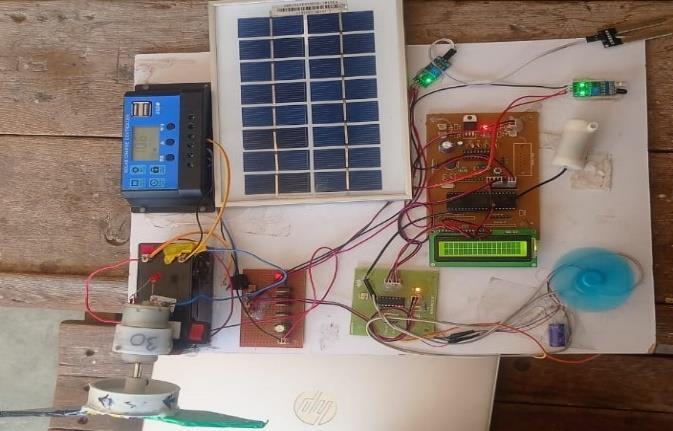
Fig-2: Output of the project
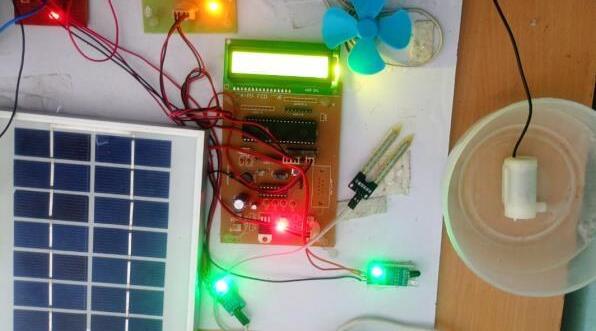
Fig-3: Water pump activated
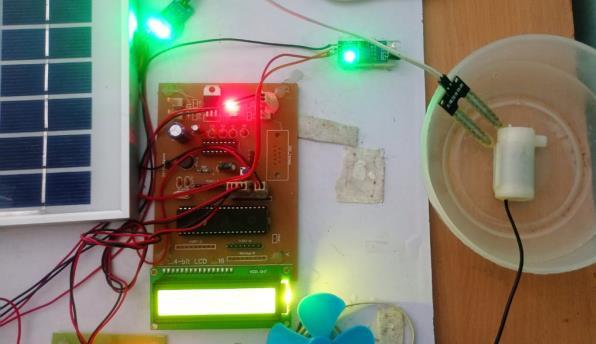
Fig-4: Water pump not activated
In Fig-2, IR sensor detects the person and DC fan isactivated.
InFig-3,thesoilmoisturesensorisnotincontact withwaterdetectingdry,makingthewaterpump trigger.
InFig-4,thesoilmoisturesensorisincontactwith water detecting wet, making the water pump not toactivate.
Theproposedproject, “Utilization of Solar and Wind Power for Home Automation,” hasbeensuccessfullyimplemented. The system integrates renewable energy sources solar and wind to power home automation applications including DC fan and water pump. This not only reduces dependency on conventional electricity but also contributes to a greener environment by utilizing clean energy. The automation system was effectively designed to control home appliances using the harvested energy, ensuring reliability, energy efficiency, and costeffectiveness.Overall,theprojectdemonstratesapractical and eco-friendly solution for future smart homes, highlightingthepotentialofrenewableenergyintegration indailylife.
Future directions for this research include developing moreeffectiveenergystoragesystemstooptimizesystem performance, extending IoT capabilities for remote monitoring, and incorporating artificial intelligence for predictive energy management. Byincorporatingartificial intelligence(AI)intosolarpanelsandwindturbines,itcan detect errors and prevent further damage by detecting patterns that optimize generation. Since it is a home automation system, it can be used with smart home appliancestooffereffectiveenergymonitoringandcontrol throughauser-friendlyinterface.
We sincerely thank all those who supported us in completing our major project,“Utilization of Solar and Wind Power Generation for Home Automation.”
Wearegratefultoourparents,family,andfriendsfortheir constantencouragement.
Special thanks to Dr. Satya Prasad Lanka, our principal, and Dr. N. Nagasekhara Reddy, Head of the Department, fortheirsupportandpermissiontocarryoutthisproject.
We extend our heartfelt gratitude to our guide, Mrs. Ch. LakshmiMadhuri,forhervaluableguidanceandsupport.
We also appreciate the faculty and friends who contributedtoourprojectdirectlyorindirectly.
[1] Imam Hossain, Md Shihabul Islam, Rabeya Sultana, “IoT Based Home Automation System Using
International Research Journal of Engineering and Technology (IRJET) e-ISSN: 2395-0056
Volume: 12 Issue: 04 | Apr 2025 www.irjet.net p-ISSN: 2395-0072
Renewable Energy”. https://www.academia.edu/113346078/IoT_Based_H ome_Automation_System_Using_Renewable_Energy
[2] Md.SabbirAlam,SabbirHossain,“Investigating the prospect of small scale wind turbine based on regional wind velocity”. https://www.scirp.org/journal/paperinformation?pa perid=120790
[3] QusayHassan a,SameerAlgburi, “A review of hybrid renewable energy systems: Solar and wind-powered solutions: Challenges, opportunities, and policy implications”. https://www.sciencedirect.com/science/article/pii/S 259012302300748X
[4] Masoud Alilou, Hossein Shayeghi, Behrouz Tousi, “Optimal Management of Smart Home Appliances Considering Stochastic Behaviour of Wind Turbine”. https://www.researchgate.net/publication/3729330 42_Optimal_Management_of_Smart_Home_Appliances _Considering_Stochastic_Behavior_of_Wind_Turbine
[5] S.Rao et al., “An IoT based Home Automation IntegratedApproach:ImpactonSocietyinSustainable DevelopmentPerspective”
https://www.researchgate.net/publication/3390266 01_An_IoT_based_Home_Automation_Integrated_Appr oach_Impact_on_Society_in_Sustainable_Development_ Perspective



Greeshma Boda received engineering degree from Stanley college of engineering and technology for women in 2025. Primaryresearchincludeprojects relatedtoRenewableEnergy.
Rumana Farooqui received engineering degree from Stanley college of engineering and technology for women in 2025. Primaryresearchincludeprojects relatedtoRenewableEnergy.
Chandana Sainabarapu received engineering degree from Stanley college of engineering and technology for women in 2025. Primaryresearchincludeprojects relatedtoRenewableEnergy.
CH. Lakshmi Madhuri is currently an Asst. professor of the Stanley College of Engineering & Technology for Women, working in the departmentofElectrical&Electronics Engineering. She has B. Tech degree in Electrical & Electronics Engineering from JNTUH university and Master’s degree in Power Electronics from JNTUA university. Her research interests include Power electronic converters and Renewable energyTechnology.