
International Research Journal of Engineering and Technology (IRJET) e-ISSN: 2395-0056
International Research Journal of Engineering and Technology (IRJET) e-ISSN: 2395-0056
Weili
Zheng1, Qinghua Zhou2
1QingXian No. 4 Middle School, Cangzhou, Hebei, China
2School of Applied Mathematics, Beijing Normal University, Zhuhai, Guangdong, China
Abstract: Aiming at the difficulty of deploying wireless sensor network nodes in complex environment, we introduce a hybrid algorithm. Actually, the improved Dijkstra algorithm is used for global path planning, and at the same time the improvedantcolonyalgorithmisusedforlocalpathplanningtorealizenodedeployment.Inordertoreducetherunning timeforthealgorithmtosearchnodes,thepositioninformationofstartingpointanddestinationnodesareusedtoguide the search direction and then the constructed map is segmented. Furthermore, obstacle environmental factors are introduced tojointlylimitthetransitionprobabilityof thenexthopnode.Intermsofpheromone volatilefactor,adaptive technology is used to update it. In terms of energy consumption, threshold mechanism is used to reduce energy consumption. The simulation results show that the improved hybrid algorithm can further reduce the network energy consumption, prolong the network lifecycle and accelerate the optimization speed, which proves the effectivenessof the algorithm.
Key words:Antcolonyalgorithm;Thresholdmechanism
1 Introduction
Nodedeployment
Dijkstraalgorithm
Pathplanning
Wireless Sensor Network(WSN)[1,2] is a wireless communication network composed of a large number of fixed or mobile sensor nodes in a self-organizing and multi-hop manner. In recent years, with the continuous development of wirelesscommunicationtechnologyandflexiblenetworksettings,ithasattractedmuchattentionofmanyresearchersin various application scenarios. For example, monitoring of the natural environment, disaster warning, etc. Due to the diversityofapplicationscenarios,informationtransmissionpathplanningandnodedeploymentareveryimportanttasks. Thesenodescooperatewitheachotherthroughlow-powerwirelesscommunicationmethodstomonitordesignatedareas, sothatpeoplecanobtainalargeamountofeffectiveinformationinanyenvironment.
Volume: 12 Issue: 06 | Jun 2025 www.irjet.net p-ISSN: 2395-0072 © 2025, IRJET | Impact Factor value: 8.315 | ISO 9001:2008 Certified Journal | Page1135
International Research Journal of Engineering and Technology (IRJET) e-ISSN: 2395-0056
Volume: 12 Issue: 06 | Jun 2025 www.irjet.net p-ISSN: 2395-0072
The sensor nodes are usually powered by batteries and we cannot frequently replace batteries for these nodes. Therefore,energysavingisparticularlyimportantforWSNsinordertoextendthelifecycle[3]
There are many methods studied for extending the life of the network include selecting necessary constraints. For example, the design of the routing algorithm must consider the energy limitation of the sensor node and the required resources[4],improve energy efficiency[5]and use clustering[6-8], to ensure proper network operation. However, traditional routing protocols cannot be used in WSNs due to high routing costs. Therefore, an efficient routing algorithm that takes into account the power constraints of sensor nodes is needed. Most of the applications in WSN networks have great similaritiesintheworkanddeploymentofsensornodes.Inasimplesingle-hopmethod,itwillleadtoanearlydepletionof itsenergy.Forexample,LEACHalgorithmisaclusteringprotocolthatorganizessensornodesandtheirCHSintodifferent clusters[9],however,theshortcomingsofthisalgorithmareobvious.Inadditiontotherandomelectionofclusterheads,the data transmission between nodes adopts a single-hop form. Therefore, the energy of relatively distant communication nodes tends to consume somewhat fast, which is not enough to support the network to work for a long time. In 2012, Zhao[10] proposes an improved LEACH routing algorithm. In the cluster head selection stage, the clusters are selected by theremaining energy nodes topreventnodes withlow remaining energyfrom becomingclusterheads.Then,in thedata transmissionstage,asingle-hophybridtransmissionmodeisadopted,butitdoesnotconsidertheenergyofasinglenode inthepathandthenumberofnodes.PEGASIS[11]isachain-basedroutingprotocolinwhichonlyonesensornodecalledthe leader communicates with the base station, each sensor node can act as a transmitter or receiver at the same time to forwarddatainformationtothenextsensornode.Sincethetransmissiondistanceofthisprotocolisoftenrelativelyshort, thenetworkenergyconsumptionwillbesmall,andthenetworklifecyclewillbegreatlyimproved.ComparedwithLEACH, PEGASISlinkprotocolshows100%-300%improvementinnetworklife.Theabovealgorithmsmainlyimprovetheenergy consumptionofthesingle-targetpathandachieveveryimpressivepromotion.
Undernormalcircumstances,WSNisrelativelylargeinscaleandtheenvironmentiscomplexandchangeable,soitis moredifficulttofindtheshortestandenergy-savingpathinacomplexenvironment.Thegeneralwaytosolvethisproblem isto use a two-waygraph ora road network to find the path with thesmallestsum of edge weights among all reachable pathsfromthebeginningtotheendnode.Thetraditionalsingle-sourcegoalistoobtaintheleastcostpathfromthesource node to the target node. The algorithm is mainly not only used in the static environment with the external environment
International Research Journal of Engineering and Technology (IRJET) e-ISSN: 2395-0056
Volume: 12 Issue: 06 | Jun 2025 www.irjet.net p-ISSN: 2395-0072
Among them, the Dijkstra algorithmand the A* algorithmare more common dealingwiththestatic environment.At present,Dijkstraalgorithm[12] isawell-knownpathsearchalgorithm,whichismainlyusedtosearchfortheshortestpath of a single source with a single purpose. While A* algorithm[13] is a common Breadth-First-Search(BFS) algorithm, which reliesonheuristicfunctionstofindtheshortestpathfromthesourcenodetothetargetnodeinthegrid.Nowadays,many researchersaredevelopingtheDijkstraalgorithmtosolvetheshortestpathprobleminmulti-targetnodes[14-18] .
In wireless sensor network path planning, in addition to requiring the shortest path and low energy consumption, the network is also required to have higher quality. The high quality of the network includes the bandwidth, delay and other performance of the network. At the same time, the parameters of the wireless sensor network also involve the networklifecycle,coverage,connectivityandotherbroaderQualityofService(QOS)indicators.
In a two-dimensional geographic environment with obstacles, this paper proposes an algorithm based on the combinationofimprovedDijkstraalgorithmandantcolonyalgorithmtoplanpathsandintroducesanewnodestrategyto reducenetworkenergyconsumption.
Actually, an improved Dijkstra algorithm and ant colony algorithm are proposed to solve the QOS multicast routing problem when wireless sensor network nodes are deployed under obstacles. The heuristic function is improved and the numberofobstaclesonthenodeiscombinedtolimitthetransitionprobabilityofthenexthopnode.Inordertoobtainthe optimal parametervaluesofpheromoneandexpectedfactor,differentparametervalueswereindependentlyinvestigated severaltimes.Thevolatilecoefficientinantcolonyalgorithm wasmodifiedintoanadaptivemethod.Intermsofnetwork energy consumption, a transmission threshold mechanism was introduced to reduce the energy consumption of the network.
3.1 Network model
We consider the multicast routing problem with bandwidth and delay constraints from a source node to multiple destination nodes. For the convenience of problem analysis, the WSN network is regarded as an undirected weighted connected graph. Let ( ) represents the network, where represents the node set, represents the
2025, IRJET | Impact Factor value: 8.315 | ISO 9001:2008 Certified Journal | Page1137 unchangedbutthedynamicenvironmentwiththeexternalenvironmentchanging.
International Research Journal of Engineering and Technology (IRJET) e-ISSN: 2395-0056
Volume: 12 Issue: 06 | Jun 2025 www.irjet.net p-ISSN: 2395-0072
communication link set connecting the nodes of the wireless sensor network, and and E represent the number of nodesandlinksinthenetworkrespectively.
Let N n n n n S V m 3 2 1 ,..., , , , bethesetofmulticasttreefromsourcetodestinationnode.Where isthesource node, m 2 1 ,..., , u u u U isthesetofdestinationnodes,thenthemulticasttree ( ) canberepresented.For any node, there is the same maximum transmission distance , and represents the distance between node and , ( )is a link from node to node . Therefore, there must be a path u S PT , from the source node to the destinationnode.Threenon-negativerealvaluefunctionsareassociatedwitheachlink: ( ), ( ) andbandwidth ( ). The link delay, ( ), is considered to be the sum of switching, queuing, transmission, and propagation delays. Thelinkbandwidth, ( ),istheresidualbandwidthofthephysicalorlogicallink.Thelinkdelayandbandwidthfunctions definethecriteriathatmustbeconstrained.
ThecostofthepathPT isdefinedasthesumofthecostofalllinksinthatpathandcanbegivenby
ThetotalcostofthetreeTisdefinedasthesumofthecostofalllinksinthattreeandcanbegivenby
Thetotaldelayofthepath ( ) issimplythesumofthedelayofalllinks:
The delay of multicast tree T is the maximum value of delay in the path from source node to each destination node
The bandwidth of the path ( ) is defined as the minimum available residual bandwidth at any link along the path:
© 2025, IRJET | Impact Factor value: 8.315 | ISO 9001:2008 Certified Journal | Page1138
International Research Journal of Engineering and Technology (IRJET) e-ISSN: 2395-0056
Volume: 12 Issue: 06 | Jun 2025 www.irjet.net p-ISSN: 2395-0072
ThebandwidthofthetreeTisdefinedastheminimumavailableresidualbandwidthatanylinkalongthetree:
(6)
The wireless sensor node is deployed optimally in a hindered environment. The goal is to obtain the optimal path under the condition of satisfying the QOS constraints and reduce the energy consumption of WSN communication. Therefore,wechoosethepathlengthasthepathcost.
Totally, the goal of this article is to find one or more optimal paths that satisfy the multi-constrained QOS routing of thenetwork,namely:
3.2 Wireless channel energy consumption attenuation model
The channel model used in this article is the wireless channel energy free space and multi-path attenuation model proposedbyHeinzelman,ChandrakasanandBalakrishnan[19]
(9)
Where n is the degree of loss caused by the distance between nodes on the path. 0d is the threshold of energy consumptionforreceivingandsendinginformation,expressedas:
(10)
Where L is the wireless transmission loss, is the wavelength of the wireless battery wave, and c rd h T Re , is the heightoftheantennaforsendingandreceivinginformationrespectively.
Inthispaper,allwirelesssensornodeshavethesamestructure,thenodestransmitinformationwiththesameradius, and the initial energy . Due to the movement of network nodes and energy consumption during data transmission and reception,wecantakethesumofthesizeofthedatasentandreceivedbythenodeasameasureofitsenergyconsumption. Themoredatatransmitted,themoreenergythenodeconsumes.Inthefirst-orderenergyconsumptionmodel,theenergy consumptionformulafortransmittingdatapacketsisasfollows[20]
International Research Journal of Engineering and Technology (IRJET) e-ISSN: 2395-0056
Volume: 12 Issue: 06 | Jun 2025 www.irjet.net p-ISSN: 2395-0072
(12)
Where elecE represents the energy consumed per unit of data processing, and 0d represents a threshold. ms fs , representthepoweramplificationfactorsatdifferentdistancesbetweennodes.Theenergy �� ofthenodereceivingdata lossisexpressedas.
(13)
3.3 Model background
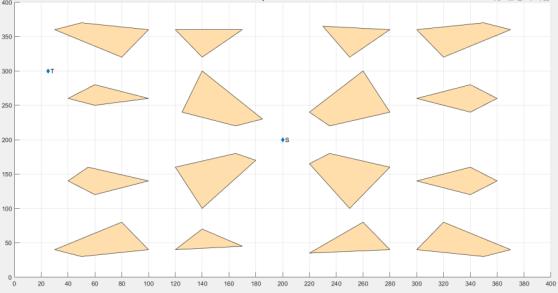
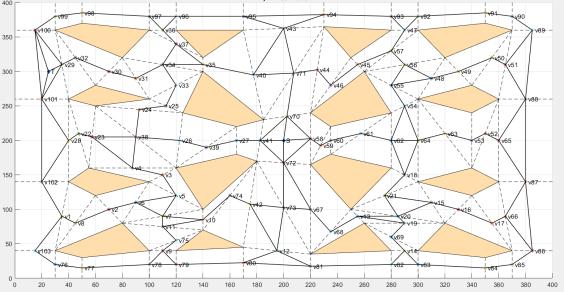
This article discusses the establishment of the problem of deploying wireless sensor nodes in an environment with obstacles. The obstacles are scattered to form a space (Figure 1). The environment in Figure 1 is mainly to solve the problemofnodedeploymentoptimizationindiscontinuousblockspaceontheplanewherethenodeisdeployed.Inorder to determine the deployment of nodes, weuse the MAKLINK graph segmentation method[21]to process Figure 1, and the resultisshowninFigure2whichrepresentstheinitialnodepositiondeployment.
International Research Journal of Engineering and Technology (IRJET) e-ISSN: 2395-0056
Volume: 12 Issue: 06 | Jun 2025 www.irjet.net p-ISSN: 2395-0072
4.1 Dijkstra algorithm and its improvement
Dijkstraalgorithm[12] isoneofthemostcommonlyusedalgorithmsforsolvingtheoptimalpathbetweennodes.Aswe all know, with the gradually increased nodes, the size of the matrix will also become larger. Actually, the matrix size is n×n where n is the number of nodes. In addition, due to the ergodicity of Dijkstra algorithm, it searches all nodes adjacenttothepresentinthegraphduringtheprocessofpursuingtheoptimalpath.Throughcontinuouscalculation,the pathdistanceofdifferentnodeswillbecomparedtoeachotheruntiltheoptimaldistanceofeachnodeiscalculated,which makes the algorithm take too much time to run in the process of solving the problem. We keep our mind to reduce the searching time for the whole process so as to increase the running efficiency of the algorithm, and then we propose an improvedmethodtoreducethenumberofiterationsbysearchinglessnumberofnodes.
Since the purpose of this article is to find the optimal path for WSN multicast energy saving in an obstacle environment, and wireless communication between nodes, then the QOS requirements of the network have to be considered too, including the delay, bandwidth, jitter and other aspects of the network and so on. This work takes the bandwidthanddelayofthenetworkastheimportantparametersoftheQOSoptimalpath.Sincetheinformationexchange needs to pass through multiple nodes, and because the real problem is considered within the case of large nodes, the Dijkstraalgorithmwillsearchallnodesinthegraph, whichwillleadtotherunningtimeofthealgorithmistoolong.Soin order to reduce the number of iterations of the algorithm, this paper proposes a method of dividing the nodes of the
International Research Journal of Engineering and Technology (IRJET) e-ISSN: 2395-0056
Volume: 12 Issue: 06 | Jun 2025 www.irjet.net p-ISSN: 2395-0072
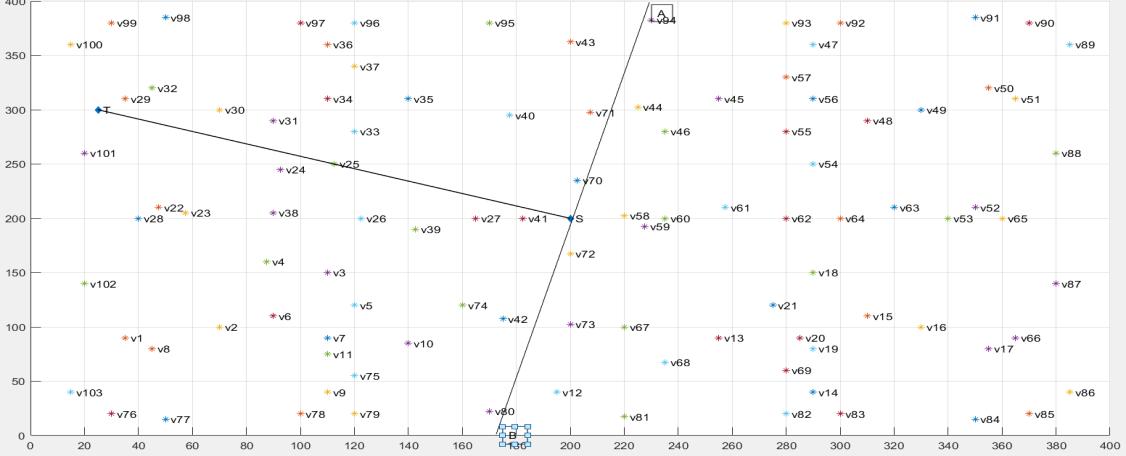
8.315 | ISO 9001:2008 Certified Journal | Page1142 connectedgraphintotwopartstoreducethesearchtimeofthealgorithm.Thecoreideaofthesegmentationmethodisto knowthespecificlocationofthesourcenodeandthetargetnode,clarifythesearchdirection,andthenconnectthesource node and the target node and divide the vertical line. In order to thoroughly understand the method, this article will combineanon-negativeWeightedconnectedgraph,asshowninFigure3-4fordetailedexplanation.Inthenon-negatively weightedconnectedgraphgiveninFigure3-4,thenumberofnodesinthegraphis105,thecoordinatesofthesourcenode are(200, 200), and the coordinatesof thetarget node are(30,310), and thepurposeis to findan optimal path fromthe sourcenodetothetargetnodewhilesatisfyingtheQOSconstraint.Afterclarifyingthecoordinatesof thesourcenodeand the destination node, we connect the source node and the target node by a straight line, and draw another straight one perpendicular to it through the source node, which will divide the figure 4 into two parts. Because the positions of the sourcenodeandthetarget nodeareknowninadvance,itwill provideacleardirectionforfindingtheoptimal pathfrom the source node to the target node in real situation. Thatis to say, in the process offinding the optimal path, the node is always searched following the direction of the target node, then in Figure 4, the node algorithm on the right side of the vertical line will not need to search, and so the number of algorithm search nodes is greatly reduced. This segmentation makes the improved Dijkstra algorithm not searching all the nodes in Figure 4 compared with the classic Dijkstra algorithm. The experiment shows that the optimal path can effectively reduce the number of iterations of the algorithm, andtheoptimalsearchingtimeofthealgorithmisreducedmuch.
We segment the actual circumstances depicted in Figure 4. Then, according to the link bandwidth and delay constraints,deletinglinksthatdonotmeetthesetwoconstraintswillalsoreducethepathsearchtimeofthealgorithm.
2025, IRJET | Impact Factor
International Research Journal of Engineering and Technology (IRJET) e-ISSN: 2395-0056
Volume: 12 Issue: 06 | Jun 2025 www.irjet.net p-ISSN: 2395-0072
InFigure4,thestartingpointSandthetargetnodeTareconnected,andanSTverticallineABisconstructed,which dividestheimageintotwoparts.
Algorithm 1:ImprovedDijkstra'salgorithm
Step0:Splitthesearchingenvironment.
Step1:EntertheinitialconditionsoftheQOSparametersoftheWSNnetwork.
Step2:Determine whether all links meet the bandwidth constraints or not, if they are satisfied, go to the next step, otherwisedeletetheviolatedones.
Step3:Determinewhetheralllinksthatmeetthedelayconstraints,iftheyaresatisfied,gotothenextstep,otherwise deletetheviolatedones.
Step4:FindtheoptimalpaththatsatisfiesthebandwidthanddelayconstraintsthroughDijkstra'salgorithm.
Step5:Determinewhethertherearemultipleoptimalpaths.Ifso,selectanoptimalpathwithalargerbandwidthfor output;otherwise,proceedtostep7.
Step6:Determinewhether therearemultipleoptimalpathswiththesamebandwidth.Ifso,thepathwithasmaller numberofhopsisselectedastheoptimalpathforoutput.
Step7:Outputtheoptimalpaththatmeetstheconstraintsofsufficientbandwidthanddelay.
Itisapopulation-basedheuristicrandomsearchalgorithmproposedbyItalianscholarsM.Dorigo,V.ManiezzoandA. Colorni in the early1990sbysimulating thecollective path-finding behavior of ants in nature[22]. Ants havethe abilityto adaptively search for a new path as the environment changes and provide new choices for subsequent ants. The fundamentalreasonisthatantscanreleaseaspecialsecretion-pheromoneonthepaththeytravel[23].Whentherearemore andmoreantswhopassingthroughthesamepath,moreandmorepheromonesareleftbehind.Asaresult,theprobability ofchoosingthispathforantsishigher.However,theoptimalpathfoundinthiswaymayonlybealocaloptimum.Inorder toavoidthealgorithmfallingintothelocaloptimum,theantcolonyalgorithmproposesapositivefeedbackmechanismto optimizethealgorithm.Thisalgorithmissuitableforfindingthebestrouteinthewirelesssensornetwork.
Assuming that the current path-finding ant is k-th, and the k-th ant is at the i node at this time, the probability of it transferringtothenextnodejis t Pij ,theformulaisasfollows:
International Research Journal of Engineering and Technology (IRJET) e-ISSN: 2395-0056
Volume: 12 Issue: 06 | Jun 2025 www.irjet.net p-ISSN: 2395-0072
Amongthem,isthepheromoneonthepath(i,j),isthelocalheuristicfunction,usuallyexpressedbythepathlength,α andβarethepheromoneweight,heuristicfactorweight,jrepresentsthenodeofthenexthop,Ji representsthenextJump collection."Ants"candeterminethenexthopbasedonpheromoneandlocalheuristics.Theheuristicfunctionformulaisas follows
Where dij represents the distance between node i and node j. When ant k finishes foraging, it needs to update the pheromoneconcentrationofthepathittravels,whichcanbeexpressedas:
Consideringtheconvergencespeedofthealgorithmandtheglobalsearchcapability,thisarticlechoosestheant-cycle model:
otherwise, , pathhe throught goes antKththe,
Where, 01, representsthepheromone volatilizationcoefficientand ij representsthepheromoneincrementof theantinthisiterationonthepath(i,j);Qisthepheromoneintensity; kL representsthetotallengthofthepathtakenby thekthantinthisiteration.
4.2.1
Antcolonyalgorithmgenerallytakesalong timetosearch,andthenexthopofanantisdeterminedbythetransition probability function. This probability depends on the enlightening effect of the next hop node on the ant and the pheromoneconcentration.Thebasicantcolonyalgorithmisbasedontheheuristicfunction.Theantstendtochoosenodes thatareclosertoeachotherwithoutconsideringtheobstacles.Whentherearemanyobjectsandthemapiscomplicated,
International Research Journal of Engineering and Technology (IRJET) e-ISSN: 2395-0056
Volume: 12 Issue: 06 | Jun 2025 www.irjet.net p-ISSN: 2395-0072
theantsmaystopata certainnode.Inorder toavoidtheabovesituation,we introducethe environmental factor[24].This methodcaneffectivelyavoidtheantdeadlockphenomenon.Theformulaisasfollows:
(19)
5 node around obstacles of 1Number 5 node around obstacles of Number 1 i i

(20)
In the initial stage, the ants have no purpose in finding the next node, which increases the optimization time and consumes the energy ofthe ants.In order tospeeduptheant'soptimizationability andreduce energyconsumption,the followingschemeisdesigned,asshowninthefigure:




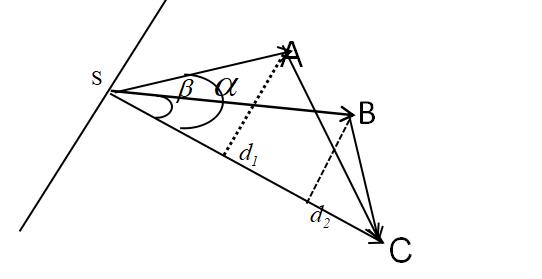
Fig.5 Search direction and next-hop node selection principle
InFig.5,nodeSisthesourcenode(startingpoint),andnodeCisthetargetnode.SupposethedistancesfrompointA andpointBtotheraySCare , ,respectively.Theanglebetweentherayandtherayis .respectively.Obviouslythe angle is small, and the node b is close to the target node c. And it is obvious from Figure5 that the distance from nodeBtotheraySCislessthanthedistance fromnodeAtotheraySC.Theprincipleofselectingnodesistobecloser toSCthebetter.Therefore,theprobabilityofchoosingnodeBishigher.
Inthetraditionalantcolonyalgorithm,theheuristicfunctiononlyconsidersthedistancebetweennodes.Suchanode selection principle has certain flaws. Therefore, the next hop node angle, node distance and environmental factors are combinedtomodifytheantheuristicfunction,therebychangingtheprobabilityofnodestatetransition.
Theheuristicfunctionismodifiedfromequation(19)to:
|
International Research Journal of Engineering and Technology (IRJET) e-ISSN: 2395-0056
Volume: 12 Issue: 06 | Jun 2025 www.irjet.net p-ISSN: 2395-0072
Wheredisthedistancefromthenexthopnodetothestraightline(theconnectionbetweenthestartingpointandthe targetnode),and isaconstant.
Insummary,thetransitionprobabilityofthepathcanbemodifiedbytheformula(14)as:
4.2.2 Modification of pheromone volatilization factor
Thevolatilizationfactorisupdatedasfollows.
In the formula(24): is the minimum value of , which can prevent from being too small and reducing the convergence speed of the algorithm. represents the current number of iterations, represent the maximum numberofiterations.
Algorithm2:Theimprovedantcolonyalgorithm
Step1:Establishanenvironmentmodelwithalinkviewingmethod.
Step2:UseimprovedDijkstraalgorithmtoplananinitialpathfromthestartingpointtotheendpoint.
Step3:Parameter initialization, number of iterationsNC, maximum number of iterationsNCmax, starting value of pheromoneQ,pheromoneoneachpath,initialvalue mofantandantalgebra k
Step4:Initializetabootable,putanantonthesourcenode,andaddthesourcenodetothetabootable.
International Research Journal of Engineering and Technology (IRJET) e-ISSN: 2395-0056
Step5:Findthenexthopnode,andperformnodetransferaccordingtothenexthopnodeprobabilityformula(22)and (23).
Step6:Updatethetabootableofthenode.
Step7:Ifallantsofthefirstgenerationreachthedestinationpoint,gotothenextstep;otherwise,gobacktostep4.
Step8.:Useformulas(16),(18),(24)toperformglobalpheromoneupdateonthepath.Comparethevaluesoneach pathtofindtheoptimalpathvalue,
Step9.:Ifitisgreaterthanthemaximumsetalgebra,gotothenextstep;otherwise,gotostep4.
Step10:Judge whether the algorithm satisfies the stop condition, if it is satisfied, then output the optimal value; otherwise,returntostep4.
Step11:Outputtheoptimalpath.
5 Experimental simulation and result analysis
Aseries ofsimulations are carried out and compared withDijkstra algorithm and D-ACOalgorithm. All experiments were carried out in the MATLAB environment. The position of the node is fixed in a rectangle of 400m*400m. Some experimentalparametersareshowninTable1.
Table 1. Experimental simulation parameters
In fact, pheromone heuristic factor α, expected heuristic factor β and pheromone volatile factor have close influence on the performance of ant colony algorithm. The values of these two parameters are particularly important for the algorithm to obtain the optimal solution. Since these parameters affect the output of the algorithm, we evaluate the influenceofdifferentparametercombinationsonthealgorithm.Table2showsthecontrolparameterstobeconsidered.
Volume: 12 Issue: 06 | Jun 2025 www.irjet.net p-ISSN: 2395-0072 © 2025, IRJET |
International Research Journal of Engineering and Technology (IRJET) e-ISSN: 2395-0056
Volume: 12 Issue: 06 | Jun 2025 www.irjet.net p-ISSN: 2395-0072
Table 2. Setting alpha and beta parameters
5.1 Simulation results of improved Dijkstra algorithm
InordertoreduceFortheerrorofthealgorithm'soperatingefficiency,theexperimentalsimulationrepeats30times for the same source node (200200)and the same target nodeT (30310), and then average the running time. The simulationresultsareshowninTable3.
Algorithm Data
ClassicDijkstra algorithm TheimprovedDijkstra algorithm
Table 3. Comparison results between the classic Dijkstra algorithm and the improved Dijkstra algorithm in this article
It is found from Table 2 that after repeating 30 simulations, the improved Dijkstra algorithm in this paper has the same cost value as the classic Dijkstra algorithm, but the average running time during the optimization process is 6.83s, whileitis8.37sfortheclassicDijkstraalgorithm.
5.2 Selection of the number of iterations
The parameters are set as follows: source node (200200), target node T (30310), ant algebrak 10, ant number m 30,pheromone parameterα 0.6,heuristic functionparameter β 0.7,pheromoneintensityQ 0.1,and minimumpheromonevolatilizationcoefficient ρmin 0.01.ThesimulationresultsofthealgorithmareshowninFigures 6-7.
© 2025, IRJET | Impact Factor value: 8.315 | ISO 9001:2008 Certified Journal | Page1148
International Research Journal of Engineering and Technology (IRJET) e-ISSN: 2395-0056
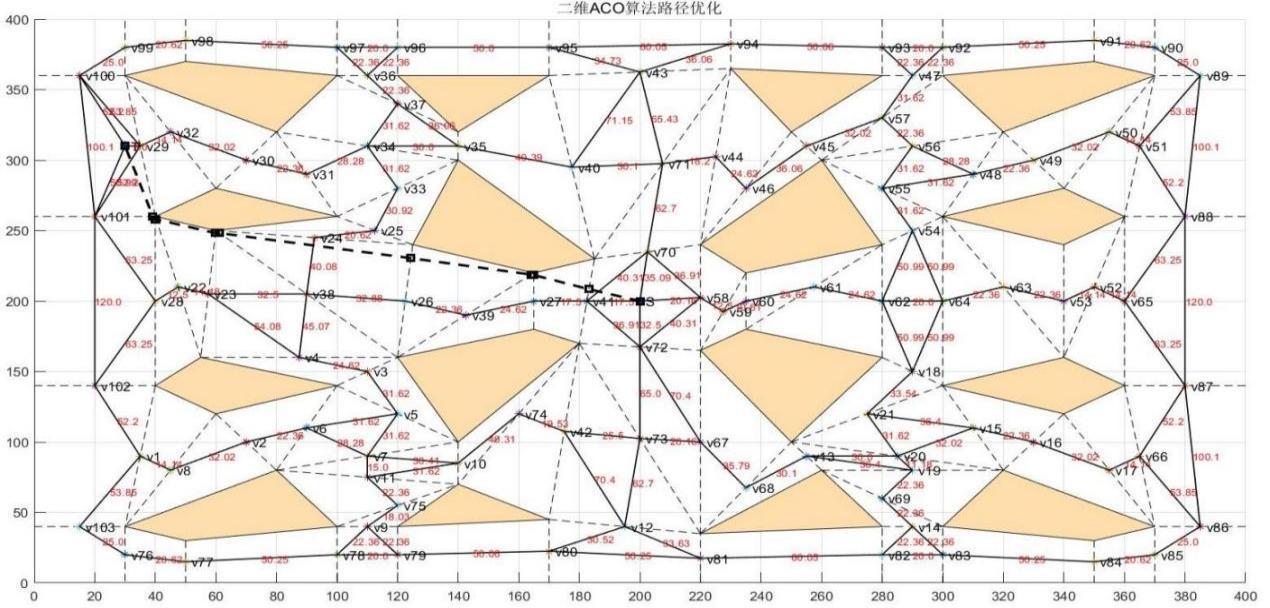
Fig.6 This article improves the ant colony algorithm path map
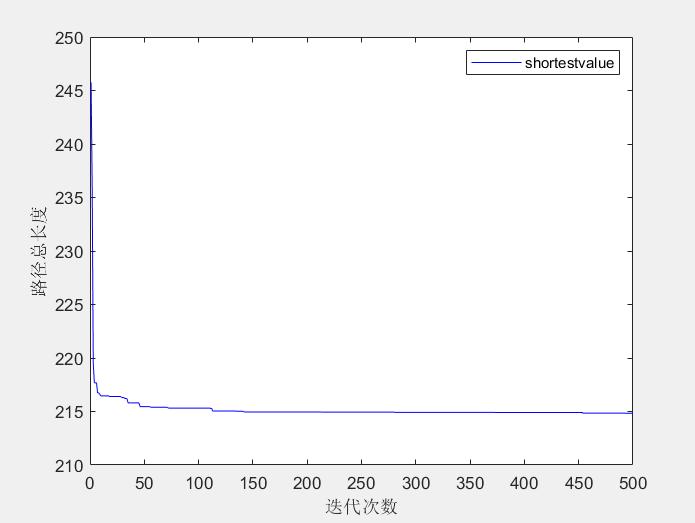
Fig.7 Iterative diagram of the path trajectory of the ant from the starting point S to the target point T
Thefigureshowsthat500iterationsareperformed,andtheresultsshowthatthealgorithmhasbeenabletoobtain therequiredoptimalsolutionwhenthenumberofiterationsisbetween100-150,andhasreachedtheexpectedgoalofthe
Volume: 12 Issue: 06 | Jun 2025 www.irjet.net p-ISSN: 2395-0072 © 2025, IRJET | Impact Factor
International Research Journal of Engineering and Technology (IRJET) e-ISSN: 2395-0056
Volume: 12 Issue: 06 | Jun 2025 www.irjet.net p-ISSN: 2395-0072
Inantcolonyalgorithm,pheromoneheuristicfactorα,expectedheuristicfactorβ,pheromoneevaporationcoefficient ρ and pheromone intensity Q are all very important parameters. In order to select better parameter values, we repeated the experiment for the given parameter(each experiment was independent). The number of ants is set to 30, and the number of iterations is 150. In order to test the influence of different parameters on the experiment, the algorithm repeatedtheexperiment50timeswithdifferentalphaandbetavalues.
Table 4. Comparison of the influence of different parameter combinations on the algorithm
It can be seen from the table 4 that when the values of alpha and beta are both 1, the average optimal cost of the algorithmisnotsignificantlyimproved,buttheaveragetimeconsumptionofthealgorithmissignificantlylowerthanother values.
In the same environment, when the parameters alpha=1 and beta=1, compare the algorithm proposed in this paper with the D-ACO algorithm, and repeat the experiment 50 times. The comparison of the results of the two algorithms is showninTable5.
© 2025, IRJET | Impact Factor value: 8.315 | ISO 9001:2008 Certified Journal | Page1150 experiment. Therefore, the maximum number of iterations of the algorithm selected in the rest of the experiment of this paperissetto150.
International Research Journal of Engineering and Technology (IRJET) e-ISSN: 2395-0056
Volume: 12 Issue: 06 | Jun 2025 www.irjet.net p-ISSN: 2395-0072
Table 5. Comparison of the results of the two algorithms
ItcanbeseenfromTable5thatafterthetwoalgorithmsbothconvergetotheoptimal,intermsoftime,thealgorithm inthispaperis12.7sisasignificantimprovementcomparedto14softhebasicantcolonyalgorithm;onthepath,thegap isobviousinthesamecomplexenvironment.Thepathlengthofthealgorithminthispaperis216.675m,whichisabout 10mlessthanthebasicantcolonyalgorithm.Therefore, thealgorithminthispaperisbetterintermsofpathlengthand timecost.
5.4 Algorithm simulation results
Whenthealgorithmfindsthefinaloptimalvalue,theoptimalpathlengthistheoptimalsolutionofthecostvalue.The above experimental resultsprovidetheoptimalparametervaluesforourfinal experiment.Theparametersettingsareas follows: Source node =(200,200), target nodeT =(30,310), T =(30,50), ant algebra k 10, number of ants m 30, pheromone parameters α 1,, heuristic function parameters β 1, maximum number of iterations NC 150. m=30, α=1,β=1,Q=1,andthenumberofiterationsis150.Accordingtotheseparametervalues,weusethealgorithmproposedin thisarticletooptimize,andtheoptimizationexperimentresultsareshowninFigure11.
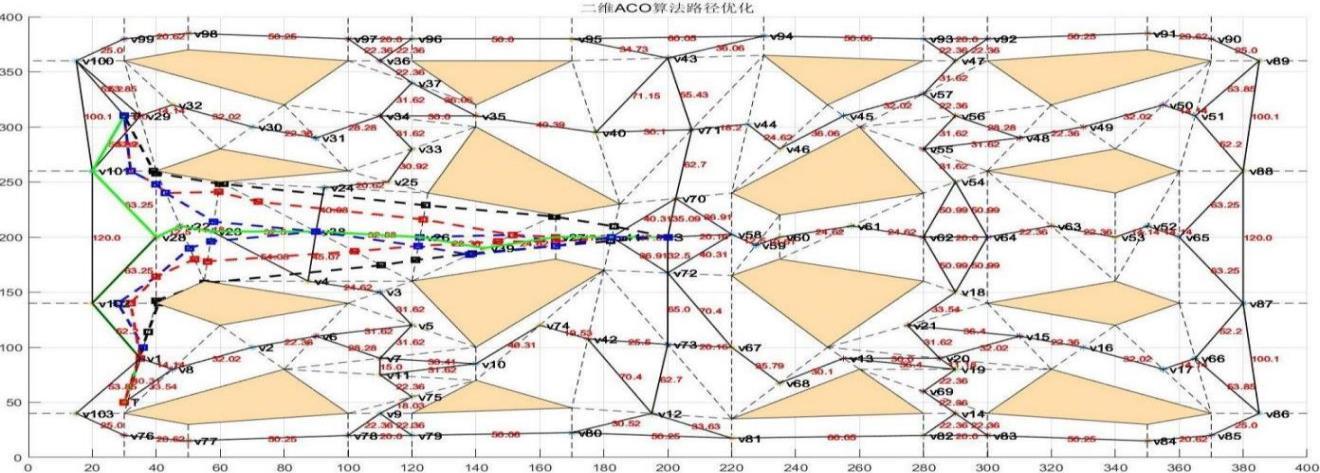
Fig.11 The simulation curve of the running path of the algorithm proposed in this paper and the other two algorithms
International Research Journal of Engineering and Technology (IRJET) e-ISSN: 2395-0056
Volume: 12 Issue: 06 | Jun 2025 www.irjet.net p-ISSN: 2395-0072
In Figure 11, The green line segment represents the initial path found by the improved Dijkstra algorithm when the QOS conditions are met, the blue line segment represents the optimized path obtained by the traditional ant colony algorithm, the red line segment represents the optimized path of the D-ACO algorithm, and the black line segment representstheimprovedantcolonyalgorithmproposedinthispaper.
In the same complex environment, the improved ant colony algorithm in this paper is superior to the other three algorithmsintermsofpathlength,thatis,thecostisthebest.ThespecificresultsareshowninTable6.
Algorithm
Data
Theimprovedant colonyalgorithm D-ACOalgorithm
Traditionalantcolony algorithm
6 Acknowledgement
Theauthorswouldbegratefultotheanonymousrefereesfortheirvaluablecommentsandsuggestions.
References
[1] Pandey O. J., Hegde R. M. Low-Latency and Energy-Balanced Data Transmission Over Cognitive Small World WSN[J]. IEEETransactionsonVehicularTechnology,2018,8:7719-7733.
[2] Senouci M. R., Mellouk A. A robust uncertainty-aware cluster-based deployment approach for WSNs: Coverage, connectivity,andlifespan[J].JournalofNetworkandComputerApplications,2019,146:102414.
[3] Hintsch T., Irnich S. Large multiple neighborhood search for the clustered vehicle-routing problem[J]. European JournalofOperationalResearch,2018:118-131.
[4] Arora V. K., Sharma V., Sachdeva M. ACO optimized self-organized tree-based energy balance algorithm for wireless sensornetwork[J].JournalofAmbientIntelligenceandHumanizedComputing,2019:4963–4975
© 2025, IRJET | Impact Factor value: 8.315 | ISO 9001:2008 Certified Journal | Page1152
International Research Journal of Engineering and Technology (IRJET) e-ISSN: 2395-0056
Volume: 12 Issue: 06 | Jun 2025 www.irjet.net p-ISSN: 2395-0072
[5] Ahmad A., Javaid N., Khan Z. A., et al. Routing Scheme to Maximize Lifetime and Throughput of Wireless Sensor Networks[J].SensorsJournalIEEE,2014,14:3516-3532.
[6] Alghamdi T. A. Secure and Energy Efficient Path Optimization Technique in Wireless Sensor Networks Using DH Method[J].IEEEAccess,2018,6:1-1.
[7] ZhaoB.,RenY.,GaoD.,etal.EnergyutilizationefficiencyevaluationmodelofrefiningunitBasedonContourletneural networkoptimizedbyimprovedgreyoptimizationalgorithm[J].Energy,2019,185:1032-1044.
[8] Radhika P. Onimproving thelifespan of wirelesssensor networkswith fuzzy based clusteringandmachine learning baseddatareduction-ScienceDirect[J].AppliedSoftComputing,2019,83:105610.
[9] Heinzelman W. R., Chandrakasan A., Balakrishnan H. Energy-efficient communication protocol for wireless micro sensornetworks[J].IEEEAccess,2000,8:3005-3014.
[10] ZhaoY.ImprovedRouteAlgorithmofWirelessSensorNetworks[J].ComputerSimulation,2012:138-141.
[11] LindseyS.,RaghavendraC.S.PEGASIS:Power-efficientgatheringinsensorinformationsystems[C].Proceedings,IEEE AerospaceConference,2002:3-4.
[12] DijkstraE.Anoteontwoproblemsinconnexionwithgraphs[J].NumerischeMathematik,1951:269-271.
[13] Xiong R., Liu Y. Improvement and parallelization of A* algorithm[J]. Journal of Computer Applications, 2015,38: 1843-1848.
[14] FredmanM.,TarjanR.Fibonacciheapsandtheirusesinimprovednetworkoptimizationproblems[J]. Journalofthe ACM,1987,34:596-615.
[15] Orlin J. B., Madduri K., Subramani K., Williamson M. A faster algorithm for the single source shortest path problem withfewdistinctpositivelengths[J].DiscretAlgorithms,2010,8:189–198.
[16] ThorupM.Undirectedsinglesourceshortestpathswithpositiveintegerweightsinlineartime[J].JournaloftheACM, 2000,46:362-394.
[17] Holzer M., Schulz F., Willhalm T. Combining speed-up techniques for shortest path computations[C]. International WorkshoponExperimentalandEfficientAlgorithms,2004.2-5.
[18] LuX.,CamitzM.Findingtheshortestpathsbynodecombination[J].AppliedMathematicsandComputation,2011,217: 6401-6408.
© 2025, IRJET | Impact Factor value: 8.315 | ISO 9001:2008 Certified Journal | Page1153
International Research Journal of Engineering and Technology (IRJET) e-ISSN: 2395-0056
Volume: 12 Issue: 06 | Jun 2025 www.irjet.net p-ISSN: 2395-0072
[19] Heinzelman W. B., Chandrakasan A. P., Balakrishnan H. An application-specific protocol architecture for wireless microsensornetworks[J].IEEETransactionsonWirelessCommunications,2002,1:660-670.
[20] KukunuruN.SecureandEnergyAwareShortestPathRoutingFrameworkforWSN[J].2019,808:379-390
[21] TanG.Z.,HeH.,SlomanA.Antcolonysystemalgorithmforreal-timegloballyoptimalpathplanningofmobilerobot-s [J].ActaAutomaticaSinica,2007,33:279 285
[22] Dorigo M., Maniezzo V., Colorni A. The Ant System: Optimization by a Colony of Cooperating Agents [J]. IEEE TransactionsonSystems,ManandCybernetics,1996,26(1):29-41.
[23] Bonabeau E., Dorigo M., Theraulaz G. Inspiration for optimization from social insect behave[J]. Nature, 2000, 406:39-42.
[24] MAX.M.,JinW.Y.Multi-objectivePathPlanningBasedonImprovedantColonyAlgorithm[J].ComputingTechnology andAutomation,2020,39:100-105.
© 2025, IRJET | Impact Factor value: 8.315 | ISO 9001:2008 Certified Journal | Page1154