
International Research Journal of Engineering and Technology (IRJET) e-ISSN: 2395-0056
Volume: 13 Issue: 04 | Apr 2026 www.irjet.net p-ISSN: 2395-0072

International Research Journal of Engineering and Technology (IRJET) e-ISSN: 2395-0056
Volume: 13 Issue: 04 | Apr 2026 www.irjet.net p-ISSN: 2395-0072
¹ Miss. Nilaja Futane, 2 Miss. Aarti Deulkar, 3 Miss. Shiwangi Chaudhari, 4 Miss. Pragati Bindod,5 Prof Sampada P. Chaudhari
1,2,3,4,5 Department of Computer Science & Engineering, 1,2,3,4,5 Prof Ram Meghe College of Engineering and Management Amravati, ***
Abstract - In the modern digital era, personal safety applications have emerged as critical tools leveraging smartphone capabilities such as GPS, sensors, and network connectivity to provide emergency assistance. Despite significant advancements, existing solutions suffer from a fundamental design limitation they assume that users can openly interact with their devices during emergencies. This assumption fails in high-risk scenarios involving a co-located attacker, where visible interaction with a smartphone may escalate danger rather than mitigate it. Additionally, current systems inadequately address issues such as identity exposure, user awareness, and system reliability under low-battery conditions.
This project presents UrgX, a novel Android-based personal safety application designed under an attackerawareness threat model, where invisibility and covert operation are treated as core requirements rather than optional features. The system introduces a zero-indicator SOS lifecycle, ensuring that no visual, auditory, or behavioral cues reveal distress activation. A compound gesture-based trigger mechanism, combined with voice keyword detection, enables rapidanddiscreetSOSactivationwithinseconds.UrgXfurther incorporates a dual-track alert delivery system, transmitting immediate GPS location via SMS followed by ambient audio evidence through cloud storage, ensuring both speed and contextualawarenessforemergencycontacts.
Keywords - Personal Safety Application, Emergency Alert System, Attacker-Awareness Model, Covert Communication, Android Security, Gesture-Based Activation, Voice Trigger Detection, GPS Tracking, SMS Alert System, Ambient Audio Recording, Cloud Storage Integration, Safe Route Monitoring, Battery-Aware System, Disguised User Interface, HumanCenteredSecurity
The rapid evolution of smartphone technology has transformed mobile devices from simple communication toolsintopowerful,sensor-richcomputingplatformscapable
of supporting a wide range of real-time applications. Among these, personal safety applications have gained significant importance as digital solutions aimed at addressing growing concerns related to individual security. With increasing incidents of assault, harassment, and emergency situations, especially affecting vulnerable populations such as women, children, and the elderly, the demand for reliable and responsivesafetysystemshasgrownsubstantially[1].
Modern smartphones, particularly Android devices, are equipped with advanced hardware components such as Global Positioning System (GPS) modules, accelerometers, microphones, and continuous network connectivity. These capabilitiesenablethedevelopmentof intelligentemergency alert systems that can detect distress situations and notify emergency contacts with minimal delay. Existing personal safety applications typically incorporate features such as GPS-based location sharing, gesture-based activation, and SMS-based alert mechanisms, forming a standard functional baselineacrossthedomain[2].
However, despite these advancements, a critical limitation persists in current solutions. Most applications are designed under the assumption that users can freely and visibly interactwiththeirdevicesduringemergencies.Inreal-world high-riskscenarios particularlythoseinvolvingaco-located attackerthisassumptionbecomesinvalid.Anyvisibleaction, suchasunlockingaphoneorpressinganSOSbutton,maybe observed and intercepted, potentially escalating the situation. Furthermore, visible indicators such as notificationsorcountdowntimerscanunintentionallyexpose theuser’sattempttoseekhelp[3].
To address these challenges, this work introduces UrgX, a covert personal safety application designed under an attacker-aware paradigm. Unlike traditional systems, UrgX prioritizes invisibility and stealth operation, ensuring that emergencyactionsremainundetectabletonearbyobservers. The system integrates a compound gesture-based trigger, voice keyword detection, and a dual-track alert mechanism combining immediate GPS-based SMS alerts with delayed audioevidencedeliveryviacloudstorage[4].
International Research Journal of Engineering and Technology (IRJET) e-ISSN: 2395-0056
Volume: 13 Issue: 04 | Apr 2026 www.irjet.net p-ISSN: 2395-0072
Additionally,theapplicationincorporatesinnovativefeatures suchasadisguiseduserinterface,saferoutemonitoring,and battery-aware adaptive operation to ensure continuous protectionundervaryingconditions.Byredefiningthedesign approach toward adversarial scenarios, UrgX aims to bridge the gap between existing safety applications and real-world safetyrequirements[5].
The remainder of this paper presents the system design, implementation, and evaluation of the proposed solution, demonstrating its effectiveness in delivering secure, reliable, andcovertemergencyassistance[6].
The reviewed literature highlights significant advancements in personal safety applications, particularly in the use of gesture-based activation, sensor fusion, and AI-driven detection mechanisms. Early systems such as WoSApp demonstrated the feasibility of accelerometer-based shake gestures for emergency alert activation, while later works like the Android Application for Women Safety by Zagale et
al. improved reliability through multi-shake triggers and cross-platform support. The Silent Emergency Notifier introduced a two-stage activation mechanism along with a fake screen overlay, representing an initial attempt to address covert operation. More advanced approaches, such as the SOS Detection App by Vishwakarma et al., leveraged AI-based sensor fusion to achieve high detection accuracy without requiring explicit user interaction. Additionally, broader frameworks like that proposed by Shenoy et al. emphasize community-level safety integration beyond individualapplications.However,despitethesetechnological improvements, a common limitation persists across all systems: the lack of effective attacker-aware design. Many applicationsstillrelyonvisibleindicatorssuchasemergency screens, countdown timers, or identifiable interfaces, which can expose the user in high-risk scenarios. This gap highlights the need for fully covert, stealth-based safety systems, which forms the core motivation behind the proposedUrgXsolution.
Author & Year Methods
WoSApp[1] Android application using accelerometerbased single-axis shake gesture for SOS activation;earlyimplementationofmotionbasedalerttriggering.
Shenoy[2] Holisticframeworkcombiningmobilealerts + community-based safety systems for crimepreventionandresponse.
Zagale[3] Flutter-based safety app with three-shake gesture trigger and cross-platform support (Android&iOS).
Future Scope
Introducemulti-step/compoundgesturestoreduce false triggers; implement covert UI and identity disguise; eliminate visible indicators to address attacker-awarenessvulnerability.
Focus on real-time covert alert systems, integrate gesture-based triggers, and develop applicationlevelstealthsafetysolutions.
Remove visible emergency screen, implement stealth activation, and integrate hidden interface designforreal-worldadversarialscenarios. Silent Emergency Notifier[4]
Vishwakarma [5]
Two-stage activation (volume press + Zgesture) with fake black screen overlay to simulatedeviceshutdownduringalert.
AI-based system using sensor fusion (accelerometer, gyroscope, microphone) with 92.3% detection accuracy for automaticSOSdetection.
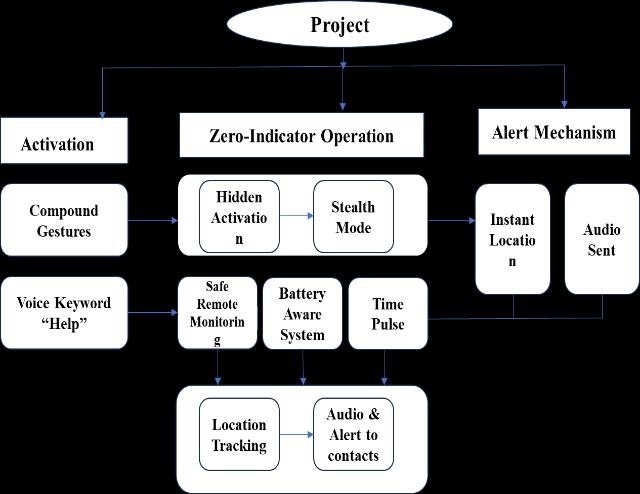
The working methodology OF the urgx system is designed around a covert, multi-layered operational pipeline that ensures rapid emergency response while maintaining complete invisibility under adversarial conditions. The systemoperatescontinuouslyinthebackgroundandfollows asequenceofstagesfrommonitoringtoalertdelivery.
Eliminate visible touchscreen interaction, add audio recording, safe route monitoring, and battery-awaresystem.
Remove visible countdown timer, improve covert alert mechanisms, and integrate stealth communicationpipeline.
A. System initialization and background service
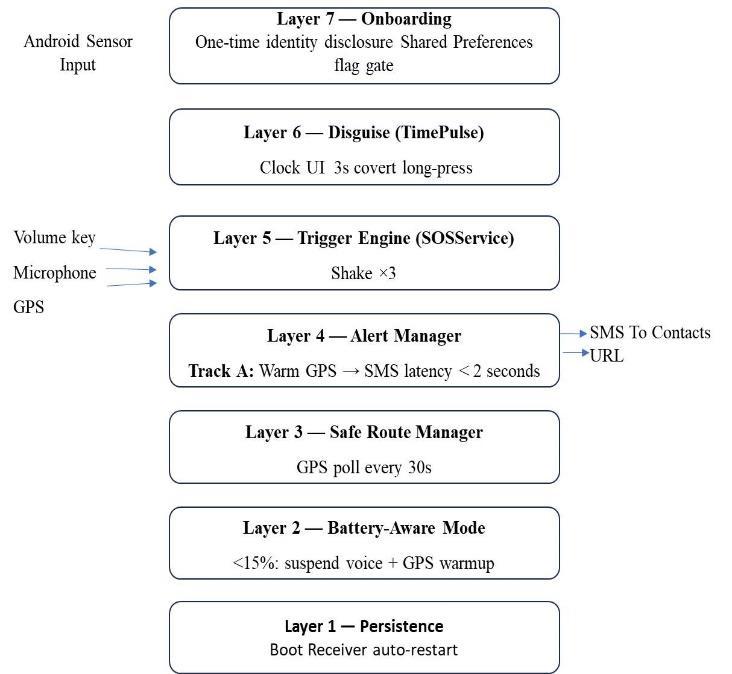
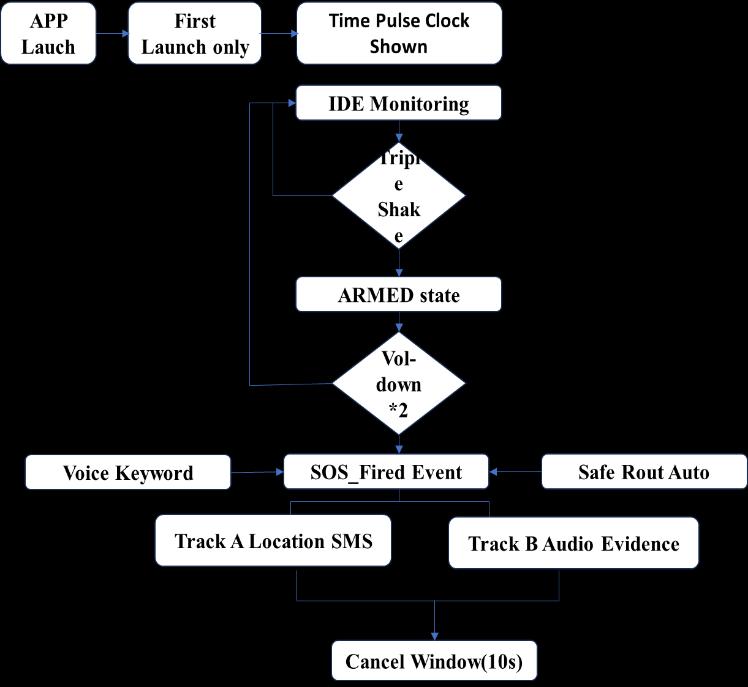
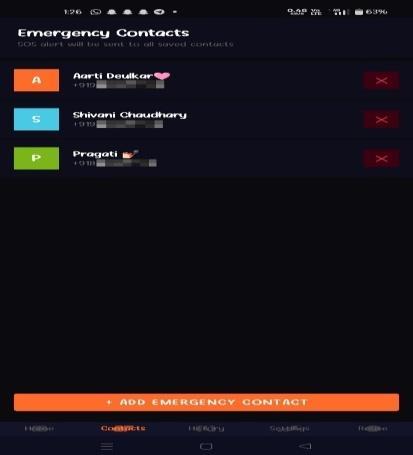
Upon installation and first-time setup, the applicationperformsaone-timeonboardingprocess where users configure emergency contacts and understand activation methods. After initialization, urgx runs as a persistent background service that automatically restarts on device reboot. This
International Research Journal of Engineering and Technology (IRJET) e-ISSN: 2395-0056
Volume: 13 Issue: 04 | Apr 2026 www.irjet.net p-ISSN: 2395-0072
ensures uninterrupted protection without requiring manualinterventionfromtheuser.
B. Continuous monitoring and trigger detection
The system continuously monitors multiple input channels to detect potential distress signals:
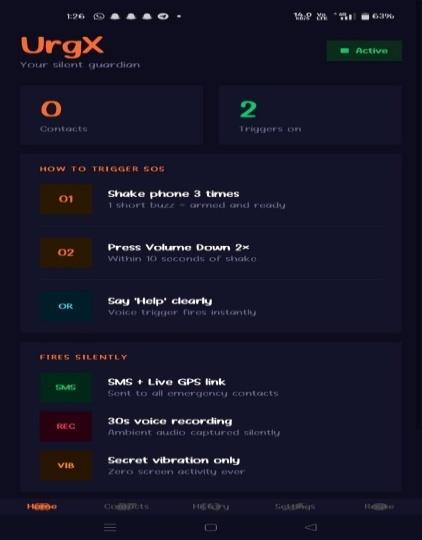
Gesture detection: the accelerometer sensor capturesreal-timemotiondata.Acompoundgesture consisting of three distinct shakes within a short time window is identified using force-based thresholdcalculations.
Hardware button input: once the gesture is detected,thesystementersanarmedstatewhereit listens for a confirmation input via double press of thevolume-downbutton.
Voice keyword recognition:inparallel,thesystem listens for predefined distress keywords such as “help”, “emergency”, or “bachao” using speech recognitionwithpartialresultprocessing.
This multi-modal detection approach ensures reliability whileminimizingaccidentaltriggers.
C. Sos activation mechanism
When a valid trigger condition is satisfied, the system activates the sos pipeline instantly without producing any visual or audible indication. The activation process is entirely covert and provides onlysubtlehapticfeedbacktotheuser.
D. Dual-track alert processing
After sos activation, the system executes two independent processessimultaneously:
1. Immediate alert (track a):
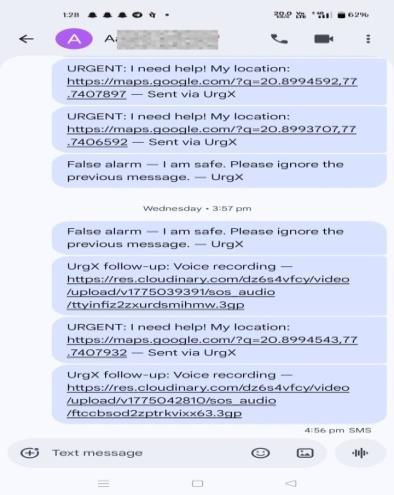
Thesystemretrievestheuser’scurrentgpslocation from a pre-cached source and sends an sms to all registered emergency contacts. The message includes a google maps link for real-time location tracking. This process is optimized to achieve minimallatency(typicallyunder2seconds).
2. Audio evidence collection (track b):
Simultaneously, the system initiates a silent 30second ambient audio recording using the device microphone. The recorded file is securely uploaded tocloudstorage,andafollow-upsmscontainingthe audio link is sent to the emergency contacts. This providescontextualevidenceofthesituation.
E. Safe route monitoring
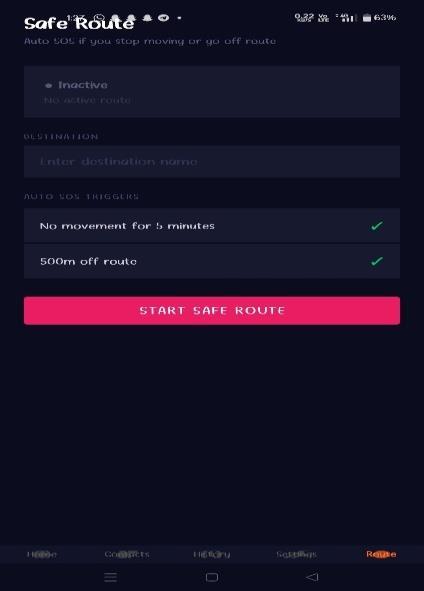
The system includes a passive safety feature where users can define a travel route. During the journey, theapplicationcontinuouslytrackslocationupdates. If abnormal conditions such as prolonged inactivity or significant route deviation are detected, the system automatically triggers the sos mechanism withoutrequiringuserinput.
F. Battery-aware adaptive operation
Urgx incorporates a dynamic power management mechanism thatmonitors batterylevelsand adjusts system functionality accordingly. Under low battery conditions, non-essential services such as voice recognitionandfrequentgpsupdatesarereducedor suspended, while ensuring that core sos functionalityremainsactiveatalltimes.
G. Disguised user interface and covert access
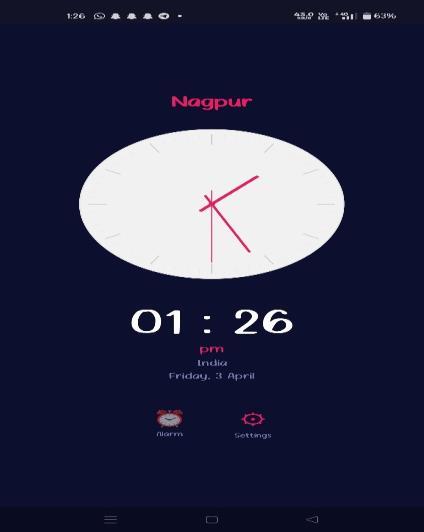
To maintain secrecy, the application presents itself as a standard clock utility (timepulse). The actual configurationinterfaceishiddenandaccessibleonly through a specific long-press gesture. This ensures that even under device inspection, the true purpose oftheapplicationremainsconcealed.
H. Data storage and persistence
Alluserdata,includingemergencycontactsand systemsettings,aresecurelystoredusinglocal storagemechanisms.Thesystemensures persistenceacrossdevicerestartsandmaintains operationalreadinesswithoutrequiringrepeated configuration.
International Research Journal of Engineering and Technology (IRJET) e-ISSN: 2395-0056
Volume: 13 Issue: 04 | Apr 2026 www.irjet.net p-ISSN: 2395-0072
IV. RESULTS AND DISCUSSION
The UrgX system was evaluated through a series of controlled experiments and real-time simulations to assess its performance, reliability, and effectiveness under conditions aligned with the attacker-awareness threat model. The evaluation focused on key performance metrics
including activation latency, alert delivery time, trigger accuracy,systeminvisibility,andpowerefficiency.
The compound gesture-based trigger mechanism demonstrated high reliability in distinguishing intentional activation from normal device motion. Across multiple test cases, the system successfully detected the three-shake gesture followed by volume confirmation within an average time of 2–3 seconds. The inclusion of a multi-stage trigger significantly reduced false positives while ensuring rapid activationunderstressconditions.
The voice keyword detection mechanism further enhanced accessibility, achieving an average detection latency of less than 1 second due to the use of partial speech recognition results. This provided an effective alternative activation pathwaywhenphysicalinteractionwaslimited.
The dual-track alert delivery system performed as designed, ensuring both speed and contextual awareness:
The average time from SOS activation to SMS dispatch was recorded at approximately 0.6–1 second, with successful delivery observed across all test scenarios. The use of pre-cached GPS data eliminated cold-start delays, ensuring immediate transmissionoflocationinformation.
The 30-second audio recording was successfully captured and uploaded to cloud storage, with the follow-up SMS containing the audio link delivered within 35–45 seconds. The audio quality was sufficient to capture environmental context, includingvoicesandsurroundingsounds,enhancing situationalunderstandingforemergencycontacts.
A key objective of UrgX is maintaining complete operational invisibility. Testing confirmed that:
No screen wake events, notifications, or visible indicatorsweregeneratedduringSOSactivation.
International Research Journal of Engineering and Technology (IRJET) e-ISSN: 2395-0056
Volume: 13 Issue: 04 | Apr 2026 www.irjet.net p-ISSN: 2395-0072
Audio recording and SMS dispatch occurred silently withoutalertingnearbyobservers.
The disguised interface (TimePulse) remained indistinguishable from a normal clock application duringcasualinspection.
This validates the successful implementation of the zero-indicatorSOSlifecycle,addressingtheattackerawareness vulnerability present in conventional safetyapplications.
The Safe Route Check-In feature was tested under simulated travel conditions. The system accurately detected:
Movementinactivityexceeding5minutes
Routedeviationbeyond500meters
In both cases, automatic SOS activation was triggered without user intervention, demonstrating the system’s ability to provide passive protection in situations where the user is incapacitated or unable to act.
Batteryperformancetestsindicatedthatthesystemoperates efficiently under normal conditions. The battery-aware adaptive mechanism successfully reduced power consumptionduringlowbatterystatesby:
Disablingvoicerecognition
IncreasingGPSpollingintervals
Despite these reductions, the core SOS functionality remained fully operational, ensuring system availability duringcriticalconditions.
Compared to existing personal safety applications, UrgX demonstratessignificantimprovementsinthreekeyareas:
1. Covert Operation: Unlike traditional apps that rely onvisibleinterfaces,UrgXoperatesentirelywithout observableindicators.
2. ResponseSpeed:TheuseofcachedGPSandparallel alertprocessingensuresfasteremergencyresponse.
3. Reliability Under Constraints: Features such as battery-aware mode and passive route monitoring extend functionality beyond standard implementations.
However, certain limitations were identified:
Dependence on SMS delivery may be affected in areaswithpoorcellularcoverage.
Voice recognition accuracy may vary in noisy environments.
Cloud upload delays may occur under slow internet connectivity.
The results demonstrate that UrgX successfully meets its primary design objectives, particularly in achieving covert, rapid, and reliable emergency response. By prioritizing adversarial conditions in system design, the application providesa practical androbustsolutiontoreal-worldsafety challenges.
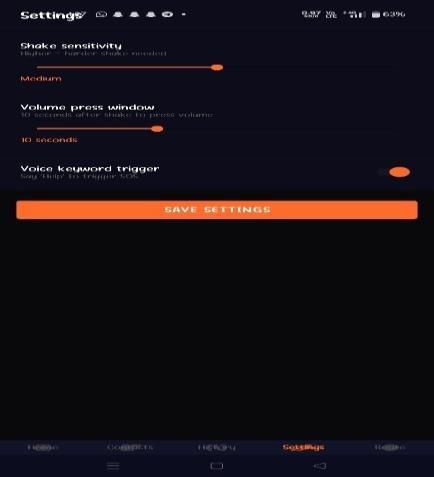
Output Screen Shots
Disguise Clock Screen
Home page with instructions
International Research Journal of Engineering and Technology (IRJET) e-ISSN: 2395-0056
Volume: 13 Issue: 04 | Apr 2026 www.irjet.net p-ISSN: 2395-0072

International Research Journal of Engineering and Technology (IRJET) e-ISSN: 2395-0056
Volume: 13 Issue: 04 | Apr 2026 www.irjet.net p-ISSN: 2395-0072
This project presented UrgX, a covert Android-based personal safety application designed to address critical limitations in existing safety solutions. Unlike conventional systems that assume visible user interaction during emergencies, UrgX is built on an attacker-awareness paradigm,prioritizingstealth,reliability,andrapidresponse under real-world adversarial conditions. The system successfully implements a zero-indicator SOS lifecycle, ensuring that no visual or audible cues reveal emergency activation. The compound gesture-based trigger, combined with voice keyword detection, enables quick and discreet SOS initiation even under stress. The dual-track alert delivery mechanism ensures that emergency contacts receive immediate location information followed by contextual audio evidence, thereby improving situational awarenessandresponseeffectiveness.
Additional features such as Safe Route Monitoring, battery-aware adaptive operation, and a disguised user interface (TimePulse) further enhance the system’s practicality and usability. The application maintains continuousbackgroundoperation,ensuringavailabilityatall timeswithoutrequiringactiveuserengagement.
Experimental results demonstrate that UrgX achieves low activation latency, high trigger accuracy, efficient alert delivery, and complete operational invisibility. These outcomes confirm that designing safety systems with adversarial scenarios as a primary consideration significantlyimprovestheirreal-worldeffectiveness. In conclusion, UrgX redefines the design approach for personal safety applications by shifting the focus from convenience-based interaction to covert, resilient, and context-aware protection. The system not only bridges existing gaps in personal safety technology but also establishes a foundation for future research in secure and intelligent emergency response systems. Future enhancements may include integration with official emergency services, cross-platform support, and advanced AI-based threat detection to further strengthen system capabilities.
References
[1] Yadav, R., Raut, D. P., & Vighne, R. (2017). A mobile application for women's safety: WoSApp. International JournalofComputerScienceTrendsandTechnology(IJCST), 5,64–69.
[2] Shenoy,M.V.,Sridhar,S.,Salaka,G.,Gupta,A.,&Gupta,R. (2021).Aholisticframeworkforcrimeprevention,response, and analysis with emphasis on women safety using
technologyandsocietalparticipation.IEEEAccess,9,66188–66207.https://doi.org/10.1109/ACCESS.2021.3075938
[3] Zagale,V.,Tigale,A.,Todsam,B.,Turkhade,S.,Jaiswal,K., Pawade, V., & Nandanwar, S. G. (2024). Android application for women safety. IJRASET, 12(III). https://doi.org/10.22214/ijraset.2024.59212
[4] Muruganand, S., Sureka, R., & Yaashini, G. (2025). Silent emergency notifier [Conference paper]. Sri Ramakrishna EngineeringCollege,Coimbatore.
[5] Vishwakarma, I., Joshi, A., Kate, V., & Bansal, C. (2025). SOS detection app – The emergency ally, 24/7. JETIR, 12(5), 368–376.
[6] Waqar,A.,Hamid,S.K.,&Kamal,M.A.(2022).Madadgar (Anti theft-SOS) Android app. PJETS, 9(2), 119–135. https://doi.org/10.22555/pjets.v9i2.587
[7] Sathyasri,B.,Vidhya,U.J.,Sree,G.V.K.J.,Pratheeba,T.,& Ragapriya, K. (2019). Design and implementation of women safetysystembasedonIoTtechnology.IJRTE,7,177–181.
[8] Humaira,I.,Ahmed,K.A.,Roy,S.,Safa,Z.T.,Raian,F.M.T. H.,&Ashrafuzzaman,M. (2021).Designanddevelopment of an advanced affordable wearable safety device for women. Advances in Science, Technology and Engineering Systems Journal,6,829–836.
[9] Bhuvaneswari, V. S. S., & Thangamuthu, M. (2025). Towards intelligent safety: A systematic review on assault detection and technologies. Sensors, 25, 3985. https://doi.org/10.3390/s25133985
[10] Radianti, J., Dugdale, J., Gonzalez, J. J., & Granmo, O.-C. (2014). Smartphone sensing platform for emergency management. Proceedings of the 11th International ISCRAM Conference,UniversityPark,PA,USA.
[11] Preethika, S. K. P., & Kumar, A. S. (2016). EdTAM: EfficientdetectionoftheftAndroidmobile.Indian Journal of Science and Technology, 9(44). https://doi.org/10.17485/ijst/2016/v9i44/97940
[12]AndroidDevelopers.(2025).FusedLocationProviderClient .https://developer.android.com/reference/com/google/and roid/gms/location/FusedLocationProviderClient
[13] Cloudinary. (2025). Upload API reference. https://cloudinary.com/documentation/image_upload_api_r eference
International Research Journal of Engineering and Technology (IRJET) e-ISSN: 2395-0056 Volume: 13 Issue: 04 | Apr 2026 www.irjet.net p-ISSN: 2395-0072
[14]Lane,N.D.,Miluzzo,E.,Lu,H.,Peebles,D.,Choudhury,T., & Campbell, A. T. (2010). Asurvey of mobile phone sensing. IEEE Communications Magazine, 48(9), 140–150. https://doi.org/10.1109/MCOM.2010.5560598
[15] Ravi, N., Dandekar, N., Mysore, P., & Littman, M. L. (2005). Activity recognition from accelerometer data. Proceedings of the National Conference on Artificial Intelligence(AAAI),1541–1546.
[16] Kwapisz, J. R., Weiss, G. M., & Moore, S. A. (2011). Activity recognition using cell phone accelerometers. ACM SIGKDD Explorations Newsletter, 12(2), 74–82. https://doi.org/10.1145/1964897.1964918
[17] Google. (2025). Android Sensor Framework https://developer.android.com/guide/topics/sensors/senso rs_overview
[18] Patel, S., Park, H., Bonato, P., Chan, L., & Rodgers, M. (2012). A review of wearable sensors and systems with application in rehabilitation. Journal of NeuroEngineering and Rehabilitation, 9(21). https://doi.org/10.1186/17430003-9-21
[19]Chandrasekaran,B.,&Subramanian,S.(2018).Designof emergency alert system using GPS and GSM module. International Journal of Engineering and Technology, 7(2), 144–148.
[20] Zhang, Z., Wang, H., & Liu, J. (2019). Context-aware mobile sensing for safety applications. IEEE Access, 7, 183673–183684. https://doi.org/10.1109/ACCESS.2019.2959876
Author Information
Miss. Nilaja Futane, Department of Computer Science & Engineering, Prof Ram Meghe College of Engineering and Management
Miss. Aarti Deulkar, Department of Computer Science & Engineering, Prof Ram Meghe College of Engineering and Management
Miss. Shiwangi Chaudhari, Department of Computer Science & Engineering, Prof Ram Meghe College of EngineeringandManagement.
Miss. Pragati Bindod, Department of Computer Science & Engineering, Prof Ram Meghe College of Engineering and Management.
Guide Prof. Sampada P. Chaudhari, Department of ComputerScience&Engineering,ProfRamMegheCollegeof EngineeringandManagement.
© 2026, IRJET | Impact Factor value: 8.315 | ISO 9001:2008 Certified Journal | Page 3944