
International Research Journal of Engineering and Technology (IRJET) e-ISSN: 2395-0056
Volume: 12 Issue: 03 | Mar 2025 www.irjet.net p-ISSN: 2395-0072
International Research Journal of Engineering and Technology (IRJET) e-ISSN: 2395-0056
Volume: 12 Issue: 03 | Mar 2025 www.irjet.net p-ISSN: 2395-0072
1,2,3,4 Student, Dept. of Computer Engineering, All India Shri Shivaji Memorial Society’s Institute of Information Technology Pune, India
5Professor, Dept. of Computer Engineering, All India Shri Shivaji Memorial Society’s Institute of Information Technology Pune, India ***
Abstract - Images from digital cameras have been used in an increasing variety of applications because of the extraordinary rise that digital photography has seen in recent decades. There are several pieces of software available now that can be used to alter images to make them appear as they did in the original. Pictures are utilized as authenticated proof of any crime; thus, it will be problematic if they stop being genuine. These kinds of forgeries are difficult to detect now. It might be difficult to tell whether a digital image is authentic or has been altered. It might be difficult to spot signs of tampering in digital images.
In this research paper, a novel approach is proposed for detecting image manipulation using a combination of ResNet101 and Unet neural networks. The need for such techniques has become paramount due to the rise in manipulated images in digital media. A literature survey of more than 20 research papers on image manipulation detection was conducted, which revealed that deep learning techniques, specifically CNNs, have shown promising results in identifying manipulated images. The proposed methodology involves using ELA for feature extraction, followed by Unet for pixel-wise segmentation of the manipulated area. The approach was tested on the CASIA dataset and achieved overall accuracy of 93.30%. With the help of ELA preprocessing technique, the binary predicted mask, predicted mask, and numerous statistical graphs on evaluation metrics are generated. Hence, the proposed approach can be used as a reliable tool for identifying image manipulation, thereby mitigating the spread of manipulated images in digital media.
Key Words: TransferLearning,ImageSegmentationModel,ResNet-100,Unet,ImageManipulationDetection.
Artificial intelligence (AI), and more specifically image processing,hasmadeimpressivestridesinrecentyears.AI models can now complete a variety of complicated image processing tasks, like picture recognition, segmentation, and restoration, with remarkable accuracy and speed thanks to the development of deep learning techniques. These developments have also raised the possibility of
image manipulation. It has become difficult to distinguish betweenrealphotographsandmodifiedimagesduetothe accessibility of image editing software and the expansion ofmanipulatedimagesonline.Itispossibletoemployimagealterationtopropagatefalseinformation,trickpeople, ordamagesomeone’sreputation.Ithasbecomemorecrucialthanevertocreateeffectivemethodsfordetectingand flagging image tampering, as the need to defend against the dissemination of false information, protect people’s reputations, and guarantee the integrity and authenticity of the photos used as evidence in various judicial procedures has increased. The rising problem of manipulated photos can be solved by building an image manipulation detectionapplication, which canhelptocreatea moresecureandreliableonlineenvironment.
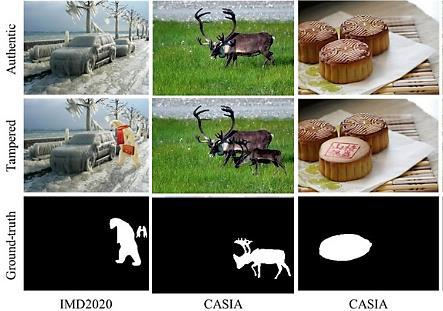
Fig -1:Examplesoftamperedimagesfromdifferentdatasets.Thenamesofdatasetarementionedatthebottom
Digital image manipulation is now simpler than ever thankstotheexpandingrangeoftoolsandsoftwareavailable for it. Image modification has the potential to be exploited for deceit, propaganda, and other harmful ends, evenwhileitcanhavegenuineusesinart, entertainment, andadvertising.Asaresult,thereisarisingneedfortools andmethods thatcanidentifyandstoppicturealteration, especially in industries like journalism, forensics, and securitywhereimageauthenticityiscrucial.
International Research Journal of Engineering and Technology (IRJET) e-ISSN: 2395-0056
Volume: 12 Issue: 03 | Mar 2025 www.irjet.net p-ISSN: 2395-0072
In recent studies, the combination of UNet and ResNet101 has shown promising results for image manipulationdetection.TheUNetmodelcanbeusedtoidentifythe altered areas of an image, and the ResNet101 model can beusedtoclassifythetypeofmanipulation.Thiscombinationofmodelscanincreasetheaccuracyandeffectiveness ofimagemanipulationdetectionsystems.
The ResNet101-based method for detecting picture alteration has several advantages over earlier approaches. The difficulty of earlier systems to handle photographs with intricate backgrounds or many alteration techniques appliedwasoneoftheirfundamentalflaws.Contrarily,the ResNet101 model has a deeper architecture that can capture more intricate elements in a picture, making it more adeptatspottingvariousmodifications.
Also, the ResNet101 model has already learned to recognizeavarietyoffrequentfeaturesandpatternsinimagesduetopre-trainingonasizabledataset.Asaresult,itis consideredablysimplertofine-tunethemodelforpicture modificationdetectionthanitwouldbeifonehadtostart fromscratch.ResNet101isagoodchoiceforpicturemodification detection because it has demonstrated superior performance to other CNN-based models in several computer vision applications. Overall, ResNet101 has the potential to increase the precision and effectiveness of current methods for picture manipulation detection and, ultimately,contributetotheefforttostopthedissemination of modified images, which may have unfavorable effects onsociety.
The study [1] suggests a novel multi-scale method for detectingimage alterationsthat makes use of deepconvolutional neural networks. The method consists of two steps: feature extraction using a pre-trained VGG-19 network andmanipulationdetection.To combinetheoutputs of the multi-view and multi-scale supervision networks, they employ a unique loss function and a binary classifier to assess if a picture has been changed. The outcomes demonstratethatthesuggestedtechniqueperformsbetter on benchmark datasets than current methods in terms of accuracy,resilience,andefficiency.
Intheirstudy[2],thescientistsemployeda multi-scale approach using a pre-trained VGG-19 network to identify picture modification. They used a unique loss function to improve a binary classifier that was trained on network featureextractions.TheMVSS-Nettechnologymakesuseof a multi-level fusion method and multi-view supervisionto improve the system’s resilience and find manipulation artefactsatvariouslevelsofabstraction.Theprocedureperformed more accurately and effectively than cutting-edge techniques.
A unique method for spotting picture change utilizing multi-modality data from several sources is suggested by research [3]. Many separate CNN models are used by the authorstoextractcharacteristicsfromtheimage,including color, texture, and shape information. To recognize photographs that have been manipulated,theyclassifythemusinga SupportVectorMachineandtheretrievedcharacteristics. The authors also present a brand-new dataset dubbed ”CMFD” to test the effectiveness of their method, which surpasses cutting-edge ones even in difficult situationslikecompressionandnoise.
The approach for locating picture forgeries using a trained AlexNet model is described in the work [4]. The authors analyze whether the image is real or false by extracting characteristics from the image input using CNN. Theyalsodiscussedthedatasetthatwasutilizedfortraining, testing, and evaluation of the CNN’s performance in comparisontoothermethods.
In the study [5], the efficacy of block-based, key-point based, and deep learning-based techniques for identifying copy move forgeries is compared. To assess these techniques’computationeffectiveness,falsepositiverates,and detection accuracy, the authors used a variety of datasets ofdifferinglevelsofcomplexity.
In [6], the authors present a method for detecting picturemodificationthatcombinesaCNNwithsemanticdata taken from a trained object identification model. CNN is maderesilienttovariouskindsofimagealterationbytrainingonadatasetthatincludesbothchangedandunaffected pictures.Techniquesforpost-processingarealsoofferedto increase precision detection. The method is tested on benchmark datasets and is shown to be superior to or comparabletostate-of-the-artmethodsforidentifyingpicturealteration.
A trained CNN model and SVM classifier are used in study[7]todemonstratea techniquefordetectingpicture alteration. The input picture is split into overlapping patches,andtheCNNisusedtoextractfeaturesfromeach patch.ThecombinedfeaturevectorproducedbymaxpoolingissuppliedtotheSVMclassifier,whichhasbeentrained to distinguish between altered and real pictures. To find the ideal collection of hyper-parameters, the author’s grid search optimizes the SVM classifier. In terms of accuracy andprecisionforpicturemodificationdetection,theycomparetheirtechniquetoexistingstate-of-the-artalgorithms usingavarietyofdatasetsandshowcompetitiveorsuperiorperformance.
Thestrategytoidentifyfakedimagesissuggestedinthe study [8] by combining copy-move analysis with re samplingfeatureanalysis.Thecopy-moveanalysisdetectspicture counterfeiting by recognizing regions that have been copied and pasted into other portions of the same image, whilethere-samplingfeatureanalysisrevealsanomaliesin
International Research Journal of Engineering and Technology (IRJET) e-ISSN: 2395-0056
Volume: 12 Issue: 03 | Mar 2025 www.irjet.net p-ISSN: 2395-0072
there-samplingtechniqueusedtochangetheimage.Intwo benchmark datasets, the method is tested, and it outperformscutting-edgemethodsintermsofaccuracy.
The Constrained R-CNN model forimage alterationdetection, which employs region-based convolution neural networks(R-CNN)andconstrainedadversariallearning,is introduced in the publication [9]. To recognize areas in photos that have been edited, the model uses a bounding boxregressionlayer.Itistrainedusinga restrictedadversariallossfunction,whichencouragesthemodeltoacquire robust features that are impervious to typical imageeditingtechniques.Theauthorsshowhowtheirmethodis successful atspotting different kindsof picture alterations andcanhandlevarieddegreesofmanipulationcomplexity.
Thestudy[10]coversthedifficultiesinidentifyingvariouskindsofpictureforgeriesandevaluatesseveralimage forgery detection techniques. It covers the application of machinelearning techniques and gives an overview of the picturecharacteristicsandclassifiersusedinforgerydetection.
Deep belief networks (DBNs), feature selection methods, and (SVM) classifiers are all employed by the researcher in [11] to providea technique for identifying image tampering in satellite photos. The DBNs extract featuresfromthesatellitephotos,andafeatureselectionalgorithmselectsthemostdiscriminativefeatures.Afterwards, the SVM classifier is employed to determine if the photos arerealorfake.Usingadatasetofsatellitephotoswithvariousformsofimagemodifications,thesuggestedapproach istested,andtheresultsshowgoodaccuracyinidentifying varioustypesofImageManipulation.
For feature extraction and categorization of photographs,theauthorsof[12]employedamodifiedversionof the VGG-16 CNN architecture. They used a dataset of real and manipulated photographs to train the CNN, and they changed the weights to lessen the difference between the predicted and actual labels. The Network was able to successfully identify if fresh photographs were authentic or fraudulentbyautomaticallyextractingedges,textures,and colorpatternsfromimages.
A deep learning-based method for identifying copymoveforgeriesindigital picturesissuggestedinthestudy [13].Preprocessingtheinputimage,extractingoverlapping patches, feeding them into a pre-trained VGG-16-based CNNtoextracthigh-levelfeatures,calculatingthesimilarity matrix between patches, clustering similar patches using spectral clustering, and using leftover clusters to detect copy-move forgeries are all steps in the method. A pretrainedVGG-16CNNmaybeusedtotrainthealgorithmon abigdataset,improvingaccuracy.
Using TSBTC and LBP methods, the research [14] suggests an image modification detection approach. The pic-
ture is divided into blocks using TSBTC, and each block’s texture properties are extracted by LBP. The TSBTC-LBP characteristicsare usedto traina machinelearningclassifier to differentiate between photographs that have been editedandthosethathaven’t.Thetechniquemightbehelpful in forensic investigations since it performs better than othercutting-edgetechniques.
A dual-branch CNN is suggested in [15] for the detectionofpicturealteration.Toidentifydifferentkindsofpicturemodifications,theCNNcontainstwobranches:onefor noise detection and the other for edge detection. The methodshowedgreataccuracyinidentifyingvariousforms of picture changes after being trained and assessed on a largedatasetofactualandchangedphotographs.
Amethodfordetectingphototamperingissuggestedin [16]utilizingtheC-CNNdeepneuralnetwork.Tosolvethe over fitting issue and obtain cutting-edge performance on different picture alteration detection tasks, such as copymoveforgery,splicing,andimagerecoloringdetection,the regularize known as CFB is introduced to the network’s lossfunction.
In the study [17], a strategy for Siamese convolutional neuralnetworktrainingwithacontrastivelossfunctionto identify picture tampering is proposed. The method compares a reference picture with a test image, and if the Euclidean distance between the test image’s feature vector and that of the reference image exceeds a predetermined threshold, it is classified as changed. For greater accuracy, the authors additionally use an ensemble of numerous CNNs.
A method for spotting picture change using pixel cooccurrence matrices was put out by the authors in [18]. (PCMs). The method entails pre-processing the image by making it grayscale and deleting information, calculating the frequency ofco-occurring pixel pairs atvarious angles anddistancestocreatePCMs,extractingfeaturesfromthe PCMs using statistical measurements, and training a machinelearning classifier to categorize the image as altered orgenuine.
The authors of[19]suggestObjectFormer HF,a method for extracting high-frequency characteristics from images that employs a transformer-based encoder to do so separately from each scale. The manipulation detection moduleusestheseattributestobuildaheatmapthatshows theregionsofthepicturethataremostlikelytohavebeen manipulated.Forseveralbenchmarkdatasets,thestrategy beatscutting-edgemethodsforpicturemodificationdetectionandlocalization.
In order to identify picture tampering, the publication [20] suggests a technique that combines edge-based segmentation with wavelet coefficient analysis. The method dividesthepictureintoareasbylocatingedgesusingaSo-
International Research Journal of Engineering and Technology (IRJET) e-ISSN: 2395-0056
Volume: 12 Issue: 03 | Mar 2025 www.irjet.net p-ISSN: 2395-0072
beledgedetector.Asupportvectormachine(SVM)classifieristhenusedtocategorizeeachregionaseitherchanged or unaffected based on the statistical characteristics of its waveletcoefficients.Accordingtobenchmark datasets,the systemperformsbetterthanpreviousalgorithmsinidentifyingmodifiedphotos.
3.1
Transfer learning can be used for image segmentation modelstoimprovetheirperformance,especiallywhenthe data available for training is limited. The most common approach is to use a pre-trained convolutional neural network(CNN)trainedonalargedatasetsuchasImageNetas afeatureextractor.Pre-trainedCNNscanbeusedtoextract high-levelfeaturesfrominputimages,whichcanbeusedto improvesegmentationperformance.
Acommontechniqueistousepre-trainedCNN(suchas VGG16,ResNet,orInception)astheencoderinanencoder decoder architecture. The encoder part of the model consists of a pre-trained CNN to extract high-level features from the input image. The decoder part of the model consists of a series of oversampling and convolution layers thatreconstructthesegmentationmasks.
Pre-trained CNNs can be frozen and only the decoder layercanberefinedusingtrainingdataavailableforaspecificsegmentationtask.Thisapproachimprovessegmentation performance and reduces the training time needed to achieve good results. Another approach is to fine-tune the pre-trainedCNNsetforsegmentationtasks.Thisapproach requires more training data and is more computationally expensive,butitcanleadtobetterresults,especiallywhen pre-trained CNNs are trained for similar tasks. In general, transfer learning is a powerful technique that can be used to improve the performance of image segmentation models,especiallywhentheavailabletrainingdataislimited.
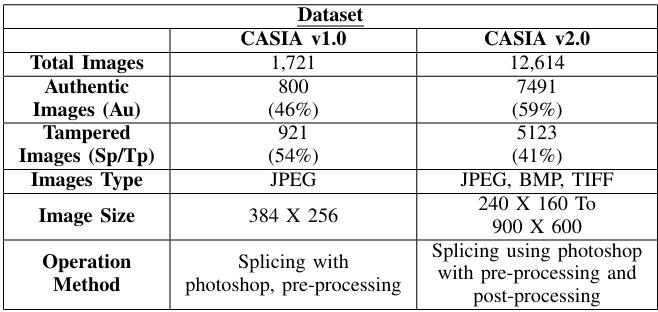
Table -1: COMPARISONOFCASIADATASET
TheCASIAImageManipulationDatasetisacollectionof manipulatedimagescreatedforthepurposeofdeveloping
and evaluating forensic techniques for detecting image tampering.ThedatasetwascreatedbytheChineseAcademy of Sciences’ Institute of Automation (CASIA) [21], the dataset contains more than 50,000 images in various formats, including JPEG, BMP, and PNG. Images are classified into four categories: copy-move forgery, splicing, removal, and combinations of these. Each category has a corresponding set of ground truth images that indicating the locationandtypeofmanipulationpresentintheimage.The datasetiswidelyusedintheresearchcommunitytodevelop and evaluate image forensic techniques and has been thesubjectofnumerousresearchpapersandcompetitions.
To train the model, the image is changed to 256*256 (height*weight). As images are resized, we need to apply anti-aliasingtoallchangingimagesinthedataset.Aliasing isthevisualstaircaseofedgesthatappearsinimageswhen the resolution is too low. Anti-aliasing is the smoothing of jaggededgesindigitalimagesbyusingthecolorofthepixelsattheborder
Error level analysis (ELA) [22] is a forensic technique used to detect digital image forgeries. The method works byidentifyingareasofanimagethathavebeenmanipulatedbymeasuringthedifferenceincompressionqualitybetween the original image and the manipulated areas. The basicprincipleofELAisthatdifferentpartsofadigitalimagewillhavedifferentcompressionlevels.Whenanimage is saved multiple times or manipulated, the compression qualitycanchangeinthemanipulatedareas.ELAcanhelp todetecttheseareasbycomparingthecompressionquality oftheoriginalimagetothemanipulatedareas.
The process involves saving an image in a lossy compressed format such as JPEG and then re-saving it at low quality. The difference between the original and recompressed image is calculated using an algorithm, and
International Research Journal of Engineering and Technology (IRJET) e-ISSN: 2395-0056
Volume: 12 Issue: 03 | Mar 2025 www.irjet.net p-ISSN: 2395-0072
thisdifferenceisthendisplayedasanimage.Theresulting ELA image highlights areas of the image where the compression quality is different, which can indicate potential areas of tampering. The technique has limitations, and its effectiveness depends on the specific manipulation technique used, the image quality, and the com pression settings.Therefore,itisrecommendedtouseELAincombination with other image forensics techniques to increase the accuracyoftheanalysis.TheELAimagewillhighlightareas of the image where the compression quality is different, which can indicate potential areas of tampering. Manipulatedareasoftheimagewillappearasregionswithhigher ELAvaluescomparedtotheoriginalimage.
Convolutional Neural Networks (CNNs) are a type of neuralnetworkthatincludeslearnableweightsandbiases. Eachneuroninthenetworkconsistsofinputs,weights,and anactivationmechanismthatgeneratesoutput.Additionally, the network contains a loss function to minimize the loss in weights. To a machine, an image is just a matrix of pixelswitharesolutionofhxwxd,wherehrepresentsthe height, w represents the width, and d represents the dimension, which is influenced by the image’s color space. Forexample,grayscalehasacolorscaleof1,whileRGBhas acolorscaleof3.
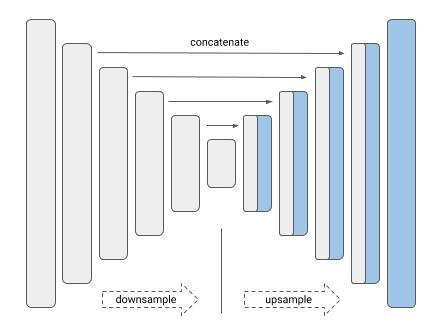
Fig -3:UnetArchitectureDiagram.
CNNs are commonly used for classification tasks, and thus,theimageistypicallytransformedintoavector.However, Unet, which is derived from traditional CNNs, is utilizedtocapturethepixelinformationoftheimage.InUnet, the image is transformed into a vector and then back into an image using the same mapping, thereby preserving the image’s original structure and reducing distortion. Therefore,Unetisemployedwhenthetask istoclassifythepixelsoftheimage.Totrainthemodel,theimagesareresized to 256 x 256 (height x width), and anti-aliasing is applied toalltheimagesinthedatasettoeliminatethevisualstaircaseofedgesknownasaliasing.
When designing a convolutional neural network, the number of layers used typically increases to enhance the network’s performance. However, this approach can lead tothevanishinggradientproblem,wherebackpropagation fails to accurately update the weights of the initial layer, resultinginrapidlydiminishingperformanceaserrorsare propagated back to earlier layers. To mitigate this issue, theResidualNetwork(ResNet)approachisutilized.ResNet tackles this problem by incorporating an identity matrix, which preserves input information during backpropagation, preventing information loss and improving inputpreservation.Asaresult,ResNetisapromisingsolution to the vanishing gradient problem, which can help to improve the performance of convolutional neural networks.
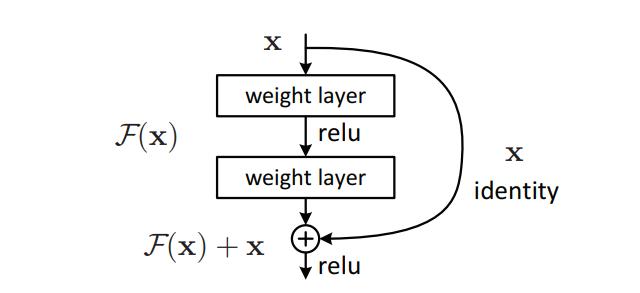
Fig -4:Skip(Shortcut)connection.
ResNet uses a skip connection method in which the original inputandconvolutionblock outputarecombined. Thisoffersthegradientanalternativewaytoflowthrough, helping to resolve the issue of vanishing gradient. ResNet uses an identity function as well, which helps the higher layersperformaswellasthelowerlayers.
Segmentation model is a Python library containing Neural Networks used for picture segmentation based on Keras, as part of the suggested methodology. Among the library’skeyattributesare:
1) To develop a Neural Network that offers High Level APIcapability,justtwolinesareneeded.
2) It offers us four model architectures for segmenting dataintobinaryandmanyclasses.
3) Eacharchitecturehas25differentbackbonesthatare available.
4) Each backbone has pre-trained weights forquickand efficientconversion.
One of the model architectures offered by the segmentation model is UNet. For improved classification, the res-
International Research Journal of Engineering and Technology (IRJET) e-ISSN: 2395-0056
Volume: 12 Issue: 03 | Mar 2025 www.irjet.net p-ISSN: 2395-0072
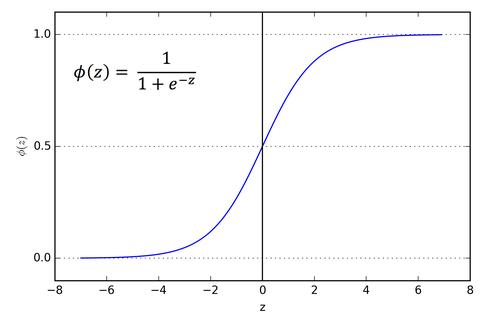
net-101modelinthesuggestedmodelisdevelopedoffthe Unetmodel.Aconvolutionalneural network with101layers iscalled the resnet-101.Together with resnet-101,the sigmoid activation function is utilized. The neural network’soutput,suchasyesorno,ischosenusinganactivation function. There is an S shaped curve in the sigmoid activationfunction.Asigmoidactivationfunction’sprimary benefitisthatitmapsvaluesbetween0and1.Asaresult,it works well for models that need the calculation of probability.
Additionally,themodelistrainedusingthepre-trained weights of ImageNet to improve performance. The ImageNetisaprojectthatconsistsofimagedatabaseswith photographs that have been manually tagged. There are around14 million photosand over 21 thousand classes in it. The weights of ImageNet are employed because they offer a consistent wayto gauge how well a model is doing atclassifyingimages.Thesepre-trainedweightsenablethe proposed model to train more quickly by allowing the modeltoconvergeinfewerepochs.
TheAdamoptimizeristhenusedtocompilethemodel. Gradient descent is employed as an optimization method along with adaptive moment (Adam) estimation. By considering the gradients’ exponentially weighted average, it speeds up the gradient descent procedure. As a result, the modelisbuiltusingarchitectureandispreparedtoidentify imagemanipulation
TheproposedapproachforenhancingimageauthenticitywithResNet101-basedmanipulationdetectionusingUNetarchitecturewasevaluatedonadatasetofmanipulated and authentic images. The results show that the proposed method achieved overall accuracy of 93.30% in detecting tamperedimages.
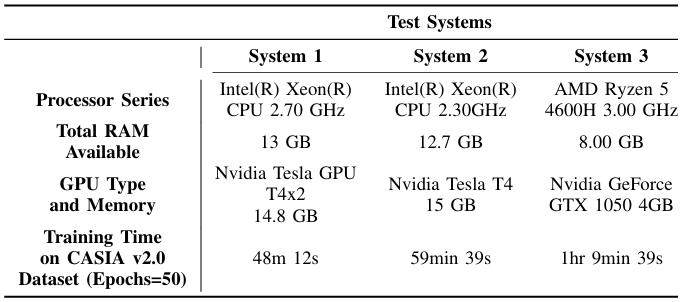
Table -2: SYSTEMSPECIFICATIONANDTRAININGTIME.
CASIA dataset was utilized as an image dataset for authentic and tampered images .It consists of two datasets, namely CASIA v1.0& v2.0.The detailedanalysisof bothis mentionedinTable1.
In this study, the TensorFlow 2.11.0 deep learning libraryandPython3.7.12programminglanguagewereused. Three test systems were used to train the model with belowmentionedspecifications.
The backbone network for feature extraction in the suggested system was ResNet101, which had been previously trained on ImageNet. For segmentation, the U-Net architecturewasutilizedwithbatchsizeof16.Thesystem underwent50epochsoftrainingbeforebeingstoppedearlyduetovalidationloss.
Dice Coefficient (dice Coeff): A predicted segmentation’spixel-by-pixelagreementwiththeassociatedground truthcan be compared using the Dice coefficient. The dice coefficient is two. divided by the total number of pixels in bothphotos,istheoverlaparea.
( ) | | | | | |
Intersection Over Union (iou score): The Jaccard Index, often known as the Intersection-Over-Union (IoU) metric, is one ofthe most widely applied metrics insemantic segmentation. The IoU, as illustrated on the left image, is the areaofunionbetweenthepredictedsegmentationandthe ground truth divided by the area of overlap between the predictedsegmentationandthegroundtruth.Thisstatistic hasarangeof0to1,with0denotingcompleteoverlapand 1denotingnooverlapatall.
( ) | | | |
International Research Journal of Engineering and Technology (IRJET) e-ISSN: 2395-0056
Volume: 12 Issue: 03 | Mar 2025 www.irjet.net p-ISSN: 2395-0072
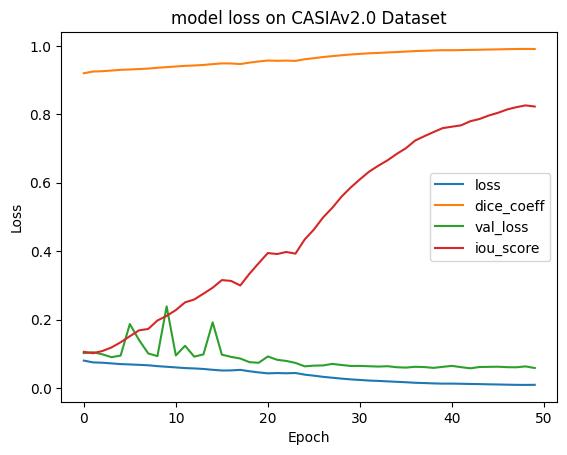
Fig -6:TheDicecoefficient,IoUscore,valueloss,and lossforthesuggestedstrategyaredisplayedonthe graph.Throughouttime,thevaluelossandlossdiminishastheDicecoefficientandIoUscorerise.
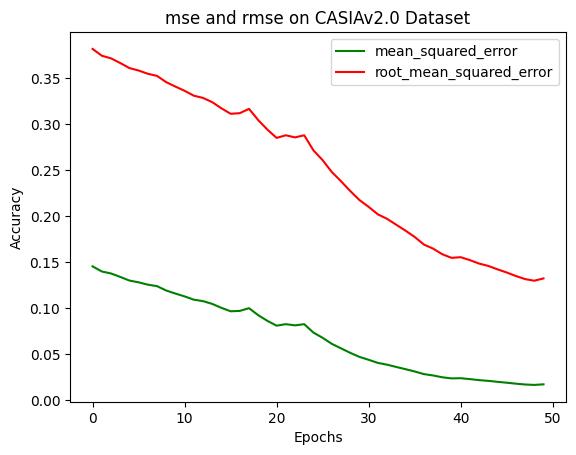
Fig -7:Thegraphillustratesthevaluesofrootsmean squareerror(RMSE)andmeansquareerror(MSE) duringthetrainingphaseofthemodelonCASIAv2.0 dataset.ThediscrepancybetweentheexpectedandactualvaluesismeasuredusingRMSEandMSE.TheperformanceofthemodelimproveswithdecreasingRMSE andMSEvalues.ThegraphdisplaystheRMSEandMSE valuesforvarioustrainingepochs.
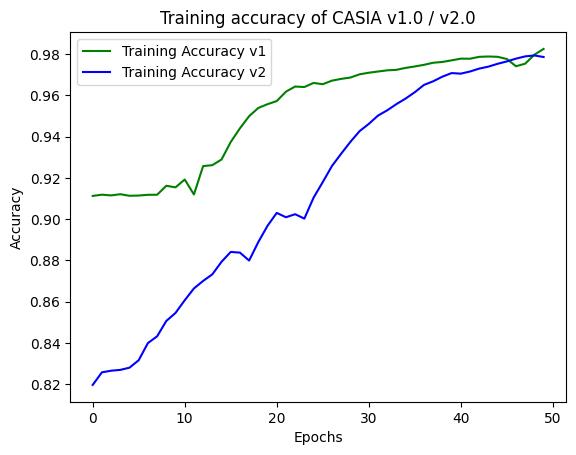
Fig -8:Thefiguredisplaysacomparisonbetweenthe trainingaccuracyofCASIAv1.0andCASIAv2.0indetectingimagemanipulation.Ascanbeseeninthecomparisongraphabove,themodelforCASIAv2.0hasa fasterlearningratebutstillCASIAv1.0’strainingaccuracyismarginallybetterthanCASIAv2.0’s.
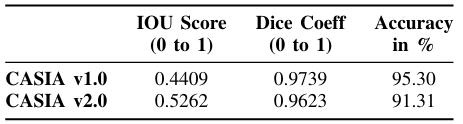
Our experimental results showed that the proposed system achieved high accuracy in identifying the manipulatedareasinthetestimages.Thesystemwasabletosuccessfullydetectthemanipulatedareaswithanaccuracyof 95.3% using the segmentation model. We also presented statistical graphs showing the performance of our model duringthetrainingprocess,whichshowedthatourmodel had a high accuracy and low loss rate. However, in some cases, the model marked tampered sections in an authenticimagebecauseoftheimageresolution.Hence,theaccuracy of the proposed system is highly dependent on the type and resolution of the input images. Sometimes the model can’t show exactly where the tampering is, but it gives a general idea of where the manipulation was done. Therefore, further studies on the subject are needed to improveaccuracyandeliminatethesedistortions.
Table -3: Comparativestudyofmodelresultstrainedon CASIAv1.0andCASIAv2.0datasets.Thetablebelowshows theevaluationmetrics(iouscore,diceCoeffandaccuracy) ofthemodelwhichhasbeentrainedindividuallyonboth thedatasets.
International Research Journal of Engineering and Technology (IRJET) e-ISSN: 2395-0056
Volume: 12 Issue: 03 | Mar 2025 www.irjet.net p-ISSN: 2395-0072
The increasing use of digital platforms has led to a pressingneedforvalidatingtheauthenticityofthecontent posted on them. Detecting the authenticity of images not only helps to prevent the circulation of false images but alsohelpsincontrollingthespreadoffalsenews,notonly on digital platforms but also in legal and medical professions.Inthisresearchpaper,athoroughsurveyofexisting techniques and methods related to image pre-processing and manipulation detection was conducted. The study foundthatdeeplearningmethodslikeConvolutionalNeural Networks (CNNs) are best suited for detecting image authenticity.
Theproposedmethodology introducedtheErrorLevel Analysis(ELA)technique,whichisusedtostudypixeldif-
ferences in an image. Using these pixel differences, the segmentationmodelistrainedusingUNetandResnet101, whichmarksthe manipulatedareaswithin a given image. The model was trained on the CASIA dataset, achieving a training accuracy of 93.30%. However, one limitation of the model is that it is dependent on the resolution of the givenimage.Thus,sometimes,itfailstogivetheexactmanipulation of the image, rather it provides us with a marked region where the manipulation has been done. Further study is required in the future to overcome these limitations. The proposed methodology provides an alternative to the current methods of image manipulation detectionwithincreasedperformanceandaccuracy.Accordingly, it has the potential to create a significant impact on regulatingcontentintoday’sincreasingdigitalworld.
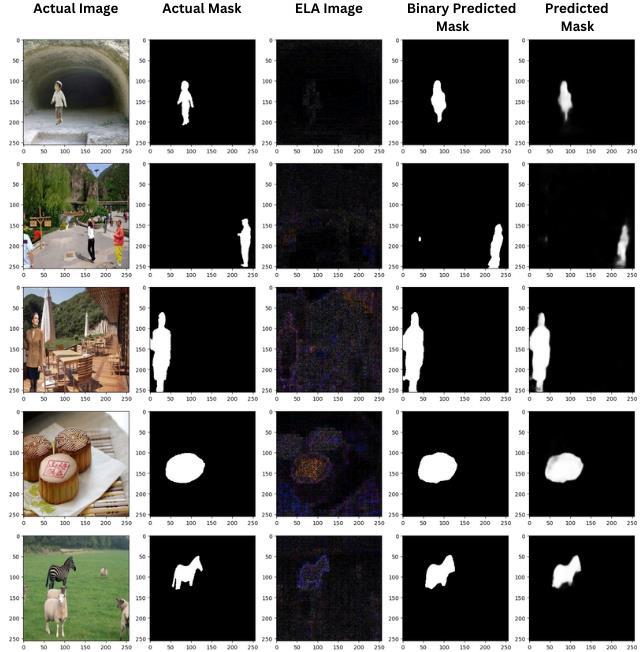
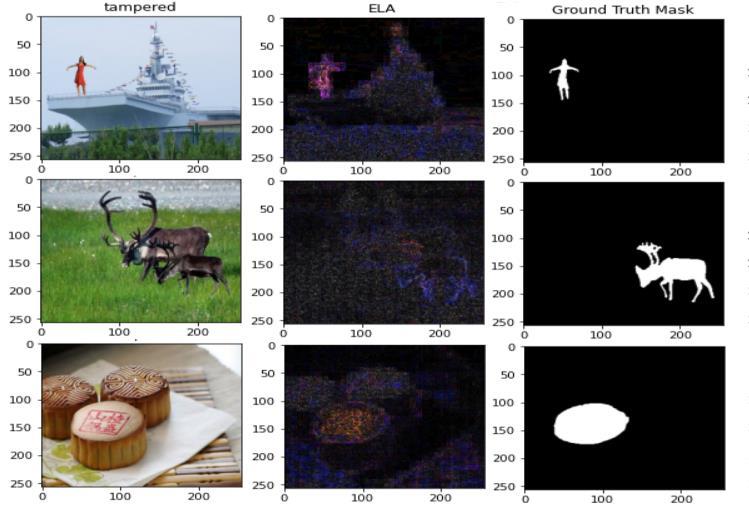
Fig -9:Figurepresentsaside-by-sidecomparisonofdifferentimageanalysistechniquesappliedtoasampleimagefrom theCASIAdataset(actualimage).Theactualmaskdrawsattentiontothesameareathathumanspecialistshaveidentified aspotentiallymanipulated.ThedifferenceincompressionbetweenimagepixelsisknownastheErrorLevelAnalysis (ELA),anditisusedtoinvestigatepixeldiscrepanciesintheimage.Wecanidentifyanyinconsistenciesbetweenthepixels inanimageusingELA.ELAisusedtoforecasttheportionsinaphotographthathavebeenaltered,producingtheexpected mask.Theanticipatedmaskisthemodel’soutput.Thepredictedmaskisconvertedtoblackandwhite,oftenknownasthe binarypredictedmask.
Chen, X., Dong, C., Ji, J., Cao, J. and Li, X., 2021. Image manipulation detection by multi-view multi-scale supervision. In Proceedings of the IEEE/CVF International ConferenceonComputerVision(pp.1418514193).
C. Dong, X. Chen, R. Hu, J. Cao and X. Li, ”MVSS-Net: Multi View Multi-Scale Supervised Networks for Image ManipulationDetection,”inIEEETransactionsonPattern Analysis and Machine Intelligence, vol. 45, no. 3, pp. 3539-3553, 1 March 2023, doi: 10.1109/TPAMI.2022.3180556.
International Research Journal of Engineering and Technology (IRJET) e-ISSN: 2395-0056
Volume: 12 Issue: 03 | Mar 2025 www.irjet.net p-ISSN: 2395-0072
C. Yang, Z. Wang, H. Shen, H. Li and B. Jiang, ”MultiModality Image Manipulation Detection,” 2021 IEEE International Conference on Multimedia and Expo (ICME), Shenzhen, China, 2021, pp. 1-6, doi: 10.1109/ICME51207.2021.9428232.
A. Doegar, M. Dutta, and K. Gaurav, “CNN Based Image Forgery Detection Using Pre-trained AlexNet Model,” MaterialsEngineeringeJournal,2019.
V.Christlein,C.Riess,J.Jordan,C.RiessandE.Angelopoulou,”AnEvaluationofPopularCopy-MoveForgeryDetection Approaches,” in IEEE Transactions on Information Forensics and Security, vol. 7, no. 6, pp. 18411854,Dec.2012,doi:10.1109/TIFS.2012.2218597.
P.Zhou,X.Han,V.I.MorariuandL.S.Davis,”LearningRich Features for Image Manipulation Detection,” 2018 IEEE/CVFConferenceonComputerVisionandPattern Recognition, 2018, pp. 1053-1061, doi: 10.1109/CVPR.2018.00116.
Kim, D.H. and Lee, H.Y., 2017. Image manipulation detectionusingconvolutionalneuralnetwork.International Journal of Applied Engineering Research, 12(21), pp.11640-11646.
Mohammed, T., Bunk, J., Nataraj, L., Bappy, J., Flenner, A., Manjunath,B.,Chandrasekaran,S.,Roy-Chowdhury,A., Peterson,L.(2018).BoostingImageForgeryDetection usingResamplingDetectionandCopymoveanalysis.
C.Yang, H.Li,F.Lin,B. JiangandH. Zhao,”Constrained RCnn:AGeneral ImageManipulationDetectionModel,” 2020 IEEE International Conference on Multimedia and Expo (ICME), 2020, pp. 1-6, doi: 10.1109/ICME46284.2020.9102825.
H. Benhamza, A. Djeffal and A. Cheddad, ”Image forgery detection review,” 2021 International Conference on Information Systems and Advanced Technologies (ICISAT), 2021, pp. 1-7, doi: 10.1109/ICISAT54145.2021.9678207.
J. Horv´ath, D. M. Montserrat, H. Hao and E. J. Delp, ”Manipulation Detection in Satellite Images Using Deep Belief Networks,” 2020 IEEE/CVF Conference on ComputerVisionandPatternRecognitionWorkshops (CVPRW), 2020, pp. 2832-2840, doi: 10.1109/CVPRW50498.2020.00340.
Y.RaoandJ.Ni,”Adeeplearningapproachtodetectionof splicing and copy-move forgeries in images,” 2016 IEEE International Workshop on Information Forensics and Security (WIFS), 2016, pp. 1-6, doi: 10.1109/WIFS.2016.7823911.
Muzaffer, Gul and G¨uzin Ulutas¸. “A new deep learningbased method to detection of copy-move forgery in
digital images.” 2019 Scientific Meeting on ElectricalElectronics and Biomedical Engineering and ComputerScience(EBBT)(2019):1-4.
S. D. Thepade, D. M. Bakshani, T. Bhingurde, S. Burghate and S. Deshmankar, ”Thepade’s Sorted Block TruncationCodingAppliedonLocalBinaryPatternsofImages for Splicing Identification Using Machine Learning Classifiers,”2020IEEEBombaySectionSignatureConference (IBSSC), 2020, pp. 208-213, doi: 10.1109/IBSSC51096.2020.9332219.
Zhang, Z., Qian, Y., Zhao, Y., Zhu, L. and Wang, J., 2022. Noise and Edge Based Dual Branch Image ManipulationDetection.arXivpreprintarXiv:2207.00724.
B. Bayar and M. C. Stamm, ”Constrained Convolutional Neural Networks: A New Approach Towards General Purpose Image Manipulation Detection,” in IEEE Transactions on Information Forensics and Security, vol. 13, no. 11, pp. 2691-2706, Nov. 2018, doi: 10.1109/TIFS.2018.2825953.
Mazumdar,AniruddhaBora,Prabin.(2018).UniversalImage Manipulation Detection using Deep Siamese ConvolutionalNeuralNetwork.
Nataraj, Lakshmanan et al. “Holistic Image Manipulation Detection using Pixel Co-occurrence Matrices.” ArXiv abs/2104.05693(2021):n.pag.
Junke Wang, Zuxuan Wu, Jingjing Chen, Xintong Han, Abhinav Shrivastava, Ser-Nam Lim, Yu-Gang Jiang; ProceedingsoftheIEEE/CVFConferenceonComputerVisionandPatternRecognition(CVPR),2022,pp.23642373
B. G. Jeong and I. K. Eom, ”Image manipulation detection usingEdgebasedsegmentationandstatisticalproperty of wavelet coefficients,” 2014 International ConferenceonElectronics,InformationandCommunications (ICEIC), 2014, pp. 1-2, doi: 10.1109/ELINFOCOM.2014.6914358.
J. Dong, W. Wang and T. Tan, ”CASIA Image Tampering Detection Evaluation Database,” 2013 IEEE China Summit and International Conference on Signal and InformationProcessing,Beijing,China,2013, pp. 422426,doi:10.1109/ChinaSIP.2013.6625374.
N. B. A. Warif, M. Y. I. Idris, A. W. A. Wahab and R. Salleh, ”AnevaluationofErrorLevelAnalysisinimageforensics,” 2015 5th IEEE International Conference on System Engineering and Technology (ICSET), Shah Alam, Malaysia, 2015, pp. 23-28, doi: 10.1109/IC SEngT.2015.7412439.
International Research Journal of Engineering and Technology (IRJET) e-ISSN: 2395-0056
Volume: 12 Issue: 03 | Mar 2025 www.irjet.net p-ISSN: 2395-0072
P. Iakubovskii, Segmentation Models. GitHub, 2019. [Online]. Available: https://github.com/qubvel/segmentation-models
F. Milletari, N. Navab and S.-A. Ahmadi, ”V-Net: Fully Convolutional Neural Networks for Volumetric Medical ImageSegmentation,”2016 FourthInternational Conference on 3D Vision (3DV), Stanford, CA, USA, 2016, pp.565-571,doi:10.1109/3DV.2016.79.
© 2025, IRJET | Impact Factor value: 8.315 | ISO 9001:2008
| Page