
International Research Journal of Engineering and Technology (IRJET) e-ISSN: 2395-0056
Volume: 13 Issue: 04 | Apr 2026 www.irjet.net p-ISSN: 2395-0072

International Research Journal of Engineering and Technology (IRJET) e-ISSN: 2395-0056
Volume: 13 Issue: 04 | Apr 2026 www.irjet.net p-ISSN: 2395-0072
Pranshul Sharma1 , Dharmendra Solanki 2 , Sumit Khirwar 3 and Anshul Kumar Singh4
1+2+3 UG Students, Department of Computer Science & Engineering
4 Assistant Professor, Department of Computer Science & Engineering Raja Balwant Singh Engineering Technical Campus, Bichpuri, Agra, India
Abstract - Student recruitment, engagement, andretention remain key priorities for universities, leading to increased adoption of digital support tools. Chatbotshaveemergedasan effective solution for managingstudentqueries, particularlyin online and hybrid environments. This paper reviews the evolution of university chatbots from rule-based systems to advanced Natural Language Processing(NLP)and generative AI models, with a focus on administrative andsupportservices beyond classroom use. It compares existing implementations and highlights the role of development platforms in deployment. The study identifies a major challenge in the lack of high-quality, domain-specific datasets and notes thatmany institutions have yet to fully leverage modern chatbot capabilities. It concludes by emphasising the potential of integrating institutional data with generative AI to create more responsive and student-centred support systems.
Key Words: Universitychatbots,studentsupport,Natural Language Processing, generative AI, higher education systems,conversationalagents,digitallearningsupport.
Chatbots, also known as conversational agents, originated fromearlyartificialintelligenceresearch,withfoundational ideassuchastheTuringTestproposedinthe1950s.Oneof theearliestworkingsystems,ELIZA,demonstratedthatbasic human–computerconversationswerepossibleandlaidthe groundworkforfuturedevelopmentsinthisfield[1].Over time, artificial intelligence has progressed significantly, especiallysincethe2000s,whenincreasedcomputingpower and large datasets enabled the rise of modern machine learninganddeeplearningtechniques.
Today’schatbotsystemsrelyheavilyonNaturalLanguage Processing (NLP). This includes Natural Language Understanding (NLU), which interprets user intent, and Natural Language Generation (NLG), which produces meaningfulresponses,asdiscussedbyMaroengsitetal.[2]. These advancements have made conversational systems
common in everyday tools such as Apple Siri, Google Assistant,andAmazonAlexa.Asaresult,usershavebecome comfortable interacting with machines through natural conversation,leadingtowidespreadadoptionofchatbotsas efficient self-service support systems, replacing or supplementing traditional communication channels like emailandphonesupport[3].
Inthecontextofhighereducation,chatbotsareincreasingly used to handle student-related queries, especially for academicandadministrativesupportsuchascoursedetails, schedules,andexaminationinformation.However,research by Nwankwo [20] highlights that many existing academic advisingsystemsstillfocusnarrowlyonadministrativetasks like course registration, rather than supporting broader studentdevelopmentneedssuchaslearninggoals,skills,and careerplanning.
Several practical implementationsshowhowchatbotsare being used in education. For instance, Goel and Polepeddi [21] developed “Jill Watson” to support students in a massive open online course (MOOC), where it handled repetitive questions, shared announcements, and assisted withroutineinteractionsatscale.Similarly,Leeetal.[22] introduced“Infobot,”achatbotdesignedforanintroductory networkingcourse thatallowed studentstoask questions about lectures, schedules, and class locations through platformslikeTelegramandFacebookMessenger.
Overall, existing studies suggest that most educational chatbots are primarily used for teaching support, student engagement, and answering routine queries. A systematic review by Okonkwo and Ade-Ibikola [23] further groups chatbot applications in education into areas such as administration,assessment,advising,andresearchsupport, withthemajoritystillfocusedoninstructionalandstudent assistancetasks.
International Research Journal of Engineering and Technology (IRJET) e-ISSN: 2395-0056
Volume: 13 Issue: 04 | Apr 2026 www.irjet.net p-ISSN: 2395-0072
Universities are increasingly adopting digital systems to improve student engagement, retention, and service delivery.Inthiscontext,chatbottechnologiesareemerging as effective tools for supporting both students and administrative staff. Hussain [5] categorises institutional chatbot applications into three primary functional areas: improving access to information and guidance for prospective and current students, streamlining routine campus services, and enhancing teaching, learning, and assessmentprocesses.
These applications are particularly relevant in higher education environments where institutions face growing competition, rising student expectations, and pressure to deliverhigh-qualityservicesunderconstrainedbudgets.Asa result,theoptimisationofstudentexperience whetherin physicaloronlinelearningenvironments hasbecomeakey strategicpriority[9].
BasedonHussain’sframework[5],chatbotdeploymentin universities can broadly be grouped into two main operationaldomains:
Admissions, student recruitment, and administrativesupport
Teachingandlearningsupportsystems
Thesecategoriesprovideastructuredlensforanalysinghow conversational AI systems are currently being integrated intohighereducationservices.
Thisreviewfocusesonchatbotapplicationsinuniversities that support student queries outside direct classroom teaching. The study was conducted through a structured literature search using Google Scholar, targeting peerreviewed conference papers and journal articles across differentdomainswherechatbotsareapplied.
Thesearchwaslaterrefinedtofocusspecificallyonhigher educationbyusingkeywordssuchas“chatbot+university” and“chatbot+education.”Althoughseveralrelevantstudies wereidentified,onlypublicationsfrom2015onwardswere included,asthisperiodmarkstheemergenceofmodernAI frameworkssuchasTensorFlow[10] and PyTorch, which significantlyinfluencedchatbotdevelopment.
Selectedstudieswerefurtherfilteredtoincludeonlythose implementedinrealuniversityenvironmentsandfocusedon administrative or student support functions rather than classroom-basedteachingorlearningsystems.
TocapturerecentdevelopmentsingenerativeAI,additional searchqueriessuchas“ChatGPTuniversity,”“closed-domain chatbot GPT,” “RAG chatbot university,” and “LangChain chatbot university” were used. These searches helped identify newer implementations based on retrievalaugmentedgenerationandlargelanguagemodels.
Finally, all collected studies were critically reviewed to ensurerelevance,withstrictinclusioncriteriaensuringthat only chatbot systems used for non-instructional student support within universities were considered for detailed analysis.
University admissions and student recruitment processes are critical for maintaining a steady inflow of students, making them one of the most important areas for chatbot deployment.Duringpeakadmissionperiods,particularlyin latesummer,oftenreferredtoasthe“summermelt”phase, universitiesexperienceahighvolumeofrepetitivestudent queriesthatcanoverloadadministrativestaff[11].
Toaddressthis,manyinstitutionshaveintroducedchatbots to improve responsiveness and enhance the applicant experience. Choque-Díaz et al. [12] emphasise that timely communicationduringadmissionsisessential,notingthat somesystemsaimtorespondtostudentquerieswithin48 hourstoimproveengagementandsatisfaction.
Several studies demonstrate practical chatbot implementations in this area. For example, Chandra and Suyanto[13]developedaWhatsApp-basedchatbotthatuses frequentlyaskedquestions(FAQs)fromadmissionsdatato respondtoapplicantsefficiently.Similarly,Santosoetal.[14] implementedanFAQ-drivenchatbottosupportuniversity admissionservices,showingthatrepetitivequeriesarewellsuitedforautomatedhandling.
Thesesystemsaregenerallybasedonasimpleinteraction model where a user asks a question and the chatbot immediatelyprovidesapredefinedresponse.Thisisknown as a single-turn conversation, which works effectively for straightforward and repetitive queries. However, more advancedsystemssupportmulti-turnconversations,where
International Research Journal of Engineering and Technology (IRJET) e-ISSN: 2395-0056
Volume: 13 Issue: 04 | Apr 2026 www.irjet.net p-ISSN: 2395-0072
contextfrompreviousinteractionsisretained.Aujogueand Aussem [15] highlight this capability, explaining that it allows chatbots to understand follow-up questions more intelligently. For example, if a student first asks about studyingmechatronicsonlineandthenasksaboutitscost, thechatbotcaninterpret“it”basedonearliercontextand providerelevantfeeinformation.
Beyondadmissions,universitiesalsomanagealargeamount of distributed administrative knowledge across websites, internal systems, and staff expertise. Khin and Soe [16] developedachatbotthatconsolidatessuchinformationto handle general campus queries, including details about departments, library services, research, and alumni. In a similarapproach,Rana[17]designedachatbotsystemthat supports enrolled students using both structured and unstructuredFAQdata,ensuringassistanceisavailableeven whenstaffmembersarenotaccessible.
Teachingandlearninginhigher educationinvolveseveral interconnected activities, including student engagement, feedbackdelivery,academicsupport,andlearninganalytics, asoutlinedbySingh[18].Withinthisecosystem,AI-based teachingassistantsareincreasinglybeingexploredastools toenhancelearningexperiences.Satow[19]proposesasixlevel framework for AI teaching assistants, ranging from basic functions such as welcoming students with personalised messages to advanced capabilities like providingindividualisedacademiccoaching.
Despitetheseadvancements,theapplicationofchatbotsin educationremainscomplex.YangandEvans[7]arguethat educationalrequirementsareoftenmorediversethanthose in other domains, which can limit the effectiveness of standardisedchatbotsolutions.Theirworkhighlightsvaried implementations, including simulation-based chatbots for online programs, library recommendation assistants, and helpdesksupportsystems.
Similarly, Cunningham-Nelson et al. [6] present an FAQbasedchatbotdesignedtoanswerroutineacademicqueries suchasassessmentguidelines,examinationschedules,and class timings. However, Nwankwo [20] points out a limitationinmanyacademicadvisingsystems,notingthat they tend to focus mainly on course selection and registration rather than broader academic development, including learning outcomes, skill-building, and career
guidance.Moreadvancedimplementationsdemonstratethe growing capabilities of educational chatbots. Goel and Polepeddi [21] introduced “Jill Watson,” developed for a massiveopenonlinecourse(MOOC),whichwascapableof handling large-scale student interaction by responding to introductions, sharing weekly updates, and answering frequentlyaskedquestionsautonomously.
In another example, Lee et al. [22] developed “Infobot,” a chatbot designed to support students in an introductory networking course in Hong Kong. This system operated acrossplatformssuchasTelegramandFacebookMessenger, allowing students to access information related to course content,schedules,andclassroomlocations.
Collectively,thesestudiesillustrateawiderangeofchatbot applications in teaching and learning, from simple FAQ systemstomoreadvancedAI-drivenassistants.Asystematic reviewbyOkonkwoandAde-Ibikola[23]furthercategorises these applications into areas such as administration, assessment, academic advising, and research support. Notably, around 66% of the reviewed systems focus primarily on teaching and learning functions, particularly student engagement, content delivery, and personalised assistance.
Chatbotsystemsinhighereducationtypicallyoperatewithin a closed-domain setting, meaning they are designed to respond only to queries related to a specific area such as admissions, academic services, or student support. These systems differ from open-domain chatbots, which can engage in general conversation across virtually any topic. Open-domain models are often more conversational and human-like,makingthemclosertopassingbenchmarkssuch astheTuringTest[24].Incontrast,closed-domainchatbots arepurpose-drivenandrestrictedtopredefinedtaskswithin a specific context, which makes them more suitable for universityenvironments.Thisreviewfocusesspecificallyon suchclosed-domainimplementations.
Modernchatbotsystemsarebuiltusingarangeoflanguage model architectures that have evolved significantly over time.Earlierapproachesincluderule-basedsystemssuchas Artificial Intelligence Markup Language (AIML) [25], followedbyneuralapproacheslikeSequence-to-Sequence (Seq2Seq)models[26].Morerecentadvancementsinclude transformer-basedarchitecturessuchasBERT(Bidirectional
International Research Journal of Engineering and Technology (IRJET) e-ISSN: 2395-0056
Volume: 13 Issue: 04 | Apr 2026 www.irjet.net p-ISSN: 2395-0072
Encoder Representations from Transformers) [27], [28], whichhavesignificantlyimprovedlanguageunderstanding capabilities.Thesemodelshavebeenwidelyappliedbeyond education, including in sectors such as e-commerce customer support, insurance claim processing, financial advisory systems, and even healthcare applications like ophthalmologyconsultationchatbots.
Inrecentyears,GenerativePre-trainedTransformer(GPT)based models have emerged as state-of-the-art (SOTA) solutionsforconversationalAI.Thesemodelsenablemore natural,context-awareresponsesandareincreasinglybeing exploredinbothopen-domainandclosed-domainsettings. Whileuniversity-specificimplementationsremainlimited, several recent studies have demonstrated the use of GPTbased and hybrid approaches in higher education environments for student support and administrative assistance[29],[30],[31],[32].
Rule-basedchatbots,alsoknownaspattern-basedsystems, represent one of the earliest and most widely used approachesinconversationalAI.Thesesystemsoperateby definingafixedsetof intents,whichrepresentcategoriesof user queries. In a university context, these intents often include areas such as admissions, registration, fees, timetables,andexaminations.
Within each intent, multiple possible user questions are mapped to predefined responses. For example, under the “registration”category,achatbotmayhandlequeriessuchas “WhenshouldIregister?”,“Whatdocumentsarerequiredfor registration?”, or “Is on-campus registration necessary?”. Each of these questions represents different patterns expressingthesameintent.
Thechatbotrespondsbymatchinguserinputtopredefined rulesinastructuredhierarchy.However,itsintelligenceis limited strictly to the knowledge encoded in its rule set. Whilerule-basedsystemsworkwellincloseddomainswith predictablequeries,theirperformancedependsheavilyon howcompletetheruledatabaseis[33].
A key limitation of this approach is scalability. As user queries grow, developers must manually define and maintain large sets of intents, responses, and linguistic variations.Ifaquerydoesnotmatchanypredefinedrule,the chatbotfailstorespond,reducingitsflexibilityandoverall usefulnessinreal-worldscenarios.
AIML(ArtificialIntelligenceMarkupLanguage)isanopensource, XML-based framework used for developing rulebasedchatbots.Itrepresentschatbotknowledgeintheform of patterns (user inputs) and corresponding responses, structured using interpretable tags processed by an AIML engine[34].InAIML,thefundamentalunitofknowledgeisa category, which consists of a user input pattern and a matching response template. The <pattern> tag captures possibleuserqueries,whilethe<template>tagdefinesthe chatbot’s response. However, AIML does not naturally support multiple synonyms within a single category, meaningvariationsofaquestionmustbeexplicitlydefined. Forinstance,differentgreetingssuchas“Hello,”“Hi,”“Hey,” and “How are you” must each be separately included as patternstoensurecorrectmatching.
Despitebeingintroducedintheearly2000s,AIMLremains in use today and is supported by various open-source interpretersandplatforms, includingPandorabots.Witha largeuserbaseandlong-standingpresence,Pandorabotsis oneofthemostestablishedAIML-basedchatbotplatforms, which may explain its continued use in academic chatbot implementations.
Duetoitsrule-basedstructure,AIMLisparticularlysuitable for FAQ-driven systems. For example, Khin and Soe [16] developed a university chatbot using an AIML knowledge base containing 970 question–answer pairs across nine categories, covering queries from students, faculty, and parents.ThissystemwasdeployedusingthePandorabots platform.
Similarly,Ranoliyaetal.[35]implementedanAIML-based chatbotdesignedspecificallyforuniversityFAQs,coveringa broad range of student queries. In another approach, Nwankwo[20]proposedanAIML-drivenacademicadvising chatbot named Adviserbot, aimed at supporting student guidanceserviceswithinuniversities.
AI-basedchatbots,alsoknownasneuralordeeplearningbasedchatbots,usemachinelearningmodels oftenmultilayer neural networks to generate or predict responses fromuser inputusingtrainingdata andNatural Language Processing(NLP)techniques[36].
Unlikerule-basedsystems,thesechatbotsarenotrestricted topredefinedresponses;instead,theylearnpatternsfrom
International Research Journal of Engineering and Technology (IRJET) e-ISSN: 2395-0056
Volume: 13 Issue: 04 | Apr 2026 www.irjet.net p-ISSN: 2395-0072
data and generate suitable outputs based on context and probability.Thechoiceofmodeldependsontheapplication andtheavailabilityoftrainingdata.
AI chatbots are generally classified into two main types: retrieval-based and generative-based systems.Retrievalbasedmodelsselectresponsesfromanexistingdatabaseof question–answerpairs.
Although they can be improved through training and expanded datasets, they cannot generate entirely new responses.Suchsystemsarecommonlyimplementedusing platformslikeMicrosoftQnAMakerandGoogleDialogflow.
Incontrast,generativechatbotsusedeeplearningmodelsto producenewresponsesthatarenotexplicitlystoredinthe dataset.ModernarchitecturessuchasBERT,GPT,Gemini, Claude,andLLaMAareexamplesofstate-of-the-art(SOTA) systems that have gained popularity due to increased computationalpowerandaccesstolarge-scaledatasets[2], [37].
All AI-based systems rely on Natural Language Understanding(NLU)preprocessingtointerpretuserintent beforegeneratingresponses.Thispreprocessingimproves model efficiency and accuracy. Common steps include tokenization,normalization,stop-wordremoval,stemming, andlemmatization.Thesestepshelpconvertrawtextintoa structuredformatsuitableformachinelearningmodels.
Beyondpreprocessing,severalNLPtechniquesareusedfor deeperunderstandingofuserqueries. Intent classification identifies the purpose of a user’s input, while domain classification is used when multiple subject areas are involved. Traditional modelssuchasBagofWords(BoW) andTF-IDFrepresenttextnumericallybyconvertingwords intovectorsbasedonfrequencyandimportance[47].
Forsemanticunderstanding,techniqueslikeWord2Vecand GloVe are widely used to generate word embeddings. Word2Vecusesneuralnetworkstolearnwordrelationships basedoncontextwindows,whileGloVebuildswordvectors using global co-occurrence statistics [48], [49]. However, bothmethodsarecontext-independent,meaningawordhas thesamerepresentationregardlessofmeaningindifferent sentences.
To address contextual limitations, advanced architectures such as Long Short-Term Memory (LSTM) networks were introduced. LSTMs are capable of capturing long-term
dependencies in text using gated memory structures, including forget, input, and output gates [50]. This allows models to retain important contextual information over longer sequences, improving understanding in complex sentences.
Forexample,inasentencelike“Thestudentcompletedher exam,” LSTM models can retain contextual information to correctly interpret references such as pronouns across earliersentences.
Retrieval-basedchatbotsgenerateresponsesbyselectingthe most relevant answer from a predefined set. They are typicallybasedonsupervisedlearning,wheremodelslearn the mapping between user queries and corresponding responses. For new inputs, the system predicts the best match, and if confidence is low, it may ask the user to rephrasethequery.
Theirperformanceimprovesbyupdatingthedatasetwith newquestion–answerpairsorrefiningexistingones.Datais usuallyobtainedfromFAQs,knowledgebases,orAPIsand processedusingtechniquessuchasintentrecognitionand wordembeddings(e.g.,word2Vec,GloVe).
ApplicationsincludesystemslikeLeo[51]andAcabot[52], whilehybridapproachescombiningretrievalandgenerative methodshavealsobeenexplored[17],[53].
Althougheasytodeploy,thesechatbotsrequirecontinuous maintenancetokeepresponsesaccurateanduptodate.
Generative-basedchatbotsuseself-superviseddeeplearning modelstogenerateresponsesthatarenotexplicitlypresent inthetrainingdataset.Unlikeretrieval-basedsystems,they are capable of producing new, context-aware outputs by learningpatternsfromlarge-scaleunlabelledtextdata.Such dataistypicallycollectedfromsourceslikewebdocuments, books, code repositories, and social media, enabling large languagemodels(LLMs)toundergopre-trainingfollowedby task-specific fine-tuning. Common datasets used in this process include the Cornell Movie Dialogue Corpus and SQuAD,whichsupportconversationallearningandquestion answeringtasks[37],[54].
2026, IRJET | Impact Factor value: 8.315 | ISO 9001:2008 Certified Journal | Page1494
International Research Journal of Engineering and Technology (IRJET) e-ISSN: 2395-0056
Volume: 13 Issue: 04 | Apr 2026 www.irjet.net p-ISSN: 2395-0072
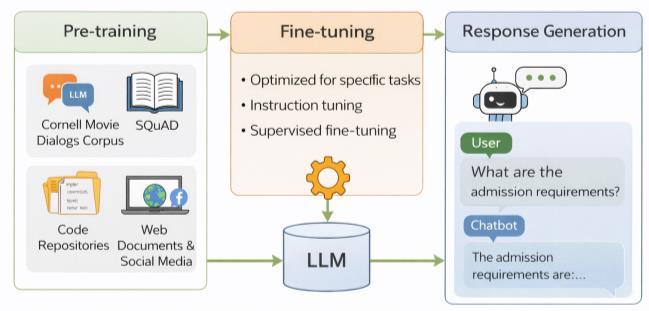
Fig.-1:OverviewofGenerativeChatbotTrainingPipeline
Generativemodelsaretypicallybuiltusingacombinationof supervisedlearning(withlabelleddata)andself-supervised learning(withunlabelleddata),makingthemhighlyscalable for natural language tasks. These approaches form the foundationofmodernLLMsandadvancedchatbotsystems.
Frequent Pattern (FP) Growth is an unsupervised data miningtechniqueusedtodiscoverfrequentpatternsinlarge datasets. It constructs a tree-based structure that compressestransactionaldataandidentifiesrelationships between items. In chatbot systems, it has been used to extract user intent patterns from interaction logs. For example,Aliasetal.[52]developedthe“Acabot”academic chatbotusingavariantcalledFrequentAdjacentSequential Pattern (FASP), showing improved intent detection comparedtotraditionalN-grammethods[55],[56].
Sequence-to-Sequence (Seq2Seq) Models is a neural networkarchitecturebasedonRecurrentNeuralNetworks (RNNs) designed to map input sequences to output sequences. It is widely used in machine translation and conversational AI. However, standard RNNs suffer from limitations such as vanishing gradients and difficulty in handlinglong-termdependencies[59].
Toimproveperformance,enhancementssuchas Attention mechanisms and Bidirectional LSTMs (BiLSTM) were introduced,allowingmodelstocapturebothpastandfuture contextinasentence[60].
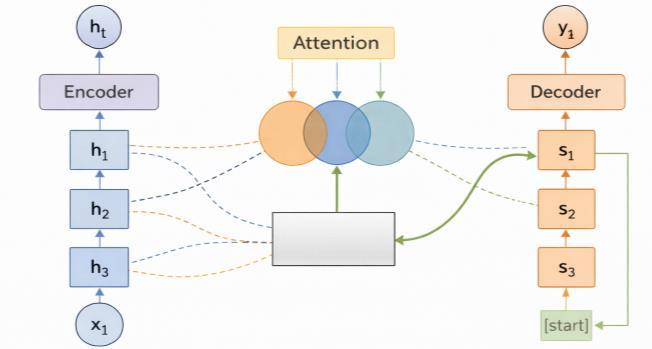
Fig. 2:Sequence-to-SequenceModelwithEncoder–DecoderandAttentionMechanism
Studies show that Seq2Seq-based chatbot systems can generate meaningful responses in university settings. For instance,KhinandSoe[62]andChandraandSuyanto[13] demonstratedimprovedperformanceusingattention-based Seq2Seq models, with evaluation metrics such as BLEU scores showing better response quality compared to baselinemodels[63].
Transformer-Based Models (BERT, GPT, LLMs) introducedself-attentionmechanisms,allowingmodels to analyse relationships between all words in a sentencesimultaneouslyratherthansequentially.
Thissignificantlyimprovescontextualunderstanding [64],[65]
BERT (Bidirectional Encoder Representations from Transformers)isapre-trainedbidirectionalmodelthatuses Masked Language Modelling (MLM) and Next Sentence Prediction (NSP) for training [66]. It is widely used for questionansweringandtextclassificationtasks.
GPT (Generative Pre-trained Transformer), introduced by OpenAI, is an autoregressive model capable of generating coherent text by predicting the next token in a sequence. Newer versions, such as GPT-4, significantly improve reasoningabilityandmultimodalprocessing,includingtext and image understanding [67], [68]. The introduction of ChatGPT has further expanded real-world adoption in conversationalAIsystems.
Despitestrongperformance,challengessuchashallucination and bias remain in large language models, often linked to datasetqualityandtraininglimitations[70].
International Research Journal of Engineering and Technology (IRJET) e-ISSN: 2395-0056
Volume: 13 Issue: 04 | Apr 2026 www.irjet.net p-ISSN: 2395-0072
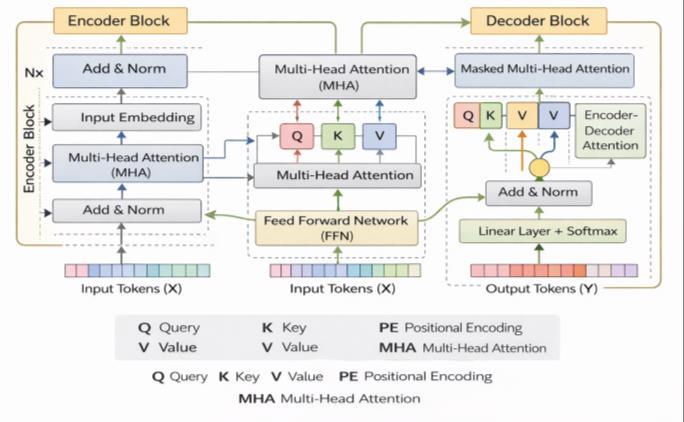
Fig. 3:Transformer-BasedLanguageModelArchitecture (Self-AttentionMechanism)
RecentstudiesshowincreasinguseofGPT-basedsystemsin universities, particularly when combined with RetrievalAugmented Generation (RAG), which enhances responses using external knowledge sources without retraining the model[73].Applicationsincludeacademicadvising,library support, and program-specific chatbots [30]–[32]. Frameworks such as LangChain are also widely used to integrateLLMswithinstitutionaldatabases.
Modern LLM Ecosystem Recent advancements include modelssuchas Gemini (Google), Claude (Anthropic),and LLaMA (Meta). These systems improve reasoning, safety, andefficiencywhilesupportingmultimodalinputsandopensourcedevelopment[74]–[76].Theycollectivelyrepresent the current state-of-the-art in generative AI for conversationalsystems
3.3 Model Overview
Table1presentsahigh-levelcomparisonofclosed-domain chatbot models used in university environments, selected specificallyforhandlingstudentqueriesoutsideclassroom teaching. These models are further evaluated in terms of performance,limitations,andapplicabilityinlatersections ofthisreview.
AsobservedinTable1,onlyonemodelfollowsapurelyrulebasedapproach.AlthoughAIMLremainseffectiveforFAQdriven systems, its relevance has decreased with the emergence of more advanced AI-based techniques. In contrast, a majority of the reviewed models are based on encoder–decoderarchitectures,whichformthebackboneof moderngenerativechatbotsystems.
Amongthese,Seq2Seqservesasanintermediateapproach between retrieval-based and fully generative systems. It demonstratesthatFAQdatasetscanstillbeeffectivelyused ingenerativeframeworks,makingitatransitionalmodelin chatbotevolution.
With the introduction of transformer-based architectures such as BERT and GPT, chatbot development has shifted toward large-scale pre-trained models. These systems are firsttrainedonmassivedatasetsusinghighcomputational resources and later fine-tuned for specific closed-domain universityapplicationsusingsmallertask-specificdatasets. Thistransferlearningapproachhassignificantlyimproved contextualunderstandingandresponsequality.
A similar observation is also reported in existing review studies on AI-based educational chatbots,whichhighlight thetransitionfromrule-basedandretrieval-basedsystems to modern transformer-driven architectures, emphasising improvementsinscalability,contextualunderstanding,and adaptabilityinhighereducationenvironments[77].
Table 2 summarises the comparative advantages and limitations of each model within university chatbot applications, highlighting trade-offs in complexity, scalability,andcontextualperformance.
Chatbot development platforms play a crucial role in enablingresearchersanddeveloperstodesign,deploy,and evaluate conversational agents across various domains, includinghighereducation.
Theseplatformssupportawiderangeofcapabilities,from simpleFAQ-basedretrievalsystemstoadvancedAI-driven conversationalframeworks,makingthemsuitableforboth technicalandnon-technicalusers[6].
Commonly used platforms such as Microsoft QnA Maker, GoogleDialogflow,RASA,Wit.ai,andBotkitprovideflexible environments for building chatbots [6]. While these tools were initially designed for retrieval-based chatbot development, they have evolved significantly to support advanced features such as intent classification, multi-turn dialogue management, and API-based integration with externalsystems.
Microsoft QnA Maker is often used in combination with Microsoft Language Understanding Intelligent Service (LUIS),whichhelpsinidentifyinguserintentandcontextual
International Research Journal of Engineering and Technology (IRJET) e-ISSN: 2395-0056
Volume: 13 Issue: 04 | Apr 2026 www.irjet.net p-ISSN: 2395-0072
meaning. Similarly, Google Dialogflow provides a fully managedconversationalAIplatformthatsupportsnatural language understanding and scalable chatbot deployment usingmodernNLPtechniques[6].
Open-source frameworks such as RASA offer full control over chatbot pipelines, allowing developers to customize naturallanguageunderstanding,dialoguemanagement,and trainingworkflows.Incontrast,Wit.aiprovidesanAPI-based development approach with support for multiple programming languages, enabling rapid prototyping of conversationalagents.Botkitisanotheropen-sourcetoolkit designed primarily for building chatbots integrated with messagingplatformssuchasSlack,FacebookMessenger,and othercommunicationchannels[6].
Inrecentyears,cloud-basedandresearch-focusedplatforms such as Hugging Face and Google Colab have significantly improvedaccessibilitytostate-of-the-artmachinelearning models. These environments provide pre-trained models, GPUacceleration,andnotebook-baseddevelopmenttools, allowingresearcherstoexperimentwithadvancednatural language processing techniques without requiring highperformancelocalinfrastructure.
In addition to general-purpose tools, several educationfocused chatbot solutions, such as Mainstay (formerly AdmitHub) and Unibuddy, have been widely adopted in universities. These platforms are specifically designed for studentengagement,admissions,enrolment,andretention processes. They also support integration with learning managementsystems(LMS)suchasCanvasandBlackboard, as well as CRM platforms like Slate. Furthermore, they provide analytics-driven insights to measure student engagement,conversionrates,andinteractioneffectiveness.
Overall,chatbotdevelopmentplatformshaveevolvedfrom basicrule-basedsystemstosophisticatedAIecosystemsthat supportscalable,intelligent,andhighlycustomizable conversationalagents.Thisevolutiondirectlyalignswiththe transition from traditional rule-based models to modern transformer-basedarchitecturesdiscussedinTables1and2, highlightingthestrongrelationshipbetweenchatbotmodels andtheirdeploymentenvironments[6].
Table-1:High-LevelBreakdownofClosed-DomainChatbotModels
AIML Retrieval N/A N/A
Seq2Seq Generative/Retrieval
BERT Generative
GPT Generative
FPGrowth Retrieval ✓
RNN/LSTM Encoder–Decoder, Auto-regressive Supervised
Transformer Encoder–Decoder, Auto-encoding Selfsupervised
Transformer Decoder,Autoregressive Selfsupervised
FrequentPattern (FASP) N/A Unsupervised
Table-2: Comparativeanalysisofadvantagesandlimitationsofcommonlyusedchatbotmodels. Model
AIML Well-establishedandwidelyused
Simpletoimplement
UsesXMLforstructuredrepresentation
Seq2Seq Supportsbothretrievalandgenerativetasks
Attentionmechanismsimproveperformance
BERT Utilisespre-trainingandfine-tuning
Open-sourceavailability
Requiresmanualdataentryoreditingtools
Reliesonpatternmatchingforintentdetection
Outdatedcomparedtomoderntechniques
Struggles with long input sequences due to contextloss
Requireslargetrainingdatasets
High computational cost due to large model
International Research Journal of Engineering and Technology (IRJET) e-ISSN: 2395-0056
GPT
FP-Growth
Pre-trainingandfine-tuningapproach
Workswithrelativelylesstask-specificdata
SupportsRAG-basedintegration
Increasingreal-worldimplementations
Usefulforexploringalternative,non-traditional approaches
Afterreviewingdifferentchatbotmodelsusedinuniversity environments, it is important to compare these implementations with those developed in other closeddomainsectors.Thiscomparisonprimarilyfocusesonthree aspects: dataset availability, training methodology, and evaluationtechniquesusedtomeasureperformance. Evaluationofnaturallanguageprocessing(NLP)systemshas traditionally relied on standard metrics, although these continue to evolve with modern large language models (LLMs). One of the most widely used metrics is BLEU (BilingualEvaluationUnderstudy),introducedbyPapineni etal.[63],whichiscommonlyappliedinmachinetranslation
tasks.Inuniversitychatbotstudies,BLEUhasbeenusedin workssuchasPalasundrametal.[61],ChandraandSuyanto [13], Khin and Soe [62], and Kapociute-Dzikiene [77] to evaluate response similarity between generated and reference answers. In addition to BLEU, other evaluation measures such as the F1 score are frequently adopted, particularly in intent classification and information extraction tasks. The F1 score, used in studies by NuruzzamanandHussain[26]andYuetal.[28],combines precisionandrecalltoprovideabalancedmeasureofsystem performance [78]. Precision reflects correctly identified outputs,whilerecallmeasureshowmanyrelevantoutputs aresuccessfullyretrieved.
More recent approaches incorporate semantic similarity metrics.Forexample,ROUGE-1andBERTScorehavebeen applied in GPT-based chatbot evaluations such as Cherumanal et al. [30]. ROUGE evaluates overlap using ngram matching, whereas BERTScore leverages contextual embeddings to measure meaning-based similarity rather
Often accessible via paid APIs (though alternativesexist)
Riskofbiasedorincorrectoutputs
Highly experimental with limited practical adoption
than exact word matches [79], [80]. These methods are particularly useful for generative systems where multiple validresponsesmayexist.
AbroaderevaluationperspectiveisdiscussedbyMaroengsit et al. [2], who categorise chatbot assessment into user satisfaction, system functionality, and content quality. Similarly, Liu et al. [81] argue that embedding-based and context-awareevaluationtechniquesaremoresuitablefor modernconversationalAIsystemscomparedtotraditional lexicalmetricsalone.
Table 3 presents a comparative summary of chatbot implementationsacrossdifferentdomains,includinghigher education, finance, healthcare, and e-commerce. Notably, most university-based systems rely on relatively small datasetscomparedtoothersectors.
For example, Palasundram et al. [61] used only 100 question–answerpairsfortrainingaSeq2Seqmodel,while Chandra and Suyanto [13] and Khin and Soe [62] worked with a few thousand pairs collected from university admission queries and messaging platforms. In contrast, financialandcommercialdomainsdemonstratesignificantly largerdatasets,suchasIntellibotwithover10,000pairs[26] andAVAwithmorethan22,000pairs[28].
Thisdifferenceindatasetsizehasadirectimpactonmodel performance and generalisation ability. For instance, Seq2Seq-based university chatbots typically achieve moderate BLEU scores (around 0.41–0.95), while larger datasetsinfinance-relatedsystemsresultinhigherF1scores (up to 0.98) [26]. Similarly, BERT-based systems show improved robustness but still depend heavily on dataset qualityandstructure[28].
Acrossuniversityimplementations,arecurringchallengeis thedifficultyinaccessingandcuratinghigh-qualitytraining data. Many datasets are manually constructed from FAQs, emaillogs,ormessagingplatforms,whichlimitsscalability.
Palasundram et al. [61] also highlight the importance of controlled dataset variation, where unseen question categoriesarecreatedthroughmodificationssuchasword
Volume: 13 Issue: 04 | Apr 2026 www.irjet.net p-ISSN: 2395-0072 © 2026, IRJET | Impact Factor value: 8.315 | ISO 9001:2008 Certified Journal | Page1498
International Research Journal of Engineering and Technology (IRJET) e-ISSN: 2395-0056
Volume: 13 Issue: 04 | Apr 2026 www.irjet.net p-ISSN: 2395-0072
reordering,synonymreplacement,spellingvariations,and sentenceshorteningtotestmodelgeneralisation.
In studies such as Khin and Soe [62] and Chandra and Suyanto [13], even when attention mechanisms were introduced into Seq2Seq models, improvements in BLEU scores remained limited due to linguistic complexity and datasetconstraints.Aliasetal.[52]furtherdemonstratethat even small datasets can be useful for intent discovery, althoughperformanceisrestrictedcomparedtolarge-scale models.
More advanced systems using retrieval-augmented generation (RAG) and transformer-based models, such as FalconandGPT,showimprovedadaptability.
Forexample,Cherumanaletal.[30]foundthatintent-based FAQ models performed better in structured evaluation, while RAG-based approaches were more effective for handlingunseenorinferredqueries.Similarly,Siragusaand Pirrone [32] observed that GPT-based systems combined withRAGprovidedmorereliableresponsesthanfine-tuned models alone, although hallucination issues still remain a concerninacademiccontexts.
Inthehealthcaredomain,BERT-basedsystemssuchasthose developed by Lee et al. [27] demonstrate potential for assisting patients, although formal evaluation remains limited.
Meanwhile,ine-commerceapplications,Kapociute-Dzikiene [77]highlightsthatevenwithlimiteddatasets,transformerbased architectures can still achieve usable performance levelsforpracticaldeployment.
Overall,akeyobservationfromthereviewedliteratureisthe clear disparity in dataset availability between university chatbots and those developed in commercial domains. Financial and enterprise systems benefit from large, structured datasets and sustained investment, whereas universitysystemsoftenrelyonlimited,manuallycurated datasources.
This directly affects model performance, evaluation outcomes,andscalability.Despitetheselimitations,thereis growinginterestindeployingchatbotsystemsinuniversities forreal-worldstudentsupport,particularlyinadmissions, administration,andengagementservices.
Author(s)
Palasundram et al. [61] N/A University Seq2Seq 100Q-A
Word-basedmodel outperforms character-based model
Khin and Soe [16] N/A University AIML(Rulebased) 970Q-Apairs Human Evaluation N/A StrongFAQ performance;needs MLenhancement
Chandra and Suyanto [13]
N/A University
Seq2Seq+ Attention ~2900 messages
0.4468 Attentionimproves responsequality
Alias et al. [52] Acabot University FP-Growth 537 conversation lines N-Gram Analysis N/A Effectiveintent patternextractionin smalldatasets
Khin and Soe [62] N/A University Seq2Seq+ Attention 5000Q-Apairs BLEU 0.41 Moderate performance; attentionimproves output
Cherumanal et al. [30] Walert University Falcon-7B(RAG +Prompting) 106Q-A+ documents BERTScore, ROUGE-1 0.771/ 0.671 RAGimproves inferenceover structuredFAQ
Siragusa & Pirrone [32] UnipaGPT University GPT(RAG+ Fine-tuning) 506docs+269 pairs Human Evaluation N/A RAGismorestable thanfine-tuning alone
International Research Journal of Engineering and Technology (IRJET) e-ISSN: 2395-0056
Volume: 13 Issue: 04 | Apr 2026 www.irjet.net p-ISSN: 2395-0072
Rana [17] Eaglebot University
Nuruzzaman & Hussain [26]
Yu et al. [28] AVA Finance
Lee et al. [27] OCS Medical
KapociuteDzikiene [77] N/A Ecommerce
This review primarily examined the implementation of chatbots within university environments, focusing specificallyonsystemsdesignedtosupportstudentqueries outsideofdirectclassroomlearningactivities.Theobjective wastounderstandhowdifferentchatbotarchitecturesare applied in higher education and how they compare with solutionsusedinotherindustries.
Acrosstheselectedstudies,eightuniversity-basedchatbot implementationswereidentifiedassuitablefordetailed
analysis. These systems employed a range of techniques, including rule-based approaches, sequence-to-sequence models, and modern transformer-based architectures. However, only a small subset of these implementations utilised large language models (LLMs) or approaches that can be considered state-of-the-art (SOTA), such as GPTor similartransformer-basedsystems. Whencomparedtootherdomainssuchascustomerservice, finance, healthcare, and travel, the number of advanced universitychatbotdeploymentsremainsrelativelylimited. Thissuggeststhathighereducationinstitutionsmaystillbe in the early stages of adopting large-scale generative AI technologies for student support services. One possible explanation for this trend is the increasing reliance on commercial “turn-key” chatbot solutions within the educationsector.Ratherthandevelopingsystemsin-house, manyuniversitiesappeartoadoptpre-builtplatformsthat
Highaccuracydueto alargedataset
Largedataset improves robustness
Promising,butlacks formalevaluation
Limiteddataset,but usablepractical results
requireminimaltechnicalconfiguration.Thisissupported bythepresenceofspecialisedproviderssuchasUnibuddy and Mainstay, which offer dedicated chatbot services tailoredspecificallyforstudentrecruitment,admissions,and engagementprocesses.
Theseplatformsreducetheneedforuniversitiestodevelop complex AI systems internally, while also providing integrated analytics, CRM connectivity, and learning management system (LMS) compatibility. However, this conveniencemayalsolimitinnovationindevelopingmore advanced, research-driven chatbot architectures within academicinstitutions.
Overall,thefindingssuggestacleargapbetweenacademic experimentation and real-world deployment in university chatbotsystems.WhileadvancedNLPandLLMtechnologies arewidelydiscussedinresearch,theirpracticaladoptionin higher education remains comparatively slow when contrastedwithothercommercialsectors.
Akeyfindingofthisreviewistheconsistentlysmallsizeof training datasets used in university chatbot implementations.Onlyonestudyreportedmorethan5,000 question–answerpairs,andthiswasforarule-basedAIML systemratherthanadeeplearningmodel.
Limited access to domain-specific data remains a major challenge in closed-domain educational chatbot development.ThisissuehasalsobeenhighlightedbyEzenCan[83],Sumikawaetal.[84],Kapociute-Dzikiene[85],and Adamopoulou[36],whonotethatsuitabletrainingdatasets areoftendifficulttoobtainorcurateinthisdomain.
In university settings, relevant information is typically scatteredacrossmultiplesourcessuchasemails,websites,
International Research Journal of Engineering and Technology (IRJET) e-ISSN: 2395-0056
Volume: 13 Issue: 04 | Apr 2026 www.irjet.net p-ISSN: 2395-0072
andinternaldocuments,makingstructureddatasetcreation difficult.Asaresult,manysystemsrelyonmanuallycreated question–answerpairs,limitingscalabilityandcoverage.
Despite this limitation, transformer-based models still demonstrate acceptable performance even with small datasets, largely due to pre-training and transfer learning capabilities.
DespiterecentprogressingenerativeAI,universitychatbot deploymentsremainlargelydominatedbyretrieval-basedor rule-based systems. The continued use of conventional question-answering approaches suggests that fully generative solutions are not yet widely adopted in this sector.
Thistrendmaybeinfluencedbyseveralfactors.First,many advanced models such as GPT are still accessed primarily throughpaidAPIs,whichcanlimitlarge-scaleinstitutional deployment. Second, universities often face challenges in accessing structured and high-quality knowledge bases requiredforeffectivegenerativemodelintegration.
Inaddition,concernsregardingmodelreliabilityalsoplaya significantrole.Issuessuchasbiasingeneratedresponses [86]andthedifficultyindistinguishingAI-generatedcontent from human-written text [87] raise ethical and academic integrity considerations. These factors may contribute to cautiousadoptionwithinhighereducationenvironments.
Overall,whilegenerativemodelsaretechnicallycapableof improvingchatbotperformance,theirpracticalintegration inuniversitiesremainslimitedcomparedtootherindustries.
Rana[17]observesthatBERT-basedchatbotsystemstendto perform better when input knowledge is divided into smaller units, such as sections or paragraphs, instead of using full documents. This structure improves processing efficiencyandsupportsfasterandmorescalableinformation retrieval.
Similarly,Yangetal.[7]reportthatretrievinginformationat theparagraphlevelgenerallyproducesbetterresultsthan
using complete articles. Full documents often contain unrelated or less relevant content, which can reduce accuracyandintroducenoiseduringresponsegeneration.
Very few studies in the reviewed literature discuss model selectionfromacostorimplementationperspective.Aliaset al. [52] indicate that their custom approach was largely drivenbythehighcostofcommercialchatbotplatformssuch as Microsoft and Google services. However, their system remainsmorefocusedonintentdetectionratherthanfullscaledeploymentinuniversityenvironments.
Although research on ChatGPT in education is expanding, limited attention has been given to its application in university administration and support services. Nevertheless,recentstudiesbyBieletzke[29],Cherumanal et al. [30], Odede and Frommholz [31], and Siragusa and Pirrone [32] demonstrate increasing interest in this direction.Theseworksexploretechniquessuchasprompt engineering, retrieval-augmented generation (RAG), finetuning comparisons, and the use of frameworks like LangChain to build LLM-based systems for university use casesbeyondclassroomteaching.
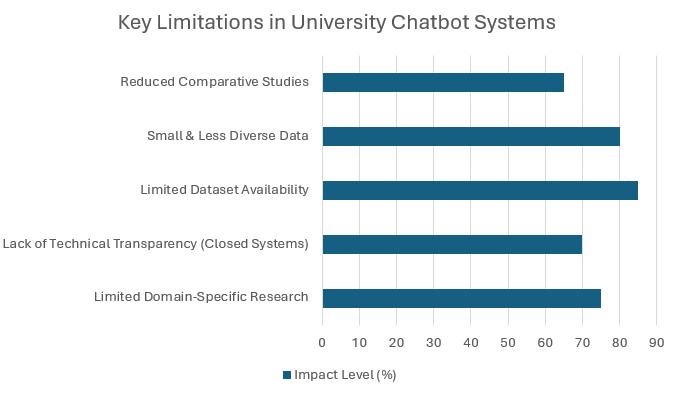
Thisstudyhascertainlimitationsduetoitsfocusedscopeon universitychatbotsystemsforadministrativeandsupportrelatedtasks.Whilethereisextensiveresearchavailableon ChatGPTandotherLLMsinteachingandlearningcontexts, comparatively fewer studies address their application in areassuchasadmissions,recruitment,andstudentservices. Thislimitedavailabilityofdirectlyrelevantliteraturemay haveinfluencedthedepthofcomparison.
Furthermore, the increasing use of commercial, ready-todeploy chatbot platforms in universities reduces the visibility of technical implementation details in academic research.AssuggestedbyYangandEvans[7],suchsolutions often operate as closed systems, which can limit research transparencyandtechnicalevaluation.
Anotherimportantlimitationistherestrictedavailabilityof large,structureddatasetsin thehigher educationdomain. Comparedtosectorslikefinanceore-commerce,university chatbot systems typically rely on smaller and less diverse datasets,whichcanconstrainmodeltraining,performance evaluation,andcross-studycomparability.
© 2026, IRJET | Impact Factor value: 8.315 | ISO 9001:2008 Certified Journal | Page1501
International Research Journal of Engineering and Technology (IRJET) e-ISSN: 2395-0056
Volume: 13 Issue: 04 | Apr 2026 www.irjet.net p-ISSN: 2395-0072
Thisreviewanalysedstate-of-the-artchatbot implementationsinuniversityenvironments,specifically focusingonsystemsdesignedtohandlestudentqueries outsideclassroomlearning.
Thestudyexaminedmodelarchitectures,datasets,and applicationdomainsusingtheclassificationframework proposedbyHussain[5],includingAdmissions,Student Recruitment,Administration,andTeachingSupport. Amongthese,AdmissionsandStudentRecruitment remainrelativelyunderexploredareasinchatbot development.
Thereviewcoveredbothtraditionalrule-basedsystemsand AIML-based approaches, alongside modern AI-driven methodssuchasretrieval-basedandgenerativemodels.
Whileretrieval-basedchatbotscontinuetobewidelyused for FAQ-style interactions due to their simplicity and reliability, generative models represent a significant advancement in flexibility and conversational capability. However,theirdeploymentstillrequirescarefulevaluation duetolimitationsinreliabilityandconsistency.
The analysis of eight selected university chatbot implementationshighlightsthateducationalinstitutionsare stillgraduallyadoptingadvancedgenerativeAItechnologies. Thisalignswith observationsby YangandEvans[7], who noted that chatbot adoption in education is often constrained by diverseinstitutional requirementsand the availabilityofeasy-to-usedevelopmentplatformsthatmay still require ongoing maintenance and optimization.
Nevertheless,recentstudiessuchasCherumanaletal.[30] andSiragusaandPirrone[32]demonstrategrowinginterest in state-of-the-art LLM-based systems, including comparisonsbetweenfine-tuningapproachesandRetrievalAugmentedGeneration(RAG).
Arecurringlimitationidentifiedacrossstudiesisthescarcity oflarge,high-qualitydatasetswithinuniversities.Compared to other sectors, educational institutions often lack structuredandaccessibleconversationaldata.However,as noted by Adamopoulou [36], this challenge is common acrossmostclosed-domainchatbotapplications.
Futuredevelopmentofuniversitychatbotsshouldfocuson leveragingavailableinstitutionaldatasourcessuchascourse catalogues, FAQs, email interactions, and CRM systems to constructcurateddatasets.Ahybridarchitecturecombining retrieval-basedmethodsforstructuredFAQsandgenerative modelsforcomplexqueriesappearstobethemostpractical solution.However,effectiveimplementationrequirescareful data preparation, especially for structured academic informationsuchasfees,course duration,andcurriculum details.
Therapidevolutionoflargelanguagemodels(LLMs)since the introduction of ChatGPT in 2022 has significantly influenced research directions. Earlier transformer-based models such as BERT and its variants (e.g., RoBERTa, DistilBERT,andXLNet)remainrelevant,whileSBERToffers improved semantic embedding capabilities for FAQ-based systems[88]–[91].
Finally,emergingframeworkssuchasLangChain,alongwith techniqueslikepromptengineering,ensemblelearning,and multi-agent orchestration systems (e.g., AutoGen and CrewAI),areexpectedtoplayakeyroleinnext-generation university chatbot development. These tools enable more scalable, intelligent, and context-aware conversational systems,makingthemstrongcandidatesforfutureresearch anddeploymentinhighereducationenvironments.
[1] J.Weizenbaum,“ELIZA acomputerprogramforstudy ofnaturallanguagecommunicationbetweenmanand machine,” Communications of the ACM,vol.9,no.1,p.36, 1966.
[2] W. Maroengsit, P. Piyakulpinyo, K. Phonyiam, C. Pongnumkul,andP.Chaovalit,“Asurveyonevaluation methodsforchatbots,”in Proc. 7th Int. Conf. Information and Education Technology (ICIET),2019,pp.111–119.
International Research Journal of Engineering and Technology (IRJET) e-ISSN: 2395-0056
Volume: 13 Issue: 04 | Apr 2026 www.irjet.net p-ISSN: 2395-0072
[3] M. J. van der Goot and T. Pilgrim, “Exploring age differencesinmotivationsforandacceptanceofchatbot communication in a customer service context,” in Chatbot Research and Design,Springer,2020.
[4] D.Baidoo-AnuandL.O.Ansah,“Educationintheeraof generativeartificialintelligence(AI):understandingthe potentialbenefitsofChatGPT,” Journal of AI,vol.7,no.1, pp.52–62,2023.
[5] A.Hussain,“5usecasesforacampuschatbot,” Chatbots Magazine,2018.
[6] S. Cunningham-Nelson et al., “A review of chatbots in education:practicalstepsforward,”in Proc. AAEE 2019, EngineersAustralia,2019.
[7] S.YangandC.Evans,“Opportunitiesandchallengesin usingAIchatbotsinhighereducation,”in Proc. 3rd Int. Conf. Education and E-Learning,ACM,2019,pp.79–83.
[8] P.A.SmutnyandP.Schreiberova,“Chatbotsforlearning: a review of educational chatbots for Facebook Messenger,” Computers & Education,2020.
[9] S. L. Mendez et al., “Chatbots: a tool to supplement faculty mentoring,” International Journal of Doctoral Studies,vol.15,no.1,p.373,2020.
[10] M. Abadi et al., “TensorFlow: large-scale machine learningonheterogeneousdistributedsystems,” arXiv preprint arXiv:1603.04467,2015.
[11] L. C. Page, J. Lee, and H. Gehlbach, “Conditions under whichcollegestudentscanberesponsivetonudging,” EdWorkingPapers,2020.
[12] M. Choque-Díaz, J. Armas-Aguirre, and P. ShiguiharaJuárez, “Cognitive technology model to enhance academic support services with chatbots,” in IEEE INTERCON,2018.
[13] Y. W. Chandra and S. Suyanto, “Indonesian university admission chatbot using Seq2Seq model,” Procedia Computer Science,vol.157,pp.367–374,2019.
[14] H. A. Santoso et al., “DINA chatbot for university admissionservices,”in IEEE ICAT 2018,2018.
[15] J. B. Aujogue and A. Aussem, “Hierarchical recurrent attention networks for education chatbots,” in IJCNN, IEEE,2019.
[16] N. N. Khin and K. M. Soe, “University chatbot using AIML,”in IEEE ICCA,2020.
[17] M. Rana, “Eaglebot: chatbot-based QA system using BERT,” Electronic Theses and Dissertations,2019.
[18] R.Singh,“AIandchatbotsineducation:whatdoesthe futurehold?,” Chatbots Magazine,2018.
[19] L. Satow, “Chatbots as teaching assistants,” SAP Blogs, 2017.
[20] W. Nwankwo, “Interactive advising with bots in education,” American Journal of Operational Management,vol.3,no.1,pp.6–21,2018.
[21] A. K. Goel and L. Polepeddi, “Jill Watson: a virtual teaching assistant,” Georgia Institute of Technology, 2016.
[22] L.K.Leeetal.,“Multiplatformchatbotasonlinetutor,”in IEEE ISET,2020.
[23] C.W.OkonkwoandA.Ade-Ibijola,“Chatbotapplications in education: systematic review,” Computers & Education: AI,vol.2,2021.
[24] A.M.Turing,“Computingmachineryandintelligence,” Mind,vol.59,no.236,pp.433–460,1950.
[25] N.T.Thomas,“E-businesschatbotusingAIMLandLSA,” in IEEE ICACCI,2016.
[26] M.NuruzzamanandO.K.Hussain,“IntelliBot:insurance chatbot,” Knowledge-Based Systems,vol.196,2020.
[27] J.H.Leeetal.,“OphthalmicchatbotsystemusingBERT,” in IEEE IMCOM,2021.
[28] S. Yu, Y. Chen, and H. Zaidi, “Financial chatbot using transformers,” arXiv preprint,2020.
[29] S.Bieletzke,“AIchatbotintegrationincampussystems,” in EDULEARN23,2023.
[30] S.P.Cherumanaletal.,“Walert:LLM-poweredchatbot foruniversities,” arXiv preprint arXiv:2401.07216,2024.
[31] J. Odede and I. Frommholz, “JayBot: LLM-based admissionchatbot,”in CHIIR,2024.
[32] I. Siragusa and R. Pirrone, “Unipa-GPT case study,” in NL4AI Workshop,2023.
[33] R.AgarwalandM.Wadhwa,“Reviewofchatbotdesign techniques,” SN Computer Science,vol.1,no.5,2020.
[34] AIML Foundation, “AIML framework,” Available: http://www.aiml.foundation/
[35] B.R.Ranoliya,N.Raghuwanshi,andS.Singh,“University FAQchatbot,”in IEEE ICACCI,2017.
[36] E.AdamopoulouandL.Moussiades,“Chatbots:history, technology, and applications,” Machine Learning and Applications,vol.2,2020.
[37] C.Danescu-Niculescu-MizilandL.Lee,“Chameleonsin imaginedconversations,”ACLWorkshop,2011.
[38] C.E.Pratt, My Bonny Lies Over the Ocean,1881.
[39] M.Honnibal,“spaCyNLPlibrary,”2015.
[40] S.Birdetal., Natural Language Processing with Python, O’Reilly,2009.
[41] K. Welbers, W. Van Atteveldt, and K. Benoit, “Text analysis in R,” Communication Methods and Measures, 2017.
[42] H.P.Luhn,“Automaticcreationofliteratureabstracts,” IBM Journal,1958.
[43] M. F. Porter, “An algorithm for suffix stripping,” Program,1980.
[44] M.F.Porter,“Snowballstemmingalgorithm,”2001.
[45] A.G.Jivani,“Stemmingalgorithmscomparativestudy,” Int. J. Comp. Tech.,2011.
[46] A.Rajuetal.,“Contextuallanguagemodeladaptation,” arXiv,2018.
[47] S.QaiserandR.Ali,“TF-IDFtextmining,” International Journal of Computer Applications,2018.
[48] T.Mikolovetal.,“Word2Vec,” arXiv preprint,2013.
[49] J. Pennington, R. Socher, and C. Manning, “GloVe embeddings,”EMNLP,2014.
International Research Journal of Engineering and Technology (IRJET) e-ISSN: 2395-0056
[50] S. Hochreiter and J. Schmidhuber, “Long short-term memory,” Neural Computation,1997.
[51] A.Mislevicsetal.,“Chatbotimplementationframework,” 2018.
[52] S.Aliasetal.,“FP-growthchatbotintentdiscovery,”IEEE ICETAS,2019.
[53] S.MathurandD.Lopez,“Neuralconversationalmodel,” Concurrency and Computation,2019.
[54] P. Rajpurkar et al., “SQuAD dataset,” arXiv preprint arXiv:1606.05250,2016.
[55] J.Han,J.Pei,andY.Yin,“Frequentpatternmining,” ACM SIGMOD,2000.
[56] S.Aliasetal.,“Sequentialpatterngrowthmodel,” Pattern Analysis and Applications,2018.
[57] I.Sutskever,O.Vinyals,andQ.V.Le,“Seq2Seqlearning,” NeurIPS,2014.
[58] S. Shalev-Shwartz et al., “Failures of gradient-based learning,”2017.
[59] S. Hochreiter, “Vanishing gradient problem,” Neural Computation,1998.
[60] D.Chenetal.,“BiLSTMattentionmodels,”arXiv,2017.
[61] K. Palasundram et al., “Seq2Seq chatbot evaluation,” IJET,2019.
[62] N.N.KhinandK.M.Soe,“Seq2Sequniversitychatbot,” IEEEO-COCOSDA,2020.
[63] K.Papinenietal.,“BLEUmetric,”2002.
[64] A. Vaswani et al., “Attention is all you need,” NeurIPS, 2017.
[65] J. Uszkoreit, “Transformer architecture overview,” GoogleAIBlog,2017.
[66] J. Devlin et al., “BERT model,” arXiv preprint arXiv:1810.04805,2018.
[67] A.Radfordetal.,“GPTpretraining,”OpenAI,2018.
[68] J. Achiam et al., “GPT-4 technical report,” arXiv:2303.08774,2023.
[69] [69]L.FloridiandM.Chiriatti,“GPT-3analysis,” Mind & Machines,2020.
[70] E. M. Bender et al., “On the dangers of stochastic parrots,”FAccT,2021.
[71] Y.LappalainenandN.Narayanan,“Librarychatbotusing GPTAPI,” Journal of Web Librarianship,2023.
[72] E.Almazroueietal.,“FalconLLMs,”arXiv:2311.16867, 2023.
[73] P. Lewis et al., “Retrieval-augmented generation,” NeurIPS,2020.
[74] Google Team, “Gemini multimodal models,” arXiv:2312.11805,2023.
[75] Y.Baietal.,“ConstitutionalAI,”arXiv:2212.08073,2022.
[76] H.Touvron et al.,“LLaMAmodels,”arXiv:2302.13971, 2023.
[77] J. Kapočiūtė-Dzikienė, “Low-data generative chatbot,” Applied Sciences,2020.
[78] L.Derczynski,“F1scoreinNLPevaluation,”2016.
[79] C.Y.LinandE.Hovy,“ROUGEmetric,”NAACL,2003.
[80] T.Zhangetal.,“BERTScore,”arXiv:1904.09675,2019.
[81] C. W. Liu et al., “Dialogue evaluation metrics study,” arXiv:1603.08023,2016.
[1] A. S. Lokman and M. A. Ameedeen, Modern Chatbot Systems,Springer,2018.
[2] A. Ezen-Can, “BERT vs LSTM for small corpora,” arXiv:2009.05451,2020.
[3] Y. Sumikawa et al., “FAQ dataset creation,” Springer, 2020.
[4] J. Kapočiūtė-Dzikienė, “Small data chatbot training,” Applied Sciences,2020.
[5] D.M. Korngiebel andS. D. Mooney,“GPT-3healthcare risks,” npj Digital Medicine,2021.
[6] T. B. Brown et al., “Few-shot learning with LLMs,” arXiv:2005.14165,2020.
[7] Y.Liuetal.,“RoBERTamodel,”arXiv:1907.11692,2019.
[8] V.Sanhetal.,“DistilBERT,”arXiv:1910.01108,2019.
[9] Z.Yangetal.,“XLNet,”NeurIPS,2019.
[10] N. Reimers and I. Gurevych, “Sentence-BERT,” arXiv:1908.10084,2019.
[11] X.Dongetal.,“Surveyonensemblelearning,” Frontiers of Computer Science,2020.
Pranshul Sharma



Volume: 13 Issue: 04 | Apr 2026 www.irjet.net p-ISSN: 2395-0072 © 2026, IRJET | Impact Factor value: 8.315 | ISO 9001:2008 Certified Journal | Page1504
FinalYearB.Tech(CSE)studentatRaja BalwantSinghEngineeringTechnical Campus,Bichpuri,Agra
InterestedinArtificialIntelligence, MachineLearning,andWeb Development.
Currentlyworkingonafinalyear projectinthefieldofA.I.
Email:pranshulbharadwaj@gmail.com
Dharmendra Solanki
FinalYearB.Tech(CSE)studentatRaja BalwantSinghEngineeringTechnical Campus,Bichpuri,Agra.
InterestedinCyberSecurity,Cloud Computing,andDataScience.
Currentlyworkingonafinalyear projectinthefieldofA.I.
Email: dharmendrasolanki736@gmail.com
Sumit Khirwar
FinalYearB.Tech(CSE)studentatRaja BalwantSinghEngineeringTechnical Campus,Bichpuri,Agra.
InterestedinInternetofThings(IoT), MobileAppDevelopment,and SoftwareEngineering.
Currentlyworkingonafinalyear projectinthefieldofA.I.
Email:sumitkhirwar01@gmail.com
International Research Journal of Engineering and Technology (IRJET) e-ISSN: 2395-0056
Volume: 13 Issue: 04 | Apr 2026 www.irjet.net p-ISSN: 2395-0072

Anshul Kumar Singh AssistantProfessor(CSE)atRaja BalwantSinghEngineeringTechnical Campus,Bichpuri,Agra. Email:akrajawat20@gmail.com
© 2026, IRJET | Impact Factor value: 8.315 | ISO 9001:2008 Certified Journal | Page1505