
International Research Journal of Engineering and Technology (IRJET) e-ISSN: 2395-0056
Volume: 13 Issue: 03 | Mar 2026 www.irjet.net p-ISSN: 2395-0072
International Research Journal of Engineering and Technology (IRJET) e-ISSN: 2395-0056
Volume: 13 Issue: 03 | Mar 2026 www.irjet.net p-ISSN: 2395-0072
Mrs. NVN Sowjanya1 , K.Ashwini2 , K.Sriya Reddy3 , K.Sandeep4
1 Assistant Professor, Department of Computer Science and Engineering
2,3,4 B.Tech Students, Department of Computer Science and Engineering
Teegala Krishna Reddy Engineering College , Telangana, India
Abstract - Therapidgrowthofdigitalmediasharingonthe internet has made it easy to copy, modify, and redistribute images without the permission of the original owner. This creates serious issues related to copyright protection, ownership verification, and image authenticity. To address these challenges, this paper proposes a blockchain-based system for unique image identification and ownership monitoring. The system combines cryptographic hashing, perceptual hashing, digital watermarking, and blockchain ledgertechnologytosecurelyregisterandverifyimages.When an image is uploaded, unique hash values such as SHA-256, perceptual hash (pHash), and difference hash (dHash) are generated and embedded into the image as a hidden watermark. These hashes and ownership details are then stored in a blockchain ledger to ensure immutability and transparency.Duringverification,thewatermarkisextracted fromtheimageandcomparedwiththestoredblockchaindata to confirm its authenticity. If the hashes match, the image is verifiedasauthentic;otherwise,itismarkedastampered.The proposed system ensures secure image ownership tracking, prevents unauthorized modifications, and provides a reliable method for verifying image authenticity in digital environments.
Key Words: Blockchain, Image Authentication, Digital Watermarking, SHA-256, Perceptual Hashing, Image Ownership Verification
1.INTRODUCTION
With the rapid growth of digital technologies and the internet,imageshavebecomeoneofthemostwidelyshared forms of digital content. Social media platforms, online mediaportals,anddigitalcommunicationtoolsallowusers to upload and distribute images instantly. However, this accessibility also increases the risk of image theft, unauthorized modification, and misuse of digital content. Protecting digital image ownership and verifying authenticityhasthereforebecomeanimportantchallengein moderndigitalenvironments.
Traditionalcopyrightmechanismsarenotalwayssufficient toensureimageownershipandauthenticity.Digitalimages can be easily copied, edited, or redistributed without the consentoftheoriginalcreator.Asaresult,thereisaneedfor advancedtechnologiesthatcansecureimageownershipand providereliableverificationmechanisms.
Blockchaintechnologyhasemergedasapowerfulsolution forensuringdataintegrityandtransparencyindistributed systems.Ablockchainisadecentralizedledgerthatrecords transactionsinasecureandimmutablemanner.Eachblock in the blockchain contains data, a timestamp, and a cryptographic hash of the previous block, which makes it extremelydifficulttoalterstoredinformation[1].
Blockchain systems eliminate the need for centralized authoritiesandprovideatransparentenvironmentwhere recordscannotbeeasilymodifiedordeleted.Thisproperty makesblockchainanidealtechnologyforapplicationsthat requiretrust,security,andimmutabilityofdata[6],[8].In thecontextofdigitalmedia,blockchaincanbeusedtostore ownership records and verify the authenticity of digital assets such as images. Digital watermarking and hashing techniques are widely used to protect digital images and verifytheirauthenticity.Cryptographichashingalgorithms such as SHA-256 generate unique digital fingerprints for images.Evenasmallmodificationintheimageresultsina completely different hash value, which helps detect tampering.PerceptualhashingtechniquessuchaspHashand dHasharedesignedtoidentifyvisualsimilaritiesbetween images even if minor modifications are applied. These techniqueshelpidentifyalteredimageswhilemaintaining the ability to recognize the original content. Digital watermarkingtechniquesembedhiddeninformationwithin the image pixels, allowing the extraction of ownership informationwhenrequired[3],[5].
Combining hashing algorithms with watermarking techniquesprovidesaneffectiveapproachtosecuredigital images and detect unauthorized modifications.Existing systems for image ownership verification often rely on centralized databases. These systems are vulnerable to hacking, data manipulation, or unauthorized access. Additionally, watermarking techniques alone may not guarantee long-term security because watermarks can sometimes be removed or altered.Blockchain technology offersadecentralizedandtamper-proofstoragemechanism thatcanenhancethesecurityofimageownershipsystems. Bystoringimageidentificationdataonablockchainledger,it becomes possible to track ownership records and verify imageauthenticityinatransparentandreliablemanner.
To address these challenges, this paper proposes a blockchain-basedsystemforuniqueimageidentificationand
International Research Journal of Engineering and Technology (IRJET) e-ISSN: 2395-0056
Volume: 13 Issue: 03 | Mar 2026 www.irjet.net p-ISSN: 2395-0072
ownershipmonitoring.Thesystemintegratescryptographic hashing, perceptual hashing, digital watermarking, and blockchain technology to ensure secure image authentication.Intheproposedapproach,uniquehashvalues are generated for each uploaded image and embedded as hidden watermark data. The corresponding ownership details and hash values are then recorded in a blockchain ledger.Duringverification,thewatermarkdataisextracted and compared with the blockchain records to determine whethertheimageisauthenticortampered.Thisapproach providesasecure,transparent,andtamper-resistantsystem for monitoring image ownership and protecting digital mediafromunauthorizedmanipulation.
The proposed system introduces a secure framework for image ownership verification and monitoring using blockchaintechnologybyintegratingcryptographichashing, perceptual hashing, digital watermarking, and blockchain ledgerstoragetoensureimageauthenticityandownership protection.Theprimaryobjectiveofthesystemistoprevent unauthorized image modification and provide a reliable method for verifying the originality of digital images. The system operates in two main phases: image registration (upload process) and image verification (authentication process).Intheimageregistrationphase,theuseruploads an image along with identification details, after which the system securely stores the image and generates unique identifiersusingmultiplehashingtechniquestoensurehigh security and reliability. The image is stored in the system database, while its ownership details and hash values are recorded in the blockchain ledger, thereby assigning a uniquedigitalidentitytoeachregisteredimage.Toachieve accurateidentification,thesystemgeneratesmultiplehash values using SHA-256, perceptual hash (pHash), and differencehash(dHash).SHA-256producesaunique256-bit cryptographichashensuringdataintegrity,whilepHashand dHash capture visual and structural characteristics of the image,enablingdetectionofevenminormodifications.After hash generation, the system embeds these values into the imageusingadigitalwatermarkingtechnique.Specifically,a Least Significant Bit (LSB) method is used to hide the watermark within pixel values without affecting visual quality,andtheembeddeddataincludespHash,dHash,and SHA-256 values. Once the watermark is embedded, the systemstorestheownershipinformationandhashvaluesin a blockchain ledger, where each block contains the block index, timestamp, image hash values, owner information, previousblockhash,andcurrentblockhash.Theblockchain structureensuresimmutabilityandpreventsunauthorized modificationofstoredrecords.Duringtheverificationphase, the user uploads an image, and the system extracts the embedded watermark to retrieve the stored hash values. These values are then compared with the corresponding records in the blockchain ledger; if the values match, the image is verified as authentic, otherwise it is identified as tampered.Thesystemalsoincorporatesatamperdetection
mechanism that flags images as tampered when the watermarkismissing,corrupted,orwhenhashmismatches occur, thereby enabling accurate and reliable detection of unauthorizedimagemodifications.
TheproposedsystemisimplementedusingPythonandthe Djangowebframework,integratingblockchain-basedledger storage,digitalwatermarkingtechniques,andimagehashing algorithms to ensure secure image ownership verification andtamperdetection.Thesystemenablesuserstoupload images, generate unique hash values, embed watermark information into images, and store ownership records securelyinablockchainledger.Thedevelopmentandtesting environmentincludesPythonastheprogramminglanguage, Djangoastheframework,aJSON-basedblockchainledgeras thedatabase,andimageprocessinglibrariessuchasPillow (PIL) and ImageHash. Security is ensured using hashing algorithms like SHA-256, perceptual hash (pHash), and difference hash (dHash), while the frontend is developed using HTML, CSS, and Bootstrap on a Windows operating system. The system incorporates a user registration and authenticationmodulewhereusersprovidepersonaldetails andfacialdata,whichisprocessedusingafacerecognition librarytogenerateafaceencoding.Thisencodingisstored inthedatabaseandusedduringlogintoauthenticateusers by comparing captured facial data with stored values, thereby enhancing system security through biometric verification. In the image upload module, users upload imageswhichareassigneduniqueidentifiers(UUIDs)and stored securely in the server directory, followed by processing steps such as hash generation and watermark embeddingbeforeregistrationintheblockchainledger.The system generates multiple hash values using SHA-256 for cryptographicintegrity,pHashforperceptualsimilarity,and dHashforstructuralcomparison,therebycreatingreliable digital fingerprints of images. These hash values are then embeddedintotheimageusingaLeastSignificantBit(LSB) watermarkingtechnique,wherethehashdataisconverted into binary format and hidden within the least significant bitsofpixelvalueswithoutaffectingvisualquality,enabling later extraction for verification. The blockchain ledger is implementedasa JSON-basedstructure where eachblock contains fields such as block index, timestamp, user information, image path, hash values, previous hash, and current block hash, ensuring immutability through cryptographic linkage between blocks. The image verificationmoduleallowsuserstouploadanimage,from whichtheembeddedwatermarkisextractedandcompared withblockchainrecords;iftheextractedhashvaluesmatch, theimageismarkedasauthentic,otherwiseitisidentifiedas tamperedduetohashmismatchormissingwatermark.The tamperdetectionmechanismfurtherstrengthensthesystem byidentifyingconditionssuchasmissingwatermarkdata, corrupted watermark information, or mismatched hash values,ensuringaccuratedetectionofunauthorizedimage
International Research Journal of Engineering and Technology (IRJET) e-ISSN: 2395-0056
Volume: 13 Issue: 03 | Mar 2026 www.irjet.net p-ISSN: 2395-0072
The proposed system for Unique Image Identification and OwnershipMonitoringusingBlockchainwasimplemented and tested using various digital images to evaluate its performance. The system successfully performs image registration,watermarkembedding,blockchainstorage,and imageverification.Theresultsdemonstratetheabilityofthe system to accurately identify authentic images and detect tamperedimages.Theexperimentalevaluationfocuseson three main aspects: image upload and registration, blockchain record generation, and image authenticity verification.
Inthefirstphase,theuseruploadsanimagealongwiththe username. The system processes the uploaded image by generating hash values using SHA-256, pHash, and dHash algorithms.Thesehashvaluesactasuniqueidentifiersfor theimage.Aftergeneratingthehashes,thesystemembeds thehashvaluesintotheimageusingadigitalwatermarking technique and stores the ownership information in the blockchainledger.
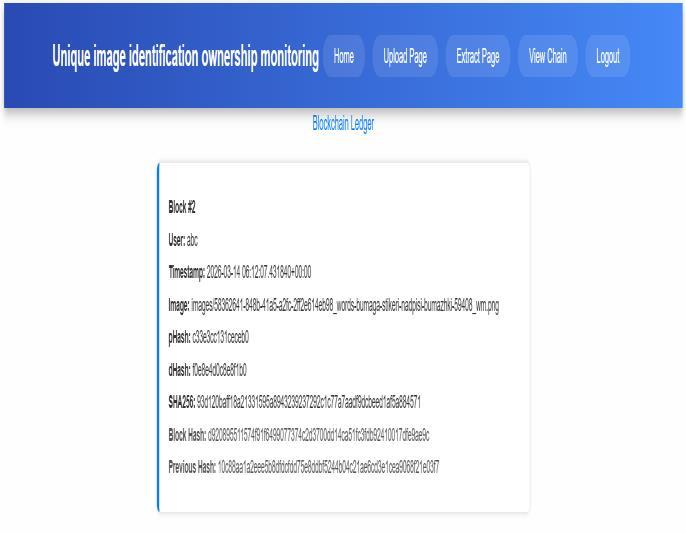
generated hash values and blockchain registration.
Thesystemdisplaysthegeneratedhashvaluesandconfirms that the image has been successfully registered in the blockchain ledger. This ensures that the image ownership dataispermanentlystoredandcannotbemodified.
The verification module allows users to upload a watermarked image to check its authenticity. During this process,thesystemextractstheembeddedwatermarkdata andretrievesthehashvalues.
The extracted values are then compared with the stored blockchain records. If the values match, the image is identifiedasauthentic.
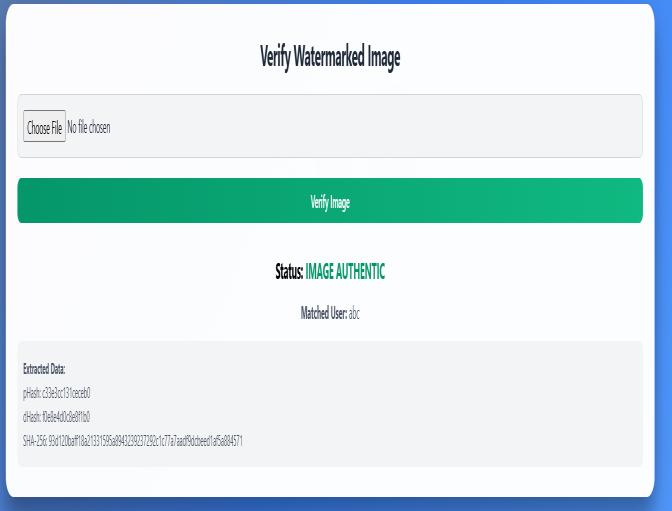
2: Image verification result showing that the uploaded image is authentic.
The system successfully identifies the original image and displays the matched user information along with the extractedhashvalues.Thisconfirmsthattheimagehasnot beenmodifiedsinceitsregistration.
To test the robustness of the proposed system, several modified images were used during verification. These modifications included cropping, pixel modification, and editingoperations.Whenatamperedimageisuploaded,the systemextractsthewatermarkinformationandcomparesit withtheblockchainrecords.Ifthewatermarkiscorrupted or the hash values do not match, the system detects the imageastampered.

Fig 3: Detection of a tampered image with invalid or corrupted watermark.
Thesystemcorrectlyidentifiesthemanipulatedimageand reports the reason for tampering. This demonstrates the effectiveness of the proposed system in detecting unauthorizedmodifications.
Volume: 13 Issue: 03 | Mar 2026 www.irjet.net
Theperformanceofthesystemwasevaluatedbasedonits ability to correctly identify authentic images and detect tamperedimages.
Althoughtheproposedsystemsuccessfullyensuressecure image ownership verification and tamper detection using blockchaintechnology,severalimprovementscanbemade to enhance its functionality and scalability in real-world applications.
One potential future enhancement is the integration of a distributedblockchainnetworkinsteadofalocalblockchain ledger.Inthecurrentsystem,theblockchainisimplemented usingaJSON-basedledger.Infuturework,thesystemcanbe integrated with public blockchain platforms such as Ethereum or Hyperledger, which will provide higher security,decentralization,andglobalaccessibility.
Another possible improvement is the implementation of smart contracts for automated ownership management. Smartcontractscanautomaticallyverifyownership,record transactions,andtrackthetransferofimagerightsbetween userswithouttheneedformanualintervention.
The results show that the system performs reliably in detectingimageauthenticityandpreventingunauthorized modifications.
Therapidgrowthofdigitalmediasharinghasincreasedthe riskofimagepiracy,unauthorizedmodification,andmisuse ofdigitalcontent.Ensuringtheauthenticityandownership of digital images has therefore become a significant challenge.Inthisresearchwork,asecuresystemforUnique Image Identification and Ownership Monitoring using Blockchainhasbeenproposedandimplementedtoaddress theseissues.
The proposed system integrates blockchain technology, cryptographic hashing, perceptual hashing, and digital watermarkingtechniquestocreateareliableframeworkfor protecting digital images. During the image registration process, unique hash values such as SHA-256, pHash, and dHasharegeneratedforeachimageandembeddedintothe imageashiddenwatermarkdata.Thesevalues,alongwith theownerinformation,arestoredinablockchainledgerto ensureimmutability,transparency,andtamper-resistance.
The experimental results demonstrate that the system successfullyverifiesauthenticimagesandaccuratelydetects tamperedimages.Whenthewatermarkdataextractedfrom an image matches the blockchain records, the image is identified as authentic. If the watermark is missing, corrupted, or the hash values do not match, the system detects the image as tampered. This approach ensures reliable image ownership verification and helps prevent unauthorizedmodifications.
The system can also be extended to support multiple multimediaformats,suchasvideos,audiofiles,anddigital documents. This would allow the system to provide comprehensive protection for different types of digital content.
Additionally, advanced machinelearning or deep learning techniques can be integrated to improve image similarity detectionandtamperidentification.Thesetechniquescan helpdetectmorecompleximagemanipulationsthatmaynot beeasilyidentifiedbytraditionalhashingmethods.
Anotherimportantfutureenhancementisthedevelopment ofalarge-scalecloud-baseddeploymentthatallowsmultiple usersandorganizationstoaccessthesystemsimultaneously. Thiswouldimprovescalabilityandmakethesystemsuitable forreal-worlddigitalmediamanagementplatforms.
Finally, the system can be enhanced by implementing strongerwatermarking techniquesand improvedsecurity mechanismstoprotecttheembeddeddatafromremovalor distortion during image processing operations such as compression,resizing,orfiltering.
Inconclusion,futureenhancementsfocusingondistributed blockchainintegration,smartcontracts,multimediasupport, and advanced image analysis techniques can further improve the efficiency, scalability, and security of the proposedimageownershipmonitoringsystem.
International Research Journal of Engineering and Technology (IRJET) e-ISSN: 2395-0056
Volume: 13 Issue: 03 | Mar 2026 www.irjet.net p-ISSN: 2395-0072
[1] S. Nakamoto, “Bitcoin: A Peer-to-Peer Electronic Cash System,”2008.[Online].Available: https://bitcoin.org/bitcoin.pdf
[2]A.M.Antonopoulos,MasteringBitcoin:UnlockingDigital Cryptocurrencies, 2nd ed. Sebastopol, CA, USA: O’Reilly Media,2017.
[3] J. Fridrich, Steganography in Digital Media: Principles, Algorithms, and Applications. Cambridge, U.K.: Cambridge Univ.Press,2009.
[4]M.K.JohnsonandH.Farid,“ExposingDigitalForgeries Through Chromatic Aberration,” in Proc. ACM Multimedia andSecurityWorkshop,Geneva,Switzerland,2006,pp.48–55.
[5]R.C.GonzalezandR.E.Woods,DigitalImageProcessing, 4thed.NewYork,NY,USA:Pearson,2018.
[6] N. Kshetri, “Blockchain’s Roles in Strengthening CybersecurityandProtectingPrivacy,”Telecommunications Policy,vol.41,no.10,pp.1027–1038,2017.
[7]A.Jain,K.Nandakumar,andA.Ross,“BiometricTemplate Security,”EURASIPJournalonAdvancesinSignalProcessing, vol.2008,pp.1–17,2008.
[8]Z.Zheng,S.Xie,H.Dai,X.Chen,andH.Wang,“Blockchain Challenges and Opportunities: A Survey,” International JournalofWebandGridServices,vol.14,no.4,pp.352–375, 2018.
2026, IRJET | Impact Factor value: 8.315 |