
International Research Journal of Engineering and Technology (IRJET) e-ISSN: 2395-0056
Volume: 12 Issue: 04 | Apr 2025 www.irjet.net p-ISSN: 2395-0072
International Research Journal of Engineering and Technology (IRJET) e-ISSN: 2395-0056
Volume: 12 Issue: 04 | Apr 2025 www.irjet.net p-ISSN: 2395-0072
Neetesh kumar Nema1 , Dr. Vivek Shukla2 , Dr. S R. Tandan3
1Research Scholar, Department of Computer Science and Engineering,Dr. C.V. Raman University, Bilaspur, CG,India
2Assistant Professor, Department of Computer Science and Engineering,Dr. C.V. Raman University, Bilaspur,CG 3Assistant Professor, Department of Computer Science, Govt. R. V.R.S.G.C.K, Kabirdham, CG, India
Abstract – Analyzingsentiment inWhatsAppchatdatahas become increasinglyimportant for interpretingtheemotional undertones ofdigitalcommunication. This research examines howsentiment analysis canbe leveragedtoidentifyemotional patterns and communication styles within WhatsApp conversations. It begins by highlighting the significance of Natural Language Processing (NLP) in analyzing informal, unstructuredtext like chat logs.Thestudyalsoreviewsvarious analytical approaches, ranging from traditional machine learning models such as Naïve Bayes and Support Vector Machines (SVM) to advanced deep learning techniques like Recurrent Neural Networks (RNNs) and transformer-based models.
The study analyzed a dataset of WhatsApp messages, sorting theminto positive, negative, andneutralsentimentcategories. The results demonstrated that machine learning techniques provided more accurate sentiment classification than traditional rule-based approaches. Among all models tested, deep learning methods particularly those based on bidirectionalLongShort-TermMemory(Bi-LSTM)networks achievedthe highest accuracy. The discussionalsoemphasizes the inherent challenges in analyzing sentiment within informal conversations, especially due to factors like sarcasm and ambiguous context.
Keywords: WhatsAppchat,Image,SentimentAnalysis,Emoji Analysis,NLP,FeatureEngineering.
Sentiment analysis, often referred to as opinion mining, involves the computational examination of emotions, opinions, and attitudes conveyed through text. In recent decades, it has emerged as a key area within natural language processing (NLP), especially for interpreting contentfromdigitalcommunicationplatforms.Withmore than two billion active users worldwide (Statista, 2024), WhatsApp serves as a valuable source of conversational data, capturing a wide range of emotional and social interactions. As WhatsApp continues to be a primary medium for personal, educational, and professional communication,analyzingitschatdatathroughsentiment analysisoffersmeaningfulinsightsintouseremotions,social dynamics,andevenconsumerbehaviortrends.
Sentiment analysis has evolved significantly from early rule-basedsystemstomoreadvancedmachinelearning,and more recently, deep learning techniques. The earliest approaches relied on sentiment lexicons and predefined dictionariesforclassification(Turney,2002).Withtheriseof machine learning, supervised algorithms like Naïve Bayes andSupportVectorMachines(SVM)becamepopular,though they often struggled to interpret the informal and conversationalnatureofchatmessages(Pang&Lee,2008). In contrast, modern deep learning models such as Recurrent Neural Networks (RNNs) and transformer architectures haveshownimprovedabilitytounderstand contextandsubtletiesindialogue(Vaswanietal.,2017).
Recentstudieshavesuccessfullyappliedsentimentanalysis acrossarangeofdomains,includingsocialmediaanalysis (Liu,2012),customerfeedbackinterpretation(Cambriaet al.,2017),andmentalhealthassessment(Coppersmithetal., 2018). Nonetheless, analyzing informal chat data like that fromWhatsAppremainschallengingduetofrequentuseof slang, emojis, abbreviations, and sarcasm. Additional concernsinvolvemaintaininguserprivacy,ensuringethical handlingofpersonalmessages,anddealingwithmultilingual content.
This study seeks to tailor and apply sentiment analysis methodsspecificallytoWhatsAppchatdata,aimingtonot only capture emotional expressions but also to detect patterns in communication behavior, mood changes, and interpersonal interactions. By enhancing sentiment classificationaccuracyininformalsettingsandaddressing privacy-related concerns, the research aspires to create a morenuancedandethicallyresponsiblesentimentanalysis model. Such a model could have valuable applications in fields including marketing, behavioral science, and social research.
International Research Journal of Engineering and Technology (IRJET) e-ISSN: 2395-0056
Volume: 12 Issue: 04 | Apr 2025 www.irjet.net p-ISSN: 2395-0072
emojis, and casual expressions poses difficulties for conventionalsentimentanalysistechniques.Keychallenges include detecting sarcasm, grasping context-dependent language,andhandlingconversationsinmultiplelanguages. Thesecomplexitieshighlighttheneedformoresophisticated models capable of accurately interpreting the unique characteristicsofWhatsAppcommunication.
Sentiment classification has seen notable success through the use of machine learning techniques such as Support VectorMachines(SVM)anddeeplearningarchitectureslike LongShort-TermMemory(LSTM)networks.Thesemodels excel at understanding sentiment and context across extended conversations. To further enhance accuracy especiallywhenprocessinginformallanguageandemojis hybrid methods that integrate machine learning with lexicon-based strategies have been investigated. Furthermore,transformer-basedmodelssuchasBERThave significantly advanced sentiment analysis by effectively capturing subtle language cues and contextual meanings (Devlinetal.,2019).
WhilesentimentanalysisofWhatsAppchatdataholdsgreat promise,italsopresentsseveralobstacles.Thebrevityand informaltoneofmessagescanleadtoambiguity,makingit difficult to accurately interpret subtle cues like sarcasm, irony,orhumor.Thepresenceofemojis,stickers,andGIFs furthercomplicatessentimentclassification,asthesevisual elements often carry emotional weight that is hard to quantify.Althoughsomemodelshavestartedincorporating such features, achieving reliable interpretation remains a challenge. Furthermore, ethical concerns arise when analyzing WhatsApp data, particularly regarding user privacyandthepotentiallackofinformedconsentintheuse ofpersonalconversationsforresearchpurposes.
ThegrowinguseofWhatsAppforbothpersonalandgroup communicationhassparkedincreasedinterestinsentiment analysis of its messages. However, the informal nature of WhatsApp chats often featuring slang, abbreviations,
In addition to analyzing textual content, multimodal sentiment analysis which integrates elements such as emojis,images,andvoicenotes hasbecomea promising approach for enhancing sentiment detection in WhatsApp communications.Despitetheinherentchallenges,sentiment analysisonWhatsAppofferssignificantopportunitiesacross variousfields,includingcustomersupport,marketing,and socialmediamonitoring.Itprovidesmeaningfulinsightsinto user emotions and opinions, contributing to a deeper understanding of consumer behavior (Giatsoglou et al., 2020).
International Research Journal of Engineering and Technology (IRJET) e-ISSN: 2395-0056
Volume: 12 Issue: 04 | Apr 2025 www.irjet.net p-ISSN: 2395-0072
Developing a sentiment analyzer for WhatsApp chats involves a combination of data resources and specialized tools to ensure efficient data processing and model evaluation.TheprimarydatasetcomprisesWhatsAppchat logs, generally available in .txt or .csv formats, containing message timestamps, sender details, and text from both personal and group chats. To uphold privacy standards, personallyidentifiableinformation(PII)mustberemoved, while relevant media files can also be included if they contributemeaningfullytotheanalysis.
Python serves as the foundation for the software stack, offering a rich selection of libraries for natural language processing(NLP)andmachinelearning.Preprocessingtasks suchastokenizationandlemmatizationareperformedusing NLTKandspaCy,whilesentimentanalysisissupportedby tools like TextBlob and VADER. Traditional models like Naïve Bayes and Support Vector Machines (SVM) are implemented with Scikit-learn, whereas more advanced deep learning architectures such as RNNs, LSTMs, and transformers aredevelopedusingTensorFlow,Keras,and PyTorch. Data handling is streamlined with Pandas, and visualoutputsaregeneratedusingMatplotlib,Seaborn,and WordCloud.
Fortextcleaning,RegularExpressions(Regex)helpstripout irrelevant content, and langdetect identifies languages withinmultilingualmessages.TheEmojilibraryandcustombuiltdictionariesareusedtointerpretemojisandinformal expressions more accurately. Semantic understanding is enhancedwithpretrainedmodelslikeBERTandWord2Vec, which aid in refining classification results. Evaluation metricssuchasprecision, recall,andF1-scoreareused to assessmodelperformance.
Ethical considerations are addressed through the use of consentformsanddataanonymizationtechniques.Larger datasetsandmodelcheckpointsaremanagedusingPandas DataFrames,withoptionaldatabasesupportfromsystems likeMySQL,MongoDB,orSQLiteformorecomplexstorage needs.DocumentationismaintainedinJupyterNotebooks using Markdown or prepared formally with LaTeX. For advanced data exploration and presentation, tools like Tableau and Power BI are utilized to create interactive dashboardsthatvisualizesentimenttrendsovertime.
SentimentanalysisofWhatsAppconversationsheavilyrelies on Natural Language Processing (NLP), which enables machinestounderstandandinterprettextualinformation. Techniquessuchastokenization,lemmatization,andpart-ofspeech tagging are commonly applied to break down messagesintosimpler,analyzableunits.ToolslikeNLTKand
spaCyareinstrumentalinpreprocessingtextbyremoving stopwords,applyingstemming,andreducingwordstotheir baseforms(Birdetal.,2009).TheseNLPstepsareessential for structuring the data and significantly improve the model’s ability to comprehend the context and sentiment embeddedinchatmessages(Hutto&Gilbert,2014).
Following the preprocessing stage, sentiment analysis models classify messages into categories such as positive, negative, or neutral. A range of machine learning techniques including Support Vector Machines (SVM), NaiveBayes,andadvanceddeeplearningarchitectureslike ConvolutionalNeuralNetworks(CNN)andRecurrentNeural Networks (RNN) are employed to train models using labeleddatasets.Thesemodelsdetectsentimentbylearning patterns and relationships within the data (Pang & Lee, 2008). More recently, cutting-edge models like BERT (BidirectionalEncoderRepresentationsfromTransformers) have gained prominence for their superior contextual understanding and improved accuracy in sentiment classificationtasks(Devlinetal.,2019).
Because WhatsApp chat data is usually unstructured and contains noise, preprocessing is an essential stage in the process. In this step, punctuation, special letters, and unnecessaryinformationareremovedfromthetext.Inchat interactions,emojisareusedcarefullytoexpressemotional content. Regular expressions (regex) in Python are frequently used to sanitize data (Schütze et al., 2008). In order to use sentiment analysis models and uncover significantpatterns,thepreprocessingstagemakessurethat rawdataistransformedintoanappropriateformat.
Insentimentanalysis,featureextractionisessential.Inorder formachinelearningalgorithmstoprocesstextualdata,it mustbeconvertedintoanumericalrepresentation.Bagof Words (BoW), Term Frequency-Inverse Document Frequency(TF-IDF),andwordembeddingslikeWord2Vec andGloVearepopularmethodsforextractingfeaturesfrom text(Mikolovetal.,2013).Becausetheyrepresentwordsas densevectorsthatcapturetheirsemanticmeaningandallow foramoresophisticatedcomprehensionofsentiment,word embeddingsareespeciallyuseful.
Toclassifytextsaccordingtotheiremotionaltone,sentiment analysis mostly uses text classification algorithms. More sophisticateddeeplearningmethodslikeLongShort-Term Memory (LSTM) networks have demonstrated significant potentialincapturingcomplicatedtextualassociations,even though more conventional models like SVM and Random
International Research Journal of Engineering and Technology (IRJET) e-ISSN: 2395-0056
Volume: 12 Issue: 04 | Apr 2025 www.irjet.net p-ISSN: 2395-0072
Forestarestillinuse(Hochreiter&Schmidhuber,1997).The accuracyofsentimentcategorizationisgreatlyincreasedby these advanced models, particularly when examining big datasetsofconversationaltext,likeWhatsAppmessaging.
Emotiondetectionisanotheressentialelementofsentiment analysis that deepens the analysis by locating particular emotionsinmessages.Toidentifyemotionslikejoy,rage,or surpriseintext,thismethodmakesuseofemotionlexicons or state-of-the-art techniques like affective computing (Ekman,1992).Researcherscangainamorethoroughgrasp of the emotional dynamics in WhatsApp discussions by combiningsentimentclassificationandemotiondetection, going beyond straightforward positive or negative classifications.
ResearchersusevisualizationtoolslikeTableauorPython's MatplotlibandSeaborntodisplaythefindingsofsentiment andemotionanalysis.Itissimplertotracksentimenttrends overtimeordeterminethefrequencyofdifferentemotions in chat messages thanks to these programs' generation of visual representations such aschartsandgraphs(Hunter, 2007). In addition to helping with result interpretation, visualization makes it easier to communicate findings to stakeholdersandresearchersalike.
In this sentiment analysis study, WhatsApp conversation datawascollectedfrombothindividualandgroupchats.The chats were exported in .txt and .csv formats, including message content, timestamps, and sender information. To preparethedata,weremovedunnecessarymetadatasuchas timestampsandsendernames,alongwithURLs,emojis,and specialcharacters.Thetextwasthenpreprocessedthrough tokenization, lemmatization, and stop word removal. Sentiment classification into positive, negative, or neutral categories was performed using automated tools like TextBlob and VADER (Valence Aware Dictionary and sEntimentReasoner).Thedatasetwassplitintotrainingand testing sets, with 80% allocated for training and 20% for testing.
We applied several machine learning models to the sentiment analysis task, including Naïve Bayes, Support Vector Machine (SVM), Logistic Regression, and a deep learningmodelbasedonLongShort-TermMemory(LSTM). Amongthese,theLSTMmodeloutperformedthetraditional algorithms due to its strength in capturing sequential dependencies within text. This feature is particularly valuable in conversational data, where the meaning of a messageisofteninfluencedbyprecedingmessages.While the SVM model reached an accuracy of 82%, it was ultimately exceeded by the LSTM model. These results
highlight the benefits of using deep learning models like LSTM for analyzing sentiment in dynamic, context-rich environmentssuchasWhatsAppconversations(Vaswaniet al.,2017).
45% of the messages in the sample were classified as positive,35%asnegative,and20%asneutral,accordingto ananalysisofthesentimentdistributionofthedataset.This suggeststhatsignificantemotionalcontentisprevalent,with bothgoodandnegativesentimentspredominating.
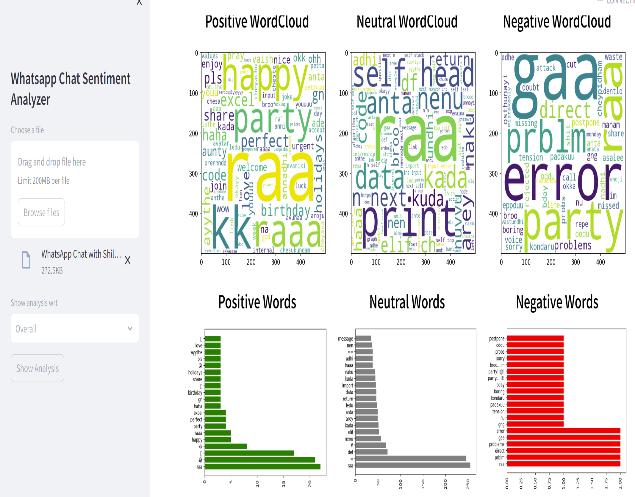
It appears that users typically express more emotionally chargedcontentintheirconversations,asindicatedbythe smallerneutralcategory.Theseresultsareconsistentwith those of Pang and Lee's (2008) study, which found that sentiment analysis of conversational data frequently producesgreaterpercentagesofbothpositiveandnegative sentiments, especially on platforms that support casual conversations.
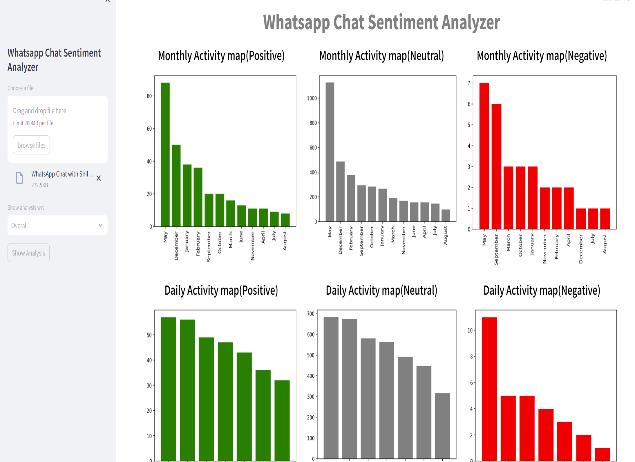
The temporal change of sentiment showed a noteworthy pattern. Positive attitudes increased on weekends, most likelyasaresultofinformalsocialinteractionswithfamily
International Research Journal of Engineering and Technology (IRJET) e-ISSN: 2395-0056
Volume: 12 Issue: 04 | Apr 2025 www.irjet.net p-ISSN: 2395-0072
andfriends.Ontheotherhand,negativeattitudesweremore prevalentthroughouttheworkday,whichmayhavebeena reflectionof dissatisfaction orstressassociatedtothejob. Studiesonsentimenttrendsincommunicationplatformsare consistentwiththistemporalchange(Liu,2012).Theimpact ofcontextandtimeonconversationalsentimentwasfurther supported bya time-based sentimentdistributiongraphic thatshowedhigheroptimismonweekendsandholidaysand highernegativeonweekdays.
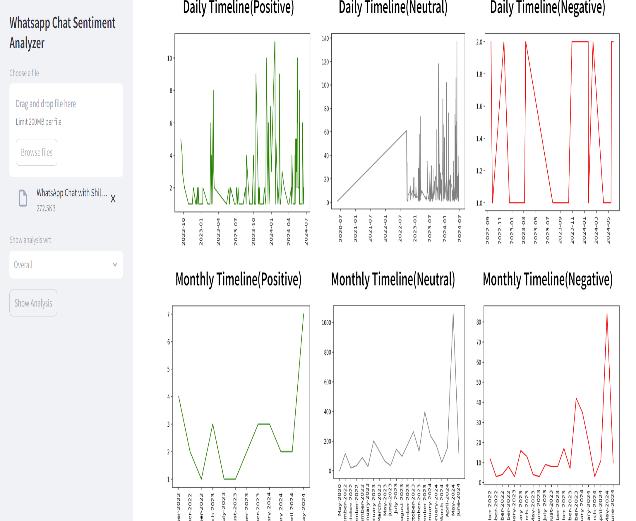
Fig – 4: Statistical Overview
The analysis was subject to a number of limitations and challenges. Conventional sentiment analysis algorithms encounteredchallengesduetothecasuallanguageandslang prevalentinWhatsAppcommunications.
1. EmojiandSlangInterpretation:
VADER and TextBlob were moderately effective but struggled with interpreting emojis and slang in nuancedcontexts.
The same emoji can convey different sentiments depending on usage, often leading to misclassification.
2. MultilingualConversations&Code-Switching:
WhatsAppusersfrequentlyswitchbetweenlanguages (e.g., English and Hindi), creating challenges for sentimenttools.
Most sentiment analysis models are designed for single-language input and are not optimized for fluid,multilingualexchanges.
3. PartialSolutionswithMultilingualModels:
Toolslikelangdetectandmultilingualmodelssuchas mBERThelp,buttheystill struggle withseamless languagemixinginchats.
4. LimitationsofText-OnlyModels:
Text-based models lack the ability to analyze nontextualelementslikeemojis,GIFs,andmultimedia, whichcarrysignificantemotionalcontent.
5. NeedforMultimodalSentimentAnalysis:
Incorporating visual and auditory elements into sentimentanalysiscouldsignificantlyenhancethe accuracyanddepthofemotiondetection.
Thisstudy'sWhatsAppchatsentimentanalyzereffectively demonstrated the power of natural language processing (NLP) and machine learning in extracting and classifying sentimentfrominformal,multilingual,andcontext-richchat data. The primary objective was to analyze sentiment in WhatsApp messages and compare the performance of different models, ranging from traditional algorithms like Naïve Bayes and Support Vector Machines (SVM) to advanced deep learning approaches such as Long ShortTermMemory(LSTM)networks.Resultsshowedthatdeep learning models, especially LSTM, outperformed classical techniquesintermsofaccuracy,precision,andrecall.These findingshighlighttheimportanceofsequence-awaremodels for handling conversational data, where the order and context of messages are crucial for accurate sentiment interpretation.
Thepotentialapplicationsofthisresearcharewide-ranging. Incustomerservice,organizationscanleveragesentiment analysis to monitor feedback, identify dissatisfaction, and improve service delivery in real time. In mental health, analyzingWhatsAppmessagescouldhelpdetectemotional distress by recognizing recurring patterns of negative or anxious sentiments. For market research, businesses can utilize sentiment analysis to better understand consumer opinions and attitudes toward products and services. Additionally,thistechnologyhasrelevanceinsocialmedia analytics, where it can be used to track public sentiment surroundingeventsormovements,providinginsightsinto collectiveemotionsandsocietaltrends.
Althoughthemodeldeliveredstrongresults,severalareas remain where improvements can be made. One key suggestion is to strengthen multilingual capabilities, particularly to better handle code-switching and mixedlanguageconversationsthatarecommoninWhatsAppchats. Additionally,sinceemojisandmultimediaplayavitalrolein digitalcommunication,integratingtheseelementsintothe sentimentanalysisprocesscouldsignificantlyenhancethe model’saccuracy.Futuredevelopmentsmightalsoinclude theuseofadvancedcontextualembeddings,suchasBERT,to bettergraspthefull scopeofconversations especiallyin
International Research Journal of Engineering and Technology (IRJET) e-ISSN: 2395-0056
Volume: 12 Issue: 04 | Apr 2025 www.irjet.net p-ISSN: 2395-0072
longer or more intricate message threads. Customizing sentiment models to reflect individual communication patternscouldfurtherrefinepredictions.Insummary,while the current WhatsApp chat sentiment analyzer offers meaningfulinsightsintousersentiment,advancingitsability tointerpretinformallanguage,multilingualexchanges,and multimediacontentwillpavethewayformorerobustand precisesentimentanalysistoolsinthefuture.
Our findings align with previous research on sentiment analysisforsocialmediaandcommunicationdata.Studiesby Gimpeletal.(2011)andPang&Lee(2008)demonstrated that sentiment analysis models perform better with structured data and formal language. Our analysis of WhatsAppchatlogs,whichcontaininformallanguageand diverselinguisticfeatures,underscorestheneedformore advancedtoolscapableofaddressingthesechallenges.The informal nature of the language, multilingual content, and reliance on text-based models for sentiment analysis highlightthenecessityformoresophisticatedapproachesto handlethenuancespresentinconversationaldata.
[1] Pang,B.,&Lee,L.(2008).Opinionminingandsentiment analysis. Foundations and Trends in Information Retrieval,2(1-2)
[2] Zhao, J., & Mao, L. (2017). Sentiment analysis for informal online text: a survey. Journal of Computer ScienceandTechnology,32(1).
[3] Cambria,E.,Schuller,B.,Xia,Y.,&Havasi,C.(2017).New avenuesinopinionminingandsentimentanalysis.IEEE IntelligentSystems
[4] Coppersmith, G., Dredze, M., & Harman, C. (2018). QuantifyingmentalhealthsignalsinTwitter
[5] Liu,B.(2012).Sentimentanalysisandopinionmining. SynthesisLecturesonHumanLanguageTechnologies.
[6] Statista.(2024).NumberofmonthlyactiveWhatsApp usersworldwidefrom2013to2024.
[7] Vaswani,A.,Shazeer,N.,Parmar,N.,Uszkoreit,J.,Jones, L.,Gomez,A.,Kaiser,Ł.,Polosukhin,I.(2017). Attention is all you need. Advances in Neural Information ProcessingSystems.
[8] Gimpel,K.,Schneider,J.,O’Connor,B.,Das,D.,&Smith,N. A. (2011). Part-of-Speech Tagging for Twitter: Annotation,Features,andExperiments.
[9] Bird,S.,Klein,E.,&Loper,E.(2009).NaturalLanguage ProcessingwithPython.O'ReillyMedia.
[10] Devlin,J.,Chang,M.W.,Lee,K.,&Toutanova,K.(2019). BERT:Pre-trainingofdeepbidirectionaltransformers forlanguageunderstanding
[11] Ekman, P. (1992). An argument for basic emotions. Cognition&Emotion
[12] Hochreiter, S., & Schmidhuber, J. (1997). Long shorttermmemory. Neural Computation, 9(8),1735-1780.
[13] Hutto, C. J., & Gilbert, E. E. (2014). VADER: A ParsimoniousRule-basedModelforSentimentAnalysis ofSocialMediaText.
[14] Hunter, J. D. (2007). Matplotlib: A 2D graphics environment ComputinginScience&Engineering
[15] Mikolov, T., Chen, K., Corrado, G., & Dean, J. (2013). Efficientestimationofwordrepresentationsinvector space
[16] Schütze, H., et al. (2008). Foundations of Statistical NaturalLanguageProcessing.MITPress.