International Research Journal of Engineering and Technology (IRJET) e-ISSN: 2395-0056
Volume: 13 Issue: 04 | Apr 2026 www.irjet.net p-ISSN: 2395-0072

International Research Journal of Engineering and Technology (IRJET) e-ISSN: 2395-0056
Volume: 13 Issue: 04 | Apr 2026 www.irjet.net p-ISSN: 2395-0072
V. Dass Mohan¹, K. Niraikula Sekaran², Dr. P. Satheesh Kumar³, A. Abima⁴, J. Jumail4, R. Jeevan Sasi4, R. Kavi Raj4
¹ Assistant Professor and Head of Department, Department of Agricultural Engineering, Mohamed Sathak Engineering College, Tamilnadu, India.
² Assistant Professor, Department of Civil Engineering, Mohamed Sathak Engineering College, Tamilnadu, India.
³ Professor and Head of Department, Department of Civil Engineering, Mohamed Sathak Engineering College, Tamilnadu, India.
⁴ UG Student, Department of Civil Engineering, Mohamed Sathak Engineering College, Tamilnadu, India.
ABSTRACT
Concrete is the most widely used construction material in modern infrastructure due to its strength, durability, and economicadvantages.However,itishighlypronetocracking causedbyshrinkage,thermalvariations,andexternalloads, which significantly reduces its service life and structural performance. Cracks allow the penetration of water and aggressivechemicals,leadingtoreinforcementcorrosionand long-term deterioration. To address these challenges, this study presents the development of Triple Action Living Concrete, an innovative material designed to enhance strength, durability, and self-healing capability. This approach integrates fish flakes powder, coir fiber, and bacteria into the concrete matrix. Fish flakes powder, a protein-rich waste material, acts as a natural binding enhancer that improves compressive strength. Coir fiber, a biodegradablenaturalfiber,enhancesflexuralstrengthand controls crack propagation by improving ductility. The inclusion of bacteria, particularly Bacillus species, enables autonomous crack healing through microbiologically inducedcalciumcarbonateprecipitation.Whencracksform, the bacteria become active in the presence of moisture and producecalcite,effectivelysealingthe cracks. Experimental results indicate that the combined use of these materials significantly improves compressive strength, flexural performance, and crack-healing efficiency compared to conventional concrete. Moreover, this method promotes sustainability by utilizing eco-friendly and waste-derived materials.Thedevelopedtripleactionlivingconcreteoffersa cost-effectiveanddurablesolutionforlong-lastingconcrete roads, reducing maintenance requirements and enhancing infrastructure lifespan.
Key Words: Self-healing concrete, Bacterial concrete, Coir fiber, Fish flakes powder, Sustainable construction, Triple action concrete, Bacillus bacteria, Calcite precipitation
Concreteplaysavitalroleintheconstructionindustryand is extensively used in infrastructure such as buildings, bridges,andhighways.Despiteitswidespreaduse,concrete has an inherent weakness in tension, making it highly susceptible to cracking. These cracks may occur due to plastic shrinkage, drying shrinkage, thermal stresses, or appliedloads.Overtime,crackscanwidenandpermitthe ingressofwater,chlorides,andotherharmfulsubstances, leadingtosteelcorrosionandstructuraldegradation.
To improve the durability and performance of concrete, variousadvancedtechnologieshavebeendeveloped,among whichself-healingconcretehasgainedsignificantattention. Self-healingconcretehastheabilitytorepairitsowncracks without the need for external maintenance, thereby increasingservicelifeandreducingrepaircosts.Oneofthe most effective methods involves the use of bacteria that precipitate calcium carbonate, which fills cracks and restoresstructuralintegrity.
Inadditiontobiologicaltechniques,theuseofnaturalfibers andorganicadditiveshasproveneffectiveinenhancingthe mechanicalpropertiesofconcrete.Coirfiber,derivedfrom coconuthusk,isaneco-friendlymaterialwithhightensile strength that improves flexural behavior and crack resistance. Similarly, fish flakes powder, a waste-derived material,enhancesbondingwithintheconcretematrixand contributestoimprovedcompressivestrength.
International Research Journal of Engineering and Technology (IRJET) e-ISSN: 2395-0056
Volume: 13 Issue: 04 | Apr 2026 www.irjet.net p-ISSN: 2395-0072
ThisstudyintroducesanovelconceptknownasTriple Action Living Concrete, which combines fish flakes powder,coirfiber,andbacteriatoachieveasynergistic effect.Theintegrationofthesematerialsenhancesboth strengthandself-healingcapability,makingtheconcrete more durable and sustainable. This research aims to develop an efficient, eco-friendly, and cost-effective solutionsuitableformodern construction, particularly for concrete roads where durability and reduced maintenanceareessential.
Conventional concrete has low tensile strength and is vulnerabletocracking.Oncecracksform,theyallowwater andchloridestopenetrate,causingreinforcementcorrosion andstructuraldeterioration.Repairandmaintenanceof cracked concrete structures are expensive and timeconsuming.Thereisaneedforasustainable,cost-effective solution that can prevent crack propagation and automaticallyrepaircracksastheyform.
Theconstructionindustryisconstantlyseekinginnovative materialsthatcanimprovetheperformanceandlongevity of concrete structures. Self-healing concrete offers a promising solution to the cracking problem. By incorporatingwastematerialslikefishflakesandnatural fiberslikecoir,thisstudyalsoaddressesenvironmental concerns related to waste disposal. The use of locally available, eco-friendly materials makes this technology accessibleandaffordablefordevelopingcountries.
The novelty of this research lies in the combination of three different mechanisms - biological self-healing (bacteria),fiberreinforcement(coir),andorganicmicrofilling (fish flakes) - in a single concrete mix. While individual studies have investigated these components separately,thesynergisticeffectofallthreetogetherhas notbeenthoroughlyexplored.Thistripleactionapproachis expectedto provide superior performance compared to anysingleadditivealone.
Self-healing concrete has been extensively studied over the past two decades. Various approaches have been developed,includingautogenoushealing,capsule-based healing, vascular healing, and bacteria-based healing. Amongthese,bacteria-basedself-healinghasshownthe mostpromisingresultsduetoitslong-termeffectiveness
andcompatibilitywithcementitiousmaterials.
BacteriasuchasBacillusspeciesproduceureaseenzymes that catalyze the hydrolysis of urea into carbonate and ammoniumions.Thesecarbonateionsreactwithcalcium ions present in the concrete to form calcium carbonate (calcite) crystals. The calcite precipitates within cracks, effectivelysealingthemandpreventingfurtheringressof waterandharmfulsubstances.Themostcommonlyused bacteria include Bacillus pasteurii, Bacillus subtilis, and Bacillusmegaterium.
Jonkers (2011) demonstrated that bacteria-based healing significantly increases durability. Achal et al. (2011) reportedthatmicrobialconcretecanenhance the durability of building structures. Ramachandran (2001)firstintroducedtheconceptofusingbacteriafor remediationofconcretecracks.
Coir fiber is a natural, renewable, and biodegradable material obtained from coconut husks. It has high tensile strength, good elongation properties, and excellentresistancetorotting.Whenaddedtoconcrete, coir fiber helps in controlling crack formation and propagation.Itimprovesthepost-crackingbehaviorof concrete and increases its toughness and ductility. Studieshaveshownthatcoirfibercanreducethewidth ofmicro-cracksandpreventthemfromdevelopinginto macro-cracks.
Alhozaimy (1996) studied the effect of fiber reinforcement on concrete properties. Li (2018) investigatedcoirfiberreinforcedconcreteproperties and reported significant improvement in flexural behavior.
Fishwaste,includingfishscalesandflakes,isamajor environmental problem in coastal areas. Fish flakes contain high amounts of protein and calcium. When groundintopowderform,theycanactasabio-based filler in concrete. The protein content helps in improving the bonding between cement paste and aggregates, while the calcium content contributes to theformationofadditionalcalciumsilicatehydrate(CS-H)gel.Thisresultsinimprovedcompressivestrength andreducedporosity.
International Research Journal of Engineering and Technology (IRJET) e-ISSN: 2395-0056
Volume: 13 Issue: 04 | Apr 2026 www.irjet.net p-ISSN: 2395-0072
Ganesan (2015) studied the utilization of waste materialsinconcrete.Theuseoffishby-productshas been shown to enhance sustainability and filler properties.
2.5 Research Gap
Whileindividualstudieshaveinvestigatedtheeffectsof bacteria,coirfiber,andfishflakesseparately,veryfew studieshaveexaminedthecombinedeffectofallthree materialsinasingleconcretemix.Thesynergisticeffect of combining bacterial self-healing with fiber reinforcement and organic filler has not been thoroughlyexplored.Thisstudyaimstofillthisresearch gap by developing and testing a Triple Action Living Concrete.
3.1 Scope of the Study
Thescopeofthisstudyincludesthefollowingaspects:
▪ UsefishflakespowderandcoirfiberasecofriendlyadmixturesinM25gradeconcrete
▪ Study the effectiveness of Bacillus bacteria forselfhealingofcracks
▪ Analyzethecombinedeffectoffibers,bacteria, andorganicfilleronmechanicalproperties
▪ ComparetheperformanceofTripleAction concretewithconventionalconcrete
▪ Evaluate crack healing efficiency at 7, 14, and 28days
3.2 Limitations of the Study
ThisstudyislimitedtoM25gradeconcrete.Thefishflakes powderpercentagesarerestrictedto5%,10%,and15%. Coirfiberisaddedatafixedpercentageof1%byweight ofcement.Thebacteriaconcentrationiskeptconstantas per standard literature. Long-term durability studies beyond28daysarenotincludedinthisstudy.
3.3 Objectives
Theprimaryobjectivesofthisresearchare:
▪ To develop an eco-friendly and economical concreteusingwastematerials
▪ To improve compressive strength, flexural strength, and split tensile strength using triple actionmaterials
▪ ToevaluatecrackhealingefficiencyusingBacillus bacteria
▪ To reduce maintenance costs in road
constructionthroughself-healingtechnology
▪ Topromotesustainableconstructionpracticesby utilizingindustrialandagriculturalwaste
4.1 Materials Used
4.1.1 Cement
OrdinaryPortlandCement(OPC53grade)isuseddueto itshighstrengthandavailability.Thecementconformsto IS12269andhasaspecificgravityof3.15.
4.1.2 Fine Aggregate
Locally available river sand conforming to IS 383 standardsisused.The sand passesthrough4.75mmIS sieve,hasaspecificgravityof2.65,andfinenessmodulus of2.8.
4.1.3 Coarse Aggregate
Crushedgranitestonesofsize20mmareused.Thecoarse aggregate has a specific gravity of 2.75 and water absorptionof0.8%.
4.1.4 Fish Flakes Powder
Fishwasteisprocessedintopowderform.Fishflakes were collected from local fish markets, washed thoroughlytoremoveimpurities,driedinsunlightfor 48hours,andgroundintofinepowderusingaballmill. The powder passes through 90-micron sieve. It improvesdensityandcompressivestrengthbyfilling micro-voids.
4.1.5 Coir Fiber
Natural coir fibers (length 20-30 mm) are added to enhancecrackresistanceandductility.Coirfiberwas obtainedfromlocalcoconutprocessingunits,cleaned, dried,andcuttotherequiredlength.
4.1.6 Bacteria (Bacillus Species)
Bacteriacapableofprecipitatingcalciumcarbonateare used.Bacilluspasteuriiwasculturedinthelaboratory using nutrient broth medium. The bacterial concentrationwasmaintainedat10^8cells/ml.These bacteria remain dormant and activate when cracks occur.
4.1.7 Water
PotablewaterconformingtoIS456wasusedformixing
International Research Journal of Engineering and Technology (IRJET) e-ISSN: 2395-0056
Volume: 13 Issue: 04 | Apr 2026 www.irjet.net p-ISSN: 2395-0072
andcuringofconcretespecimens.
4.2
ConcretemixwasdesignedforM25gradeasperIS 10262:2019.Themixproportionforordinaryconcrete was 1:1.5:3 with water-cement ratio of 0.45. For modifiedmixes,fishflakespowderwasaddedat5%, 10%, and 15% by weight of cement. Coir fiber was added at 1% by weight of cement. Bacterial solution wasusedaspartialreplacementofmixingwater. Thefollowingmixeswereprepared:
1.Ordinaryconcrete(controlmix)
2.Fish5%+Coir1%+Bacteria
3.Fish10%+Coir1%+Bacteria(Optimummix)
4.Fish15%+Coir1%+Bacteria
5.Fish10%alone
6.Coir1%alone
7.Bacteriaalone
Concretewasmixedusingatiltingdrummixer.Cement, fine aggregate,andcoarse aggregate were dry mixed for2minutes.Fishflakespowderandcoirfiberwere added and mixed for another 2 minutes. Water and bacterialsolutionwereaddedgraduallywhilemixing. The fresh concrete was poured into molds and compactedusingavibratingtable.
Specimenswerecastinthefollowingsizes:
▪ Compressivestrength:150mmx150mmx 150mmcubes
▪ Flexural strength: 100mm x 100mm x 500mmbeams
▪ Splittensilestrength:150mmdiameterx 300mmcylinders
Aftercasting,specimenswerekeptatroomtemperature for 24 hours and then demolded. Curing was done in normal waterat27°C± 2°C forperiodsof7,14, and28 days.
4.5 Testing Methods
4.5.1 Compressive Strength Test
CompressivestrengthwasdeterminedasperIS516:1959 usinga compressiontestingmachine(CTM) of2000kN capacity. Three specimens were tested for each mix at eachcuringage,andtheaveragevaluewasreported.
4.5.2
FlexuralstrengthwasdeterminedasperIS516:1959using thecenter-pointloadingmethod.Beamspecimensofsize 100mm x100mmx500mmweretestedusingaflexural testingmachine.
4.5.3
SplittensilestrengthwasdeterminedasperIS5816:1999. Cylinder specimens were placed horizontally between loading plates, and compressive load was applied until failure.
Artificial cracks of 0.3 mm width were induced in specimensafter28daysofcuringusingacrackinducing machine. Cracked specimens were kept in water and observedunderamicroscopeat7,14,and28days.Crack healing efficiency was calculated as the percentage reductionincrackwidth.
5.1 Compressive Strength (MPa) – Combined Mix
Table 1: Compressive Strength Results
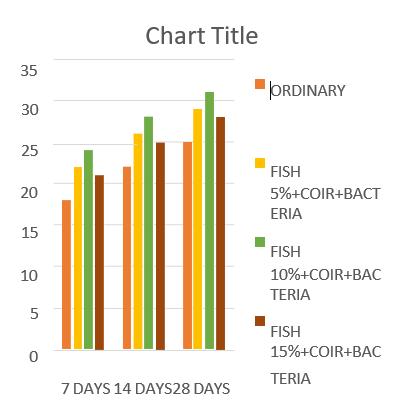
Fromtheresults,itisobservedthattheoptimummix (Fish 10% + Coir + Bacteria) achieved the highest compressive strength of 31 MPa at 28 days, which is 24% higher than ordinary concrete (25 MPa). The improvementisattributedtothecombinedeffectoffish flakes powder acting as a micro-filler, coir fiber providing crack resistance, and bacteria producing calcitethatfillsmicro-pores.
Thefishflakespowderfillsthevoidsbetweencement particles, resulting in a denser microstructure. The protein content in fish flakes improves the bond between cement paste and aggregates. The bacteria
International Research Journal of Engineering and Technology (IRJET) e-ISSN: 2395-0056
Volume: 13 Issue: 04 | Apr 2026 www.irjet.net p-ISSN: 2395-0072
producecalciumcarbonatewhichfurtherdensifiesthe matrix and fills microcracks. Coir fiber helps in controlling crack propagation under compressive loading.
5.2 Flexural Strength (MPa) – Combined Mix
Table 2: Flexural Strength Results
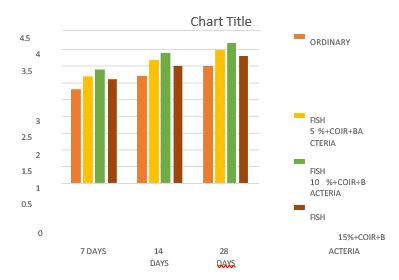
Theoptimummixachievedaflexuralstrengthof4.2MPa at28days,whichis20%higherthanordinaryconcrete (3.5 MPa). The coir fiber plays a significant role in improvingflexuralstrengthbybridgingacrosscracksand transferring tensile stresses. The fiber acts as reinforcement,preventingsuddenfailureandproviding post-crackingductility.
5.3 Split Tensile Strength (MPa) – Combined Mix
Table 3: Split Tensile Strength Results
7DAYS14DAYS28DAYS CTERIA
International Research Journal of Engineering and Technology (IRJET) e-ISSN: 2395-0056
Volume: 13 Issue: 04 | Apr 2026 www.irjet.net p-ISSN: 2395-0072
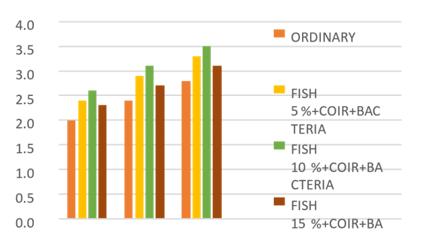
Theoptimummixachievedasplittensilestrengthof3.5MPa at28days,whichis25%higherthanordinaryconcrete(2.8 MPa).Similartoflexuralstrength,thecoirfibercontributes significantlytosplittensilestrengthby providingbridging actionacrossthesplittingplane
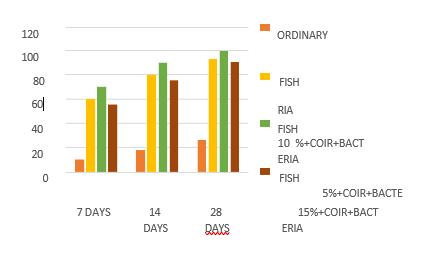
5.4 Crack Healing Efficiency (%) – Combined Mix
Mix (Combined) 7 Days 14 Days 28 Days Ordinary 10 18 26
Fish5%+Coir+ Bacteria 60 80 93
Fish10%+Coir+ Bacteria(OPTIMUM) 70 90 100
Fish15%+Coir+ Bacteria 55 75 90
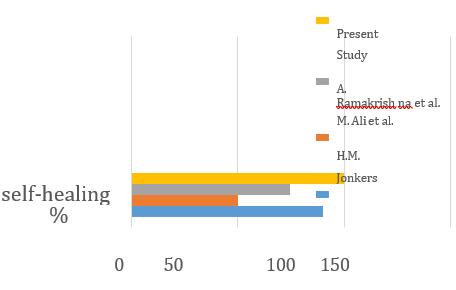
The optimum mix achieved 100% crack healing at 28 days. This indicates complete sealing of cracks. Microscopic examination revealed white calcium carbonate deposits filling the cracks in bacteriacontaining mixes. The bacteria alone mix alsoshowed excellent healing, but the combined mix achieved the bestoverallperformance.
5.4 Discussion
Fish flakes improved compressive strength due to enhanced bonding and micro-filler action. The protein content in fish flakes enhances the adhesion between cement paste and aggregates, resulting in a denser microstructurewithreducedporosity.
Coir fiber increased flexural strength and reduced crack propagation. The fiber acts as a bridge across cracks, transferringtensilestressesandpreventingsuddenfailure.
Thenaturalroughnessofcoirfiberprovidesgoodbonding withthecementmatrix.
Bacteria enabled self-healing of cracks through calcite formation.Whencracksform,waterentersandactivates thedormantbacteria.Thebacteriametabolizenutrients andproducecalciumcarbonatecrystalsthatfillthecrack volume.
Thecombinedmixshowedmaximumoverallperformance becauseofthesynergisticeffectofallthreemechanisms workingtogether.Thefishflakesprovideinitialstrength and density, the coir fiber provides ductility and crack control, and the bacteria provide autonomous healing whencrackseventuallyform.
TheTripleActionLivingConcretedevelopedinthisstudy proves to be an effective and innovative solution for enhancingtheperformanceofconventionalconcrete.By integrating fish flakes powder, coir fiber, and bacterial agents, the concrete exhibits improved mechanical propertiesalongwithself-healingcapabilities.
Theadditionoffishflakesactsasamicro-filler,reducing voids and significantly increasing compressive strength. Theoptimummix(Fish10%+Coir+Bacteria)achieveda 28-day compressive strength of 31 MPa, which is 24% higherthanordinaryconcrete.
Coirfiberscontributetoenhancedflexuralstrengthand ductility by bridging micro-cracks and preventing their propagation under stress conditions. The optimum mix achieved a flexural strength of 4.2 MPa (20% improvement)andsplittensilestrengthof3.5MPa(25% improvement).
Furthermore,the incorporationofbacteria introducesa biologicalself-healingmechanism,wherecracksformedin the concrete are autonomously repaired through the precipitation of calcium carbonate. The optimum mix achieved100%crackhealingat28days.
Thisprocessnotonlyrestoresstructuralintegritybutalso prevents the ingress of water and harmful chemicals, thereby reducing the risk of corrosion and long-term deterioration.Theexperimentalresultsconfirmthatthe combined effect of these three components provides superior performance compared to conventional and partiallymodifiedconcretemixes.
In addition to improved strength and durability, this approachpromotessustainabilitybyutilizingnaturaland waste materials such as coir fiber and fish flakes. This
International Research Journal of Engineering and Technology (IRJET) e-ISSN: 2395-0056
Volume: 13 Issue: 04 | Apr 2026 www.irjet.net p-ISSN: 2395-0072
reducesenvironmentalimpactandsupportseco-friendly constructionpractices.Thereductioninmaintenanceand repairrequirementsfurthercontributestocostefficiency overthelifecycleofstructures.
Overall, Triple Action Living Concrete offers a promisingadvancementinthefieldofcivilengineering materials. Its ability to enhance strength, control cracking,andprovideself-healingmakesitparticularly suitableforinfrastructureapplicationssuchasroads, bridges,andmarinestructures.Withfurtherresearch andlarge-scaleimplementation,thismaterialhasthe potentialtotransformmodernconstructionpractices.
The Triple Action Living Concrete developed in this project has strong potential for further research and real-worldimplementation.Futureworkcanfocuson thefollowingaspects:
▪ Optimizingtheproportionsoffishflakes,coir fiber, and bacterial concentration to achieve maximumstrengthandhealingefficiency
▪ Exploring advanced bacterial strains or genetically modified microorganisms to improvethespeedandeffectiveness of crack healing
▪ Conducting large-scale field testing on highways,bridges,andpavementstoevaluate long-term performance under real environmentalandloadingconditions
▪ Integrating this concrete with modern technologiessuchassmartsensorstomonitor crackformationandhealinginrealtime
▪ Investigatingthedurabilityofthisconcretein extreme conditions such as marine environments, high temperatures, and chemicalexposure
▪ Exploringtheuseofothernaturalorindustrial wastematerialstoenhancesustainability
▪ Developing standardization guidelines and codes for the practical application of triple actionlivingconcrete
▪ Conducting life cycle assessment and costbenefitanalysisforlarge-scaleimplementation
Withproperdevelopmentandstandardization,Triple Action Living Concrete can be widely adopted in the construction industry, leading to more durable, ecofriendly,andlowmaintenanceinfrastructure.
TheauthorswouldliketothanktheDepartmentof CivilEngineeringforprovidinglaboratoryfacilities and support. The authors also acknowledge the contributions of laboratory staff and research scholarswhoassistedintheexperimentalwork. Specialthankstothelocalfishmarketvendorsand coconutprocessingunitsforprovidingthewaste materialsusedinthisstudy.
[1]ASTM C39/C39M-21, "Standard Test Method for Compressive Strength of Cylindrical Concrete Specimens,"ASTMInternational.
[2]ASTMC78/C78M-21,"StandardTestMethodfor Flexural Strength of Concrete," ASTM International.
[3]IS 10262:2019, "Concrete Mix Proportioning –Guidelines,"BureauofIndianStandards,NewDelhi.
[4]A. Gupta, "Sustainable construction materials and technologies,"ElsevierPublications,2019.
[5]M. Li, "Coir fiber reinforced concrete properties," MaterialsTodayProceedings,vol.5,no.5,2018,pp. 1245612462.
[6]IS 383:2016, "Specification for Coarse and Fine Aggregates from Natural Sources for Concrete," BureauofIndianStandards,NewDelhi.
[7]P. Ganesan, "Utilization of waste materials in concrete," Journal of Cleaner Production, vol. 102, 2015,pp.45-53.
[8]S.Wang,C.Li,"Engineeredbacteriaforself-healing concrete,"ConstructionandBuildingMaterials,vol. 68,2014,pp.110-116.
[9]K. Van Tittelboom and N. De Belie, "Self-healing in cementitiousmaterials–Areview,"Materials,vol.6, no.6,2013,pp.2182-2217.
[10] M. Ramakrishnan, "Bacterial concrete: A review," International Journal of Civil Engineering and Technology,vol.3,no.2,2012,pp.45-52.
International Research Journal of Engineering and Technology (IRJET) e-ISSN: 2395-0056
Volume: 13 Issue: 04 | Apr 2026 www.irjet.net p-ISSN: 2395-0072
[11] H.M. Jonkers, "Self-healing concrete using bacteria:Areview," Heron,vol.56,2011,pp.112.
[12] P.K. Mehta and P.J.M. Monteiro, Concrete: Microstructure,Properties,andMaterials,4th ed.,McGrawHill,2006.
[13] IS 516:1959 (Reaffirmed 2004), "Methods of tests for strength of concrete," Bureau of IndianStandards,NewDelhi.
[14] S.K. Ramachandran, V. Ramakrishnan, S.S. Bang, "Remediation of concrete using bacteria,"ACIMaterialsJournal,vol.98,no.1, pp.3-9,2001.
[15] IS456:2000,"PlainandReinforcedConcrete–CodeofPractice,"BureauofIndianStandards, NewDelhi.
[16] A. Alhozaimy, "Effect of fiber reinforcement onconcreteproperties,"CementandConcrete Research,vol.26,no.4,pp.569-579,1996.
[17] IS 1199:1959, "Methods of Sampling and Analysis of Concrete," Bureau of Indian Standards,NewDelhi.
Author
Ramakrishna et al.