
International Research Journal of Engineering and Technology (IRJET) e-ISSN: 2395-0056
Volume: 13 Issue: 01 | Jan 2026 www.irjet.net p-ISSN: 2395-0072
International Research Journal of Engineering and Technology (IRJET) e-ISSN: 2395-0056
Volume: 13 Issue: 01 | Jan 2026 www.irjet.net p-ISSN: 2395-0072
Prof.Payal Nikam
1, Anuj
Newase
2,
Rushikesh Nikam3, Hariom Raut4 ,Divya Raut
5
2,3,4,5 Student, Dept. of Computer Engineering, Dhole Patil college of Engineering, Pune, Maharashtra, India 1Professor, Dept. of Computer Engineering, Dhole Patil college of Engineering, Pune, Maharashtra, India
Abstract - Trekking and adventure communities are challenged by fragmented platforms, making it difficult to find suitable partners, plan secure routes, and communicateeffectivelyinrealtime.Trek-mateaddresses these by offering a community-driven, web-based platform enabling trekkers to discover treks matching their fitness and experience, connect with peers, plan collaboratively, and use real-time group chat. Combining scientificinsightsonhikingtourism,socialinteraction,and real-time communication (Socket.IO, MERN stack), Trekmate integrates social and technological advances to position itself as a unique, smart solution for trekmanagement.
Key Words: Trek Management System, Real time group chat, Community based tracking, Route Planning tools
Recent years have witnessed exponential growth in the popularity of trekking and adventure activities, driven by their contributions to health, well-being, and sustainable tourism. However, digital solutions often lack specificity for trek planning, community coordination, and real-time group management. Fragmented information, absence of smart recommendations, and limited group communication has hindered the trekking community’s ability to connect and plan efficiently. Trek-mate aims to solvethesechallengesbyprovidingacentralizedplatform withpersonalizedtrekrecommendations,intelligentroute planning, and seamless group communication using advancedwebtechnologies.
The problem-solving methodology adopted for Trek Mate followsa structuredanditerativeapproach, ensuring that thefinalproductisefficient,reliable,andusercentric.The system development life cycle involves the following majorphases:
1. Problem Identification and Requirement Analysis:
Thefirststepinvolvedidentifyingthekeychallengesfaced by trekkers such as unpredictable weather, navigation errors, fitness misjudgment, and emergency inaccessibility. A detailed requirement analysis was
conducted through user surveys, online research, and interviewswithtrekkingprofessionalstogatherinsights.
2.System Design and Architecture Planning:
Basedontherequirements,amodularsystemarchitecture wasdesigned to ensuresmoothdata flow and component interoperability. The architecture integrates front-end (user interface), back-end (server-side logic), and AI components(recommendationandanalysis).
3. Technology Selection:
The project leverages React Native for front-end mobile development, Node.js and Express.js for server-side processing, Mongo DB for data management, and AI frameworks such as Tensor Flow or Scikit-learn for predictivemodelingandanalytics.
4. Algorithm Development:
AI algorithms were designed to analyze user fitness metrics, environmental data, and route information. Machine learning techniques such as decision trees, knearest neighbors (KNN), or regression models are employedtogenerateintelligentrecommendations.
5. Implementation:
Theactualcodingandintegrationofvariousmoduleswere carried out using agile principles, allowing for iterative developmentandcontinuousfeedbackincorporation.
6. Testing and Validation:
Each module underwent multiple rounds of testing including unit testing, integration testing, and user acceptancetesting toensurereliabilityandaccuracyin real-worldconditions.
7. Deployment and Maintenance:
Once validated, the application was deployed on cloud servers for scalable performance and maintained through periodicupdatesandperformancemonitoring.
This systematic methodology ensured that the Trek Mate applicationevolvedthroughiterativerefinements,aligning
International Research Journal of Engineering and Technology (IRJET) e-ISSN: 2395-0056
Volume: 13 Issue: 01 | Jan 2026 www.irjet.net p-ISSN: 2395-0072
closely with real-world trekking needs while maintaining technicalrobustness.
Scien tometrics and technical analyses shape TrekMate’s features: Review of literature on trek tourism shows increasing demand for personalized, knowledgebasedsupportandcommunity-drivensafety.
Social interaction analysis highlights the value of realtime group communication for coordination, decisionmaking,andpeersupport.TechnicalmodellingofSocket.IO implementations(scalablechatrooms,eventhandling,fail over) ensures robust and low-latency messaging for groups.
The platform’s recommendation system utilizes user clustering by fitness and experience, tested on synthetic andrealuserdataforaccuracyintreksuggestions.
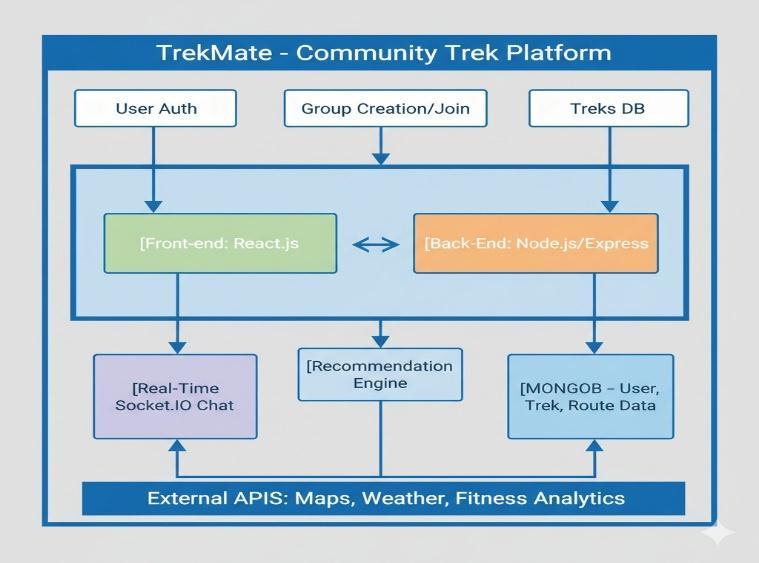
For Trek Mate project, several algorithms can be used basedonthefunctionalitiesyouwanttoachieve.Hereare the primary algorithms relevant to the system components:
Algorithm: Hashing and Salting (e.g., bcrypt) for secure passwordstorage
Role: Protects user credentials and manages secure login sessions.
Personalized Trek Recommendation Algorithm
Algorithm: Collaborative Filtering and Content-Based Filtering
Role: Matches users with treks based on similar user profiles, fitness levels, trek history, preferences, and community ratings. Can combine user demo graphic data andtrekattributestorecommendthebest-fittreks.
Algorithm: Dijkstra’s or A Algorithm* for shortest path andoptimalrouteplanning
Role: Enables users to collaboratively plan safe routes by computing optimal trek paths with minimal risk or distance.
Algorithm: Event-drivenmodelemployedbySocket.IO
Role: Manages messaging between users in chat rooms, ensures low-latency real-time updates and group synchronization. Crowd sourced Safety and Feedback Aggregation
Algorithm: WeightedAveragingandSentimentAnalysis
Role: Aggregates user reviews and safety feedback to influence future recommendations and highlight risky or highlyratedtrails.
These algorithms work synergistically to create personalized, interactive, and safe trekking experiences for users, which is the core proposition of your TrekMateplatform.
International Research Journal of Engineering and Technology (IRJET) e-ISSN: 2395-0056
Volume: 13 Issue: 01 | Jan 2026 www.irjet.net p-ISSN: 2395-0072
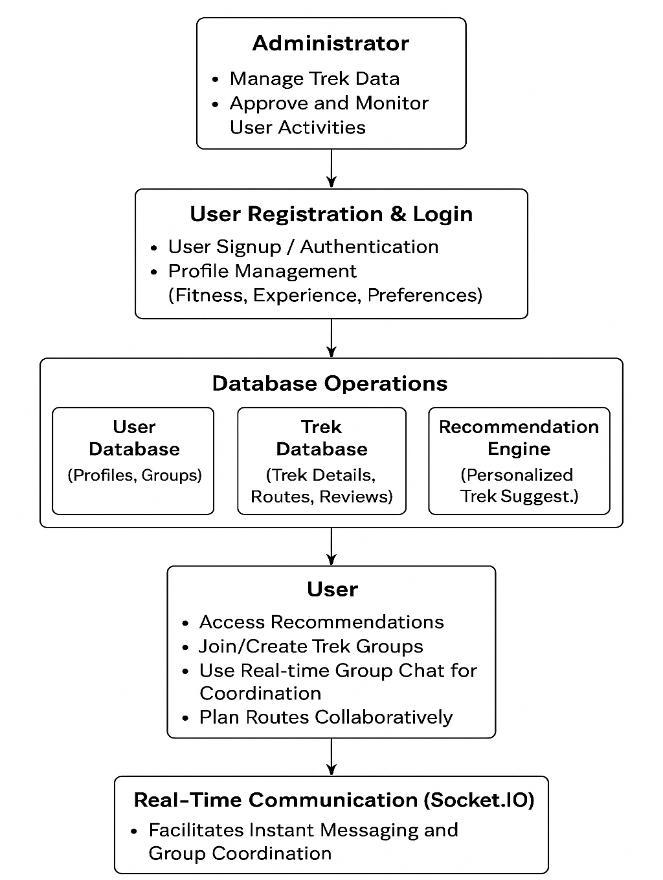
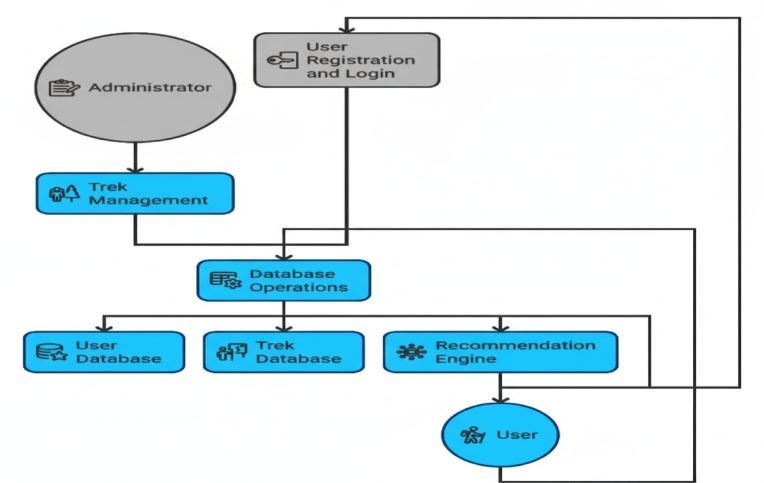
The administrator oversees the platform’s health by managing trek data, reviewing and approving treks or user-generated content to maintain quality, and monitoringactivityforsecurityorabuse.
This module allows users to securely create accounts and input essential profile information such as fitness level, trekking experience, and preferences. This data is crucial forgeneratingpersonalizedtrekrecommendations.
Thedatabaseformsthesystem’sbackbone,comprising:
User Database: Storesuserprofiles,trekkingpreferences, andgroupmemberships.
Trek Database: Contains detailed information about treks,routes,safetydata,andpastuserreviews
Recommendation Engine: Utilizes stored data and user inputs to generate personalized trekking suggestions by analyzing compatibility between user profiles and trek attributes.
Users interact with the platform to discover treks, join or create trekking groups, plan routes collaboratively, and participate in real-time group chats. This fosters a social environmenttoconnectwithlike-mindedtrekkers.
Socket.IO powers instant messaging and live group coordination, ensuring users can communicate without delays, share locations, update plans on the fly, and stay connectedduringtreks.
This block diagram and explanation collectively describe howTrek-Mateintegratesusermanagement,datastorage, personalized recommendations, and real-time social functionalities into a seamless platform for adventure enthusiasts.Mateplatform.
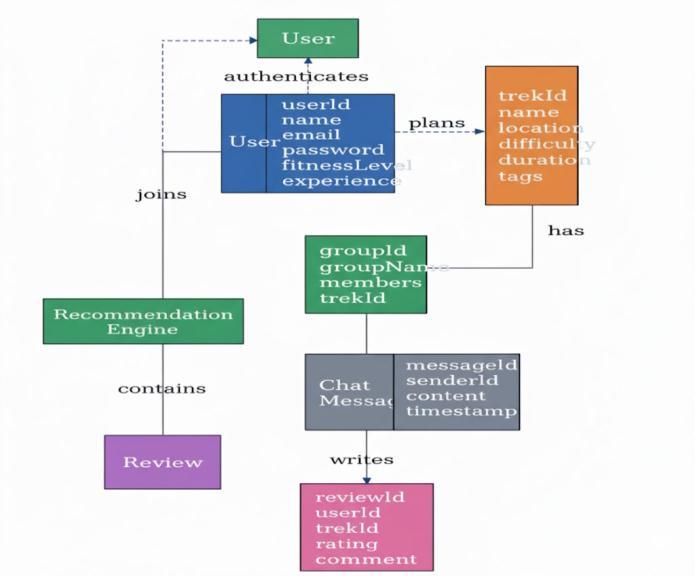
FortheTrekMatesystem,awell-structuredUMLdiagram can include these common types depending on the depth andfocusyouwant:
1. Use Case Diagram to represent user interactions like registration, trek planning, group chat, and recommendationusage.
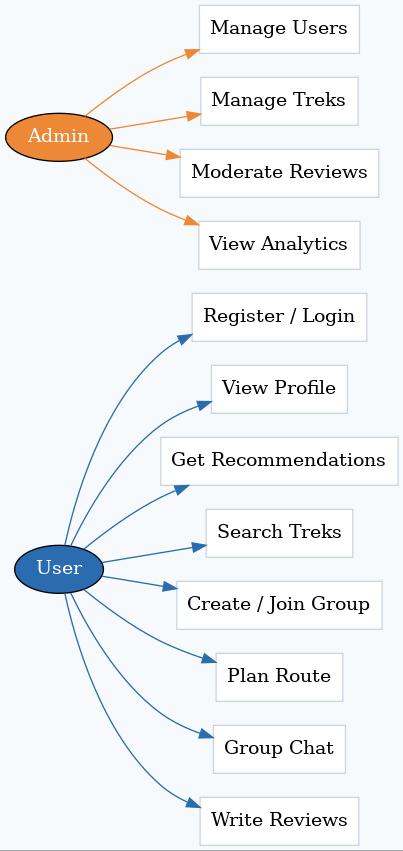
2. Class Diagram aclassillustrationintheworldof Unified Modeling Language or UML can be defined as a type of stationary structure illustration which substantiallydefinesthestructureofasystem.Itworksby showing the system’s classes and their attributes, operations, or styles, and also the connections among objects.
3. Sequence Diagram showing flow for critical processes like user registration, trek recommendation generation,orreal-timechatinteractions.
International Research Journal of Engineering and Technology (IRJET) e-ISSN: 2395-0056
Volume: 13 Issue: 01 | Jan 2026 www.irjet.net p-ISSN: 2395-0072
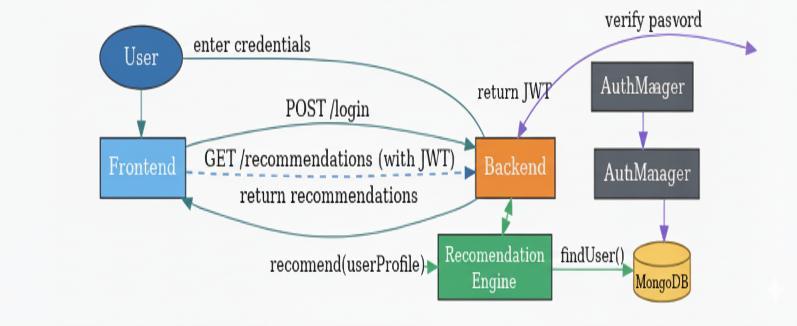
4. Activity Diagram to illustrate workflows like trekplanningorgroupchatusageandcoordination
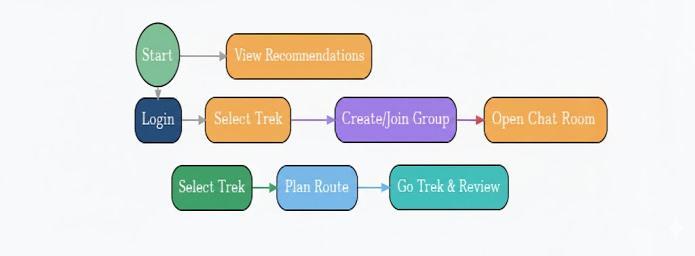
A data flow diagram is a graphical representation of the "work flow" of the data through the entire information system. A Data flow diagram (DFD) is basically used to buildabaseofthesystembaseduponwhichinfurtherthe wholesystemcanbedesigned.Theyareoftenusedforthe datavisualizationprocessalso.
This DFD shows the logical, systematical flow of the data intheTrekMatesystem.
Is a show how smoothly the input data is converted into the system usable format managing the user data, trek details, group interaction details etc? This system could bridge the gap between the technology and outdoor adventure by offering the user to have personalized suggestions. The real-time communication helps the executionprocessworksmoothlywithoutanyhindrance
Pilotdeploymentsandanalysessuggestthefollowing: Trekkers using Trek Mate report higher satisfaction in groupcoordinationandtrekplanningcomparedtocontrol groups using generic platforms.The intelligent recommendation system matches users with treks better suitedtotheirprofile,supportedbypositivefeedbackand improvedsafetyoutcomes.
Real-timechatfeatures enabletimelyinformation sharing and emergency coordination, cited as critical during adverse weather or health incidents.Community-driven reviewsandroute-sharingfosterknowledgeexchangeand build trust among trekkers, supporting sustainabletourism.
Comprehensive Future Scope for Trek Mate: Smart CommunityTrekManagementPlatform
Overview
TrekMate'sevolutionextendsfarbeyonditscurrentrealtime communication and basic recommendation features. Byintegratingemergingtechnologiesandresearchtrends, theplatformcantransformintoanintelligent,sustainable, and globally accessible ecosystem for adventure communities.Belowisadetailedfuturescoperoadmap.
Advanced Personalization: Implement collaborative filtering and federated learning to deliver hyperpersonalizedtrekrecommendationswhilepreservinguser privacy. Machine learning can analyze seasonal patterns, user behavior clustering, and predictive health analytics from wearable’s to match users with optimal treks and compatiblegroups.DeployNLP-poweredcatboatsoffering 24/7 support for trek planning, emergency guidance, and conversational trip recommendations.. These systems learn from user interactions to continuously improve response accuracy. Use deep learning models (auto encoders, LSTM networks)toidentify unusual patterns in vital signs, weather conditions, and route difficulty, triggering proactive safety alerts before emergencies occur..[4]
2.
AR-Enhanced Navigation Overlay real-time directions, plant identification, geological information, and weather patternsonusers'camerafeeds.ARappslikeViewRanger
International Research Journal of Engineering and Technology (IRJET) e-ISSN: 2395-0056
Volume: 13 Issue: 01 | Jan 2026 www.irjet.net p-ISSN: 2395-0072
and Peak Visor demonstrate how geographic information enhancesoutdoor experiences.Create immersivepre-trek training environments where users practice emergency response scenarios, develop climbing techniques, and familiarizethemselveswithspecificroutesinsafesettings. Implement AR-based treasure hunts and interactive challenges along trek routes, encouraging exploration whilecreatingcommunityengagementopportunities..[6]
2. Connect smart watches, fitness trackers, and health monitors to Trek Mate for continuous vital sign monitoring (heart rate, SpO2, temperature, altitude acclimatization tracking).. This enables adaptive route recommendations based on real-time health metrics. IntegrateGPS-enabledbackpacks,smartwaterbottles,and IoT-poweredsafetyequipmentthatcommunicatelocation and status to the platform and group members. Deploy sensornetworksattrekstartingpointsandpopularroutes to provide hyper-local weather, air quality, soil stability, andwildlifemovementdata..[8][9]
3. Deploy edge servers at trekking base camps to enable local processing of GPS data and messages
This reduces chat latency from 100-200ms (cloud) to 1030ms (edge), ensuring near-instantaneous group coordination. Leverage 5G'ss 10ms latency for missioncritical emergency alerts, real-time AR navigation overlays, autonomous drone operations, and live video streaming from trek locations. Edge computing reduces data transmission by 30-40% through local compression, intelligentcaching,andtransmittingonlyessentialinsights ratherthanrawsensordata..[11][4]
3. BLOCKCHAIN FOR TRUST & SAFETY
Decentralized Trail Verification Create immutable block chainrecordsoftrailconditions,maintenancehistory,and safetycertifications.Smartcontractscanrewardusersfor submitting verified trail updates, reducing misinformation. Establish block chain-based guide registrationsystemswithverifiablecertifications,accident reports, and community reputation scoring that works across international borders .Automate insurance claim processing and emergency fund distribution through smart contracts triggered by safety sensor alerts, expediting response times and reducing bureaucratic delays..[16]
6. Calculate and display the environmental impact of each trek based on transportation, route distance, and group size.. Implement carbon offset mechanisms allowinguserstocontribute to reforestation projects. Use IoT and analytics to optimize visitor flow, recommend seasonalclosuresforconservation,andplaninfrastructure developmentbasedonrealusagedata.Developalgorithms that suggest routes minimizing environmental impact while maintaining scenic value, with leave-no-trace principlesembeddedintotheplatform..[8]
7. ADVANCED SOCIAL & COMMUNITY FEATURES
AI-Powered Group Matching: Beyond fitness-level matching, implement personality-based matching, language affinity grouping, and mentorship programs connectingexperiencedtrekkerswithbeginners.[1]
Gasification with Purpose Design achievement systems that reward safe behavior, environmental conservation contributions, and community participation. Balance competitiveandcooperativeelementstofostersupportive communities.[2]
Content Creation Platform Enable users to create and monetize trek documentation (guides, photography, videos). Establish intellectual property frameworks protectingbothcreatorsandtheplatform.[2]
Inthisproject,weproposedanddevelopedTrekMate,an intelligent trekking companion platform designed to simplify and enhance the trekking experience for users. The system provides essential features such as user registration and login, personalized trek recommendations, group joining, real-time chat, and detailed trek information, all integrated within a single platform.
Trek Mate leverages a Mongo DB-based backend for efficient and secure data storage, while bcrypt.js ensures robust password hashing for user security. The upcoming integration of JWT tokens will further strengthen session handling and authentication. The system’s architecture efficiently manages user data, trek details, and group interactionstoensureasmoothuserexperience. By enabling personalized trek suggestions based on user preferences, experience, and fitness levels, Trek Mate bridges the gap between technology and outdoor adventure. The inclusion of real-time chat enhances communicationandcollaborationamongtrekkinggroups, makingtheplanningandexecutionprocessseamless.
In the future, the system can be enhanced by integrating AI-driven recommendation algorithms, GPS tracking, and weatherforecastingfeaturestoprovidemoreaccurateand context-aware suggestions. Overall, Trek Mate proves to be a reliable, scalable, and user-friendly solution for modern trekkers, promoting safer and smarter outdoor exploration
1) J. Dietze, "Influence of digital technologies on hikers'spatialexperiences,"Sciencedirect,2025.
2) Á. Acevedo-Duque, G. R. Llanos-Herrera, E. E. García-Salirrosas, S. Simón-Isidoro, A. P. ÁlvarezHerranz, R. Álvarez-Becerra, and L. C. Sánchez
International Research Journal of Engineering and Technology (IRJET) e-ISSN: 2395-0056
Volume: 13 Issue: 01 | Jan 2026 www.irjet.net p-ISSN: 2395-0072
Díaz, "Scientometric analysis of hiking tourism and its relevance for wellbeing and knowledge management," Int. J. Environ. Res. Public Health, vol.19,no.14,p.8534,Jul.2022.
3) R. K. Pandey, "Online visualisation of hiking activities," M.S. thesis, Dept. Geoinformatics, PalackýUniv.Olomouc,CzechRepublic,2022.
4) J. Li et al., "Seasonal dynamics of hiking activities inmountainousareas,"Sciencedirect,2024.
5) L. Kotut and M. Horning, "Community framework for social media use and support by trail thruhikers," in Proc. ACM Conf. Comput. Supported CooperativeWorkSocialComput.,2020.
6) S.Kim, J.Eun,C.Oh,B. Suh,andJ.Lee,"Botinthe bunch: Facilitating group chat discussion by improving efficiency and participation with a chatbot," in Proc. 2020 CHI Conf. Human Factors Comput.Syst.,Apr.2020,pp.1–13.
7) "Building a real-time location app with Node.js andSocket.IO,"LogRocketBlog,Jun.2024.
8) "Understanding the role of social interactions duringthru-hiking,"Int.J.Wilderness,Apr.2021.
9) Pandiri, "Scalable and secure real-time chat application development using MERN stack and Socket.io for enhanced performance," FCR, vol. 2, no.3,Sep.2024.
10) "Real-world examples: Socket.IO in action," Logix Built,2024.
11) "What is the best Socket.IO design for my application?,"StackOverflow,May2020.
12) "Real-time chat application technical implementation,"JETIRRes.J.,2024.
13) S. Jadon, P. Singh, P. Singh, and M. Haris, "Realtime chat application development using MERN stack," Int. J. Res. Appl. Sci. Eng. Technol., vol. 13, Apr.2025.
14) "Social networking and group coordination platforms,"IJSDR,vol.2455-2631,2024.
15) M. Tripathi, "Real-time chat application: Practical deployment and features," M.S. thesis, Jaypee Univ.Inf.Technol.,India,2024.
16) "Real-time communication with Socket.IO and Node.js,"Dev.to,May2022.
17) "Tensions on trails: Understanding differences between group and community needs in outdoor settings,"arXivpreprint,2024.