
International Research Journal of Engineering and Technology (IRJET) e-ISSN: 2395-0056
Volume: 13 Issue: 02 | Feb 2026 www.irjet.net p-ISSN: 2395-0072
International Research Journal of Engineering and Technology (IRJET) e-ISSN: 2395-0056
Volume: 13 Issue: 02 | Feb 2026 www.irjet.net p-ISSN: 2395-0072
Akanksha Gavhane1 , Manisha Bharambe2 , Yogeshri Gaidhani3
1Student, Department of Computer Science, M.E.S’ Abasaheb Garware College, Pune, INDIA.
2Professor, Department of Computer Science, M.E.S’ Abasaheb Garware College, Pune, INDIA
3Associate Professor, Department of Computer Science, M.E.S’ Abasaheb Garware College, Pune, INDIA
Abstract - The rapid expansion of online recruitment platforms, particularly LinkedIn, has significantly increased employmentopportunitieswhilesimultaneouslygivingriseto fraudulent job postings. These fraudulent posts often use misleadingtacticssuchasvagueorexaggeratedkeywordslike "DM me," "comment interested," "urgent hiring," and "work from home", redirecting applicants to Google Forms, WhatsApp groups, or anonymous sites instead of official application portals. The absence of verified company information,jobdescriptions,salary,andlocation,unrealistic salary offers such as large pay scales for interns, and unauthorized recruitment processes such as use of fake posters, demand of application fees, or fake HR engagement may not only waste applicants’ time but also expose them to financial and identity theft risks. To address this issue, this research proposes a fraud detection system that utilizes Machine Learning and Natural Language Processing techniques to automatically identify fraudulent job postings. Transformer-based embeddings are used for extracting contextualtext features tocapture semantic meanings inthe post, and classification models such as Logistic Regression, Random Forest and XGBoost are applied to distinguish between legitimate and fake job listings. Along with this, structured metadata features and fraud keyword indicators are used to enhance detection capability. The Synthetic MinorityOversamplingTechnique(SMOTE)isappliedduring model training to address class imbalance. The proposed system aims to improve fake job detection accuracy and contribute to a more secure and trustworthy online recruitment environments.
Key Words: Fake Job Detection, LinkedIn, Fraud Detection, Machine Learning, Natural Language Processing, Transformer Embeddings,XGBoost,SMOTE, Contextual NLP
Online recruitment platforms have transformed the job search process by providing easy accessibility to employmentopportunities.LinkedInalonehostsmillionsof jobpostingsworldwide.Withover14millionjobpostings uploaded monthly on LinkedIn, identifying fraudulent job postings manually has become difficult. Job seekers on LinkedIn often face various forms of recruitment fraud. Common issues include fake job engagements claiming to
represent multinational companies, where unauthorized individualsposeasHRrepresentatives.Fraudulentpostings sometimesuseimagesofcorporateemployees,particularly female professionals, to attract attention and build false credibility.Additionally,scammersfrequentlypromotefake remote job opportunities offering unrealistically high salaries,especiallytargetingfreshgraduatesandentry-level candidates.
Many fraudulent recruiters direct applicants to join WhatsAppgroups,fillanonymousonlineforms,orpayhiring and documentation fees. These postings often lack official company career portal links and instead encourage job seekerstolikeorcommentwithphrasessuchas“Interested” toincreaseengagement.Othersuspiciousindicatorsinclude missing salary details, unclear job locations, absence of company’sonlinepresence,andmisleadingstatementssuch as “Interview is manageable, charges applied”, “DM me”, "workfromhomeearn","noexperienceneeded"or“Limited periodoffer.”Fraudstersalsocommonlyuseurgency-based marketingphraseslike“Urgenthiring,”“Followthispage,”or “Closingapplicationssoon”topressurecandidatesintoquick responses.Thesedeceptivepracticeshighlightthegrowing needforautomateddetectionsystemscapableofidentifying suspicious job postings and protecting job seekers from recruitmentfraud.
Sathwika et al. [7] proposed a Machine Learning-based approachfordetectingfakejobpostingsusingclassification techniquessuchasRandomForest,SupportVectorMachine, andLogisticRegression,demonstratingimproveddetection accuracy. Similarly, Deka et al. [3] conducted a comprehensivereviewofMachineLearningtechniquesfor identifyingfraudulentjobadvertisementsandemphasized the importance of feature engineering and NLP-based analysisinimproving classification performance.Machine learning approaches have shown promising results in detectingrecruitmentfraudbyidentifyinghiddenpatterns within job posting data. Dutta and Bandyopadhyay [8] developedaclassification-baseddetectionframeworkusing multiple Machine learning algorithms and reported that ensemble-basedmodelsprovidebetterpredictionaccuracy compared to individual classifiers. Furthermore, recent research by Vrinda et al. [12] introduced a deep learningbased fake job detection model using advanced NLP techniques, highlighting the effectiveness of transformerbased language models in identifying suspicious textual
International Research Journal of Engineering and Technology (IRJET) e-ISSN: 2395-0056
Volume: 13 Issue: 02 | Feb 2026 www.irjet.net p-ISSN: 2395-0072
patterns in job advertisements. Apart from classification algorithms,severalstudieshavefocusedonimprovingfraud detection models using data augmentation and advanced analytical techniques. Anderson et al. [2] emphasized the importanceofsyntheticdatagenerationforenhancingfraud detection models when labelled datasets are limited. Similarly,JohnsonandLee[4]demonstratedthatdecision tree-based and hybrid Machine Learning models improve classification accuracy by capturing complex feature relationships.Additionally,KumarandPatel[5]highlighted thenecessityofintegratingintelligentsecuritymechanisms intoweb-basedrecruitmentplatformstopreventfraudulent activitiesandimprovetrustinonlinejobportals.
Basedonthereviewofexistingliterature,itisseenthatmost studies focus on general fraud detection such as spam emails, phishing websites, and fraudulent e-commerce listings, while fake job postings on professional platforms likeLinkedInremainunderexplored.Thesesystemsheavily rely on user awareness rather than automated detection. Keyword-basedfakecompanypages,andengagementtricks. Thereisnocomprehensivesystemthatintegrateslinguistic analysis, metadata verification, and fraud indicators specifically for detecting fake job postings. Therefore, this research aims to develop an integrated fake job detection system that combines NLP preprocessing, hybrid feature engineering, and multiple supervised Machine Learning algorithms to improve detection accuracy and real-world applicability.
NLPtechniquescanbeusedtopreprocessjobdescriptions, extract meaningful features, and identify suspicious linguistic patterns commonly associated with fraudulent postings. These extracted features can then be used by Machine Learning classification algorithms to detect fraudulentjobadvertisementswithimprovedaccuracyand efficiency.MultiplesupervisedMachineLearningalgorithms, includingLogisticRegression,RandomForest,andExtreme Gradient Boosting (XGBoost), are implemented to analyze job posting patterns and classify them into genuine or fraudulentcategories.Theperformanceofthesemodelsis evaluated using standard evaluation metrics such as accuracy,precision,recall,F1-score,confusionmatrix,and ROC-AUCanalysis.
The dataset used in this study is the Real or Fake Job Posting Prediction Dataset available on Kaggle, which containsjobpostingslabelledasfraudulentorgenuinealong withvarioustextualandmetadatafeaturessuchasjobtitle, description, company profile, location, and salary information. The dataset contains 17,880 rows and 20 columnswith17,014jobslabelledasgenuineand866jobsas fake. The proposed system utilizes Natural Language Processing(NLP)techniquesalongwithMachineLearning classificationmodelstodetectandclassifyfakejobpostings. Transformer-based contextual embeddings using
SentenceTransformer are applied to extract semantic featuresfromjobpostingtext.Inaddition,fraudkeywordbased featuresandstructured metadata attributessuchas companylogopresence,employmenttype,andexperience requirements are combined to enhance fraud detection capability TheSyntheticMinorityOversamplingTechnique (SMOTE)isappliedtoaddressclassimbalance,andmultiple Machine Learning algorithms are then implemented to classify job postings as genuine or fraudulent. The performance of these models is evaluated using standard evaluationmetricstodeterminethemosteffectivemodelfor accuratefakejobdetection.
Random Forest is a classification algorithm used in supervised Machine Learning for categorizing data into differentclasses.Thealgorithmusesmultipledecisiontrees, forming a “forest” of decision trees. It improves the performanceofamodelbycombiningmultipleclassifiersto solve complex problems. Random Forest is based on the conceptofensemblelearning,asitdoesnotrelyonasingle decisiontree.Instead,itpredictsthefinaloutputbasedonthe majority voting of predictions obtained from each tree. It achieves this by using techniques such as bagging and bootstrap sampling. Random Forest includes several importanthyperparameterssuchas n_estimators, max_depth, max_features,max_samples, min_samples_split,max_leaf_nodes, and bootstrap. Techniques such as GridSearchCV and RandomizedSearchCV can be used to tune these hyperparameterstoimprovemodel performance.Random Forest has been widely used in fraud detection and classification problems due to its ability to handle highdimensionaldataandcomplexfeatureinteractions[6].
XGBoost (Extreme Gradient Boosting) is a supervised Machine Learning classification algorithm widely used for solvingcomplexclassificationandregressionproblems.Itis an advanced implementation of gradient boosting that improves model accuracy and efficiency by combining multiple weak learners, typically decision trees. XGBoost works by building decision trees sequentially, where each new tree focuses on correcting the errors made by the previoustrees.Insteadofgivingequalimportancetoalltrees, itassignsweightstoreducepredictionerrorsandimprove overall performance. The algorithm uses gradient descent optimization to minimize the loss function and enhance prediction accuracy. It also includes regularization techniquesthathelppreventoverfittingandimprovemodel generalization.
XGBoost provides several hyperparameters such as n_estimators, learning_rate, max_depth, subsample, colsample_bytree, gamma, and reg_lambda, which control
International Research Journal of Engineering and Technology (IRJET) e-ISSN: 2395-0056
Volume: 13 Issue: 02 | Feb 2026 www.irjet.net p-ISSN: 2395-0072
tree complexity and learning behaviour. Due to its computational efficiency and high predictive performance, XGBoosthasbeensuccessfullyappliedinclassificationand frauddetectionstudies[12].
SMOTE is a popular technique used to handle class imbalance in a dataset where one class outshines other leadingtobiasintheresult.Toimprovetheperformanceof themodelandreducethebias, itcreates syntheticsamples forminorityclass.
Sentence Transformer is a transformer-based Natural Language Processing (NLP) technique used to capture the contextualmeaningoftext.Unliketraditionalmethodssuch as TF-IDF, which focus on word frequency, Sentence Transformerconvertsjobpostingtextintoembeddingsthat represent semantic relationships between words and sentences.Inthisresearch,theSentenceTransformermodel (‘all-MiniLM-L6-v2’) is used to generate contextual embeddingsfromjobpostings.Theseembeddingshelpdetect hidden fraud patterns, misleading phrases, and suspicious recruitment language. The generated embeddings are combined with metadata and fraud keyword features to improvetheaccuracyoffakejobdetection.
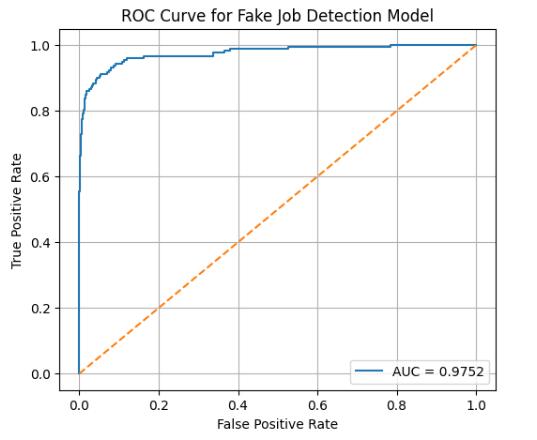
Area Under the Receiver Operating Characteristic Curve (AUC-ROC) is a performance metric used to evaluate the performance of classification models using various thresholds. The ROC curve is used to show the trade-off betweentheTruePositiveRate(TPR)andtheFalsePositive Rate(FPR)usingagraphicalplotwithadiagonalline(AUC= 0.5)representing arandomclassifier.AUCrangesfrom0to 1. A curve closer to the top-left corner indicates better performance. Irjet Template sample paragraph .Define abbreviationsandacronymsthefirsttimetheyareusedin thetext,evenaftertheyhavebeen definedintheabstract. AbbreviationssuchasIEEE,SI,MKS,CGS,sc,dc,andrmsdo nothavetobedefined.Donotuseabbreviationsinthetitleor headsunlesstheyareunavoidable.
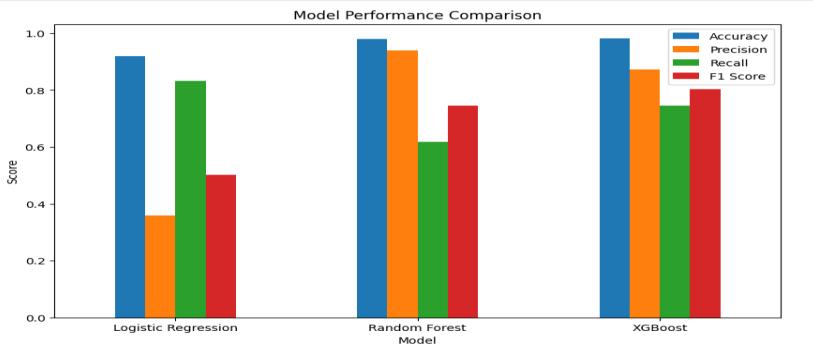
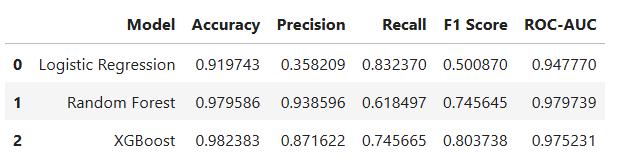
AsshowninFigures,XGBoostachievedthehighestoverall performance with the best F1-score and recall, indicating highest capability in identifying fraudulent job postings. While Logistic Regression achieved perfect precision, its recallvaluewassignificantlylower,suggestingthatitfailedto detect a large number of fraudulent cases. Random Forest showedbalancedperformancebutwasslightlyoutperformed by XGBoost in terms of recall and F1-score. Therefore, XGBoostwasselectedasthemosteffectivemodelforfakejob detection.
International Research Journal of Engineering and Technology (IRJET) e-ISSN: 2395-0056
Volume: 13 Issue: 02 | Feb 2026 www.irjet.net p-ISSN: 2395-0072
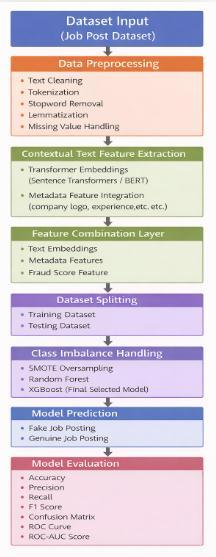
Theproposedsystemarchitectureincludesmultiplestages such as data preprocessing, transformer-based contextual featureextraction,fraudkeyworddetection,metadatafeature integration, featurecombination, class imbalance handling usingSMOTE,andMachineLearningclassification
2.3 Result
Theperformanceoftheproposedfakejobdetectionsystem wasevaluatedusingmultiplesupervisedMachineLearning algorithms. The classification results were analyzed using evaluation metrics such as accuracy, precision, recall, and F1-score to determine the effectiveness of the models in identifyingfraudulentjobpostings
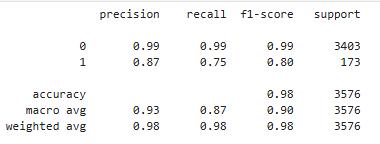
Fig. 2- ClassificationReport
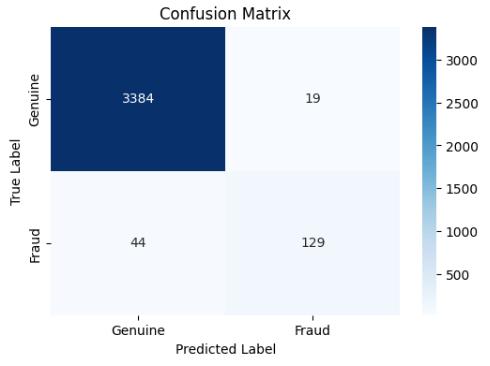
Fig. 3 – ConfusionMatrix
FromFig5,Itisseenthatthemajorityoffraudulentand genuinejobpostingswerecorrectlyclassified,andthe modelachievedanoverallaccuracyof98%.
This research demonstrates that Machine Learning, combined with NLP-based text analysis, can accurately classifyfakeandgenuineLinkedInjobpostings.Parameters such as salary range, location, job description, company profile completeness, and job description patterns play a crucialroleinfakejobpostdetection.Byanalyzingalarge dataset and applying statistical tests (ANOVA, Chi-square, and t-tests), it was confirmed that certain features significantly differentiate fake from real jobs. This work contributestoimprovingonlinejobsafetyandcansupport LinkedInandsimilarplatformsinflaggingfakejobs.Future improvementsmayincludeexpandingthemodeltohandle multilingual postings, integrating real-time web scraping APIs, and improving model generalization with deep learningtechniques.
[1] Amrutha P, Kavya H. V, “Fake Job Detection”, Zhuzao/FoundryJournal,Vol.28,Issue8,pp.232–240,2024.
[2] Anderson, L., Brown, D., & Harris, M. (2022). “Synthetic Data Generation for Fraud Detection in MarketingAnalytics.”IEEETransactionsonBigData (TBD),ISSN2332-7790,Vol.8(4),pp.1125–1138.
[3] Dipjyoti Deka, Rituparna Seal, Shubham Banik, “UnmaskingFraudulentJobAds:ACriticalReviewof Machine Learning Techniques for Detecting Fake Jobs”, International Journal on Emerging Research Areas(IJERA),Vol.3,Issue1,pp.59–62,2023.
[4] Johnson,R.,&Lee,C.(2023).“ComparativeAnalysis ofDecisionTreeAlgorithmsforFraudulentPattern Detection.” Proceedings of the IEEE International ConferenceonDataMining(ICDM),ISSN1550-4786, Vol.3,pp.221–229.
International Research Journal of Engineering and Technology (IRJET) e-ISSN: 2395-0056
Volume: 13 Issue: 02 | Feb 2026 www.irjet.net p-ISSN: 2395-0072
[5] Kumar, P., & Patel, R. (2021). “Modern Web Application Security and Fraudulent Activity Detection.” IEEE Transactions on Dependable and Secure Computing (TDSC), ISSN 1545-5971, Vol. 18(5),pp.1458–1470.
[6] PraveenB.,“DeepLearningFrameworkforDetecting FraudulentOnlineJobPostings”,Anusandhanvallari Research Journal, Vol. 2023, Issue 1, pp. 170–177, 2023.
[7] Sathwika Ch. P. Shirin, G. Meghana, A. Anokh, V. Prathima, “Fake Job Posting Detection”, Journal of Emerging Technologies and Innovative Research (JETIR),Vol.11,Issue3,pp.K110–K114,2024.
[8] ShawniDutta,SamirKumarBandyopadhyay,“Fake JobRecruitmentDetectionUsingMachineLearning Approach”, International Journal of Engineering TrendsandTechnology(IJETT),Vol.68,Issue4,pp. 48–53,2020.
[9] SheezaHabeebaKhan,I.SamuelPeterJames,“Deep Learning Based Methods for Online Recruitment Fraud Detection”, International Journal of Engineering Science and Advanced Technology (IJESAT),Vol.25,Issue9,pp.87–93,2025.
[10] Shivani K., P. Ajay, Ch. Abhishek Reddy, B. ShreeVardhan, D. Pushpa, “Detecting Real or Fake JobPostingsUsingMachineLearning”,International JournalofResearchPublicationandReviews(IJRPR), Vol.6,Issue4,pp.5326–5331,2025.
[11] Shubham Sonkar, Shreyash Yadav, R. Kumar, “A Hybrid Machine Learning Approach for Fake Job Posting Detection: Integrating Naive Bayes and LogisticRegressionModels”,InternationalJournalof Innovative Science and Research Technology (IJISRT),Vol.10,Issue6,pp.323–329,2025.
[12] VrindaS,ThusharaS,BinduN,“FraudulentOnline JobAdvertisementDetectionusingMachineLearning Models”, International Journal of Innovative Research in Science, Engineering and Technology (IJIRSET),Vol.13,Issue9,pp.16815–16819,2024.