
International Research Journal of Engineering and Technology (IRJET) e-ISSN: 2395-0056
Volume: 12 Issue: 11 | Nov 2025 www.irjet.net p-ISSN: 2395-0072
International Research Journal of Engineering and Technology (IRJET) e-ISSN: 2395-0056
Volume: 12 Issue: 11 | Nov 2025 www.irjet.net p-ISSN: 2395-0072
Prof. Priyanka R Navale1 , Arjun B N2 , Haritejashree N2, Pavani P2, Vinayak I Gaddi2
1 Assistant Professor, Dept. of Computer Science and Business Systems, Bapuji Institute of Engineering and Technology, Davangere, Karnataka, India
2 Student, Dept. of Computer Science and Business Systems, Bapuji Institute of Engineering and Technology, Davangere, Karnataka, India
Abstract - Women’s Safety Applications frequently rely extensively on smartphones and consistent network access, which restricts their effectiveness in emergency situations. To overcome these limitations this paper introduces TRANAM, a women’s safety system that merges a self-sufficient SOS hardware device with acloud-linkedmobileandwebplatform. The device, created with an ESP32 microcontroller features a trigger button, voice and motion activation, GPS, camera and GSM components to independently record images, brief video clips and live location information, during incidents. Gathered data is sent to a backend server via GSM for storage, alert creation and distribution to emergency contacts and law enforcement. The mobile app offers user sign-up, contact handling, live tracking and alert display while the admin dashboard allows real-time supervision and evidence examination. Experimental tests confirm dependable SOS triggering, precise GPS retrieval and steady media recording with SMS alert latencies of 2-4 seconds. The proposed system offers a scalable, autonomous, and smartphone-independent safety solution, suitable for public deployment, institutional use, and emergency response networks.
Key Words: IoT-based SOS Device, ESP32-CAM, GSM Communication, GPS Tracking, Motion Sensor, Voice Activation, Real-Time Alerts, Media Capture, Automated SOS Triggering, Mobile/Web Dashboard
1. INTRODUCTION
Thesafetyofwomencontinuestobeanissueworldwide ascasesofharassment,assaultandkidnappingriseinboth cityandcountrysideareas.Whilemanymobilesafetyapps areavailabletheireffectivenessinemergenciesisfrequently hinderedbylimitationslikerequiringmanualinput,reliance, on smartphones, battery life restrictions and unreliable network connectivity. In moments victims might find it difficulttounlockorreachtheirphonesmakingapp-based solutions ineffective. These limitations highlight the necessity for a reliable, autonomous, and non-intrusive safetymechanismthatcanoperateindependentlyofauser’s smartphone.
Latest progress in IoT, embedded systems, wireless communication and cloud computing has facilitated the creation of safety devices that surpass the functions of conventional mobile apps. Gadgets integrated with microcontrollers,sensors,GSMmodulesandGPSunitsare capableofdetectioncapturingmediaandsendingimmediate
alerts without needing user input. These systems boost emergency response by minimizing reliance on humans increasingdependabilityandallowingcommunication,with officialsandcaretakers.
The proposed system, TRANAM, integrates an ESP32based SOS device, real-time location tracking, GSM-based alerting, media evidence captures, and a multi-platform application interface. The system also incorporates an admin/police dashboard for live monitoring and alert management. By combining hardware automation with cloud-enabled communication, TRANAM addresses the shortcomingsofexistingsolutionsandprovidesascalable, fast, and dependable emergency-response framework for women’ssafety.
Recent progress in IoT, embedded systems and mobile technologies has spurred the creation of women’s safety solutionsthatgobeyondsmartphone-basedSOSapps.Initial systemsreliedonmobileapplicationsbuttheirperformance waslimitedduetotherequirement,foruserinteractionand consistent internet access. To address these challenges researchers have designed devices and automated alert systems.
Bhatetal.(2025)Developedanemergencyalertplatform usingFlaskandtheWhatsAppAPIprovidingmessagingbut needing internet access.Nemane et al.(2024)Suggested a wearable based on Arduino Nano BLE with a buzzer and audiocapturealthoughthesoundalarmlesseneddiscretion, in scenarios. Gonde and Ghewari (2021) presented a Raspberry Pi system combining GSM, GPS and video streaming; nevertheless, the large equipment hindered mobility. Pednekar et al. (2020) Developed a safety ring equipped with IoT featuring a pressure sensor and a tiny camera. Its small size restricted its processing power and communicationfunctions.
Previous systems also had limitations: Bharathi et al. (2018) Employed IR sensors and RFID, in a cybersecurity framework.Encounteredproblemsrelatedtocomplexityand networkreliability.HantodeandSambhare(2018)developed an Arduino-based fingerprint-activated device with GPS notifications although it demanded finger positioning to activate in emergency situations. The FEMME system
International Research Journal of Engineering and Technology (IRJET) e-ISSN: 2395-0056
Volume: 12 Issue: 11 | Nov 2025 www.irjet.net p-ISSN: 2395-0072
(Monisha et al., 2016) integrated GPS, GSM and various sensors.Stillreliedontheusertotriggerit.
Collectively, existing systems exhibit limitations suchas smartphone dependency, bulky hardware, short communication range, limited automation, and lack of integratedevidencecapture.Thesegapsunderscoretheneed for a compact, autonomous, multi-trigger women’s safety devicewithreal-timemediatransmissionandcloud-enabled monitoringcapabilitiesaddressedbytheproposedTRANAM system.
The system architecture is structured into three core layers:HardwareInputLayer,BackendProcessingLayer,and UserOutputLayer.TheSOSdevicefunctionsastheprimary inputunit,integratingmulti-triggeractivationmechanisms such as a button press, motion detection, and voice-based commands. Once activated, the onboard ESP32-CAM and GPS6MV2modulescaptureimages/videosandretrievelive geographic coordinates. This collected data is transmitted throughtheSIM800GSMmoduletothebackendserver.
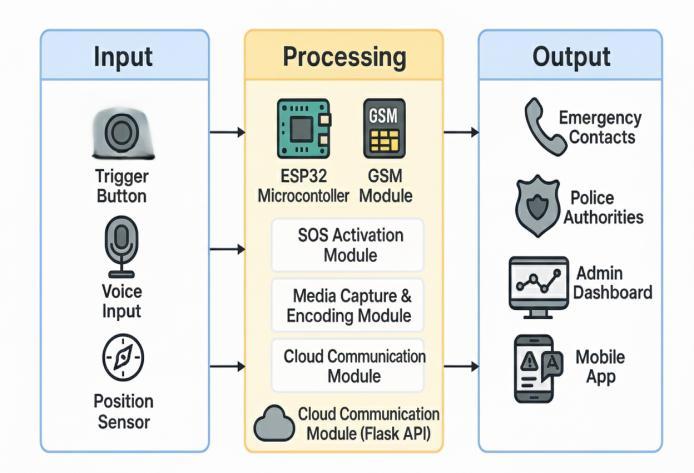
Fig
ThisfigureillustratesthesystemarchitectureofTRANAM,a Women’s Safety System, organized into Input, Processing, and Output layers. The Input layer includes the trigger button,voiceinput,andpositionsensorthatinitiateanSOS event. These signals are processed by the ESP32 microcontroller and GSM module, which handle SOS activation,mediaandlocationcapture,encoding,andcloud communication. The backend Flask API receives the transmitted data for storage and alert routing. Finally, the Outputlayer distributes real-timealerts,GPSlocation,and mediaevidencetoemergencycontacts,policeauthorities,the admin dashboard, and the user’s mobile application. This modular structure ensures fast, reliable, and continuous emergencyresponse.
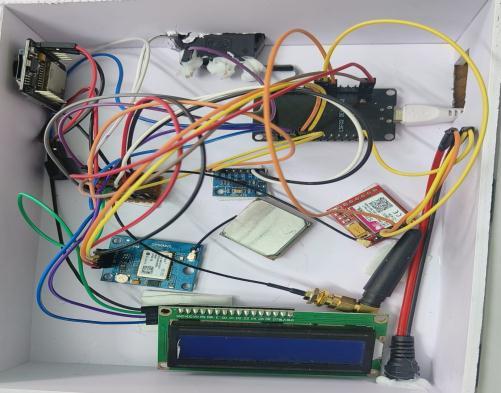
The TRANAM hardware prototype is built using an ESP32/ESP32-CAMmicrocontrollerintegratedwitha GSM module, GPS unit, trigger button, voice input, and position sensor.Itautonomouslycapturesmedia,retrieveslocation, and sends SOS alerts via GSM, functioning reliably even withoutasmartphone.
Hardware Enclosure: The TRANAM prototype features a casing created to house all embedded partswhilemaintainingalightweightandportable feature.
Sensing & Activation Unit: Comprises a trigger button,ADXL345positionsensorandavoiceinput component allowing SOS activation, through pressing,motiondetectionorvoicecommands.
Media Capture Unit: The ESP32-CAM module automatically records images and brief videos duringemergenciestogatherevidence.
Processing & Communication Unit: The ESP32 microcontrollermanagesreal-timeoperationsand the SIM800 GSM module sends location retrieved through GPS6MV2 module, media URLs and SOS informationtothebackend.
Power System: Adirectchargingadaptor
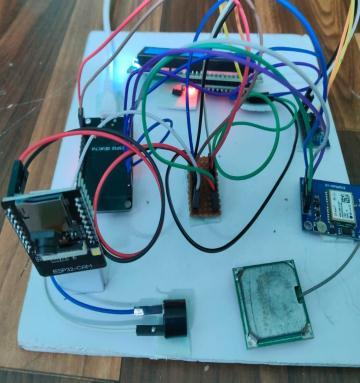
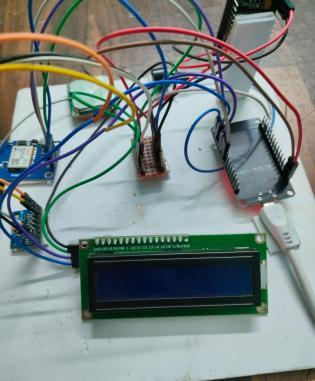
Volume: 12 Issue: 11 | Nov 2025 www.irjet.net
ThisfigureillustratesTRANAMhardwareprototypewhich integrates the ESP32 microcontroller, ESP32-CAM, GPS module,GSMSIM800,ADXL345positionsensor,buzzer,and a16×2LCDdisplayontoacompactprototypingboard.All modules are interconnected through jumper wiring, enabling SOS activation, GPS tracking, media capture, and GSMcommunication.Theprototypecurrentlyoperatesusing astandardchargingadapterforpower,suitablefortesting beforebatteryintegration.Thelayoutisorganizedtoverify module interaction, signal routing, and stable data transmissionduringemergency-triggersimulations.
The software architecture of TRANAM is built using Python Flask, enabling reliable backend processing, cloud communication, and real-time alert routing. The system follows a continuous “Detect–Process–Notify” workflow to ensurerapidemergencyresponse.
SOS Detection Logic: SOSeventsaretriggeredvia threemechanisms-buttonpress,voicecommand,or position-sensoractivation.Embeddedfirmwareon theESP32continuouslymonitorstheseinputsand initiatesthealertsequenceupondetection.
MediaProcessing: UponSOSactivationtheESP32CAM records images and brief video segments. Thesefilesare.SentviatheSIM800GSMmoduleto thecloudserver.
GPS Location Retrieval: The GPS6MV2 module collectsreal-timelatitudeandlongitudedata,which ismergedwiththeSOSpayload.Locationupdates are periodically refreshed until the incident is acknowledged.
BackendProcessing(Flask Server): Thebackend receives SOS data, extracts GPS and metadata, storesmediasecurely,logstheevent,andforwards alertstoemergencycontacts,police.Italsomanages periodicGPSupdatesuntiltheSOSisacknowledged.
Frontend Mobile/Web Application: The user interface, developed using HTML, CSS, JavaScript, and responsive frameworks. Interactive UI componentsaretightlysynchronizedwithbackend APIsforreal-timeresponsevisibility.
Alert Management & Decision Logic: Event handling follows a looped update mechanism: incoming SOS → verify user → store evidence → broadcastalerts→monitoracknowledgmentstatus. If no acknowledgment is received, the server continuestofetchandupdatelocationinformation inrealtime,ensuringaccuratevictimtracking.
-3: SystemSoftware
International Research Journal of Engineering and Technology (IRJET) e-ISSN: 2395-0056
Volume: 12 Issue: 11 | Nov 2025 www.irjet.net p-ISSN: 2395-0072
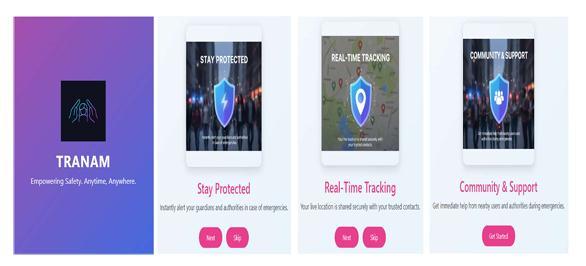
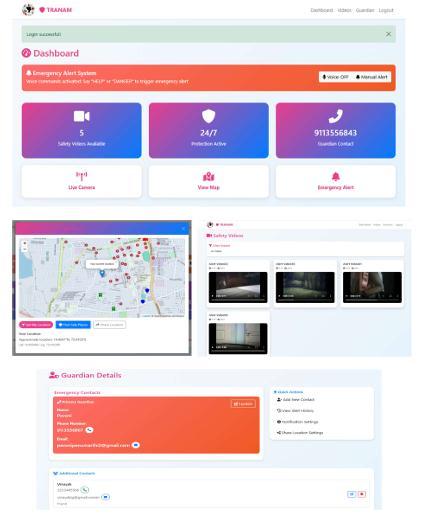
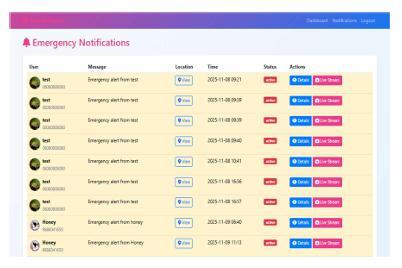
This figure illustrates the software components of the TRANAM system, including the user dashboard, SOS notification panel, and admin monitoring interface. The dashboard allows users to register, manage emergency contacts,andpreviewcapturedmedia,whiletheSOSpanel displaysreal-timealertswithlocationandtimestampdetails. The admin interface supports centralized supervision by providingaccesstoliveSOSevents,userrecords,andstored evidence,enablingcoordinatedemergencyresponse.
Testingisessentialforconfirmingthedependabilityand responsivenessofTRANAM,awomen’ssafetysystem.The assessmentincludedunittestingofhardwarecomponents (ESP32-CAM, GPS, GSM, sensors) as well as integration testing, throughout the full SOS workflow from device → backend→mobile/webdashboards.Thekeygoalswereto ensureSOSactivationmaintainstableGPSsignalreception verify dependable GSM communication and guarantee backend alert delivery worked within acceptable delay limits.Allsystemtestswereconductedindoorsandoutdoors underdifferentlightingandnetworkconditionstosimulate realisticemergencyscenarios.
TheTRANAMsystemwasevaluatedbasedonSOSTrigger ResponseTime,GPSAccuracy,MediaCaptureReliability,and Alert Delivery Latency. The prototype was tested through repeated SOS activations using all supported trigger mechanisms.
SOS Activation Duration: Whether through the button,voiceorpositionsensorthedevicerecorded SOSsignalswithauniformactivationguaranteeing swiftemergencyinterventionincriticalsituations.
GSM Transmission Latency: Employing the SIM800 module on a 2G network, media packets andGPSdataweretransmittedtothebackendwith adelaybetween2and4secondsvaryingbasedon signalquality.Thisdelayfellwithinthelimits,for emergencycommunications.
GPS Precision: Field trials with the GPS6MV2 module yielded location accuracy within ±5m to ±9msufficient,fordeployingemergencyresponders andpolice.
Media Capture & Upload: The ESP32-CAM effectively recorded images and brief video segments achieving a 97% success rate, over 50 trial runs. Sporadic failures occurred in lighting conditions,markedforsubsequentimprovement.
Backend Alert Routing: Alertsweredeliveredto emergencycontacts,policeauthorities,andthe admindashboardconsistently,withatotalendto-endlatency(device→server→mobileapp)of 5–7seconds.
Testing, at the unit level was carried out on functional componentstoconfirmtheirindependentdependability.A summaryoftestscenariosandresultsisprovidedbelow:
Button Trigger (Case BT-01): Thephysicaltactile buttonunderwenttestingforresponsivenessover 50 pressing cycles. Every activation was successfully logged by the system resulting in a Pass,forthetest.
Position Sensor Triggering (Case PS-01): The sudden-tiltdetectionconsistentlyinitiatedtheSOS procedure while slight movements were deliberatelydisregardedtoavoidfalsealarms.This testreceivedaPassresult.
Camera Capture (Case MC-01): The ESP32-CAM moduleunderwenttrialsforcapturingimagesand videosacrosslightingenvironments.Itperformed consistently under lighting while tests, in dim conditions resulted in a Partial Pass because of intermittentframeloss.
GPS Acquisition (Case GPS-01): The GPS device reliably acquired satellite signals within 8–20 secondsofpoweringon.Afterlockingthelocation datawasconsistentlysteadyandpreciseleadingto aPassresult.
GSM Transmission (Case GSM-01): SOS packets withmediaandlocationdataweresentoverGSM withoutanypacketdamage,acrossnetworksignal strengths. Every transmission was successful resultinginaPass.
Backend Alert Logging (Case BE-01): The Flask server accurately interpreted SOS packets safely savedmediafilesandrefreshedtheSOSlogs.Each test case showed database records resulting in a Pass.
Mobile & Web Notification (Case FW-01): Push alertsanddashboardrefreshesshowedupquickly on both platforms. Slight UI lags were noticed on speedy phones resulting in a verdict of Partially Pass.
International Research Journal of Engineering and Technology (IRJET) e-ISSN: 2395-0056
Volume: 12 Issue: 11 | Nov 2025 www.irjet.net p-ISSN: 2395-0072
The TRANAM system was tested in various real-life settingssuchasclassrooms,hallwaysandopenspacesonthe college grounds. The main goal of the assessment was to confirmthepromptnessof SOSactivationtheprecision of GPSlocalizationandtherobustnessofmediadeliveryduring usage. The assessment covered evaluations, at both the hardware and backend layers to guarantee emergency communication.
TheTRANAMprototypeunderwenttestinginindoorand outdoor settings to assess the effectiveness of its SOS activationmethods.Activationthroughbuttonpress,motion detectionandvoicecommandconsistentlygeneratedanSOS signalwithin1–2secondssucceededbyrecordingandGPS dataacquisition.GSMtransmissiondelaysrangedfrom2to4 secondsonaveragevalidatingalerttransmission,innormal networkenvironments.Thesefindingsconfirmthesystem’s ability to independently start emergency communication withlatencywithoutrelyingonasmartphone.
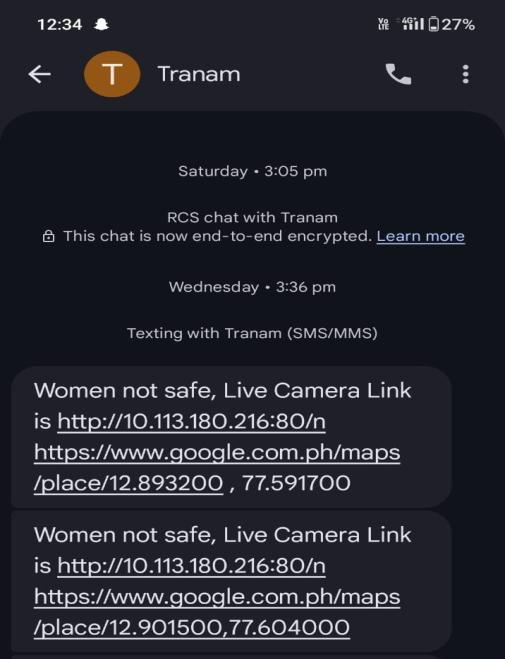
ThissnapshotdemonstratestheSOSalertsentonreceiving thetrigger.
5.2
InoutdoorsettingstheGPSmoduleprovidedconsistent location fixes with an accuracy range of ±5–10 meters whereas weak indoor signals activated the fallback estimation mechanism as intended. Throughout SOS incidentsthebackendobtainedGPSdataatintervalsof8–12
Seconds enablinguninterruptedusermonitoringonboth theadminandmobileinterfaces.Theongoingupdatecycle functioned dependably guaranteeing time situational awareness,foremergencyresponders.
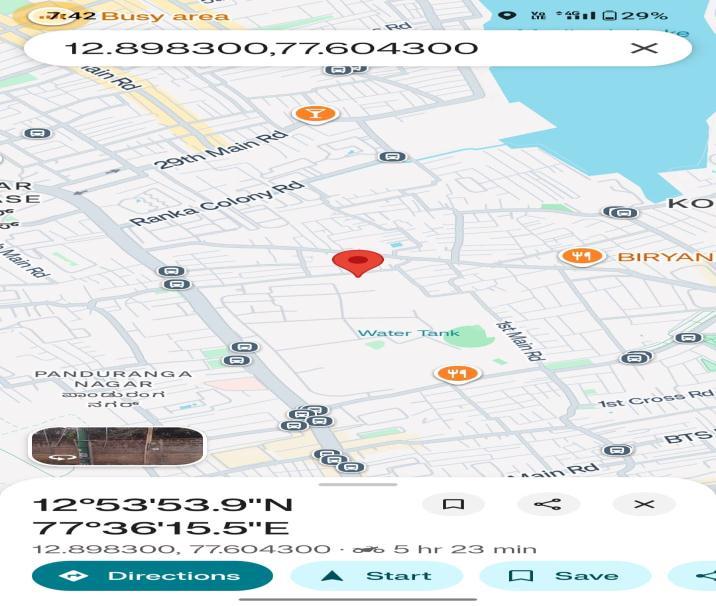
Thissnapshotdemonstratesthelocationcoordinatesfetched throughtheGPSmodule.
The ESP32-CAM successfully captured and transmitted imagesandshortvideoclipstotheserverduringSOSevents. Snapshotuploadscompletedwithin3–5seconds,whileshort videotransfersvariedbasedonGSMbandwidth.Live-stream attemptsperformedconsistentlyatlow-resolutionsettings, confirming feasibility for evidence capture during emergencies.
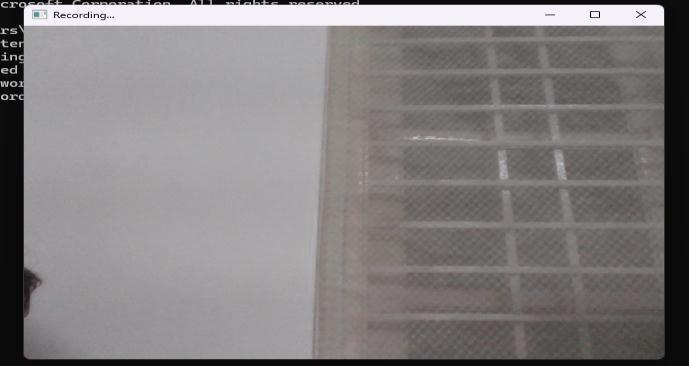
-6: MediaCapture
Thissnapshotdemonstratesthemediacapture(videosand images).
International Research Journal of Engineering and Technology (IRJET) e-ISSN: 2395-0056
Volume: 12 Issue: 11 | Nov 2025 www.irjet.net p-ISSN: 2395-0072
TheTRANAMsystemeffectivelyshowcasestheviabilityof abasedself-sufficientwomen’ssafetyplatformfeaturinga compactSOSgadgetGSMalerting,GPSlocationtrackingand cloud-supported supervision. By combining an ESP32 microcontrollerwithacamera,GPS6MV2module,SIM800 GSMunitandmultipleactivationtriggers(button,voiceand motion detection) the prototype delivers emergency responses without relying on smartphones or internet access.Thebackend,developedwithPythonFlaskefficiently handlesSOSsignalsuploadsmediaproofanddirectsalerts toemergencycontactsandlawenforcement.Testingverified GPS acquisition, consistent photo/video recording and dependable SMS transmission with low delay proving the system’seffectivenessinpracticalemergencysituations.In summaryTRANAMclosesthedivide,betweenmobilesafety apps and completely automated emergency-response systems.
Although the existing prototype confirms the functions multiple improvements are intended to strengthen TRANAM:
ImprovedCompactness: AtailoredPCBcombined with a refined enclosure design will considerably decreasethedevicedimensions.Enhancecomfort foreverydaywear.
Geofencing & Intelligent Analytics: Integrating geofencing, motion analysis and anomaly identificationwilloffersafetywarningsalong,with enhancedreporting.
Mobile Application Enhancement: The mobile app will be improved to include support for language notifications, incident density maps and community safety functionalities, for user interactions.
Cloud Scalability: Transitioning to distributed cloud systems will facilitate deployment, throughout institutions, public areas and emergencyresponseframeworks.
With these advancements, TRANAM has the potential to evolve into a comprehensive smart safety infrastructure capable of supporting real-time protection, rapid intervention,andcommunity-widesecurityenhancement.
We express our sincere gratitude to our Head of Department, Dr. Vinutha H P,forhersupportthroughout this project. We also extend our gratitude to our Project
Guide, Prof.PriyankaRNavale forherinvaluableguidance throughout this project. We also thank our Project Coordinator, Mr.PuneethB H,forhisconsistentmotivation andtimelyinput.Weextendourgratitudeto Dr. Aravind H B, Principal, and Prof. Y Vrushabhendrappa, Director, BapujiInstituteofEngineeringandTechnology,Davangere, forprovidingthenecessaryinfrastructureandresourcesto completethisworksuccessfully.Finally,wethankthefaculty members of the Department of Computer Science and BusinessSystemsfortheirsuggestionsandsupport.
[1] A.S.Bhat,S.Pavan,M.Sharath,B.M.Vishal,andM.B. Suresh, “Empowering women’s safety using real-time alertsystem,”Int.J.Eng.Res.Technol.,vol.14,no.5,pp. 1–5,2025.
[2] T.Nemane, P.Naik,S.PalkarandA. Poonawala "Realtimewomen’ssafetysystemusingIoT"Int.J.Adv.Res. Sci.,Commun.Technol.vol.3,No.1Pp.45–49,2024.
[3] P. Y. Gonde and P. B. Ghewari, “Women safety system usingRaspberryPi,”Int.Res.J.Eng.Technol.,vol.8,no. 4,pp.4044–4047,2021.
[4] Y. S. Bisht, S. Agarwal, S. Sharma, V. Pandey, and S. Kumar,“Device-to-devicebasedwomensafetysystem,” Int. J. Eng. Res. Technol., vol. 10, no. 6, pp. 500–503, 2021.
[5] A. Pednekar, S. Narvekar, J. Mendes, S. Kamat, V. Pugazhnthi,andA.Narvekar,“Womensafetyring,”Int.J. Adv.Res.Comput.Commun.Eng.,vol.9,no.2,pp.88–92, 2020.
[6] R. Gifty and R. Bharathi, “Cyber physical self-defense system,”Int.J.Adv.Res.Electr.,Electron.Instrum.Eng., vol.7,no.4,pp.1900–1905,2018.
[7] P. R. Hantode and G. S. Sambhare, “Women’s safety devicewithGPStracking&alerts,”Int.J.Res.Eng.,Sci. Manage.,vol.1,no.6,pp.215–218,2018.
[8] P. Bedarkar, S. Radke, V. Raut and N. Larokar "Emergencyalert,forwomensafetyusingArduino"Int. J.Innov.Res.Sci.,Eng.Technol.vol.6,No.3Pp.5123–5126,2017.
[9] D. G. Monisha, M. Monisha, G. Pavithra, and R. Subhashini, “Women safety device and application –FEMME,” in Proc. IEEE Int. Conf. Electr., Comput. Commun.Technol.(ICECCT),2016,pp.1–5.
[10] K. Rai, J. Gupta, and A. K. Srivastava, “Android-based NiDar app with safe path and camera access,” Int. J. Innov.Sci.Res.Technol.,vol.8,no.1,pp.122–126,2023.