
International Research Journal of Engineering and Technology (IRJET) e-ISSN: 2395-0056
Volume: 13 Issue: 03 | Mar 2026 www.irjet.net p-ISSN: 2395-0072

International Research Journal of Engineering and Technology (IRJET) e-ISSN: 2395-0056
Volume: 13 Issue: 03 | Mar 2026 www.irjet.net p-ISSN: 2395-0072
Urvish Bhavsar1 ,Prof and Head (Dr) Manish Thakker2 , Assistant Prof (Dr) Manisha Patel3
1Urvish Bhavsar, Department of Applied instrumentation(Instrumentation and control), LD college of engineering, Gujarat, Ahmedabad, India
2Professor and Head (Dr) Manish Thakker, Department of Applied instrumentation(Instrumentation and control), LD college of engineering, Gujarat, Ahmedabad, India
3Assistant Prof (Dr) Manisha Patel, Department of Applied instrumentation(Instrumentation and control), LD college of engineering, Gujarat, Ahmedabad, India ***
Abstract - Traffic signs are one of the most primary components in any transportation system. As modern transportation gradually shifts towards automated and semi-automated driving systems, the need for accurate and robust traffic sign recognition is increasing. Traditional techniques struggle with real-world complexities, such as shadows and harsh environmental conditions.To address these challenges, the present research combined a classical edge-detection method with a Polar coordinate-based Convolutional Neural Network(PC-CNN). Edge detection stage reduces noise and redundant background details, ensuring that the features remain consistent even under variable lighting or environmental disturbances.The polarCNN is better suited to recognize signs from multiple orientations.The combination of both methods improved accuracy, and precision as compared to the conventional CNN-based models. This hybrid technique provides a solutionfortrafficsignrecognition.
Key Words: Image Processing, Pre-processing, Edge detection, Rotation-invariant, Polar Convolutional Neural Network, Polar coordinates, Traffic Sign Recognition ,Intelligent Transportation Systems
Traffic-sign recognition is a technology by which a vehicle is able to recognize the traffic signs put on the road. e.g. “Speed limit” or “turn ahead” or “left ahead”.Traffic signs provide valuable information to driversandotherroadusers.Bykeepingdriversinformed of traffic signs.TSR helps prevent accidents caused by missed or ignored signs, such as speed limits and stop signs.Therearethreemaintypesofroadsigns:regulatory signs,which dictaterulesandcommands(Speedlimits). warning signs , which alert drivers to potential hazards (Curve ahead). informatory signs , which provide directional or facility informations (Hospital, Town).CNNs lack the ability to learn fully rotation-invariant features because. Rotation-invariant feature learning is critically importantinreal-worldapplications.ThereforeIproposea new approach, using polar coordinate transformation to convert rotation variations into translation variations, which standard CNNs handle naturally. This provides the theoreticalmotivationfordesigningthePC-CNNmodel.
Todevelopahybridtrafficsignprediction(e.g,Canny , Sobel, Prewitt) with Polar CNN for enhanced feature extraction.To increase the recognition accuracy and resistance towards illumination, orientation , and partial occlusion of traffic signs. The project aims at traffic sign prediction via computer vision and AIML based deep learning approaches , with preprocessing via traditional edge detection methods. Benchmark datasets like GTSRB will be utilized mainly for training and validation in experiments.Canbeexpandedwith embeddedsystemsor automativehardwareorasatrafficoptimization.
Road sign prediction is critical for autonomous vehicles and intelligent transportation systems. Here I integrates edge detection method and Polar CNN method toachieveenhancedrecognitionaccuracyandrobustness. Edge detection emphasizes boundaries of signs , and the Polar CNN method achieves rotation and scale invariance appropriateforreal-worldscenarios.
Thissectiondescribesthepresentsystem'sliterature review, as well as the existing system's problem statements. Harikesh Kumar Sharma and Anupama Jamwa[1] suggest a reliable and accurate traffic sign recognition systemthat can help enhance road safety and reduce accidents caused by driver error. To achieve detection accuracy so that the system is viable for practical use. Their Classification accuracy is nearly 94.5%. The model can run in various lighting conditions, including shadows and daylight brightness. Ugur Yuzgec, and Irfan OKten[2] demonstrated performance degradationunderadverseconditions,butstillacceptable. Comparison showing adding augmentation weaks improved performance. Future improvements include addressingclassimbalance,expandingdataaugmentation, testing in real-world driving conditions, and exploring advanced architectures.Bharath Kumar, and Anupama Rani[3] try to improve over existing methods by leveraging deep learning and reduce reliance on human observations. Their research identifies detection performance can degrade with increased distance,lower quality,orenvironmentalnoise. Theuse ofCNNsfurther enhances prediction, precision, and reduces false
Volume: 13 Issue: 03 | Mar 2026 www.irjet.net
detection. Compared to existing systems like K-means clustering, the proposed model shows superior performanceintermsofaccuracy,computationspeed,and cost-effectiveness. Bhogadi Sreeja,and SruthilaBokka [4] evaluateandcomparevariousavailablemethodsfortraffic sign detection under similar conditions to see which performbetter.TheyMeasureaccuracy,possiblydetection rate, precision, recall etc . for different techniques.The results show that deep learning techniques significantly better than the traditional deep learning techniques. The CNN model achieves an accuracy of 95%, establishing a strong foundational performance. Ruoqiao Jiang, and Shaohui Mei[5] uses Rotation-Invariant Feature Learning, which allow feature extraction to be invariant to image rotations, without needing overly complex architectures orheavy augmentation.Thissuggest better performance. To outperform or be competitive with other rotationinvariant CNN designs, but without introducing lots of extra parameters or complexity. The research outcomes show that the proposed PC-CNN significantly improves rotation-invariant feature learning compared to traditionalCNNsmodels. PC-CNNagainachievessuperior performance with an accuracy of 97.80%, highlighting its abilitytomaintainin-variancewithoutrelyingonmultiple branches. Senthilnayaki B, and Rajeswary C[6] successfullyresultedinthedevelopmentofcompleteendto-end traffic sign detection.The developed model shows strong potential for deployment in Advanced Driver Assistance system. Further, it reduced traffic accidents rats,more stableandefficienttrafficmanagementsystem. Dr. Vijaykumar S. Bidve, ,and Sneha Wagh[7] provides a strong foundation for future improvements, such as hardware implementation, voice alerts, and adaptive learning for new traffic sign patterns. Ahmed J. Abougarair,and Mohammed Elmaryul[8] finding also open up future scope and research direction for the hardware implementation, edge-device optimization for newlyintroducedtrafficsigns.Gjithin,YanamalaUmesh[9] proposed system detects the traffic signal and recognizes using machine learning algorithms. The proposed system is also scalable for detecting and recognizing the traffic sign by image processing. The system is not having complexprocesstodetectandrecognizethatthedatalike the existing system. Proposed system gives genuine and fastresultthanexistingsystem.
2.1 Datasets German TrafficSignRecognitionBenchmark(GTSRB)datasetused, which is widely recognized as a dataset for traffic signsrelated research. Here it provides 51,893 real-world images, which are further categorized into 43 different traffic-sign classes. Figure 1 shows some sample dataset images.


2.2.
Device : Laptop (LENOVO Ideapad 320) Input Devices : Keyboard,Mouse RAM : 2 GB , Storage : At least 10 GB free disk space is recommended for installing Python, VS Code, and storing datasets, libraries, and other project files. Arduino Uno : The Arduino Uno is an open-source microcontroller board.It handles and controls input and output, managing communication protocols. RGB color module: Itisan electronic componentthatcombinesred, green, and blue LEDs. It typically features 4 pins (R,G,B, and common), allowing Arduino to control light, Defines colors by specifying red, green, and blue values from 0255.
2.2.2
Operating system : Windows 10 : compatible with Python, drivers, various libraries and package used VS Code : VSCodeprovidesseveralfeatures,including:Syntax highlighting ,Git integration ,User friendly interface , Debuggingtools Arduino IDE : Forprogrammingin Microcontroller like Arduino Uno. Coding Language : Python
2.2.3
NumPy : NumPystandsforNumericalPython,whichisan open-source Python library designed for efficient numericalcalculationanddataprocessing. OpenCV (Open Source Computer Vision) : widely used open-source librarydevelopedforreal-timecomputervisionandimage processingapplications. Keras : Kerasisahighlevel deep learning API in Python and designed to enable fastdevelopmentwithneuralnetworks.Itisthetopofthe low-level deep learning frameworks such as TensorFlow andprovides a user friend interface for building, training, and evaluating deep learning models. Matplotlib : Matplotlib is widely used Python visualization library designed for the interactive and animation type of plots. Matplotlib is used in deep learning to analyze visual metrics such as accuracy, loss, precision, recall, and confusion metrices. Pygame : Pygame is an open-source
International Research Journal of Engineering and Technology (IRJET) e-ISSN: 2395-0056
Volume: 13 Issue: 03 | Mar 2026 www.irjet.net p-ISSN: 2395-0072
Python library designed for developing multimedia applications. It provides handling of graphics, sound, and timing control. With minimal complexity, developers can create real-time interactive applications. pyttsx3 : pyttsx3isanopen-sourcetext-to-speechlibraryinPython that enables applications to convert textual information into natural-sounding speech. It works offline, making it suitableforreal-timeembeddedintelligentsystemswhere an internet connection is limited or unavailable. Scikit-Learn : it is used for fast model building, training andevaluation..
1 Image Resizing and Spatial Normalization To ensure the model's optimum performance of neural network models, initially all raw images were converted into NumPyarrays.Thenimageswerere-sizedtoa resolution, typically 32x32 or 64x64 pixels,depending on the model architecture. Iresized = R(Ioriginal, H, W) , where H andWdenotethetargetheightandwidth.
2 Color Space Conversion Originally, trafficsignsarestoredinRGBformat.So,thistypeofcolor informationislesscriticalcomparedtotheshapeandedge when polar transformation is using. Hence, images are converted to grayscale: Igray = 0.299R + 0.587G + 0.114B
3 Pixel Intensity Normalization To overcome this, pixel intensities are normalized as mentioned : Inorm = Igray/255. This results in values in therangeof[0,1]or[-1,1].
4 Polar Coordinate Transformation After normalization is completed, the grayscale images are converted from Cartesian coordinates to polar coordinates. Polar Cordinate Transformation Algorithm Find height andwidth :h,w=img.shape
Findcentre :centre=(w//2,h//2) Find radius : radius = np.sqrt((w/2)**2 + (h/2)**2) Convert into Polar transformation : polar_img = cv2.wrapPolar(gray,(360,radius),centre,radius,cv2.WRAP_ FILL_OUTLIERS)
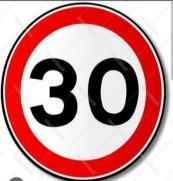
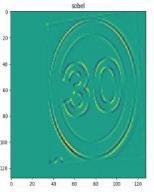
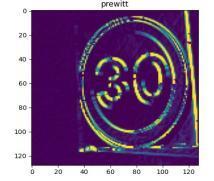
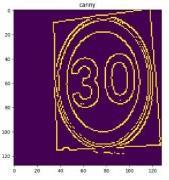
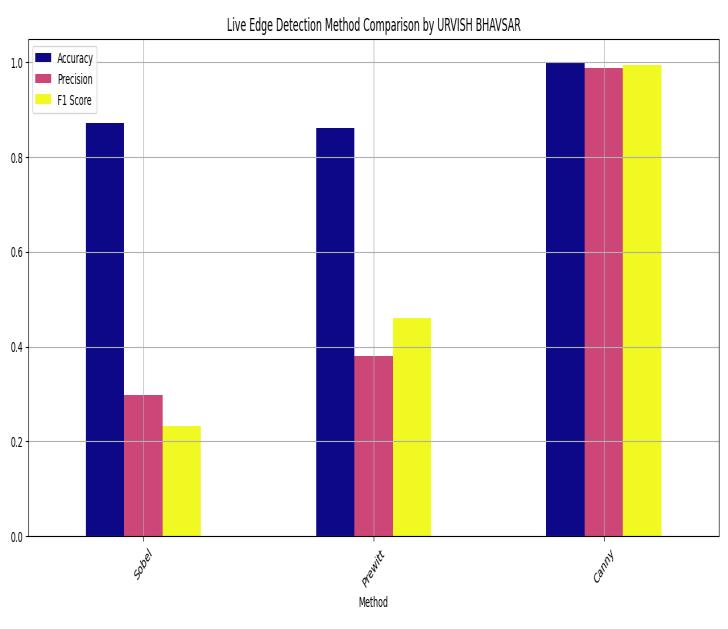
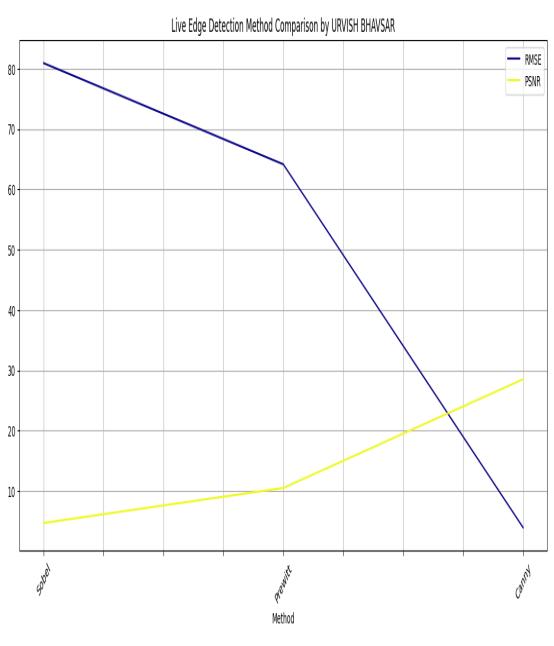
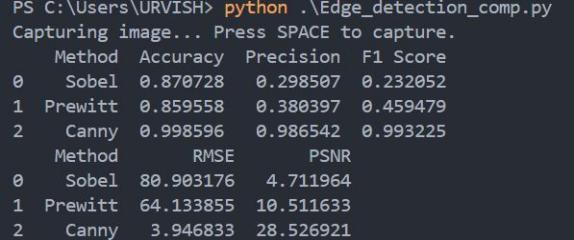
5 Edge detection comparison
Some traditional edge-detection techniques such as Canny, Sobel, and Prewitt algorithms used and applied somebasicedgedetectionalgorithmsforanimagetofind outwhichoneisthemostsuitable.
International Research Journal of Engineering and Technology (IRJET) e-ISSN: 2395-0056
Volume: 13 Issue: 03 | Mar 2026 www.irjet.net p-ISSN: 2395-0072
- 5 : Edge detection comparison
Canny edge detection significantly improves traffic sign recognition by reducing noise, improving high-precision, and enabling robust, real-time identification in complex, low-contrast, or poor-lighting conditions.It simplifies imagesforfasterclassification.
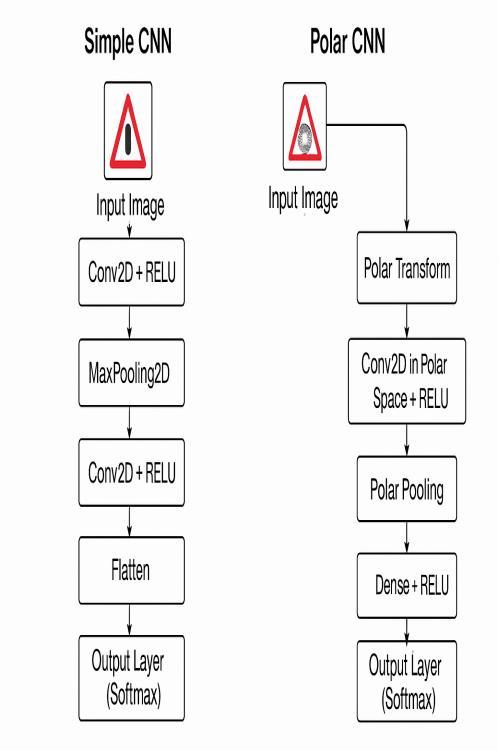
Figure 9 shows the architecture of proposed system. Input layer : Takes the standard Cartesian image. The inputlayerofthePolarCNNreceivestrafficimages,which are resized and preprocessed. Similar to a basic CNN, normalization is applied. The input layer plays a crucial role in providing consistent images for transformation intopolar space.
Polar Coordinate Transformation layer: Maps the image pixelstoapolargrid.ThislayerconvertstheCartesian(x,y) coordinate pixel grid onto polar coordinates by radius (r) and angle (θ). Through this, circular, triangular or octagonalsignshapesbecomelinearizedpatterns,making themeasierfortheCNNtodetect.
Convolutional and Polling layers : Extracts features from thepolargrid.
Flatten Layer : Converts the final feature map into a onedimensionalvector.
Fully Connected Layers : Classifies the extracted features andpassedfromRectifiedLinerUnitactivationfunction.
OutputLayer:Providesthefinalprediction.
- 6 : System Architecture
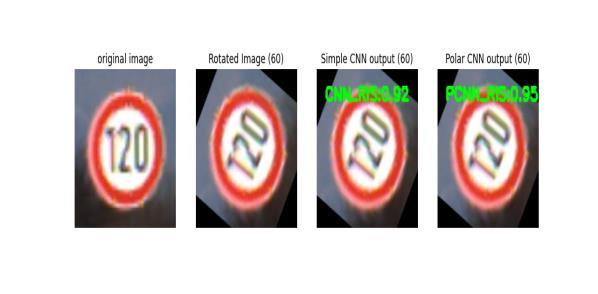
Fig -7 : Practically comparison of RIS score for different angles
International Research Journal of Engineering and Technology (IRJET) e-ISSN: 2395-0056
Volume: 13 Issue: 03 | Mar 2026 www.irjet.net p-ISSN: 2395-0072
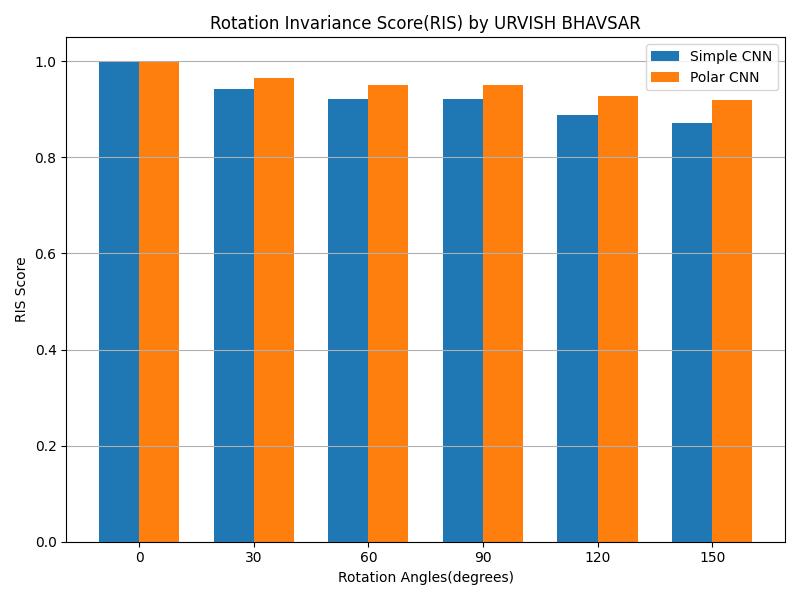
The complete preprocessing pipeline contributed significantlytothereductionofnoise,improvementofthe reductionofnoise,andenhancementof thefeature,which strengthenstheperformanceofthetrafficsignrecognition system. It clearly shows polar CNN better perform when imageisrotated.
1 Data Loading and Preprocessing : Imagesareloaded, resized and normalized. For PolarCNN, images are converted to polar coordinates before being fed to the network.
2 Data Augmentation : In this step, augmentation techniques such as rotation, scaling, translation, zooming, and brightness adjustments are applied which reduce overffiting.Italsohelpfulfortheimprovinggeneralization.
3 Initialize CNN weights Randomly : weights
4 Forward Propagation : Input images pass through different layers such as convolution, pooling, and fully connected layers to generate predicted class probabilities usingtheSoftmaxfunction.
5 Loss Computation : The predicted output is compared with the labels using the cross-entropy loss function for predictionerror.
6 Backpropagation : It helps to update weights to minimizeerror.
7 Weight Update : The Adam optimizer updates the weights using adaptive learning rates, which helps to minimizelossefficiently.
8 Validation Evaluation : This process is repeated from Step 2 to Steps 5 iteratively over all the epochs, which measurevalidationaccuracyandloss.
9 Model Check pointing : The best performing model is saved for deployment as follow : model.save("model.h5"), whichisfurtherusedwithreal-timeapplications.
International Research Journal of Engineering and Technology (IRJET) e-ISSN: 2395-0056
Volume: 13 Issue: 03 | Mar 2026 www.irjet.net p-ISSN: 2395-0072
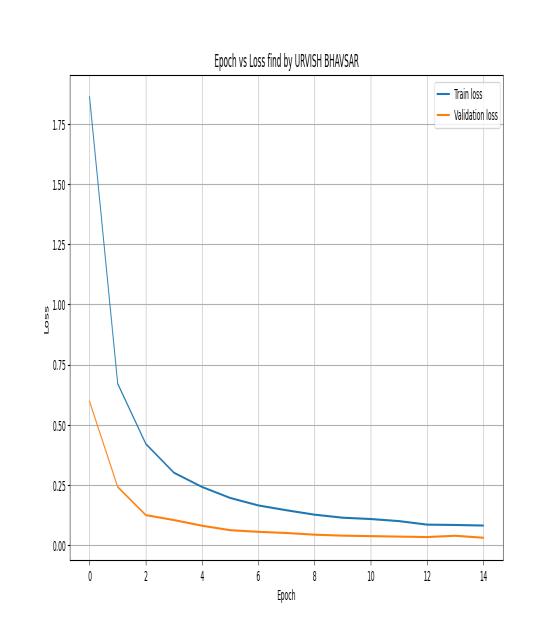
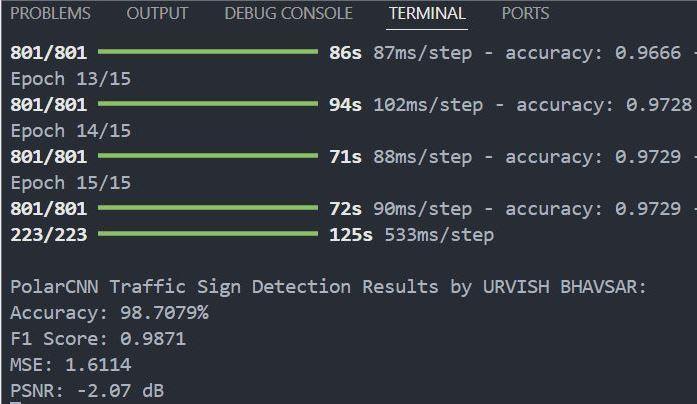
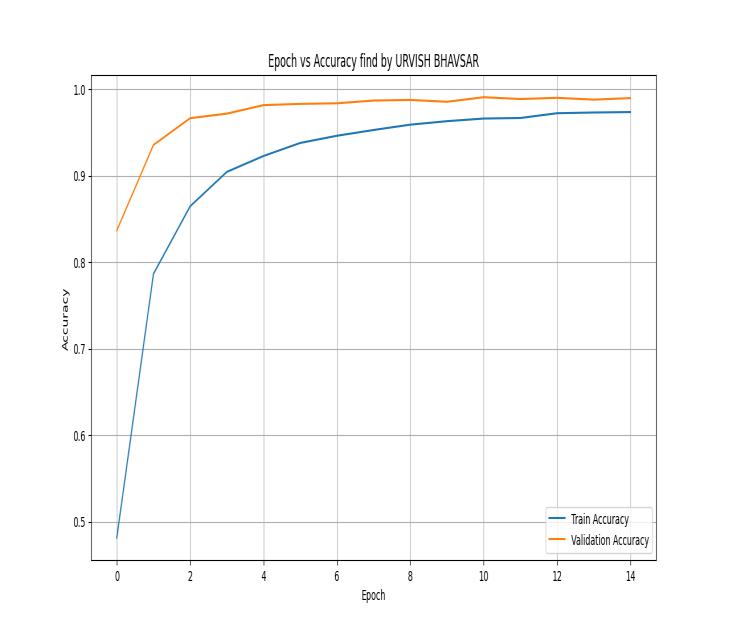
- 9 : Trainig result
3.2 Model Testing
1
Load the Trained Model : First load the trained polarCNNmodel(.h5file),thiswassavedaftertraining.Model = keras.model(“Polar_cnn.h5”).
2 Load the Test Dataset : The next step is loading test imagesfromdataset,whichyouhavetotest.
3 Preprocess Test Images : Apply preprocessing steps such as Resize images( 32 x 32 or 64 x 64) , Normalize pixelvalues(0-1)andConverttoarray.
4 Run Model Prediction : Prediction = model.predict(img) , Class_id = prediction.argmax() This modeloutputsthepredictedtrafficsignclass
5 Calculate performance metrics : After testing many images, performance metrics such as accuracy, precision, recall, and F1-score are calculated to evaluate the model performance.
6 Visualize Results : Display Bounding box detection results and prediction labels with light and sound indication.
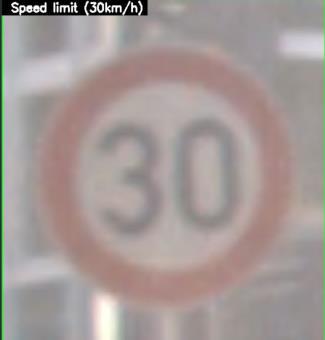
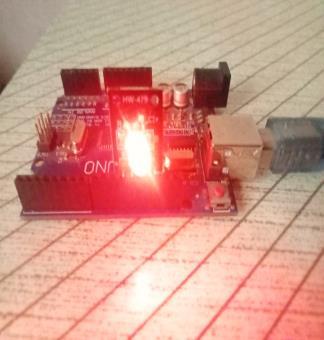
- 10 : Detection sign : Speed limit(30km/h) + bounding box + Red light indication + Sound

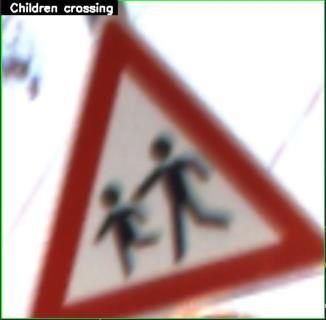
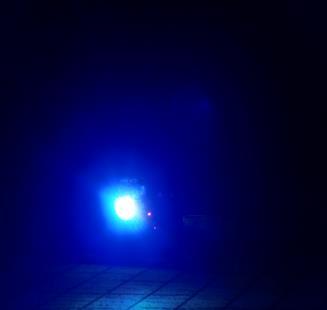
- 11 : Detection sign : Children crossing + bounding box + Blue light indication + sound
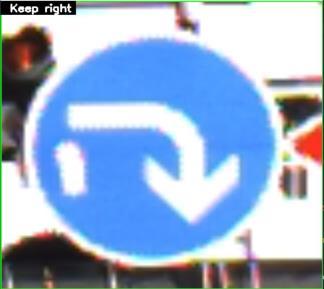
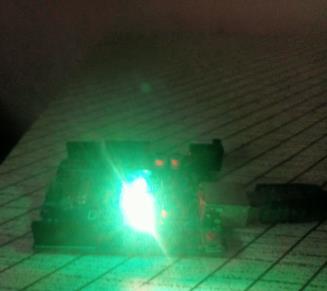
- 12 : Detection sign : Keep right + bounding box + Green light indication + sound
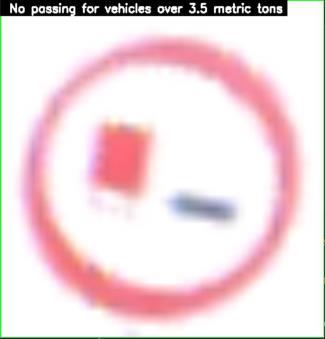
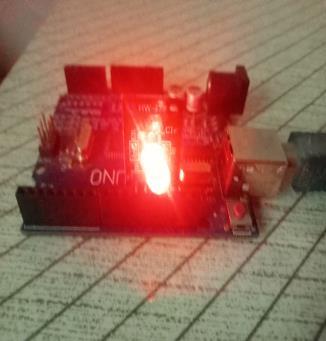
Fig - 13 : Detection sign : No passing for vehicles over 3.5 metric tons + bounding box + Red light indication + sound
International Research Journal of Engineering and Technology (IRJET) e-ISSN: 2395-0056
Volume: 13 Issue: 03 | Mar 2026 www.irjet.net p-ISSN: 2395-0072
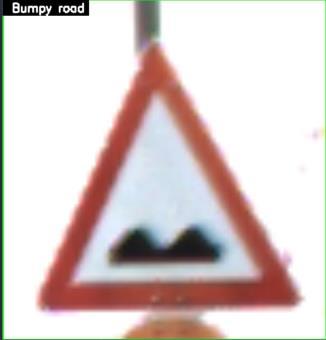
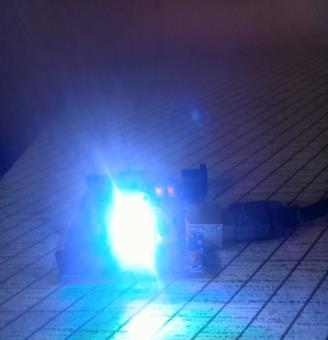
Fig - 14 : Detection sign : Bumpy road + bounding box + Blue light indication + sound
Table -1: Comparison and result
Feature SimpleCNN PolarCNN InputFormat Cartesian(x,y) Polar(r, θ)(radius,angle)
Rotation Invariance No Yes(inherent)
Implementation Easier Slightlycomplex Robustnessto
Rotation Low High Model Performancein
UsecaseExample DigitRecognition TrafficSign dectection
Developed an AI-based Traffic Sign Recognition system usingPolarCNNforaccuratedetectionoftrafficsigns.The system displays bounding boxaround the sign,sign name astext,andvoicealerts(audiofeedback)toinformtheuser about the detected traffic sign.The Polar CNN model improves recognition performance by effectively capturing rotational features of traffic signs.To enhance thepracticalusabilityofthesystem,hardwareintegration wasimplementedusinganArduinoandRGBLEDmodule. Wheredifferentcolorsindicatesdifferentconditions. RedLED:indicatesprohibitorysigns,BlueLED:indicates warningsigns,GreenLED:indicatesmandatorysigns. This system demonstrates how AI combined with hardwarecanimprovedriverawarenessandroadsafety.
The existing system can be improves using larger and morediversetrafficsigndatasets.
Additional sensorssuch ascameras,andIOTmodulescan be integrated for smart traffic monitoring systems integrationwithautonomousvehicleandAdvancedDriver AssistanceSystem(ADAS)canenhanceroadsafety.
[1] Harikesh Kumar Sharma Anupama Jamwa, “Traffic Sign Recognition System using CNN” International Journal of Innovative Science and Research Technology(IJSRT),11 November2023
[2] Ugur Yuzgec Irfan OKten, “Traffic Signs Recognition usingDeeplearningModel”,ResearchGate,May2025.
[3] Bharath Kumar Anupama Rani,“Traffic Sign Detection using Convolution Neural Network”, International Journal of Creative research thought (IJCRT), 5 May 2020
[4] Ruoqiao Jiang, Shaohui Mei, “Polar Cordinate Convolution Neural Network : From Rotation InvariancetoTranslationInvariance”,IEEE2019
[5] Bhogadi Sreeja Sruthila Bokka Giddi Shravya Katari Sri Vidya Vardini , “Trafic Sign Detection using Transfer learning and a Comparison Between DifferentTechniques”,IEEE2022
[6] Senthilnayaki B, Rajeswary C, Nivetha G, Dharanyadevi P, Mahalakshmi G, A.Devi “Traffic Sign Prediction and Classification Using Image Processing Techniques”2022 International Conference on Smart Technologies and Systems for Next Generation Computing(ICSTSN)
[7] Dr. Vijaykumar S. Bidve, Anula Bhole, Mrunalini Temgire, Sneha Wagh, Bhakti Toraskar, “ Traffic sign detectionusingCNN”,IJISET-InternationalJournalof Innovative Science, Engineering & Technology, Vol. 7 Issue7,July2020.
[8] Ahmed J. Abougarair, Mohammed Elmaryul, Mohamed KI Aburakhis ,”Real time traffic Sign detection and recognition for autonomous vehicle”,InternationalRobotics&AutomationJournal, Volume8Issue3-2022
[9] G jithin,Yanamala Umesh, “Traffic sign detection and recognition using deep learning”, Institute of Science andtechnology,May-2022.
[10] KaggleGTSRB-GermanTrafficSign[Dataset].Kaggle. Retrieved from https://www.kaggle.com/gtsrbgerman-traffic-sign