
International Research Journal of Engineering and Technology (IRJET) e-ISSN: 2395-0056
Volume: 13 Issue: 02 | Feb 2026 www.irjet.net p-ISSN: 2395-0072
International Research Journal of Engineering and Technology (IRJET) e-ISSN: 2395-0056
Volume: 13 Issue: 02 | Feb 2026 www.irjet.net p-ISSN: 2395-0072
Harshvardhan Laxman Bhosale1 , Vaishnavi Suryabhan Chothave2 , Arati Bharat Jadhav3 , Prof. Vikas Solanke4
1 2 3 Student, Diploma in Computer Engineering, Marathwada Mitra Mandal’s Polytechnic, Pune, Maharashtra, India
4 Head of Department, Department of Computer Engineering, Marathwada Mitra Mandal’s Polytechnic, Pune, Maharashtra, India
Abstract - In today’s organizations and educational institutions,handlingemployeeattendance,taskdistribution, and leave records through manual methods is inefficient, error-prone, and time-consuming. As digital transformation continues to expand, there is an increasing demand for centralized and automated solutions that enhance transparency, accuracy, and overall productivity. This paper introduces Trackify, a web-based system developed to efficiently manage attendance, tasks, and leave processes usingrole-basedaccesscontrol, real-time datahandling, and comprehensive reporting features.
Trackifyoffersaunifiedplatformwhereemployeescanrecord attendance, submit leave applications, and track assigned tasks, while managers and administrators can oversee workforceactivities,approverequests,andgeneratedetailed analytical reports. The system is built using modern web technologies such as Laravel, a MySQL database, and a responsive user interface to ensure scalability, security, and user friendliness. By automating routine administrative operations, the proposed system minimizes manual effort, supports better decision-making, and significantly improves organizational efficiency.
Keywords: Attendance Management, Task Management, Leave Management, Web Application, Laravel, RoleBased Access Control
In the modern, fast-moving professional landscape, organizationsencounternumerouschallengesineffectively managingworkforceoperations.Conventionalpracticesfor handling attendance records, task assignments, and leave documentation largely depend on manual processes or fragmentedsoftwaresystems.Suchmethodsfrequentlylead to data inconsistencies, reduced transparency, delayed approvalworkflows,anddifficultiesinevaluatingemployee performance
As web-based enterprise solutions become more widely adopted, organizations are increasingly shifting toward integrated management systems that offer real-time data access and automate routine administrative tasks. Attendance tracking, task supervision, and leave administration are essential aspects of workforce
management,andinefficienciesintheseareascannegatively affect productivity, employee morale, and overall organizationaldevelopment.
Toovercomethesechallenges,Trackifyisintroducedasan all-in-one web-based solution designed to centralize attendance, task, and leave management. The system incorporates multiple user roles such as Employee, Manager, and Administrator with clearly defined access privileges. By leveraging automation and real-time monitoring, Trackify reduces human errors, enhances transparency, and ensures accountability across all organizationallevels.
Despitesignificantprogressininformationtechnology,many organizations continue to depend on semi-manual or fragmented systems to manage attendance and employeerelatedactivities.Asaresult,severalrecurringissuescanbe observed. Manual attendance processes often lead to inaccuratetimerecordsandinstancesofproxyattendance. Leaveapplicationsarefrequentlymanagedthroughemailsor paper-basedforms,whichcancausecommunicationgapsand approval delays. Task allocation is commonly performed withoutpropermonitoringmechanisms,resultinginmissed deadlinesandweak accountability.Additionally,managers face challenges in assessingemployee performance due to databeingdispersedacrossmultipleplatforms.Manyexisting solutions also fail to provide adequate role-based security andreal-timereportingcapabilities.
ThemainobjectiveoftheTrackifysystemistodesignand develop a reliable web-based platform for efficient workforce management. The specific objectives of the systemincludeautomatingattendancemanagementthrough precisecheck-inandcheck-outtimerecording,providingan organizedtaskmanagementmechanismfortaskassignment, progresstracking,andstatusupdates,andimplementinga comprehensive leave management module supported by structuredapprovalworkflows.
Additionally,thesystemaimstoenforcerole-basedaccess control for employees, managers, and administrators to
International Research Journal of Engineering and Technology (IRJET) e-ISSN: 2395-0056
Volume: 13 Issue: 02 | Feb 2026 www.irjet.net p-ISSN: 2395-0072
ensureproperauthorizationandresponsibilityseparation. Trackifyalsofocusesongeneratingreal-timereports
The scope of the Trackify system encompasses a comprehensivesetoffeaturesaimedateffectiveworkforce management. The Attendance Module supports real-time check-inandcheck-outfunctionality,automatedattendance statuscalculation,andmaintenanceofattendancehistory. TheTaskModuleenablestaskcreation,assignment,progress monitoring, and timely status updates to ensure accountabilityandproductivity.TheLeaveModulefacilitates leave application submission, approval or rejection workflows,andsystematicmaintenanceofleaverecords.
In addition, the Reporting Module generates detailed attendancesummaries,taskperformancereports,andleaverelated analytics to assist management in evaluation and planning. User Management is implemented through rolebased access control, providing distinct permissions for employees,managers,andadministrators.Thesystemalso emphasizes security by incorporating authentication, authorization,andsecuredatastoragemechanisms.
Trackify is primarily designed for small to medium-scale organizations;however,itsmodularandscalablearchitecture allowsittobeextendedtolargerenterpriseswithminimal changes.
Numerous studies have explored workforce management systems,emphasizingtheroleofautomationinattendance monitoring,tasktracking,andleaveadministration.Earlier approaches primarily depended on biometric devices or manualrecord-keeping,whichoftenledtodataduplication, inflexibility, and limited adaptability. Recent research highlights the adoption of web-based platforms as an effectivesolutionforenhancingaccessibility,accuracy,and operationalefficiency.
Research on web-based attendance systems demonstrates thatreal-timeattendancemonitoringhelpsminimizeproxy attendance and significantly improves data reliability. Similarly,studiesondigitaltaskmanagementsystemsreveal that automated task assignment and tracking enhance accountabilityandpromotebettercollaborationamongteam members. Integrated leave management systems with structured approval workflows have also been shown to reduce administrative delays while improving employee satisfaction.
Despitetheseadvancements,manyexistingsolutionsfocus ononlyasinglefunctionalarea suchasattendancetracking ortaskmanagement ratherthanofferingacomprehensive andintegratedsystem.Furthermore,severalplatformslack
effectiverole-basedaccesscontrol,limitingtheirsuitability for organizations with hierarchical structures. Trackify overcomes these limitations by providing a unified webbased platform that integrates multiple workforce management modules with clearly defined user roles and accesspermissions.
TheTrackifysystemisdevelopedusinganenhancedthreetier web-based architecture combined with role-based access control and modular service components. This architectural design ensures scalability, security, maintainability, and efficient coordination among various functionalmodules,includingattendancemanagement,leave management,tasktracking,projecthandling,reporting,and notifications.
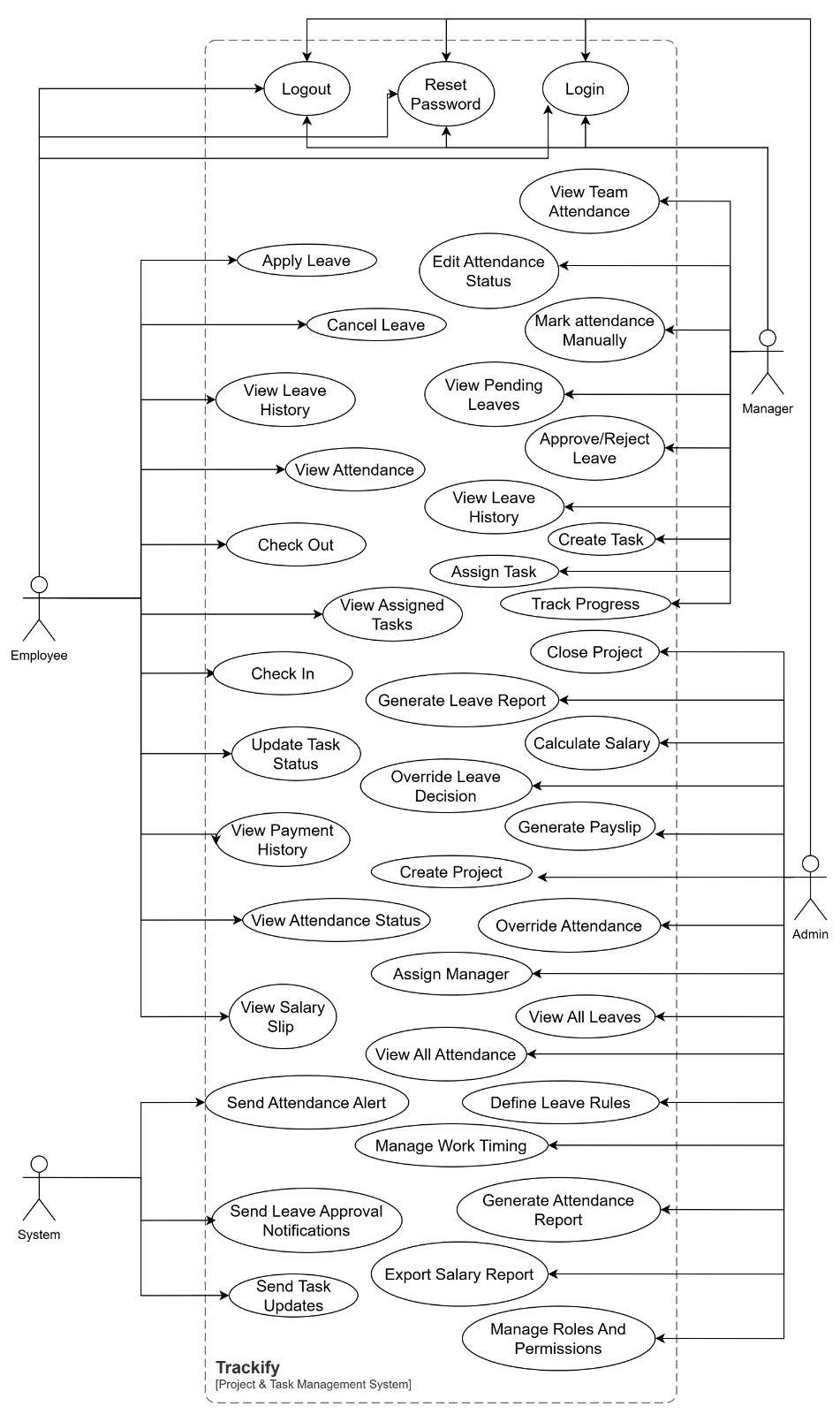
The system architecture is closely aligned with the UML ClassDiagramandUseCaseDiagram,whichclearlydefine boththestructuralcomponentsandfunctionalbehaviorof theapplication.
The presentation layer serves as the user interface of the Trackify system and facilitates interaction between users andtheapplication.Itprovidesrole-specificdashboardsfor Employees, Managers, and Administrators, ensuring that users can access only those features permitted by their assignedroles.
This layer is implemented using:
HTML and CSS for page structureand visual styling Blade templating engine for generating dynamic and reusable views.JavaScriptforclient-sideinteractivityandvalidation Throughthepresentationlayer,userscanperformvarious operations such as marking attendance and viewing attendance status, submitting leave applications and tracking approval status, viewing assigned tasks and updatingtaskprogress,andmonitoringprojectdetailsand analyticalreports.Communicationbetweenthepresentation layer and the application layer occurs securely through HTTPrequests.
The application layer represents the core processing componentoftheTrackifysystem.Itisdevelopedusingthe Laravel PHP framework, which follows the Model-ViewController(MVC)architecturalpattern.
This layer is responsible for processing user requests received from the presentation layer, executing business logic related to attendance, leave, tasks, projects, and reporting, and enforcing authentication and role-based authorization. It also manages data validation, workflow
International Research Journal of Engineering and Technology (IRJET) e-ISSN: 2395-0056
Volume: 13 Issue: 02 | Feb 2026 www.irjet.net p-ISSN: 2395-0072
rules, calculations such as leave status and salary-related logic, and generates system notifications and reports. Controllers,services,andmodelsimplementedwithinthis layer directly correspond to the entities and relationships defined in the UML Class Diagram, ensuring consistency betweensystemdesignandimplementation.
Thedatabaselayerisresponsibleforstoringandmanaging all persistent data used by the Trackify system. It utilizes MySQL as the relational database management system to providereliableandefficientdatastorage.
This layer maintains structured data for user profiles and role assignments, attendance records with check-in and check-out timestamps, leave applications and approval histories,taskallocationsandprojectstatusinformation,as well as system-generated reports and notifications. Relationalconstraints,indexingmechanisms,andvalidation rulesareappliedto maintaindata integrity,accuracy,and consistency.
The three-tier architecture of Trackify is reinforced and validated through UML modeling techniques. The Class Diagram illustrates the static structure of the system and aligns with both database entities and application logic, whiletheUseCaseDiagramrepresentsinteractionsbetween differentuserrolesandsystemfunctionalities. This integrated architectural approach ensures that the Trackifysystemremainsmodular,scalable,andadaptableto futureenhancementsandorganizationalrequirements.
7.1 Class Diagram
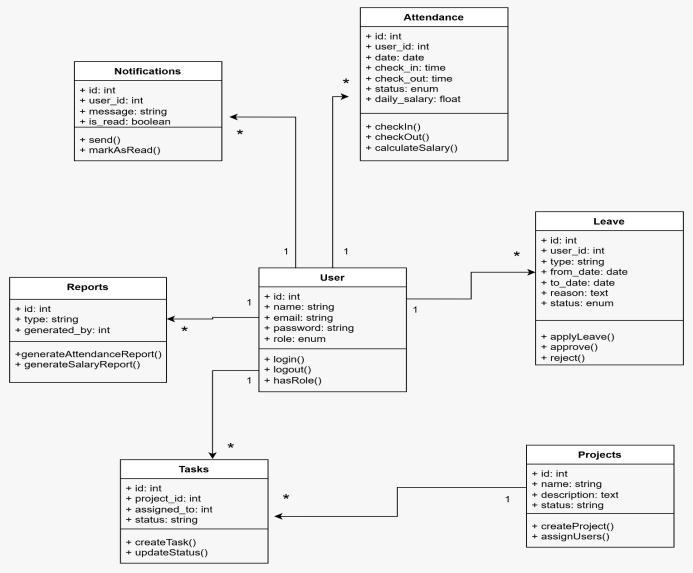
The Class Diagram illustrates the static structure of the Trackifysystembydefiningitsclasses,attributes,methods, andtherelationshipsamongthem.Itoffersacomprehensive viewofhowdataisstructuredwithinthesystemandhow variouscomponentsinteractwithoneanother.
In the Trackify system, the User class serves as the core entity,representingalltypesofusers,includingEmployees, Managers, and Administrators. Each user interacts with multiple functional modules such as Attendance, Leave, Tasks,Projects,Reports,andNotifications.Thiscentralized user-centric design ensures consistent data management andsmoothinteractionacrossallsystemmodules.
7.1. Use- Case Diagram
International Research Journal of Engineering and Technology (IRJET) e-ISSN: 2395-0056
Volume: 13 Issue: 02 | Feb 2026 www.irjet.net p-ISSN: 2395-0072
TheUseCaseDiagramrepresentsthefunctionalbehaviorof theTrackifysystembydepictingtheinteractionsbetween various actors and system features. It clearly defines the actionsthateachuserrole suchasEmployee,Manager,and Administrator canperformandillustrateshowtheseroles interactwiththesystemtoaccomplishspecifictasks.
TheTrackifysystemisstructuredintoeightcorefunctional modules, each addressing a specific organizational need. These modules operate in coordination to deliver a comprehensiveweb-basedsolutionforemployeeandproject management.
The User Management Module manages user registration, authentication, and authorization processes. Each user is assignedapredefinedrolesuchasEmployee,Manager,or Administrator,andsystemaccessisgovernedaccordingto these roles. This module ensures secure authentication, password protection, and strict role-based access control, thereby preventing unauthorized access to sensitive information.
TheAttendanceManagementModuleenablesemployeesto record daily attendance using a check-in and check-out mechanism. The system captures exact timestamps and automaticallyclassifiesattendancestatus suchasPresent, Late, Half-Day, or absent based on predefined organizationalrules.Managersandadministratorscanview attendancesummaries,modifyrecordswhennecessary,and generatedetailedattendancereports.
TheTaskManagementModuleallowsmanagerstoallocate taskstoemployeeswithclearlydefineddeadlines,priorities, andtaskdescriptions.Employeescanaccessassignedtasks, update progress, and change task status accordingly. This module enhances accountability, supports timely task completion, and improves transparency in daily work activities.
TheProjectManagementModuleenablesadministratorsand managerstocreate,manage,andmonitorprojects.Tasksare linked to specific projects, allowing structured project tracking. This module supports real-time monitoring of projectprogress,identificationofdelaysorbottlenecks,and effective utilization of organizational resources. Project statuses such as ongoing, completed, or delayed can be trackedefficiently.
TheLeaveManagementModulefacilitatesemployeeleave applicationsforvariouscategoriessuchasCasualLeave,Sick Leave, and Paid Leave. Leave requests are forwarded to managersforapprovalorrejection,whileadministratorscan analyzeleavetrendsandmaintaincompleteleavehistories. This module reduces manual paperwork and ensures compliancewithorganizationalleavepolicies.
TheNotificationModuledeliversreal-timealertsandsystem updatestousers.Notificationsaretriggeredforkeyevents including task assignments, leave approval or rejection, attendancestatuschanges,andimportantannouncements. Thismoduleenhancesinternalcommunicationandensures usersremaininformedaboutcriticalactionsanddeadlines.
TheReportsandAnalyticsModulegeneratescomprehensive reports related to attendance, task performance, project status, productivity metrics, and leave statistics. These reports assist managers and administrators in evaluating employee performance and organizational efficiency. Summarized insights and visual representations support informeddecision-making.
The Settings and Configuration Module allows administrators to define and manage system-level parameters such as working hours, attendance policies, leaverules,andorganizationaldetails.Whilemanagersand employees can view configuration settings, modification privilegesarerestrictedtoadministratorsonly.Thismodule ensures system flexibility and adaptability to evolving organizationalrequirements.
TheTrackifysystemincorporatesrole-basedaccesscontrol to ensure secure and authorized usage of system functionalities.Employeesarepermittedtoaccessonlytheir personaldata,whereasmanagersaregrantedaccesstoview andmanageinformationrelatedtotheirrespectiveteams. Administrators possess complete system privileges, including user administration and report generation. This hierarchical access structure prevents unauthorized operationsandsafeguardsdataconfidentiality.
TheproposedTrackifysystemprovidesseveralsignificant benefits. It minimizes manual workload and reduces paperworkbyautomatingroutineprocesses. The system enhances accuracy and transparency in attendanceandleavemanagement,therebyreducingerrors
International Research Journal of Engineering and Technology (IRJET) e-ISSN: 2395-0056
Volume: 13 Issue: 02 | Feb 2026 www.irjet.net p-ISSN: 2395-0072
and inconsistencies. Productivity is improved through efficient task allocation and tracking mechanisms. Additionally, real-time reporting supports informed managerialdecision-making,whilerole-basedaccesscontrol ensuressecureaccesstosystemresources.
The Trackify system is implemented using contemporary web technologies to ensure scalability, security, and longtermmaintainability.Thechosentechnologystacksupports rapidapplicationdevelopment,effectiverole-basedaccess control,andefficientreal-timedataprocessing.
11.1 Front-End
TheuserinterfaceoftheTrackifysystemisdevelopedusing HTML5,CSS3,andJavaScript.HTML5definesthestructural layout of the web pages, while CSS3 is utilized to create responsiveandvisuallyengagingdesigns.JavaScriptenables interactivefeaturessuchasdynamicforms,liveupdates,and client-side input validation. Additionally, the Blade templatingengineisemployedtoseamlesslyintegratefrontendcomponentswithbackendfunctionality.
11.2
ThebackendoftheTrackifysystemisbuiltusingPHPwith the Laravel framework. Laravel follows the Model-ViewController(MVC)architecturalpattern,whichenhancescode readability, modularity, and maintainability. It provides built-insupportforessentialfeaturessuchasauthentication, authorization, routing, middleware handling, and form validation,making it well-suited for enterprise-grade web applications.
MySQL is used as the relational database management systemtostoreuserprofiles,attendancelogs,taskdetails, projectdata,leaverecords,andsystemreports.Thedatabase design follows normalization principles to minimize redundancy and maintain data consistency. Laravel’s Eloquent ORM facilitates secure and efficient database operationsthroughanobject-orientedapproach.
XAMPP serves as the local development environment, offering an integrated setup of the Apache web server, MySQLdatabase,andPHPinterpreter.VisualStudioCodeis usedastheprimarydevelopmenteditorduetoitsextensive extension ecosystem and debugging capabilities. Git is utilizedforversioncontroltomanagesourcecodechanges andsupportcollaborativedevelopment.
TheTrackifysystemisdesignedfordeploymentoncloudbased or shared hosting platforms that support PHP and MySQL. The deployment process involves environment configuration, database migration, and implementation of securitymeasurestoensurereliableandsecureoperationin aproductionenvironment.
The implementation of the Trackify system follows a modularandrole-orienteddesignapproach.Eachfunctional moduleisdevelopedindependentlyandthenintegratedto operatecohesivelyasaunifiedsystem.
User authentication is handled using Laravel’s built-in authentication mechanisms. Role-based access control is implementedthroughmiddlewaretoensurethatEmployees, Managers, and Administrators can access only the functionalitiespermittedtotheirroles.Userpasswordsare securely stored using standard hashing techniques to maintaindatasecurity.
The Attendance Management Module captures real-time check-inandcheck-outtimestampsusingserver-sidetimeto eliminatethepossibilityofmanualmanipulation.Attendance status is automatically determined based on predefined organizational rules. Managers and administrators are granted additional privileges to review, verify, or modify attendancerecordswhennecessary.
Projects are created and managed by administrators and managers,withtasksassignedtoemployeesunderspecific projects.Eachtaskincludesattributessuchasprioritylevel, deadline, and current status. Employees update task progress, which is reflected in consolidated project summaries,enablingeffectivemonitoringofworkprogress andteamperformance.
Employees submit leave applications through structured formsthatcapturedetailssuchasleavetype,duration,and reason. These requests are stored in the database and forwardedtomanagersforapprovalorrejection.Anychange in leave status automatically updates records and notifies theemployeethroughthenotificationsystem.
The Notification Module utilizes database-driven notificationstoalertusersaboutimportantsystemevents,
International Research Journal of Engineering and Technology (IRJET) e-ISSN: 2395-0056
Volume: 13 Issue: 02 | Feb 2026 www.irjet.net p-ISSN: 2395-0072
includingattendanceupdates,taskassignments,andleave approvaldecisions.Notificationsaredisplayedinrealtime on the user dashboard to ensure timely and effective communication.
TheReportsandAnalyticsModulegeneratescomprehensive attendance reports, leave summaries, task performance indicators,andproductivityinsights.Databasequeriesare optimized to efficiently handle large volumes of data. Reports can be viewed within the system or exported for administrativeandrecord-keepingpurposes.
The Settings and Configuration Module enables administrators to define system-wide parameters such as office working hours, attendance policies, and leave rules. These settings dynamically influence system behavior without requiring changes to the application source code, ensuringflexibilityandeaseofmanagement.
Testing and validation play a vital role in ensuring the reliability,accuracy,andoverallperformanceoftheTrackify system. Various testing methodologies are applied at differentstagesofdevelopmenttoverifysystemcorrectness andstability.
Unittestingiscarriedoutonindividualcomponentssuchas attendancestatuscalculation,leaveapprovallogic,andtask status updates. Each module is tested independently to confirmthatitperformsitsintendedfunctioncorrectly.This approachhelpsindetectingandresolvingissuesatanearly stageofdevelopment.
13.2
Integrationtestingisconductedtoverifyproperinteraction and data flow between different modules of the system. Scenariossuchasattendancedatagenerationinreportsand the integration of leave approvals with the notification system are tested to ensure consistency and seamless moduleinteraction.
Systemtestinginvolvesevaluatingthecompleteapplication in a simulated real-world environment. All user roles including employees, managers, and administrators perform their respective operations to ensure that the system functions correctly under both normal and peak workloadconditions.
UserAcceptanceTestingisperformedbyallowingendusers, such as employees and managers, to interact with the system.Feedbackcollectedduringthisphaseisusedtomake minor usability enhancements, improving overall user experienceandsystemacceptance.
All defined test cases were executed successfully, and the system satisfied both functional and non-functional requirements identified during the requirement analysis phase. The Trackify system demonstrated high levels of accuracy,reliability,anduserfriendliness.
TheTrackifysystemeffectivelyaddressesthekeychallenges faced by organizations in managing attendance, tasks, projects,leaveprocesses,notifications,reporting,anduser roles through a unified web-based platform. Conventional manualmethodsandisolatedsoftwaretoolsoftenresultin operational inefficiencies, data inconsistency, limited transparency,andincreasedadministrativeburden.Trackify successfully overcomes these challenges by offering a centralized, automated, and role-based workforce managementsolution.
Thesystemisdevelopedusingamodulararchitecturethat enables seamless interaction among various functional modules,includingattendancemanagement,tasktracking, projectmonitoring,leaveprocessing,notifications,reporting, and system configuration. The adoption of modern web technologies ensures scalability, security, and ease of use. Role-based access control clearly defines permissions for employees, managers, and administrators, thereby minimizing unauthorizedaccessandreducingoperational errors
Real-time attendance tracking with accurate check-in and check-outtimestampsenhancesaccountabilityandprevents time manipulation. Automated leave approval workflows improve transparency and significantly reduce delays in decision-making. Task and project management features provide better visibility into employee productivity and projectprogress,whilethereportingandanalyticsmodule supports informed managerial decisions through comprehensivesummariesandinsights.
Extensive testing and validation confirm that the Trackify system performs reliably across various usage scenarios. The system satisfies all functional and non-functional requirements and demonstrates strong potential for deployment in educational institutions, small-to-medium enterprises,andcorporateenvironments.
International Research Journal of Engineering and Technology (IRJET) e-ISSN: 2395-0056
Volume: 13 Issue: 02 | Feb 2026 www.irjet.net p-ISSN: 2395-0072
AlthoughTrackifysuccessfullyfulfillsitscurrentobjectives, there is considerable scope for future enhancements to furtherexpanditsfunctionalityandadaptability.
Future developments may include the integration of biometric and facial recognition-based attendance mechanisms to improve accuracy and eliminate proxy attendance. The development of mobile applications for Android and iOS platforms can enhance accessibility and allowuserstomanageattendance,tasks,andleaverequests remotely.
Advancedanalyticsandartificialintelligencetechniquescan be incorporated to predict employee performance trends, analyzeleavepatterns,andidentifypotentialprojectrisks. Machinelearningmodelsmayalsobeemployedtoprovide intelligentrecommendationsforworkloaddistributionand productivityoptimization.
Integration with payroll systems can automate salary calculations based on attendance records, leave data, and overtime,therebyreducingmanualprocessing.Additionally, connectivitywiththird-partycommunicationservicessuch as email, SMS, and messaging platforms can strengthen notificationdeliveryandcommunicationefficiency. Adopting cloud-based deployment and microservices architecture can further improve system scalability, reliability, and performance for large-scale organizations. Enhanced security features such as two-factor authentication, audit logging, and advanced access monitoring can also be implemented to strengthen data protection.
Withthesefutureenhancements,Trackifyhasthepotential to evolve into a comprehensive enterprise resource management platform capable ofsupportingcomplex and dynamicorganizationalrequirements.
[1]. I.Sommerville,SoftwareEngineering,10thed. PearsonEducation,2016.
[2]. R.S.PressmanandB.R.Maxim,Software Engineering:APractitioner’sApproach,8thed. McGraw-HillEducation,2015.
[3]. K.C.LaudonandJ.P.Laudon,Management InformationSystems:ManagingtheDigitalFirm, 15thed.PearsonEducation,2018.
[4]. A.Dennis,B.H.Wixom,andR.M.Roth,Systems AnalysisandDesign,7thed.Wiley,2015.
[5]. M.Fowler,UMLDistilled:ABriefGuidetothe StandardObjectModelingLanguage,3rded. Addison-Wesley,2004.
[6]. P.DeitelandH.Deitel,Internet&WorldWideWeb: HowtoProgram,5thed.PearsonEducation,2012.
[7]. LaravelDocumentation,“LaravelFramework.” [Online].Available:https://laravel.com/docs (Accessed:Jan.2026).
[8]. MySQLDocumentation,“MySQLDatabase ManagementSystem.”[Online].Available: https://dev.mysql.com/doc(Accessed:Jan.2026).
[9]. WorldWideWebConsortium(W3C),“HTML5 Specification.”[Online].Available: https://www.w3.org/TR/html5/(Accessed:Jan. 2026).
[10]. WorldWideWebConsortium(W3C),“CSS3 Specification.”[Online].Available: https://www.w3.org/Style/CSS/(Accessed:Jan. 2026).
[11]. ECMAInternational,“ECMAScript2021Language Specification.”[Online].Available: https://www.ecma-international.org(Accessed:Jan. 2026).
[12]. IEEEComputerSociety,IEEEStandardforSoftware andSystemTestDocumentation,IEEEStd8292008,2008.
[13]. OWASPFoundation,“OWASPTopTenWeb ApplicationSecurityRisks.”[Online].Available: https://owasp.org(Accessed:Jan.2026).
[14]. R.Buyya,J.Broberg,andA.Goscinski,Cloud Computing:PrinciplesandParadigms.Wiley,2011.
[15]. ISO/IEC25010,SystemsandSoftwareQuality RequirementsandEvaluation(SQuaRE). InternationalOrganizationforStandardization, 2011.