
International Research Journal of Engineering and Technology (IRJET) e-ISSN: 2395-0056
Volume: 12 Issue: 12 | Dec 2025 www.irjet.net p-ISSN: 2395-0072
International Research Journal of Engineering and Technology (IRJET) e-ISSN: 2395-0056
Volume: 12 Issue: 12 | Dec 2025 www.irjet.net p-ISSN: 2395-0072
Andrew Renault1
1 Grad Student, Dept. of Aeronautical Science, Capital Technology University, South Laurel, Maryland, USA
Abstract - ThisExegesispresentsanintegratedsynthesisof three interrelated studies that collectively address the modernization of air traffic control (ATC) systems to enable thesafeandefficientintegrationofunmannedaerialvehicles (UAVs)intocontrolledairspace.Together,thestudiesestablish a coherent research trajectory that progresses from conceptual framing to empirical validation. Paper 1, “NavigatingtheSkies:TheNecessityforUpgradingAirTraffic Control Systems,” identifies the structural and technological limitations of legacy ATC infrastructure and articulates the strategic need for digital transformation across communication, radar, and procedural domains. Paper 2, “Seeing the Unseen: A Literature Review of UAV Detection Gaps and Surveillance and Security Solutions for ATC Modernization,” deliversacomprehensiveliteraturereviewof emerging detection and surveillance technologies, emphasizing multi-sensor fusion, artificial intelligence, automation, and cybersecurity as enablers of operational safety and resilience. Paper 3, “Designing Safer Skies: Evaluating UAV and ATC System Interactions through SimulationandQualitativeAnalysis,” appliesamixed-methods Design of Experiments (DOE) approach to empirically test modernizationvariables,producingquantitativeevidencethat integrated, AI-assisted systems substantially enhance detection accuracy, communication stability, and cyberresilience. The Exegesis consolidates these findings to demonstratethateffectiveUAVintegrationrequiresaholistic modernization framework uniting engineering innovation, regulatoryadaptation,andsafetymanagement.Itintroduces avalidatedsystem-of-systems(SoS)modelforintelligentand adaptive airspace governance capable of supporting autonomousoperationswhilepreservingsafetymargins.The collective results confirm that modernization is achieved not through isolated technological upgrades but through the convergence of networked data systems, automation, and secure digital infrastructure. This work contributes to both scholarlyandoperationalpracticebyprovidingareproducible framework for policymakers, engineers, and researchers seekingtoadvanceUAV–ATCinteroperabilityandensurethe futuresafetyandsustainabilityofglobalairspaceoperations.
Key Words: UAV integration, system-of-systems, air traffic control, AI in aviation, radar limitations, cybersecurity, human factors, regulatory frameworks, multi-sensor fusion
The integration of unmanned aerial vehicles (UAVs) into controlled airspace represents one of the most intricate modernizationchallengesconfrontingtheglobalairtraffic control (ATC) community. Traditional ATC systems were originally engineered for predictable, manned flight operations,whereradarsurveillance,voicecommunication, andstructuredflightrulesmaintainedadequatesituational awareness.TherapidproliferationofUAVs rangingfrom smallcommercialdronestolargeautonomousaircraft has disrupted this equilibrium, introducing new operational risks, surveillance gaps, and cybersecurity vulnerabilities. Addressing these issues requires not incremental adjustment but a comprehensive evolution of both the technical infrastructure and procedural frameworks that supportmodernairtrafficmanagement(ATM).
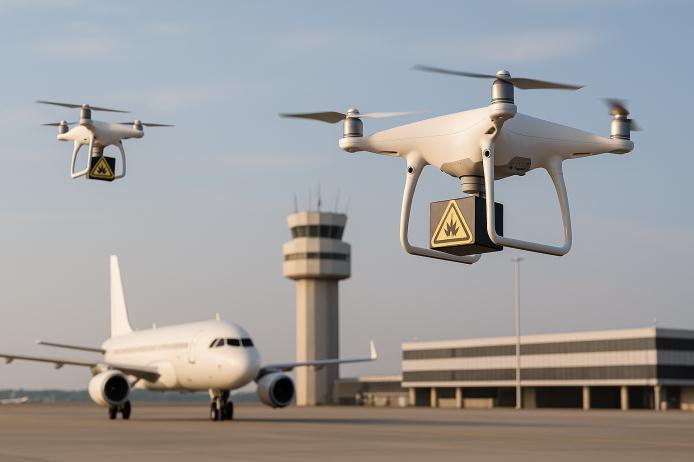
Figure 1.1 - UAVswithweaponizedpayloadsundetected atacommercialairport
ThisExegesisintegratesthreepeer-reviewedstudiesthat collectively examine ATC modernization through technological,policy,andsafety-performanceperspectives. Paper1,“NavigatingtheSkies:TheNecessityforUpgrading AirTrafficControlSystems”[1],establishedthefoundational argumentthatlegacyATCinfrastructurecannotsustainably managetheprojectedvolumeanddiversityofUAVtraffic.It identified critical bottlenecks in radar coverage, communication latency, and controller workload, emphasizing the necessity of automation-assisted architecturesanddigitallyintegratednetworkstomaintain systemresilience.
International Research Journal of Engineering and Technology (IRJET) e-ISSN: 2395-0056
Volume: 12 Issue: 12 | Dec 2025 www.irjet.net p-ISSN: 2395-0072
Paper2,“SeeingtheUnseen:ALiteratureReviewofUAV DetectionGapsandSurveillanceandSecuritySolutionsfor ATCModernization”[2],expandeduponthisfoundationby performingacomprehensiveliteraturereviewofemerging surveillanceanddetectiontechnologies.Itevaluatedradar, optical,acoustic,andmulti-sensorfusionapproacheswhile highlightingpersistentdetectionlimitationsthatconstrain reliable UAV tracking. This research demonstrated how artificial intelligence (AI) and data-fusion analytics can mitigate these gaps, enhancing situational awareness and decisionaccuracyinmixed-trafficairspaceenvironments.
Paper3,“DesigningSaferSkies:EvaluatingUAVandATC System Interactions through Simulation and Qualitative Analysis” [3], operationalized these insights through a mixed-methods Design of Experiments (DOE) framework. ThestudyquantifiedhowUAVdesigncharacteristics,sensor configurations, radar performance, and cyber-resilience measures influence overall safety outcomes. Empirical results provided statistical evidence supporting the deploymentofadaptive,AI-enabledcontrolsystemscapable of improving detection accuracy, reducing latency, and strengtheningnetworksecurity.
Within the publication-based dissertation framework, this Exegesis functions as the integrative synthesis that binds these independent studies into a cohesive body of knowledge. Its primary objective is to demonstrate the cumulative contribution of the three papers toward advancing UAV–ATC modernization. By consolidating theoretical, technical, and empirical findings, it presentsa unified narrative illustrating how the combined research informs aviation policy, system design, and safetymanagementpractices.
Furthermore,italignsthecollectiveoutcomeswiththe overarchingdissertationresearchquestion:
How can integrated technological and procedural modernization enable the safe and efficient coexistence of UAVs within existing ATC systems?
Through this integration, the Exegesis reinforces the significance of each publication while situating their collective insights within the broader scholarly and operationaldiscourseonnext-generationATM.Thesections that follow expand this synthesis by examining shared literaturefoundations,cross-paperknowledgecontributions, andthepracticalimplicationsthatemergewhenthethree studiesareviewedasasingle,progressiveinvestigationinto thefutureofsaferandsmarterskies.
The purpose of this Exegesis is to synthesize the collective outcomes of three peer-reviewed studies that together explore the modernization of ATC systems in response to the expanding operational presence of UAVs.
Each publication addresses a specific dimension of the overarching research problem the safe, secure, and efficientintegrationofUAVsintocontrolledairspace while contributingincrementallytothebodyofknowledgeguiding technologicalandproceduraltransformationwithinaviation systems.
ThisExegesisisgroundedinamixed-methodsresearch paradigm combining quantitative simulation, qualitative documentanalysis,andDOEmodelingtoevaluateUAV–ATC interactions. This methodological integration reflects the multidimensional character of aviation modernization, whichdemandsconvergenceamongengineeringinnovation, human–systemintegration,regulatoryevolution,andriskmanagementpractices.Accordingly,theExegesisfunctions notonlyasaconsolidationofpublishedworkbutalsoasa unified analytical framework demonstrating how multidisciplinaryinquirycaninformpolicyandengineering decisionsinacomplexsocio-technicalenvironment.
Fromadisciplinaryperspective,theresearchoperatesat theintersectionofaerospaceengineering,ATM,andsafety systemsengineering.
Paper [1], framed the modernization problem by identifying structural deficiencies in legacy ATC infrastructure,particularlyitslimitedadaptability todynamicandautonomousflightoperations.
Paper[2],expandedtheacademiccontextthrougha systematic review of surveillance and detection technologies,evaluatingradar,optical,acoustic,and multi-sensor fusion approaches to reduce uncertaintyandstrengthendetectioncapability.
Paper [3], translated these theoretical constructs into an applied DOE framework, generating measurable performance data on detection accuracy,systemreliability,andcyber-resilience.
Thepurposeofconsolidatingthesethreeworkswithin theExegesisisfourfold:
1. Integration of Knowledge: To connect the conceptual, analytical, and experimental insights generated by each paper, demonstrating their interdependence in forming a comprehensive modernizationmodel.
2. Validation of Research Coherence:Toshowhow each publication builds sequentially toward a unified understanding of UAV–ATC interaction challengesandsystem-levelsolutions.
3. Translation of Research to Practice:Tohighlight the implications of the findings for aviation authorities, system engineers, and policymakers
International Research Journal of Engineering and Technology (IRJET) e-ISSN: 2395-0056
Volume: 12 Issue: 12 | Dec 2025 www.irjet.net p-ISSN: 2395-0072
engaged in developing next-generation ATC systems.
4. Identification of Future Directions:Toestablisha roadmap for continued scholarly and technical innovation,supportingfutureresearchinAI-driven surveillance, advanced automation, and adaptive safety-managementframeworks.
Contextually, this work aligns with international modernization initiatives led by the Federal Aviation Administration (FAA), European Union Aviation Safety Agency(EASA),andInternationalCivilAviationOrganization (ICAO) eachprioritizingthesafeintegrationofUAVsinto shared airspace. These agencies advocate digital transformation across communication, navigation, and surveillance(CNS)systemswhilereinforcingcybersecurity andinformation-assurancestandardsascriticalenablersof operational resilience. The Exegesis situates its findings withinthisglobalframework,illustratinghowtheresearch supports efforts to achieve interoperability, situational awareness,andnetwork resilienceacrossnext-generation ATCinfrastructures.
Ultimately,the purpose of this Exegesis isto present a unified analytical lens through which UAV–ATC modernizationcanbeunderstoodnotasisolatedstudiesbut as a coordinated research trajectory bridging theoretical insight, technical experimentation, and operational application. This context underscores the urgency of adapting existing infrastructures to keep pace with technological advancement while maintaining the uncompromising safety culture that defines modern aviation.
ThestructureofthisExegesisfollowsalogical,sequential progression that integrates three foundational peerreviewed studies, each representing a distinct stage of research maturity, into a single cohesive body of work. Together, these papers form the backbone of the doctoral investigation,guidingthereaderfromproblemidentification through theoretical development and empirical validation [1]–[3].
The document is organized into four primary sections, eachcorrespondingtoakeylayerofsynthesisandanalysis withinthebroaderUAV–ATCmodernizationframework:(1) Introduction, (2) Collective Literature and Knowledge Synthesis, (3) Integration of Publications, and (4) Conclusions, Recommendations, and Future Work. This structuredapproachensuresconceptualcontinuityamong the three publications and demonstrates their combined contribution to advancing research in air traffic management.
Section 1 (1.0–1.2) establishes the foundation of the Exegesis by defining the research problem, purpose, and scholarly context. It explains how the three studies, developedbetween2024and2025,collectivelyaddressthe challenges of UAV integration into controlled airspace through complementary methodological perspectives. “Navigating the Skies” [1]introducescriticalinfrastructure and policy limitations within legacy ATC systems, while “Seeing the Unseen” [2]extendsthisdiscussionbyexploring technologicalinnovationsindetectionandsurveillance.The third paper, “Designing Safer Skies” [3], completes this progressionthroughsimulation-basedexperimentationand statistical modeling that evaluate safety outcomes within modernizedATCarchitectures.
Section2(2.0–2.4)providesaconsolidatedreviewofthe literature as interpreted across the three publications. Rather than repeating individual reviews, this synthesis identifiesthematicconvergenceinautomation,multi-sensor fusion,radarperformance,andcybersecurity,showinghow cumulative findings have expanded current theoretical frameworks in UAV–ATC modernization. It also highlights theprogressionofknowledgeacrossthestudies,illustrating how early conceptual propositions in [1] were refined throughthecomprehensivesynthesisin[2]andempirically validatedin[3].
Section 3 (3.0–3.3) links the three publications to the overarching research question: How can integrated technologicalandproceduralmodernizationenablethesafe and efficient coexistence of UAVs within existing ATC systems? It examines how the papers interact methodologically policy analysis, literature review, and design-of-experiments to form an evidence-based continuum. This section underscores the mixed-methods designofthedissertation,connectingthequalitativeinsights from[1]and[2]withthequantitativeDOEframeworkand analysisofvariance(ANOVA)findingsfrom[3].
Section4(4.0–4.3)synthesizesthecollectiveoutcomes and articulates their implications for aviation practice, regulatorypolicy,andfutureresearch.Itdistillsthelessons learned from all three studies into actionable recommendationsforATCmodernization,emphasizingthe value of integrated research in bridging the gap between conceptualmodelsandoperationalimplementation.
Bymaintainingaconsistentnumericheadingstructure, theExegesisensuresreadabilityandtraceabilitybetweenits chaptersandtheoriginalpublications.Thisorganizational designenablesexaminersandreaderstomoveseamlessly fromthefoundationalanalysis[1],throughthetheoretical expansion[2],totheempiricalvalidation[3].Indoingso,it reinforces the dissertation’s central thesis that the modernizationofATCsystemsrequiresaninterdisciplinary approach combining engineering innovation, data-driven validation,andregulatoryforesight.
International Research Journal of Engineering and Technology (IRJET) e-ISSN: 2395-0056
Volume: 12 Issue: 12 | Dec 2025 www.irjet.net p-ISSN: 2395-0072
The modernization of ATC systems to accommodate UAVs requires the consolidation of research spanning surveillance technology, automation, communication networks,cybersecurity,andhuman–systemconsiderations. The three foundational studies [1]–[3] collectively reveal thatUAV–ATCintegrationisnotasingle-domainchallenge but a multi-layered transformation involving both [1]contributionsacrossthethreepaperswithoutrestating thematic conclusions, which are addressed separately in Section2.1.
The first publication [1] established the broader modernizationlandscapebyanalyzingsystemiclimitations oflegacyATCinfrastructures.Ithighlighteddeficienciesin radarcoverage,analogcommunicationmethods,andmanual controller workload, demonstrating that traditional architectures are not equipped to manage the scale and diversityofUAVoperations.Theliteraturereviewedin[1] positioned digital transformation, networked communication, and automation as foundational componentsforfutureATCcapability.
The second publication [2] expanded this foundation throughacomprehensiveassessmentofemergingdetection andsurveillancetechnologies.Itsreviewofradar,electrooptical,acoustic,andradio-frequencysystemsrevealedthat no single sensing modality is sufficient for reliable UAV tracking under diverse operational conditions. Literature acrossthesedomainssupportedtheconclusionthathybrid sensing approaches and algorithmic data fusion are necessaryforimprovingdetectionaccuracyandsituational awareness.Additionally,[2]underscoredtheroleofAIand machinelearning(ML)inprocessingheterogeneoussensor data, identifying anomalies, and supporting real-time decision-makingwithinATCenvironments.
Thethirdpublication[3]transitionedtheresearchfrom analyticalsynthesistoquantitativevalidation.UsingaDOE framework, the study evaluated how UAV characteristics, sensorconfigurations,radarperformance,andcybersecurity dimensions influence system-level safety outcomes. The literature incorporated into [3] reinforced the need for simulation-basedexperimentationwhenreal-worldtesting is constrained by safety, cost, or regulatory limitations. Through replication trials and statistical analysis, [3] demonstratedhowintegratedsurveillancearchitecturesand adaptive algorithms yield performance improvements consistentwiththerecommendationsidentifiedin[1]and [2].
Takentogether,theliteratureacross[1]–[3]illustratesa coherentevolutionofknowledge:
Paper[1]surveyedanddefinedthemodernization problemwithinglobalATCpractice.
Paper[2]consolidatedandevaluatedtechnological pathways capable of addressing the documented gaps.
Paper [3] operationalized and validated these pathwayswithinacontrolledanalyticalframework.
This collective synthesis confirms that modernization requires alignment between conceptual understanding, technologicalinnovation,andempiricalevidence.Whilethe specificthematicimplicationsarediscussedinSection2.1, the literature synthesized here forms the substantive foundation for the integrated research trajectory that follows.
The three foundational studies [1]–[3] collectively produceastructuredandinterconnectedunderstandingof UAV integration within modern air traffic control (ATC) systems.Byexamininginfrastructureconstraints,emerging detectiontechnologies,andexperimentallyvalidatedsystem performance, the research identifies a coherent set of themes that define the path toward ATC modernization. Thesethemesrepresentthedeeperconceptualconnections among the publications and form the analytical bridge between literature synthesis and system-level interpretation.
The first study [1] introduced modernization as a strategicnecessitydrivenbythelimitationsofradar-centric, voice-based,andhuman-intensiveATCpractices.Itsanalysis underscoredtheneedfordigitalcommunicationnetworks, automationsupport,andnewformsofsituational-awareness tools capable of scaling with increasing UAV density. This work established the conceptual basis for identifying modernization as a system-wide challenge requiring technologicalandproceduralreform.
The second study [2] expanded the technological dimensionofmodernizationbydemonstratingthateffective detectionrequirestheintegrationofheterogeneoussensing modalities.Itemphasizedthatradaraloneisinsufficientfor trackingsmall orlow-altitudeUAVsand thatmulti-sensor fusion leveraging optical, infrared, acoustic, and radio frequency (RF) data is essential for achieving robust surveillance. AI and ML algorithms were highlighted as criticalenablersforprocessinglargevolumesofsensordata and supporting predictive analytics in dynamic airspace environments.
Thethirdstudy[3]providedempiricalvalidationofthese conceptualandanalyticalinsights.ThroughaDOEapproach, itquantifiedhowUAVcharacteristics,sensorconfigurations, and cybersecurity attributes influence safety scores and detectionreliability.Theexperimentalresultsdemonstrated that adaptive, AI-assisted surveillance architectures
International Research Journal of Engineering and Technology (IRJET) e-ISSN: 2395-0056
Volume: 12 Issue: 12 | Dec 2025 www.irjet.net p-ISSN: 2395-0072
significantly enhance system resilience and performance, confirmingthetheoreticalpropositionsfrom[1]and[2].
Theintegratedthemesthat emergefrom[1]–[3]areas follows:
1. Technological Integration: Modernization requires cohesive system-level design. Advancementsinsensing,communication,anddata processingmustworktogetherratherthanfunction asisolatedupgrades.
2. Automation and AI Enablement: Intelligent algorithms reduce controller workload, improve situational awareness, and enable predictive conflictdetection.
3. Cybersecurity and System Resilience:Integrated digital networks require embedded defenses againstspoofing,jamming,anddatamanipulationto maintainoperationalintegrity.
4. Regulatory and Organizational Alignment: Modernization efforts must align with evolving policies,certificationstandards,andhuman–system integration requirements to ensure safe and scalabledeployment.
Thesethemesformaunifiedconceptualarchitecturefor understandingUAV–ATCmodernization.Theydemonstrate howtheresearchprogressesfromproblemidentification[1] totechnologyassessment[2]andempiricalvalidation[3], producing a comprehensive system-of-systems (SoS) perspective. This thematic integration provides the analytical foundation for the chapters that follow and reinforces the dissertation’s overarching argument that modernizationdependsoncoordinatedadvancementacross engineering,policy,andoperationalpractice.
The collective research presented in the three foundational studies [1]–[3] represents a progressive advancement in understanding and implementing modernizationstrategiesforATCsystemsintheevolvingera ofUAVs.Eachpublicationcontributeduniqueinsightswithin itsrespectivephaseofresearchmaturity,andtogetherthey establish a unified framework addressing the operational, technological,andregulatorydimensionsofUAVintegration. The cumulative knowledge generated from these studies extends existing theory, informs applied engineering practice, and supports evidence-based decision-making in aviationsafetyandsystemsdesign.
The first contribution centers on the theoretical articulationofthemodernizationproblemintroducedin[1]. This study advanced the discussion of ATC infrastructure limitations by linking technical deficiencies to systemic safetyrisks.Itwasamongtheearlyscholarlyeffortstoshow thatradar-centricarchitecturesareinadequateformanaging
heterogeneous airspace participants, particularly small autonomous UAVs. By framing modernization as a multidimensional challenge encompassing technology, human factors, and policy, [1] broadened the conceptual boundaryofATCresearchbeyondequipmentimprovement to include organizational adaptation and digital transformation.
The second major contribution emerged from the comprehensiveliteraturereviewin[2],whichsynthesized diverseresearchonUAVdetectionandsurveillanceintoa coherenttaxonomyoftechnologiesandmethodologies.This paperidentifiedacriticalknowledgegapbetweendetection theory and operational implementation, emphasizing that reliable UAV identification depends on integrated sensing andreal-timedataanalytics.Thereviewunifiedfragmented literatureintoanaccessibleframeworkforresearchersand practitioners, enabling future investigations to compare resultsusing standardized metrics.Moreover, itadvanced theoreticalunderstandingbyproposingthatMLandAIact asmediatorsbridgingthedividebetweenhumancognitive processesandautomatedsurveillancefunctions.
The third study [3] extended these theoretical and analyticalfindingsintotheempiricaldomainbydesigning andexecutingaDOEmethodology.Thisresearchprovided measurable validation of the conceptual propositions developed in [1] and [2]. The DOE model quantified the effects of UAV characteristics, sensor configurations, and cybersecurityparametersonsystemperformanceindicators, including detection accuracy, latency, and reliability. Through statistical analysis and ANOVA results, [3] established a reproducible framework for evaluating modernization strategies under controlled simulation conditions. This contribution is both methodological and practical, providing a replicable model that other researcherscanusetoassessemergingATCtechnologiesor simulatepolicy-drivenoperationalscenarios.
Beyond the individual findings, the integrated body of workcontributestotheacademicandprofessionaldiscourse inseveraloverarchingways:
1. It establishes a cross-disciplinary foundation connectingaeronauticalengineering,datascience, andaviation policy withina single modernization model.
2. Itprovidesanempiricalbasisfordecision-making, demonstrating how data-driven methods can inform regulatory planning and technology adoption.
3. Itadvancesmethodological rigorinUAVresearch byapplyingDOEandmixed-methodsapproachesto aviation systems analysis, bridging theoretical modelingwithappliedvalidation.
International Research Journal of Engineering and Technology (IRJET) e-ISSN: 2395-0056
Volume: 12 Issue: 12 | Dec 2025 www.irjet.net p-ISSN: 2395-0072
4. Itpromotesstandardizationofevaluationcriteria, encouraging the aviation community to adopt consistent benchmarks for measuring integrated ATCperformance.
Collectively, the contributions of [1]–[3] demonstrate how a structured sequence of research from theoretical framing to empirical validation can evolve into a comprehensivemodelforATCmodernization.Thesestudies notonlyadvancetechnicalunderstandingbutalsoshapethe broader discussion of how emerging technologies can coexistwithinlegacyinfrastructure.Theresearchconfirms thatUAV–ATCmodernizationmustbeapproachedasaSoS challengeintegratinghardware,software,humanoperators, andgovernancemechanismsintoaunifiedframework for safety,efficiency,andresilience.
Despite the comprehensive scope of the three foundationalstudies[1]–[3],severalcriticalresearchgaps and limitations remain in both theoretical and applied aspects of UAV and ATC modernization. These limitations highlightareasrequiringcontinuedinvestigationtoensure that the proposed modernization strategies evolve into operationally deployable systems capable of maintaining safety,resilience,andinteroperability.
The first gap concerns the translation of simulation resultsintoreal-worldimplementation.Theempiricalwork in[3]wasconductedundercontrolledsimulationconditions thatprovidedprecisionand repeatability butdid notfully replicate atmospheric variability, electromagnetic interference, or dynamic pilot behaviors found in live environments. Future research should incorporate hardware-in-the-loop testing, field trials, and operational data feeds to validate model assumptions and improve externalvalidity.
Asecondlimitationliesintheavailabilityanddiversityof high-fidelitydatasets.Both[2]and[3]identifiedconstraints in open-source data for UAV detection and tracking. Classified or proprietary datasets from government and industry sources restrict access to critical performance information such as radar cross-section variability, communication latency, and sensor-fusion accuracy. The absenceofsharedbenchmarkdatasetsinhibitscross-study comparisonandslowstheprogressiontowardstandardized ATCmodernizationmetrics.
Third, there remains a policy-to-technology alignment gap. The theoretical propositions in [1] and [2] assume regulatory flexibility for digital data links, AI-assisted decision support, and autonomous flight management. However,civilaviationauthoritiessuchastheFAAandEASA continue to enforce legacy certification and safety-case procedures that limit rapid adoption of emerging
technologies. A more adaptive regulatory framework is neededtobalanceinnovationwithsafetyassurance.
A fourth gap involves the human-systems integration dimension. While [3] quantified technical improvements throughAIandsensorfusion,limitedattentionwasgivento controller situational awareness, trust in automation, and decision-support interface design. These human-factor variables will influence the acceptance and reliability of automated ATC systems and should be evaluated through cognitive task analysis and simulation-based human performancemetrics.
Finally, methodological limitations should be acknowledged.AlthoughtheDOEapproachin[3]provided statistical insight into main effects and interactions, the numberoffactorsandreplicationswaslimitedtomaintain tractability. Expanding future DOEs to include larger factorial structures or mixed qualitative–quantitative designs could yield greater generalizability and reliability acrossATCoperationalscenarios.
Insummary,theresearchgapsidentifiedacross[1]–[3] underscoretheneedforexpandedempiricalvalidation,data transparency, regulatory adaptation, and human-centered systemdesign.Addressingtheselimitationswilladvancethe maturity of UAV–ATC modernization from a validated conceptual framework to a fully deployable operational model.
Thecollectivesynthesisofthethreefoundationalstudies [1]–[3] yields a unified conceptual framework describing howtechnological,procedural,andregulatoryinnovations mustconvergetoenablethesafeintegrationofUAVswithin ATCsystems.Thisframeworkpositionsmodernizationasa SoS transformation, combining engineering design, digital connectivity,andadaptivegovernance.
Theconceptualmodel,illustratedinFigure2.1,integrates fourinterdependentdomains:
1. Technological Infrastructure: sensor networks, automation,andcommunicationarchitecturesthat formthedigitalbackboneofUAV–ATCinteraction [2].
2. Data and Analytics Layer: artificial intelligence (AI), machine learning (ML), and real-time datafusion processes that transform raw inputs into predictivesituationalawareness[3].
3. Operational Processes: controller decisionsupporttools,flight-pathoptimization,andconflictresolution protocols that connect data insights to humanactions[1].
International Research Journal of Engineering and Technology (IRJET) e-ISSN: 2395-0056
Volume: 12 Issue: 12 | Dec 2025 www.irjet.net p-ISSN: 2395-0072
4. Regulatory and Safety Governance:institutional frameworks (FAA, EASA, ICAO) ensuring compliance, certification, and cross-border interoperability[1].
These domains interact cyclically: technological infrastructure enables data fusion, which informs operationaldecisionsgovernedbypolicyfeedback.Theflow ofinformationisbi-directional,allowingadaptivelearning acrosstechnicalandregulatorylayers.
Table 2.1 provides a structured view of how modernization spans five interdependent domains. It demonstratesthatsuccessfulUAV–ATCintegrationdepends onthecoordinatedalignmentoftechnology,dataanalytics, operations, and regulatory governance. The progression from technological infrastructure to policy oversight representsaSoSmodelthatsupportscontinuousadaptation andresilienceinnext-generationairspacemanagement.
Table 2.1: Cross-Domain Integration in UAV–ATC Modernization
Domain Core Function Key Components Integration Outcome
Technological Infrastructure Providesthe foundational hardwareand communication systemsthat enableUAV tracking,data exchange,and automation.
Network Infrastructure Supportsrealtimedata transmission andsystem interoperability.
Data & Analytics Layer Transforms sensorand operationaldata intoactionable intelligence.
Sensors(radar, optical, acoustic,RF), communication networks,and AI-assisted control algorithms.
Cloud-based networks, distributed computing, datalinks,and encryption protocols.
Datafusion engines, machine learning models, predictive analytics,and visualization dashboards.
ReliableUAV detection, continuousdata flow,and automation readiness.
Enablesscalable, secure,andhighbandwidth information exchange.
Improves situational awarenessand decision-support forATC operations.
Operational Processes Defines workflowsand human–machine interactions withinATC operations. Controller decision protocols, automation oversight, safety management systems(SMS). Enhances efficiency, reduceshuman workload,and maintainssafety performance.
Regulatory & Safety Governance Establishes policy, compliance,and oversight frameworksfor
FAANextGen, ICAOGlobalAir Navigation Plan, cybersecurity and Ensures interoperability, accountability, andadaptive regulatory
UAVintegration. certification standards. alignment.

Figure 2.1 illustrates the hierarchical and feedback relationships among key modernization domains. This framework emphasizes how technological infrastructure, data analytics, operational processes, and regulatory governanceinteractdynamicallytoenablesafeandresilient UAVintegrationwithinmodernairtrafficcontrolsystems.
This integrated model emphasizes that successful modernizationdependsoncross-domainalignmentrather than isolated technological upgrades. It supports a continuous-improvementcycleinwhichperformancedata informs regulatory updates, automation enhances human oversight,andsafetygovernancefeedsbackintoengineering design. The framework thus provides both a theoretical structure and an operational roadmap for the aviation community to implement intelligent, resilient, and secure ATC systems capable of accommodating diverse UAV operations.
Sections 2.0 through 2.4 collectively demonstrate that modernizationofATCsystemsforUAVintegrationisnota single-disciplinepursuitbutaninterdisciplinarysynthesisof engineeringinnovation,dataanalytics,policydevelopment,
International Research Journal of Engineering and Technology (IRJET) e-ISSN: 2395-0056
Volume: 12 Issue: 12 | Dec 2025 www.irjet.net p-ISSN: 2395-0072
and safety management. The conceptual framework developedherebridgestheoryandpractice,settingthestage for Section 3.0 Integration of Publications, where the individual papers [1]–[3] are explicitly connected to this overarchingresearchstructure.
The three foundational publications [1]–[3] form a coherent investigative sequence that progresses from conceptual framing to empirical validation. Each study contributes a distinct layer of evidence that, when synthesized, provides a comprehensive response to the centralresearchquestionconcerningthemodernizationof airtrafficcontrol(ATC)systemsforthesafeintegrationof UAVs.Together,theseworksillustratehowacumulativeand iterative research strategy can transform discrete studies intoaunifiedbodyofknowledgeadvancingboththeoretical understandingandpracticalapplication.
The first paper [1] established the conceptual and contextual foundation. It identified the operational limitationsoflegacyATCinfrastructures,emphasizingthat analog radar and voice-based communications cannot accommodate the expected density and diversity of UAV traffic. The study proposed modernization strategies centered on digital networking, automation, and systemic workflow redesign. This initial publication framed the central problem and underscored the urgency of digital transformationwithinATC.
Thesecondpaper[2]expandedanalyticaldepththrough a structured literature synthesis of UAV detection and surveillance technologies. It evaluated radar, optical, acoustic, and RF systems as elements of multi-sensor detection frameworks, and explored artificial intelligence (AI) and data-fusion techniques as enablers of real-time situationalawareness.Thefindingsvalidatedthenecessity oftechnologicalconvergenceandprovidedthetheoretical basisfortheexperimentaldesignlaterexecutedin[3].Thus, the literature mapping in [2] bridged the infrastructure critiquein[1]withthesimulation-basedempiricalanalysis in[3].
The third paper [3] operationalized these insights throughaquantitativeDOEframework.ItanalyzedhowUAV characteristics, sensor configurations, and cybersecurity variables influence safety performance. Using simulated datasets,replicationtrials,andANOVA,thestudyproduced empiricalevidencesupportingthehypothesesoftheearlier publications.Theresultsconfirmedthatintegrated,adaptive surveillancesystemsandAI-assisteddatafusionsignificantly improvedetectionaccuracyandsystemresilience,validating both the modernization principles from [1] and the technologicalrecommendationssynthesizedin[2].
Viewed collectively, [1]–[3] demonstrate a logical progression from qualitative analysis to quantitative
validation.Theconceptualargumentin[1]justifiedtheneed for change, the literature synthesis in [2] outlined the mechanismstoachieveit,andtheempiricalevaluationin[3] confirmed its feasibility and impact. Each publication reinforced prior findings while extending research scope, producing a cohesive and replicable framework for UAV–ATCmodernization.
This integration also underscores methodological consistency across all three works. While they employed differentanalyticaltools policyanalysisin[1],systematic literaturereviewin[2],andexperimentalsimulationin[3] theyshareda unified design logiccenteredonidentifying, evaluating, and validating modernization drivers. Such coherence strengthens the validity and credibility of the Exegesisbydemonstratingthateachstudyfunctionsasan interdependentcomponentofaunifiedresearchdesign.
Moreover, the collective integration highlights the evolutionofscholarlyfocusfromdescriptive,toprescriptive, to evaluative inquiry. The first paper described the modernization problem, the second prescribed potential technological solutions, and the third evaluated those solutions under controlled experimental conditions. This progression mirrors the scientific process within aviation systems research and exemplifies how publication-based dissertationscanachievebothacademicrigorandapplied relevance.
Finally, the integration reinforces the dissertation’s broadercontributiontoaeronauticalscience.Thecombined findingsdemonstratethatATCmodernizationrequiresaSoS approachaligningpolicy,technology,andhumanfactors.The research confirms that modernization is not a single initiativebutanenduringtransformationofinfrastructure, governance, and operational culture. By merging the conceptual,analytical,andempiricalstrandsof[1]–[3],this ExegesisestablishesaholisticframeworkforachievingUAV integrationwithintheevolvinglandscapeofglobalATC.
Paper [1] established the foundational context for this research by defining the core challenge of ATC modernization in the era of UAV operations. The study argued that legacy ATC infrastructure, originally designed forpredictable,mannedaviation,isincreasinglyinadequate formanaginghigh-density,mixed-trafficenvironmentsthat include autonomous and semi-autonomous UAV systems. Without substantial transformation, existing ATC frameworks risk degradation in safety, efficiency, and interoperabilityastheaerospacedomainevolves.
Paper [1] identified three principal limitations in traditionalATCsystems.First,thestudyhighlightedradar dependency as a technological constraint. Conventional radarperformsreliablyforlargeraircraftbutexperiences reduceddetectioncapabilitywithsmall,low-altitudeUAVs
International Research Journal of Engineering and Technology (IRJET) e-ISSN: 2395-0056
Volume: 12 Issue: 12 | Dec 2025 www.irjet.net p-ISSN: 2395-0072
that possess minimal radar cross-sections. Second, it identified communication latency caused by continued reliance on voice-based, analog communication, which cannotsupportthereal-timedatasynchronizationneededto manage multiple concurrent UAV operations. Third, it emphasizedhumanworkloadsaturation,notingthatmanual coordination and procedural control frameworks do not scale effectively in dynamic mixed-traffic environments. Collectively,theselimitationsdemonstratethatlegacyATC models are structurally mismatched to the operational characteristicsintroducedbyUAVintegration.
Paper [1] also positioned modernization within the globalaviationpolicylandscape,referencinginitiativessuch as the FAA NextGen program and the ICAO Global Air Navigation Plan. These programs illustrate that modernization is both a technical and institutional imperative,requiringnotonlyequipmentupgradesbutalso proceduralredesign,automation-assisteddecisionsupport, and integrated digital information networks. Thus, modernization is framed as a systemic transformation, rather than a series of incremental technological improvements.
A significant conceptual contribution of [1] was the identification of digital communication, automation, and machine intelligence as the technological pillars of nextgeneration ATC systems. The study proposed that integrating these technologies enables adaptive traffic management,predictivesafetyanalytics,andnearreal-time conflictdetectionandresolution.Theseprinciplesprovided the theoretical platform for the subsequent research: the technology-focused surveillance analysis in [2] and the experimentalevaluationin[3]bothderivedirectlyfromthe modernizationrationaleintroducedin[1].
Methodologically,[1]employedqualitativeanalysisand secondary data synthesis, comparing historical ATC architectureswithemergingdigitalandautonomoussystem models. Although it did not involve primary empirical experimentation,itfunctionedastheintellectualcatalystfor thedissertation. Thestudyidentifiedkey researchgaps detection performance, system scalability, and controller workload management which later became controlled variablesandperformancefactorsexaminedin[2]and[3].
In summary, Paper [1] contributes to the Exegesis by definingthemodernizationproblem,establishingtheneed for a holistic, SoS approach, and positioning the research within the broader discourse of aerospace systems engineering. It provides the conceptual and operational groundworkthatsupportstheliteraturereviewin[2]and theempiricalvalidationin[3],ensuringthatthedissertation proceeds along a coherent, logically progressive research trajectory.
Paper [2], expanded upon the conceptual foundation established in [1] by conducting a comprehensive and systematic review of research concerning UAV detection, surveillance, and security in the context of ATC modernization. This study synthesized emerging technological developments and identified persistent capability gaps that limit the effectiveness of current surveillance architectures. In doing so, [2] served as the analytical bridge between the conceptual arguments advancedin[1]andtheempiricalvalidationlaterperformed in[3].
Theprimaryaimof[2]wastodeterminehowevolving detectionandmonitoringtechnologiescansupportthesafe integration of UAVs into controlled airspace. The review examined research across multiple detection domains, including radar-based surveillance, electro-optical and infrared sensing, acoustic monitoring, and RF signal characterization.Thefindingsdemonstratedthatnosingle sensor modality provides sufficient coverage across all operational and atmospheric conditions. Instead, [2] concludedthatmulti-sensorfusion,inwhichheterogeneous data sources are combined, offers the most reliable foundationforsituationalawarenessanddetectionaccuracy. This conclusion directly supported the modernization imperatives introduced in [1], which emphasized the limitations of single-technology dependence in complex airspaceenvironments.
Acentralanalyticalthemein[2]wastheroleofAIand MLinUAVdetectionandclassification.Thestudyexamined algorithmic strategies for feature extraction, trajectory prediction, and anomaly detection, demonstrating how intelligentdataprocessingenhancessystemresponsiveness and adaptability. The literature indicated that machine learningenablesadaptivedetectionperformance,improving asoperationaldataaccumulates.Thisinsightextendedthe conceptualfoundationfrom[1],illustratingthatautomation andintelligentanalyticscanfunctionnotonlyasefficiency tools, but also as safety mechanisms in increasingly autonomousATCenvironments.
Paper 2 also introduced a structured methodological framework for organizing UAV detection research. It categorized existing approaches according to sensor modality,data-processingstrategy,andsystemintegration level. This taxonomy clarified the relationships among detectionmethods,highlightedgapsininteroperability,and identifiedwherefutureresearchcouldprovidethegreatest impact.Manypriorstudiesexamineddetectionmethodsin isolation, without considering how they function within a SoS ATC environment. By emphasizing this limitation, [2] reinforced the holistic modernization perspective establishedin[1],andprovidedthetheoreticaldirectionfor theDOE-basedexperimentationlaterconductedin[3].
International Research Journal of Engineering and Technology (IRJET) e-ISSN: 2395-0056
Volume: 12 Issue: 12 | Dec 2025 www.irjet.net p-ISSN: 2395-0072
Akeyoutcomeof[2]wasitsidentificationofunresolved challenges involving real-time data fusion, false-positive suppression, environmental robustness, and scalability. While many prototype systems demonstrated strong performance under controlled conditions, few addressed national airspace-level operational demands. This gap motivatedtheexperimentalvalidationphasein[3],where controlledsimulationswereusedtotestperformanceunder varyingsystemandtrafficconfigurations.
Additionally,[2]highlightedcybersecurity,dataintegrity, and information assurance as essential components of surveillance system modernization. As ATC environments become more dependent on interconnected sensors and digital communication, the risk of signal interference, spoofing, and data manipulation increases. The study emphasizedthatcyberresiliencemustevolveconcurrently withdetectiontechnology.Theseinsightswereincorporated intotheexperimentalvariablesof[3],wherecybersecurity posture was treated as a factor influencing overall safety performance.
Insummary,Paper[2]contributedtothedissertationby providingtheanalyticalsynthesisnecessarytoconnectthe conceptualmodernizationrationaleof[1]withtheempirical evaluationin[3].Itsprincipalcontributionsinclude:
AcomprehensivemappingoftheUAVdetectionand surveillancelandscape
Aclearargumentformulti-sensordatafusion
The identification of cybersecurity as a core dimensionofATCmodernization
Thisworkpositionedthedissertationattheintersection ofemergingtechnologyandaviationpolicy,establishingthe knowledge framework required for the subsequent quantitativeresearchphase.
Paper [3], represented the empirical phase of the researchsequenceandservedasthequantitativevalidation oftheconceptualandtheoreticalfoundationsestablishedin [1]and[2].Thisstudyemployedamixed-methodsresearch design that integrated a DOE framework with qualitative interpretation to evaluate how specific technological and proceduralfactorsinfluencethesafetyandeffectivenessof AV) integration within modern ATC systems. Through statistical analysis and simulation-based performance modeling,[3]providedmeasurableevidencesupportingthe modernization strategies proposed in the earlier publications.
TheDOEframeworkin[3]wasstructuredtoexaminethe effects of multiple independent variables across four experimental configurations, each representing a critical dimension of UAV–ATC interaction: UAV Characteristics,
SurveillanceTechnologies,CybersecurityVulnerabilities,and Radar Detection Performance. Three configurations employed2×3factorialdesigns,whileoneuseda3×2model, enabling the identification of both main effects and interactioneffectsamongvariables.Forexample, theUAV Characteristicsconfigurationexaminedhowairframetype, communicationprotocol,andoperationalaltitudeinfluenced safety outcomes. The Surveillance Technologies configurationevaluatedtheimpactofsensormodalityand data fusion strategy on detection accuracy, directly extendingthemulti-sensorintegrationconceptsidentifiedin [2].Meanwhile,theCybersecurityandRadarconfigurations aligned with vulnerabilities and radar performance limitationsrecognizedin[1]and[2].
Across all configurations, performance was evaluated using composite dependent variables derived from simulationdata,includingtheDetectionEffectivenessScore (DES),CompositeSurveillanceScore(CSS),CyberResilience Score(CRS),andoverallSafetyScore(SS).Thesecomposite metrics were computed using weighted statistical aggregation, and replication trials ensured experimental consistency.ResultswereanalyzedusingANOVA,supported byinteractionplots.Thefindingsdemonstratedthatsystems incorporating adaptive data fusion, redundant communicationchannels,andautomation-assisteddecision support consistently achieved higher safety and detection performance.Theseoutcomesvalidatedtheconclusionfrom [2]thatintegratedsensingsystemsimproverobustnessand confirmedtheargumentin[1]thatmodernizationrequires network-leveldigitalcommunicationandautomation.
A significant contribution of [3] was the explicit incorporation of cybersecurity as a performance variable. The results showed that improvements in signal integrity and intrusion detection protocols produced measurable gainsinoverallsystemsafety.Thisfindingreinforcedthat modernizationmustaddressnotonlyphysicalsurveillance capability,butalsotheprotectionofdigitalinfrastructure, linking the technological, operational, and resilience dimensionsofUAV–ATCintegration.
Thestudyalsoincludedqualitativedocumentanalysisto contextualize simulation outcomes within real-world aviationpolicyandsystemimplementationenvironments. This interpretive layer demonstrated how experimental results can guide regulatory development, system architecture decisions, and interagency coordination. The findingsalignedwithongoingmodernizationinitiativessuch astheFAA’sNextGenandtheEuropeanU-SpaceFramework, situating the research in the global trajectory of ATC evolution.
Methodologically,[3]contributedanovelapplicationof DOEtoaerospacesystemsevaluation,demonstratinghow controlledexperimentationcanbeusedtoanalyzecomplex systeminteractionsthataredifficultorimpracticaltotestin operational settings. The factorial design improved the
International Research Journal of Engineering and Technology (IRJET) e-ISSN: 2395-0056
Volume: 12 Issue: 12 | Dec 2025 www.irjet.net p-ISSN: 2395-0072
reproducibility, transparency, and statistical rigor of the research, strengthening the empirical foundation of the dissertation.
In summary, Paper [3] provided the empirical verification required to transform the modernization frameworkfromaconceptualmodelintoadata-supported operational strategy. The study confirmed that modernization emphasizing multi-sensor integration, AIassisted automation, and cyber-resilient architectures can measurablyenhancesafetyinUAV-inclusiveairspace.This workcompletestheresearchtrajectoryinitiatedin[1]and expandedin[2],demonstratingacoherentprogressionfrom conceptual justification to analytical synthesis to experimentalconfirmation.
The cumulative findings of the three foundational publications[1]–[3]confirmthatthemodernizationofATC systemsforUAVintegrationrequiresamulti-dimensional, SoS approach that unites technological innovation, operational redesign, and policy alignment. The research sequenceprogressedlogicallyfromtheconceptualframing establishedin[1],throughtheanalyticalsynthesisin[2],to the empirical validation demonstrated in [3]. Collectively, theseworksformacoherentandactionablemodernization model that advances both theoretical understanding and practicalimplementation.
This Exegesis synthesizes the outcomes of three interrelatedstudies[1]–[3]topresentacoherentframework forATCmodernizationintheeraofUAVs.Collectively,the research sequence established a structured progression from conceptual problem framing, to literature-based analytical synthesis, and finally to empirical validation through simulation and experimental modeling. The first publication [1] identified critical systemic limitations of legacyATCinfrastructureanddemonstratedthenecessity for digital transformation. The second publication [2] expanded the analytical foundation by synthesizing contemporary research on surveillance technologies and identifying multi-sensor fusion, automation, and cybersecurity resilience as key enablers of safe UAV integration.Thethirdpublication[3]operationalizedthese insightsthroughaDOEmethodology,providingquantitative evidence that integrated, adaptive surveillance and communication architectures improve detection performance, operational robustness, and overall safety outcomes.
The cumulative findings confirm that UAV–ATC modernization is a SoS challenge, not a technology replacement effort. Effective modernization requires the
coordination of sensing architectures, data networking, automated decision-support, and resilient cyber-defense mechanisms. The research also demonstrates that modernization must extend beyond engineering, incorporating human–system integration and regulatory adaptation to ensure operational feasibility and safety continuity.TheDOEresultsin[3]reinforcetheprinciplethat integration, rather than isolated improvement, is the defining mechanism for enabling safe shared airspace operations.
TheExegesiscontributestobothscholarshipandpractice byprovidinganevidence-basedmodernizationmodelthat connects engineering design, automation, and policy formation into a unified operational framework. It underscores the need for interdisciplinary collaboration across aviation authorities, system engineers, and human factors experts and highlights the importance of standardization and interoperability in global airspace management. Furthermore, the research establishes a replicable foundation for ongoing inquiry, offering methodological and conceptual pathways for studying emergingoperationalvariablessuchasweathervariation, spectrumcongestion,andmulti-UAVcooperativebehavior.
Fouroverarchinginsightsemergefromthesynthesisof [1]–[3]:
1. Multi-sensor architectures significantlyimprove UAV detection reliability under variable environmentalandtrafficconditions.
2. Automation and AI-enabled decision support reduce controller workload and increase the efficiencyofconflictdetectionandresolution.
3. Cybersecurity and dataintegrity arefoundational to maintaining safe operations in networked ATC environments.
4. Regulatory and procedural adaptation is requiredtoensurethatnewtechnologiesintegrate effectivelyintosafetyandgovernanceframeworks.
The research also acknowledges that modernization involvesorganizationalandculturaladaptation,notsolely technicalchange.SuccessfulUAV–ATCintegrationrequires ongoing collaboration among engineers, regulators, controllers,pilots,andhumanfactorsspecialists,ensuring that automation supports rather than replaces human oversight.Modernizationshouldthereforebeconceptualized as a continuous process, evolving alongside emerging technologies, operational demands, and cyber-threat landscapes.
Inconclusion,thisExegesisdemonstratesthatUAV–ATC modernization can be achieved through the coordinated application of data-driven technologies, interdisciplinary research, and adaptive governance. The body of work validatesthedissertation’scentralhypothesisthatsafeand
International Research Journal of Engineering and Technology (IRJET) e-ISSN: 2395-0056
Volume: 12 Issue: 12 | Dec 2025 www.irjet.net p-ISSN: 2395-0072
efficientUAVintegrationdependsonholisticmodernization strategies supported by both empirical evidence and conceptual rigor. Sections 4.2 and 4.3 provide detailed implications for practice and future research directions derivedfromtheseconclusions,outliningclearpathwaysfor continuedscholarlyandoperationaladvancement.
Theintegratedfindingsacrossthethreepublications[1]–[3]carrysignificantimplicationsforthedesign,regulation, andoperationoffutureATCsystemsinenvironmentsthat includeUAVs.Asaviationtransitionstowardsharedairspace between manned and unmanned platforms, the research confirmsthatmodernizationmustextendbeyondisolated technologicalupgradesandincorporateproceduralreform, regulatory evolution, and human–system integration. The implications discussed in this section apply directly to policymakers, system engineers, air traffic managers, and safetyanalysts.
Thefirstimplicationrelatestosystemarchitectureand integration. The empirical results in [3] reinforce the principle established in [1] and [2] that modernization requires multi-layer integration across sensing, communication,anddecision-supportsystems.Traditional radar-centricsurveillanceisinsufficientfordetectingsmall or low-altitude UAVs. Instead, multi-sensor fusion, incorporating optical, acoustic, and RF sensing, should be implemented to improve detection reliability and reduce falsealarms.Tosupportscalability,systemdesignersshould employ modular and open architectures that allow incremental incorporation of new sensing modalities and adaptivealgorithmsovertime.
The second implication concerns automation and decision-support systems. Findings from [2] and [3] demonstrate that AI and ML can enhance real-time situational awareness and enable predictive conflict detectionandresolution.IntegratingAI-assistedautomation into ATC workflows can reduce controller workload and improve responsiveness during high-density UAV operations.However,automationmustbedesignedwithina human-centered framework, preserving transparency, operator authority, and situational comprehension. This balance ensures that automation supports rather than supersedesthehumanrole.
A third implication involves cybersecurity and data assurance.TheDOEresultsin[3]showthatcyberresilience has a direct and statistically significant effect on system safety.AsATCsystemsincreasinglyrelyoninterconnected digitalnetworks,riskssuchassignaljamming,spoofing,and data manipulation become critical. Modernization efforts mustincorporatelayeredcybersecuritydefense,encryption protocols,andreal-timeintrusiondetectionfromtheearliest stages of system design, rather than adding them
retroactively.Thisembedsresilienceasaninherentproperty ofATCnetworks.
The fourth implication concerns policy and regulatory adaptation. Paper [1] emphasized that regulatory frameworksmustevolvealongsidetechnological capacity. Thequantitativeevidencefrom[3]providesregulatorswith data-backedthresholdsandperformancemetricstosupport risk-based certification, dynamic airspace access, and adaptiveoperatingrules.Thisenablesagenciessuchasthe FAAandICAOtoshiftfromprescriptive,staticproceduresto flexible,evidence-drivengovernancemodelsappropriatefor mixed-trafficenvironments.
The fifth implication pertains to training and human factors. The findings across [1]–[3] reaffirm that human expertiseremainscentraltosafety,evenintechnologically advanced environments. Controllers, engineers, and maintenancepersonnelmustbetrainednotonlyinsystem operation, but also in interpreting AI outputs, managing uncertainty, and responding to automation anomalies. Trainingprogramsshouldintegratetechnical,cognitive,and procedural competencies to sustain human-system coordination.
Finally,theresearchhighlightstheneedforinternational interoperability and standardization. Shared airspace requiresconsistentdataexchangeformats,communication protocols,andcertificationcriteriaacrossjurisdictions.The synthesisoffindingsin[1]–[3]supportstheestablishmentof global modernization standards, ensuring that UAV integrationisefficient,predictable,andsafeacrossnational boundaries.
Inpractice,theresearchsequenceprovidesanevidencebasedroadmapforATCmodernization.Itsubstantiatesthe advantagesofmulti-sensorintegration,validatestheroleof automationandAIinoperationalsupport,andemphasizes the necessity of cyber-secure system architectures and adaptive governance frameworks. Modernization is therefore achievable only through a balanced synthesis of technology, human oversight, and regulatory alignment, guiding the transition toward intelligent, resilient, and interoperableairspacemanagementsystems.
The collective findings from the three foundational publications [1]–[3] and the synthesis presented in this Exegesis establish a comprehensive basis for continued investigation into UAV integration within modern ATC systems. However, the evolving pace of technological innovation,theincreasingdiversityofautonomousairspace users,andthedynamicnatureofglobalaviationgovernance create new research opportunities. Future work should expand the theoretical, methodological, and empirical frameworks developed in this dissertation to further examine the emerging frontiers of automation, resilience,
International Research Journal of Engineering and Technology (IRJET) e-ISSN: 2395-0056
Volume: 12 Issue: 12 | Dec 2025 www.irjet.net p-ISSN: 2395-0072
and human–machine collaboration in shared airspace environments.
Aprimarydirectionforfutureresearchistheintegration ofreal-worldoperationaldataintovalidationefforts.While [3] employed simulation-based DOE methods to produce statistically controlled insights, subsequent studies could incorporate live or recorded airspace data from test corridors, integration pilot programs, or controlled UAV operations.Thesedatasetswouldsupportmodelrefinement, enhance the predictive accuracy of AI-based detection mechanisms,andenablevalidationofsystembehaviorunder authentic environmental and traffic conditions. Collaboration among universities, industry partners, and regulatory agencies would facilitate such field-based evaluation.
A second research direction involves advancing multisensorfusionthroughdistributedcomputationandartificial intelligence. The findings in [2] and [3] indicate that surveillance performance improves when heterogeneous sensing modalities are integrated. Future studies should examine methods such as federated learning, edge computing, and adaptive inference models to enable scalable, low-latency processing across distributed ATC networks.Thislineofresearchsupportsthedevelopmentof autonomous decision-support systems capable of selfadjustingtoairspacedynamicsinrealtime.
A third direction focuses on cybersecurity assurance withindigitalATCecosystems.Theexperimentalresultsin [3] demonstrated that even incremental improvements in signalintegrityandintrusiondetectionsignificantlyenhance system safety. Future work should investigate zero-trust architectures,behavioralanomalydetection,andblockchainbasedauthenticationasmethodsforsafeguardingdatalinks, sensorfeeds,andcommand-and-controlchannels.Simulated cyberattackmodelingandresiliencestress-testingrepresent promisingmethodologiesforevaluatingthesestrategies.
A fourth direction involves human–automation interactionandtraining.Although[1]identifiedlimitations intraditionalcontrollerworkload,furtherempiricalresearch isneededtounderstandhowAI-enableddecisionsupport can enhance performance while maintaining situational awareness and operational authority. Potential methods includeeye-trackingstudies,cognitiveworkloadmodeling, and user-interface evaluation in high-fidelity simulation environments. These studies will help ensure that automationfunctionsasacollaborativeaugmentationtool, ratherthanareplacementforhumanoversight.
Afifthresearchtrajectoryconcernspolicyharmonization and international interoperability. As identified in [1] and [2], modernization requires regulatory frameworks that align with technological capability. Comparative policy analysis across FAA, EASA, and ICAO jurisdictions could identifycommonbaselinesforUAVaccess,certification,and airspace classification. Research should also focus on developingstandardizeddata-exchangeprotocolsandcross-
borderriskassessmentmodelsthatsupportseamlessglobal UAVoperations.
Finally,thereissignificantpotentialtoexpandtheDOE methodologyfrom[3]toincorporateadditionaloperational variables.Futurestudiescouldmodeltheeffectsofweather variability, communication bandwidth constraints, and cooperativeswarmbehavioramongUAVs.HybridDOE–ML approaches may allow real-time experimental adaptation, enablingresearcherstoexamineemergentsystemdynamics incongestedandautonomousairspaceenvironments.
Insummary,thenextphaseofUAV–ATCmodernization research requires interdisciplinary collaboration across systems engineering, artificial intelligence, aviation regulation, and human factors. By extending the research trajectory established in [1]–[3], future scholars and practitionerscancontinuetorefinemodernizationstrategies thatenhancesafety, efficiency,andresilienceina globally interconnectedaviationecosystem.
[1] A. Renault and M. Johnson, “Navigating the Skies: The Necessity for Upgrading Air Traffic Control Systems,” International Research Journal of Engineering and Technology (IRJET), vol. 11, no. 10, pp. 626–632, Oct. 2024. [Online]. Available: https://www.irjet.net/archives/V11/i10/IRJETV11I1091.pdf
[2] A.Renault,“SeeingtheUnseen:ALiteratureReviewof UAV Detection Gaps and Surveillance and Security Solutions for ATC Modernization,” International Research Journal of Engineering and Technology (IRJET), vol. 12, no. 5, pp. 1541–1551, May 2025. [Online]. Available: https://www.irjet.net/archives/V12/i5/IRJETV12I5233.pdf
[3] A.Renault,“DesigningSaferSkies:EvaluatingUAVand ATC System Interactions through Simulation and QualitativeAnalysis,”InternationalResearchJournalof EngineeringandTechnology(IRJET),vol.12,no.9,pp. 461–485, Sept. 2025. [Online]. Available: https://www.irjet.net/archives/V12/i9/IRJETV12I966.pdf
This appendix provides a synthesized summary of the threepeer-reviewedpublicationsthatcollectivelyformthe research foundation for this Exegesis. Each paper contributesadistinctyetcomplementarylayerofinquiry conceptual,analytical,andempirical thattogetherdefine a unified framework for unmanned aerial vehicle (UAV) integrationandair-traffic-control(ATC)modernization.The full-textversionsofeachpublicationareavailablethrough
International Research Journal of Engineering and Technology (IRJET) e-ISSN: 2395-0056
Volume: 12 Issue: 12 | Dec 2025 www.irjet.net p-ISSN: 2395-0072
the International Research Journal of Engineering and Technology(IRJET)archivesandarecitedwithinthemain bodyofthisExegesisasreferences[1]–[3].
Paper [1] Summary:
This foundational publication [1] established the conceptualframeworkforATCmodernizationintheeraof increasing UAV operations. The study identified key structurallimitationsoflegacyATCinfrastructure,including:
Radar dependence, which reduces detection capability for small UAVs with low radar crosssections.
Analog and voice-based communication protocols, which introduce latency and limit scalability.
Controller workloadsaturation,whichconstrains humanperformanceinmixed-trafficenvironments.
The paper argued that these constraints cannot be resolvedthroughincrementalsystemupgrades.Instead,it advocated for a system-wide digital transformation integratingautomation,high-bandwidthdatanetworks,and adaptivehuman–machinecollaboration.
The study also aligned ATC modernization with major globalinitiatives,includingtheFAA’sNextGenprogramand ICAO’s Global Air Navigation Plan, demonstrating that the modernizationchallengeisbothtechnicalandinstitutional. By positioning modernization as a multi-dimensional imperative,thepublicationlaidthetheoreticalgroundwork for the deeper analytical review in Paper [2] and the empiricalvalidationinPaper[3].
Its central contribution is the articulation of UAV–ATC modernization as a SoS challenge, requiring coordination acrosstechnologydevelopment,operationalredesign,and regulatoryevolution.
Paper [2] Summary:
Thispublication[2]expandedtheconceptualfoundation established in Paper [1] by delivering a comprehensive, structuredliteraturereviewofUAVdetection,surveillance, and security technologies relevant to ATC modernization. Thereviewsynthesizedoverfiveyearsofresearchspanning radar systems, optical and infrared sensing, acoustic detection, and RF monitoring, revealing that no single modality provides complete, reliable coverage across all operationalenvironments.
Acentralfindingof[2]isthecriticalimportanceofmultisensor fusion, where heterogeneous sensing inputs are combinedintoaunifieddetectionarchitecture.Multi-sensor fusion was shown to substantially improve detection reliability, range performance, and environmental robustness, especially for small, low-altitude UAVs that challengeconventionalradar.Thisthemedirectlyreinforced themodernizationpathwaysproposedin[1].
Anadditionalcontributionof[2]wasitsexaminationof AI and ML algorithms as key enablers of real-time data fusion, anomaly detection, and target classification. The literature demonstrated that AI-supported surveillance systems outperform traditional rule-based processing, offering adaptive detection, faster update cycles, and improved identification accuracy in cluttered or dynamic environments.
The publication also introduced a three-dimension taxonomyfororganizingdetectionliteraturebasedon:
1. Sensor Modality (radar,optical,acoustic,RF)
2. Data Processing Strategy (rule-based,AI-driven, hybrid)
3. Integration Level (stand-alone, multi-sensor, networkedecosystem)
Thistaxonomyprovidedastandardizedframeworkfor comparingresearchmethods,addressingamajorgapwhere priorstudieslackedanalyticalconsistency.
Paper[3]representstheempiricalandexperimentalcore ofthedissertation,translatingtheconceptualmodernization frameworkfrom[1]andtheanalyticalinsightsfrom[2]into a quantitative, simulation-based evaluation of UAV integration within modern ATC systems. This study employed a mixed-methods DOE approach supported by qualitative document analysis, creating a dual-layered examination of UAV–ATC interactions that is both statisticallyrigorousandoperationallygrounded.
The DOE model tested four major modernization dimensions,eachrepresentedbyadedicatedexperimental configuration:
1. UAV Characteristics
2. Surveillance Technologies
3. Cybersecurity Vulnerabilities
4. Radar Detection Performance
These factors were selected directly from the gaps identifiedin[1]and[2],ensuringmethodologicalcontinuity acrosstheresearchsequence.TheDOEstructureincluded 2×3 factorial designs for three configurations and a 3×2 factorialdesignforthecyber-focusedconfiguration,withfive replicationspercelltoensurestatisticalreliability.
Dependent variables Detection Effectiveness Score (DES),CompositeSurveillanceScore(CSS),CyberResilience Score (CRS), and an overall Safety Score (SS) were computed as composite indices derived from simulated operational data. These metrics provided a consistent numerical representation of system performance across diversetechnologicalandproceduralfactors.
International Research Journal of Engineering and Technology (IRJET) e-ISSN: 2395-0056
Volume: 12 Issue: 12 | Dec 2025 www.irjet.net p-ISSN: 2395-0072
The analysis employed ANOVA, interaction plots, and mean comparison techniques to identify statistically significantrelationships.Thekeyempiricalfindingsinclude:
Multi-sensor fusion and AI-assisted processing significantly improved detection accuracy, validatingtheliteraturesynthesisin[2].
Higher cyber resilience levels correlatedstrongly with improved safety outcomes, confirming cybersecurityasacentralmodernizationpillar.
Adaptive communication protocols reduced latencyandincreasedsystemstability,supporting thedigitaltransformationimperativeidentifiedin [1].
Radar enhancements (e.g.,multistaticorphasedarray configurations) demonstrated superior performance over legacy radar, particularly for smallUAVtargets.
Inadditiontoquantitativeoutputs,Paper[3]integrated qualitative document analysis to contextualize simulation findings within real-world ATC constraints. This hybrid approachlinkedempiricalresultstopolicyframeworkssuch as FAA’s NextGen and EASA’s U-Space initiatives, highlighting the operational relevance of the research for globalmodernizationefforts.
Methodologically,[3]introducedanovelapplicationof DOE techniques to aviation systems analysis a domain wherecontrolledexperimentationisoftenimpracticaldueto safetyandregulatoryrestrictions.Thestudydemonstrated that simulation-based DOE can produce reproducible, system-level insights that complement traditional operationalevaluations.
Paper[3]thereforeservedasthevalidationphaseofthe research sequence, transforming conceptual ideas and literature-based theories into a data-supported modernizationmodel.Itscontributionsinclude:
a. Empiricalconfirmationofmodernizationbenefits
b. DemonstrationofSoSinterdependencies
c. Establishmentofreproducibleevaluationmethods
d. Directapplicationtobothengineeringpracticeand regulatorypolicy
Together, the findings in [3] complete the research trajectoryinitiatedin[1]andexpandedin[2],providingthe evidence base for next-generation ATC modernization strategiesinUAV-inclusiveairspace.
Paper [2] further highlighted persistent challenges, including false positive management, environmental sensitivity, and real-time computational load, particularly whenlargesensornetworksmustprocesshigh-volumedata streams. These limitations informed the selection of
variables and experimental designs in Paper [3], where multi-sensor and AI-fusion concepts were tested quantitatively.
Finally, the review underscored the interdependence between detection performance and cybersecurity resilience, noting that increasingly digital and networked ATCenvironmentsexposesurveillancedatatoriskssuchas jamming, spoofing, and manipulation. This insight anticipatedthecybersecuritydimensionincorporatedinto theDOEexperimentsof[3].
Overall,Paper[2]providedtheanalyticalbridgebetween the conceptual modernization framework in [1] and the empiricalvalidationin[3]. Byconsolidatingdetectionand surveillance research into a unified interpretive model, it advanced both theoretical understanding and practical directionforUAV–ATCmodernization.
This appendix presents the consolidated DOE outputs developed and analyzed in Paper [3]. The data reflect the quantitative and qualitative outcomes derived from controlled simulations evaluating the interaction between UAVs and ATC systems under varying operational, technological,andcybersecurityconditions.
TheDOEprocessservedastheempiricalfoundationfor validatingtheUAV–ATCmodernizationmodel,confirming that integrated multi-sensor and AI-assisted architectures can substantially improve detection reliability, communicationstability,andoverallsafetyperformance.
This appendix presents the consolidated DOE outputs developed in Paper [3]. The results summarize the quantitativeandqualitativeevidencesupportingtheUAV–ATC modernization framework. Collectively, the experimental data confirm that integrated multi-sensor surveillance, AI-assisted analytics, and embedded cybersecurity measures significantly enhance system resilience, detection accuracy, and overall safety performanceinmixedairspaceenvironments.
The DOE comprised four primary configurations, each structured to isolate main and interaction effects among criticalmodernizationvariables:
Table B.1 – Overview of the four DOE configurations
Volume: 12 Issue: 12 | Dec 2025 www.irjet.net
range,resistancetoenvironmentalinterference,andimage clarity[3].
FRS (Fusion Responsiveness): Captures the speed and effectivenessofcombiningmultiplesensorstreams.Manual fusion exhibits higher latency, while rule-based and AI drivenmethodsimprovereal-timeresponsiveness.
TDS (Target Discrimination Score): Assesses the system’s ability to distinguish UAVs from clutter or non-threat airborne objects. Stronger target discrimination reduces falsepositivesandenhancesclassificationaccuracy
Paper [3]employedfourfactorialDOEconfigurationsto evaluate how UAV characteristics, sensor architectures, cybersecurity variables, and radar modalities influence system performance. Each configuration used a balanced factorial structure with five replications per cell, ensuring reproducibilityandvariancecontrol.
Each experiment measured dependent variables using normalizedperformanceindicesrangingfrom0to1,derived throughweightedaggregationofdetectionaccuracy,latency, andstabilitycomponents.
The Safety Score (SS) for each UAV configuration was computedusingthefollowingformula:
SS=DRS+CLS+CLR (1)
Where:
DRS(DetectabilityRatingScore):Representsthedegreeto whichaUAVisvisibletoradarsystemsandATCdetection frameworks. This score accounts for radar cross-section signature, signal strength, and detection latency under standardsurveillanceconditions.
CLS(CommunicationLinkStability):Capturesthereliability of command and control links. Higher scores indicate reducedsignaldropouts,consistenttelemetryfeedback,and minimal latency. This value is influenced by the UAV’s communicationmethod(ADS-B,RemoteID,ornone).
CLR (CollisionLikelihoodReduction):MeasurestheUAV’s ability to autonomously detect and avoid midair conflicts. Factorsincludeonboardsensorfidelity,guidancealgorithm responsiveness,andmaneuverability.
The Composite Surveillance Score (CSS) for each configurationwascalculatedusingthefollowingformula:
CSS=SR+FRS+TDS (2)
Where:
SR (Sensor Reliability): Measures the ability of visual or infraredsensorstoconsistentlydetectandtrackUAVsunder varying conditions. Performance factors include detection
The cybersecurity resilience score (CRS) of each configuration was evaluated using the following additive formula:
CRS=FR+TD+RT (3)
Where:
FR(FirewallRobustness):Representsthesystem’sabilityto block,resist,andmitigateunauthorizedaccessorintrusion attempts.HighFRvaluesindicatestrongerresilienceagainst malicious penetration, ensuring critical UAV and ATC functionsremainsecure.
TD(ThreatDetection):Measuresthesystem’scapabilityto identify cyber threats in real time, including spoofing, jamming, and DDoS attempts. A higher TD score reflects improved monitoring fidelity and faster recognition of anomaliesthatcouldcompromiseUAVoperations.
RT (Recovery Time): Indicates how quickly the system restores full operational capacity following a cyber disruption or intrusion. Lower RT values correspond to more effective recovery processes, ensuring continuity of UAVmissionperformancewithminimaldowntime.
TheDetectionEffectivenessScore(DES)inthisconfiguration wasevaluatedusingacompositescoringmodelrepresented bythefollowingformula:
DES=TAR+TSI+CRE (4)
Where:
TAR (TargetAcquisitionRate):Measureshowrapidlyand consistently the radar system detects UAVs entering the surveillance zone. Higher TAR values indicate stronger responsivenessandacquisitionreliability.
TSI(TrackStabilityIndex):Representstheradar’sabilityto maintaincontinuoustrackingofUAVswithoutlossofsignal. This metric reflects resilience to terrain masking and intermittentvisibility.
CRE (Clutter Rejection Efficiency): Evaluates the radar’s abilitytodistinguishUAVsignalsfrominterferencesuchas
International Research Journal of Engineering and Technology (IRJET) e-ISSN: 2395-0056
Volume: 12 Issue: 12 | Dec 2025 www.irjet.net p-ISSN: 2395-0072
birds, weather, structures, or terrain. High CRE values improvedetectionprecisionandreducefalsenegatives.
TableB.2.1presentsthemeanandstandarddeviationof UAV Safety Scores across five replications for each configuration. These descriptive statistics enable reliable comparisonandformthefoundationforvarianceanalysis [3].
Table B.2.1
Table B.2.3 – Summary Statistics for Surveillance Scores
TableB.2.2displaystheresultsofatwo-wayANOVA,testing the main and interaction effects of flight profile and communication method on Safety Scores. Results indicate statistically significant main effects (p < 0.01) for both factors,whiletheirinteractioneffectwasnotsignificant(p= 0.3827). This suggests that while UAV type and communicationmethodeachindependentlyinfluencesafety, their combined effect does not significantly vary across testedlevels[3].
Table B.2.2 – Two-Way ANOVA: UAV Safety Scores
TableB.2.4summarizestheresultsofatwo-wayANOVA assessingthemainandinteractioneffectsofsensortypeand fusionmethodonSurveillanceScore.Bothmaineffectswere statisticallysignificant,whiletheinteractioneffectwasnot [3].
Table B.2.4 – Two-Way ANOVA: Surveillance Score by Sensor Type and Fusion Method
Table B.2.5 summarizes the mean Cyber Resilience Scoresandstandarddeviationsacrossfivereplicationsfor eachconfiguration.AI-BasedIDSresultsexhibitedthelowest variability, indicating stable performance, while “None” configurations displayed higher variability, reflecting inconsistentresilienceunderrepeatedattacks[3].
Table B.2.5 – Summary Statistics for Cybersecurity Vulnerabilities
Table B.2.3 presents the mean and standard deviation of Surveilance Scores across five replications for each configuration
TableB.2.6reportstheresultsofatwo-wayANOVA.Both safeguard type and threat type showed statistically significant main effects (p < 0.01), confirming that each factor independently affected resilience outcomes. The interactiontermwasnotstatisticallysignificant(p=0.5963), suggestingthattheimpactofsafeguardtypeandthreattype was additive rather than multiplicative. Together, these results confirm that while both threat type and defensive mechanismmatter,investmentinadvancedsafeguardssuch as AI-Based IDS yields the most reliable improvements in cyberresilience[3].
International Research Journal of Engineering and Technology (IRJET) e-ISSN: 2395-0056
Volume: 12 Issue: 12 | Dec 2025 www.irjet.net p-ISSN: 2395-0072
Table
Source
TableB.2.7summarizesthemeanDetectionEffectiveness Scores and standard deviations across replications. Multistatic radars exhibited higher stability, particularly underpartialobscuration,whilePSRperformancedeclined sharplyinfullobscurationscenarios[3].
Table B.2.7 – Summary Statistics for Radar Detection Scores
link interruptions. Performance increased progressively from analog to encrypted protocols, indicating that communication integrity is a primary driver of system resilience.
Theinteractionpatternshowsthatmultirotorplatforms benefit more sharply from communication upgrades transitioning from analog to encrypted links yielded the largestrelativeimprovementinSafetyScore.Thissuggests that airframe agility amplifies dependency on secure and stable communication pathways, whereas fixed-wing performanceislesssensitivetoprotocolvariation.Overall, Chart3.1supportstheDOEfindingsthatairframetypeand communication architecture jointly influence operational safety, with secure digital communication acting as the largestperformancedifferentiator[3].
TableB.2.8reportstheresultsofatwo-wayANOVA.Both Radar Type and Obscuration Level showed statistically significant main effects (p < 0.001), confirming their independentinfluenceondetection. Theinteractioneffect wasnotstatisticallysignificant(p=0.384),indicatingthat the relative performance gap between radar types was consistentacrossobscurationlevels[3].
Together, these findings highlight that environmental obscuration and radar architecture each have measurable andindependenteffectsondetectioncapability.
Table B.2.8 – Two-Way ANOVA for Radar Type and Obscuration Effects
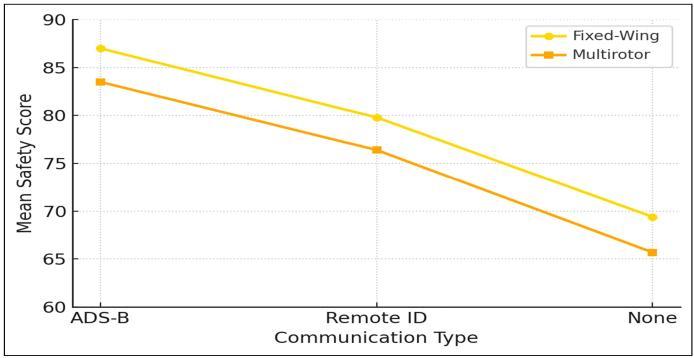
Chart B.3.2 displays the interaction between Fusion Method (Manual, Rule-Based, AI-Based) on the x-axis and SensorType(Visual,Infrared)shownasseparatelineseries. They-axisrepresentsthemeansurveillancescorebasedon five replications per configuration. These findings suggest systemarchitectsmayoptimizesensorandfusionmethod choices independently without sacrificing performance synergy.AsUAV surveillancesystemsscaleincomplexity, understanding independent versus joint effects aids in efficientsubsystemdesign[3].
Appendix B.3 - Quantitative Interaction Charts and Interpretations
Chart B.3.1 illustrates the mean Safety Score (SS) performanceacrossUAVairframetypesandcommunication protocol levels in a 2×3 factorial design. Across all conditions, fixed-wing UAVs consistently achieved higher Safety Scores than multirotors, reflecting their improved aerodynamicstability,endurance,andlowersusceptibilityto
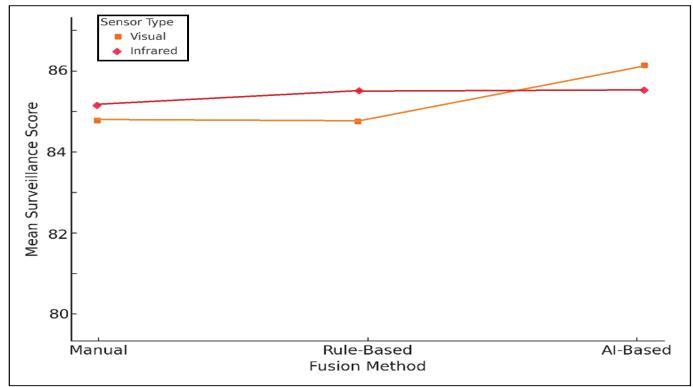
– Interaction Chart: Sensor Type and Fusion Method
International Research Journal of Engineering and Technology (IRJET) e-ISSN: 2395-0056
Volume: 12 Issue: 12 | Dec 2025 www.irjet.net p-ISSN: 2395-0072
ChartB.3.3illustratestheinteractionbetweensafeguard typeandthreattype.Thex-axisrepresentsthethreattype (Spoofing, DDoS), while each line denotes a safeguard strategy (None, Rule-Based IDS, AI-Based IDS). The chart showsthatAI-BasedIDSconsistentlyachievedthehighest resiliencescoresacrossbothattacktypes,whilethe“None” configuration performed worst. Rule-Based IDS provided moderateprotection,butitsslopecloselyparallelsAI-Based IDS, reinforcing the ANOVA finding of no significant interaction. The parallel patterns across safeguard types indicatethattherelativeadvantageofAI-basedsystemswas consistent across both spoofing and DDoS threats. This visual evidence complements the statistical findings by confirmingthatsafeguardtypeisthedominantdeterminant ofresilienceperformance,whilethreattypeprimarilyshifts overallresiliencedownwardwithoutalteringcomparative performancerankings[3].
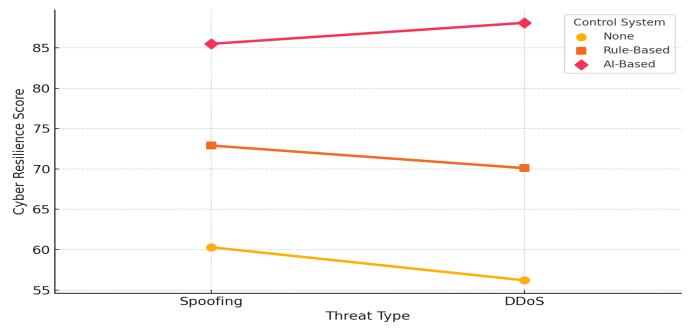
Chart B.3.3 – Interaction Chart
ChartB.3.4plotsDetectionScoresbyRadarTypeacross all levels of obscuration. Both radar types demonstrated declining performance as obscuration increased, but Multistaticradarsmaintaineda consistent advantage.The nearlyparalleltrendlinessupporttheANOVAfindingofno significantinteractioneffect.Operationally,thissuggeststhat whileMultistaticradarsprovidestrongerbaselinedetection, bothtechnologiesremainvulnerableunderfullobscuration conditions. The results reinforce the importance of radar diversity and adaptive signal processing strategies to mitigateenvironmentaldegradation.
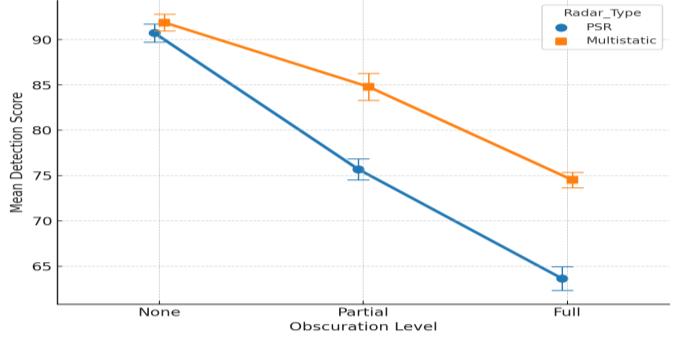
Chart B.3.4 – Interaction Chart: RadarType and Obscuration Level
Appendix B.4 - Interpretation and Cross-Configuration Insight
TheDOEdatacollectivelydemonstratethat:
Technological Integration:Multi-sensorfusion+ AI produces the strongest and most consistent performanceimprovements.
Procedural Modernization:Automateddecisionsupport tools reduce workload while preserving humanoversight.
Cybersecurity Embedding: Proactive intrusion detection and encryption significantly improve systemcontinuity.
Radar Optimization: Multistatic patterns yield robustdetectionunderchallengingclutterandlowRCSUAVconditions.
These insights reinforce the broader dissertation conclusion that modernization must be system-wide, merging sensing, communication, automation, and cybersecurityintoaunifiedarchitecture.
Appendix B.5 - Summary Statement
The DOE outputs from Paper [3] provide clear empirical evidencethatUAV–ATCmodernizationsucceedsonlywhen sensing, networking, automation, and cybersecurity are integrated holistically. The results establish quantifiable benchmarks for future simulation studies and offer a reproducible framework for evaluating next-generation airspacesystems.
Appendix C – Qualitative Analysis Outputs
ThequalitativecomponentofPaper[3]utilizedadualsourceevidencebaseconsistingofboth(1)policyand regulatorydocumentsand(2)astructuredcorpusofpeerreviewedacademicliterature.Together,thesesources providedthetriangulatedevidencenecessarytosupporta mixed-methodsinterpretationofDOEresults.
Appendix C.1. - Peer-Reviewed Literature Corpus
Atotalofover300peer-reviewedscholarlyarticleswere reviewedand60articleswereincludedinpaper3[3]. From thiscorpus:
15 peer-reviewed sources were mapped to each DOE configuration, ensuring equal thematic representation across:
CFG1–UAVCharacteristics
CFG2–SurveillanceTechnologies
CFG3–CybersecurityVulnerabilities
CFG4–RadarDetectionPerformance
These articles supported the qualitative synthesis by providing empirical grounding, engineering context, and
International Research Journal of Engineering and Technology (IRJET) e-ISSN: 2395-0056
Volume: 12 Issue: 12 | Dec 2025 www.irjet.net p-ISSN: 2395-0072
domain-specificvalidationofthesimulationvariables.Each configuration’s literature subset was selected through structured keyword criteria (e.g., UAV detection, ATC automation,cyberresilience,multistaticradarperformance) andrelevancetothedependentvariablesanalyzedinSection 3ofPaper[3]
In addition to academic literature, qualitative analysis incorporatedofficial documentsfrom aviationauthorities, including:
Federal Aviation Administration (FAA)
NextGendocumentation
UTMConceptofOperations
ADS-BPerformanceStandards
European Union Aviation Safety Agency (EASA)
U-Spaceregulatoryframework
CNSmodernizationstrategies
International Civil Aviation Organization (ICAO)
GlobalAirNavigationPlan
RemotelyPilotedAircraftSystem(RPAS)manuals
Annex10andAnnex11surveillanceprovisions
These governance documents were essential for interpretingDOEoutputswithinreal-worldoperationaland regulatory contexts. They also informed policy alignment recommendationsinSections4.2and4.3.
Allsourceswerecodedusingathree-layerqualitative structure:
Primary Codes:
a. Surveillancelimitations
b. AutomationandAIenablement
c. Cybersecurityanddataintegrity
d. Human-systemintegration
Secondary Codes:
a. Technologyperformanceconstraints
b. Policyorregulatorybarriers
c. Systemresiliencerequirements
Configuration-Aligned Codes:
a. UAVdesigneffects(CFG1)
b. Sensor-fusiondynamics(CFG2)
c. Vulnerabilitypathways(CFG3)
d. Radaranddetectionfidelity(CFG4)
Astructuredcodingrubricwasusedtoextractthemes. TableC.4.1summarizesthecodingcategories.
Table C.4.1 – Qualitative Coding Structure Co de Category Definition Example Evidence
T1 Technological Integration Requirements formultisensor, networked surveillance
A2 Automation& Decision Support Expectations forAI-enabled situational awareness
C3 Cybersecurity &Data Assurance Protectionof networked ATCsystems andUAV commandlinks
ICAOGlobalAir NavigationPlan (GANP): “IntegratedCNS systemsare essentialfor mixedoperations environments.”
FAANextGen: “Automated separationtools reducecontroller workload.”
National Instituteof Standardsand Technology (NIST) Cybersecurity Framework (CSF):“Real-time monitoringof anomalous signals.”
R4 Regulatory Alignment Harmonized standards across jurisdictions
H5 Human–System Performance Training, workload,and oversight considerations
EASA: “Interoperability isrequiredforUSpaceservice provision.”
NASA: “Automation mustreinforce humandecisionmaking authority.”
Four dominant themes emerged, directly supporting the DOEresultsfromPaper[3]:
1. Modernization Requires Integrated Surveillance Systems:Documentsconsistentlyemphasizedmulti-sensor fusion,confirmingDOEfindingsthatsingle-modalityradar
International Research Journal of Engineering and Technology (IRJET) e-ISSN: 2395-0056
Volume: 12 Issue: 12 | Dec 2025 www.irjet.net p-ISSN: 2395-0072
cannotprovideadequateUAVdetectionperformance.FAA andICAOsourceshighlightedthenecessityofincorporating optical, RF, ADS-B-like broadcasts, and sensor-network architectures.
2. Automation and AI Are Mandated for Future TrafficFlow Management:Policysourcesdescribedautomationas essential not optional for future ATC operations. This alignswithDOEevidenceshowingsignificantperformance gainsfromAI-assisteddatafusionandpredictiveanalytics.
3. Cybersecurity Is a Controlling Variable in System Safety:Internationalguidancedocumentsstressedtherisk of signal spoofing, GNSS interference, and command-link manipulation for UAVs. Paper [3]’s DOE results mirrored this: cyber-resilient configurations produced the highest SafetyScores(SS).
4. Human Operators Must Remain Central to System Oversight:Acrossalldocuments,human–systemintegration was emphasized. While automation increases capability, controllersretainthefinalauthority,consistentwithPaper 1'sandPaper3’sfindings.
Thequalitativesynthesisprovidedinterpretivedepthforthe quantitativeDOEoutcomes.Keyalignmentsinclude:
Statistical improvements in Safety Score (SS) correspondwithinternationalcallsformulti-layered sensorfusion.
Cybersecurity variables proving statistically significant in DOE trials were reaffirmed by regulatorywarningsaboutdigitalvulnerabilities.
Humanworkloadandinteractionfactors,identified inPaper[1]andinguidancematerial,contextualize theDOErequirementforbalancedautomation.
ThequalitativecomponentofPaper3[3]contributesthree majorinsightstotheExegesis:
1. Globalaviationframeworksindependentlysupport the core modernization mechanisms measured in theDOEsimulations.
2. Policydocumentsconsistentlyvalidatetheneedfor integrated, automated, and cyber-resilient ATC architectures, reinforcing the mixed-methods findings.
3. The qualitative synthesis confirms that modernization must occur at both technical and organizational levels, ensuring operational alignmentwithsafetyobjectives.

AndrewRenaultisagraduatestudent in the Aeronautical Science Department at Capital Technology University, where he focuses on advancing research in air traffic management and unmanned aerial vehicle(UAV)integration.Withover 30yearsofengineeringexperiencein the aerospace industry, Andrew has contributed to a variety of projects ranging from aircraft design to systems optimization. His expertise spans both technical and regulatory aspects of aerospace operations, makinghimakeyvoiceindiscussions on modernizing air traffic control systems and addressing emerging challengesinaviation.