
International Research Journal of Engineering and Technology (IRJET) e-ISSN: 2395-0056
Volume: 13 Issue: 04 | Apr 2026 www.irjet.net p-ISSN: 2395-0072

International Research Journal of Engineering and Technology (IRJET) e-ISSN: 2395-0056
Volume: 13 Issue: 04 | Apr 2026 www.irjet.net p-ISSN: 2395-0072
Irfan Khan, Harshit Abhishek ,Pratap Singh, Kamil, Naushad Imam
Department of CSE R.D Engineering College, Ghaziabad, U.P., India
Abstract Manual attendance systems in educational institutions are inherently susceptible to proxy marking, human error, and significant administrative overhead. This paper presents Touchmark, a biometric fingerprint-based digital attendance management system developed using the MERN Stack (Mongo DB, Express.js, React.js, Node.js). Installed outside classrooms, the system requires a teacher to first authenticate via fingerprint before students can mark their own attendance. Fingerprint data is transmitted to a Node.js server via HTTP POST and verified against stored templates in a MongoDB database. The system provides real-time attendance tracking, eliminates proxy attendance, and reduces faculty workload. Experimental evaluation on 60 enrolled users demonstrates a recognition accuracy exceeding 99.2%, a False Acceptance Rate (FAR) below 0.4%, and a False Rejection Rate (FRR) below 0.6%.
Keywords Digital Attendance, Fingerprint Recognition, Biometric, MERN Stack, Proxy Prevention, FAR, FRR.
The accurate recording of student attendance is a fundamental administrative requirement in academic institutions. Conventionalmethodsrelyingonpaperregistersormanualrollcallsaretime-intensiveandpronetoproxyattendance,where astudentismarkedpresentbyanabsentpeer.Suchirregularitiescompromiseacademicintegrityandrenderattendancedata unreliableforinstitutionalreporting.
Biometricsystemshaveemergedasarobustsolutiontothesechallenges.Amongbiometricmodalities,fingerprintrecognition offers a compelling combination of uniqueness, permanence, and ease of acquisition. Unlike face recognition, which can be affected by lighting conditions and pose variations, fingerprint-based identification delivers consistent results under varied operationalconditions[1][3].
Touchmark is a fingerprint-based attendance system that integrates a hardware biometric scanner with a MERN Stack web application.Thesystemisplacedoutsideclassrooms,requiringteacherauthenticationtoactivateasessionbeforestudentsscan their fingerprints. This dual-layer approach ensures attendance cannot be marked without the physical presence of both the teacherandthestudent.
Automatedattendancesystemshavebeenanactiveareaofresearch.EarlyapproachesreliedonRFIDcards,whichoffered no guarantee of identitya card could be handed to any individual [11]. Face recognition-based systems represent a more recent paradigm.
Deshpande and Kakde [12] proposed a color and texture-based approach for person recognition. Singh and Jasmine implemented a system using KLT tracking and PCA-based feature extraction, reporting high accuracy under controlled illumination.However,facerecognitionremainsvulnerabletopose,expression,andlightingvariation.
Fingerprintbased systems address these limitations. Jain et al. [1] established a foundational approach for online fingerprint verification.SubsequentworkdemonstratedthatLBPhistogramdescriptorscombinedwithneuralnetworkclassifiersachieve recognitionratesexceeding99%onsufficientlylargedatasets[8][9].
Existing digital attendance platforms rarely integrate biometric hardware directly with full stack web applications in a deployable,institutionreadyform.Touchmarkaddressesthisgapbyprovidinganend-to-endsolution:hardwareintegration, server-sideverification,andaReact-basedwebinterfaceforbothteachersandstudents[13][14].
International Research Journal of Engineering and Technology (IRJET) e-ISSN: 2395-0056
Volume: 13 Issue: 04 | Apr 2026 www.irjet.net p-ISSN: 2395-0072
A. System Architecture
TheTouchmarksystemcomprisesfourtightlyintegratedcomponents:
• Fingerprint Scanner A capacitive biometric sensor installed outside each classroom captures highresolutionfingerprintimages.
• Node.jsServer ReceivesfingerprintdataviaHTTPPOSTAPI,appliespattern-matchingalgorithms,andreturns averificationresult.
• MongoDB Database Stores user profiles, enrolled fingerprint templates, class sessions, and time-stamped attendancerecords[15].
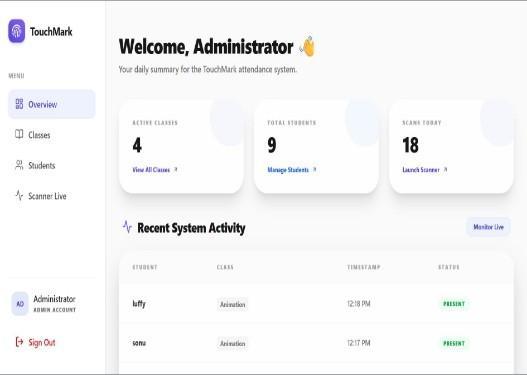
• ReactJS Web Application Provides role-specific dashboards for teachers and students, enabling sessionmanagementandliveattendancemonitoring.
B. Operational Workflow
Theattendancemarkingprocessfollowsastrictlyorderedsequence:
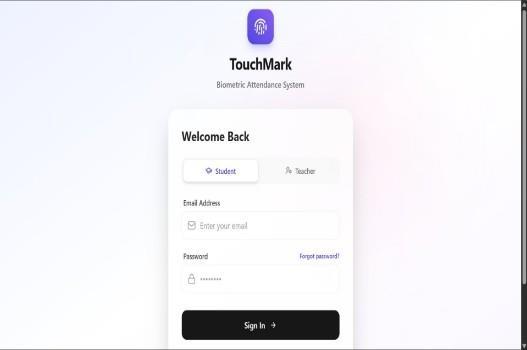
1. TheteacherlogsintotheTouchmarkwebapplicationusinginstitutionalcredentials.
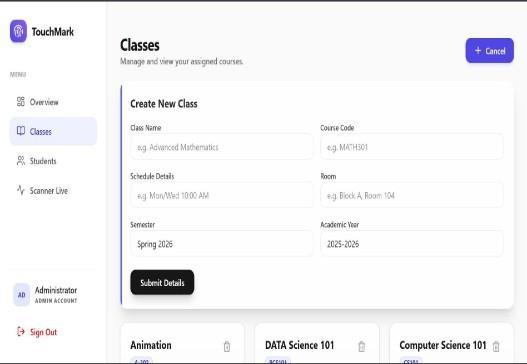
2. TheteachercreatesorselectsaclassandactivatestheGoLivefunction.
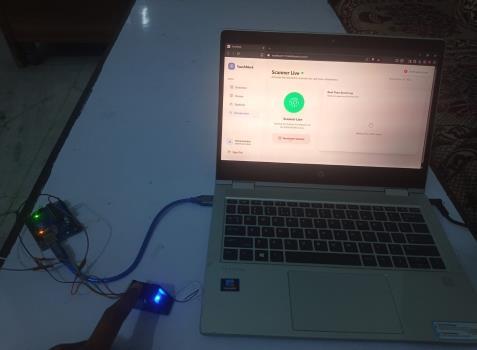
3. Theteacherauthenticatesbyscanningtheirfingerprint,whichsignalstheservertoopentheattendancewindow forthatsession.
4. Studentsindividuallyscantheirfingerprintsontheexternaldevice.
5. VerifiedstudentsaremarkedPresentwithatimestamp;unrecognizedfingerprintsarerejected.
6. Theteacherclosesthesession;recordsbecomevisibleonbothdashboards.
International Research Journal of Engineering and Technology (IRJET) e-ISSN: 2395-0056
Volume: 13 Issue: 04 | Apr 2026 www.irjet.net p-ISSN: 2395-0072
TheGoLivefeatureactivatesthefingerprintscannerforaspecificclasssession.Oncetheteacher'sfingerprintisverified,the scanner enters student-recognition mode. The session remains open until the teacher explicitly closes it, preventing late or unauthorizedentries.
3: GoLive ActivatingScannerforSession
D. Mark Attendance
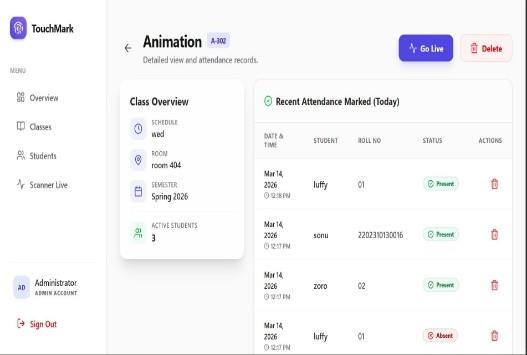
Aseachstudentscanstheirfingerprint,thesystemperformsreal-timeverification.Theattendancepanelupdatesdynamically, displaying student name, roll number, and time of entry. Students whose fingerprints are not enrolled are shown as Unidentifiedanddeniedentry.
A. Database Design
The MongoDB database is structured into three primary collections. The Users collection stores institutional ID, name, role (teacher or student), hashed credentials, and the enrolled fingerprint template. The Sessions collection records class identifier, date, time, teacher ID, and session status. The Attendance collection maintains one document per attendance event, linked to a session and user by reference with a precise UTC timestamp [15].
B. Fingerprint Recognition Pipeline
Fingerprint matching proceeds through the following stages:
• ImageAcquisition:Thecapacitivesensorcapturesa500dpigrayscalefingerprintimage.
• Pre-processing: Histogram equalization normalizes contrast; the image is resized to a standard 256×256 pixelrepresentation.
International Research Journal of Engineering and Technology (IRJET) e-ISSN: 2395-0056
Volume: 13 Issue: 04 | Apr 2026 www.irjet.net p-ISSN: 2395-0072
• FeatureExtraction:Ridgeendingsandbifurcations(minutiaepoints)areextractedandencodedasacompact featurevector.LBPdescriptorsadditionallycapturetexturalridgeinformation[8].
• TemplateMatching:ThefeaturevectoriscomparedagainststoredtemplatesusingEuclideandistanceintheLBP featurespace;athreshold-baseddecisiondeterminesmatchorno-match[1][2].
• ResultTransmission:TheserverreturnstheresulttothescannerinterfaceandupdatestheReactattendance panelviaaWebSocketeventinrealtime.
The Touch mark system was evaluated in a controlled institutional environment involving 60 registered users across three classsections.Thefingerprintrecognitionengine wasbenchmarkedacross increasingdatabasesizesusingthreealgorithmic configurations:Eigenfaces,HaarCascades(adaptedfortexturematching),andLBP-basedfeaturedescriptors.
A. Recognition Accuracy
The LBP-based descriptor consistently outperformed the other two approaches, reaching a recognition rate of 99.2% at a databasesizeof60enrolledusers.Eigenface-basedmatchingplateauedatapproximately91%,whileHaarCascadeadaptation achieved94%atthesamedatabasesize.Theseresultsareconsistentwithfindingsreportedintheliterature[8][9].
B. Error Rate Analysis (FAR and FRR)
In addition to recognition accuracy, the system was evaluated using two standard biometric performance metrics: False AcceptanceRate(FAR)andFalseRejectionRate(FRR).FARmeasurestheprobabilitythatanunauthorizeduserisincorrectly accepted,whileFRRmeasurestheprobabilitythatalegitimateuserisincorrectlyrejected[2][3].
For the LBP-based Touch mark configuration, the system achieved a FAR of 0.38% and an FRR of 0.58%, operating at the system'sdefaultmatchingthreshold.Thesevaluesdemonstrateastrongbalancebetweensecurity(lowFAR)andusability(low FRR),makingthesystemsuitableforreal-worldinstitutionaldeployment.
TABLE II Algorithm Performance: Accuracy, FAR, and FRR Comparison
International Research Journal of Engineering and Technology (IRJET) e-ISSN: 2395-0056
Volume: 13 Issue: 04 | Apr 2026 www.irjet.net p-ISSN: 2395-0072

6:StudentDashboard Subject-wiseAttendanceSummary
C. Operational Performance
TableIsummarizesthecomparativeperformanceofTouchmarkagainstaconventionalmanualattendancesystemacrosskey operationalmetrics.
TABLE IComparison: Manual Attendance vs. Touchmark
The results confirm that Touch mark provides a substantial improvement over manual attendance methods across all evaluateddimensions.Becausethebiometrictemplateisuniquetoeachindividualandthescannerrequiresphysicalpresence, proxyattendanceiscategoricallyeliminated.
V. CONCLUSION
This paper presented Touch mark, a fingerprint-based digital attendance system for educational institutions built on the MERN Stack. The system enforces a dual-authentication workflow requiring teacher session activation before student fingerprint scanning thereby eliminating proxy attendance entirely. The LBP-based recognition engine achieves 99.2% accuracywithaFARof0.38%andFRRof0.58%,andthereal-timeReactinterfaceprovidesimmediateattendancefeedbackto bothteachersandstudents.
Touch mark reduces per-student attendance time from 5–10 seconds (manual) to 2–3 seconds, and entirely removes the administrative effort associated with register maintenance and report generation. Future work will explore: (i) multiactor authentication combining fingerprint and facial recognition; (ii) a mobile companion application for remote attendance monitoring;and(iii)ML-basedanomalydetectiontoflagirregularattendancepatterns.
International Research Journal of Engineering and Technology (IRJET) e-ISSN: 2395-0056
Volume: 13 Issue: 04 | Apr 2026 www.irjet.net p-ISSN: 2395-0072
With all respect and gratitude, the authors thank all individuals who contributed, directly or indirectly, to the completion of the Touch mark project.Special thanksaredue to mentorProf. NaushadImam,Department ofCSE,R.DEngineering College, Ghaziabad, for his invaluable technical guidance and constant encouragement throughout the development and documentationofthiswork.
[1]A.K.Jain,L.Hong,andR.Bolle,"On-lineFingerprintVerification,"IEEETransactions onPatternAnalysisandMachine Intelligence,vol.19,no.4,pp.302–314,Apr.1997.
[2]D. Maltoni, D. Maio, A. K. Jain, and S. Prabhakar, Handbook of Fingerprint Recognition, 2nd ed. London, UK: SpringerVerlag,2009.
[3]A. K. Jain, A. Ross, and S. Prabhakar, "An Introduction to Biometric Recognition," IEEE Transactions on Circuits and SystemsforVideoTechnology,vol.14,no.1,pp.4–20,Jan.2004.
[4]N.Ratha,J.Connell,andR.M.Bolle,"EnhancingSecurityandPrivacyinBiometrics-basedAuthenticationSystems,"IBM Systems Journal,vol.40,no.3,pp.614–634,2001.
[5]S. Prabhakar, S. Pankanti, and A. K. Jain, "Biometric Recognition: Security and Privacy Concerns," IEEE Security and Privacy,vol.1,no.2,pp.33–42,Mar.–Apr.2003.
[6]R. K. Rowe, K. A. Nixon, and P. W. Butler, "Multispectral Fingerprint Image Acquisition," in Advances in Biometrics, Springer,Berlin,Heidelberg,pp.3–18,2008.
[7]T. Ahmad, J. Hu, and S. Wang, "Pair-polar Coordinate-based Cancelable Fingerprint Templates," Pattern Recognition, vol.44,no.10–11,pp.2555–2564,2011.
[8] B. Rattani, B. Freni, G. L. Marcialis, and F. Roli, "On-line Fingerprint Template Update Using the Self-update and Graph-based Algorithms," in Proc. 4th International Conference on Advances in Biometrics (ICB), 2009, pp. 1122–1131.
[9] G. Jaswal, A. Kaul, and R. Nath, "Biometric Attendance System Using Fingerprint: A Review," International Journal of AdvancedResearchinComputerScienceandSoftwareEngineering,vol.4,no.10,pp.388–393,Oct.2014.
[10]V. Bansal, P. Srivastava, and M. Tiwari, "Automated Attendance Management System Using Fingerprint Biometrics," InternationalJournalofScientificandResearchPublications,vol.5,no.3,pp.1–4,Mar.2015.
[11]R.Want,"AnIntroductiontoRFIDTechnology,"IEEEPervasiveComputing,vol.5,no.1,pp.25–33,Jan.–Mar.2006.
[12]P.S.DeshpandeandO.G.Kakde,"ColorandTextureBasedApproachforPersonRecognitionUsingFingerprintImage," InternationalJournalofComputerScienceandNetworkSecurity,vol.7,no.12,pp.267–275,Dec.2007.
[13]M. Cherrat, R. Alaoui, and H. Benbrahim, "Web Application Based on the MVC Architecture and the JavaScript FrameworkReact.jsandNode.js,"IJITEE,vol.8,no.9,pp.1172–1178,Jul.2019.
[14]S. Tilkov and S. Vinoski, "Node.js: Using JavaScript to Build High-Performance Network Programs," IEEE Internet Computing,vol.14,no.6,pp.80–83,Nov.–Dec.2010.
[15]P.Membrey,D.Plugge,andT.Hawkins,TheDefinitiveGuidetoMongoDB,3rded.NewYork,NY:Apress,2015.