
International Research Journal of Engineering and Technology (IRJET) e-ISSN: 2395-0056
Volume: 12 Issue: 05 | May 2025 www.irjet.net p-ISSN: 2395-0072
International Research Journal of Engineering and Technology (IRJET) e-ISSN: 2395-0056
Volume: 12 Issue: 05 | May 2025 www.irjet.net p-ISSN: 2395-0072
1Post Graduate Student, Dept. of Civil Engineering, KMEA Engineering College, Edathala Ernakulam, Kerala
2Assistant Professor, Dept. of Civil Engineering, KMEA Engineering College, Edathala Ernakulam, Kerala
Abstract - This study investigated the Lateral loading performance of various curved braces, specifically the single curved V, single inverted curved V, D-type, double inverted curved X, and double curved X-type braces. A comprehensive nonlinear analysis, along with a dimensional parametric study, was conducted to evaluate the behavior of these curved braces under different conditions. A numerical finite element analysis was performed using ANSYS Workbench FE software. A comparative study between o grid and novel crooked bracings and effective model is identified and time history analysis with PGA data is performed. Conclusive statements on the overall performance comparison, highlighting the single and double curved braces we developed have greater ductility, load carrying capacity, energy absorption than o-grid and other conventional bracings. The result shows double inverted curved X-brace also demonstrated excellent load capacity and ductility, with a maximum load capacity of 139.65 kN and a ductility factor of 40.96, which 9.6 times than O-Grid bracing systems By performing time history analysis, the result shows that the double inverted curved brace the top story displacement decreases by 16.69% & the acceleration drops by 28.39% compared to O-Grid and time period is reduces. So, the double inverted x-brace performs more effectively than O-Grid systems, showing a notable reduction in both acceleration and displacement.
Key Words: Novel Crooked bracing system, Innovative lateral loading system, Steel structures, Push over analysis, Time history analysis, PGA data
Inthedesignofstructures,itisnecessarytoconsiderlateral loadsandLateralLoadResistingSystems(LLRS).LLRSare indispensable in the design of buildings located in the seismicproneareas.Inordertopreventstructuralcollapse, itisimportantthatduringsevereearthquakes,lateralload resistingsystemsshouldhaveappropriateductility,stability andresistance
The1994Northridgeearthquakeexposedunexpectedbrittle fractureinsteelmomentresistingframe(MRF)connections, challenging long-held assumptions about their seismic reliability (e.g. [1-2]). The paper reviews the damage sustainedbysteelbuildingsduring1995Hyogoken-Nanbu earthquake focusing on seismic design., building characteristics,anddamagepatterns.ithighlightsfailuresin
welded beam to column connection and classifies the damagepriorknowledgeandchallengingaddressingit(e.g. [2-4])
In high-rise buildings, seismic design often prioritizes stiffness over strength to enhance overall performance duringearthquakes.Steelstructurestypicallyusemomentresisting frames and braced frames to counteract lateral forces. Moment-resisting frames provide high ductility by allowingcontrolledyieldinginconnections,buttheyoften lackthestiffnessneededfortallbuildings.Concentricbraced frames(CBFs),ontheotherhand,offersubstantialstiffness buthavelimitedcapacitytodeformwithoutfailure.Various configurationssuchasdiagonal,X,V,andchevronbracing enhanceseismicresistancebyeffectivelytyingbracesinto beam-column junctions.To combine the benefits of both stiffness and ductility, Eccentric Braced Frames (EBFs), developedbyRoederandPopov,incorporateshearlinksthat deforminelasticallytodissipateseismic energy. However, repairingtheseshearlinksafteramajorseismiceventcanbe complex and costly. As an alternative, the Knee Braced Frame(KBF)wasintroducedbyOchoa,featuringaspecially designed knee element that yields under stress, thereby absorbingenergymoreefficiently.Thisconceptwasfurther improved by Balendra and colleagues, who proposed modifying chevron braced systems by using relatively weakerbracespairedwithstrongerbeams.Thisadjustment enhancesductilityandallowsforamoredistributedpattern ofdamageacrossthestructure.
Followingthe1995Kobeearthquake,Buckling-Restrained BracedFrames(BRBFs)gainedpopularityinseismic-prone regions. These systems feature a steel core encased to prevent buckling, allowing it to yield in both tension and compression. This configuration offers reliable energy dissipationandstablehystereticbehavior.However,because theyieldingcoreisrelativelyslender,BRBFstendtobemore flexible and may concentrate damage in specific stories. Moreover, they often experience significant residual deformationsafterseismiceventsduetotheirlowpost-yield stiffness.(e.g.[5-81]).
Many ways studied to improve steel bracing systems, and oneeffectiveideaisusingcircular-shapedelements.Murty [82] tested a circular part in a toggle bracing system and
International Research Journal of Engineering and Technology (IRJET) e-ISSN: 2395-0056
Volume: 12 Issue: 05 | May 2025 www.irjet.net p-ISSN: 2395-0072
foundthatitabsorbedenergywellduringloading.Similarly, Bazzaz et al. [83–87] and Andalib et al. [88, 89] studied bracing systems with circular components and found that theyofferedgoodductilityandenergydissipation.Inspired bytheseresults,thisstudytakesanewapproachbyusing circularorellipticalshapesinabracingsystemknownasthe O-Grid. Earlier computer simulations showed that O-Grid systemscouldcarryheavyloads,deformwithoutbreaking (ductility), and absorb energy effectively during seismic events. ThestudyisongoingwithtwotypesnamedasOH andOI.AndconcludedOIenhancedbetterperformancein terms of stiffness and ductility in the study by Maryam Boostani.[82-107]
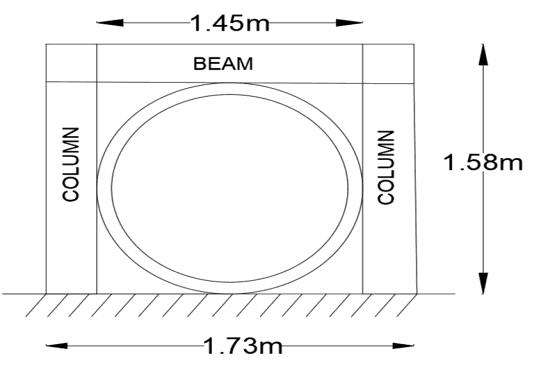
The Novel Crooked Bracing system is a newly developed concept aimed at improving the seismic performance of structuresthroughtheuseofcurvedbracingelements.The term"novel" reflectsitsinnovativedesignapproach,while "crooked"referstotheintentionalcurvatureofthebraces. This system draws inspiration from the O-Grid bracing model,where braces forman O-shapedcurve thatinitially resists forces through bending. As lateral displacement increases,thebracetransitionstoacombinedbendingand tensionbehaviour,whichhelpsdelayout-of-planebuckling. Thistransition enhances energy dissipationandstructural ductility during seismic events. In conventional bracing systems,whileexternalforcesareeffectivelyresisted,braces are prone to sudden buckling when subjected to large displacements. This sudden failure reduces their energy absorption capacity and can result in concentrated force transfertootherstructuralmembers,increasingtheriskof collapse. The O-Grid bracing configuration, by contrast, improves performance by being anchored at four critical points:thetopofthebeam,thebaseofthecolumn,andboth sides of the column. This configuration distributes forces more evenly and prevents localized buckling, making the framemoreresilientunderseismicloading.Thecurvedshape oftheO-Gridbraceaddsflexibilitytothesystem,allowingit toyieldmoregraduallyunderincreasinglateralloads.Unlike straightbraces,whicharemorerigidandpronetosudden instability,thecurveddesignallowsforamoreprogressive
load transfer to the building structure. This results in improved performance in terms of strength, ductility, and energy absorption. These benefits have prompted the developmentofalternativecurvedbracinggeometriesthat seek to expand the advantages of the O-Gridconcept. This study introduces the Novel Crooked Bracing system as a refined continuation of the curved bracing approach. Five distinctshapeshavebeendesignedtoexploretheeffectsof curvatureonseismicperformance.TheseincludetheSingle Curved V-type, which functions similarly to traditional chevron bracing, and the Single Curved Inverted V-type, analogous to the inverted V configuration. The third type, Single Curved D-type, takes inspiration from K-bracing systems. In addition, two double-curved types have been developed: the X-type and Inverted X-type, which mirror conventionalXandinvertedXbracingsystemsbutfeature curvature for enhanced performance. Each of these five bracingtypeswascreatedwiththeintentionofmaintaining the general form and structural purpose of conventional systemswhilereplacingthestraightmemberswithcurved ones.Theprimaryobjectiveofthisresearchistoinvestigate how this curvature affects the structural response under seismicloading.Byanalysingthebehaviourofthesecurved configurations, the study aims to determine whether the incorporationofcurvaturecanofferimprovementsinterms of energy dissipation, ductility, and stability compared to conventionalbracingmethods.
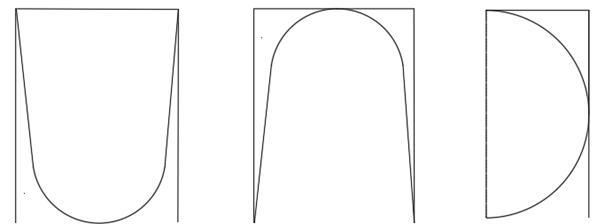
-2(a):U-type,InvertedU-type,D-type Singlecurvedbracingsystems
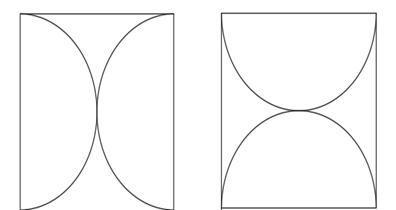
:CurvedinvertedX-type,CurvedX-type Doublecurvedbracingsystems
SeveralstructuralmodelswerecreatedusingANSYSDesign Modelertoinvestigatetheeffectsofgeometricvariationson performance.Anon-linearstaticanalysiswascarriedoutfor eachmodeltoexaminetheirresponseunderappliedloads. The study focused on altering two key parameters: the thicknessof the web flangeand the depthof the brace.By systematicallyvaryingthesedimensions,theresearchaimed
International Research Journal of Engineering and Technology (IRJET) e-ISSN: 2395-0056
Volume: 12 Issue: 05 | May 2025 www.irjet.net p-ISSN: 2395-0072
to understand how they influence the structure’s stiffness anddeformationbehaviour.
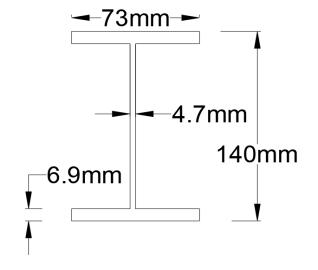
In total, fifteen models were analysed with web flange thicknessessetat2mm,3mm,and4mm,andbracedepths at41mm,79mm,and155mm.Theresultingload-deflection curvesfromeachconfigurationwerecomparedtoevaluate how different thickness-depth combinations impact structuralperformance.Thiscomparativeapproachprovided valuable insights into the relationship between design geometry andstructural stability, helpingto identify more efficientandresilientdesignoptions.
To analyse the nonlinear behaviour of the structural specimens, finite element models were developed using ANSYS software. The frame dimensions used in the simulation were 1.73 meters in width and 1.58 meters in height.Thesteelcomponentsweremodelledusing20-node hexahedral Solid186 elements, which are suitable for capturingcomplexstressdistributionsinthree-dimensional analyses. A mesh size of 40 mm was chosen to ensure a balancebetweencomputationalefficiencyandaccuracy.The materialbehaviourofsteelwasdefinedusingamultilinear stress-strain model to represent its inelastic properties accurately. The structural steel used in the model correspondedtoFe345grade,withitsmechanicalproperties specified as follows: a yield strength of 0.24 kN/mm², an ultimate tensile strength of 0.345 kN/mm², a Young’s modulusof210kN/mm²,amassdensityof7850kg/m³,and a Poisson’s ratio of 0.3. These values were input into the softwaretoreplicatetheactualbehaviourofthesteelunder loading conditions. All column bases were assigned fixed boundary conditions to simulate real-world support restraints.Displacement-controlledloadingwasappliedto monitor the deformation patterns and load-response characteristics more precisely, especially under nonlinear regimes. To simplify the model and reduce computational complexity,thestructuralcomponentsandconnectionplates were merged and treated as rigidly connected. The simulation did not explicitly model welds, based on the assumptionthattheyweresufficientlystrongandwouldnot failduringloading.Thisassumptionallowedtheanalysisto focus on the primary structural elements and their interaction,ratherthanlocalconnectionbehaviour.
Table -1: SteelProperties(Fe345)
YieldStrength(fy) 240MPa
TensileUltimatestrength(fu) 345MPa
ModulusofElasticity(E) 2.1×10⁵ MPa
Poisson’sratio 0.3
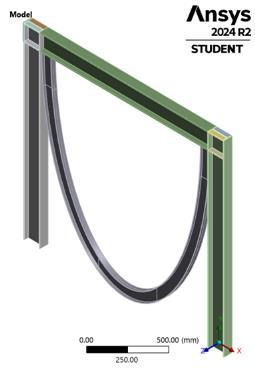
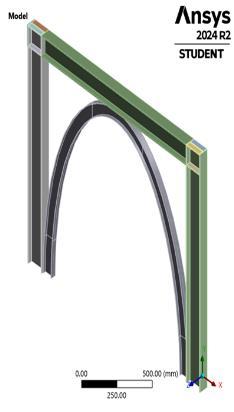
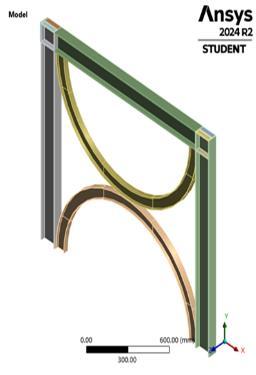
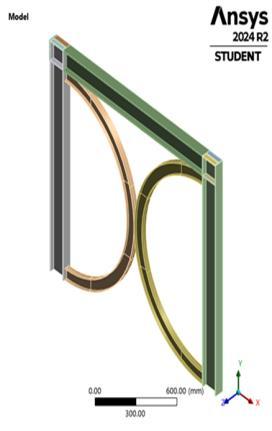
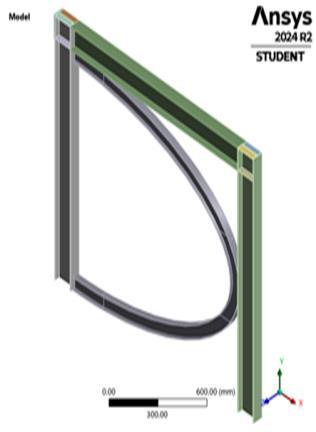
Fig -3:Geometry-NovelCrookedBracings
(a)SinglecurvedU-type(b)Singleinvertedcurved U-type(c)DoubleinvertedcurvedX-type (d)DoublecurvedX-type(e)D-type
International Research Journal of Engineering and Technology (IRJET) e-ISSN: 2395-0056
Volume: 12 Issue: 05 | May 2025 www.irjet.net p-ISSN: 2395-0072
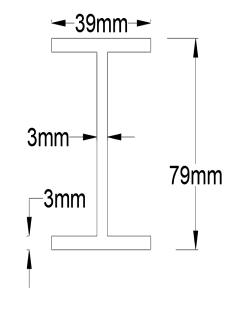
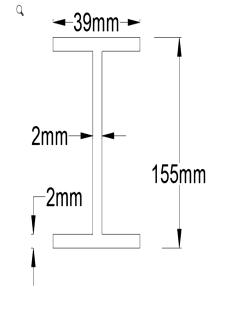
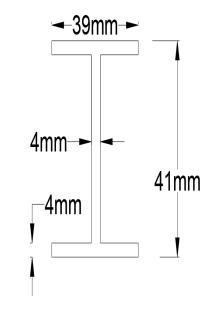
Fig -5:DimensionalParametersofNovelCrooked bracingsusedinthisstudy
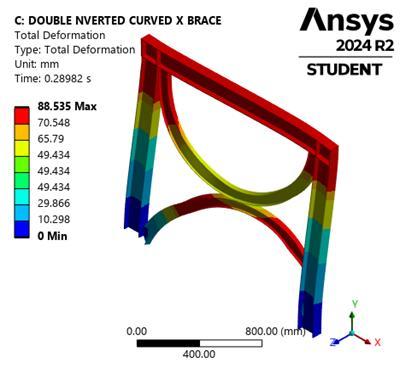
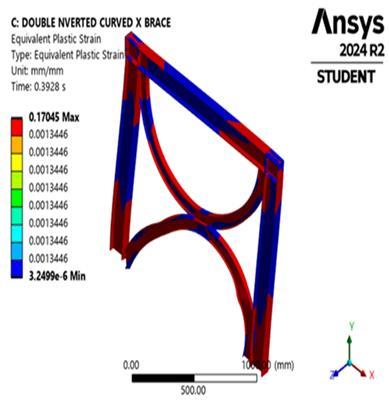
Fig -6:Totaldeformation&Equivalentplasticstrainof doubleinvertedX-brace
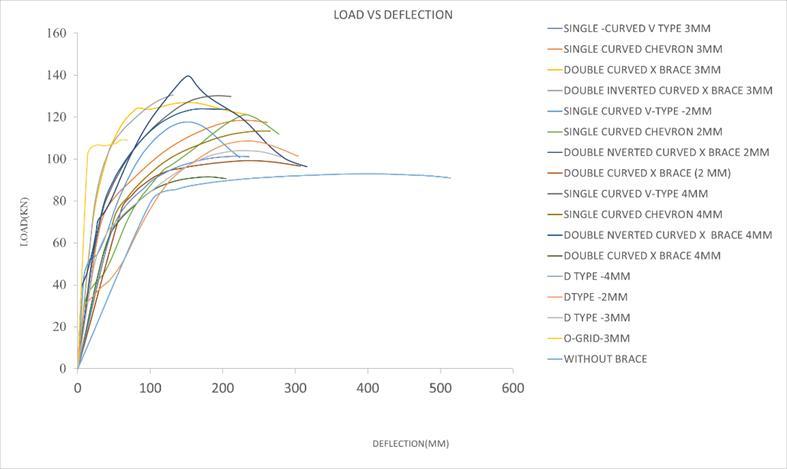
Chart - 1:Load-deflectioncurves
Among the dimensional parametric study carried out it is foundthatthedoubleinvertedx-braceexhibitshighestload carryingcapacitythereforehigherstrength.Fig4Theplastic hingesareformedfirstlyinthedoubleinvertedx-braceat4 points, and by increasing the displacement, the beam was experiencedplasticdeformations,andfinally,thecolumns wereexperiencedplasticdeformations.
Stiffnessreferstotheresistanceofastructureorstructural elementtodeformationunderanappliedforceorload.Itisa
measure of how much a material or structure resists bending, stretching, or compression when subjected to external forces. The stiffer a structure is, the less it will deformwhenaloadisapplied. Thedoublecurvedxbrace and double inverted x brace of parameter of thickness of webandflange3mm&depth79mmexhibitshigherlateral stiffnesscomparedtoothercurvedbraces.Thedisplacement is higher for single curved U -type, D-type of thickness of webandflange3mm&depth79mmandhencelowerlateral stiffness.
Theductilityfactorinstructuralengineeringreferstothe ability of a material or structural element to undergo significantplasticdeformationbeforefailure.Itisameasure ofhowmuchdeformationamaterialcansustainunderload without fracturing, which is particularly important for structuressubjecttodynamicforces,suchasearthquakes.A higher ductility factor indicates that the material or structure can undergo more deformation before failure, whichisgenerallydesiredinearthquake-resistantdesign,as itallowsthestructuretoabsorbanddissipateenergy The ductilityfactorhasbeenobtainedasμ=Δu/Δy Where,Δuis maximumdisplacementoftheframe&Δyisthefirstplastic yieldingdisplacementoftheframe.Thehigherductilityisfor doubleinvertedcurvedxtypeofthicknessofwebandflange 2mm & depth 155mm. And ductility is less for d-curved braceofthickness4mm.
Thehighertheductilityofamaterialorstructure,themore energyitcanabsorbwithoutfracturing.Thedoubleinverted xbraceofthicknessofwebandflange2mm&depth155mm havegreatestenergyabsorption.
3.TO PERFORM THE TIME HISTORY ANALYSIS WITH PGA DATA OF EFFECTIVE CURVED BRACING MODEL IN MULTISTOREY FRAME
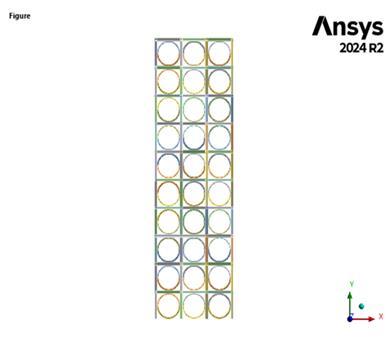
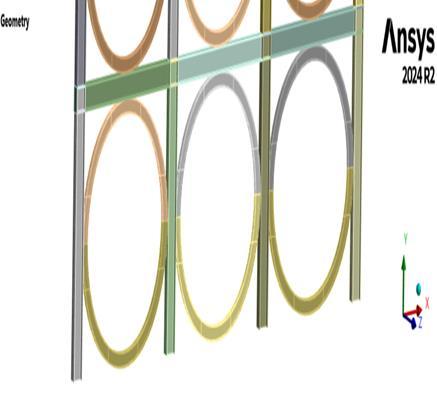
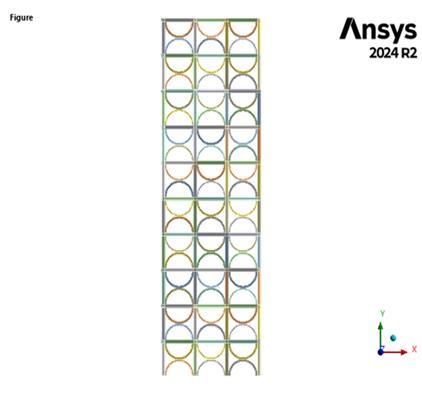
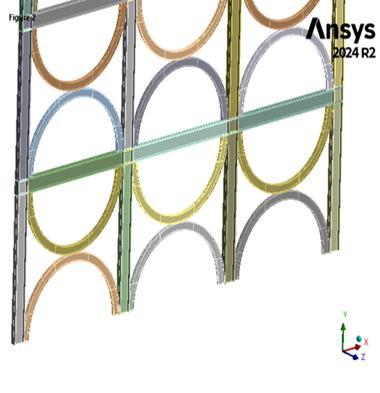
Double inverted curved x-brace have high lateral load carrying capacity and exhibits better performance. So Doubleinvertedcurvedx-typeisusedtoperformthetime historyanalysiswithPGAdatainmultistoreyedframeand compare the results with o-grid. In a multi-storey frame, modal analysis helps identify the natural frequencies and modeshapesofthestructure.Thisanalysisrevealshowthe frame, with the brace system, vibrates at different frequenciesunderdynamicloadingconditions.Itimpactsthe overall stiffness of the structure, influencing the modes of vibration. Time history analysis of the double inverted X brace evaluates the structure’s response to time-varying loads,suchasearthquakesorwindforces.Thetimehistory analysisforthemulti-storeyframewithadoubleinvertedX brace helps assess the effectiveness of the brace in minimizing displacement, energy absorption, and maintaining stability during dynamic events. The multi storeyedframeisofdimension30mx9mhaving10stories. ThedefinedsteelFe345 steelisusedformodellingtheFE
International Research Journal of Engineering and Technology (IRJET) e-ISSN: 2395-0056
stimulation. The boundary condition is fixed at column bases.theloadisgivenasaPeakGroundAcceleration(PGA) data.Ameshsizeof40mmbeenutilizedinthefiniteelement simulationwithelementtypesolid186andelementshapeis hexahedron.Thegeometryofdoubleinvertedx-brace&ogridbraceisshowninfig.7a&7b
Volume: 12 Issue: 05 | May 2025 www.irjet.net p-ISSN: 2395-0072 © 2025, IRJET | Impact Factor value: 8.315 | ISO 9001:2008
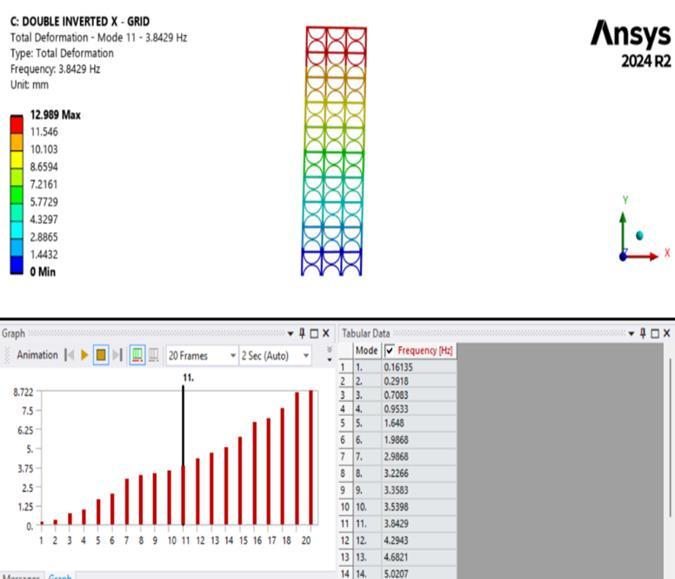
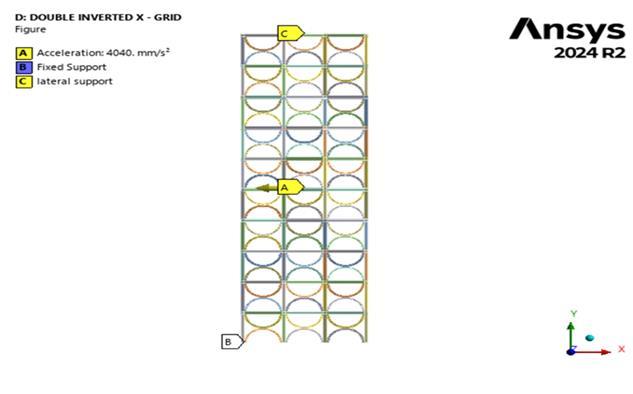
:DoubleinvertedX-brace(a)ModalAnalysis (b)TimehistoryAnalysis
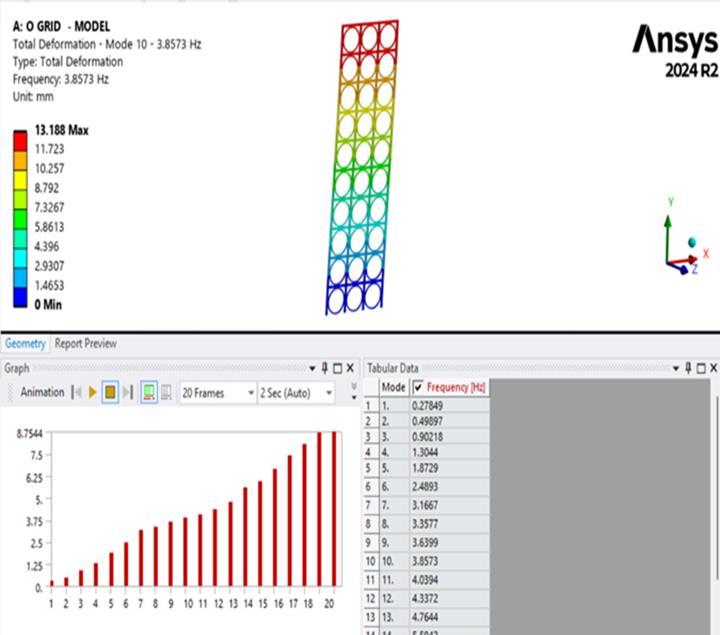
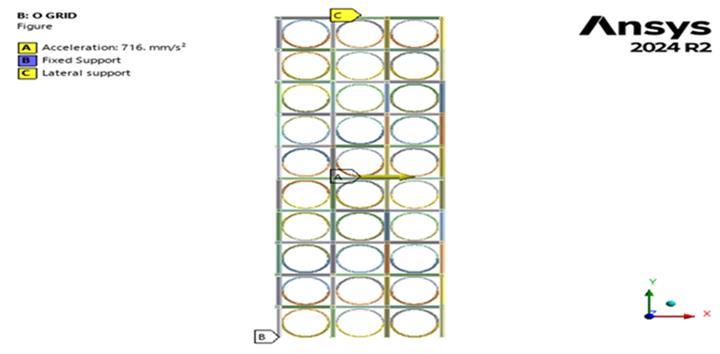
Fig -8(b):O-Grid(a)ModalAnalysis (b)TimehistoryAnalysis
International Research Journal of Engineering and Technology (IRJET) e-ISSN: 2395-0056
Volume: 12 Issue: 05 | May 2025 www.irjet.net p-ISSN: 2395-0072
Zone5isconsideredthemostvulnerabletosevereseismic activity,similartothelevelofshakingobservedduringtheEl Centroearthquake.Thatiswhytheyareoftencomparedor usedasreferencedataforstructuraldesignandearthquake engineeringinsuchregions
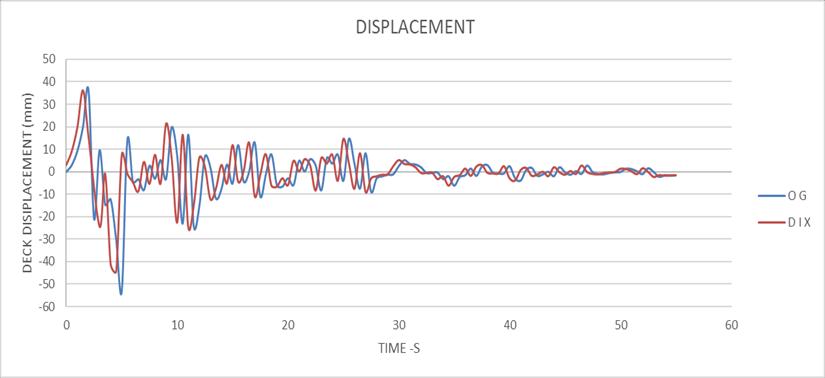
Chart-2:Displacement–Time
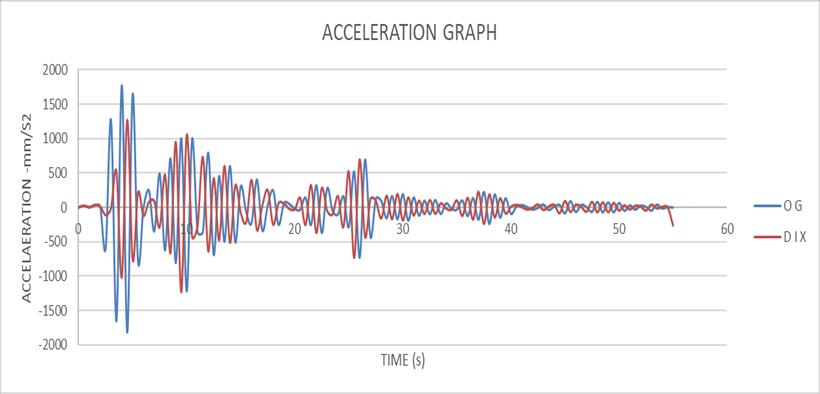
Chart-3:Acceleration–Time
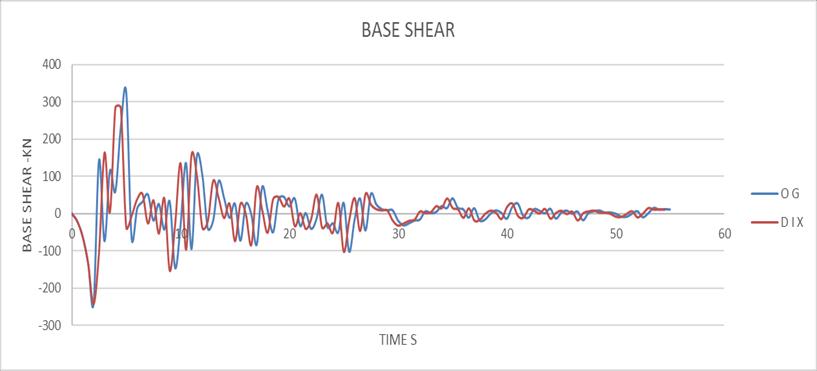
Chart -4:Baseshear-Time
Table -2: TimeHistoryAnalysisresult
TheDoubleInvertedCurvedX-BraceoutperformstheO-Grid intermsofstructuralperformance.Specifically,thedouble invertedx-braceleadstoareductionindisplacement(58.34 mm) compared to the O-Grid, which shows higher displacement.Additionally,theaccelerationis1772mm/s², which is higher than the O-Grid's 1269 mm/s², indicating better structural response to dynamic forces. The time periodofthedoubleinvertedx-braceisalsoreduced,which suggests a quicker response to seismic or dynamic loads, improvingtheoverallstabilityofthestructure.Furthermore, the top story displacement decreases by 16.69% and acceleration reduces by 28.39% in the double inverted xbrace system, indicating better control of forces and displacements.
This study investigated the seismic behaviour of various curved braces, specifically the single curved V, single inverted curved V, D-type, double inverted curved X, and double curved X-type braces. A comprehensive pushover analysis, along with a dimensional parametric study, was conductedtoevaluatethebehaviourofthesecurvedbraces. To ensure the accuracy and reliability of the results, a numerical finite element analysis was performed using ANSYS Workbench FE software. The study focused on assessingseveralcriticalstructuralaspects,includingfailure modes, plastic hinge formation, strength, stiffness, energy dissipationcapacity,andductility.Thefindingsrevealedthat the different curved brace types we developed exhibited varyingstructuralbehaviours,withsomedesignsshowing better performance in terms of energy dissipation and ductility. Specifically, the failure modes and plastic hinge formations were influenced by the brace design, which directly impacted the overall strength and stability of the structure. The O-Grid brace exhibits higher stiffness comparedtotheothercurvedbraces,butthecurvedbraces stillpossessadequatestiffnessfortheirintendedpurpose. Globalbucklingwasnotobservedinanyofthecurvedbrace systems, and most of the dissipated energy was due to a combinationofbendingdeformationandtensionyieldingin thebracingmembers.Ontheotherhand,thedoubleinverted curved X-brace with a 2mm thickness& depth 155mm showedthehighestenergyabsorptionandductility,whereas the double curved X-brace with a 2mm thickness & depth155mmabsorbedtheleastenergy.Thisnotindicatea specificbracinghavehighloadcarryingcapacity,ductility, stiffness and energy absorption but all single and double curvedbracingswedevelopedexhibitsbetterperformance thantheo-gridbracingsystem.Thedoubleinvertedcurved X-brace also demonstrated excellent load capacity and ductility,withamaximumloadcapacityof139.65kNanda ductilityfactorof40.96,which9.6timesthanO-Gridbracing systems. Both of which were highly favourable ductility factorsofthespecimensindicatedthatthedistancebetween yielding and ultimate deformation was acceptable, which was expected due to the high number of plastic hinges
International Research Journal of Engineering and Technology (IRJET) e-ISSN: 2395-0056
Volume: 12 Issue: 05 | May 2025 www.irjet.net p-ISSN: 2395-0072
observed in the braces. Therefore, these curved bracing systemshavebeenshowntomeetthedemandsforstiffness, load-bearingcapacity,andenergyabsorptioneffectively.
[1] Yousssef,N.F.G.,Bonowitz,D.,Gross,J.L.“Surveyofsteel momentresistingframebuildingsaffectedbythe1994 NorthridgeEarthquake”“
[2] M.Nakashima,K.Inoue,M.Tada”Classificationofdamage tosteelbuildingsobservedinthe1995HyogokenNanbu earthquake”Volume20,issues4-6april-june1998.
[3] FEMA.Recommendedseismicevaluationandupgrade criteria for existing welded steel moment-frame buildings,FEMA351.WashingtonDC.Report:Federal EmergencyManagementAgency2000.
[4] Smallidge, J. M. (1999). Behavior of bolted beam-tocolumn T-stub connections under cyclic loading. Master’sthesisGeorgiaInstituteofTechnology,Atlanta, GA30332.
[5] Calado L, Mele E. Cyclic tests on bolted and welded beam-to-column connections. ISET Journal of EarthquakeTechnology2000;37(4):65–88.
[6] PopovEP,TakhirovSM.Boltedlargeseismicsteelbeamto-columnconnectionspart1:Experimentalstudy.Eng Struct2002;24(12):1523–34
[7] Piluso V, Rizzano G. Experimental analysis and modellingofboltedt-stubsundercyclicloads.JConstr SteelRes2008;64(6):655–69.
[8] Herrera R, SalasC,Beltran JF,Nu˜nezE. Experimental performanceofdoublebuilt-uptmomentconnections undercyclicloading.JConstrSteelRes2017;138:742–9.
[9] ChenS-J,YehCH,ChuJM.Ductilesteelbeam-to-column connections for seismic resistance. J Struct Eng 1996;122(11):1292–9.
[10] PlumierA.Thedogbone:Backtothefuture.Engineering Journal-AmericanInstituteofSteelConstruction1997; 34:61–7.
[11] Jones,S.L.,Gary,T.,&DEngelhardt,M.(2000).Reduced beam section welded steel moment frames. In 12th worldconferenceonearthquakeengineering,Auckland, NewZealand,Paper1671.
[12] HanSW,MoonK-H,HwangS-H,StojadinovicB.Rotation capacities of reduced beam section with bolted web (RBS-B)connections.JConstrSteelRes2012;70:256–63.
[13] EngelhardtMD,SabolTA.Reinforcingofsteelmoment connectionswithcoverplates:Benefitsandlimitations. EngStruct1998;20(4-6):510–20.
[14] Uang C-M, Bondad D, Lee C-H. Cyclic performance of haunch repaired steel moment connections: Experimentaltestingananalyticalmodeling.EngStruct 1998;20(4-6):552–61.
[15] ArlekarJN,MurtyCVR.Improvedtrussmodelfordesign ofweldedsteelmoment-resistingframeconnections.J StructEng2004;130(3):498–510.
[16] Adan SM, Gibb W. Experimental evaluation of kaiser bolted bracket steel moment-resisting connections. EngineeringJournal2009;46(3):181.
[17] ChenC-C,LinC-C,LinC-H.Ductilemomentconnections used in steel column-tree moment-resisting frames. J ConstrSteelRes2006;62(8):793–801.
[18] Costanzo S, Tartaglia R, Di Lorenzo G, De Martino A. SeismicBehaviourofEC8-CompliantMomentResisting andConcentricallyBracedFrames.Buildings2019;9(9): 196.https://doi.org/10.3390/buildings9090196.
[19] Yu X, Ji T, Zheng T. Relationships between internal forces, bracing patterns and lateral stiffnesses of a simpleframe.EngStruct2015;89:147–61.
[20] Okazaki T, Lignos DG, Hikino T, Kajiwara K. Dynamic response of a chevron concentrically braced frame. J StructEng2013;139(4):515–25.
[21] Patil DM, Sangle KK. Seismic behaviour of different bracing systems in high rise 2-D steel buildings. Structures2015;3:282–305.
[22] Sabelli,R.,Roeder,C.W.,&Hajjar,J.F.(2013).Seismic design of steel special concentrically braced frame systems. NEHRP, Gaithersburg, USA, Seismic Design TechnicalBrief,8.
[23] SiddiqiZA,HameedR,AkmalU.Comparisonofdifferent bracingsystemsfortallbuildings.Pak.J.Engg.&Appl. Sci.2014;14:17–26.
[24] Zayas, A. Z., Shing, P. B., Mahin, S. A., and Popov, E. P. (1980). “Cyclic inelastic buckling of tubular steel braces.”Rep.No.UCB/EERC-80/16,Univ.ofCalifornia, Berkeley,CA.
[25] Popov EP, Black RG. Steel struts under severe cyclic loadings.J.Struct.Div.1981;107(9):1857–84.
[26] Astaneh-Asl A, Goel SC. Cyclic in-plane buckling of doubleanglebracing.J.Struct.Eng.1984.https://doi.org/1 0.1061/(ASCE)0733-9445 (1984)110:9(2036), 20362055.
International Research Journal of Engineering and Technology (IRJET) e-ISSN: 2395-0056
Volume: 12 Issue: 05 | May 2025 www.irjet.net p-ISSN: 2395-0072
[27] Astaneh-AslA,GoelSC,HansonRD.Earthquakeresistant designofdoubleanglebracing.Eng.J.1986;23(4):133–47.
[28] Aslani F, Goel SC. Stitch spacing and local buckling in seismic resistant double angle bracing members. J. Struct. Eng. 1991. https://doi.org/10.1061/(ASCE) 0733-9445(1991)117:8(2442),2442-2463.
[29] Tremblay R, Filiatrault A. Seismic impact loading in inelastic tension-only concentrically braced steel frames: Myth or reality. Earthquake Eng. Struct. Dyn. 1996;25(12):1373–89.
[30] Tremblay R. Achieving a stable inelastic seismic response for multi-story concentrically braced steel frames.Eng.J.2003;40(2):111–29.
[31] Shaback B, Brown T. Behavior of square hollow structural steel braces with end connections under reversedcyclicaxialloading.Can.J.Civ.Eng.2003;30(4): 745–53.
[32] Yang,F.,andMahin,S.A.(2005).“Limitingnetsection fracture in slotted tube braces.” Steel tips, structure, StructuralSteelEducationalCouncil,Moraga,CA.
[33] Uriz,P.,andMahin,S.A.(2008).“Towardearthquakeresistant design of concentrically braced steel-frame structures.”PEERRep.No.2008/08,Univ.ofCalifornia, Berkeley,CA.
[34] LehmanDE,RoederCw,HermanD,JohnsonS,KotulkaB. Improved seismic performance of gusset plate connections.J.Struct.Eng.2008;134(6):890–901.
[35] https://doi.org/10.1061/(ASCE)0733 9445(2008)134:6(890).
[36] Stoakes CD, Fahnestock LA. Cyclic flexural testing of concentricallybracedframebeam-columnconnections. J. Struct. Eng. 2011;137(7):739–47. https://doi.org/10.1061/(ASCE)ST.1943541X.0000326
[37] BradleyCR,FahnestockLA,HinesEM,SizemoreJG.Fullscalecyclictestingoflow-ductilityconcentricallybraced frames. J. Struct. Eng. 2017;143(6): 04017029. https://doi.org/10.1061/(ASCE)ST.1943541X.0001760.
[38] Costanzo S, D’Aniello M, Landolfo R, De Martino A. Critical discussiononseismic designcriteria for cross concentrically braced frames. Ingegneria Sismica 2018;35(2):23–36.
[39] CostanzoS,D’AnielloM,LandolfoR.Seismicdesignrules for ductile Eurocode-compliant two-storey X
concentrically braced frames. Steel and Composite Structures2020;36(3):273–91.
[40] Aristizabal-Ochoa JD. Disposable knee bracing: improvementinseismicdesignofsteelframes.JStruct Eng1986;112(7):1544–52.
[41] Hsu,H.L.,Juang,J.L.,&Chou,C.H.(2011).Experimental evaluation on the seismic performance of steel knee braced frame structures with energy dissipation mechanism.steelandcompositestructures,11(1),7791.
[42] ShinJ,LeeK,JeongS-H,LeeH-S,KimJ.Experimentaland analyticalstudiesonbuckling-restrainedkneebracing systemswithchannelsections.InternationalJournalof SteelStructures2012;12(1):93–106.
[43] Wongpakdee N, Leelataviwat S, Goel SC, Liao W-C. Performance-based design and collapse evaluation of bucklingrestrainedkneebracedtrussmomentframes. EngStruct2014;60:23–31.
[44] MichelB,Chia-MingU,RafaelS.DuctileDesignofSteel Structures.2nded.McGraw-HillProfessional;2011.
[45] Yoshino,T.,&Karino,Y.(1971).Experimentalstudyon shearwallwithbraces:Part2.InSummariesoftechnical papersofannualmeeting(pp.403–404).Architectural InstituteofJapan,StructuralEngineeringSection.
[46] SabelliR,MahinS,ChangC.Seismic demandsonsteel bracedframebuildingswithbuckling-restrainedbraces. EngStruct2003;25(5):655–66.
[47] XieQ.Stateoftheartofbuckling-restrainedbracesin Asia.JConstrSteelRes200561(6):727–48
[48] JuddJP,MarinovicI,EathertonMR,HyderC,PhillipsAR, TolaTolaA,etal.Cyclictestsofall-steelweb-restrained buckling-restrained brace sub assemblages.J Constr SteelRes2016;125:164–72.
[49] Bonetti,S.,&Matamoros,A.(2008).Fuseelementsfor special concentrically braced frames. In 14th world conferenceonearthquakeengineering,Beijing,China.
[50] Yu H, Guo Y, Zhang Y, Wang X. Design and seismic responseofmodifiedsuspendedzipperbracedframes.J ConstrSteelRes2016;120:8–24.
[51] D’Aniello M, Costanzo S, Landolfo R. The influence of beam stiffness on seismic response of chevron concentricbracings.JConstrSteelRes2015;112:305–24.
[52] Costanzo S, D’Aniello M, Landolfo R. The influence of moment resisting beam-to- column connections on
International Research Journal of Engineering and Technology (IRJET) e-ISSN: 2395-0056
Volume: 12 Issue: 05 | May 2025 www.irjet.net p-ISSN: 2395-0072
seismic behavior of chevron concentrically braced frames.SoilDynEarthquakeEng2018;113:136–47.
[53] CostanzoS,D’AnielloM,LandolfoR.Critical review of seismicdesigncriteriaforchevronconcentricallybraced frames: the role of the brace-intercepted beam. IngegneriaSismica:IntJEarthqEng2016;1:72–89.
[54] Costanzo S, D’Aniello M, Landolfo R. Seismic design criteriaforchevronCBFs:EuropeanvsNorthAmerican codes(part-1).JConstrSteelRes2017;135:83–96.
[55] Costanzo S, D’Aniello M, Landolfo R. Seismic design criteria for chevron CBFs: Proposals for the next EC8 (part-2).JConstrSteelRes2017;138:17–37.
[56] FujimotoM,AoyagiT,UkaiK,WadaA,SaitoK.Structural characteristics of eccentric k-braced frames. TransactionsAIJ1972;195:39–49.
[57] RoederCW,PopovEP.Inelasticbehaviorofeccentrically braced steel frames under cyclic loadings. NASA STI/Recon Technical Report N 1977;78. https://ui.adsabs.harvard.edu/abs/1977STIN...7820375 R/abstract.
[58] Manheim DN, Popov EP. Plastic shear hinges in steel frames.JStructEng1983;109(10):2404–19.
[59] HjelmstadKD,PopovEP.Cyclicbehavioranddesignof linkbeams.JStructEng1983;109(10):2387–403.
[60] KasaiK,PopovEP.Cyclicwebbucklingcontrolforshear linkbeams.JStructEng1986;112(3):505–23.
[61] RiclesJM,PopovEP.Compositeactionineccentrically bracedframes.JStructEng1989;115(8):2046–66.
[62] Yang, M.-S. (1985). “Shaking table studies of an eccentrically braced steel structure.” Proc., 8th World Conf. Earthquake Engineering, Vol. 4, IAEE, San Francisco,257–264
[63] RoederCW,FoutchDA,GoelSC.Seismictestingoffullscale steel building Part II. J Struct Eng 1987;113(11):2130–45.
[64] WhittakerAS,UangC-M,BerteroVV.Seismictestingof eccentrically braced dual steel systems. Earthquake spectra1989;5(2):429–49.
[65] Dusicka, P., & Itani, A. M. (2002). Behavior of built-up shear links under large cyclic deformations. In Proceedings of the 2002 Annual Meeting of the StructuralStabilityResearchCouncil.
[66] Itani AM, Elfass S, Douglas BM. Behavior of built-up shearlinksunderlargecyclicdisplacement.Engineering
Journal-American Institute of Steel Construction 2003;40(4):221–34.
[67] McDanielCC,UangC-M,SeibleF.Cyclictestingofbuiltupsteelshearlinksforthenewbaybridge.JStructEng 2003;129(6):801–9.
[68] MansourN,ChristopoulosC,TremblayR.Experimental validation of replaceable shear links for eccentrically bracedsteelframes.JStructEng2011;137(10):1141–52.
[69] BermanJW,BruneauM.Tubularlinksforeccentrically braced frames. I: Finite element parametric study. J StructEng2008;134(5):692–701.
[70] Ramadan T, Ghobarah A. Behaviour of bolted linkcolumnjointsineccentricallybracedframes.CanJCiv Eng1995;22(4):745–54.
[71] Musmar MA. Effect of link dimensions on d type eccentricsteelframes.AmericanJournalofEngineering andAppliedSciences2013;6(1):31–41.
[72] SaravananM,GoswamiR,PalaniGS.Replaceablefusesin earthquake resistant steel structures: A review. International Journal of Steel Structures 2018;18(3): 868–79.
[73] Shayanfar MA, Barkhordari MA, Rezaeian AR. Experimental study of cyclic behavior of composite verticalshearlinkineccentricallybracedframes.Steel andCompositeStructures2012;12(1):13–29.
[74] WangF,SuM,HongM,GuoY,LiS.CyclicbehaviourofYshapedeccentricallybracedframesfabricatedwithhighstrength steel composite. J Constr Steel Res 2016; 120:176–87.
[75] BouwkampJ,VetrMG,GhamariA.Ananalyticalmodel for inelastic cyclic response of eccentrically braced framewithverticalshearlink(V-EBF).CaseStudStruct Eng2016;6:31–44
[76] Lin Y-Y, Chang K-C. An improved capacity spectrum method for ATC-40. Earthquake Eng Struct Dyn 2003;32(13):2013–25.
[77] HaoH.Developmentofanewnon-bucklingsegmented brace. Int J Struct StabDyn. 2015;15(08):1540012. https://doi.org/10.1142/S021945541540012X.
[78] Haque AR, Alam MS. Cyclic performance of a piston based self-centering bracing system. Structures Congress,doi2015;10(1061/9780784479117):205.
[79] Nejad,P.A.(2016).Beehive(Hexagrid),NewInnovated Structural System for Tall Buildings. Int J High-rise Build.,https://doi.org/10.21022/IJHRB.2016.5.4.251.
2025, IRJET | Impact Factor value: 8.315 | ISO 9001:2008
International Research Journal of Engineering and Technology (IRJET) e-ISSN: 2395-0056
Volume: 12 Issue: 05 | May 2025 www.irjet.net p-ISSN: 2395-0072
[80] LianM,SuM.Seismicperformanceofhigh-strengthsteel fabricatedeccentricallybracedframewithverticalshear link. J Constr Steel Res. 2017; 137:262–85. https://doi.org/10.1016/j.jcsr.2017.06.022.
[81] AsadiE,AdeliH.Diagrid:Aninnovative,sustainable,and efficient structural system. Struct Des Tall Spec Build. 2017;26(8): e1358. https://doi.org/10.1002/ tal.v26.810.1002/tal.1358.
[82] M.Boostanietal.Structures35(2022)172–191191
[83] GolafshaniAA,FallahS,SahafipourfardMA,ArzeytoonA, ToufighV.Experimentalandnumericalstudyonanovel ribbed bracing system. Adv Struct Eng. 2018;21(9):1349–60. https://doi.org/10.1177/1369433217744355.
[84] Fanaie N, Zafari N. Sensitivity Analysis on Response Modification Factor of New Cable-Cylinder Bracing Systems.JEarthqEng.2019;23(4):648–68.https://doi org/10.1080/13632469.2017.1326419.
[85] ZhangA,YeQ.Designandtestingofprefabricatedsteel frame with an innovative re-centering energy dissipative brace. Eng Struct. 2019; 201:109791. https://doi.org/10.1016/j.engstruct.2019.109791.
[86] MurthyANCK.ApplicationofVisco-HyperelasticDevices in Structural Response Control. M.Sc. Thesis. Virginia PolytechnicInstituteandStateUniversity;2005.
[87] BazzazM,KheyroddinA,KafiMA,AndalibZ.Evaluation oftheseismicperformanceofoff-centrebracingsystem with ductile element in steel frames.Steel. Compos Struct.2012;12(5):445–64.
[88] BazzazM,KafiMA,KheyroddinA,AndalibZ,EsmaeiliH. Evaluatingtheseismicperformanceofoff-centrebracing system with circular element in optimum place. Int J Steel Struct. 2014;14(2):293–304. https://doi.org/10.1007/s13296-014-2009-x.
[89] BazzazM,AndalibZ,KafiMA,KheyroddinA.Evaluating the performance of OBS-CO in steel frames under monotonicload.JEarthqStruct.2015https://doi.org/1 0.12989/eas.2015.8.3.697.
[90] BazzazM,AndalibZ,KheyroddinA,KafiMA.Numerical comparisonoftheseismicperformanceofsteelringsin off-centrebracingsystemanddiagonalbracingsystem.J SteelComposStruct.2015;19(4):917–37.
[91] Andalib Z, Kafi MA, Kheyroddin A, Bazzaz M. Experimental investigation of the ductility and performance of steel rings constructed from plates. J Constr Steel Res. 2014; 103:77–88. https://doi.org/10.1016/j.jcsr.2014.07.016.
[92] Andalib Z, Kafi MA, Kheyroddin A, Bazzaz M, Momenzadeh S. Numerical evaluation of ductility and energyabsorptionofsteelringsconstructedfromplates. J Eng Struct. 2018; 169:94–106. https://doi.org/10.1016/j.engstruct.2018.05.034.
[93] LegeronF,DesjardinsE,AhmedE.Fuseperformanceon bracing of concentrically steel braced frames under cyclicloading.JConstrSteelRes2014;95:242–55.
[94] Boostani M, Rezaifar O, Gholhaki M. Introduction and seismic performance investigation of the proposed lateralbracingsystemcalled“OGrid”.ArchCivMechEng. 2018;18(4):1024–41. https://doi.org/10.1016/j.acme.2018.02.003.
[95] Boostani,M.,Rezaifar,O.,&Gholhaki,M.(2019).Seismic BehaviorofNewLateralBracingSystemsCalled“OGrid” and “Nested” in Mid-rise Buildings. 13th International ConferenceonEngineering&Technology.Oslo,Norway.
[96] Boostani M, Rezaifar O, Gholhaki M. Seismic performanceinvestigationofnewlateralbracingsystem called “OGrid-H”. SN Appl Sci. 2019;1(4). https://doi.org/10.1007/s42452-019-0369-8.
[97] IBC.InternationalBuildingCode.StructureEngineering DesignProvision2015.
[98] ASTM-A370-02,StandardTestMethodsandDefinitions for Mechanical Testing of Steel Products, American Society for Testing and Materials, Philadelphia, PA, 2002.
[99] ASTM (American Society of Testing and Materials). (2007). Standard Test Methods for Cyclic (Reversed) LoadTestforShearResistanceofVerticalElements of theLateralForceResistingSystemsforBuildings.ASTM E2126-07a.
[100]FEMA (Federal Emergency Management Agency). (2000). Commentary for theSeismic Rehabilitation of Buildings.FEMA-356.
[101]SouthwellR.Castigliano’sprincipleofminimumstrainenergy. Proc Roy Soc Lond Ser A Math Phys Sci 1936;154(881):4–21.
[102]Roark RJ, Young WC. Formulas for Stress and Strain. McGraw-Hill;1975.
[103] Boostani,M.,Rezaifar,O.,&Gholhaki,M.(2019).Seismic Performance Investigation on an Innovative Lateral Bracing System (OGrid) in Tall Buildings. 13th InternationalConferenceonEngineering&Technology. Oslo,Norway.
[104] F. Albouye, Experimental Investigation of New Structural System ‘‘OGRID’’, Department of Civil
International Research Journal of Engineering and Technology (IRJET) e-ISSN: 2395-0056
Engineering, Semnan University, Iran, 2016 (M.Sc. Thesis).
[105]Nader Fanaie, Alireza Shirpour “Analytical and numerical evaluation of quarter-elliptic-braced steel moment frames (QEB-MFs)”2023 ELSEVIER https://doi.org/10.1016/j.istruc.2023.01.100
[106]Maryam Boostani, Omid Rezaifar b, Majid Gholhaki “Introductionandseismicperformanceinvestigationof theproposedlateralbracingsystemcalled‘‘OGrid’2018 ELSEVIER https://doi.org/10.1016/j.acme.2018.02.003
[107]Maryam Boostani a, Omid Rezaifar b,, Majid Gholhaki
Experimental investigation of a new lateral bracing system called OGrid under cyclic loading” 2022 ELSEVIERhttps://doi.org/10.1016/j.istruc.2021.11.015
Volume: 12 Issue: 05 | May 2025 www.irjet.net p-ISSN: 2395-0072 © 2025, IRJET | Impact Factor value: 8.315 | ISO 9001:2008