
International Research Journal of Engineering and Technology (IRJET) e-ISSN: 2395-0056
Volume: 12 Issue: 12 | Dec 2025 www.irjet.net p-ISSN: 2395-0072
TITLE: DESIGN AND IMPLEMENTATION OF AN INTELLIGENT IOT-BASED WASTE MANAGEMENT SYSTEM WITH GSM-BASED CLOUD ANALYTICS
Dr Sanjeev Kulkarni¹, Prajwal Hiremath²
¹Assistant Professor, Department of Computer Science and Engineering, S G Balekundri Institute Of Technology, Belagavi, Karnataka, India
²Student, Department of Computer Science and Engineering, S G Balekundri Institute Of Technology, Belagavi, Karnataka, India
Abstract-Rapid urbanization and population growth have precipitated a critical challenge in municipal waste management, where traditional, static collection methodologies fail to address dynamic waste generation patterns. The conventional approach, characterized by fixed routing and manual surveillance, results in inefficiencies such as overflowing bins, unaddressed sanitary hazards, and suboptimal resource utilization. This paper proposes the design and technological framework for a comprehensive Smart Waste Monitoring System (SWMS), a unified digital platform aimed at revolutionizing the urban sanitation lifecycle. The SWMS integrates robust IoT hardware specifically the ESP32 microcontroller, HC-SR04 ultrasonic sensors, and IR flame detectors with a sophisticated cloud-based software architecture utilizing Flask and Google Firebase A distinguishing feature of this system is its reliance on a robust GSM-only communication protocol via the SIM800L module. This approach ensures consistent data transmission and critical alert delivery even in remote or outdoor urban environments where Wi-Fi infrastructure is unavailable or unreliable. Furthermore, this research explores the integration of predictive data analytics to visualize fill patterns and estimate accumulation rates, thereby transitioning waste management from a reactive to a proactive, data-driven utility.
Keywords: Internet of Things (IoT), Smart Cities, Waste Management, ESP32, GSM Communication, Cloud Analytics, Predictive Modelling, Real-time Monitoring.
I. INTRODUCTION
The efficient management of solid waste is a foundational pillar of sustainable urban development. As cities expand, the volume of waste generated increases exponentially, imposing a severe strain on existing municipal infrastructure. Inadequate waste collection leads to severe consequences, including the proliferation of vector-borne diseases, environmentaldegradation,andaestheticblight.
A. the Paradigm Shift in Waste Management Traditionally, waste collection has been an operational task governed by static logistics. Municipalities rely on fixed schedules collecting waste on specific days regardless of the actual volume accumulated.This"blind"approachleadstotwoprimaryinefficiencies:thecollectionofemptybins,whichwastesfueland manpower, and the neglect of overflowing bins, which creates health hazards. The advent of the Internet of Things (IoT) and low-cost embedded computing has catalysed a paradigm shift towards "Smart Sanitation," where data dictates logistics.
B. Objectives of the Proposed System the proposed SWMS is engineered to address specific deficiencies in the current frameworkthroughthefollowingobjectives:
1. Real-Time Automation: To eliminate the need for manual physical inspection by automating the monitoring of binfillslevelsandinternalconditions(temperature/fire)viasensorarrays.
2. Ubiquitous Communication: To establish a resilient communication backbone that operates independently of localinternetinfrastructure,employingcellularGSMnetworksforalldatatransmissionandcriticalalerts.
3. Centralized Data Aggregation: To consolidate distributed sensor data into a single, cloud-native dashboard, enablingadministratorstovisualizethestatusoftheentiresanitationnetworkinstantly.
4. Predictive Capability: Toleveragehistoricaldatalogsforanalysingwastegenerationtrends,therebyenablingthe predictionof"time-to-full"andoptimizingfuturecollectionroutes.
International Research Journal of Engineering and Technology (IRJET) e-ISSN: 2395-0056
Volume: 12 Issue: 12 | Dec 2025 www.irjet.net p-ISSN: 2395-0072
C. Scope and Significance The scope of this project encompasses the end-to-end development of a Smart Dustbin prototype, from the hardware interfacing of sensors to the deployment of a full-stack web application. Unlike generic hardware projects, this system emphasizes software architecture specifically API design, database synchronization, and frontendvisualization highlightingthepivotalroleofComputerScienceinphysicalinfrastructuremanagement.
II. LITERATURE REVIEW
The foundation of the SWMS design is built upon a critical analysis of existing methodologies and an evaluation of contemporaryIoTsolutions.
A. Limitations of Traditional Methodologies Current literature [1, 2] extensively documents the inefficiencies of the "staticrouting" model.Studiesindicatethatupto30%ofmunicipalcollectioncosts areincurredbyvisiting binsthatare lessthanhalffull.Furthermore,manualreportingmechanismsforhazardslikebinfiresaredangerouslyslow,oftenrelying oncitizencomplaintsthatarriveonlyaftersignificantdamagehasoccurred[3].
B. Comparative Analysis of Existing Solutions Whilevarioussmartbinprototypeshavebeenproposed,theyoftensuffer fromspecificlimitations:
RFID-based Systems: Earlyiterations[4]focusedontrackingthecollectiontruckratherthanthewasteitself,failing toaddressthecoreissueofoverflow.
Short-Range Connectivity: Many modern solutions [5, 6] rely on Wi-Fi or Bluetooth. In large-scale outdoor urban deployments, these technologies suffer from limited range and reliability issues, rendering them unsuitable for city-widemonitoring.
Lack of Analytics: Asignificantportion of existing literaturefocusesheavily on the hardware implementation but neglectsthesoftwarelayer,oftenprovidingonlyrawtextdataratherthanactionablevisualanalytics[7].
C. the Proposed Advance this paperaddressesthesegapsbyproposingarobust,long-rangeGSMcommunicationmodel and prioritizing a rich, web-based user interface that mimics professional industrial dashboards, providing historical insightsalongsidereal-timedata.
III. SYSTEM ARCHITECTURE The SWMS architectureis rooted in a scalable, three-tier IoT model designed to handle concurrentdatastreamsandensurehighavailabilityinoutdoorenvironments.
A. Tier 1: The Perception Layer (Hardware) At the edge of the network lies the sensing infrastructure. The ESP32 microcontroller serves as the central processing unit, chosen for its robust performance and multiple UART interfaces. It interfaceswith:
HC-SR04 Ultrasonic Sensor: Operates on the principle of sonar to determine the distance to the waste surface, convertingthismetricintoapercentageofbincapacity.
IR Flame Sensor: adigitalsensorcalibratedtodetectthespecificinfraredwavelengthsemittedbyfire,providing instantaneoushazarddetection.
SIM800L Module: Acellularmodemthatservesasthe sole communication gateway.IthandlesbothGPRSdata transmissionforroutineupdatesandSMS/Voicecallsforemergencyalerts.
B. Tier 2: The Application Layer (Backend) This layer acts as the intelligent bridge between hardware and user. A lightweight Flask (Python) server is deployed to manage Application Programming Interface (API) requests. This middleware accepts JSON payloads sent via GPRS from the SIM800L, validates the data integrity, and routes it to the database.Thisdecouplingofhardwareandstorageallowsforeasiermaintenanceandfuturescalability[8].
C. Tier 3: The Data and Presentation Layer Data persistence is managed by Google Firebase (Realtime Database), selected for its low-latency synchronization capabilities [9]. The presentation layer is a responsive web dashboard built with HTML5, CSS3, and JavaScript. It utilizes the Chart.js library to render dynamic visualizations, transforming raw databaseentriesintointuitivegaugesandtrendgraphs.
International Research Journal of Engineering and Technology (IRJET) e-ISSN: 2395-0056
Volume: 12 Issue: 12 | Dec 2025 www.irjet.net p-ISSN: 2395-0072
IV. CORE FEATURES AND IMPLEMENTATION The SWMS introduces several advanced features that differentiate it fromstandardsensorprojects.
A. Intelligent Signal Processing Rawsensordataisoftennoisy.TheESP32firmwareimplementsamovingaveragefilter tosmoothultrasonicreadings,preventingfalsetriggerscausedbyloosedebris.Similarly,theflamedetectionlogicutilizes an interrupt-driven approach, ensuring that a fire event triggers an immediate system wake-up, bypassing standard reportingintervalsformaximumsafety[10].
B. GSM-Based Alert & Data System Toensurereliableoperationinfieldconditions,thesystemimplementsarobustGSM communicationstrategy:
1. Routine Data Transmission (GPRS): The ESP32 periodically establishes a GPRS connection via the SIM800L to sendJSONpayloadscontainingfilllevelsandsystemstatustothecloudserver.
2. Critical Alerts (SMS/Call): Intheeventoffiredetection,thesystempre-emptsroutinedatataskstoimmediately place a direct GSM voice call or send a high-priority SMS to the administrator, ensuring instant notification independentofinternetdataavailability[11].
C. The "Control Centre" Dashboard Unlike simple data logs, the web interface is designed as a command centre. It features:
Live Widgets: Gauge-styleindicatorsthatchangecolour(Green/Yellow/Red)basedonfillpercentage.
Alert Logs: Atimestamped,immutablehistoryofallcriticalevents(e.g.,"FireDetected@14:20").
Historical Analysis: An interactive line graph displaying waste accumulation over the past 24 hours, allowing administratorstoidentifypeakusagetimes.
V. EMERGING TECHNOLOGIES AND IMPLEMENTATION STRATEGIES The system is designed with futurereadinessinmind,integratingconceptsthatdefinemodernSmartCities.
A. Predictive Analytics Integration Moving beyond descriptive analytics, the SWMS lays the groundwork for predictive modelling. By accumulating historical fill-rate data in Firebase, the system can apply linear regression algorithms to estimate "Time-to-Full." For instance, if data indicates a 10% fill rate per hour, the system can pre-emptively schedule a pickup,optimizinglogisticsbeforeanoverflowoccurs[12].
B. Energy Efficient Edge Computing Giventhepotentialforsolardeployment,energyefficiencyisparamount.Thesystem utilizes the ESP32’s "Deep Sleep" modes, powering down the sensors and the power-hungry GSM module between readings. This duty-cycling approach extends battery life significantly, making the system viable for off-grid deployment [13].
VI. TECHNICAL IMPLEMENTATION DETAILS The implementation utilizes a modern technology stack to ensure performanceandscalability.
A. Hardware Interfacing The ESP32 communicates with the SIM800L via UART (Universal Asynchronous ReceiverTransmitter)usingadedicatedpowerrailwithsufficientcapacitancetohandletheGSMmodule'scharacteristic2Acurrent transmissionspikes. Voltagedividersare employedtoprotectthe3.3Vlogicofthe microcontrollerfromthe5Vsignalsof theultrasonicsensor.
B. Software Development Stack
Backend: PythonFlaskwasselectedforitssimplicityandrobustlibrarysupportforRESTfulAPIcreation,capable ofhandlingdatastreamsfromGPRSsources.
Database: FirebaseprovidesaNoSQLstructureperfectforstoringunstructuredJSONsensordata.
Frontend: Thedashboardisbuiltona"Mobile-First"designphilosophyusingBootstrap,ensuringaccessibilityfor fieldworkersusingsmartphones.
International Research Journal of Engineering and Technology (IRJET) e-ISSN: 2395-0056
Volume: 12 Issue: 12 | Dec 2025 www.irjet.net p-ISSN: 2395-0072
VII. TESTING AND VALIDATION Rigorous testing was conducted to validate system reliability under various conditions.
A. Sensor Accuracy Testing The ultrasonic sensor was calibrated against manual measurements at various bin depths (Empty, 50%, 100%). The system demonstrated an accuracy of ±2cm, which is sufficient for waste management applications[14].
B. GSM Communication Reliability Tests were conducted to measure the reliability and latency of GSM transmissions across different signal strengths. GPRS data uploads averaged 15-20 seconds depending on network congestion. Critical SMS/Call alerts averaged 8-12 seconds, proving to be a reliable channel for emergency notification even in areas with moderatecellularcoverage.
VIII. RESULTS AND DISCUSSION
TheimplementedSmartWasteMonitoringSystem(SWMS)wassubjectedtooperationaltestingto validatethereliability of its sensor data aggregation and GSM-based cloud visualization capabilities. The system successfully transmitted realtimetelemetryfromtheESP32microcontrollertothecustom-builtwebdashboard.
A. Cloud Analytics and Visualization Fig. 1 presentsthecentralized"SmartBinPro"analyticsdashboard,whichservesas the primary interface for municipal administrators. The dashboard provides a unified view of critical metrics. As demonstrated in the figure, the interface visualizes real-time status (e.g., "68% Current Fill") and safety conditions (e.g., "Safe" fire status), providing immediate situational awareness. The "Device Status" chart confirms that the system is currently"Online"andtransmittingdataviatheGSMnetwork.

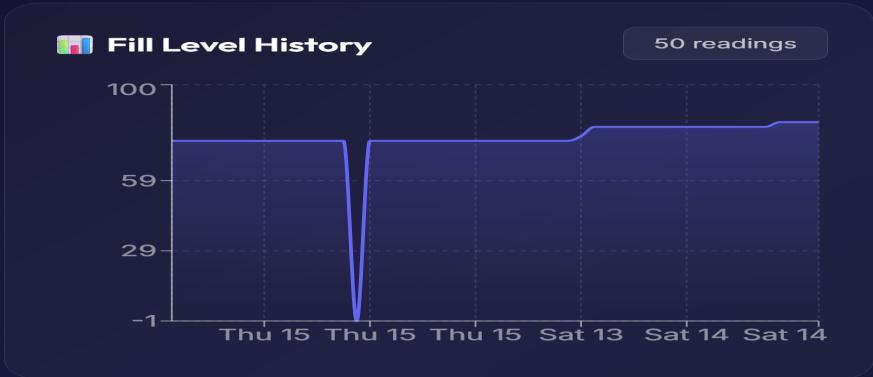
B. Waste Accumulation Analysis Fig. 2 details the "Fill Level History" graph, which visualizes the waste generation pattern over a monitored period. The graph accurately depicts the dynamic nature of waste disposal. The plot displays a sharpdownwardspike,representingawastecollectioneventorsensorreset,followedbyastabilizationatthecurrentfill level. This historical data validates the system's ability to track fill rates and verify that collection services have been performed.
International Research Journal of Engineering and Technology (IRJET) e-ISSN: 2395-0056
Volume: 12 Issue: 12 | Dec 2025 www.irjet.net p-ISSN: 2395-0072
C. Power Consumption Trends Fig. 3 illustrates the "Battery History" graph, tracking the voltage levels of the system's power source over several days. The trend line captures the discharge usage during active monitoring hours and subsequentrechargingphases.Thedata confirmsthestabilityofthepowermanagementalgorithms, ensuringthedevice maintainsoperationaluptimeinoff-gridoutdoordeployments.
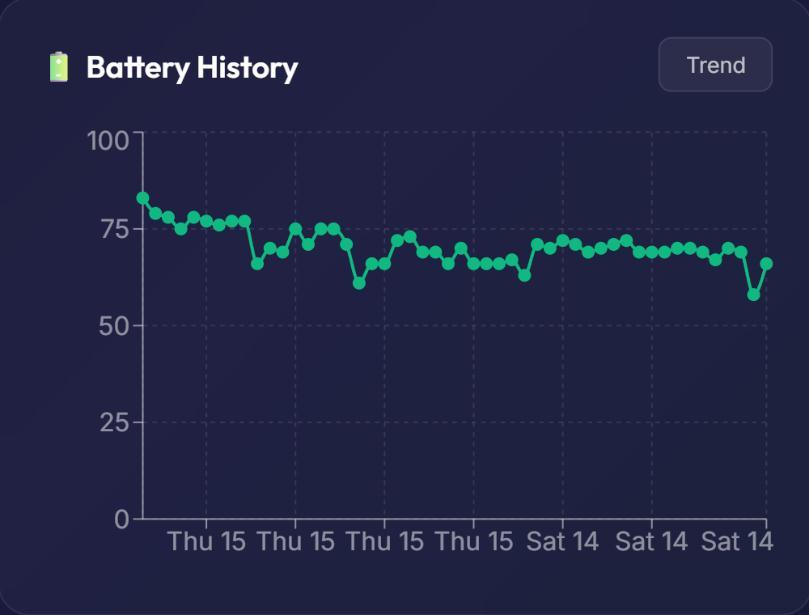
Fig3: Battery History graph tracking the voltage discharge and recharge cycles.
IX. CONCLUSION AND FUTURE SCOPE The Smart Waste Monitoring System represents a critical step towards the digitizationofurbaninfrastructure.Byintegratingrobusthardwaresensingwithcellular-basedcloudanalytics,thesystem addressesthecoreinefficienciesofmanualwastemanagementinamannerthatisdeployablecity-widewithoutrelyingon localinternetinfrastructure.
Future Scope:
1. NB-IoT/LoRaWAN Integration: Transitioning from 2G GSM to more power-efficient Low-Power Wide-Area Network(LPWAN)technologiesforevenlongerbatterylife.
2. Route Optimization: Feeding bin data into mapping APIs (e.g., Google Maps) to dynamically generate the most fuel-efficientcollectionrouteforgarbagetrucks.
3. Blockchain Integration: To create an immutable record of waste disposal data for auditing and compliance purposes[15].
X. REFERENCES
[1] S. Kumar et al., "IoT Enabled Smart Waste Management System for Smart Cities," International Journal of Engineering Research,vol.9,no.5,2023.
[2]A.Zanella,N.Bui,andA.Castellani,"InternetofThingsforSmartCities," IEEE Internet of Things Journal,vol.1,no.1,pp. 22-32,2014.
[3]"GlobalWasteManagementOutlook," UN Environment Programme,2024.
[4]M.Hannanetal.,"SolidWasteBinMonitoringusingRFIDandIoT," Waste Management,vol.40,2018.
[5]P.SivaNagamanietal.,"SmartGarbageMonitoringSystemUsingInternetofThings," IEEE Xplore,2020.
[6]T.Anagnostopoulosetal.,"IoTTechnologiesinWasteManagement," Sustainable Computing,vol.19,2019.
[7]"FirebaseRealtimeDatabaseDocumentation,"GoogleDevelopers,2024.
[8]M.Grinberg, Flask Web Development: Developing Web Applications with Python,O'ReillyMedia,2018.
International Research Journal of Engineering and Technology (IRJET) e-ISSN: 2395-0056
[9]"EspressifSystems:ESP32TechnicalReferenceManual,"Version4.1,2023.
[10] Anuradha Singh and P. Tiwari, "Smart Dustbin Using IOT Notification," International Journal of Science and Research, 2021.
[11]SIMComWirelessSolutions,"SIM800LATCommandManual,"v1.0,2015.
[12]J.Brownlee, Machine Learning Mastery with Python,2019.
[13]"LowPowerDesignwithESP32,"EspressifApplicationNote,2022.
[14]"HC-SR04UltrasonicRangingModuleUserGuide,"ElecFreaks,2020.
[15]K.Pateletal.,"BlockchainforSecureIoTDataTransfer," Journal of Network Security,2024.
BIOGRAPHY

Volume: 12 Issue: 12 | Dec 2025 www.irjet.net p-ISSN: 2395-0072 © 2025, IRJET | Impact Factor value: 8.315 | ISO 9001:2008 Certified Journal | Page993
Prajwal Hiremath is a final-year student in the Department of Computer Science and Engineering at S G BalekundriInstituteOfTechnology,Belagavi.