
International Research Journal of Engineering and Technology (IRJET) e-ISSN:2395-0056
Volume: 12 Issue: 04 | Apr 2025 www.irjet.net p-ISSN:2395-0072
International Research Journal of Engineering and Technology (IRJET) e-ISSN:2395-0056
Volume: 12 Issue: 04 | Apr 2025 www.irjet.net p-ISSN:2395-0072
1Gunturu.Maheswarareddy,2Alaparthi.Yaswanth,3Janga.Vedeshreddy, 4Andagula.Trinadh, 5Mr. Y.V. Narayana, AssistantProfessor.
1,2,3,4,5Dept. of Information Technology, VVIT, Andhra Pradesh, India
Abstract
With cyber threats like Distributed Denial of Service (DDoS) attacks becoming more sophisticated, protecting online services has never been more critical. Traditional threat detection systems often Depend on preset rules, which limits their effectiveness.at spotting new and evolving cyber threats, including Previously unknown attacks. To mitigate this, this paper presents a threat detection system powered by dilated convolutional neural networks (DCNNs), which are highly effective at analyzing network traffic patterns by capturing longrange dependencies. This allows for more accurate and efficient threat detection. The model is trained using supervisedlearningonadatasetcontainingbothnormal and unwanted traffic, with preprocessing and data normalization techniques applied to handle issues like data imbalance and noise. Performance is Assessed based on essential classification Indicators such as accuracy, precision, recall, F1-score, and ROC-AUC are used for evaluation, ensuring reliability in identifying Online threats. Testing results indicate tha DCNN-based system significantly outperforms traditional CNN and RNN models, achieving 99.03% accuracy, 98.88% precision, 99.03% recall, 98.95% F1-score, and 99.27% ROC-AUC. These results highlight the effectiveness and scalability of the proposed model in real-time threat detection, offering organizations a powerful tool to strengthen cybersecurity and proactively defend against emergingcyberattacks.
Key Words:
Cybersecurity, Threat Detection, DDoS Mitigation, Network Security, Deep Learning, Dilated Convolutional Neural Networks, Anomaly Detection, Real-Time Security.
With the rise in cyber threats, especially Distributed Denial of Service (DDoS) attacks, ensuring network security has become a major concern. Conventional ThreatDetectionSystems(TDS)largelydependonstatic rules, which are inadequate for identifying new and advancedattacks.Toimproveupontheselimitations,this study introduces a novel TDS utilizing Dilated Convolutional Neural Networks (DCNNs) to effectively recognize both known and emerging threats.DCNNsare particularly effective in processing network traffic
patterns by capturing long-range dependencies, thereby improvingaccuracyinthreatdetection.vulnerable.
In today’s digital world, cybersecurity is more crucial than ever, with organizations constantly battling increasingly sophisticated cyber threats, from the internet, especially Distributed Denial of Service (DDoS) attacksTraditionalThreatDetectionSystems(TDS)They mainly depend on established rules and recognizable attack patterns, which makes them less effective against emergingandevolvingthreats,suchasunknownattacks
To handle these challenges, machine learning (ML) and deep learning (DL) have been utilizedhave emerged as promisingapproachesinnetworksecurity.Amongthese, Dilated Convolutional Neural Networks (DCNNs) stand out due to their ability to detect cyber threats by capturing long-range dependencies in network traffic. This section reviews existing research on ML/DL-based threat detection techniques and highlights the advantagesofDCNNsoverconventionalmodels.
Threat Detection Systems (TDS) Are typically classified intotwomaincategories:
Pattern-Based TDS (PBTDS): Thesesystems,like Snort and Suricata, rely on predefined attack signatures. Althoughtheyworkwellagainstknownthreats,theyare unabletoidentifyunknownattacks(Garciaetal.,2019).
Anomaly-Based TDS (ABTDS): These systems use statistical analysis or machine learning to identify unusual traffic patterns (Santos et al., 2020). While more adaptive than SBTDS, they often struggle with high false-positive rates and evolvingattacktactics.
Given these challenges, there’s a growing need for more intelligentandadaptivesolutions.
Researchers have explored various ML techniques to enhancethreatdetection,including:
Support Vector Machines (SVM): Useful for classifying attacks, but resource-intensive when handlinglargedatasets.(Wangetal.,2021).
International Research Journal of Engineering and Technology (IRJET) e-ISSN:2395-0056
Volume: 12 Issue: 04 | Apr 2025 www.irjet.net p-ISSN:2395-0072
Random Forest (RF): Efficient for processing large datasets but struggles when dealing with highly imbalanced network traffic (Liu et al., 2022).
K-Nearest Neighbors (KNN): Performs well on smaller datasets but lacks the scalability required for real-time detection (Rizvi et al., 2023).
WhileMLtechniquesimprovedetectioncapabilities,they still require extensive feature engineering and often fail togeneralizewelltonewlyemergingthreats.
Deep learning offers a more advanced approach by automatically learning patterns in network traffic without manual feature extraction. Several architectures havebeenexplored:
Convolutional Neural Networks (CNNs): CNNs are able to detect local traffic patterns but struggle with capturing sequential dependencies, Restricting their capability to identify prolonged attack patterns(Fu et al., 2019;Zhangetal.,2021).
Recurrent Neural Networks (RNNs): For sequential data analysis, RNNs improve upon CNNs but Encounter vanishing gradient problems, which hinder the retention of longterm dependencies(Hassan et al., 2021; Qiu et al., 2020). Additionally, they require high computational power, making real-time implementationchallenging.
Long Short-Term Memory Networks (LSTMs): LSTMs overcome vanishing gradient challengesproblems and can model complex attack sequences (Yue et al., 2021). However, they require extensive training time and consumesignificantcomputationalresources.
Transformers for TDS: Attention-basedmodels improve long-range dependency learning (Zhangetal.,2023).However,theirhightraining costsmakethemimpracticalforreal-timethreat detection.
Key Advantages of DCNNs in TDS:
1. Captures both local and global dependencies in network traffic without needing recurrent layers, making it more efficient (Gupta et al., 2022).
2. More computationally efficient compared to LSTMsandTransformers.
3. Highly scalable,allowing forreal-timenetwork trafficanalysis.
4. Proven effectiveness in recent research:
5. Li et al. (2022): Demonstrated that DCNN outperforms CNN and RNN models in detecting DDoS, Probe, and R2L attacks, achieving an impressiveaccuracyof 97.5%
6. ByleveragingDCNNs,cybersecuritysystemscan improve their ability to detect both known and emerging threats, offering a more adaptive and reliable solution for modern network security challenges.
Conclusion:
- 1:ComparativeAnalysisofTDS
Theliteraturereviewtraces theadvancementsinThreat Detection Systems (TDS), showcasing how DCNNs outperform both traditional and other deep learningbased models. With their ability to recognize intricate attack patterns, DCNNs prove to be a highly effective solutionforcybersecurity.Buildingonpreviousresearch, thisstudyintroducesarobust,real-timeTDSpoweredby DCNNs, trained on the CIC-IDS2017 dataset to enhance threatdetectioncapabilities.
The proposed system enhances conventional Threat Detection Systems (TDS) by incorporating Dilated Convolutional Neural Networks (DCNNs), which are highly effective at recognizing subtle and complex patternsinnetworktraffic.Byutilizingdeeplearning,the system continuously evolves, improving Its capability to distinguish between legitimate and malicious activity. With its capability to analyze long-range dependencies, the DCNN-based model ensures real-time detection of emerging cyber threats, strengthening overall network security. This advanced approach provides a more efficient, adaptable, and scalable solution to counter sophisticatedcyberattacks.
International Research Journal of Engineering and Technology (IRJET) e-ISSN:2395-0056
Volume: 12 Issue: 04 | Apr 2025 www.irjet.net p-ISSN:2395-0072
3.1 Proposed System Architeture:
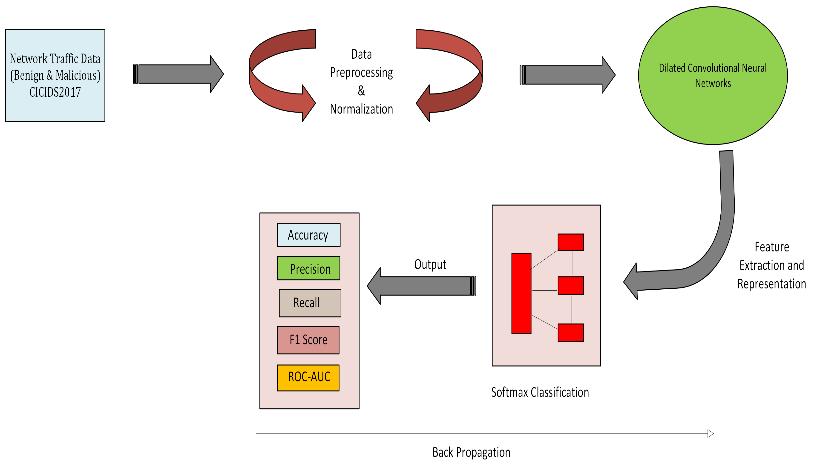
-2:SystemArchiteture
3.2 Proposed System Algorithm
Step 1: Load and Prepare the Dataset
1. Start by loading the dataset from the given file location.
2. Sincethetargetlabelsarecategorical(likeclass names), convert them into numbers using LabelEncoder. This helps the model understand thembetter.
3. Separate the dataset into two parts: features (X), which the model will use to learn patterns, and labels (y),whicharethecorrectanswers.
4. Standardize the feature values using StandardScaler so that all the The input data is withinacomparablerange
5. ,makinglearningmoreefficient.
6. Convert the numerical labels into a categorical formattoworkwellwithclassificationmodels.
7. Use 80% of the data for training and 20% for testing.Thetrainingdata helpsthemodel learn, and the testing data checks how well it performs.
8. Step 2: Define the Dilated CNN Model
1. Set up a sequential neural network, which processesdatastepbystep.
2. Add the first one-dimensional convolutional layer with 64 filters and a kernel size of 3, a dilation rate of 1, and ReLU activation to help detectpatterns.
3. Add another 1D convolutional layer, Comparable tothe first but witha dilation rate
of 2,allowingthemodeltorecognizepatternsat alargerscale.
4. Add a third 1D convolutional layer with a dilation rate of 4, helping the model capture evenmorecomplexrelationshipsinthedata.
5. Use Global Average Pooling to reduce Reduces the number of features while preserving essentialinformation
6. Add A fully connected dense layer containing 128 neurons with ReLU activation to further processtheextractedfeatures.
7. Include a Dropout layer (30% dropout rate) to Avoid overfitting and enhance the model's performance.
8. Finally, add an output A dense layer with softmaxactivationtoenablethemodeltooutput probability distributions for each class in a multi-classclassificationtask.
Step 3: Train and analyse the Model
1. Train the Dilated Convolutional Neural Network (DCNN) using The training dataset (X_train, y_train), where the model identifies patternsfromthedata
2. Setthetrainingguidelines:runthemodelfor 20 epochs (cyclesoflearning)andusea batchsize of 32, indicating that the design processes 32 samples at once before making updates to its learning.
3. During training, Validate the model using the test data (X_test, y_test) to monitor its performanceonunseendata.
4. Once training is complete, Assess the model's accuracy on the test dataset to determine its capabilityofspreadnewdata.
5. Step 4: Display Results and Save the Model
1. Print the final test accuracy in a percentage format.
2. Save the trained model as "dcnn_threat_detection_model.h5" for future use.
Softmax classification is widely used for multi-class classification problems, including threat detection systems.Itconvertstherawoutputvalues(logits)froma neural network into probability scores, making it easier toclassifyaninstanceintooneofseveralcategories.
International Research Journal of Engineering and Technology (IRJET) e-ISSN:2395-0056
Volume: 12 Issue: 04 | Apr 2025 www.irjet.net p-ISSN:2395-0072
4.1 What is Softmax Classification?
Softmaxisanactivation functionusedinthe resultlayer of a multi-class neural network. It ensures that the outputsareinterpretableasprobabilities,meaning
The total of all class probabilities is 1, with the highest probabilityindicatingthepredictedclass
In a Threat Detection System, Softmax helps in categorizing network traffic into different classes, such as:
1. BenignTraffic
2. DDoSAttack
3. MalwareAttack
Softmax Formula
For a given input vector z containing raw scores (logits) forNclasses,theSoftmaxfunctionisdefinedas:
Where:
��(����)=Probabilityofclassiii.
��ⅈ=Logit(rawscore)forclassiii.
������ =Exponentialfunctionappliedtothelogit.
��=1 = Sum of exponentials across all NNN classes(normalizationfactor).
Thisensuresthatalloutputprobabilitiessumto1.
4.2 Softmax Classification Algorithm :
1. InputLayer:
The model receives an input feature vectorX.
It is processed through the neural networklayers.
2. ComputeLogits(RawScores):
The final fully connected (dense) layer produces a logit vector Z where each element represents the raw score for a class.
Logitsaregivenby: �� =��∙��+���� ………(2)
Where: W=Weights
X=Inputfeatures
b=Biasterms
3. ApplytheSoftmaxFunction: ��(����)= ������ ∑ ��
Where:
��(����)=Probabilityofclassiii.
��ⅈ=Logit(rawscore)forclassiii.
������ =Exponentialfunctionappliedtothelogit.
∑ ��
��=�� ��=1 = Sum of exponentials across all NNN classes
4. PredictedClassSelection:
Theclasswiththehighestprobabilityis selectedasthefinalprediction ���������� =arg������ ��(����) …….(4)
5. ComputeLoss(Cross-Entropy):
The cross-entropy loss function measures how closely the predicted probabilities align with the actual labels.:
6. Backpropagation&Optimization:
Thegradientdescentalgorithmupdates the model weights based on the loss functiontominimizeerrors.
Common optimizers: Adam, SGD, RMSprop.
7. ModelTraining&Evaluation:
The training processutilizes mini-batch gradientdescent.
Performance is measured using accuracy,precision,recall,F1-score,and ROC-AUC.
4.3 Pictorial Representation of Softmax
Below is a visual representation of how the Softmax function transforms raw network outputs into class probabilities.
International Research Journal of Engineering and Technology (IRJET) e-ISSN:2395-0056
Volume: 12 Issue: 04 | Apr 2025 www.irjet.net p-ISSN:2395-0072

Chart-1:SoftmaxClassification
5. PERFORMANCE ANALYSIS
This part provides the experimental assessment of the DCNN-based Threat Detection System. The proposed model'sperformance isevaluatedincomparisontoCNN and RNN models using common metrics like accuracy, precision,recall,F1-score,andROC-AUC
Performance Metrics
The model's performance is evaluated using the followingmetrics.:
5.1 Accuracy :
Accuracy is a mostly used metric for analysing classification models, including Threat Detection Systems (TDS). It indicates the frequency of correct predictionsmadebythemodel
Where:
TP(TruePositives):Correctlypredictedthreats.
TN(TrueNegatives):Correctlypredictedbenign traffic.
FP(FalsePositives):Incorrectlyclassifiedbenign trafficasathreat(falsealarm).
FN (False Negatives): Incorrectly classified threatsasbenign(missedattacks).
5.1.1
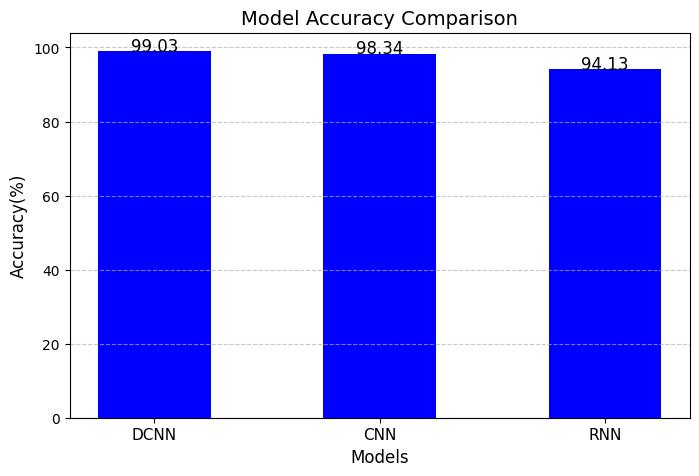
Chart -3:ModelAccuracy
5.2 Precision
Precision, also referred to as Positive Predictive Value, determines the accuracy of predicted positive cases (threats).
It is crucial in Threat Detection Systems (TDS) to minimize false positives (FP) and avoid unnecessary securityalerts.
PrecisionFormula
Where:
TP(TruePositives):Correctlypredictedthreats.
FP(FalsePositives):Incorrectlyclassifiedbenign trafficasthreats(falsealarms).
5.2.1
International Research Journal of Engineering and Technology (IRJET) e-ISSN:2395-0056
Volume: 12 Issue: 04 | Apr 2025 www.irjet.net p-ISSN:2395-0072
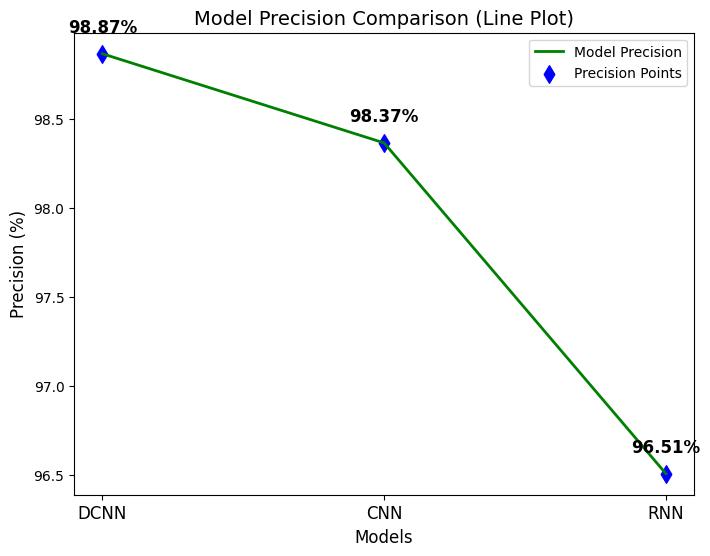
-4: ModelPrecision
5.3 F1 Score:
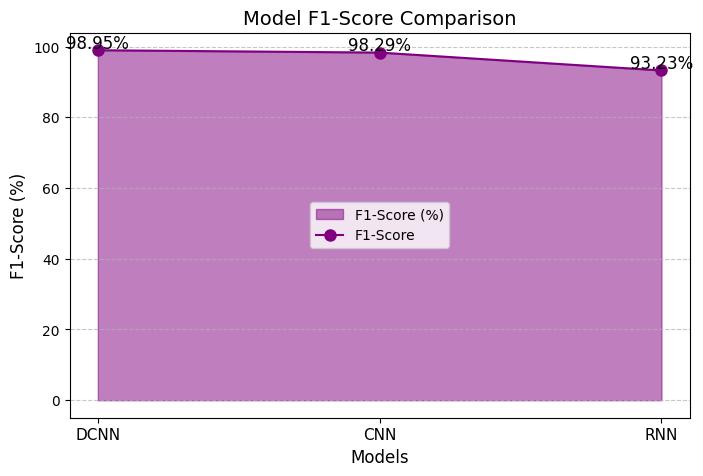
The F1 score is a metric that assesses the balance between precision and recall in classification models. It is especially valuable for imbalanced datasets, where relying only on accuracy may not provide an accurate evaluation.,
calculatedas:
Where:
Precision(PositivePredictiveValue)
Recall(Sensitivity)
TP=TruePositives(correctlypredictedthreats)
FP = False Positives (incorrectly predicted threats)
5.4 ROC-AUC
The Receiver Operating Characteristic (ROC) curve and theAreaUndertheCurve(AUC)helpmeasurehowwella classification model distinguishes between different categories. They are especially useful for assessing performanceinbothbinaryandmulti-classclassification problems.
Theseratesarecomputedas:
Where:
TP=TruePositives(correctlypredictedpositive cases)
FP = False Positives (incorrectly predicted positivecases)
TN = True Negatives (correctly predicted negativecases)
FN = False Negatives (incorrectly predicted negativecase
International Research Journal of Engineering and Technology (IRJET) e-ISSN:2395-0056
Volume: 12 Issue: 04 | Apr 2025 www.irjet.net p-ISSN:2395-0072
The AUC (Area Under the ROC Curve)
It measures the ability of the model to distinguish betweenclasses.
Itisgivenby:
This integral computes the total area under the ROC curve
5.4.1
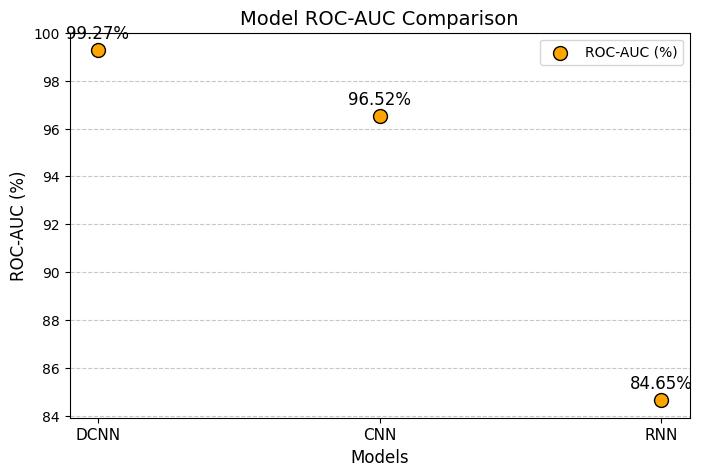
Chart -6:ModelROC-AUC
5.5 Recall:
Recall , or how well a system catches real threats, is key in cybersecurity. The higher the recall, the fewer threats slipthrough,keepingnetworkssafer..
RecallFormula
Where:
1. TP(True Positives):Correctlypredictedpositive cases(actualthreatsdetectedcorrectly).
2. FN (False Negatives): Missed positive cases (actual threats incorrectly classified as normal traffic).
5.5.1
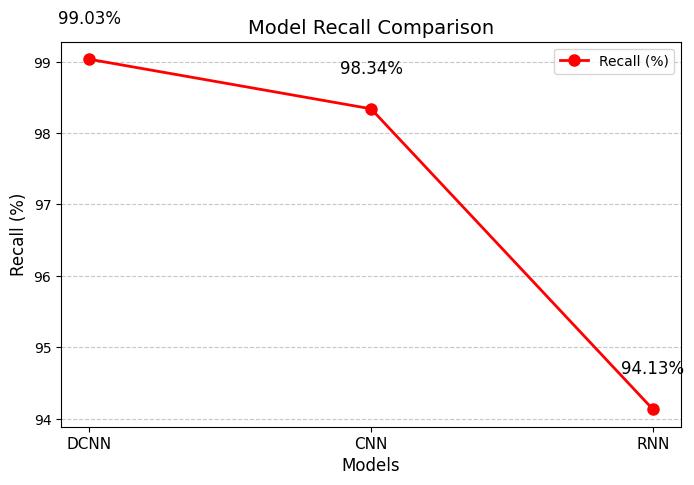
Chart -7: ModelROC-AUC
Analysis of DCNN Performance
High Accuracy: The DCNN model achieves 99.03% accuracy, significantly outperforming CNN and RNN models.
Improved Recall: With a recall of 99 03%, DCNN successfullyidentifiesahighernumberofactualthreats.
Optimized Precision: The precision of 98.87% ensures that false positives are minimized, making it a reliable classifier.
SuperiorF1-Score&ROC-AUC:TheF1-scoreof 98.95% and ROC-AUC of 99.27% validate DCNN’s ability to balance classification accuracy and threat detection efficiency.
Analysis of DCNN, CNN, and RNN
The performance evaluation of DCNN, CNN, and RNN reveals that DCNN significantly outperforms both traditional models across all key metrics. The following observationssummarizethecomparativeanalysis:
Accuracy Comparison
DCNN achieves the highest accuracy (99.03%), proving its superior ability to classify threats correctly.
International Research Journal of Engineering and Technology (IRJET) e-ISSN:2395-0056
Volume: 12 Issue: 04 | Apr 2025 www.irjet.net p-ISSN:2395-0072
CNN scores 98.34%, showing limitations in capturingcomplexpatterns.
RNN reaches 94.13%, slightly improving on CNN butstilllaggingbehindDCNN.
1. DCNN excels in both precision (9887%) and recall (9903%), indicating a low false positive rateandhighthreatdetectionefficiency.
2. RNN’s recall (94.13%) is lower, leading to missedthreats.
3. CNN performs better than RNN but still falls shortofDCNN
F1-Score & ROC-AUC Performance
1. DCNN achieves the highest F1-score (9895%), balancingprecisionandrecalloptimally.
2. CNN and RNN have lower F1-scores, indicating weakeroverallclassificationability.
3. DCNN also secures the highest ROC-AUC score (9927%), proving its ability to distinguish betweennormalandmalicioustrafficeffectively.
This research demonstrates that a DCNN-based Threat Detection Systemsignificantlyimprovesthedetectionof cyber threats compared to CNN and RNN models. By utilizing dilated convolutions, DCNNs efficiently identify complexattackpatterns,makingthemhighlysuitablefor cybersecurity applications. Future work will explore real-time deployment and hybrid deep learning techniquesforfurtherenhancements.
The This research was a collaborative effort, with each author playing a crucial role in different aspects of the study:
Gunturu Maheswarareddy led the research design and overall study framework, ensuring a structuredandlogicalapproach.
Andagula Trinadh handled data collection and preprocessing, making sure the dataset was cleanandreadyforanalysis.
Janga Vedeshreddy focused on analyzing the results and interpreting the findings to draw meaningfulinsights.
Alaparthi Yaswanth was responsible for drafting and refining the manuscript, ensuring clarityandcoherence.
Mr. Y.V. Narayana provided valuable guidance, supervised the research, and reviewed the final draftforaccuracyandcompleteness.
[1] D. A. S. Resul and M. Z. Gündüz, “Analysis of cyberattacks in infrastructures”, IoT-based critical International Journal of Information Security Science,Vol.8,No.4,pp.122-133,2020.
[2] T. T. Nguyen and V. J. Reddi, “Deep reinforcement learning for cyber security”, IEEE Transactions on NeuralNetworksandLearningSystems.2021.
[3] A. Samy, H. Yu, and H. Zhang, “Fog-based attack detection framework for Internet of things using deep learning”, IEEE Access, Vol. 8, pp. 7457174585,2020.
[4] S. Chesney, K. Roy, and S. Khorsandroo, “Machine learning algorithms for preventing IoT cybersecurity attacks”, In: Intelligent Systems and Applications: Proc. of the 2020 Intelligent Systems Conference(IntelliSys)Vol.3,pp.679-686,2021.
[5] M. Kuzlu, C. Fair, and O. Guler, “Role of artificial intelligence in the Internet of Things (IoT) cybersecurity”, Discover Internet of things, Vol. 1, pp.1-14,2021.
[6] N.Fu,N.Kamili,Y.Huang,andJ.Shi,“ANovel Deep IntrusionDetectionModelBasedonaConvolutional Neural Network”, Aust. J. Intell. Inf. Process. Syst., Vol.15,No.2,pp.52-59,2019.
[7] R. H. Hwang, M. C. Peng, C. W. Huang, P. C. Lin, and V.L.Nguyen,“Anunsuperviseddeeplearningmodel for early network traffic anomaly detection”, IEEE Access,Vol.8,pp.30387-30399,2020.
[8] W.Qiu,Q.Tang,Y.Wang,L.Zhan,Y.Liu,andW.Yao, “Multi-view convolutional neural network for data spoofing cyber-attack detection in distribution synchrophasor's”,IEEETransactionsonSmartGrid, Vol.11,No.4,pp.3457-3468,2020.
[9] C. Yue, L. Wang, D. Wang, R. Duo, and H. Yan, “Detecting Temporal Attacks: An Intrusion Detection System for Train Communication Ethernet Based on Dynamic Temporal Convolutional Network”, Security and CommunicationNetworks,2021,pp.1-21,2021.
[10] W.Liu,X.Xu,L.Wu,L.Qi,A.Jolfaei,W.Ding,andM. R. Khosravi, “Intrusion detection for maritime transportation systems with batch federated aggregation”, IEEE Transactions on Intelligent TransportationSystems,2022.
[11] M. Asam, S. H. Khan, A. Akbar, S. Bibi, T. Jamal, A. Khan, U. Ghafoor, and M. R. Bhutta, “IoT malware detection architecture using a novel channel boostedandsqueezedCNN”,ScientificReports,Vol. 12,No.1,pp.1-12,2022.
International Research Journal of Engineering and Technology (IRJET) e-ISSN:2395-0056
Volume: 12 Issue: 04 | Apr 2025 www.irjet.net p-ISSN:2395-0072
[12] Q.Liang,C.Liu,Y.Zhong,andX.Ren,“ALightweight Flow-based DDoS Detection Approach using Dual Convolutional Kernels”, In: Proc. of 2022 China AutomationCongress(CAC),pp.2838-2843,2022.
[13] S. H. Khan, T. J. Alahmadi, W. Ullah, J. Iqbal, A. Rahim, H. K. Alkahtani, W. Alghamdi, and A. O. Almagrabi,“AnewdeepboostedCNNandensemble learning based IoT malware detection”, Computers &Security,Vol.133,p.103385,2023.
[14] ]Z.Liu,J.Yu,B.Yan,andG.Wang,“ADeep1-DCNN and Bidirectional LSTM Ensemble Model with Arbitration Mechanism for DDoS Attack Detection”, IEEE Transactions on Emerging Topics in Computational Intelligence, Vol. 6, pp. 1396-1410, 2022.
[15] S. Rizvi, M. Scanlon, J. McGibney, and J. Sheppard, “Deep learning-based network intrusion detection systemforresource-constrained environments”,In: Proc. of the 13th EAI International Conference on DigitalForensicsandCyberCrime,2023.
[16] Y. V. Narayana and M. Sreedevi, "DDCATF: Deep Learning Approach for Detection of Cybercrime Activities Based on Temporal Features," 2023 International Conference on Self Sustainable Artificial Intelligence Systems (ICSSAS), Erode, India, 2023, pp. 462-469, doi: 10.1109/ICSSAS57918.2023.10331644.