
International Research Journal of Engineering and Technology (IRJET) e-ISSN: 2395-0056
Volume: 12 Issue: 09 | Sep 2025 www.irjet.net p-ISSN: 2395-0072
International Research Journal of Engineering and Technology (IRJET) e-ISSN: 2395-0056
Volume: 12 Issue: 09 | Sep 2025 www.irjet.net p-ISSN: 2395-0072
Jilla Anshu Prasanna1 , M. Shailaja2
1Student, Dept. of Mechanical Engineering, JNTUH, Telangana, India
2Professor, Dept. of Mechanical Engineering, JNTUH, Telangana, India
Abstract - Lithium-ion batteries are increasingly adopted in electric vehicles and portable electronics because of their high energy density, efficiency, and long cycle life, yet they are highly sensitive to temperature variations, and excessive heat generation during charge–discharge cycles can negatively influence performance, safety, and service life. Passive thermal management systems employing Phase Change Materials (PCMs), particularly paraffin wax, have attracted attention due to their high latent heat capacity, which enables effective absorption of excess thermal energy; however, their inherently low thermal conductivity restricts rapid heat dissipation during high-rate operations. To overcome this limitation, the present study investigates a hybrid Battery Thermal Management System (BTMS) in which paraffin wax is integrated with thermally conductive aluminium foam to enhance overall heat transfer within a prismatic lithium-ion battery module. A transient thermal simulation was performed using ANSYS 2024 R2 Student Edition to evaluate the hybrid system over a duration of 1800 seconds, focusing on key thermal parameters such as temperature distribution, total heat flux, and directional heat flux. Simulation outcomes revealed that the battery’s maximum temperature reached 80 °C while the average temperature stabilized around 27 °C, demonstrating effective passive cooling performance. Moreover, aluminium foam significantly enhanced thermal conductivity within the PCM matrix, as evidenced by a peak heat flux of 1172 W/m² at 1800 s and improved directional heat flow across the module. These findings highlight that PCM–aluminium foam composites represent a promising, cost-effective, and efficient passive solution for battery thermal management, ensuring improved safety, durability, and operational reliability without reliance on active cooling mechanisms
Key Words: Lithium-ion battery, Battery Thermal Management System (BTMS), Phase Change Material (PCM), Paraffin wax, Aluminum foam, Passive cooling, Thermal conductivity, Temperature distribution
The rapid adoption of electricvehicles(EVs),hybrid electricvehicles (HEVs),and renewable energystorage systemshas placed a significant focus on lithium-ion batteries (LIBs) due to their high energy density, long cycle life, and favorable power-to-weight ratio [1–3]. However, the performance, safety, and longevity of LIBs are strongly influenced by their operating temperature. Heat generated during charge–discharge processes a rises from ohmic losses, electrochemical reactions, and entropy changes [4]. Without appropriate control, excessive heat leads to non-uniform temperature distribution, accelerated degradation, reduced efficiency, and in severe cases, thermal runaway [5]. Studies indicate that LIBs perform optimally within a narrow temperature range of 20–40 °C; deviations below this range increase internal resistance and lower ionic conductivity, while elevated temperatures accelerate side reactions such as solid electrolyte interphase (SEI) growth and electrolyte decomposition [6,7]. Furthermore, uneven temperature distribution among cells withinamodulecanresultinlocalhotspots,leadingtoimbalanceandsafetyrisks[8].
To mitigate these challenges, an efficient Battery Thermal Management System (BTMS) is indispensable. The primary functions of a BTMS include dissipating excess heat during high load or fast charging conditions, providing heating in low-temperature environments, and ensuring uniform temperature distribution across the battery pack [9]. VariousBTMStechnologieshavebeeninvestigatedinrecentyears.
Air cooling systems, which rely on natural or forced convection, are simple, lightweight, and cost-effective, but limited by the low thermal conductivity of air, making them suitable primarily for low–medium power applications [10]. Liquid cooling systems, employing water, glycol, or dielectric fluids in cooling channels or plates, exhibit higher heat transfercoefficientsandimproveduniformity,andarewidelyimplementedinmodernEVs[11,12].
International Research Journal of Engineering and Technology (IRJET) e-ISSN: 2395-0056
Volume: 12 Issue: 09 | Sep 2025 www.irjet.net p-ISSN: 2395-0072
Phase Change Material (PCM)-based systems utilize the latent heat of melting and solidification to passively regulate temperature; however, their low thermal conductivity often necessitates enhancements using additives such as graphite,carbonnanotubes,oraluminumfoam[13,14].
Heat pipe and vapor chamber-based BTMS leverage phase change and capillary action to rapidly transfer heat from hotspotstocooler regions,offering excellentthermal conductivity though withdesignandcostlimitationsinlargescale applications [15]. To overcome the individual shortcomings of each method, hybrid BTMS combining multiple strategies (e.g., PCM + liquid cooling, heat pipe + air cooling) are increasingly gaining traction, providing improved efficiency,compactness,andreliabilityfornext-generationenergystoragesystems[16–18].
PhaseChangeMaterials(PCMs)arewidelyexploredforpassivebatterythermalmanagementduetotheirabilitytoabsorb and store large amounts of heat during phase transition. Paraffin wax is one of the most promising PCMs, offering high latent heat, chemical stability, affordability, and non-corrosiveness. When integrated into battery modules, it absorbs excess thermal energy during melting, thereby mitigating temperature rise and maintaining safe operating conditions. However,paraffinwaxsuffersfrominherentlylowthermalconductivity(~0.2W/m·K),whichlimitsheatdistributionand delays phase change under high-load or fast-charging conditions. This drawback often results in uneven cooling and reduced system efficiency. To overcome this challenge, researchers have proposed incorporating thermal conductivity enhancerssuchasgraphite,carbonnanotubes,ormetallicfoamstoaccelerateheattransferandimproveuniformity.Thus, whileparaffinwaxremainsanattractivePCM,enhancementstrategiesareessentialforhigh-performanceapplications.
To address the low thermal conductivity of paraffin wax, researchers have incorporated high-conductivity porous materials such as metallic foams into the PCM matrix. Aluminium foam, with a thermal conductivity of ~200 W/m·K, lightweightnature,andopen-cell3Dinterconnectedstructure,isparticularlyeffectiveforenhancingheattransfer.Acting as a heat conduit, it distributes thermal energy rapidly and uniformly within the PCM, enabling faster melting, reduced temperature gradients, and improved thermal stability. The combination of paraffin wax and aluminium foam forms a hybrid passive BTMS, offering both high latent heat storage and efficient heat dissipation, while reducing reliance on bulky,energy-intensiveactivecoolingsystems.
Yubai Li et al. [1] examined the advances in cooling plates and channels, emphasizing structural optimization, flow patterns, and heat transfer improvements. Optimized designs enhance thermal management, ensuring battery stability andreliability,whichsupportsadvancementsinelectricvehicletechnology.
Mohammed A. Alghassab [5] focused on the lithium-ion battery cooling using thermoelectric modules and phase change materials(PCMs).PCMsabsorbbatteryheatandtransferittowater,cooledbyTECs.Resultsshowtemperaturereductions of 12%, 9%, and 14% for 50W, 30W, and 10W batteries, respectively, outperforming natural convection. This compact systembenefitselectricvehiclethermalmanagement.
MouFangetal.[8]investigatedthermalrunawayina25AhprismaticLIBusingEV-ARC,reportinginternaltemperatures upto870°Cwith520°Cgradients.Theyhighlighteda sharpvoltagedropoccurring15–40sbeforerunaway,suggesting potentialforearlyfaultdetectionandimprovedsafetymonitoring.
Y.SalamiRanjbaranetal.[12]numericallyanalyzedpassiveBTMSusingparaffinPCMwithporousmetalfoam,comparing nineconfigurationsforthermalperformance.Resultsshowedenhancedconductivity,uniformtemperatures,andreduced peaks,provingPCM–foamcompositesimproveLIBsafetyandefficiencywithoutextraenergy.
YangYuetal.[16]investigatedontheimpactofmechanicalvibrationsonthethermalperformanceofPCM-finstructured Battery Thermal Management Systems (BTMS) for lithium-ion batteries. It finds that vibrations improve temperature uniformityandreducetheBTMSweight by5.67%,highlightingtheimportanceofconsideringvibrationsinBTMSdesign forlightweightelectricvehicles.
JiaweiXiaoetal.[19]investigatedonahybridBatteryThermalManagementSystem(BTMS)combiningliquidcoolingand phase change materials (PCM). Numerical analysis examines performance under varying discharge rates, flow velocities,
International Research Journal of Engineering and Technology (IRJET) e-ISSN: 2395-0056
Volume: 12 Issue: 09 | Sep 2025 www.irjet.net p-ISSN: 2395-0072
and directions. Results reveal that discharge rate and inlet velocity significantly influence BTMS performance, with reverse-flowofferingenhancedthermalefficiency.
TheprimaryaimofthisprojectistoevaluatetheeffectivenessofparaffinwaxPCMcombinedwithaluminumfoamin enhancinglithium-ionbatterythermalmanagement.Thestudyfocusesonregulatingtemperatureduringoperation, improvingheattransferuniformity,ensuringsafetybelowcriticalthresholds,andprovidingdesignrecommendationsfor EVandstationarybatteryapplications.
Modelling and simulation procedure of battery thermal management system for Li- ion battery
Thethermalbehaviorofthelithium-ionbatterygeometrywithaluminumfoamandparaffinwaxPCMwasanalyzedusing the Finite Element Method (FEM) in ANSYS Workbench (Student Edition) through a transient thermal simulation. The dimensions of the design is same as the dimensions of pre- existing 25Ah Li- ion battery so as to provide the external surfacedimensionsmeasuring148mminlength,91.3mminheight,and26.32mminthicknessasmentionedMouFanget al.[8]
The model setup included geometry creation of a battery module with multiple solid bodies, material assignment with defined thermal properties such as density, conductivity, specific heat, and melting point, the material propertiesusedinthesimulationincludedthoseofthe lithium-ion battery, aluminumfoam(90% porosity),andparaffin waxPCM.
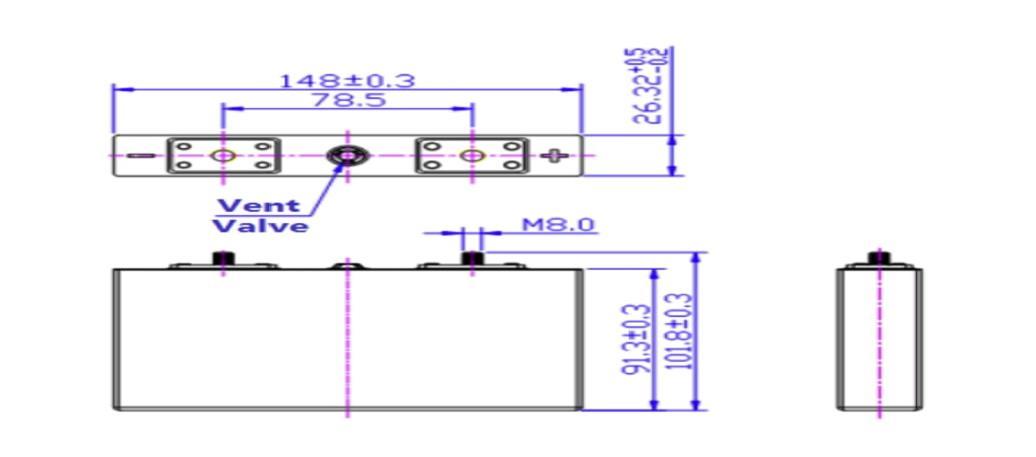
Fig.1:Dimensionofthe25AhNCMbattery[8]
Thelithium-ionbatterywasdefinedwithadensityof2700kg/m³,thermalconductivityof0.8W/m·K,andspecificheat of 1000 J/kg·K. The aluminum foam, due to its porous structure, had a much lower density of 270 kg/m³ but higher thermalconductivityof10W/m·Kandaspecificheatof900J/kg·K.Paraffinwax,usedasthePCM,wascharacterizedbya densityof900kg/m³,lowthermalconductivityof0.24W/m·K,andhighspecificheatof2100J/kg·K,withameltingpoint of55°C,makingitsuitableforthermalregulationapplications.andmeshingwithrefinedbodysizingforaccuracy.
International Research Journal of Engineering and Technology (IRJET) e-ISSN: 2395-0056
Volume: 12 Issue: 09 | Sep 2025 www.irjet.net p-ISSN: 2395-0072
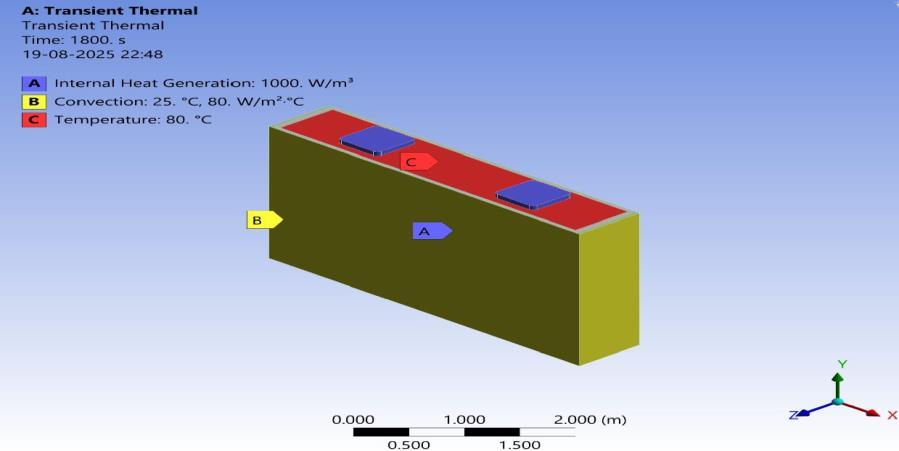
Intheabovefig.2showsphysicssetup,aninitialtemperatureof25°Cwasassigned,avolumetricheatgenerationof 1000 W/m³ was applied to represent internal heating, and convective cooling was defined with a film coefficient of 80 W/m²·Kandambienttemperatureof25°C.Thermalcontactswereestablishedbetweenthebattery,aluminumfoam,and PCM with adjusted conductance to ensure proper heat transfer across interfaces. The transient simulation was executed for 1800 seconds (30 minutes) using implicit time stepping, with outputs including temperature distribution, total heat flux,anddirectionalheatfluxalongtheX-axis.
A. Thermal Analysis Results
This chapter presents a detailed analysis of the thermal performance of the prismatic lithium-ion battery system integratedwith aluminum foamandparaffinwaxPCM,simulatedusingtheANSYS StudentEdition.Thesimulationwas performed using a transient thermal approach to capture the temperature response, heat flux behavior, and thermal stabilizationovera30-minute(1800s)operatingperiod.
a. Temperature Distribution Analysis
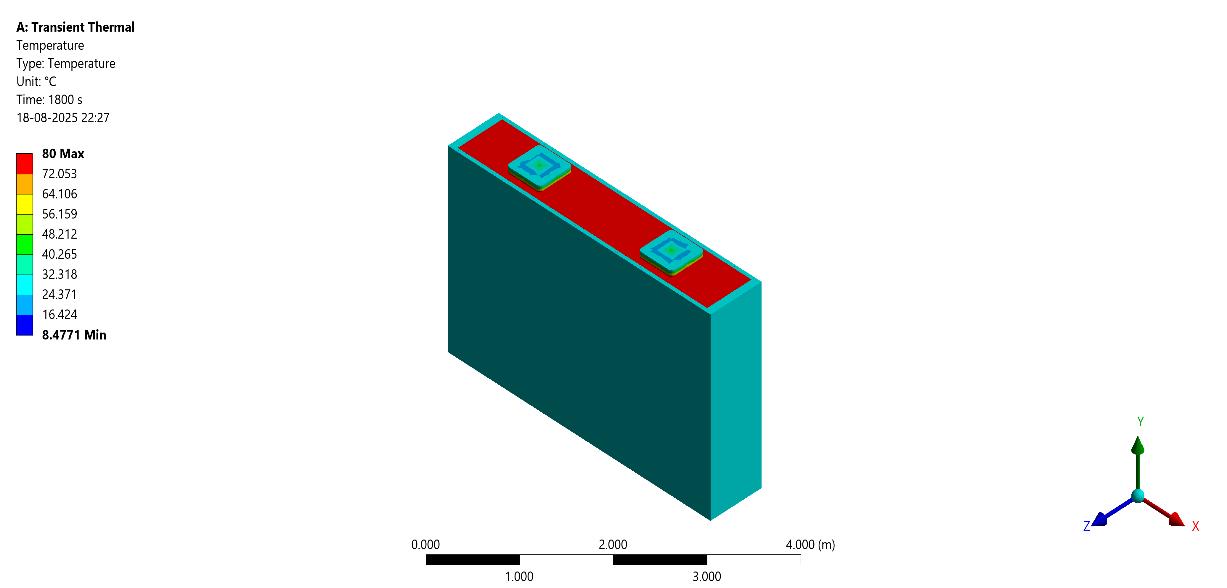
Above fig.3. shows the temperature profile of the system was evaluated under internal heat generation using transient simulation.Intheinitialphase(t=0.5s),extremeandunphysicaltemperaturesrangingfrom –42.659°Cto167.02°Cwere observed,likelyduetosuddenheatapplication,boundaryconditiondiscontinuities,andnumericalartifactsfromthermal inertia. As the simulation progressed, the profile stabilized, with temperatures ranging from 20.08°C to 80°C at 70 s and between 8.47°C and 80°C by 1800 s. The average temperature consistently remained around 26–27°C, confirming the establishmentofastablethermalregimeaftertheinitialtransientresponse.
International Research Journal of Engineering and Technology (IRJET) e-ISSN: 2395-0056
Volume: 12 Issue: 09 | Sep 2025 www.irjet.net p-ISSN: 2395-0072
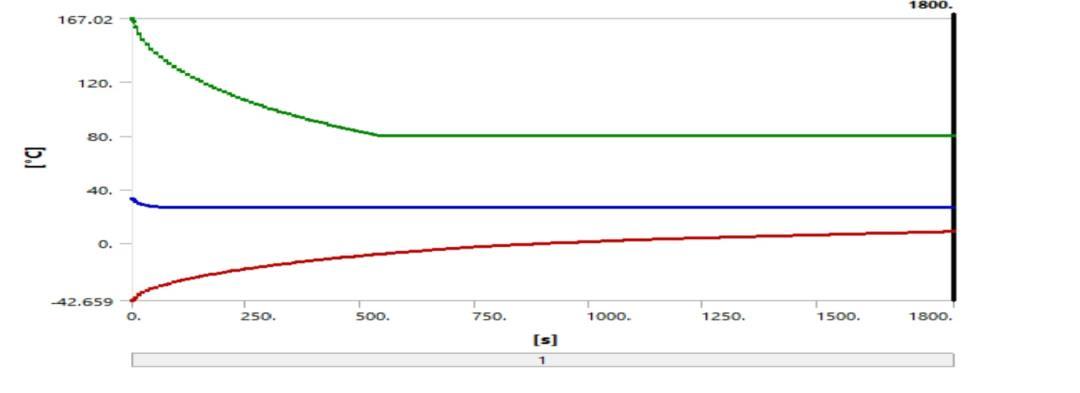
Fig.4:TemperaturevsTimeofthebattery
Redline:Minimum(negativeatinitialiterationandgradullayincreases)
Greenline:Maximum(positiveandpeakedtemperatureatearlytransientstate)
Blueline:Averagetemperature(stabilizedafterpcmabsorption)
From fig. 4, the maximum temperature peaked at 167 °C during the very early transient stage, while the average stabilized near 26–27 °C after PCM absorption. The negative values in minimum temperature are numerical overshoots during initial iterations and should be disregarded. Importantly, the PCM and aluminium foam effectively suppressed temperature rise, limiting the steady-state maximum to 80 °C and ensuring uniform thermal distribution across the batterypack.
b. Heat Flux Distribution Analysis
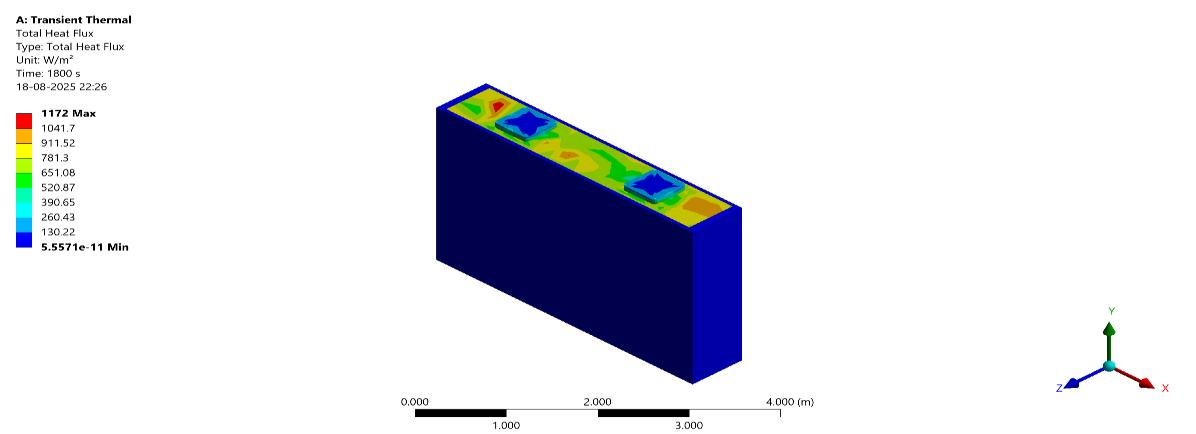
Fig.5:heatfluxofthebatterywithaluminiumfoamandpcm
From the above fig.5 heat flux distribution is crucial for evaluating heat transfer efficiency within the system. The maximumtotalheatfluxreached3268.2W/m²at0.5sbutdecreasedto1172W/m²by1800s,reflectingreducedthermal gradients as the system stabilized. The highest flux concentrations were observed near boundaries and along highconductivitypaths,particularlythroughthealuminumfoamstructure,highlightingitsroleinenhancingthermaltransport.
International Research Journal of Engineering and Technology (IRJET) e-ISSN: 2395-0056
Volume: 12 Issue: 09 | Sep 2025 www.irjet.net p-ISSN: 2395-0072
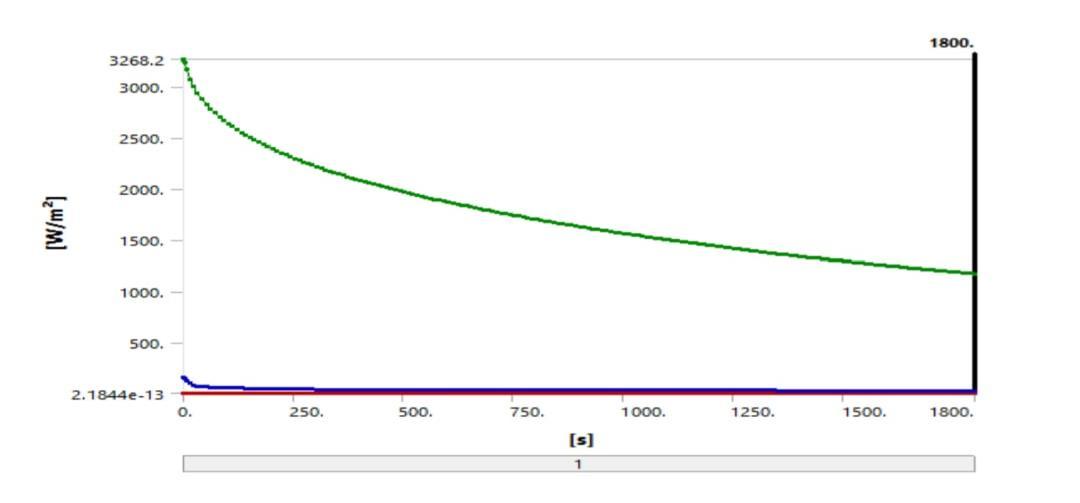
Fig.6:TimevsTotalheatfluxofthegeometry
Redline:Minimumheatfluxvalues(negative,indicatinginwardflux).
Greenline:Maximumheatfluxvalues(positive,graduallyreduced).
Blueline:Averageheatfluxvalues(reflectingstableanduniformthermaltransfer)
Fromtheabove fig. 6highlightstheheatflux evolutionduring the chargingcycle. Initially,maximumflux exceeded 3200 W/m², indicating sharp thermal gradients. However, flux values gradually reduced as the PCM absorbed heat andredistributeditthroughthealuminiumfoam.Attheendofthecycle,theaverageheatfluxdroppedto~26W/m², reflecting stable and uniform thermal transfer. The results confirm that PCM acted as a thermal buffer, while aluminiumfoamenhancedconductivity,resultinginefficientpassivecooling.
c. Directional Heat Flux (X axis) Analysis
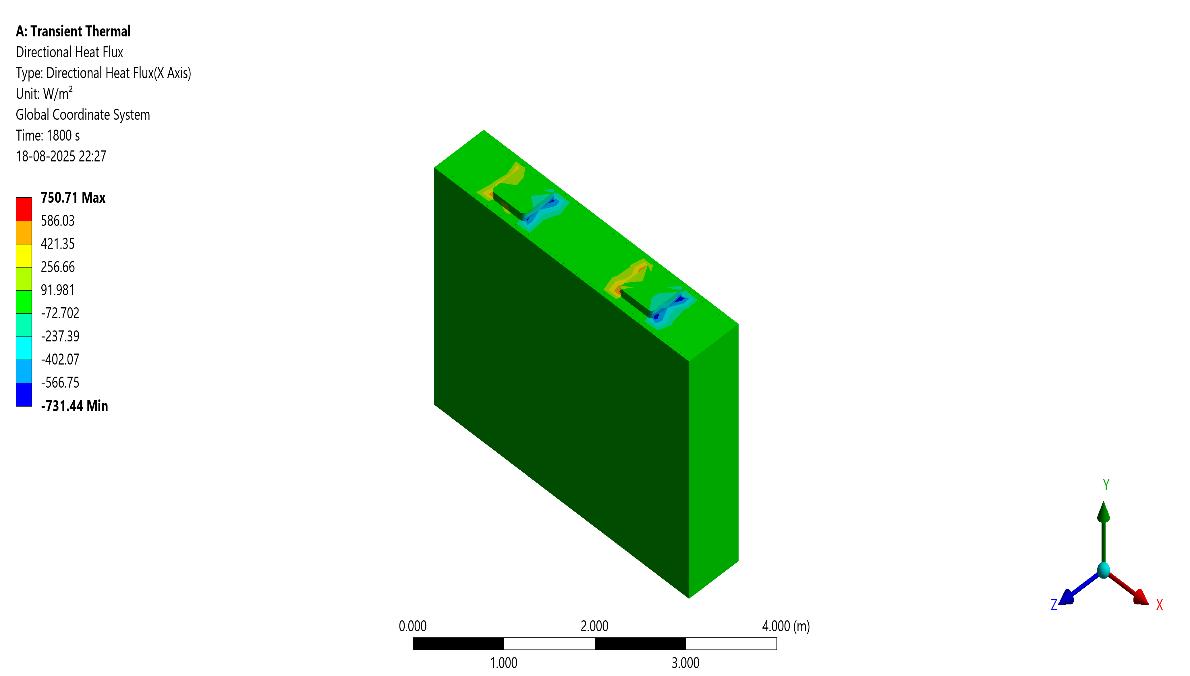
In the above fig. 7 the heat flux distribution ranged from a maximum of 750.71 W/m² to a minimum of –731.44 W/m², with the negative values indicating localized reverse heat flow caused by complex internal thermal redistribution. This strongdirectionality,particularlyintheX-direction,highlightsanisotropicheattransportinfluencedbythefoamgeometry and heat source orientation. The occurrence of reverse flux further suggests phase change effects, where latent heat absorptioninthePCMlocallycoolscertainregions,drawingheatfromadjacenthotterzones.
International Research Journal of Engineering and Technology (IRJET) e-ISSN: 2395-0056
Volume: 12 Issue: 09 | Sep 2025 www.irjet.net p-ISSN: 2395-0072
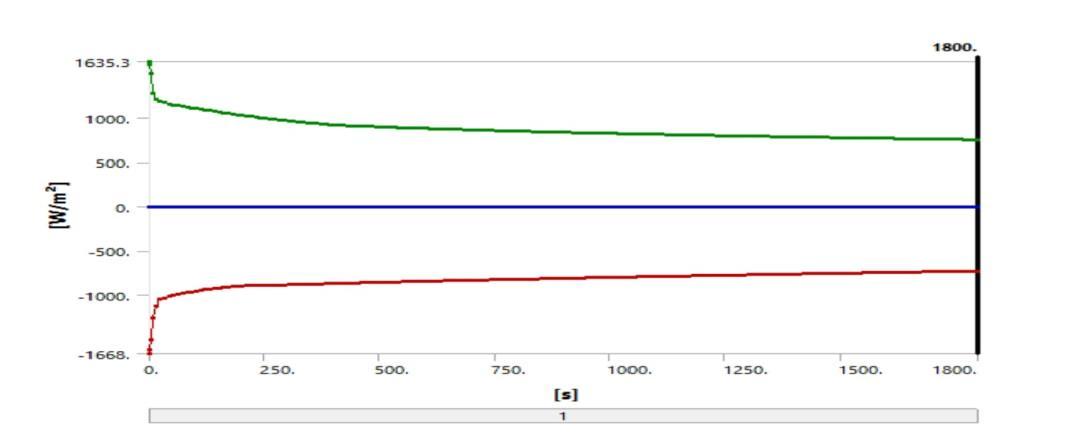
8:DirectionalHeatfluxvsTime
Redline:Minimumheatfluxvalues(negative,indicatinginwardflux).
Greenline:Maximumheatfluxvalues(positive,indicatingoutwardflux).
Blueline:Averageheatfluxvalues
From the above fig. 8 shows that during the transient simulation, directional heat flux initially fluctuated sharply between −1668 W/m² and +1635 W/m² due to strong bidirectional conduction and PCM absorption effects. Over time, these fluctuations diminished, with the average flux remaining small (~0.03–0.25 W/m²), indicating balanced heat transfer in opposite directions. By 1800 s, the flux range narrowed to −731 W/m² to +751 W/m², with an average of ~0.178 W/m², confirming near steady-state equilibrium. These results highlight that the PCM–foam structure not only stabilizesbulktemperaturebutalsosmoothsdirectionalheatflow,reducinghotspotsandthermalstresses.
Validation of work
The present study achieves both a lower maximum temperature and a significantly reduced average temperature, indicatingimprovedthermalregulationusingthealuminiumfoam-enhancedPCMsystem
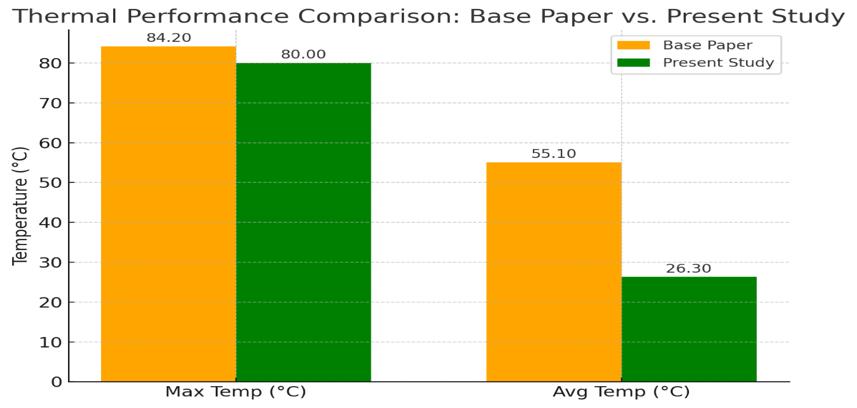
Thepresentstudyshowsalowermaximumtemperature(80 °C)comparedtothebasepaper(84.2 °C).
The average temperature in the present study is significantly reduced to 26.3 °C from 55.1 °C in the base paper, indicatingmuchbetterpassivecoolingperformanceusingthehybrid*paraffin+aluminumfoamsystem.
B. Summary of Key Findings
The hybrid PCM–aluminum foam system effectively maintained battery temperatures, with maximum temperaturelimitedto80°Candaveragetemperaturebetween26–28°C.
International Research Journal of Engineering and Technology (IRJET) e-ISSN: 2395-0056
Volume: 12 Issue: 09 | Sep 2025 www.irjet.net p-ISSN: 2395-0072
Initial thermal spike at 0.5 s was due to startup artifacts, but the system quickly stabilized as PCM melting and foamconductionbalancedheattransfer.
Paraffin wax PCM, with a latent heat of 250 kJ/kg and melting point of 55°C, absorbed significant heat without sharptemperaturerise,enhancingthermalsafety
Aluminum foam, with high effective thermal conductivity (10 W/m·K), promoted uniform heat distribution and reducedlocalizedhotspots
Directional heat flux analysis revealed reverse flow phenomena, confirming internal thermal redistribution throughPCMabsorptionandfoamconduction.
By1800s,thesystemreachedquasi-steady-stateequilibrium,withdiminishingfluxandstabletemperatures.
Comparative analysis with literature showed strong agreement in both trend and magnitude, validating the simulation’sreliability.
Overall, the PCM–foam composite BTMS improves safety, prevents thermal runaway, and enhances efficiency, makingitsuitableforlithium-ionbatteryapplications.
The transientthermal simulationconductedusingANSYS Workbenchhaseffectively demonstratedthethermal behavior andperformanceofaprismaticlithium-ionbatterysystemenhancedwithaluminumfoamandparaffinwaxphasechange material(PCM)forpassivethermalmanagement.
Over 1800 seconds, the system maintained a well-regulated temperature profile, with a maximum of 80°C and averagetemperaturesof26–28°C
An initial non-physical thermal spike at 0.5 s occurred due to startup artifacts but quickly stabilized as PCM meltingandfoamconductionbalancedheattransfer.
ParaffinwaxPCM(latentheat:250kJ/kg,meltingpoint:55°C)absorbedsubstantialthermalenergywithoutsharp temperaturerise,reducingthermalrunawayrisks
Aluminum foam (thermal conductivity: 10 W/m·K) enhanced uniform heat distribution, minimizing localized hotspots.
Directional heat flux analysis revealed reverse flow phenomena, confirming internal redistribution via PCM absorptionandfoamconduction.
By1800s,thesystemreachedaquasi-steady-state,withstabletemperatureandreducedheatfluxvariations.
Comparative analysis with validated literature showed strong agreement in trends and magnitudes, confirming simulationreliability.
[1] YifeiZhu,LyumingPan, YubaiLi,andJiayouRen, “Advancesin flow pattern design ofliquid-cooledcomponents forbatterythermalmanagement”,FutureBatteries,Vol.:5,2025,pp:100018.
[2] Magui Mama, Elie Solai, Tommaso Capurso, Amelie Danlos, and Sofiane Khelladi, “Comprehensive review of multi-scale Lithium-ion batteries modeling: From electro-chemical dynamics up to heat transfer in battery thermalmanagementsystem”,EnergyConversionandManagement,Vol.:325,2025,pp:119223.
[3] MehwishKhanMahek,DanielS.Choi,MohamadRamadan,MohammadAlkhedher,MohammedGhazalandFahid Riaz,“Advancedthermalmanagementwithheatpipesinlithium-ionbatterysystems:InnovationsandAI-driven optimization’’,NextEnergyVol.:7,2025,pp:100223.
International Research Journal of Engineering and Technology (IRJET) e-ISSN: 2395-0056
Volume: 12 Issue: 09 | Sep 2025 www.irjet.net p-ISSN: 2395-0072
[4] M. Ismail, J.R. Panter, and S. Landini, “Numerical investigation of fin geometries on the effectiveness of passive, phase-change material based thermal management systems for lithium-ion batteries”, Applied Thermal EngineeringVol.:262,2025,pp:125216.
[5] Mohammed A. Alghassab, “Advanced thermal management system of Lithium-Ion Batteries: Integrating thermoelectricmoduleswithphasechangematerials”,JournalofKingSaudUniversityScience,Vol.:36,2024,pp: 103570.
[6] Abdelrahman Gasmelseed, Mhadi A. Ismael, Mior A. Said, and Faiz Ahmad, “Numerical investigation and optimization of liquid battery thermal management system considering nanofluids, structural, and flow modificationsunderhighdischargecycles”,CaseStudiesinThermalEngineering,Vol.:64,2024,pp:105573.
[7] Parvaneh Zare, Noel Perera, Jens Lahr, and Reaz Hasan, “Uniform temperature distribution, prolonged temperature regulation, and accelerated recovery of battery thermal management system using a novel f in design”,JournalofEnergyStorage,Vol.:108,2025,pp:115054.
[8] XuningFeng,MouFang,XiangmingHe,MinggaoOuyang,LanguangLu,HaoWang,andMingxuanZhang,“Thermal runaway features of large format prismatic lithium-ion battery using extended volume accelerating rate calorimetry,”JournalofPowerSources,Vol.:255,2014,pp:294–301.
[9] Baolin Ma, LuluGuo, and Hong Chen, “Modeling and Parameter Optimization of Battery Liquid Cooling Thermal ManagementSystemforElectricVehicles”,IFACPapersOnLine,Vol.:58-29,2024,pp:118–123.
[10] FooShenHwang,ThomasConfrey,ColinReidy,DorelPicovici,DeanCallaghan,DavidCulliton,andCathalNolan, “Review of battery thermal management systems in electric vehicles”, Renewable and Sustainable Energy Reviews,Vol.:192,2024,pp:114171.
[11] Delika M. Weragoda, Guohong Tian, Qiong Cai, Teng Zhang, Kin Hing Lo, and Yan Gao, “Conceptualization of a novel battery thermal management system based on capillarydriven evaporative cooling”, Thermal Science and EngineeringProgress,Vol.:47,2024,pp:102320.
[12] Y.SalamiRanjbaran, S.JenabiHaghparast, M.H.Shojaeefard and G.R.Molaeimanesh, “Numerical evaluation of a thermal management system consisting PCM and porous metal foam for Li-ion batteries,” Journal of Thermal AnalysisandCalorimetry”,vol.:141,2020,pp:1717–1739.
[13] Hai Huang, Wei Li, Shusheng Xiong, Zihao Luo, and Muhammad Ahmed, “Singlephase static immersion-cooled battery thermal management system with finned heat pipe”, Applied Thermal Engineering, Vol.: 254, 2024, pp: 123931.
[14] Francesca Cura, Raffaella Sesana, Luca Corsaro, and Marie Marguerite Dugand, “An Active Thermography approachformaterialscharacterisationofthermalmanagementsystemsforLithium-ionbatteries”,Heliyon,Vol.: 10,2024,pp:e28587.
[15] Olanrewaju M. Oyewolaa, and Emmanuel T. Idowu, “Numerical and artificial neural network inspired study on step-like-plenumbatterythermalmanagementsystem”,InternationalJournalofThermofluids,Vol.:24,2024,pp: 100897.
[16] Jiebo Yang, Yang Yu, Sheng Chen, Maji Luo, Yuanhao Wu, and Zijian Zhou, “Optimizing PCM-fin structure Li-ion battery thermal management system under mechanical vibrational condition: A comparative study”, InternationalJournalofHeatandMassTransferVol.:217,2023,pp:124669.
[17] Jiebo Yang, Qinghua Yu, Wenjie Ye, Yang Yu, and Sheng Chen,” Performance analysis of PCM-based lithium-ion batterymodulethermal managementsystemunder mechanical vibration”,Alexandria Engineering Journal,Vol.: 113,2025,pp:205–217.
[18] Amin Rahmani, Mahdieh Dibaj, and Mohammad Akrami, “A study on a battery pack in a hybrid battery thermal management system integrating with thermoelectric cooling”, Case Studies in Thermal Engineering Vol.: 61, 2024,pp:104856.
International Research Journal of Engineering and Technology (IRJET) e-ISSN: 2395-0056
Volume: 12 Issue: 09 | Sep 2025 www.irjet.net p-ISSN: 2395-0072
[19] Jiawei Xiao, Haitao Min, RuiJiang, and Weiyi Sun, “A New Hybrid Battery Thermal Management System: A NumericalStudy”,IFACPapersOnLine,Vol.:58-29,2024,pp:13–18.
[20] Baolin Ma, LuluGuo, and Hong Chen, “Modeling and Parameter Optimization of Battery Liquid Cooling Thermal ManagementSystemforElectricVehicles”,IFACPapersOnLine,Vol.:58-29,2024,pp:118–123.
[21] FooShenHwang,ThomasConfrey,ColinReidy,DorelPicovici,DeanCallaghan,DavidCulliton,andCathalNolan, “Review of battery thermal management systems in electric vehicles”, Renewable and Sustainable Energy Reviews,Vol.:192,2024,pp:114171.