
International Research Journal of Engineering and Technology (IRJET) e-ISSN: 2395-0056
Volume: 12 Issue: 05 | May 2025 www.irjet.net p-ISSN: 2395-0072
International Research Journal of Engineering and Technology (IRJET) e-ISSN: 2395-0056
Volume: 12 Issue: 05 | May 2025 www.irjet.net p-ISSN: 2395-0072
1 Dept. of Program Engineering, University of Science, D.P.R of Korea.
2 Professor, Doctor, Dept. of Biology Engineering, University of Science, D.P.R of Korea.
3 Dept. of Program Engineering, University of Science, D.P.R of Korea.
Abstract - An abstract summarizes, in one paragraph, fromtheupperresearch,thethermalinterchangevelocity in the animal, furs and in the bird, feathers showed with thecoolingpinismarkedastothenextformula,
, the thermal efficiency is marked as to the ratio of the feather, and the thermal interchange( f Q )onthemaximumthermalinterchange max Q
incaseoftheideological,thethermalefficien-cyis marked asto the ratio of thefeather, and the fur, thermal interchange ( f Q ) on the maximum thermal interchange
incaseoftheideological.
Q
Key Words: the cooling pin, thermal interchange velocity, animal,bird
1. THE CHANGE ANALYSIS ON THE THERMAL CONDUCT BY THE ANIMAL EXTERNAL SURFACE FORM IN THE COLDEN PIN FORMS
Generally,thecoolingfintypeisusedtoincreasetheheat exchange rate between the solid surface and the surroundingfluid.Forexample,animalfeathers(including birds' wings and feathers) act as cooling wings, and the shape of scales in ectothermic animals, such as amphibians,reptiles,etc.,thatareinevolution,dependson the environment. Thus, it can be expected that the structureof the feathers(lion et al., etc.)and birds’ wings in the neck of reptiles evolved to play a role as cooling wings.
Let this phenomenon is marked with the differential equation. Suppose there is any type of cooling vane, as showninFig.1.Letusassumethatheatissuppliedatone endofthecoolingfinandthatthisheatisheattransferred
through the rod and that heat is released by convection intothesurroundingmedium.
This phenomenon can be expressed by differential equations.
It is assumed that the cooling fin is make a protruding appearance,thethermalconductivityisconstant,thefluid temperature around the cooling fin is constant and the temperaturevariesonlyinthe x-axis
Since the hair and fins in animals are usually thin, small andslender,thecoolingfinswediscussaremadethin,and wecanassumeaone-dimensionalconditionasfollows.As to see the Fig 1, in the x-spot, the length of the fur is △x, the cut area of the fur is A0, the volume element that the length of the fur is p is 1-dimention condition. Then, in case the stable state, the correlation formula on the energy,equationcanbewritten,asfollow.
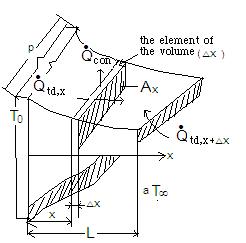
Fig -1:Thethermalexchangeinthecoolingpin,form, con Q :theheat-qualitativechangeintheconvection,
Q
: thethermalconduct
International Research Journal of Engineering and Technology (IRJET) e-ISSN: 2395-0056
Volume: 12 Issue: 05 | May 2025 www.irjet.net p-ISSN: 2395-0072
Formula(1)iswritten,again,asfollow. TC:thermalconduction ()0 x QQ apTT
In the limitation 0 x , Formula (3) is written, again, as follow.
Let,seethesurfaceareaofthecrocodileindicatedastothe researchobjectisnearly15m2 .
Thistime, 22 ()20/(6040)156000/6/conss QTTAwmkCmwhkwh
Inthecrocodileissupplementedduring10h,thecrocodile must to eat catching the animals additioned the thermal mass 6/(10)60 Qkwhhkw
If the Fourier, law td c dT QA dX is considered, the formula(4)iswritten,again,asfollow.
This formula is the thermal conduct, differentiation equation been to making in order to decide the temperature, distribution in cooling fin taken the form as sametotheFig-1.
The case of constant cross-sectional area and thermal conductivityofthecoolingfinisaspecialcaseoftheabove case,butisoftenencounteredinengineeringpractice.
Theformula(5)iswritten,again,asfollow. 2 2 2 0 d
Formula(6)istakenthegeneralresolutionknown,asnext follow. ()12 mxmx x cece (7)
Here, the integral constants C1, C2 is decided by the boundary condition owing to the case. For example, body temperature of non-homeostatic animals such as crocodiles varies with the external environment, but is generally around 40°C. And, if the temperature of the outside air is 60℃, the non-homeostatic animal can be highed to 60℃ the itself body temperature. This time, afterthenon-homeostaticanimalscomeoutintheoutside. How the quantitative of the thermal dissipation mass to hightheanimalsurface,temperature60℃ is,namely,how thequantitativemarkedthethermalenergies,andinorder to the non-homeostatic animals adhered to 10h in the outside air circumstance, how the thermal energy is needed, the upper theories in resolution of the practical problemcanbeadapted.
Many animals are supplemented the thermal dissipation massbytheseaenergyandthepreyenergy.Inthenatural convection state, the thermal conduct coefficient is α =20w/m2●k.
The animals must be additional the proteins in order to adhered these stakes. In order to additional with the proteinsthethermalenergy,mass,60kw,used,theanimal must be demand the few of proteins of the 8kg. And, because of the animal, body is not only to consist of the proteins, If the animal as same to the crocodile is eated catchingto the small animal thatis taken the13.3~15kg, weight,theyareadheredto10houres.
Generally, the non-homeostatic animals eat a little of the foodthanthehomeostaticanimals,relativelyandtheycan be to highed the itself body temperature with the seaenergy.
2. THE ANALYSIS ON THE THERMAL CONDUCT CHANGE OF THE ANIMAL, FUR AND THE FEATHER OF THE BIRD DISCUSSED BY THE AIRFOIL, EFFECTNESS.
Cooling fins are generally used for the purpose of enhancingheatexchange,butinsomecases,heatexchange can be rather weakened. This is because the blade itself represents the thermal conduction resistance from the originalsurface.Therefore,theattachmentoffinsdoesnot increasetheheatexchangerate.
For example, polar bear hairs are structurally very low in heat exchange and can be seen to maintain their body temperature.Toseetheperformanceoftheblade,wefirst definethebladeeffect.Thefineffectdefinestheratioofthe heatexchangeratewithandwithoutfins.
the thermal exchange velocity in the case to have the pin
the thermal exchange velocity in the case to havent the pin
Here, bA is the cut area of thepin in the native boot, area. Generally,inordertostrengthenthethermalexchange, f mustbelarged,possibly.Generally,tousingthecoolingpin takenthe 2 f isveryeffected.Inpolarcase,inthecase thenon-limitationalpin, f canbeappraisedwith
International Research Journal of Engineering and Technology (IRJET) e-ISSN: 2395-0056
Volume: 12 Issue: 05 | May 2025 www.irjet.net p-ISSN: 2395-0072
To see theanimals andthebirds,theyaresetupthe itself fur and the itself feather, possibly in summer. And, to see the animals and the birds, they are lay down the itself fur andtheitselffeather,possibly,inwinter.
In order to prepared living in winter, in order to formed the warm fur, the animals are proceeded the replacement of hair. From the formula (10), we can be showed the variousimportantcharacteristics.
The bigger the length P (the diameter of the fur, so on) stickedthefuroftheanimalandthefeatherofthebirdon the body surface is bid, the smaller the area Ac of the surfaceissmall, f ,namely,theratioofthevelocityofthe thermalexchangeislarger.
Therefore,unlessthefuroftheanimal,diameterislarge,p isbiggerwithstraightline.
Also, if f is layed down, the c A (external surface area of the furs) is large, the wool sticked the bird body, external surfaceareaisaciliumanditsformistensioned
Becauseofthe1/2 exponentiationintheformula (10), f isgraduallylayeddownbythepand c A ischangedbythe , a
A is the thermal interexchange coefficient of the outside circumstance and λis the thermal staining coefficient of theanimal,sorts(namely,thethicknessoftheoil,layer,so on).
This value is changed by the summer or winter regulated though is changed by the thickness of the fat regulated though
Toseethisside,theappititudeisasfollow.
First;Thebiggerthethermalconductcoefficientthequality of the pin material is very good. Although the copper is verygoodmaterialwithtohavingverybigthermalconduct coefficient, because of the copper has very high cost and has very big weight, man is usually using the aluminium materialinordertomakingthecoolingpin.Thehairsofthe animals, namely, the furs and the feather of the domestic animalsandbirdsiscompared,eachorder.
Second;Iftheratioofthepincutarea onthelengthofthe pin-boundary is big, the thermal conduct capacity is very good. Therefore, in order to high the pin, thermal conduct capacity, man is designed with very thin board and is sticked on the any turbine body, closely. If this capacity is looked at the animals, this can be to discussed on the making the bird, pin with the boards, the making the feather taken the many branches and laying form of the ciliumoftheairfoil,themakingtheboard,form.
Third; That the pin is sticking the spot taken the smallest thermal resistance coefficient, value is suitable. Therefore,
ifthethermalconducttakeplacebythenaturalconvection thanstrong convection, the cooling pin is used in order to strengthen the thermal interexchange and the cooling pin isusedintheairthanliquid.
In instance, in order to strengthen the thermal interexchange in the periphery air in the tube flowed the boiled water, the cooling pin isn’t put at the spot in the flowed the water and the cooling pin stick at the one spot in the tube surface touchedin the air. We can be analysed as to formed by these theories to stick the bird, airfoil on the body, surface and to show the animal, furs on the animalcutis,surface.
The state taken the maximum value in the convection thermal interexchange from the external surface of the airfoil to periphery material is mean the state as same to thetemperatureoftheairfoil,boot.Becauseofthethermal resistance is surely existed in the any airfoil, to do the equalize the temperature of the boot of the airfoil is idealistically,perfectly.
Thistime,thethermalflowisasto Qmax .Thepinefficiency isidentifiedasfollow(Fig-2).
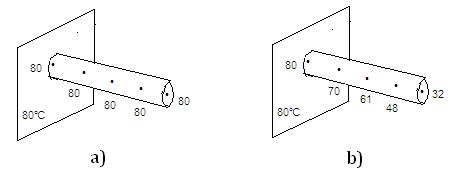
Fig -2:Thechangingprocessoftheheatconduct-thermal resistanceintheanypin a)Idealisticstateb)Practicalstate
We can be to discussed the domestic animal, furs and the bird, feathers by these theories. We can be to measurered thefur,endtemperatureandthecutissurfacetemperature ofthebirdsandofthedomesticanimals.
Because of the cutis surface temperature of the domestic animalsandofthebirdsistomaintainthemaximumvalue haven’t the relation to the its periphery circumstance temperature, namely, because of the temperature of the animalsurface,temperatureiscertainconstant.
The domestic animal, furs and the bird, feather is formed the nearly idealistically pin efficiency as same to the temperature of the fur, bottom on the surface and the temperatureofthefur,end
Therefore,thedomesticanimal, fursandthebird,feathers isthinandshort,largestly,anditsnumbersisexistedvery manyontheanimalsurface.
If f A iscalledthetotalsurfacearea ofthepinandif f Q is called the practical thermal interexchange velocity on the cooling pin the pin efficiency counting formula can be showedasfollow.
International
Volume: 12 Issue: 05 | May 2025 www.irjet.net
(11)
Be written this formula, again, we can decide the thermal interexchangevelocityfromthecoolingpin.
If the pin efficiency can be counted by this formula, the thermalinterexchangevelocityfromthecoolingpindecide, easily.
Ininstance,thereisexistedtheanimalappearedtheoutput ofthe40w.
Inthiscase,theperipheryair,temperatureis20℃.
Thebodytemperaturemusttobecomethe42℃(birds)on the 36.5~37℃(animals).Let choose the cooling pin, form in order to satisfied the upper condition. (Identification) Let, satisfied the stable condition I the state sticked the coolingpin(namely,thestatestickedthemanyfursonthe cutis,surfaceoftheanimalsandofthebirds).
The cooling pin, namely, the touched resistance formed betweenthecutis,surfaceoftheanimalsandofthebirdsis ignored and the temperature of the cooling pin surface is identified and although the output appeared the two animal sorts is differenced, each order, this output can be counted,easily.
This time, the resolution is as follow. The thermal interexchangevelocityperunit,timeis40w.Therefore,the thermalresistancecanbecountedfromnexttheformula
If the R(unit k/w) is the thermal resistance and if the thermal resistance is small, the differentiation of the temperature is small, accordingly, the pin efficiency is bigger. (4220)22 0.55/ 4040
(incaseofthebirds) (36.520) 0.412/ 40 TCC RCw w
(incaseofthedominicanimals)
From the this,in order to maintain the condition that “the cooling pin”(namely, the fur and the feather attained the suitable material) must to obtained upper the thermal resistance 0.55/ RCw , upper the thermal resistance 0.412/ RCw , the animals and the birds, surface is coveredwiththefursandthefeathers
Therefore, the length of the birds is very longer than the length of the furs of the animals on corresponding body, size, the form of the birds has a lot of variously forms, namely,wecanbeknowntohavethevariouslyforms.
Fromtheupperresearch,thethermalinterchangevelocity in the animal, furs and in the bird, feathers showed with thecoolingpinismarkedastothenextformula
And,thethermalefficiency ismarkedastotheratioofthe feather, and the fur, thermal interchange ( Q ) on the maximum thermal interchange max Q
in case of the ideological.
Namely, to equated the temperature of the bird, surface andthetemperatureofthefeather,endisideological
From these theories, the furs of the animals and the feathersofthebirdsismaximumthinandcorrespondingly sorter and very many (instance bird, cilium) the length of the bird, pin is long than animal, furs in compared the body, size, therefore, we can be known to have the variouslyshapesnamely,alotofmanyvariouslyformthan animal,furs.
[1] Peter,Rillero.PhD,DinahZike,Ecology,Glenco,2005
[2] Yns A. cengel, Heat Transfer, John willey & sons, 2002
[3] Frnk P. Incropera, Fundamentals of Heat and Nass Transfer,Johnwilley & sons,2002.
[4] Almo Farina, Principles and Method in Landscape, Ecology,NewYork,2004