
International Research Journal of Engineering and Technology (IRJET) e-ISSN: 2395-0056
Volume: 11 Issue: 12 | Dec 2024 www.irjet.net p-ISSN: 2395-0072

International Research Journal of Engineering and Technology (IRJET) e-ISSN: 2395-0056
Volume: 11 Issue: 12 | Dec 2024 www.irjet.net p-ISSN: 2395-0072
Hemadevi S1 and Raju Manda2
1 M.E in Irrigation water Management, Department of Civil Engineering, Anna University, Tamil Nadu, India 2M.Tech in Farm Machinery and Power, Department of Agricultural Engineering, Assam University, Silchar, Assam, India
Abstract - This study examines the effects of the Pani Pipe Method, a water-saving irrigation technique, on rice cultivation in Periyakkurchi Village, Ariyalur District, Tamil Nadu, India. It was found that the usage of water was significantly lesser than that of traditional flood irrigation. The Pani Pipe Method needed 16 irrigations whereas flood irrigation required 22. This water-saving trend was accompanied by increases in productive tillers per square meter (292 for Pani Pipe vs. 268 for flood irrigation), panicle number per plant (15 vs. 13), and a reduced occurrence of bacterial leaf blight (11% vs. 28%). The findings suggest an optimistic direction for sustainable rice cultivation in the PeriyakkurchiVillagethroughoptimizingtheuseofavailable water resources and enhancing the productivity of crops. There is a need for more research on these results within differentagro-climaticzonesandtounderstandhowthePani Pipe Method can economically and socially benefit local farmers in the region.
Key Words: Pani Pipe, Paddy, Yield, flood Irrigation, Irrigationwatermanagement.
1.Introduction
Alternate Wetting and Drying (AWD) irrigation is a promising water-saving technique for rice cultivation, reducingwateruseandgreenhousegasemissionswithout compromisingyields,butitrequiresvalidationacrossvaried soilsandclimatesforwideradoption.Avilkumaretal.,2019
The Pani Pipe method, a smart modification of the AWD systemintroducedbyIRRI,helpspoorandmarginalfarmers improvewateruseefficiencyinricecultivationbyproviding asimple,cost-effectivewaytodecidewhenandhowmuchto irrigate,therebysustainingorenhancingyields.Prithwirajet al.,2017
Riceisoneofthemoststaplefoodcropsforamajorportion of the world population, mainly in South Asia. But rice cultivation has always been associated with heavy water usage,whichmakespeoplethinkaboutwaterscarcityand sustainability in the environment. In regions like Periyakkurchi Village in Tamil Nadu, India, where water resources are scarce, optimizing irrigation practice is important for ensuring food security and reducing the impactonthe environment
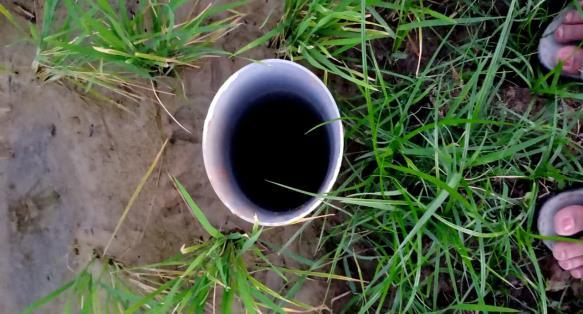
Althoughcommonlyadopted,thetraditionalfloodirrigation techniquesoftencausewaterloggingandnutrientleaching besidesunproductivewateruse.Recentyearshaveseenthe adoption of other irrigation techniques in rice cultivation, including the Pani Pipe Method to enhance water management efficiency. According to this technique, PVC pipes with holes drilled along the length of the pipe are installedintothericefield.
These pipes are moisture indicators for water, enabling farmerstogaugesoilmoistureandprovidewateronlywhen necessary.
ThisstudyinvestigatesthePaniPipeMethodimpactonrice cultivation in Periyakkurchi Village, which focuses on its potentialforconservingwater,increasingcropproductivity, anddecreasingtheincidenceofdiseaseslikebacterialleaf blight(BLB).Theresearchaimstoprovidevaluableinsights into the effectiveness of the Pani Pipe Method as a sustainableirrigationstrategyforricefarmersintheregion andcontributetothedevelopmentofmorewater-efficient agriculturalpractices.
InJuly2024,thePaniPipewasprovidedatPeriyakurichPani Pipe method,anAWDmethodofAlternate Wetting and Drying,wasappliedinPeriyakurichVillageduringtheSamba season in July 2024to optimize water usage inADT44varietyofpaddygrains.
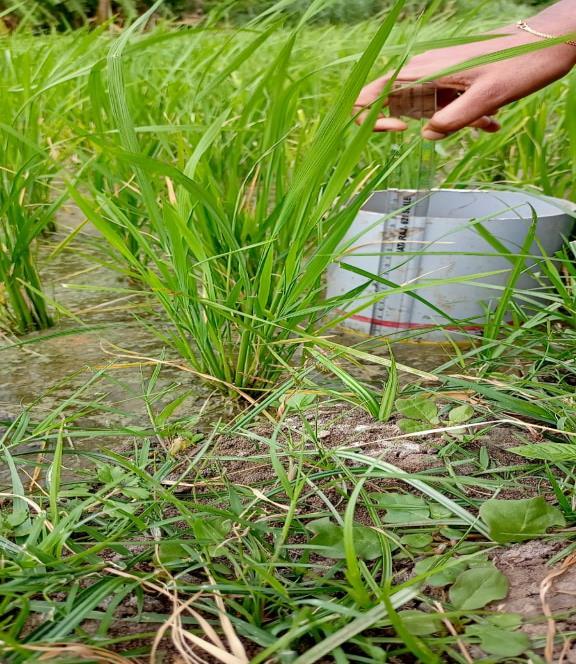
Rice seeds werecoatedwith Pseudomonas fluorescens at10g/kg, and the fieldwasappliedwithZnSO4 ata rate of10kg/acrethrough fertilizers. This methodused30 cm long plastic pipes with a 15 cm diameter, drilled with multipleholes.Thesepipeswereburiedverticallyinthefield near the bund to a depth of 15 cm, with half the pipe protruding above the ground. Twenty days after transplanting, the pipes were installed. Irrigation was triggeredwhenthewaterlevelwithinthePaniPipedropped to 15 cm below the ground level.The field was keptundercontinuousfloodingwithwatertothedepthof5 cm for one week before or after floweringwhile the Pani Pipewaskeptundersubmergedcondition.
International Research Journal of Engineering and
Volume: 11 Issue: 12 | Dec 2024 www.irjet.net
ThisapproachofAWDaimedtoreducewaterconsumption, improvetheyield ofpaddy byADT44, and enhance soil healthbyminimizingthechancesofwaterlogging.
Data onwateruse,irrigationevents,andpaddyyieldwere collectedandanalyzedforassessingtheeffectivenessofthis methodincomparisonwithconventionalirrigationpractices.
3.Results and Discussion
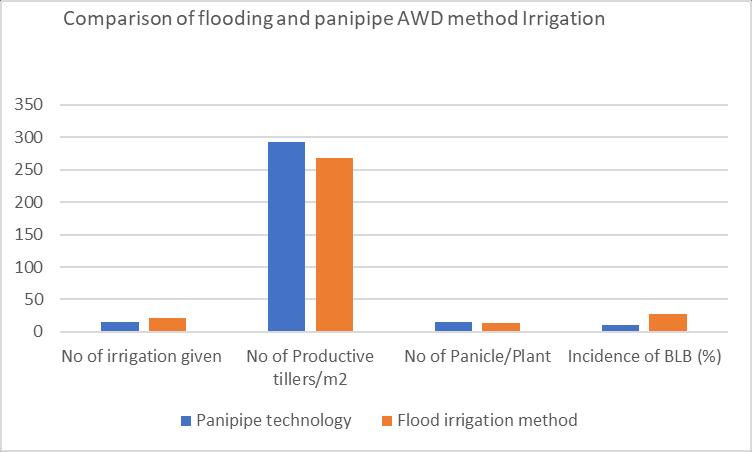
The research compared the performance of Pani Pipe irrigationwithtraditionalfloodirrigationinricecultivation. ThePaniPipemethodshowedsignificantadvantages.Ithad fewer irrigation events, 16 versus 22, which meant water saving.Inaddition,PaniPipeshowedmoreproductivetillers persquaremeter(292vs.268)andmorepaniclesperplant (15 vs. 13), which showed better plant growth and yield potential.Notably,theBLB(BacterialLeafBlight)incidence was11%inthePaniPipetreatmentcomparedto28%inthe floodirrigationtreatment,indicatingthatsoilmoistureand aeration are better controlled by Pani Pipe. Such results suggestthatPaniPipetechnologyisagoodalternativefor
floodirrigationwithbenefitsofbothyieldandsustainability ofrice.
Table -1: ComparisonoffloodingandPanipipeAWD methodirrigation
ThegraphcomparingPanipipeAWDandfloodirrigation methods shows several significant advantages of the Panipipe technology. It reduces the number of irrigation events considerably, thus saving water. This method also promotes better growth of the plant, thus having more productive tillers per square meter. It also enhances the reproductivedevelopment,whichmakesmorepaniclesper plant.Finally,thegraphpresentsalowerincidenceofBLBin the Panipipe treatment, which denotes better disease control.Insummary,thegraphpresentsanargumentthat thePanipipeAWDmethodismoresustainableandefficient inriceirrigationthanthetraditionalfloodirrigationmethod.
4. Conclusion
WediscoveredthattheAWDthresholdhadamajoreffecton yieldsandthatyieldscouldbemaintainedinmostsoilsunder mildAWD.UsingAWDalsogavea37percentreductionin numberofirrigationsgiven.
Lastly, theseresultsshowthat AWD is a promising management practiceintermsofjudicious application of irrigationwater,besidesreducingtheBLBtothe154.5per cent.
International Research Journal of Engineering and Technology (IRJET) e-ISSN: 2395-0056
Volume: 11 Issue: 12 | Dec 2024 www.irjet.net p-ISSN: 2395-0072
[1] Dey PrithwiraJ, “Smart Water Management in Rice By IRRI’sCostEffectivePani-PipeMethodForSustainable And Climate Smart Rice Development- A Short Communication”, International Journal of Agriculture Sciences,vol.9,Mar.2017,pp.-4154-4155.
[2] Narappa G, Raghavendra Yaligar, Jyothi R, Kavita Ullikashi,Radha.J,FakeerappaArabhanvi,FarzanM.K, MahanteshaMT,andMamathaMadli,”Demonstration Of Pani Pipe-Indicator Tool Of Alternate Wetting And Drying In Paddy Under Tungabhadra Command Area FarmersOfKoppalDistrict”MULTILOGICINSCIENCE” , VOL.XII,ISSUEXXXXV,Jan2023.
[3] K Venkatalakshmi,“Demonstration of Pani Pipeindicator tool of alternate wetting and drying in low land transplanted paddy,” International Journal of Chemical Studies 2020; 8(3): 1764-1766., DOI: https://doi.org/10.22271/chemi.2020.v8.i3x.9453
[4] Jagnnath P, Pullabhotla H, Uphoff N. Meta analysist evaluating water use: water saving and water productivityinirrigatedproductionofricewithSRIVs. standard management methods. Taiwan Water conservation.2013;61:14-49
[5] DaweD,DobermannA,LadhaJK,YadavRL,LinB,LalP etal.Doesorganicmatterimprovethesustainabilityand profitabilityofintensivericesystems.-FieldCropsRes. 2003;83:191-213.
2024, IRJET | Impact Factor value: 8.315 | ISO 9001:2008