
International Research Journal of Engineering and Technology (IRJET) e-ISSN: 2395-0056
Volume: 12 Issue: 05 | May 2025 www.irjet.net p-ISSN: 2395-0072
International Research Journal of Engineering and Technology (IRJET) e-ISSN: 2395-0056
Volume: 12 Issue: 05 | May 2025 www.irjet.net p-ISSN: 2395-0072
Manan Vyas1 , Aakash Suthar2
1Manan Vyas , M.Tech Student, L.J. University, Ahmedabad
2Aakash Suthar, Professor, Structural Engineering Department, L.J. University, Ahmedabad, India. ***
Abstract - The study conducts a THE INFLUENCE OF MASONRY INFILL WALLSONTHESEISMICRESPONSEOFRCC FRAME STRUCTURES: A REVIEW This literature review synthesizes existing research on the seismic performance of Reinforced Concrete (RCC) frame structures, withaparticular focus on the often-overlooked contribution of masonry infill walls. While conventionally neglected in structural analysis, infills are recognized to significantlyenhancethestrength and rigidity of the frame by acting as bracing elements, increasing stiffness and toughness through in-plane shear resistanceand diagonal strut action. The review examines how the consideration of infill walls in analytical models impacts the predicted seismic behavior of RCC frames. It compiles findings from studies that evaluate key performance parameters such as story displacement, story drift, stiffness irregularity, story strength, fundamental time period, and base shear, highlighting the discrepancies that arise when infill contributions are not accounted for. Ultimately, this review underscores the importance of appropriately modeling infill walls to achieve a more accurate and potentially economical design of earthquake-resistant structures, ensuring enhanced safety and structural integrity.
Key Words: MASONRY INFILL , STRENGTH , RIGIDITY , STIFFNESS , TOUGHNESS , STORY DISPLACEMENT , STORY DRIFT, STIFFNESS IRREGULARITY, STORY STRENGTH.
The prevalent use of masonry infills in both reinforced concrete (RCC) and steel framed buildings is a wellestablished construction practice worldwide. These nonstructural elements, often treated as mere partitions or cladding, possess a significant yet frequently overlooked capacity to enhance the overall structural performance, particularly in resisting lateral loads. Despite their substantialcontributiontothestrengthandrigidityofthe structural frame, a considerable number of analyses and designs neglect the inherent stiffening and bracing effects provided by these infill walls. This simplification in structural modelling can lead to a potentially critical underestimationofstructuralvulnerabilitiesandtheextent ofdamagethatmightoccurduringseismicevents.Inreality, masonry infill walls actively participate in the structural system'sresponsetolateralforces.Theyfunctionasaform
of bracing, effectively increasing the overall stiffness and energy dissipation capacity (toughness) of the structure. Thisisachievedthroughtheirabilitytoresistin-planeshear forcesandtheirbehaviourasdiagonalcompressionstruts, transferringlateralloadsbetweenthecolumnsandbeamsof the frame. However, a significant portion of existing reinforcedconcreteandsteelbuildingsaredesignedbased on simplified models that primarily consider uniformly distributedloads(UDL)actingonthebeams,representing theself-weightandsuperimposeddeadandliveloads.Such modellingapproaches,especiallywithinsoftwarelikeETABS when infills are not explicitly included, fail to capture the crucialbracingaction,stiffnesscontribution,andenhanced toughness provided by the infill walls. This oversight in modelling can result in structural designs that are unnecessarily conservative, leading to potentially uneconomicalsolutionswithpredictedstructuralbehaviour thatdeviatessignificantlyfromtheactualperformanceofthe built structure. Conversely, it can also lead to an underestimation of critical stresses and deformations in certain members if the stiffening effect of the infill is not accountedfor.Wheninfillwallsareappropriatelymodeled, their inherent properties exert a major influence on key seismicperformanceparameters,includingnaturalperiod, modeshapes,loaddistribution,andultimately,theinternal forces within the structural elements. Therefore, for the accurate and economical design of earthquake-resistant structures,amorecomprehensiveapproachthatgivesdue considerationtothestructuralcontributionofmasonryinfill walls is essential to ensure both the safety and structural integrityofbuildingssubjectedtoseismichazards.
To investigate the seismic response of G+3, G+5, G+7, G+10, and G+14 Special Moment Resisting Frame(SMRF)structuresundervaryingearthquake zones(III,IV,andV).
To analyze the effect of incorporating two major types of infill walls in the structural analysis and design of these SMRF structures using ETABS software.
To evaluate the influence of infill walls on key seismic performance parameters, including story
International Research Journal of Engineering and Technology (IRJET) e-ISSN: 2395-0056
Volume: 12 Issue: 05 | May 2025 www.irjet.net p-ISSN: 2395-0072
displacement,storydrift,stiffnessirregularity,story strength,fundamentaltimeperiod,andbaseshear.
Todeterminetheimpactofmodelinginfillwalls(in comparisontoconsideringonlyframeloads)onthe structural responses such as fundamental period, roof displacement, inter-story drift ratio, and stresses and member forces in the bottom story columns.
To assess the reduction in shear force (SF) and bending moment (BM) in structural members resultingfromtheexplicitmodelingofinfillwalls.
Toevaluatethestructuralsuitabilityandpotential economic benefits of incorporating infill wall modeling in the design of earthquake-resistant SMRFstructures.
[1] Kamaran Mohammed Kareem , Esra Mete Güneyisi (2018). Effect of Masonry Infill Wall Configuration and Modelling Approach on the Behavior of RC Frame Structures. Arabian Journal for Science and Engineering.
Masonry infill walls significantly influence the behavior of reinforcedconcrete(RC)framestructures,especiallyunder lateral loads. Despite their contributions to structural performance,infillwallsareoftenconsiderednon-structural due to the complexities in modeling and the variability in material properties. This study evaluated the effects of differentmasonryinfillconfigurations,includingfullyinfilled frames(FIF),partiallyinfilledframes,andframeswithinfill discontinuities.Fullyinfilledframesandinteriorbayinfilled frames (IBIF) showed substantial improvements in lateral loadcapacity,stiffness,andseismicresistance.Conversely, configurations with discontinuous infill at specific storeys, such as the ground level, exhibited vulnerabilities like reducedstiffnessandstrength.Simplifiedsingle-strutmodels effectively predicted global behavior, while multi-strut modelscapturedlocalinteractionsbetweeninfillwallsand structural elements more accurately. These findings underscore the critical role of infill walls in enhancing structural performance, though challenges in modeling remainakeyconcern.
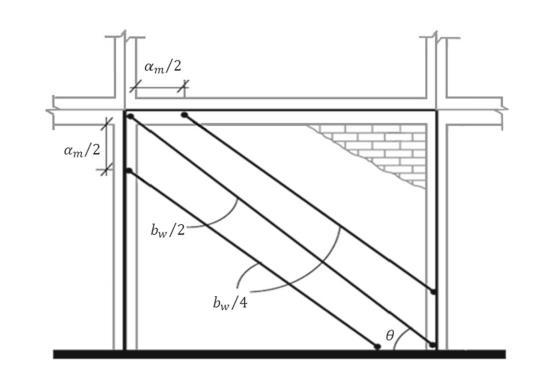
Thestudyhighlightstheimportanceofmasonryinfillwallsin the seismic performance of RC frames. Fully infilled configurationsconsistentlyenhancestrength,stiffness,and lateral load resistance, while discontinuous infill configurations introduce weaknesses such as soft-storey effects. Modeling approaches must balance simplicity and accuracy,withsingle-strutmodelsofferingeaseofuseand multi-strut models providing detailed insights. The results emphasize the need to integrate the contributions and potentialrisksofinfillwallsintoseismicdesigncodes.Future research should focus on developing robust modeling techniques that consider variations in infill geometry and materials, enabling more reliable and effective structural designs.
[2]KaiQian,M.ASCE1;andBingLi,M.ASCE2Effects of Masonry Infill Wall on the Performance of RC Frames to Resist Progressive Collapse , Journal of Structural Engineering , Volume 143, Issue 9.
Thestudyinvestigatestheimpactofmasonry-infilled(MI) walls on the progressive collapse resistance of reinforced concrete(RC)frames.Typicallyconsiderednon-structural elements, MI walls are often overlooked in progressive collapse design, with their weight included but their resistancecapacityignored.Throughexperimentalanalysis of six scaled RC subframes with varying configurations bareframeswithoutinfillwallsandinfilledframeswithsolid MI walls the research evaluates load-displacement behavior, failure modes, stiffness, and load-resisting mechanisms. The resultsreveal thatMIwallssignificantly enhancebothlateralandverticalloadresistance,improving the frames' initial stiffness and load-bearing capacity. However,these benefitsare contingentontheintegrity of theinfillwalls;failuremodessuchassplittingordetachment of compressive struts can transfer excessive loads to RC frame members, leading to structural vulnerabilities. The study also highlights the superior performance of infilled frames under vertical loading compared to bare frames, showcasing their potential for mitigating progressive collapse.
International Research Journal of Engineering and Technology (IRJET) e-ISSN: 2395-0056
Volume: 12 Issue: 05 | May 2025 www.irjet.net p-ISSN: 2395-0072
The findings emphasize the vital role of masonry-infilled wallsinenhancingtheprogressivecollapseresistanceofRC frames.MIwallsprovidesubstantialinitialstiffnessandload resistance,effectivelyredistributingforceswhensubjected tocolumnlossscenarios.Nonetheless,theirfailuremodes, suchasdiagonalstrutsplitting,underscorethenecessityof incorporating these elements into progressive collapse design and analysis. By considering the secondary loadresisting mechanisms offered by MI walls, engineers can optimizestructuraldesignstobalancesafetyandeconomy, mitigating risks associated with progressive collapse. The studyadvocatesformorecomprehensivedesignguidelines and further experimental research to better integrate MI wallbehaviorintostructuralframeworks.
ASCE.
Masonry infill walls in reinforced concrete (RC) frames significantlyinfluencetheseismicperformanceofbuildings, offering both beneficial and detrimental effects. Experimentalstudiesandpastearthquakesdemonstratethat suchinfillsenhancelateralstiffness,strength,ductility,and energy dissipation capacity. These benefits arise from the infill’s ability to alter the load transfer mechanism from frameactiontotrussaction,reducingbendingmomentsand shear forces on frame members. However, challenges like theshort-columneffect,soft-storeyeffect,andtorsionarise wheninfillsareirregularlydistributed,increasingductility demands on certain structural members. The study also highlights the role of reinforcement in infill walls, which improvesductilityandout-of-planestabilitybutmayreduce overallstiffnessduetothickermortarlayers.Theresearch underscoresthatwhileunreinforcedmasonry(URM)infills increase stiffness and strength by approximately 70% comparedtobareframes, reinforcedmasonry(RM)infills offeradditionalductilitybenefits.Despitetheiradvantages, infillwalls'brittlefailuremodesandchallengesinseismic design remain critical concerns, necessitating advanced designstrategies.
The findings emphasize the dual nature of masonry infill walls in RC frames, where their inclusion significantly improves seismic performance by increasing strength, stiffness, and energy dissipation. These advantages make themintegraltostructuralsystemsindevelopingcountries, especially in moderate-seismicity regions. However, detrimental effects such as torsion and soft-storey mechanisms necessitate careful planning and detailing. Reinforced masonry infills enhance ductility and out-ofplaneresponse,providingapromisingsolutiontomitigate some issues, though their contribution to strength and stiffness requires further optimization. Given their widespread use, developing robust seismic design
methodologies to leverage the strengths of masonry infill wallswhilemitigatingtheirweaknessesiscritical.
[4] Humayra Adiba Newaz , Sadia Mounota , Md. Wahidul Islam and Debasish Sen , MODELING AND VERIFICATION OF LATERAL BEHAVIOR OF RC FRAME WITH AND WITHOUT INFILL MASONRY , ICCESD 2022.
ThisstudyexaminesthelateralbehaviorofbareRCframes and masonry-infilled RC frames under seismic loads, focusing on modeling and validation using numerical methods. Masonry infills are common in developing countries due to their low cost and availability, yet their structural contributions are often neglected in design. Experimental investigations reveal that masonry infills significantlyenhancelateralcapacity,stiffness,andstrength. The research employed lumped plasticity modeling in SAP2000 to simulate the experimental conditions, with flexural hinges assigned to beam and column ends, shear hinges at column mid-height, and axial hinges on the diagonal strut. The numerical results closely matched experimentaldata,withcapacityratiosof0.78and0.89for bareandinfilledframes,respectively.Themasonry-infilled frame demonstrated a lateral capacity 2.68 times greater thanthebareframe,highlightingthetransformativeeffectof infillwallsonseismicperformance.
Thestudyunderscoresthecriticalroleofmasonryinfillsin enhancingtheseismicresilienceofRCframes.Byimproving lateralcapacityandoverallstructuralstrength,infill walls address key deficiencies in bare RC frames. Numerical modelingvalidatedagainstexperimentaldatademonstrates the reliability of lumped plasticity methods for analyzing suchsystems.However,the brittlenatureof masonryand associatedrapidstiffnessdegradationuponcrackingpresent challengesthatmustbeaddressed.Integratingmasonryinfill contributionsintodesignpracticescansignificantlyimprove seismic performance, particularly in developing regions wheresuchstructuresareprevalent.Futureresearchshould refinemodelingapproachestocapturethenon-linearand brittle behavior of masonry under dynamic loading conditions.
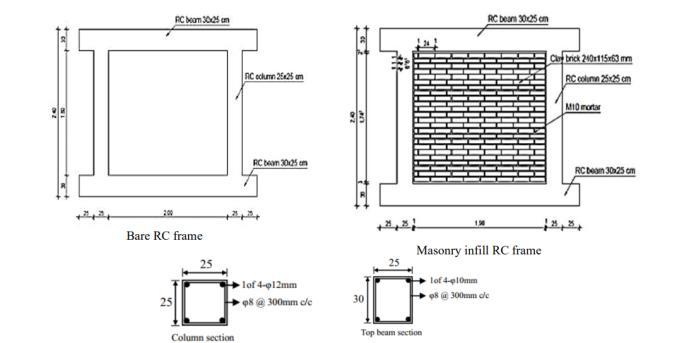
Fig -2:TestSpecimens&DimensionsLayoutwith ReinforcementDetails
International Research Journal of Engineering and Technology (IRJET) e-ISSN: 2395-0056
Volume: 12 Issue: 05 | May 2025 www.irjet.net p-ISSN: 2395-0072
[5]
Irshad
Vishwanath.
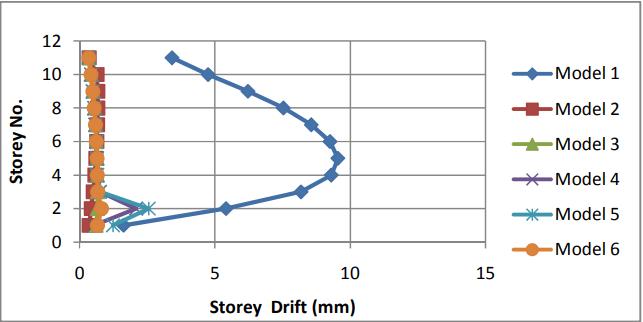
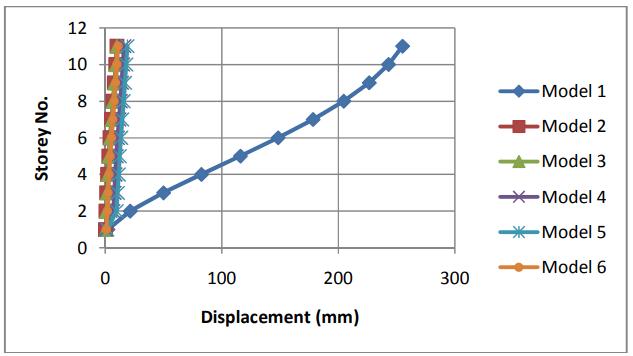
This study investigates the seismic performance of RC frames with various masonry infill configurations, emphasizingtheirinfluenceontimeperiod,baseshear,drift, anddisplacementunderearthquakeloading.Theresearch includes six models, ranging from bare frames to frames withfullinfill,softgroundfloors,softbasements,andinfills arranged in a swastika pattern. Results indicate that masonry infills significantly reduce the fundamental time period, enhance lateral stiffness, and increase base shear, compared to bare frame models. Specifically, frames with infillsbelowtheplinthorinswastikapatternsdemonstrate better earthquake-resistant behavior than those with soft basementsorgroundstores.Modelswithinfillalsoexhibit reducedstoresdriftanddisplacement,withupto93%less top-stores displacement compared to bare frames. This underscoresthecriticalroleofmasonryinfillsasdriftand displacement-controllingelementsinRCstructures.
Thefindingshighlightthestructuralimportanceofmasonry infillsinimprovingtheseismicperformanceofRCframes. Incorporatinginfillsreducesthetimeperiodandenhances stiffness, base shear, and lateral resistance, mitigating the vulnerabilities associated with soft-story and bare-frame designs.Modelswithstrategicallyplacedinfills,suchasin swastikapatterns,offerabalancedapproachtomaintaining functionalitywhileimprovingseismicresilience.Thestudy concludes that neglecting the structural contribution of masonryinfillsleadstounderestimationsinbaseshearand displacementdemand,advocatingtheirinclusioninseismic design and analysis to ensure safer and more efficient buildingperformance.
[6] Mulgund G. V , Dr. Kulkarni A. B. , SEISMIC ASSESEMENT
BRICK
RC FRAME
, INTERNATIONAL JOURNAL OF ADVANCED
AND TECHNOLOGIES Vol No. 2, Issue No. 2, 140 –147.
ThisstudyevaluatestheseismicperformanceofRCframes with various configurations of masonry infills, comparing themtobareframemodelsundernonlinearstaticpushover analysis.Fivemodelswereanalyzed,includingabareframe and others with different arrangements of masonry infill, such as outer periphery, inner core, and lift core configurations. Results indicate that masonry infills significantlyenhancelateralstiffnessandreducethenatural time period by up to 25% compared to bare frames Furthermore, masonry-infilled models showed up to 48% higher base shear and nearly 50% reduced top-story displacementatthecollapsepreventionperformancelevel under seismic loads. Soft story configurations, while improvingcertainaspectsofseismicperformance,showed slightly higher displacements compared to fully infilled frames.Theanalysishighlightsthecriticalroleofmasonry infills in improving structural performance by reducing lateraldisplacements,controllingdrift,andincreasingbase shearresistance.
The study underscores the importance of incorporating masonry infills into the seismic design of RC frames. The inclusion of infills significantly improves structural performance, reducing natural time periods, controlling drift,andenhancinglateralresistance.Outerperipheryinfill configurationsdemonstratedthebestoverallperformance, withsignificantreductionsindisplacementandincreasesin baseshear.Softstorydesigns,whilefunctionalforparkingor other purposes, require careful planning to mitigate their inherent vulnerabilities. The findings advocate for the integration of masonry infills into design codes to better predictandoptimizetheseismicbehaviorofRCstructures.
International Research Journal of Engineering and Technology (IRJET) e-ISSN: 2395-0056
Volume: 12 Issue: 05 | May 2025 www.irjet.net p-ISSN: 2395-0072
This paper investigates the seismic behavior and design implications of reinforced concrete (RC) frame structures thatincorporateplan-eccentricmasonryinfills specifically, infills arranged along two adjacent sides of a building's perimeter.Usingbidirectionalshakingtabletestsandnonlinear dynamic analyses, the study examines how these irregularinfilldistributionsaffectthedynamicresponseof buildings.Theexperimentalsetupinvolvedatwo-storeyRC frame tested under strong seismic excitation, and results werecomparedagainstacompanionbareframe.Analytical modelingaccountedforbothin-planeandout-of-planeinfill behaviors.Thestudyfoundthattheeccentricarrangement causedatorsionalresponseaboutthecommoncornerofthe infilled sides, but the overall seismic demands on critical structural elements (like corner columns) were not significantlyincreasedcomparedtoabarestructure.Infill panels, despite their slenderness, demonstrated strong resilience against out-of-plane accelerations. Additionally, sensitivitystudiesrevealedthatevensubstantialvariations ininfillstiffnessandstrengthhadlimitedinfluenceonglobal displacementdemands.Thenumericalmodelsalignedwell withexperimentaldata,validatingtheanalyticalapproach andsupportingthesimplifiedidealizationofthebuilding's torsionalbehavior.
Thepaperconcludesthatreinforcedconcreteframeswith masonryinfillsontwoadjacentsides,althoughtorsionally unbalanced,donotexperiencegreaterseismicdeformation demandsthanequivalentbarestructureswhensubjectedto bidirectional ground motion. Peak displacements in these infilledstructuresoccursimultaneouslyinbothhorizontal directions but remain within the limits seen in the bare frame. This behavior suggests that the key design considerationshouldbetoproportionstructuralelements neartheopencornertoresistsimultaneouspeakforcesor deformationsfrombothmotioncomponents.Apartfromthis adjustment,standarddesignproceduresforbareRCframes remainapplicable.Furthermore,thestudyshowsthateven thin, slender infill panels can survive significant seismic forces without collapsing or being expelled out-of-plane, suggestingtheyprovideabeneficialcontributiontoseismic performance. The findings advocate for a more nuanced viewofplan-eccentricinfilllayouts,indicatingtheymaybe lessdetrimentalthancommonlyperceivedandmay,infact, enhance overall structural resilience under certain configurations.
[8] Matjaž Dolšek, Peter Fajfar , The effect of masonry infills on the seismic response of a fourstoreyreinforcedconcreteframe adeterministic
assessment , Engineering Structures, Volume 30, Issue 8, 2008.
Thisstudypresentsadeterministicseismicassessmentofa four-storeyreinforcedconcrete(RC)framewithandwithout masonryinfills,usingtheN2method asimplifiednonlinear analysis approach. The analysis includes three structural configurations:abareframe,apartiallyinfilledframewith openings, and a fully infilled frame. The authors modeled masonry infills as diagonal compression-only struts and validatedthemodelusingexperimentaldatafromfull-scale pseudo-dynamic tests. The results indicate that masonry infillssignificantlyincreasethestiffnessandstrengthofRC frames,particularlywhentheinfillsarewell-distributedand do not introduce irregularities in elevation or plan. The seismic performance of each configuration was evaluated under ground motions of different intensities (based on return periods of 225, 475, and 2475 years), and the structuralresponsewasanalyzedthroughcapacitycurves, demand spectra, and damage patterns. The findings show thatinfillsalterdamagedistributionandoftenshiftfailure mechanisms to the first storey. While infills enhance performanceatlowerseismicintensities,theirfailureunder stronggroundmotionscanresultinasharpdegradationin overallstrengthandstiffness.
The paper concludes that masonry infills, when properly consideredinanalysisanddesign,provideabeneficialeffect on the seismic performance of RC frames. Their inclusion significantly enhances structural stiffness and strength, particularlyundermoderategroundmotions.However,once thedeformationcapacityoftheinfillsisexceeded,a rapid loss of both global strength and stiffness can occur, especially in the first storey where infill failure tends to concentratedamage.Thisunderscorestheneedforcareful modeling of infills in seismic assessments. The study also demonstrates that simplified modeling techniques using equivalent diagonal struts can effectively simulate global seismic behavior, making them suitable for practical engineeringapplications.Importantly,whileinfillsimprove seismicresistanceuptoapoint,theirfailureunderintense shakingcanleadtobrittlecollapsemechanisms,reinforcing theneedforperformance-baseddesignthatconsidersboth beneficialandadverseeffectsofinfills.
[9]AlessandraFiore,AdrianaNetti,PietroMonaco, The influence of masonry infill on the seismic behavior of RC frame buildings , Engineering Structures, Volume 44, 2012.
This paper investigates how masonry infills affect the seismicbehaviorofreinforcedconcrete(RC)frames.While infills are often ignored in structural analysis, they can significantlyalterbothglobalstiffnessandlocalforces.Using FiniteElementanalysisandvalidatedexperimentaldata,the authors evaluate the impact of frame–infill interaction, especiallytheroleoffrictionattheinterface.Anewdouble-
International Research Journal of Engineering and Technology (IRJET) e-ISSN: 2395-0056
Volume: 12 Issue: 05 | May 2025 www.irjet.net p-ISSN: 2395-0072
strut macro-model is proposed to represent infills more accurately, capturing both global displacement and local stresseffectsbetterthantraditionalsingle-strutmodels.The method is tested on various building configurations and comparedwithexistingmodelsandcode-basedapproaches.
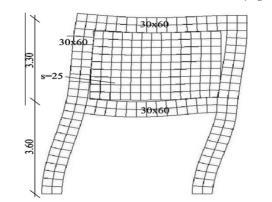
Fig -5:ExampleofaFiniteElementmodel.
The study concludes that masonry infills significantly improve structural stiffness and strength under seismic loads, but also introduce local force concentrations that standard models often miss. The proposed double-strut modeleffectivelysimulatesbothglobalandlocalresponses, makingitapracticaltoolforseismicassessment.Forreliable results, especially in high-seismic zones, the authors recommend combining this model with a bare-frame analysisadjustedforinfilleffects.Themethodislesssuitable forlow-seismicregionsbutshowsstrongpotentialforfuture dynamicapplications.
[10] T. Sruti Sai, Dr. T. Chandrasekhar Rao, B. Vasudev , Seismic Response of RC Framed Structures Having Plan and Vertical Irregularities with and Without Masonry Infill Action , (IRJET), Volume 03, Issue 02, February 2016 .
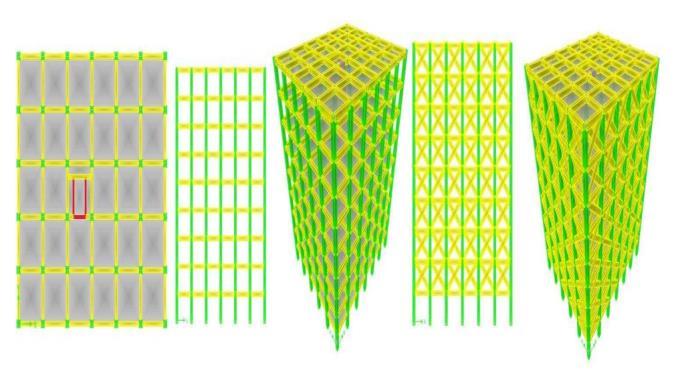
Thisstudyevaluatestheseismicperformanceofreinforced concrete (RC) frames with various plan and vertical irregularities, comparing bare frames and those with masonry infills. Using ETABS software, eight different 9storeybuildingmodelswereanalyzedunderseismiczoneV conditionsusingEquivalentStatic,ResponseSpectrum,and Pushover methods. The models include both regular and irregularconfigurations,withandwithoutinfills.Parameters such as base shear, lateral displacement, story drift, and performance point were compared. The inclusion of infill wallswasfoundtosignificantlyaffecttheseismicresponse of the buildings, particularly by increasing stiffness and reducingdisplacements.
The presence of masonry infills improves the seismic performanceofRCstructuresbyincreasinglateralstiffness and base shear capacity, while reducing lateral displacementsandstorydrifts.Regularinfillframesperform betterthan bare andirregularframes, withirregular bare framesoftenexceedingpermissibledriftlimits.Infillwalls help meet performance targets, as indicated by favorable capacity-demand curve intersections. Therefore, masonry infillsshouldnotbeneglectedinseismicanalysis,especially for structures with irregularities. The study emphasizes
designing irregular buildings for higher base shear and confirms the effectiveness of infill walls in enhancing structuralresilienceduringearthquakes.
model-1andmodel-2respectively.
Infillwallsreducedeflectioninframesduetotheirinherent mechanism.Staticanalysistendstooverestimatedeflection compared to dynamic analysis. Increased bottom story height correlates with greater deflection across various models. Overall, masonry infill proves advantageous by enhancing global stiffness and strength, thereby limiting structural deflection. However, infill walls do not mitigate torsional moments or the adverse effects of soft stores causedbyirregularities.
The following conclusions may be drawn from the study conducted:
Masonry infill walls significantly decrease overall deflection and inter-story drifts under both static and dynamic loads, indicating increased global stiffness.
Deflectionscalculatedfrom staticanalysistendto be higher than those obtained from dynamic analysis.
Increasingtheheightofthe bottomstoryleadsto increased deflection, bending moment, torsional moment, shear force, and axial force within the structure.
Theinclusionofmasonryinfillgenerallyenhances theglobalstiffnessandstrengthoftheRCCframe, therebyreducingdeflection.
Infill walls do not provide benefits in resisting torsional moments and can exacerbate soft-story effectsinducedbystructuralirregularities.
The diagonal strut analytical procedure offers a reasonably accurate method for predicting the structural stiffness, fundamental frequency, and timeperiodofmasonryin-filledframes,makingit suitablefordesignapplications.
International Research Journal of Engineering and Technology (IRJET) e-ISSN: 2395-0056
Volume: 12 Issue: 05 | May 2025 www.irjet.net p-ISSN: 2395-0072
Masonryin-filledstructures witha softfirststory are highly susceptible to failure due to the concentration of high base shear in the weaker groundfloorframe.
Whileinfillwallsgenerallyreduceshearforceson frame columns, this trend reverses in structures withasoftgroundstory,wherecolumnshearforces becomeconsiderablyhigherthaninbareframes.
For soft-story buildings, the deflection at the top level of the ground story is significantly (2-3.3 times)greatercomparedtobuildingswithoutasoft story. However, the overall top-level deflection of thebuildingisnotsignificantlyaffectedbythesoft story.
[1] Kamaran Mohammed Kareem , Esra Mete Güneyisi (2018).EffectofMasonryInfillWallConfigurationand Modelling Approach on the Behavior of RC Frame Structures.ArabianJournalforScienceandEngineering https://link.springer.com/article/10.1007/s13369-0183389-6
[2] Kai Qian, M.ASCE1 ; and Bing Li, M.ASCE2 Effects of MasonryInfillWallonthePerformanceofRCFramesto Resist Progressive Collapse , Journal of Structural Engineering,Volume143,Issue9.
https://ascelibrary.org/doi/abs/10.1061/%28ASCE%2 9ST.1943-541X.0001860
[3] C V R MURTY1 And Sudhir K JAIN , BENEFICIAL INFLUENCEOFMASONRYINFILLWALLSONSEISMIC PERFORMANCE OF RC FRAME BUILDINGS , ASCE.https://scholar.google.com/scholar?hl=en&as_sdt =0%2C5&q=BENEFICIAL+INFLUENCE+OF+MASONRY+I NFILL+WALLS+ON+SEISMIC+PERFORMANCE+OF+RC+ FRAME+BUILDINGS+&btnG=
[4] HumayraAdibaNewaz,SadiaMounota,Md.Wahidul Islam and Debasish Sen , MODELING AND VERIFICATIONOFLATERALBEHAVIOROFRCFRAME WITHANDWITHOUTINFILLMASONRY,ICCESD2022.
https://www.researchgate.net/profile/Md-Islam1977/publication/358742142_MODELING_AND_VERIFI CATION_OF_LATERAL_BEHAVIOR_OF_RC_FRAME_WITH _AND_WITHOUT_INFILL_MASONRY/links/66f304f8f59 9e0392fa17464/MODELING-AND-VERIFICATION-OFLATERAL-BEHAVIOR-OF-RC-FRAME-WITH-ANDWITHOUT-INFILL-MASONRY.pdf
[5] Md Irfanullah , Md Irshad Ali , Vishwanath. B .Patil , SEISMIC EVALUATION OF RC FRAMED BUILDINGS WITHINFLUENCEOFMASONRYINFILLPANEL,IJRET. https://citeseerx.ist.psu.edu/document?repid=rep1&ty pe=pdf&doi=dfa53eee9223550c15fb0e071d9a645bfc97 b535
[6] MulgundG.V,Dr.KulkarniA.B.,SEISMICASSESEMENT OF RC FRAME BUILDINGS WITH BRICK MASONRY INFILLS , INTERNATIONAL JOURNAL OF ADVANCED ENGINEERINGSCIENCESANDTECHNOLOGIESVolNo. 2, Issue No. 2, 140 –147.https://scholar.google.com/scholar?hl=en&as_sdt= 0%2C5&q=SEISMIC+ASSESEMENT+OF+RC+FRAME+BU ILDINGS+WITH+BRICK+MASONRY+INFILLS+%2C+INT ERNATIONAL+JOURNAL+OF+ADVANCED+ENGINEERIN G+SCIENCES+AND+TECHNOLOGIES+&btnG=
[7] M.N.FARDIS,S.N.BOUSIAS,G.FRANCHIONIANDT.B. PANAGIOTAKOS,SEISMICRESPONSEANDDESIGNOF RC STRUCTURES WITH PLAN-ECCENTRIC MASONRY INFILLS , EARTHQUAKE ENGINEERING AND STRUCTURAL DYNAMICS.https://onlinelibrary.wiley.com/doi/abs/10. 1002/(SICI)1096-9845(199902)28:2%3C173::AIDEQE810%3E3.0.CO;2-1
[8] MatjažDolšek,PeterFajfar,Theeffectofmasonryinfills on the seismic response of a four-storey reinforced concrete frame a deterministic assessment , EngineeringStructures,Volume30,Issue8,2008 https://www.sciencedirect.com/science/article/abs/pii /S0141029608000072
[9] Alessandra Fiore, Adriana Netti, Pietro Monaco , The influenceofmasonryinfillontheseismicbehaviorofRC frame buildings , Engineering Structures, Volume 44, 2012.https://www.sciencedirect.com/science/article/a bs/pii/S0141029612002659
[10] T. Sruti Sai, Dr. T. Chandrasekhar Rao, B. Vasudev , SeismicResponseofRCFramedStructuresHavingPlan and Vertical Irregularities with and Without Masonry Infill Action , (IRJET), Volume 03, Issue 02, February 2016 .https://scholar.google.com/scholar?hl=en&as_sdt=0%2 C5&q=Seismic+Response+of+RC+Framed+Structures+H aving+Plan+and+Vertical+Irregularities+with+and+Wit hout+Masonry+Infill+Action+&btnG=