
International Research Journal of Engineering and Technology (IRJET) e-ISSN: 2395-0056
Volume: 12 Issue: 03 | Mar 2025 www.irjet.net p-ISSN: 2395-0072
International Research Journal of Engineering and Technology (IRJET) e-ISSN: 2395-0056
Volume: 12 Issue: 03 | Mar 2025 www.irjet.net p-ISSN: 2395-0072
Shaheen Alam1 , Subash Chandra Dash2 , Mohammad Mehedi Hasan3 , Tanima Rahman Tanni4
1Department of Textile Engineering, Bangladesh University of Textiles, Dhaka, Bangladesh 2,3Department of Mechanical Engineering, Chittagong University of Engineering & Technology, Chittagong, Bangladesh
4Assistant Professor, Department of Yarn Engineering, Bangladesh University of Textiles.
Abstract - Inthecomplexlandscapeofyarnmanufacturing, therollergaugesettingofaringframemachineemergesasan important determinantinfluencingthequalityandattributes of the final yarn product. This research explores the complex relationship between the roller gauge setting and Yarn properties, namely Imperfection Index (IPI), Uniformity, Hairiness, Count Strength Product (CSP), and Coefficient of Variation in mass (CVm%). Thus, the study measures how the changes in roller gauge of ring spun yarn machine affects the quality of end yarn. Understanding the effects of roller gauge settings is vital for optimizing the ring spinning process in textile manufacturing. The research employs a systematic approach, conducting experiments with varying roller gauge settings on a ring frame. The study unfolds through a systematicexplorationofthreedistinct yarncounts-20Ne, 26 Ne,and40Ne-underthewiderandcloserroller gaugesetting. Employing moderntestingmethodologies, the studyrelied on the High Volume Instrument (HVI), Automated Fibre Information System (AFIS) and Evenness Tester to meticulously analyze and quantify the quality during the process and final yarn properties. The experimental results offer in depth insights into the complex relationship between roller gauge settings and yarn quality, presenting a comprehensive understanding of the dynamics at play. This researchcontributessubstantivelytotheoptimizationofyarn manufacturing processes by providing empirical evidence on the direct influence of roller gauge settings on critical yarn attributes.
Key Words: YarnCharacteristics,Rollergauge,RingFrame, UsterEvennessTester,TextileManufacturing
1.INTRODUCTION
Thetextileindustryhasbeendevelopingrapidlyandnewer technologies are introduced and the only formula for survival is encapsulating those innovations into the manufacturingprocessandmakingthebestofusethemfor increasingtheproductivityandquality.However,increasing marketcompetitionhasraisedsignificantconcerns,making itessentialfortextileindustriestotransitiontowardmore efficient and highly productive operations. In recent decades, for getting optimum and sustained yarn quality, minimum variations between spinning positions, easy
handlingandrawmaterialcostsaving-therehasbeenalot of works on this sector. But still there is a lot of opportunities to make the best use of machinery settings suchasrollersettings,thistypeofresearchfocusesonhow thesettingsoftherollersinaspinningmachinecaninfluence thepropertiesandqualityoftheyarnproduced.
Begum et al. [1] explores the relationship- between card cylinderspeedandrollergaugesettingsduringthebreaker drawingstageanditsconsequentialimpactontheevenness and imperfections of combed yarn. The methodology, key findings, and implications of this research offer valuable insightsintotheinitialstagesofyarnformation.
Cui et al. [2] reports a systematic study on the SDS (Soft DraftingSystem),amodifieddraftingsystembasedonthe ringspinningframe,aimedatenhancingyarnquality.The research,dividedintotwoparts,comparedtheSDSwiththe conventional drafting system for spinning different yarn types and explored the impact of key process parameters using Response Surface Methodology. The study revealed significantimprovementsinyarnevennessandareduction in imperfections, with statistically significant parameters, but without notable interactions, and it identified optimal conditionsforachievinghigh-qualityyarnproduction.
Hossain et al. [3] utilizing Uster testing to evaluate yarn quality before the knitting and weaving processes can effectively mitigate problems associated with defective fabricproductionandsuboptimaldyeing,leadingtoreduced productionhurdlesandadecreasedlikelihoodofcustomer rejection.Anexperimentexamining40Ne,50Ne,and60Ne ring-spunyarns,whichconsistedofa35%cottonand65% polyesterblendandwereproducedthroughthesamefiber andsliverblendingprocess, demonstratedthatincreasing yarn fineness corresponded to higher unevenness and coefficient of mass variation. Conversely, yarn hairiness decreasedwiththefineryarntypesfollowingasequenceof 40Ne>50Ne>60Ne.
Chaudhari et al. [4] present the role of draw frames in enhancingyarnqualitythroughauto-levelinganddoubling processes is crucial. The research emphasized the importance of auto-levelers in improving sliver thickness variation. Doubling becomes crucial for eliminating mass
International Research Journal of Engineering and Technology (IRJET) e-ISSN: 2395-0056
Volume: 12 Issue: 03 | Mar 2025 www.irjet.net p-ISSN: 2395-0072
variation, ensuring uniformity in the delivery sliver. The draw frame's role in improving fiber orientation and removing imperfections is pivotal in yarn manufacturing. The study dig dive into the optimization of draw frame bottomrollergaugesettings.Trialswithdifferentsettings (41/45, 40/44, 42/46) on LMW's LRSB 851 draw frame reveal that a setting of 40/44 mm yields superior yarn quality. The study highlights the need for meticulous parameteroptimization,particularlyinlarge-scalespinning operations. This study focuses specifically on studies investigatingtheimpactofdrawframebottomrollergauge settings on overall yarn quality. By analyzing the methodologiesandresultsofthesestudies,gainedinsights into the final stages of yarn production and the factors influencingtheendproduct.
Siddiqua et al.[5] focuses on the pivotal role of traveller clearersettingsinringframemachines,astheyareessential forpreventingfibercongestionandmaintainingyarnquality. BurkinaFasocottonfiberwasusedtoproduce85'stexringspun yarn, and various traveller clearer settings were employed. Fiber properties were analyzed using High VolumeInstrument(HVI)andAdvancedFiberInformation System (AFIS). Among the tested settings, a 3.10 mm traveller clearer gauge yielded the most favorable results, exhibiting superior yarn properties such as a lower imperfection index, reduced hairiness, improved tenacity, and minimized end breakage rate. Statistical analysis throughone-wayANOVAhighlightedasignificantdifference inallpropertiesexceptforyarnelongation.
Ahmadetal.[6]combingprocessisessentialforenhancing the staple length of fibrous materials by removing short fibers,aswellaseliminatingimpuritiesandneps.Thisleads toimprovedyarnaesthetics,smoothness,luster,andensures soft, uniform, and robust yarn strength. Combing also facilitatesblendingwithpolyesterfibers.Thestudysuggests that certain technical adjustments within the combing machine can significantly impact sliver and final yarn quality. Therefore, investigating the influence of nipper gauge and drafting zone gauge on end product quality is recommended to better understand and enhance the combingprocess.
Karthikeyan et al.[7]conclude that textile industries face significant challenges in maintaining yarn quality and consistentdyeingduetofluctuationsincottonfiberquality. Toaddressthis,process parametersandmachinesettings must be tailored to the fiber's quality. The draw frame process,acrucialstepinyarnmanufacturing,wasexamined in this study, with modifications made to parameters like bottomrollersetting,rollerpressure,andbreakdraft,based oncottonfiberproperties.Standardtestingmethodswere used to evaluate yarn physical properties. The results indicated notable improvements in yarn quality, with reducedunevenness,coefficientofvariation,endbreakage rate, and hairiness index after the modifications. Imperfections such as thin places, thick places, and neps
werealsosignificantlyreduced,whileyarnstrengthsawa notable increase. The study concludes that optimizing drafting roller parameters has a significant impact on enhancingyarnquality
Thisstudyexaminestheinfluenceofdifferentrollergauge settings on the properties of ring-spun yarn, employing modern spinning machinery and testing methodologies. Through the examination of parameters including yarn uniformity, tensile strength, and defects, this research endeavors to offer helpful insights for the optimization of ring frame effectiveness and the enhancement of yarn quality. The objective is to address the deficiencies in the currentliteratureandtoprovideconcreterecommendations forthetextileindustryaimedatimprovingproductquality andmanufacturingefficiency.
2.
2.1
100% cotton fibers of length 29 mm of Mali (West Africa) wereusedtoproduceringspuncardedyarnof20Ne,26Ne and40Ne.Fortheyarnsamplespreparations,blowroomto ring frame material processed through same machinery conditions as well as settings except one variable i.e. ring frame roller gauge setting. However, Uster HVI 1000 and UsterAFISPro2machineswereusedtomeasurethecotton fiberpropertieslikelength,strength,maturity,micronaire, color, trash, moisture content etc. shown in table 2.1 and table2.2.
Table -2.1: HVIReportonFibersUsed:
Table -2.2: AFISReportonFibersUsed:
International Research Journal of Engineering and Technology (IRJET) e-ISSN: 2395-0056
Volume: 12 Issue: 03 | Mar 2025 www.irjet.net p-ISSN: 2395-0072
Table -2.3:
A-11
At present, the short-staple (also called cotton or threeroller) spinning process is the most common spinning methodworldwide.Thenamethree-rollerspinningcomes fromthearrangementoftherollersinthedraftingzoneinthe most commonly used spinning machine, the ring spinning frame.Thisspinningprincipleissuitableforallfibertypes withlengthsupto40mm.Itisveryflexiblewithregardtothe properties and applications of the produced yarns. Yarns manufacturedbyringspinningareprocessedintowovens, hosiery, knits, and braidings in the areas ofapparel, home textiles,andtechnicaltextiles.
MachineFlowChartofCottonYarnManufacturingProcess:
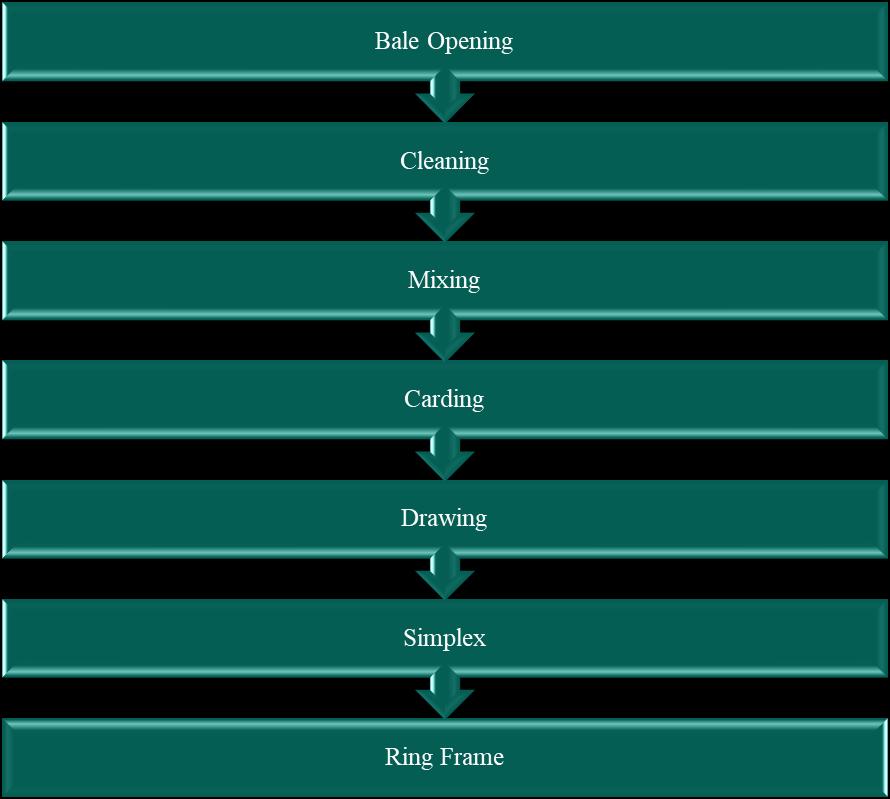
The main functions of blowroom process are opening, cleaning, blendingandmixing ofcotton fiber tuftswithout overstressingoffibers.Atfirstinblowroomthecleaningand openingofthebalewasdonebybeatersandopeners.The foreignmaterialslikedustparticles,seedsofcottonandother impurities were partially removed in this process, about 40%–70%trashwasremovedinthissection.Thecottontufts hadbeenopenedandcleanedandmixingwasalsodoneafter thestudyoftheessentialpropertiesoffiberlikestaplelength, tensilestrength,fineness,uniformityetc.Allmachinesinthe blowroomsectionaremanufacturedbythebrandknownas Rieter.
B-76
A-79
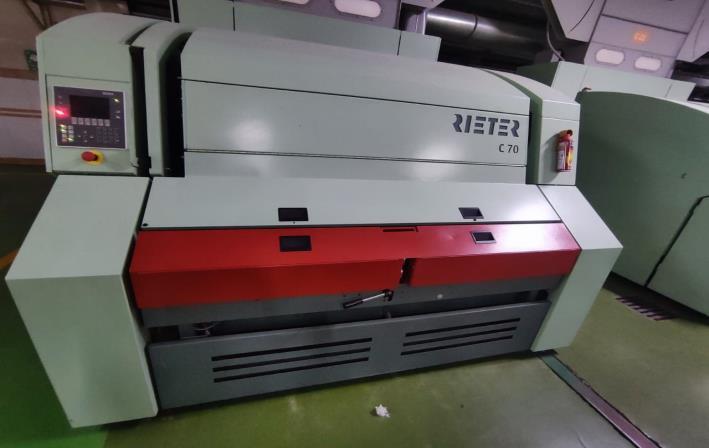
After blowroom the cotton tuft was subjected to carding machine.Cardingisthepreliminaryinspunyarntechnology justaftertheblowroomprocesswhereopeningandcleaning, removingthesmalltrashparticleswhichhavenotbeentaken outfromtheblowroomline–actionstakeplace.Itiscalled themotherorheartofspinning,becauseitpreparesthefiber insuchaway,whichisreadytomanufactureyarnbecause disentanglement, cleaning, and intermixing of fiber are happened.In this process the minute impuritieslike small seedparticles,immaturefibersetc.wereremoved.
The straightening and aligning of fibers were also done in smallamountinthisprocessandtheblowroomlapof0.0012 to0.0015laphankwasattenuatedtothecardedsliver.
Table -2.4: ParametersofCardingMachine
Rieter, Model:C70)
Volume: 12 Issue: 03 | Mar 2025 www.irjet.net
2.2.3 Draw Frame
DrawFrameisthemachinewherethesliversaredoubledor combined, blended & mixed, leveled and attenuated transientlythroughaseriesofpairsofrollers.Aftercarding processthecardedsliverof85grainsperyardwassubjected todrawinganddoublingoperation.Itwasusedasfibersneed to be kept side by side termed as parallelization of fibers. Most of the improvement in fiber parallelization and reductioninhookstookplaceinthisprocess.
Table 2.5: ParametersofDrawFrame
(Brand:Rieter, Model:SBD-45)
BottomRollerDia
Doubling
FinisherDrawing
(Brand:Rieter, Model:RSBD-45) Model RSBD-45
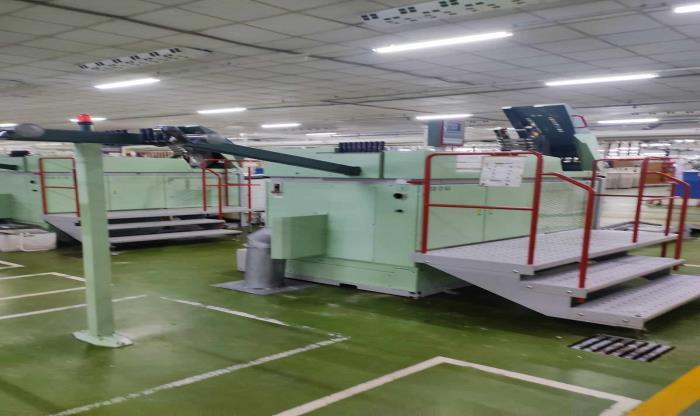
Simplexisamachinewhichconvertsthedrawnsliverintoa thinstrandoffibershavingsomeamountoftwist.Itwasused becausethesliverfromDraw-Framewasthickeranddifficult tobefedintotheRing-frame,sothesliverswerestretched and were made thinner by Drafting and mild twisting in Simplexandtheend-productfromthisprocesswascalledas Rovinganditwas0.7Ne.
Table 2.6: ParametersofSimplex
Toyota, Model:FL200)

International Research Journal of Engineering and Technology (IRJET) e-ISSN: 2395-0056
Volume: 12 Issue: 03 | Mar 2025 www.irjet.net p-ISSN: 2395-0072
2.2.5 Ring Frame
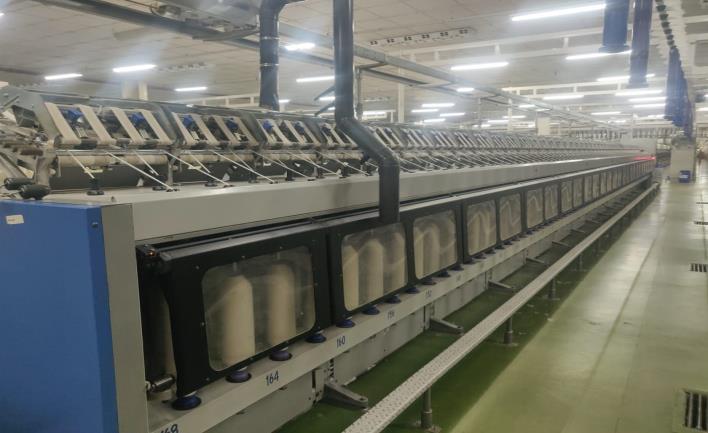
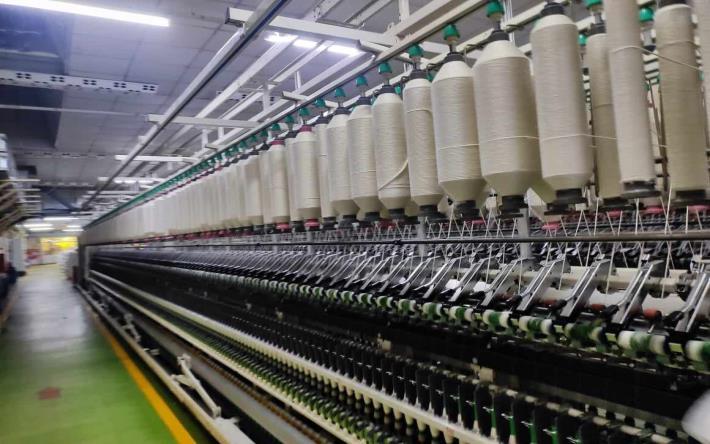
Aringframeisafundamentalmachineinthetextileindustry usedtotwiststaplefibersintoyarnbypassingthemthrough drafting zone then a rotating traveler and winding the resulting yarn onto a bobbin. This process is essential for creatinghigh-quality,fine,andstrongyarnforvarioustextile applications.
Inthisproject,rovingof0.70Ne(0.70hank/lb)isfedtotwo ringframeofdifferentrollergaugekeepingthesamecountof yarnproducedfromtheseringframemachine.Therovingis fedintothemachineandpassesthroughthedraftingsystem, where it undergoesattenuation or stretching to reduce its thickness. This drafting process helps align the fibers and control the fineness of the yarn. Subsequently, the drafted roving enters the ring and traveler system, where twist is impartedtothefibers,andtheyarniswoundontoabobbin.
Table 2.7: Requiredparametersfortworingframe machines
Ringframe Brand: Zinser Model: 351 with autodoffer
2.2.5.1 Roller Gauge Length:
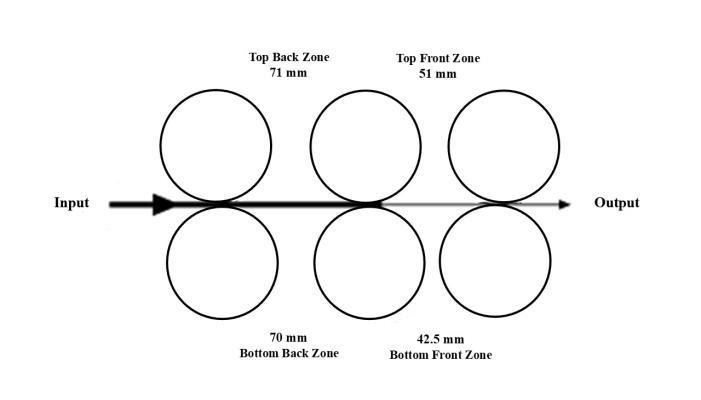
Therollergaugelengthisthedistancebetweenthefrontand middleaswellasmiddleandbackrollerswithinthedrafting system, plays a pivotal role in determining the extent of draftingandtwistingappliedtothefiberstrand.Thesetting exertsaconsiderableinfluenceonvariousyarnproperties, includingcount,strength,elongation,evenness,andhairiness etc.
Table 2.8: RollerGaugefortworingframemachines Gauge in Machine
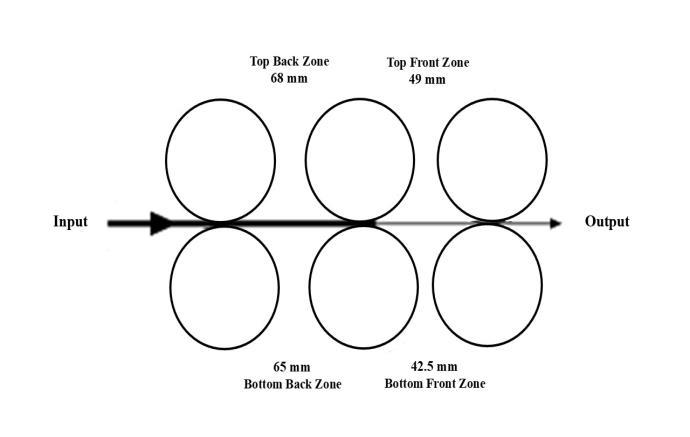
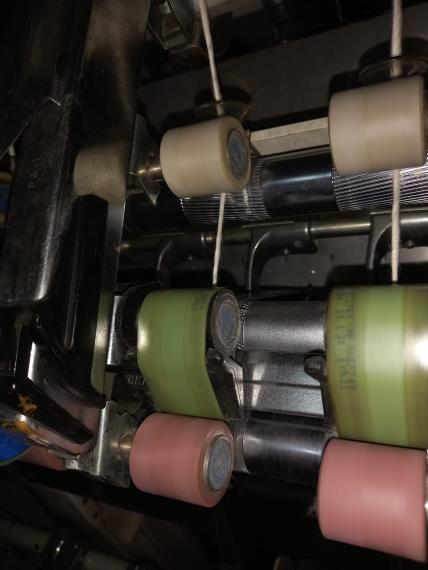
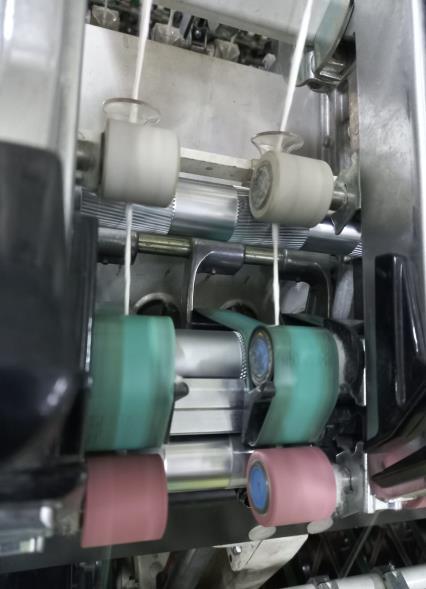
Figure 2.5 (a): CloserrollergaugesettinginRingframe machine
International Research Journal of Engineering and Technology (IRJET) e-ISSN: 2395-0056
Volume: 12 Issue: 03 | Mar 2025 www.irjet.net p-ISSN: 2395-0072
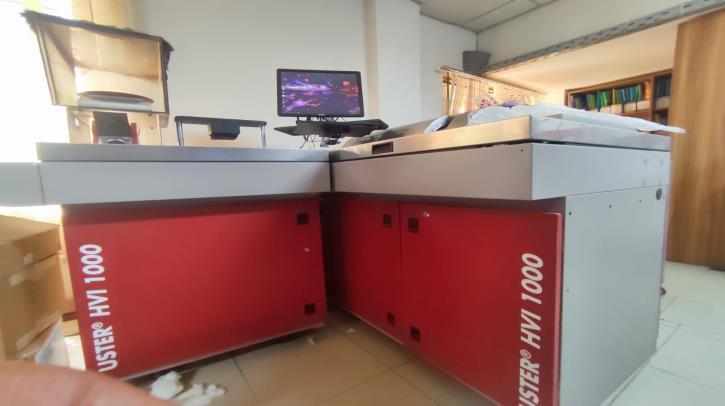
HVI,standsforHighVolumeInstrument,wasacriticaltoolin thespinningindustryusedtomeasureessentialpropertiesof cottonfibers,suchaslength,strength,micronaire,maturity, andcolor,beforetheyareprocessedinthespinningmill.It ensures that cotton lots are accurately assessed and helps yarnmanufacturersproduceconsistentandhigh-qualityyarn byoptimizingtheblendingandspinningprocesses.
Intheproject,asampleofcottonfibersfromblowroomwas collectedandconditionedtoastandardtestingparameter. ThissamplewasthenloadedintotheHVImachine'sfeeding system, which can handle loose fibers or sliver. The HVI machine electronically measure properties such as length, strength,micronaire,maturity,andcolor.Theresultingdata wasanalyzedtodeterminethequalityofthecottonsample.
International Research Journal of Engineering and Technology (IRJET) e-ISSN: 2395-0056
Volume: 12 Issue: 03 | Mar 2025 www.irjet.net p-ISSN: 2395-0072
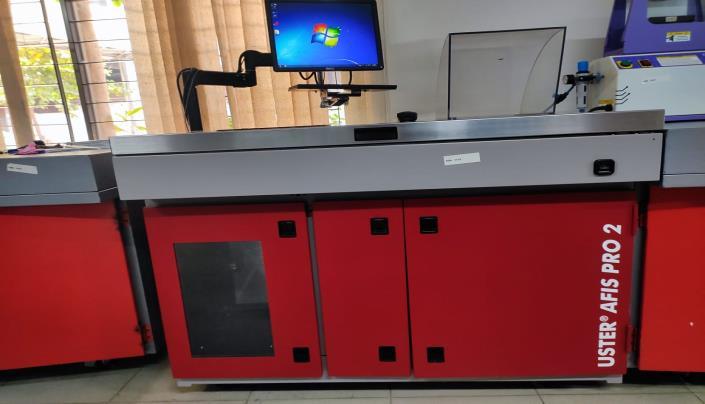
AFIS(AdvancedFiberInformationSystem)isatechnology used in the spinning industry to analyze and assess propertiesoffibers,sliversuchaslength,fineness,maturity andtrashcontentetc.Itprovidesdetaileddatatohelptextile manufacturersmakeinformeddecisionsintheirproduction processes,ensuringthequalityandconsistencyofyarn.
In the study investigating the effects of ring frame roller gauge settings on the characteristics of ring-spun yarn, a comprehensive process involving the Advanced Fiber Information System (AFIS) was employed. Three different yarn counts, specifically 14 Ne, 26 Ne, and 40 Ne, were examined under varying gauge settings. The preparatory phase involved collecting representative samples and ensuringtheirproperconditioning.
TheAFISmachinewascalibratedandconfiguredtoanalyze parameters such as fiber length, diameter, maturity, trash content,andcolor. Yarnsamples were loaded for analysis, andtheresultingdata,encompassingmultipleyarncounts andgaugesettings,weremeticulouslyrecorded.
Table 2.10: AFISTestReportforNeps
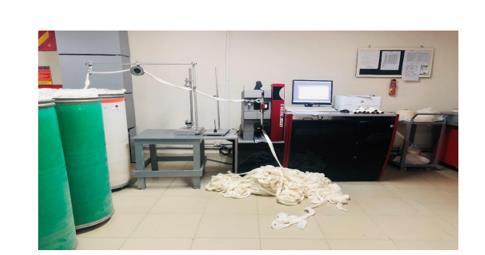
The evenness tester, often referred to as a yarn evenness tester,isaspecializeddeviceusedinthespinningindustryto measure and evaluate the regularity and consistency of a yarnortextilestrand.Italsoassessesthevariationsinyarn thickness, identifying imperfections such as thick and thin places in the yarn, which are critical for maintaining yarn quality.
The different counts, such as 20Ne, 30Ne, and 40Ne, in an evenness tester begins with the preparation of the yarn samples.Thesesamplesareunwoundfromtheirpackagesor bobbinsandconditionedforconsistentmoisturecontent.The yarn samples are then fed into the evenness tester, which employs laser or optical sensors to continuously monitor variationsinyarnthickness.Theresultingdataisanalyzedto generate a graphical representation of the yarn profile, highlightingvariationsinthickness.
Table 2.11: UsterEvennessTesterReportforRoving
International Research Journal of Engineering and Technology (IRJET) e-ISSN: 2395-0056
Volume: 12 Issue: 03 | Mar 2025 www.irjet.net p-ISSN: 2395-0072
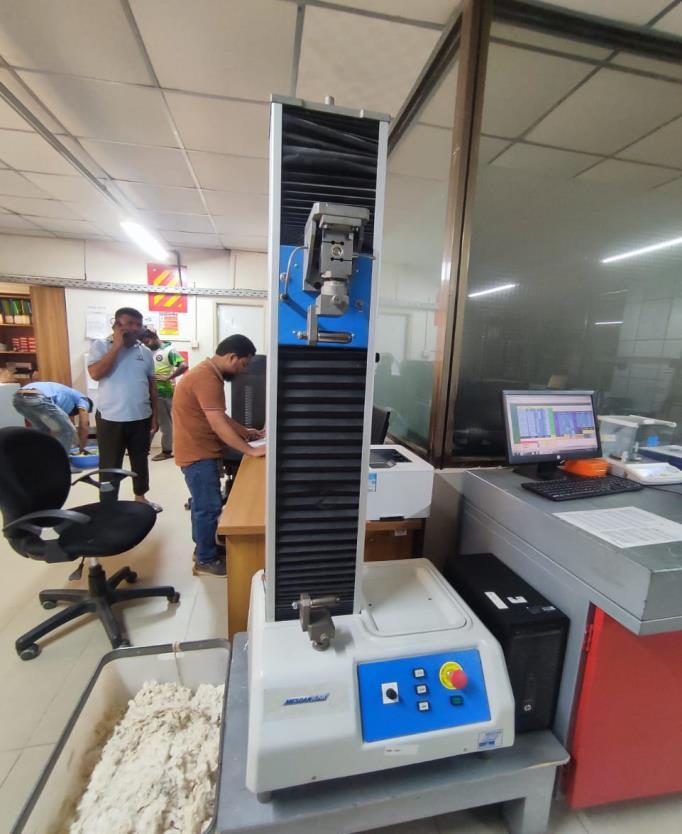
ALeaYarnStrengthTesterisaspecializeddeviceusedinthe spinningindustrytoassessthestrengthandtenacityofyarns. It measures the force required to break the yarn and calculates parameters like breaking strength and tenacity, helpingensureyarnqualityforspecificapplications.
Toidentifytheeffectsofringframerollergaugesettingson ring-spunyarncharacteristicswereinvestigatedusingaLea Yarn Strength Tester. Representative yarn samples were prepared, conditioned, and the tester was calibrated. The yarn samples were cut and loaded onto the machine, with tensionsettingsadjustedaccordingly.Thetestingprocedure tomeasuretensilestrengthandelongationwasinitiated.The processwasrepeatedforconsistency,andtheobtaineddata, includingvariationsinyarnstrengthunderdifferentroller gauge settings, was recorded. The entire procedure was documentedforreproducibility,andqualitycontrolmeasures wereimplementedtoensureresultaccuracy.
3. Result and Discussion
3.1 Comparison of Yarn Properties for 20 Ne, 26 Ne and40 Ne modifying the roller gauge setting
Theprojectdealswithcomparingyarnpropertiesfor20Ne, 26Ne,and40Neyarnswithmodifiedrollergaugesettings, variations in yarn characteristics become evident. The Ne
count signifies yarn fineness, and as it increases, yarn becomesfiner.
3.1.1 Unevenness Percentage (Um%)
"Um%" in spinning typically refers to "Unevenness Percentage". It is a measurement used to assess the irregularityorvariationinthethicknessordiameterofspun yarn.TheUm%valueindicatesthedegreeofyarnthickness variation over a specific length. Table 3.1shows the Um% varyingtherollergaugeforthreedifferentcountsofyarn.
Table 3.1: ComparisonofUm%
Count Closer Gauge Wider Gauge
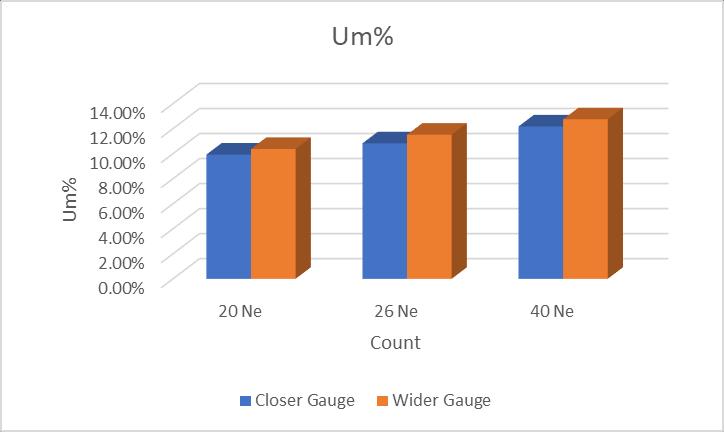
Figure 3.1: ChangesofUm%
The bar diagram illustrates that unevenness of yarn increases with the increase of yarn count. It also shows higherUm%foundinwiderrollersettingthancloserroller setting.
Theorder:40Ne>26Ne>20Ne
Thisirregularitycanresultfromfactorssuchasinconsistent spinning, fiber defects, blending issues, and mechanical problems. To mitigate this, manufacturers employ quality control measures such as regular monitoring, proper blending,fiberpreparation,andmachinerymaintenance.
3.1.2 Coefficient of Variation (CVm%)
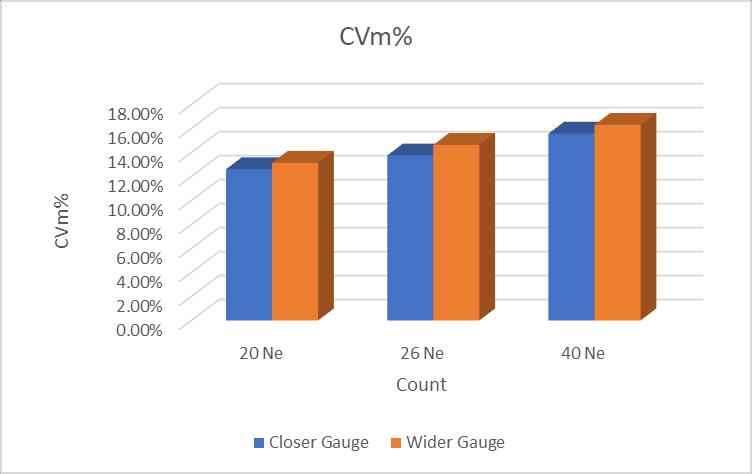
Coefficient of Variation (CVm%) in textiles measures the variation in a specific characteristic of yarn, such as its thickness or strength. It is expressed as a percentage and indicates the degree of variability within a set of yarn samples. Table 3.2 shows how the CVm% changes as the rollergaugeisalteredforthreedifferentyarncounts.
International Research Journal of Engineering and Technology (IRJET) e-ISSN: 2395-0056
Volume: 12 Issue: 03 | Mar 2025 www.irjet.net p-ISSN: 2395-0072
Table 3.2: ComparisonofCVm%
3.2: ChangesofCVm%
ThebardiagramillustratesthatCVm%ofyarnincreaseswith theincreaseofyarncount.Awiderrollersettingwasfoundto exhibitahigherCVm%comparedtothecloserrollersetting.
Theorder:40Ne>26Ne>20Ne
The lower CV% suggests that the yarn has consistent properties,whileahigherCV%signifiesgreatervariability. TextilemanufacturersstriveforlowerCV%valuestoensure thattheiryarnmeetsqualitystandardsandproducesuniform and consistent fabric in subsequent processing. Reducing CV% is often achieved through precise manufacturing processes, quality control, and careful selection of raw materials.
The Imperfections Index (IPI) is a critical quality measurement used in the spinning industry to assess the presenceofdefectsorirregularitiesinyarn.Itquantifiesthe numberofimperfections,suchasknots,slubsorneps,found in a length of yarn. Tables 3.3(a) and 3.3(b) presents the variations in IPI while altering the roller gauge for three distinctyarncounts.
Table 3.3(a): Thick,ThinandNepsareshown
Table 3.3(b): ComparisonofIPI
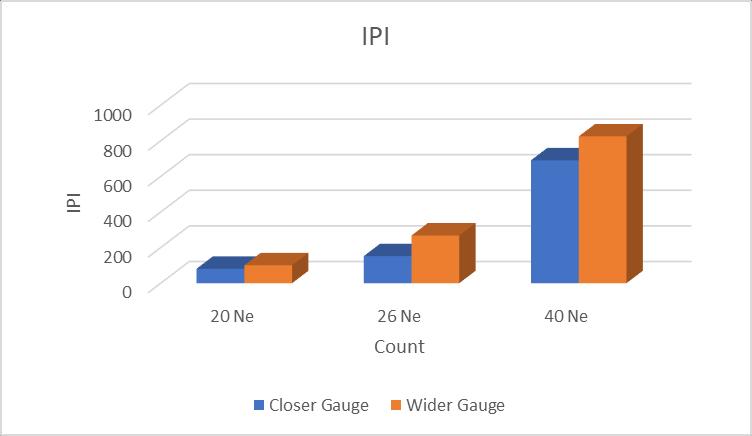
Figure 3.3: ChangesofIPI
ThebardiagramillustratesthatIPIofyarnincreaseswiththe increaseofyarncount.Thecloserrollersettingdemonstrates alowerIPIcomparedtoawiderrollersetting.
Theorder:40Ne>26Ne>20Ne
The lower IPI value indicates higher yarn quality, as it signifies fewer imperfections. IPI is determined through visual or automated inspection processes and is a vital parameterinensuringtheproductionofhigh-qualitytextiles, asitdirectlyaffectsthefinalfabric'sappearance,strength, and durability. Manufacturers often implement quality controlmeasuresanddefect-removaltechniquestoreduce IPIandimproveyarnquality.
Count Strength Product (CSP) isa crucial measurementas well,combiningyarncountanditsstrength.Thismetrichelps in evaluating the overall quality of the yarn. Table 3.4 displays differing CSP values based on adjustments to the rollergaugeforthreeseparateyarncounts.
International Research Journal of Engineering and Technology (IRJET) e-ISSN: 2395-0056
Volume: 12 Issue: 03 | Mar 2025 www.irjet.net p-ISSN: 2395-0072
Table 3.4: ComparisonofCSPfor20Ne,26Neand40Ne
Yarn Count Closer Gauge Wider Gauge
20Ne 2563 2611
26Ne 2267 2330
40Ne 2137 2239
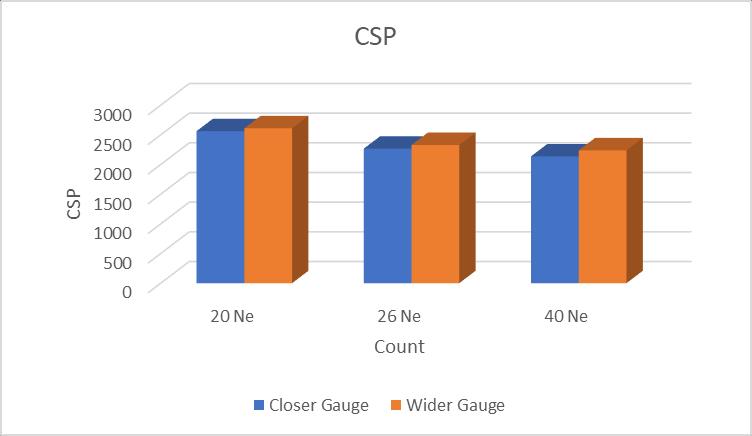
Figure 3.4: ChangesofCSP
ThebardiagramillustratesthatCSPofyarndecreaseswith theincreaseofyarncount.Thecloserrollersettingresultsin alowerCSPcomparedtoawiderrollersetting.
Theorder:20Ne>26Ne>40Ne
ThehigherCSPvaluesignifiesayarnthatisbothstrongand fine,makingitsuitableforvarioustextileapplications.
3.1.5 Hairiness Index
Thehairinessindexisaquantitativemeasurementusedin thetextileindustrytoassessthelevelofhairinessinaspun yarnorfabric.Itisanumericalvaluethatindicatesthedegree ofprotrudingfibersortuftsontheyarn'ssurface.Table3.5 showsthevariationsinHairinessIndexastherollergaugeis modifiedforthreedistinctyarncounts.
Table 3.5: ComparisonofHairiness
Yarn Count
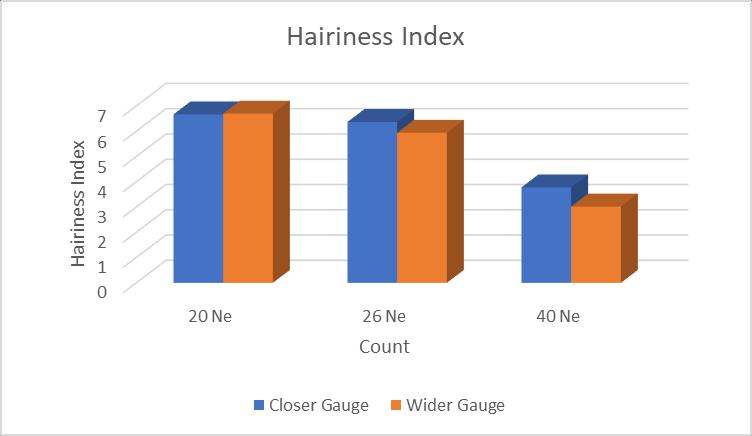
Figure 3.5: ChangesofHairiness
The bar diagram illustrates that Hairiness Index of yarn decreases with the increase of yarn count. The hairiness indexincreasedby19.48%,43.30%and16.29%respectively.
Theorder:20Ne>26Ne>40Ne
Hairiness Index in a textile material can lead to reduced aestheticappealduetoaroughorunevensurface,potentially makingitlessdesirableforvariousapplications.Excessive hairinesscanalsoresultinpilling,whichaffectsthematerial's durabilityandvisualquality.Toaddresstheseeffects,textile manufacturersmayimplementqualitycontrolmeasures,use lesshairyfibers,ormodifyproductionprocessestoreduce hairinessandimprovetheoverallqualityoftheirproducts.
3.2
Theconditioningprocesswasnotcarriedoutonthe yarns.
Some samples could not be collected due to mill authorityrestrictions
Theexperimentcouldnotbeconductedindividually ondistinctmachines.
Theanalysisofyarnpropertiesfordifferentcounts(20Ne,26 Ne, and 40 Ne) produced on two ring frame machines of wider and closer drafting zone respectively revealed important insights. Yarn count had a significant impact on severalkeyparameters,includingunevenness,coefficientof variation, imperfections, count strength product, and hairiness index. Generally, higher yarn counts were associated with increased unevenness, variability, and imperfections, while finer yarns demonstrated higher strengthandreducedhairiness.Thesefindingsunderscore theimportanceofyarncountselection,qualitycontrol,and process optimization in textile manufacturing to meet the desired quality standards for various applications. Manufacturers should carefully consider these factors to produceconsistent,high-qualityyarnfortheintendedtextile products.
International Research Journal of Engineering and Technology (IRJET) e-ISSN: 2395-0056
Volume: 12 Issue: 03 | Mar 2025 www.irjet.net p-ISSN: 2395-0072
[1] Begum,H.A.,Rakine,M.S.a.S.,Khan,S.A.,&Khan,M.K. R. (2019). Investigating the Interactive Effect of Card Cylinder Speed and Roller Gauge Settings of Breaker DrawingonCombedYarnEvennessandImperfections. Advances in Applied Sciences, 4(3), 72. https://doi.org/10.11648/j.aas.20190403.11
[2] Cui, Y., Song, H., Cheng, L., Deng, W., & Ji, Y. (2021). Experimentalstudyofamodifieddraftingsystembased on the ring spinning frame. Textile Research Journal, 91(13–14), 1486–1496. https://doi.org/10.1177/0040517520984977
[3] Hossain,M.A.,&Samanta,A.K.(2019).Usteranalysisof cotton/polyester blended spun yarns with different counts. Journal of Textile Engineering & Fashion Technology,5(4). https://doi.org/10.15406/jteft.2019.05.00204
[4] Chaudhari,V.,Raichurkar,P.P.,NarseeMonjeeInstitute ofManagementStudies,&CTF-MPSTME.(2016).Effect of Draw Frame Bottom Roller Gauge Setting on Yarn Quality. InternationalJournalonTextile Engineeringand Processes,28–29.
[5] Siddiqua, T., Aziz, T., Chowdhury, M. F., & Tania, S. I. (2022).TRAVELLERCLEARERGAUGECONSEQUENCE ON YARN QUALITY. Fibres and Textiles, 29(3), 71–77. https://doi.org/10.15240/tul/008/2022-3-007
[6] Ahmad, S., Ahmad, I., & S. Baig. (2008). The Effect of Nipper Guage and Drafting Zone Guages at Combing MachineonYarnQualityParameters. Journal of Quality and Technology Management, IV(1),21–32.
[7] Karthikeyan, M., R., Ramasamy, R., Duraisamy, R., & Habib Mammo. (2019). Improving Yarn Quality by ModificationonDraftingZoneSettingsofDrawFrame. In International Journal of Engineering Trends and Technology (IJETT) (Vol. 67, Issue 11, pp. 157–158). http://www.ijettjournal.org
[8] Delhom, C. D., Kelly, B., & Martin, V. (2018). Physical PropertiesofCottonFiberandTheirMeasurement.In Springer eBooks (pp. 41–73). https://doi.org/10.1007/978-3-030-00871-0_3
[9] Wang,H.,Siddiqui,M.Q.,&Memon,H.(2020).Physical Structure, Properties and Quality of Cotton. In Textile science and clothing technology (pp. 79–97). https://doi.org/10.1007/978-981-15-9169-3_5
[10] Oner,E.,Topcuoglu,S.,&Kutlu,O.(2018).Theeffectof cotton fibre characteristic on yarn properties. IOP ConferenceSeriesMaterialsScienceandEngineering, 459, 012057. https://doi.org/10.1088/1757899x/459/1/012057
2025, IRJET | Impact Factor value: 8.315 |
[11] Chen, K., Huang, C., Chen, S., & Pan, N. N. (2000). Developing a New Drafting System for Ring Spinning Machines. Textile Research Journal, 70(2), 154–160. https://doi.org/10.1177/004051750007000211