
International Research Journal of Engineering and Technology (IRJET) e-ISSN: 2395-0056
Volume: 12 Issue: 01 | Jan 2024 www.irjet.net p-ISSN: 2395-0072

International Research Journal of Engineering and Technology (IRJET) e-ISSN: 2395-0056
Volume: 12 Issue: 01 | Jan 2024 www.irjet.net p-ISSN: 2395-0072
Suryapratap Biswajit Puhan
Assistant Professor, Dept. of Civil Engineering, MITM Bhubaneswar, Odisha, India
Abstract - To increase compressive strength, tensile strength and promote the environmentally friendly use of fly ash (FA) produced in Malaysia, the study explores the feasibility of replacing fly ash (FA) and silica fume (SF) for ordinary Portland cement (OPC) in selfcompacting high-performance concrete (SCHPC). OPC was partially replaced by 0%, 25%, 40%, 50%, 65%, and 75% FA in six SCHPC mixes studied; SF replacement remained constant at 10%. The w/b ratio was fixed at 0.31. According to EFNARC for self-compacting concrete, fresh qualities were tested using slump flow, L-Box, and V-funnel tests. The compressive strength tests were carried out on 100 mm² cubes after 7 and 28 days of curing. The ideal mixture of 40% OPC, 50% FA, and 10% SF had a compressive strength at 28 days of 87.06 MPa, which was 5% higher than the control mix's 82.39 MPa. This exemplifies a practical and long-term approach to enhancing the performance of SCHP.
Key Words: Self-compacting high-performance concrete, Fly ash Compressive strength, Silica fume,Portland cement,STS.
1.INTRODUCTION
Withgrowingenvironmentalconsciousnessandthe needtolessentheharmfulconsequencesofindustrial wastes, the use of industrial by-products has acceleratedrecently[1].Theviscousmixtureknownas self-compaction concrete (SCC) is ideal for casting complex structures and constructions with crowded reinforcement,eitherwithorwithoutasmallamountof vibration, while preserving a steady flow devoid of bleeding and segregation [2]. Okomora started the conceptofSSCin1986,andTokyoUniversityexpanded onitin1988tocreatelong-lastingconcretestructures andraisestandardsinthebuildingsector[3].Abrasionresistantandlong-lasting,high-performanceconcrete (HPC)iscreatedwithalowwater-to-binderratio(w/b) andproperlycured[4].
High strength, durability, and fluidity are characteristics of HPC. Similar components make up both SCC and HPC, and when properly proportioned, they provide the necessary classes of concrete. Therefore,SCHPCisanewtangiblegenerationthatis founded on the ideas of HPC and SCC. It has the high strength and good durability of the HPC and the
sufficient self-compactability (filling, passage, and segregation resistance) of the SCC. SCHPC compacts without vibration, which speeds up construction and savesalotofmoney.However,itsproductioncostsare unaffordablebecauseofitshighcementitiouscontent andchemicaladmixtures.
However, a review of the literature indicates that labourcostsavingsandtheuseofmineraladmixtures like FA and SF in the SCHPC production process may significantlylowertheproductioncost.Furthermore,it is well known that the combination of FA and SF in a ternary blend enhances the qualities of concrete and makesSCHPCmoreecologicallyfriendly.WhereasSFis abyproductofthesmeltingprocessinthesiliconand ferrosilicon industries, FA is a byproduct of burning pulverizedcoalinpowerplantsthatgenerateenergy.
Coal-fired power plants are used in Malaysia to produceelectricity.Burningcoalash,theTanjungBin power plant, one of Malaysia's four coal-powered power plants, generates 42,000 metric tons of FA monthly[5].AsMalaysia'santicipatedneedforcoalto generateenergyrisesin2020,itisanticipatedthatFA output would rise as well. One affordable and easily accessiblefossilfueliscoal.Accordingtoreports,a25% FAsubstitutionforcementresultsina20%reductionin constructionexpenses.Thereisn’tmanyresearchinthe literatureonthemechanicalpropertiesofSCHPCthat incorporate class F FA and 10% SF. The goal of this workistoclosethisgap.
In their investigation of the mechanical characteristicsofSCC,Askarietal.[6]findthatalarge volume FA concentration increases compressive strengthbetween28and120daysofcuring,confirming the persistence of FA's pozzolanic activity over time. Additionally, SCC with high volume FA retains and increases its tensile strength when 10% SF is substituted for cement. Askari et al. [6] conclude that because FA particles are spherical, high-volume FA reducestheamountofsuperplasticizer(SP)neededto achieve self-compactability. Similarly, Wongkeo et al. [7] investigate the effects on SCC's compressive strength and chloride resistance of substituting Portland cement with 50, 60, and 70 weight percent high calcium class C FA and SF. They discovered that whenPortlandcementissubstitutedinlargequantities,
International Research Journal of Engineering and Technology (IRJET) e-ISSN: 2395-0056
Volume: 12 Issue: 01 | Jan 2024 www.irjet.net p-ISSN: 2395-0072
FA and SF improve SCC's resistance to chloride. Additionally, Yazici [8] evaluated the mechanical and durability characteristics of SCC mixes with 10% SF addition and a constant w/b ratio of 0.28 by substitutingclassCFAforcementfrom30%to60%.He discoveredthatadding10%SFenhancestheconcrete's fresh and hardened qualities. Furthermore, the characteristics of the component materials have an impactonthecompactivityofSCHPC.Consequently,it isnecessarytoexaminetheconcrete'sstrengthgrowth when a significant amount of cement is substituted. Given the aforementioned, this study investigates the effects on the new characteristics and compressive strength of SCHPC of replacing 25%, 40%, 50%, and 65% of the Portland cement with 10% SF and ASTM C618 class F FA. FA and SF replaced 0%, 25%, 40%, 50%,65%,and75%ofthecementinsixdistinctmixes. SF,however,waskeptatasteadyreplacementrateof 10%.Foreverymix,thew/bratiowassetat0.31.To evaluate the fresh qualities of SCHPC, tests on fresh concrete using slump flow, L-Box, and V-funnel were carriedout.Concretecubesmeasuring100mm2were testedforcompressivestrengthat7,28,and56daysof cure.
2.1.Materials
To create the SCHPC combinations, regular Portland cement of CEM 1 with a specific gravity of 3.15 and a strength of 42.5 MPa was utilized. Low calcium FA equivalenttoASTMC618-12a,[9]ClassFwithgravity of2.1,producedfromTanjungBinpowerplantatJohor Bahru, was added in varying quantities to reduce the risk of segregation and heat of hydration while achievingthenecessaryworkabilityanduniformityof SCHPC. For the FA concrete's relatively low early strength, densified SF was used, which had a bulk density of 550–650 kg/m3 and a gravity of 2.1–2.4. Mulleretal.'srecommendationof10%SFwasfollowed [10].Table1displaysthechemicalmakeupofSCMsand Portland cement as determined by X-ray diffraction (XRD) investigation. Class F FA has a minimum composition of 70% silicon dioxide (SiO2), aluminum oxide (Al2O3), and iron oxide (Fe2O3), but the total calciumoxide(CaO)contentislessthan7%,perASTM C618-12a[9].
SCMs.

Chart-1: Grading curve of fine aggregate in relation to ASTM C33 limits
Naturallyoccurringriversandwasutilizedasafine aggregate in the mixtures; its relative density (SSD), water absorption, and fineness modulus were 2.65 kg/m3, 1.15%, and 3.17, respectively. The fine aggregate grading result based on sieve analysis is showninChart-1.TheASTMC33/C33M-13maximum and lower limitations are met by the grading of the various fine aggregate sizes [11]. As a result, the fine aggregate was graded properly. A well-graded aggregate typically improves the packing density, flexibility, and workability of SCHPC by lowering the need for water and superplasticizer. The coarse aggregatewasawell-graded10mmaggregatewithan SSD and a water absorption value of 2.66 kg/m3 and 1.0%,respectively.Toattainthenecessaryconsistency, Sika Viscocrete-2044, a third-generation poly-
International Research Journal of Engineering and Technology (IRJET) e-ISSN: 2395-0056
Volume: 12 Issue: 01 | Jan 2024 www.irjet.net p-ISSN: 2395-0072
carboxylateether-basedsuperplasticizerthatconforms withASTMC494[12],wasadded.
2.2.MIXPROPORTIONSANDSPECIMENPREPARATION
SixdistinctmixeswerecreatedusingFAandSFtoreplace cementatpercentagesof0%,25%,35%,50%,60%,and75% while keeping SF constant at 10% replacement. For every mix,thew/bratiowassetat0.31.TocreateSCHPCconcrete withincreasedstrengthanddurability,replacementamounts ofaconsistent10%ofSFwereutilized[10].SFservesasa fillertoincreasethedensityofconcreteandenhancesitspore structure.Table2providesasummaryofthevariousmixing proportions.Theconcretewasmixedusinga rotarymixer withavolumeof0.03m3.Aftermixing,slumpflow,L-Box, and V-Funnel tests were conducted on the fresh concrete to explore the features of the rheological propertiesofSCMs,asrecommendedbyEFNARC[13]. To measure compressive strength, 100 × 100 mm concrete cubes were made, and the specimens were curedinwaterat20±5°Cforsevenandtwenty-eight days.
3.1Testsonfreshproperties
Abram's slump cone was used for the Slump Flow Test. In accordance with European Standard BS EN 12350-2,thetestwasconducted[14].Thistestcanbe usedtoevaluateSCHPC'sworkability,consistency,and fillingability.
The SCHPC's abilityto travel through narrow gaps, such as those between reinforcing bars and other obstructions without segregating or obstructing EFNARC,wasevaluatedusingtheL-BoxTest[13].
Using a V-funnel equipment called EFNARC, the viscosityandfillingcapacityofSCHPCwereevaluated usingtheV-FunnelTest[13].
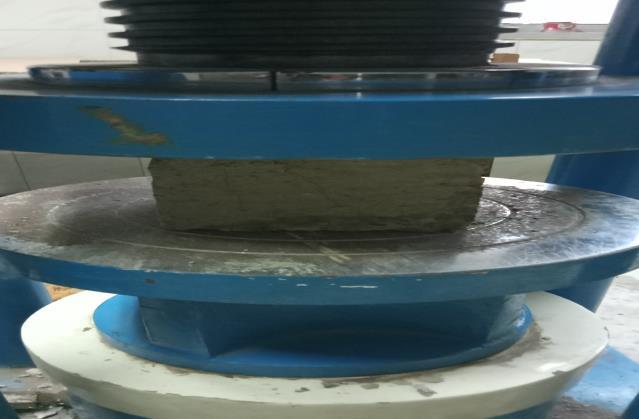
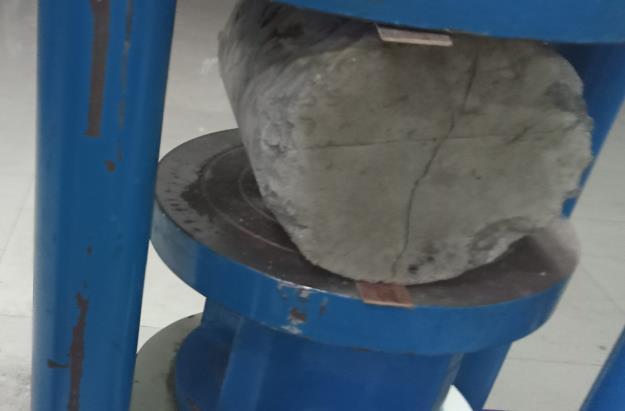
Using a V-funnel apparatus EFNARC [13], the viscosity and filling ability of SCHPC were evaluated using the V-Funnel Test. A universal testing machine with a 3000 kN capacity was used to determine the compressivestrengthofcubespecimensmeasuring100 × 100 mm in accordance with BS EN 12390-3 [15]. Between the ages of 7 and 28 days, the test was administered.Tofindthecompressivestrength,three specimens from each batch were measured, and the average value was computed. Fig. 1 depicted the compressivestrengthtest'soperationalprocess.
The cylindrical specimens were subjected to a splittingtensilestrengthtestafter28daysofcure.The test was carried out in compliance with ASTM C496/C496M-11 specifications [7]. The NL CompressionMachine,whichhasa3000KNcapacity, was used for the test. Straight from the machine, the maximum fracture load was noted. Eq. 2 was used to calculatethis:
Fct =(2F/NLD).
whereFisthemaximumloadinN,Listhespecimen's height in mm, D is its diameter in mm, and Fct is the splitting tensile strength in MPa. Fig. 3 illustrates the splittingtensilestrengthtest'soperationalprocess.
4.1.Freshproperties
SlumpFlow:AsseeninTable2,theslumpflowof thecorrespondingSCHPCvariedbetween550and650 mm.Thisslumpflowratingindicatesgoodfillingability andfallswithinClassSF1ofEFNARC[13].Italignswith themajorityofSCHPCresearch.
L-Boxpassingratio:Thecontrolmix'sL-boxpassing ratio is 0.76 (about 0.8). On the other hand, for every other blend, the passing ratio falls between 0.84 and 0.88.
Table2
Thefreshpropertiesofconcretemixes.
Concrete mixes Slump flow (mm)Min. to Max. 550 to 850
40%FA10%SF
50%FA10%SF
International Research Journal of Engineering and Technology (IRJET) e-ISSN: 2395-0056
Volume: 12 Issue: 01 | Jan 2024 www.irjet.net p-ISSN: 2395-0072
For passing ratio Class PA2, the EFNARC [13] recommendsanL-boxpassingratiorangeof0.8to1.0. Consequently, any SCHPC combination meets the criterionforpassingabilityclassPA2.Thepassingratio of SCHPC improves when the FA replacement level rises,accordingtoNagaratnametal.[16].
V-funnel flow time: The fresh mixes' Vfunnelflowtimes(Tv)rangedfrom10to12seconds. Accordingly, the Tv for each individual SCHPC falls between9and15s,asdeterminedbyEFNARC[13]for the VF2 viscosity class. The concrete becomes more viscous when silica fume is added [17]. Table 3 providedanoverviewofthenewSCHPCfeatures.
Chart-2 and 3 showed the average compressive strength and maximum compressive strength of the various samples, respectively. As the curing period increased, all SCHPC's compressive strength rose as well.SCHPCwith25%FAand0%SFhada35%lower compressive strength than the control sample. This resulted from FA's diluting impact and sluggish pozzolanicreaction.Oncemore,thecontrolspecimen's compressivestrengthis4%higherthanthatofthe65% PC, 25% FA, and 10% SFsamples. Onthe other hand, 50%PC;40%FA;10%SFand40%PC;50%FA;10% SFhadcompressivestrengthsthatareonly1%higher thanthecontrolspecimens.
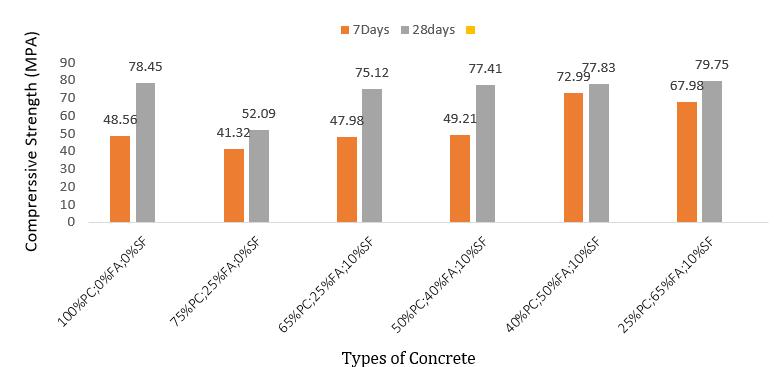
Chart-2:AveragecompressivestrengthofSCHPC
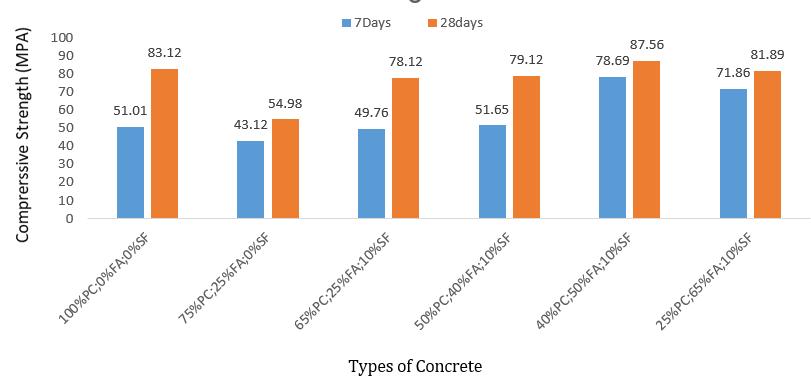
Chart-3: Maximumcompressivestrengthof individualsamplesofSCHPC.
Nonetheless, the 25% PC, 65% FA, and 10% SF compressivestrengthsare2%higherthanthePortland cementcontrols.However,thecompressivestrengthof Portland-flyash-silicafumeconcreteimprovedbecause of the higher pozzolanic reaction and the micro-filler impact of SF compared to FA. Silica fume works wonders for HPC development. Similar findings are reportedbyWongkeoetal.[7].
Whilethecompressivestrengthof25%PC;65%FA; 10%SFat28daysishigherthanthatof40%PC;50% FA; 10% SF at 7 days, Chart-2 shows that the compressivestrengthof40%PC;50%FA;10%SFat7 daysisgreaterthanthatof25%PC;65%FA;10%SF. Fly ash's diluting effect and sluggish pozzolanic responsearethemaincausesofthis.Overtime,flyash increases the concrete's compressive strength. Concrete'searlystrengthmaybeimpactedbyitsheavy application,butitcanalsoachieveexceptionalstrength lateron[18].
There is a significant t-test result, p =.096 for the compressive strength of three samples from 50% PC; 40% FA; 10% SF SCHPC (M = 77.41, SD = 2.58) in comparison to three samples from 40% PC; 50% FA; 10%SFSCHPC(M=77.83,SD=8.13).At28days,the compressivestrengthofSCHPCwith40%FAand50% FAcementreplacementdidnotdiffersignificantly.
The non-durable calcium hydroxide (lime) producedbythehydrationofPortlandcementconcrete is chemically reacted with fly ash to form calcium silicatehydrate(C-S-H),thestrongestandmostdurable component of thepaste in concrete. Asa result of the paste's gradual strengthening due to C-S-H, the capillaries that permit moisture to pass through the concrete are diminished, making the concrete more resilient and less permeable [3]. Additionally, while concrete is in a plastic condition, the "ball bearing" function of fly ash helps with the lubricating effect, which enhances workability and finishing, lessens bleedingandsegregation,andmakespumpingSCHPC easier[19,20].
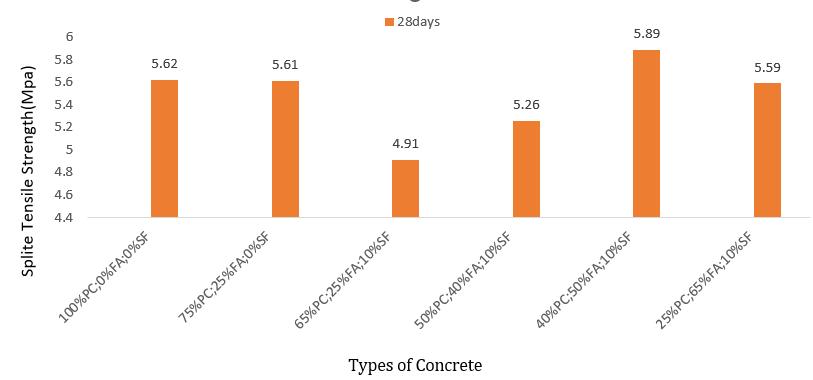
Chart-4displayedthesplittingtensilestrengthtest results.After28days,thecorrespondingstrengthlevels wereascertained.At28daysofage,SCHPC'ssplitting tensile strength rises from 4.91 to 5.89 MPa. The concrete'ssplittingtensilestrengthincreasedgradually asFAandSFwereaddedtothemixtures.ThePortlandfly ash-silica fume concrete blend's splitting tensile strengthwas increased by adding SF [21]. Two of the cylinders,representing40%PC,50%FA,and10%SF, brokeintwoatmaximumstressduringthetensiletest. LesscohesivestresseswereconveyedbecauseSCHPC
International Research Journal of Engineering and Technology (IRJET) e-ISSN: 2395-0056
Volume: 12 Issue: 01 | Jan 2024 www.irjet.net p-ISSN: 2395-0072
was brittle and there was less coarse aggregate and interlockingcomponents[22].
5. CONCLUSIONS
The following conclusions were drawn from this study'sfindings:
AllSCHPCmixesmeettherequirementsforthe passingabilityclassPA2,theV-funnelflowtime for all SCHPCs falls withinviscosity class VF2, andtheslumpflowofeachSCHPCfallswithin classSF1,indicatinggoodfillingability.
At 28 days of curing age, a Portland-fly ashsilicafumeblendof40%PC,50%FA,and10% SFreachedthemaximumcompressivestrength of 87.06 MPa, which is 5% greater than the control specimen's 82.39 MPa. The cement contentofthismixtureisonly235.00kg/m3.
At28daysofage,SCHPC'ssplittingtensilestrength rises from 4.91 to 5.89 MPa. The concrete's splittingtensilestrengthincreasedgraduallyasFA and SF were added to the mixtures. The splitting tensilestrengthisincreasedbyadding10%SF.
Thepaperhasnotreceivedanytypesoffinancialsupport fromanytypesoforganocation.
[1] K.M. Liew, A.O. Sojobi, L.W. Zhang, Green concrete: prospects and challenges, Constr. Build.Mater.156(2017)1063–1095.
[2] M.A.,A.S.I.,N.M.M,Self-compactingconcrete–areview,Int.J.Innov.Technol. Explor. Eng. 6 (2017)1–7.
[3] A.M. Falmata, A. Sulaiman, R.N. Mohamed, A.U. Shettima, Mechanical properties of selfcompacting high-performance concrete with fly ash and silicafume,SNAppl.Sci.2(2020)1–11
[4] W.Piasta,B.Zarzycki,Theeffectofcementpaste volumeandw/cratioon shrinkagestrain,water absorption and compressive strength of high performanceconcrete,Constr.Build.Mater.140 (2017)395–402
[5] M.H. Abdullah, R. Abuelgasim, A.S. Rashid, Z. Mohdyunus,Engineering Properties of Tanjung bin bottom ash, MATEC Web Conf. (2018) 1–9
[6] A. Askari, M.R. Sohrabi, Y. Rahmani, An investigation into mechanical properties of self compacting concrete incorporating fly ash and silica fume at different ages of curing, Adv. Mater. Res. 261–263 (2011) 3–7.
[7] W. Wongkeo, P. Thongsanitgarn, A. Ngamjarurojana, A. Chaipanich, Compressive strength and chloride resistance of selfcompacting concrete containing high level fly ash and silica fume, Mater. Des. 64 (2014) 261–269
[8] H. Yazici, The effect of silica fume and highvolume Class C fly ash on mechanical properties, chloride penetration and freeze-
International Research Journal of Engineering and Technology (IRJET) e-ISSN: 2395-0056
Volume: 12 Issue: 01 | Jan 2024 www.irjet.net p-ISSN: 2395-0072
thaw resistance of self- compacting concrete, Constr.Build.Mater.22(2008)456–462.
[9] ASTMC618-12a,StandardSpecificationforCoal FlyAshandRaworCalcined Natural Pozzolan for Use,Annu.B.ASTM Stand. 04.02(2003) 3–6.
[10] A.C.A. Muller, K.L. Scrivener, J. Skibsted, A.M. Gajewicz, P.J. McDonald, Influence of silica fume on the microstructure of cement pastes: new insights from 1H NMR relaxometry, Cem. Concr. Res. 74 (2015) 116–125.
[11] ASTM C33/C33M-13, Standard Specification for Concrete Aggregates, ASTM Int.(2003).
[12] American Standard Testing of Materials, ASTMC494-StandardSpecificationfor Chemical AdmixturesforConcrete,2017.
[13] EFNARC, Specification and Guidelines for SelfCompacting Concrete, 2002.
[14] BS EN 12350-2, Testing fresh concrete, Part 2: Slump Test, 2009.
[15] BSEN12390-3,Testinghardenedconcrete:Part 3, Compressive strength of test specimens, 2009.
[16] B.H. Nagaratnam, A. Faheem, M.E. Rahman, A. Mannan, M. Leblouba, Mechanical and durability properties of medium strength selfcompacting concretewithhigh-volumeflyash andblendedaggregates,Period.Polytech. Civ. Eng.59(2015)155–164.
[17] M. Jalal, A. Pouladkhan, O.F. Harandi, D. Jafari, Comparativestudyoneffectsof ClassFflyash, nanosilicaandsilicafumeonpropertiesofhigh performance self compacting concrete,Constr. Build. Mater. 94 (2015) 90–104
[18] T. Nochaiya, W. Wongkeo, A. Chaipanich, Utilization of fly ash with silica fume and properties of Portland cement-fly ash-silica fumeconcrete,Fuel89(2010) 768–774.
[19] N. Puthipad, M. Ouchi, A. Attachaiyawuth, Effectsofflyash,mixingprocedure andtypeof air-entraining agent on coalescence of entrained air bubbles in mortar of selfcompacting concrete at fresh state, Constr. Build.Mater.180 (2018)437–444
[20] N. Puthipad, M. Ouchi, S. Rath, A. Attachaiyawuth, Enhancement in selfcompactability and stability in volume of
entrainedairinself-compacting concretewith high volumefly ash, Constr.Build.Mater.128 (2016)349–360.
[21] WuW,WangR,ZhuC,MengQ(2018)Theeffectoffly ash and silica fume on mechanical properties and durability of coral aggregate concrete. Constr Build Mater 185:69–78. https://doi. org/10.1016/j.conbuildmat.2018.06.097.
[22] Korte S, Boel V, De Corte W, De Schutter G (2013). Fracture Behaviour of Self-Compacting Concrete Compared To. Pro 90, (September), 317–324. http://hdl.handle.net/1854/LU-4148321
2025, IRJET | Impact Factor value: 8.315 | ISO 9001:2008