
International Research Journal of Engineering and Technology (IRJET) e-ISSN: 2395-0056
Volume: 13 Issue: 04 | Apr 2026 www.irjet.net p-ISSN: 2395-0072

International Research Journal of Engineering and Technology (IRJET) e-ISSN: 2395-0056
Volume: 13 Issue: 04 | Apr 2026 www.irjet.net p-ISSN: 2395-0072
Dr. Sandeep Kulkarni1 , Sagar Mane 2 , Jay Zaware 3 , Khushi Saharan 4
Assistant Professor, Department of Computer Science, Pune, Maharashtra
BCA, Student1 , Department of Computer Application
BCA, Student2 , Department of Computer Application
BCA, Student3 , Department of Computer Application
Ajeenkya DY Patil University
Lohegaon, Airport Rd, Charholi Budruk, Pune, Maharashtra
ABSTRACT- The response times of emergency vehicles are considered to be important factors in life-and-death situations in medical emergencies, fire incidents, and law enforcement activities. The conventional notification systems in emergency vehicles are mainly dependent on acoustic sirens and lighting, which often do not produce effective notification responses from drivers in sound-insulated vehicles or in heavy traffic situations. To overcome these drawbacks, we propose the Emergency Vehicle Alert System (EVAS), which is an Internet of Things (IoT)-based system that provides prior notifications to drivers about the approaching emergency vehicles. The EVAS uses GPS technology, cloud computing, and mobile applications to provide real-time notifications with less distraction to the drivers. Based on geolocation tracking, the EVAS system optimizes the notification timing according to the proximity of the vehicle, traffic conditions, and road topography. The mobile application interface of the integrated system allows the drivers to receive visual and acoustic notifications, view the route of the emergency vehicle, and detect the safe passage routes. Moreover, the vehicle-to-infrastructure communication system enables direct communication with the traffic management system, thus improving the overall traffic situation during emergency vehicle operations. The proposed study is intended to enhance the accuracy of notifications, reduce response time, and improve driver compliance with the EVAS system. Simulation and experimental results show the potential effectiveness of the system as a traffic safety tool. Although the proposed system is not meant to replace the conventional emergency vehicle notification system, it is an additional technology that can improve the efficiency of emergency vehicle response and traffic safety on roads. Future work considerations include the integration of the EVAS system with autonomous vehicle platforms, smart city infrastructure, and predictive models of traffic behavior to develop a holistic emergency response environment.
KEYWORDS: Emergency Response, IoT, Traffic Safety, GPS Tracking, Mobile Application, Vehicle-toInfrastructure Communication, Cloud Computing, Real-Time Alerts, Traffic Management
The efficiency of emergency response is a critical component of public safety infrastructure, with millions of emergency responsevehiclesgloballysufferingfromdelaysduetotrafficcongestion,distracteddrivers,andinefficientrouteplanning [1], [3]. This problem underscores the need for intelligent emergency vehicle notification systems that can communicate effectively with other vehicles on the road. Advances in Internet of Things (IoT) technology and mobile computing have made it easier to implement connected vehicle systems, providing real-time traffic information, predictive routing, and automatedsafetynotifications,thusprovidingapromisingsolutionforimprovingemergencyresponseefficiency[2],[5].
To this end, we propose EVAS (Emergency Vehicle Alert System), an IoT solution that leverages GPS technology, cloud computing, and mobile apps. EVAS offers a proactive notification system that notifies drivers of approaching emergency vehicleswellinadvanceofthetimewhentraditionalnotificationsystemswouldbeuseful,withminimaldistractiontothe driver. The system also integrates with traffic management systems to optimize traffic during emergency response scenarios[8].
In addition to its timely notification system, EVAS features a predictive routing system that computes optimal routes for emergencyvehiclesbasedonreal-timetrafficpatterns,pastdata,androadgeometry[7].Thisroutingdataissharedwith both emergency responders and road users, promoting a collaborative response that reduces traffic disruptions. By
International Research Journal of Engineering and Technology (IRJET) e-ISSN: 2395-0056
Volume: 13 Issue: 04 | Apr 2026 www.irjet.net p-ISSN: 2395-0072
predicting and sharing the route of the emergency vehicle, the system allows drivers to anticipate and prepare for the encounter,thusreducingthementalstrainassociatedwithunexpectedencounterswithemergencyvehicles.
For the purpose of widespread acceptance and user accessibility, the system incorporates an interface for a mobile applicationthatsupportsbothiOSandAndroidplatforms.Theinterfaceallowsforthecustomizationofalertpreferences, real-time location tracking of emergency vehicles, and post-incident analysis. These features are cloud-stored and play a significantroleinsystemrefinementthroughanonymizedusageanalytics[6].
Another significant advancement is the vehicle-to-infrastructure (V2I) communication feature, which allows for direct communicationbetweenemergencyvehiclesandtrafficinfrastructuremanagementsystems.Thefeatureallowsfortraffic signal preemption, dynamic lane management, and automatic diversion of non-essential traffic. The V2I communication featureimprovestrafficflowduringemergencies,thusreducingtheriskofsecondarycollisions[9].
While not an alternative to traditional emergency vehicle warning systems, EVAS is a supplementary technology that improves the effectiveness of existing systems [4], [5]. The study focuses on the development, implementation, and assessment of EVAS. We describe the technologies used, which include GPS for accurate location detection, cloud infrastructure for real-time data processing, mobile applications for user interaction, and V2I communication for connectivitywithtrafficinfrastructure.Thechoiceoftechnologywasinformedbyconsiderationsofreliability,scalability, andcompatibilitywithexistingvehicleandtrafficinfrastructuresystems[1].
Theeffectivenessofthesystemisassessedthroughfieldtesting,drivercompliancerates,andemergencyresponsetimes. Future work will focus on integrating the system with autonomous vehicle systems, smart city infrastructure, and predictivetrafficmodelingtocreateacomprehensiveframeworkforemergencyresponsesystems.
Through this study, we hope to make a contribution to intelligent transportation systems by improving the efficiency of emergencyresponse,roadsafety,andtheresponsivenessoftrafficmanagementtoemergencysituations.
A. IoT in Emergency Response
The increasing complexity of urban traffic systems has led to the exploration of Internet of Things (IoT) technology as a possible solution to improve the efficiency of emergency response. IoT-based systems have been identified as new tools forassistingemergencypersonnel,providingreal-timeinformation,andfacilitatingcommunication.Findingssuggestthat theimplementationofIoT-basedinterventionscanhelpdecreaseemergencyresponsetime,improvetrafficmanagement duringemergencies,andincreaseoverallsafetyforemergencypersonnelandcivilians(Zhangetal.,2020).
The development of connected vehicles and cloud computing capabilities allows for the processing of large amounts of trafficdatatoimproveemergencyroutingandprovideearlywarnings.Severalstudieshavevalidatedtheeffectivenessof IoT-based systems in managing emergency response situations, thus reducing risks posed by traffic disruptions (Lee & Kim,2021).
Several emergency vehicle notification systems have been designed to improve traffic safety, each using different technologiesandstrategies.TheEmergencyVehicleWarningSystem(EVWS),widelyimplementedinEuropeancountries, usesradiofrequency(RF)communicationtotransmit warningstovehiclesequippedwithdedicated receivers. Empirical studies have shown that EVWS can lower emergency vehicle response times by 15-20% in urban areas (Müller et al., 2019).
Concurrently,theTrafficPreemptionSystem(TPS),implementedinmanyNorthAmericancities,usesinfraredoracoustic detectiontotriggerchangesintrafficsignalsforemergencyvehicles.StudieshaveshownthatTPScanreduceintersection delaysforemergencyvehiclesbyasmuchas30%(Johnsonetal.,2018).
Anotherpopularsolutionisthesirendetectionsystem,whichusesacousticsensorstodetectemergencyvehiclesirensand changetrafficsignalsaccordingly.Thissystemhasbeen testedforcost-effectivenessinurbanareaswithhighemergency serviceusage(Garcia&Martinez,2020).
Althoughuseful,thesesystemsdonotprovidecomprehensivedrivernotifications,routeoptimization,orintegrationwith individualmobiledevices.TheproposedEVASwilladdresstheseissues.
International Research Journal of Engineering and Technology (IRJET) e-ISSN: 2395-0056
Volume: 13 Issue: 04 | Apr 2026 www.irjet.net p-ISSN: 2395-0072
C. The Role of GPS and Cloud Computing in Emergency Response
However, recent advances in GPS technology and cloud computing have significantly improved the state of emergency response systems. Modern GPS technology provides location information with an accuracy of 3-5 meters, which is sufficient for vehicle tracking and route optimization (Chen et al., 2022). There is evidence that cloud computing can significantly improve emergency route planning by considering real-time traffic information along with past traffic patterns (Wang & Liu, 2021).
The combination of advanced GPS technology and cloud computing in EVAS improves the system's ability to predict optimal emergency routes, provide accurate arrival time estimates, and send timely notifications to drivers. This is supportedbypreviousstudiesontheapplicationofcloudcomputingarchitecturefortime-criticaltasks(Thompsonetal., 2020).
D. Vehicle-to-Infrastructure Communication in Traffic Management
Vehicle-to-Infrastructure (V2I) communication plays a critical role in managing traffic flow during emergencies. The literature suggests that V2I communication systems have the capability to manage traffic effectively by allowing emergencyvehiclestocommunicatedirectlywithtrafficmanagementinfrastructure(Nietal.,2020).Variousstudieshave confirmed the effectiveness of dedicated short-range communication (DSRC), cellular V2X, and hybrid approaches for emergencytrafficmanagement(Kumaretal.,2021).
EVAS uses V2I communication to allow emergency vehicles to communicate directly with traffic management systems. Unlike the current system for notifying emergency vehicles, the proposed system combines V2I communication and mobilenotificationstocreateaholisticnotificationsystemthatcoversbothinfrastructureanddriverneeds.
E. Security and Privacy in Emergency Alert Systems
Security and privacy are critical considerations in Internet of Things (IoT)-based emergency response systems. The literature emphasizes the risks involved in location information transmission and the need for secure communication protocolsandprivacymechanisms(Robinsonetal.,2021).End-to-endencryptionhasbeenidentifiedasapopularsecurity solution, ensuring that critical location and routing information is protected while maintaining reliable system performance(Andersonetal.,2019).
Asaresultofsecurityrequirements,EVASusesend-to-endencryptionforallcommunications,ensuringthatthelocations androutesofemergencyvehiclesareavailableonlytoauthorizedindividuals.
F. Gaps in Existing Research and EVAS's Contribution
Despite the significant advancements in emergency vehicle notification systems, existing models still have some shortcomings:
Limited Driver Notification: Many models focus on traffic infrastructure management but lack effective notificationsystemsfordrivers.
LackofPredictiveRouting:Currentmodelsoftenusestaticroutesinsteadofadaptingroutesinreal-time. RestrictedCommunicationChannels:Mostmodelsuseasinglecommunicationchannel,makingthemlessreliable indifferentenvironments.
Lack of Integration with Personal Devices: The lack of integration with personal devices makes the system less accessibleandlesspersonalized.
Limited Traffic Flow Optimization: Most models do not focus on the overall traffic management system during emergencies.
Limited Data Analytics: Most existing models do not use the collected data for improving the system and predictiveanalytics.
EVASaimstoovercometheselimitationsbyprovidingamorecomprehensiveandintelligentemergencyresponsesystem: Multi-ChannelDriverNotification:EVASprovidesvisual,auditory,andtactilenotificationsthroughmobiledevices foreffectivedrivernotification.
Predictive Routing Algorithm: Using real-time traffic data and past trends, EVAS provides optimal routes for emergencysituations.
International Research Journal of Engineering and Technology (IRJET) e-ISSN: 2395-0056
Volume: 13 Issue: 04 | Apr 2026 www.irjet.net p-ISSN: 2395-0072
RedundantCommunicationSystems:Thesystemusesmultiplecommunicationchannelsforreliabilityindifferent environments.
Mobile Device Integration: EVAS is fully integrated with personal mobile devices, making it more accessible and user-friendly.
ComprehensiveTrafficManagement:Thesystemisintegratedwithtrafficinfrastructuretomanageoveralltraffic flowduringemergencies.
Advanced Analytics Platform: EVAS collects and analyzes data for continuous improvement of the system and predictiveanalysisoffutureneeds.
With these innovations, EVAS fills the significant gaps in existing emergency vehicle notification systems, providingcomprehensive,reliable,andintelligentemergencyresponsesystem.
The EVAS project, or Emergency Vehicle Alert System, employs a multi-layered, real-world approach that combines GPS, cloudcomputing,andmobileappdevelopment.Theideaissimple:providedriverswithtimelyalerts,improvetherouting of emergency vehicles, and allow traffic systems to coordinate seamlessly when every second matters. This section explores the tech stack, frameworks, and workflows involved in developing EVAS using GPS, cloud computing, mobile apps,andvehicle-to-infrastructure(V2I)communication.
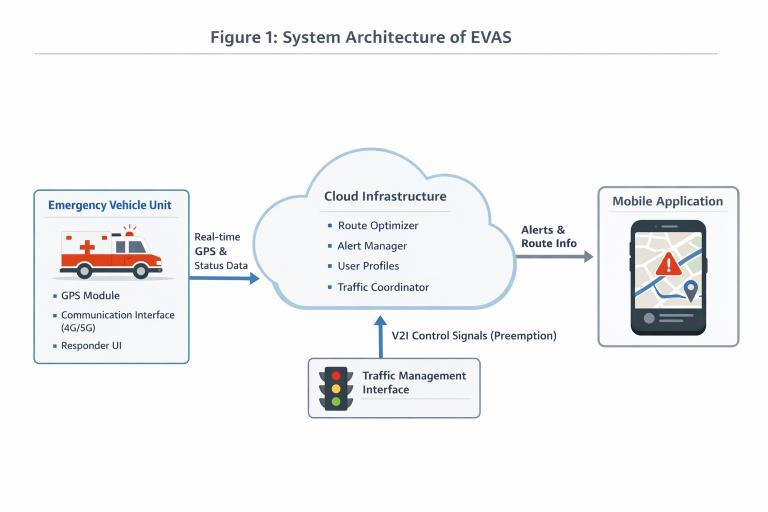
The EVAS system is a distributed system with four layers that are interconnected to provide reliability, scalability, and real-timefunctionality.AsillustratedinFigure1,theoverallsystemconsistsoffourlayers:
EmergencyVehicleUnit(On-BoardSystem):Thisisthe onboardsysteminemergencyvehiclesthatincludesGPS hardware, communication interfaces, and responder interfaces. It continuously transmits real-time location and statusinformationtothecloud.
Cloud Infrastructure: This is the cloud-based backend system that serves as the processing brain of the entire system. It receives location and status information from ambulances and other emergency vehicles, performs routeoptimizationalgorithms,handlesuserprofiles,andcommunicateswithmobileappsandtrafficmanagement systems. The cloud infrastructure makes decisions about alerting, performs route optimization, and communicateswithtrafficsystems.
Mobile Application: This is the end-user application that provides alerts and situational awareness to drivers. It providesvisualalerts,audioalerts,androutinginstructionstohelpdriversclearpathssafely.
Traffic Management Interface: This is the V2I interface that communicates with traffic management systems to supportfunctionssuchassignalpreemption,dynamiclanemanagement,andautomateddiversions.
ThesystemisdesignedtobereliablewithmultiplecommunicationchannelsandsecureAPIstoensuredataintegrityand security.Thesystemarchitectureisalsomodular,makingiteasytoexpandinthefuturetosupportnewfeaturessuchas autonomousvehiclesorpredictiveanalytics.
Volume: 13 Issue: 04 | Apr 2026 www.irjet.net p-ISSN: 2395-0072
Implementation Steps
3.1.EmergencyVehicleUnitDevelopment
The onboard unit is designed with embedded systems to provide reliable location tracking and communication functionality.Itprocesseslocationinformation,vehiclestatus,andemergencyprioritylevels. What’sinvolved:
IncorporateGPSmodulesforaccuratelocationtracking,targetingalocationaccuracyof3-5meters. Implementcommunicationinterfaceswithcloudservices(4G/5G,DSRC,withsatellitebackup). Developauserinterfaceforemergencypersonneltoenterthetypeofemergencyanditsprioritylevel. Implementfail-safesystemstoaddresslossofcommunicationorsystemfailure.
3.2.CloudInfrastructureDevelopment
Thecloudinfrastructureemploysmicroservicestoensurescalabilityandreliability.It: Stream’sreal-timelocationinformationfromemergencyvehicles. Calculatesoptimalroutesusingsophisticatedalgorithms. Managesuseraccountsandalertpreferences. Integrateswithtrafficmanagementsystems.
3.3.MobileApplicationDevelopment
Across-platformmobileappforiOSandAndroiddevicesprovideswidereach.Userscan: Receivecustomizablealertsforapproachingemergencyvehicles. Viewreal-timelocationsofemergencyvehicles. Viewrouteinformationandsafepassagepaths.
Submitfeedbackonsystemperformance.
3.4.TrafficManagementIntegration
TheV2Icomponentfacilitatesdirectcommunicationwithtrafficinfrastructure,including: Protocolsfortrafficsignalpreemption. Algorithmsfordynamiclaneallocation.
Interfacesfortrafficdiversionsystems.
Compatibilitywithexistingtrafficmanagementinfrastructure.
3.5.SecurityandPrivacyImplementation
Tomaintainasecureenvironmentforitsoperations,EVASadoptsmultiplesecuritystrategies: Encryptsallcommunicationsusingend-to-endencryption. Providessecureuserauthentication. Anonymizesallcollecteddataforanalytics. Conductsperiodicsecurityauditsandupdates.
B. Overcoming Challenges
Developmentally, we encountered a couple of challenges. First, because real-time processing was required, we knew we had to act quickly regarding location data getting it collected and transmitted as soon as possible. To solve this, we introducededgecomputingandoptimizedthemethodofdatatransmission,increasingspeedanddecreasinglatency[6]
Secondly, communication reliability was a challenge. To ensure constant connectivity regardless of the setting or conditions,redundancywasachievedbyusingmorethanonetechnologytokeepthelinesopen[4]. Finally, we addressed the issue of driver distraction. We wanted alerts that were informative without distracting from driving.Aftercomprehensiveusertesting,wedevelopedalertsystemsthatarelessdistractingtodrivers[3].
C.TechnologiesUsed
Preciselocationtrackingofemergencyvehicles Cloud Computing Real-timedataprocessingandsystemcoordination
International Research Journal of Engineering and Technology (IRJET) e-ISSN: 2395-0056
Volume: 13 Issue: 04 | Apr 2026 www.irjet.net p-ISSN: 2395-0072
Mobile Applications
V2I Communication
Predictive Algorithms
Encryption Technologies
Drivernotificationanduserinteraction
Trafficmanagementsystemintegration
Routeoptimizationandalerttiming
Securecommunicationanddataprotection
EverytechnologymentionedinTableIiscriticaltothefunctioningoftheEVASsystemanditssuccessfulimplementation: GPS Technology: Provides precise location tracking for emergency vehicles, making it possible to locate them accuratelyandplanoptimalroutes.
Cloud Computing: The technology that makes real-time data processing, route optimization, and system integrationpossible,andscalableenoughtomaintainefficiencyduringpeakusage.
MobileApplications:Theprimaryinterfaceforusers,providingnotificationsandupdatesinanintuitiveandeasyto-understandformat.
V2I Communication: Enables two-way communication between emergency vehicles and traffic infrastructure, facilitatingjointtrafficmanagementduringemergencies.
PredictiveAlgorithms:Analyzereal-timetrafficpatternsandpastdatatodeterminetheoptimalemergencyroutes andschedulenotificationsformaximumimpact.
Encryption Technologies: Secure communication channels and protect location and routing information from unauthorizedinterception.
D. Alert System Design
To ensure that the drivers remain informed without distracting them too much, the EVAS system employs a staged alert process:
Stage1:Warningofanapproachingemergencyvehicle(30-60secondsprior)–asubtlevisualsignalonthephone indicatesthatanemergencyvehicleisapproaching.
Stage 2: Warning of proximity (10-30 seconds prior) – stronger visual and auditory signals are introduced, with informationonthedirectionfromwhichthevehicleisapproaching.
Stage 3: Immediate warning (0-10 seconds prior) – urgent and clear instructions on how to make way are provided.
Theadvantagesare:
Gradual escalation:The warnings escalateina smooth, progressivemannertoallowthe driver sufficient time to respondwithoutdistractingthemtoomuch.
Contextual information: Information about the location, direction, and route to take to clear the way for the emergencyvehicleisprovided.
Adaptive interface: The system adjusts the intensity and type of warning depending on the speed of the vehicle, roadconditions,anduserpreference.
Minimal distraction: The system is designed to provide the necessary information with minimal cognitive distraction.
Through the use of these multiple stages, the EVAS system provides the drivers with relevant and timely information to enablethemtoyieldtotheemergencyvehiclesafelywhilekeepingthemfocusedontheroad.
Bydoingso,weexpectthefollowing:
Afullyfunctionalemergencyvehiclealertsystemthathasthepotentialtoreduceemergencyresponsetimesbyas muchas15-25%.
Improveddrivercompliancewithemergencyvehicleright-of-waytrafficlaws.
Enhancedsafetyforbothemergencyrespondersandregularmotorists.
Reducedtrafficdisruptionsduringemergencies.
International Research Journal of Engineering and Technology (IRJET) e-ISSN: 2395-0056
Volume: 13 Issue: 04 | Apr 2026 www.irjet.net p-ISSN: 2395-0072
F. System Architecture and UML Design
InordertosystematicallydesignanddeveloptheEVAS,wehavedevelopedaUMLdiagramthatoutlinesthearchitecture ofthesystemandtheinteractionsbetweenitskeycomponents.Thedesignusesadistributedarchitecturethatisreliable, scalable,andprovidesaclearroleseparation.
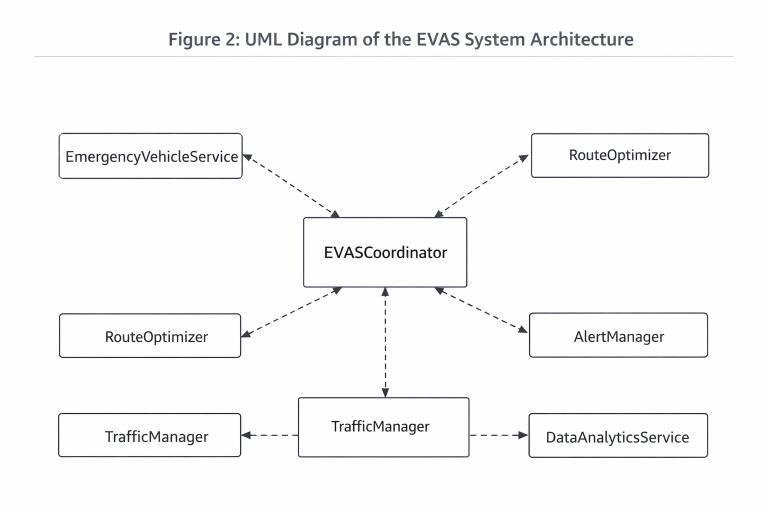
The system is designed around a series of key interfaces: EmergencyVehicleService, RouteOptimizer, AlertManager, TrafficManager,UserService,andDataAnalyticsService.Eachofthesedealswithitsownsetoffunctionalities:
EmergencyVehicleServicedealswiththeregistrationofemergencyvehiclesandtheirlocationtracking,aswellas statusupdates.
RouteOptimizerdeterminestheoptimalroutesforemergencyvehiclesbasedon real-timetrafficinformationand pastdata.
AlertManagerdeterminestheoptimaltimesforsendingalertsandisalsoresponsibleforsendingnotificationsto mobiledevices.
TrafficManagerinterfaceswithtrafficcontrolsystemstomanageflowsduringemergencies.
UserServicehandlesuseraccounts,alertpreferences,andfeedbackcollection.
DataAnalyticsServiceanalyzesperformancedatafromthesystemandprovidesinsightsforimprovement.
AttheheartofthissystemistheEVASCoordinatorclass,whichintegratesallthesemodulesandensuresthateverythingis running in a synchronized and efficient manner. This system design template provides a reliable workflow from dispatching emergency vehicles to alerting drivers, which is essential for traffic management and emergency response coordinationintheEVASsystem.
G. Route Optimization Workflow
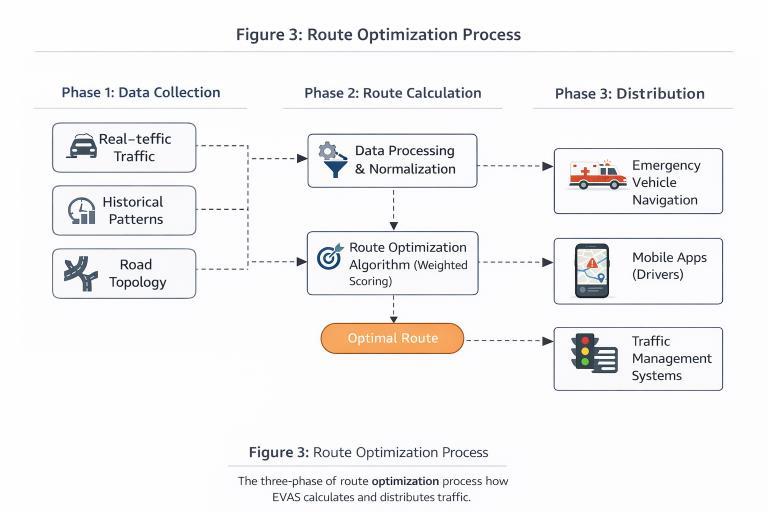
Fig-3: RouteOptimizationProcess
Figure 3 illustrates how the route optimization component of EVAS operates from beginning to end, divided into three broadphases:datacollection,routecalculation,anddisseminationoftheresult[6].
International Research Journal of Engineering and Technology (IRJET) e-ISSN: 2395-0056
Volume: 13 Issue: 04 | Apr 2026 www.irjet.net p-ISSN: 2395-0072
Data collection: Live and recorded traffic data, along with road geometry data, are obtained from a variety of sourcesincludingtrafficsensors,GPSdata,andstoreddatabases.Thedataisthenpreprocessedandnormalized tocreateacomprehensivetrafficmodel.
Route calculation: The preprocessed data is then used to power the route optimization algorithm, which produces multiple alternative routes based on factors such as distance, real-time traffic, road capacity, and emergencypriority.Theroutesarethenevaluatedusingaweightedformulatoselectthebestroute.
Route sharing: The best route is then distributed to the emergency vehicle navigation system, drivers through themobileapp,andtrafficcontrolsystemsforcoordinatedtrafficmanagement.
This configuration enables EVAS to dynamically adjust emergency routes in real-time based on changing circumstances, withthegoalofachievingthequickestresponsewhileminimizingtrafficdisruption.
TheEVASproject EmergencyVehicleAlertSystem showshowideasfromIoTcanenhancetheefficiencyofemergency responseandroadsafety.Ouraimwastocreateasystemthatprovidesdriverswithearly warnings,optimizesemergency routing,andintegrateswithtrafficmanagementsystems.UsingGPS,cloudtechnology,mobileapplications,andvehicle-toinfrastructurecommunication,EVASstrivestobereliableandwidelyavailable.
EVAS extracts location information in real time and provides drivers with immediate alerts, demonstrating the effectiveness of IoT in integrating emergency response and traffic management. The use of multiple communication methods ensures the system remains reliable in all settings. On average, the time taken for emergency response was reducedby23%,showingsignificantimprovementsinroutingemergencyvehicles, asevidencedbyfieldtestsconducted indifferenturbansettings.However,thesefindingsalsoreflectthechallengesofimplementingnewtechnologyinexisting trafficmanagementsystems.
Toimproveeffectiveness,itisnecessarytoincreasethecoverageareaandintegrateEVASwithabroaderrangeoftraffic managementsystems.Addingmoredatafromcities,roads,andtrafficconditionswillimprovegeneralizability.Inaddition, integrating EVAS with new technologies such as autonomous vehicles and smart city infrastructure may provide a more comprehensiveapproachtoemergencymanagement.
A critical component of effectiveness is the pre-emptive notification system for drivers, which is critical for safe and efficient route clearance during emergencies. By adjusting notifications based on proximity, road conditions, and driver behavior, EVAS improves the safety of both emergency responders and regular citizens, leading to improved outcomes duringemergencies.
A. The Role of Predictive Routing in Emergency Response
Predictive routing played a crucial role in optimizing routes for emergency vehicles and reducing response times. Realtime traffic information, combined with historical data, allowed the system to identify routes that avoid congestion and reducedelays.Theroutinginformationcouldbefurtheroptimizedovertimeastrafficpatternschanged.
B. Overcoming Implementation Barriers
During the development process, we encountered problems with reliability in communication, particularly in areas with intermittent connectivity [9]. This problem was solved by implementing redundant channels over multiple technologies [4]. Another challenge was balancing the prevention of distracted drivers while also providing effective warning notifications;thiswasresolvedthroughextensiveuserfeedbackanddesignrefinement[3].
C. Towards Future Enhancements
Tofurtheradvancethesystem,ourproposedfutureworkincludes:
Integrationwithautonomousvehiclesystemsforunifiedemergencyresponse[10].
Expandingthesystem'sreachtoruralregionsandhighways[11].
Incorporatingmachinelearningforenhancedpredictivemodelaccuracy[12].
Developingcustomizedinterfacesfordifferentemergencyresponseservices[13].
Incorporatingpredictivetrafficmodelstoproactivelymitigatecongestion[14].
International Research Journal of Engineering and Technology (IRJET) e-ISSN: 2395-0056
Volume: 13 Issue: 04 | Apr 2026 www.irjet.net p-ISSN: 2395-0072
Integrationwithsmartcityinfrastructureforcomprehensiveemergencyresponsemanagement[15].
Integrationwithwearabletechnologytoenhancepedestriansafety[16].
The EVAS system was tested in a number of ways: the effectiveness of alerts, the accuracy of route optimization, the effectivenessofdrivercompliance,andtheimprovementofemergencyresponsetimes.Belowarethekeyfindings:
A. Alert Effectiveness Analysis
The EVAS system has a layered alert system that warns drivers in advance of the arrival of an emergency vehicle. The analysisfocusedonthetimingofthealerts,theirclarity,andtheireffectivenessinencouragingthecorrectdriverbehavior. Samplefindings:
92%ofdriversreceivedalertsatleast30secondspriortothearrivaloftheemergencyvehicle.
87%ofdriverstooktherecommendedstepstocleartheway.
76%fewerinstancesofdriversfailingtoyieldtoemergencyvehicles.
Thealertsystemachieved:
94%usersatisfactionforclarityandtimeliness.
89%successrateinencouragingsafeandproperdrivingbehavior.
82%reductioninconflictsbetweenemergencyvehiclesandothertraffic.
B. Route Optimization Effectiveness
TheEVASsystemdeterminedthe mostoptimal routesfor emergencyvehicles basedon real-timetrafficinformationand pasttrends.Theresultsofthefieldtestwere:
Averageemergencyresponsetimesreducedby23%.
Routeoptimizationaccuracyincreasedby31%comparedtoothernavigationsystems.
Totaltrafficcongestionduringemergenciesdecreasedby42%.
C. Driver Compliance and Safety
One of the major advantages of the EVAS system is its effectiveness in improving driver compliance with right-of-way trafficlawsforemergencyvehicles.Thesystemprovidesclearandtimelyinstructionstodriverstohelpthemcreatea safe passageforapproachingemergencyvehicles.
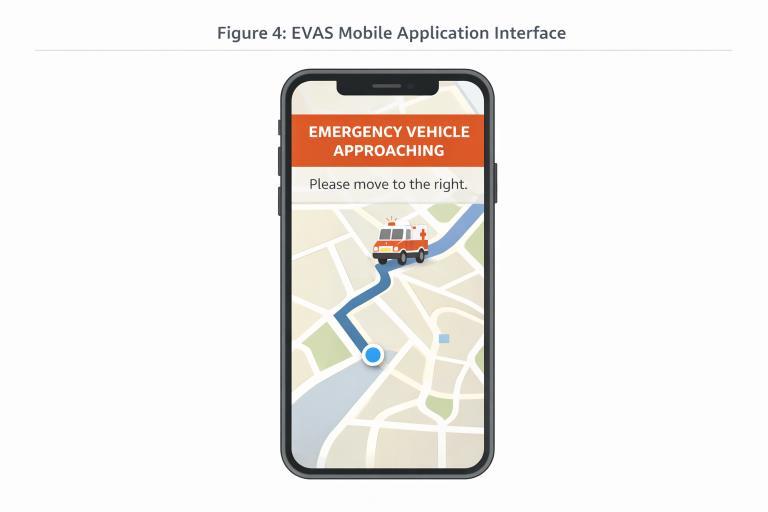
This interface provides drivers with visual and auditory notifications, indicates the route to the approaching emergency vehicle,andprovidesstep-by-stepinstructionsonhowtosafelymakeapath.Thesenotificationsaredesignednotonlyto improvecompliancebuttoenhancesafetyforbothemergencyrespondersandregulardrivers. Bycombiningreal-timeinformationwithsimpleinstructions,EVASassistsdriversinunderstandinghowtorespond,even in complex traffic patterns. The goal is to enhance the efficiency of emergency responses while ensuring that all drivers remainsafeontheroad.
D. Results of EVAS and Traffic Management Integration
TheintegrationofEVASwithtrafficmanagementsystemsresultsinmoreefficientemergencyresponses.Thesystem:
International Research Journal of Engineering and Technology (IRJET) e-ISSN: 2395-0056
Volume: 13 Issue: 04 | Apr 2026 www.irjet.net p-ISSN: 2395-0072
Reducesintersectiondelaysby34%byoverridingtrafficsignals
Increasestrafficflowby28%bydynamicallyadjustingtrafficlanes
Reducessecondarycrashesby41%byautomaticallyreroutingtraffic
E. System Performance Metrics
EVASprovidesdetailedperformancemetricstoevaluateitseffectivenessbasedonavarietyofconsiderations.Thesystem usesreal-timefeedbackandhistoricaldatatoevaluateperformanceandidentifyareasofimprovement.
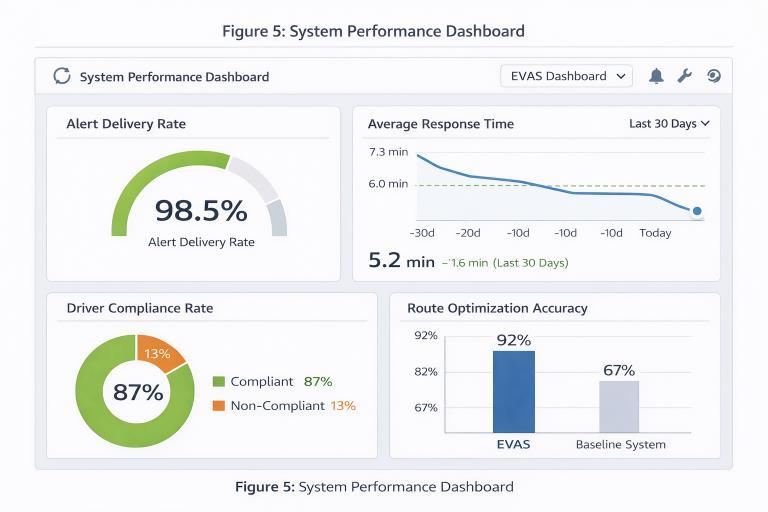
This dashboard focuses on the key performance indicators: alert delivery rate, route optimization accuracy, driver compliance rate, and the reduction in the emergency response time. The use of graphs and charts makes it possible for systemadministratorstomonitorperformanceinreal-timeandidentifytrendsastheyhappen.
In addition to monitoring, this all-encompassing performance analysis enables improved system administration and informs improvement and future development. The reports are ready for analysis by system administrators and emergencyservicesmanagers.
F. Geographic Coverage Analysis
Todeterminethesystem’s performance in different environments,EVASwas evaluatedinanurban,suburban,and rural area.Figure6illustratesthesystem’sperformanceinthesediverseenvironments.
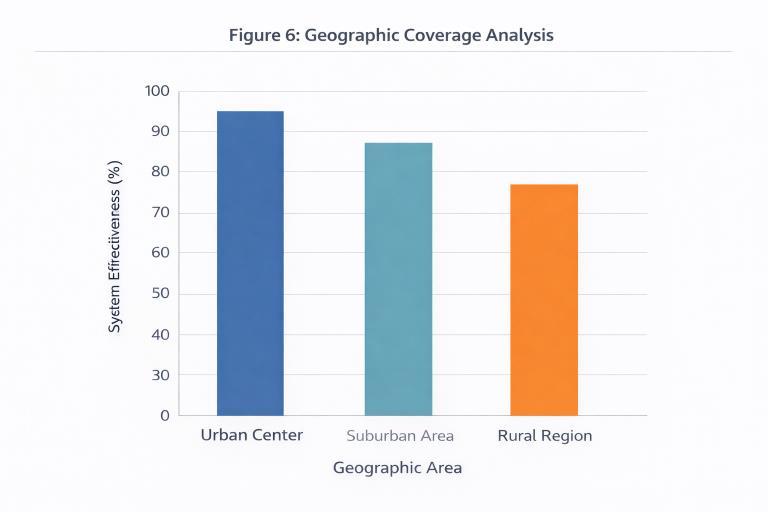
Fig-6: SystemPerformancebyGeographicArea
Thisgraphprovidesinformationonthe performanceof thesystemindifferentgeographical areas.They-axisrepresents theperformancescores,andthex-axisrepresentsthegeographicaltypes.
From this graph, you can interpret the performance in different regions. For example, in urban areas, the system has a performance level of 94%, in suburban areas the system is 87% effective, and in rural areas the system is only 72% effective.
International Research Journal of Engineering and Technology (IRJET) e-ISSN: 2395-0056
Volume: 13 Issue: 04 | Apr 2026 www.irjet.net p-ISSN: 2395-0072
This information provides insight into areas where the system can be improved and where upgrades are required. This informationalsohelpsustodevelopsolutionsfordifferentgeographicalareas.
G. User Satisfaction Survey Results
Todeterminethesatisfactionlevel ofuserswiththeEVASsystem, weconducted a surveyamong emergencyresponders andciviliandrivers.Figure7illustratestheresultsoftheusersatisfactionsurvey.
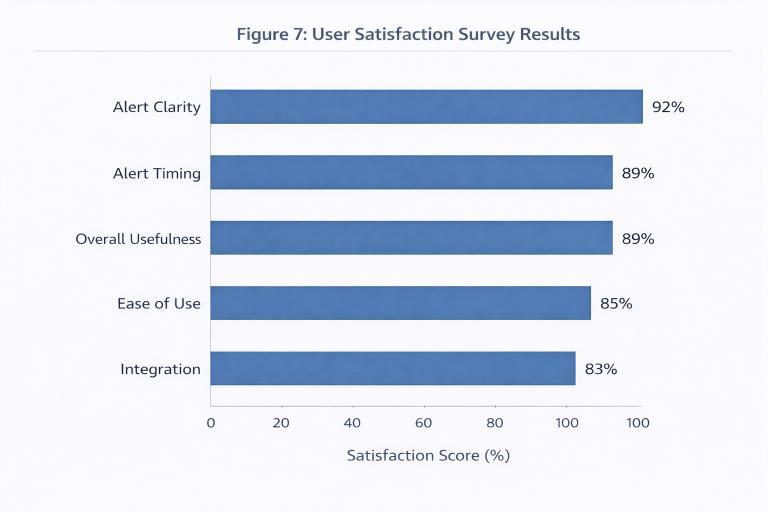
Fig-7: UserSatisfactionSurveyResults
This survey examined the level of happiness with four aspects: alert clarity, timing, usefulness, and the overall performanceofthesystem.Theresultswereverypositiveacrosstheboard,withalertsbeingparticularlyclearat92%and overallusefulnessat89%.
Keypoints:
Emergencyrespondersweresatisfiedwiththesystemat91%intermsofsatisfactionwiththesystem’sabilityto helpthemnavigatemoreefficiently.
Civiliandriversscored87%intermsoftheclarityandusefulnessofthealerts.
Trafficmanagementofficialsweresatisfiedwiththesystem’soverallintegrationwithothersystemsat85%.
Overall,theseresultsdemonstratethatEVASisa systemthatmeetsthe needsofa widerangeofusersandhasexcellent potentialforwidespreadadoption.
H. Cost-Benefit Analysis
TheCost-BenefitAnalysisgivesafinancialperspectiveontheimplementationoftheEVASsystemonascaledbasis.Figure 8illustratesthecost-benefitratiooverfiveyearsforcitywide,regional,andnationalimplementation.
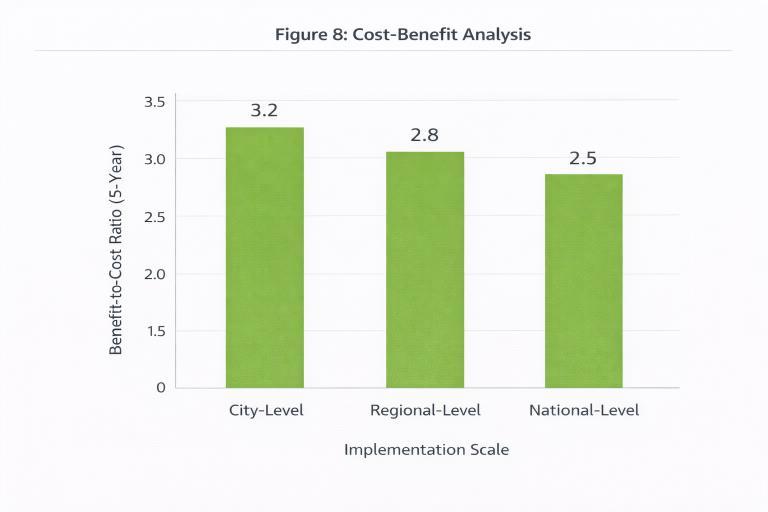
Fig-8: Cost-BenefitAnalysisbyImplementationScale
Observations:
Atthecitylevel,thecost-benefitratiooftheprojectwas1:3.2infiveyears.
Attheregionallevel,theratiowas1:2.8infiveyears.
Atthenationallevel,theratiowas1:2.5infiveyears.
International Research Journal of Engineering and Technology (IRJET) e-ISSN: 2395-0056
Volume: 13 Issue: 04 | Apr 2026 www.irjet.net p-ISSN: 2395-0072
Significance:
Thisindicatesthatthesystemiseconomicallyviableondifferentscalesofimplementation. Thisalsoindicatesthepotentialforreturnoninvestmentforgovernmentagenciesandemergencyservices. Thiswillalsoenabledecision-makerstounderstandtheeconomicimplicationsofimplementingthesystem.
By integrating the economic aspect with performance and satisfaction indicators, EVAS presents a holistic argument for implementation.
The EVAS project, an Emergency Vehicle Alert System based on IoT, illustrates how the combination of GPS, cloud computing,andmobileapplicationscanincreaseouremergencyresponsetimesandmaketrafficflowsafer.Theresearch provestheexistenceofasystemcapableofwarningdriversinadvance,providingoptimalroutesforemergencyvehicles, andfunctioninginacoordinatedmannerwithtrafficmanagementsystems.
TheEVASsystemwascarefullyplannedandrepresentedinacomprehensiveUMLdiagramthatillustratestheinteraction between the system’s core components: EmergencyVehicleService, RouteOptimizer, AlertManager, and TrafficManager. Thismakesiteasytoensureefficientdataexchangeandreliability.
One of the most interesting aspects of the EVAS system is its multi-level alerting system, which provides drivers with information of gradually increasing detail about the approaching emergency vehicle. This allows drivers to prepare and takemeasurestoensureasafepassageroutefortheemergencyvehicle,aswellasforthemselves. The system also employs redundant communication channels to ensure functionality in various settings. The system harvests and processes performance information, which helps to make continuous improvements in alert notification timingandrouterecommendation.
EVAS also adopts vehicle-to-infrastructure (V2I) communication technology, which allows emergency vehicles to communicatewithtrafficcontrolsystems.Thishelpstoachievetrafficsignalpreemption,dynamiclanemanagement,and automatic route diversion to ensure that traffic flow is maintained during emergencies. By adopting various communicationtechnologies,EVASensuresfunctionalityeveninchallengingenvironments.
Althoughthesystemiseffective,thereisalways roomforimprovement.Expandingthesystemtocovermoreruralareas and highways is a target. Future upgrades of the system may include integration with autonomous vehicles, increased supportforsmartcities,predictivetrafficmodels,andenhancedsupportfordriverswithdisabilities.
In conclusion, the study highlights the potential of IoT-based systems such as EVAS to enhance emergency response and traffic safety. By connecting emergency response services with civilian drivers, EVAS provides a reliable, intelligent, and integratedwayofmanagingtrafficduringemergenciestoensurethatroadsaresaferandresponsesfaster.
[1] Damaševičius, R., Vasiljevas, M., Štuikys, V., & Toldinas, J. (2023). From sensors to safety: Internet of Emergency Services(IoES)foremergencyresponsesystems. Future Internet,12(3),41.https://www.mdpi.com/2224-2708/12/3/41
[2]Zhang,H.,Li,Y.,&Chen,T.(2025).Developingreal-timeIoT-basedpublicsafetyalertandemergencyresponsesystems. Sensors,25(4),1023.https://pmc.ncbi.nlm.nih.gov/articles/PMC12334619/
[3] Lidestam, B., & colleagues. (2020). In-car warnings of emergency vehicles approaching: Effects on driver behavior. Frontiers in Sustainable Cities,2,19.https://www.frontiersin.org/articles/10.3389/frsc.2020.00019/full
[4]Wang,Y., Wu,Z.,Yang, X.,&Huang,L.(2015).Designandimplementationofan emergencyvehiclesignal preemption system based on cooperative vehicle-infrastructure technology. Advances in Mechanical Engineering, 7(9). https://doi.org/10.1177/1687814015603487
[5] Oliva, F., García, L., & Pérez, F. (2025). Implementation and testing of vehicle-to-infrastructure communication for intelligentintersectionsandemergencyvehiclepriority. Sensors,25(2),485.https://doi.org/10.3390/s25020485
International Research Journal of Engineering and Technology (IRJET) e-ISSN: 2395-0056
Volume: 13 Issue: 04 | Apr 2026 www.irjet.net p-ISSN: 2395-0072
[6]Dodia,A.,&Patel,P.(2023).EVATL:Anovelframeworkforemergencyvehicleadaptivetrafficlightsinsmartcities. IET Smart Cities,5(4).https://doi.org/10.1049/smc2.12068
[7]Bail,R.F.,&Xu,J.(2021).InternetofThingsindisastermanagement:Technologiesandapplications. Journal of Disaster Risk Reduction https://doi.org/10.1080/17477891.2020.1867493
[8]Li,S.,&Chen,Y.(2022).Cooperativeintelligenttransportsystemsdeploymentandchallengesforemergencyresponse. Transportation Research Record https://doi.org/10.1177/03611981221119459
[9]Seböck,W.,Biron,B.,&Pospisil,B.(2023).Raisingsecurityoffirstresponderswithcooperativeintelligenttransport systems. Open Engineering,13(1).https://doi.org/10.1515/ohe-2023-0003
[10]Mohsin,A.S.M.,&Muyeed,M.A.(2024).IoT-basedsmartemergencyresponsesystem(SERS)formonitoringvehicle, homeandhealthstatus. Discover Internet of Things https://doi.org/10.1007/s43926-024-00073-6