
International Research Journal of Engineering and Technology (IRJET) e-ISSN: 2395-0056
Volume: 13 Issue: 05 | May 2026 www.irjet.net p-ISSN: 2395-0072
International Research Journal of Engineering and Technology (IRJET) e-ISSN: 2395-0056
Volume: 13 Issue: 05 | May 2026 www.irjet.net p-ISSN: 2395-0072
Aya Jamal Mahmoud 1 , Hasan Jasim Mohammed 2
1Master Student, Civil Engineering Department, Collage of Engineering, Tikrit University, Tikrit, Iraq
2Professor, Civil Engineering Department, Collage of Engineering, Tikrit University, Tikrit, Iraq
Abstract - Improving the quality and functionality of the recycled materials is a major factor in the potential replacement of natural aggregates (NA) with recycled concrete aggregates (RCA). Recycled aggregates typically contain adhered mortar, micro-cracks, and impurities, which negatively affect their physical and mechanical properties. This experimental study investigates four different surface treatment methods aimed to enhance the characteristics of coarserecycledaggregates:cementslurrycoating,silicafume coating, soaking in 0.1 M hydrochloric acid (HCl), and boiling RCA in hot water at 100° C. The fundamental properties of RCA before and after each treatment were evaluated, along with their influence on concrete performance. The results demonstrate that the SF treatment method reduces the mechanicalcharacteristicsofconcretebyapproximately6.7% and 7.3%, respectively, for fresh and hardened densities. The concrete'scompressivestrengthwassignificantlydecreasedby up to 51.6% through the HCL treatment method. The concrete's tensile strength and modulus of rupture were lowered by up to 42.5% and 53%, respectively, using the boiling treatment method. When compared to other treatments,theboilingmethodproducesagoodresultforthe concrete's compressive strength.
Key Words: Boiling, Coarse aggregate, Mechanical properties, Recycled concrete aggregate, RCA, Treatment.
The increasing demand for concrete, driven by rapid urbanization,industrialization,andpopulationgrowth,has ledtoasignificantdepletionofnaturalaggregatessuchas gravel and sand [1]. This has sparked a pressing need for sustainable alternatives to mitigate the environmental impactofconcreteproduction.Recycledconcreteaggregate (RCA)isconsideredacompleteanswerthatcansuccessfully manage concrete waste and help reduce the pressure on normalaggregatesupplies[2].
Whenthedemolitionofoldstructures,theremovedconcrete is frequently considered unusable and disposed of as demolitionwaste.Byassemblingtherecycledconcreteand breakingitup,RCAiscreated.
ConcretecontainingRCAcanbeemployedinbothstructural and non-structural applications. One of the main aims to utilizeRCAinconcreteistomakeconstructionmoregreen
andenvironmentallyfriendlywhichdecreasesthequantity of non-renewable normal resources produced. The environmentbenefitsgreatlyfromthis.Additionally,ituses lessareaforlandfills,whichlowersairandwaterpolluting levels.
Many researches have investigated the effects of incorporating RCA into concrete, revealing that RCA's properties are influenced by the source of the original concrete.Generally,comparedwithnaturalcoarseaggregate RCAexhibitsinferiorquality,duetosurfacecracks,irregular surface,extraedgesandcorners,alesserapparentdensity, higher water absorption [3], and numerous interfacial transition zones (ITZs), which may negatively affect the mechanical performance of concrete, workability and durability [4]. Therefore, enhancement of RCA quality is important. Currently, there are two main pathways for producing high-quality RCA [5, 6]. Firstly, removing the adhered mortar from the RCA surface, and secondly, strengtheningtheadheredmortar.
This study aims to explore the mechanical properties of concrete incorporating treated RCA with different techniques. For this purpose, four surface treatment techniques (three using before and one suggested here) wereemployedtoimprovethefeatureofrecycledconcrete aggregates, which is (cement slurry coating, silica fume slurrycoating,soakingRCAinHCLacid,boilingRCAinhot water (100 °C), that suggested method. Each treatment methodwasevaluatedthroughfour replacementratios of RCA(0%,25%,50%,and100%)insteadofnaturalaggregate (NA). The RCA properties investigated in this study were density,compressivestrength,splittingtensilestrength,and modulusofrupture.
Cement: ordinary Portland cement that meets the requirementsofASTMC150[7].Thephysicalpropertiesof cementweredescribedinTable1.
Sand:Riversandisutilizedinallconcretemixes.Thesand propertiesresultsareinagreementwithASTMC778[8],as showninTable2.
Naturalcoarseaggregate(NCA):Themostcommoncoarse aggregateusedisgravel.Thecoarseaggregateparameters were tested according to ASTM, C33M [9]. The sieving analysisofcoarseaggregateareshowninTable3.
Volume: 13 Issue: 05 | May 2026 www.irjet.net
Physical Properties
Specificsurfacearea (Blaine method) (m2/kg)
Settingtime(vicate apparatus)
Initialsetting:
Finalsetting: 3hrs. 15min 5hrs. 35min >45min <6.25hrs.
Table -2: THERESULTSOFTHESANDGRADINGTEST Sieve
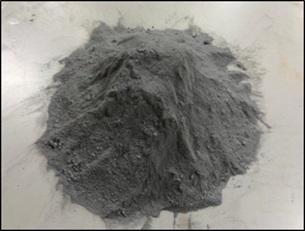
Table -3: CoarseAggregateSievingTest
Recycledconcreteaggregate(RCA): CoarseRCAwastaken fromabuildingafterdemolitionandsubstitutedwithnatural aggregateatfourdifferentweightratios:0%,25%,50%,and 100%.Recycledconcreteaggregates(RCA)haveaparticle size of 5-12 mm. The RCA sieve analysis met the coarse aggregate grading following testing of the prepared RCA sizes.TheresultsofthesievingtestareshowninTable4.
Table -4: SIEVINGOFRCA
Water: tap water was used in the preparation of concrete mixtures.
Silica fume (SF): It is an ultrafine pozzolanic material resulting from the production of silicon and ferrosilicon alloys,alsoknownasmicrosilica.Itwasusedtoenhancethe propertiesofconcrete.The manufacturerhasadoptedthe specificationASTMC1240[10].ThesortofSFthatisusedis depictedinFig.1.
Hydrochloric acid (HCl): Hydrochloric acid is an aqueous solution of hydrogen chloride (HCL), occasionally named muriaticacidorsaltspirits.Itisclassifiedasastrongacid andacolourlesssolutioncharacterizedbyanintensesmell. ThepropertiesareshowninTable5.
Table -5: PropertiesofHCL
Product Name Hydrochloric Acid
Grade LR
Vapordensity 1.3(vsair)
Vapor
Psi Productline
g/cm3
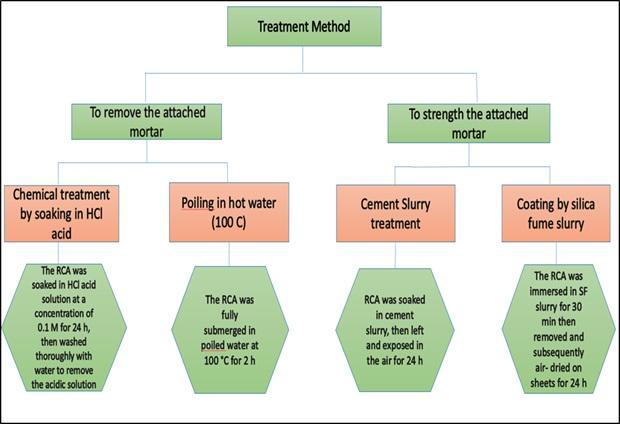
Surface treatment for recycled concrete aggregate Fig. 2 presentthetreatmentmethodsoftheRCA.
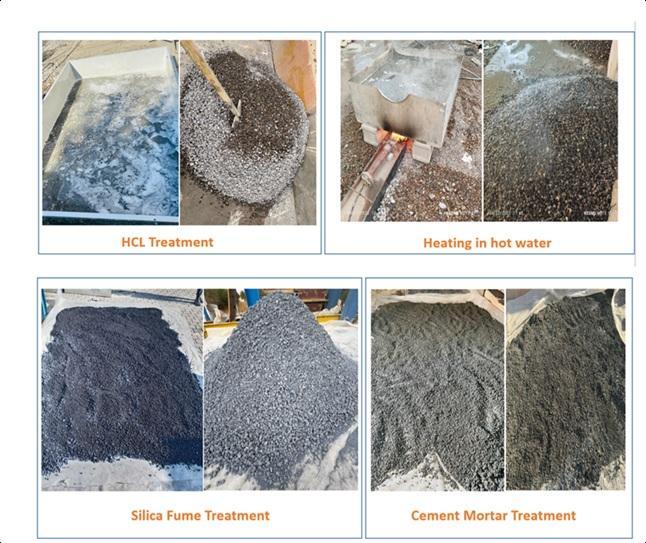
Cement slurry treatment of RCA: In this method, the RCA wassoakedincementslurry,thenliftedandexposedtoair for24hours(seeFig.3).
Silica fume-treated: The aggregates were submerged in a slurryofsilicafume(for30min),thentakenoutandplaced onsheetsforoneday(24h)(seeFig.3).
Chemical treatment of RCA using HCL acid: The RCA was treated using hydrochloric acid solution with a concentrationof0.1M.Forthispurpose,336kgofuntreated RCAwasusedwith160Lofwaterand1.5Lofacid.Firstly, theacidwasaddedtothewatercarefully.Followingthat,the untreatedRCAwassoakedinthesolutionfor24hatroom temperature(22°Cto26°C),andthenwashedthoroughly withwatertoremovetheacidicsolution,andleftinthesun for one day to reach the SSD condition. The treatment
International Research Journal of Engineering and Technology (IRJET) e-ISSN: 2395-0056
Volume: 13 Issue: 05 | May 2026 www.irjet.net p-ISSN: 2395-0072
methodology used in this method followed the treatment methodologyproposedbyTametal.(seeFig.3).
Boiling in hot water: RCA was treated by boiling it in hot watertoweakenandremovetheoldmortaradheringtoits surface.TheRCAwasplacedinacontainerofcleanwater, heated to the boiling point (approximately 100 °C), and boiledfor60minutes.Afterthat,theRCAwasremovedfrom the hot water, then left to cool and achieve the saturated surfacedrycondition(SSD)(seeFig.3).
4. MIXTURE PROPORTIONS AND CONCRETE SPECIMENS PREPARATION
ThequantitiesofthemixesarepresentedinTable6.Ascan beseen,thetreatedrecycledconcreteaggregate(TRCA)was used in the mixtures instead of the weight of coarse aggregate at a replacement ratio (0%, 25%, 50%, and 100%).Thenormalconcrete(NCorcontrolspecimen)was prepared according to ACI 211-22 [11], with a concrete targetstrengthof35MPaattheageof28days.andw/cratio was0.39.
Table -6: QUANTITYANDPROPORTIONSOFTHECONCRETE MIXTURES
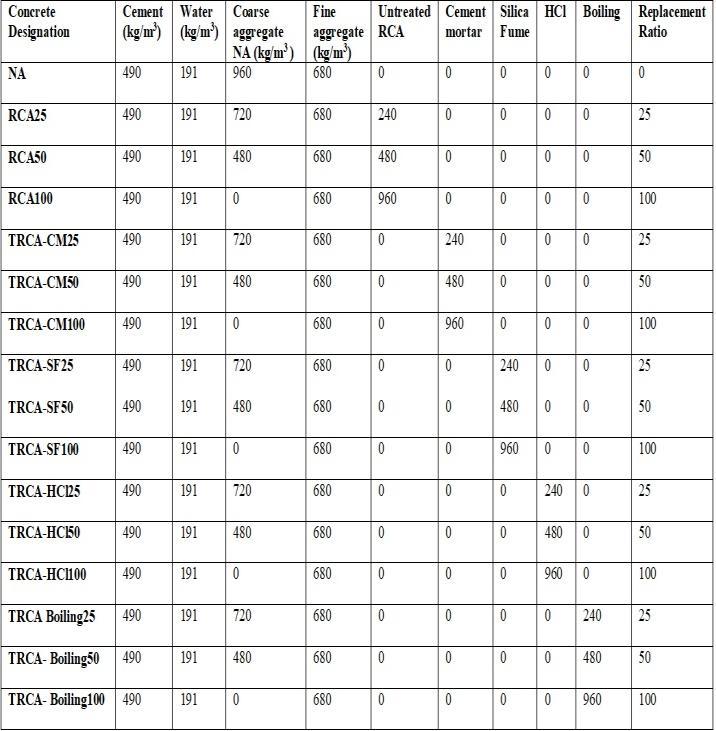
The procedures of casting, mixing, and combining were carried out. Cement, water, natural fine and coarse aggregates,andTRCAwerefirstweighedwithanaccuracyof 2.0 grams. The concrete ingredients were mixed using an electric mixer with a 0.3 m3 capacity. To prepare normal concrete,gravel,andsandwereaddedtotheelectricmixer, followed by 1/3 of the water, while the mixture was continuouslymixedfor1minutetoensurethesurfacesof the CA were fully saturated. Then the cement was added after3minutesofmixing,followedbytheslowadditionof the remaining water during the mixing operation until a homogeneous mixture is obtained. The components of treated recycled concrete aggregate mixtures were mixed usingthesameprocedure,substituting25%,50%,and100% ofthetotalweightofcoarseaggregate.
Freshdensity:The testwasconductedaccordingtoASTM C29[12]tomeasurethe freshbulkdensityofallNC,RCA, andTRCAmixes.
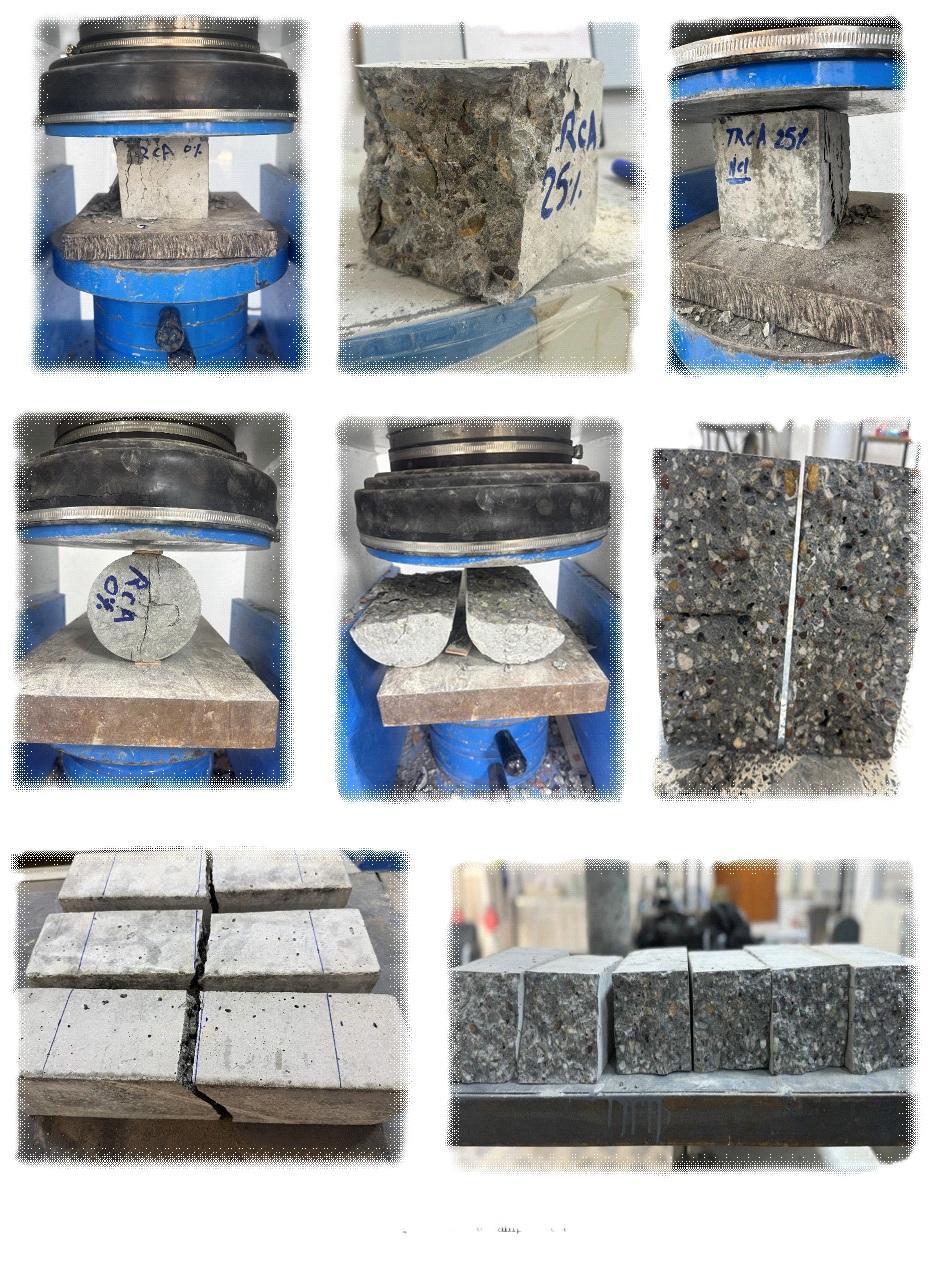
Density Test: In accordance with ASTMC138 [13], the concretedensitytestwascalculatedastheaveragedensity ofthreesamplesineverymixture.(seeFig.4).
6. MECHANICAL PROPERTIES
Compressivestrengthtest:Concretecubesofmeasurement 100 mm × 100 mm X 100 mm were cast for calculating compressive strength after 28 days, followed by the requirements of BS 1881 [14]. Compressive strength is calculatedbymeansofahydraulicmachinewithcapacityof 2000kN,andtherateofloadingwas3kN/sec.Foreachmix,
International Research Journal of Engineering and Technology (IRJET) e-ISSN: 2395-0056
Volume: 13 Issue: 05 | May 2026 www.irjet.net p-ISSN: 2395-0072
the average amount of compressive strength from three cubeswasdetermined.
Splittingtensilestrength:Anelectricmachinewithacapacity of2500kN and a loading rate of3 kN/sec isusedforthis indirect test to find the tensile strength of a cylindrical sample. Cylindrical concrete specimens were cast, having dimensionsof100mmindiameterand200mminheight. The test was performed after curing for 28 days, and in agreementwithASTMC496[15].Ineachmixture,themean valueofthreesampleswastaken.
ModulusofRuptureTest:Tofindtheconcrete'smodulusof rupture,prismspecimensmeasuring100x100x400mm wereproduced.Theexperimentwasimplementedundera three-point load after curing in water for 28 days, in agreement with ASTM C78 [16]. Three samples were employedforeachblendtocalculatetheaveragevalue.(see Fig.4)
7. RESULTS AND DISCUSSIONS
Table 7 demonstrations the results of the mechanical propertiesoftheNAandTRCAconcretes.
Table -7: ResultsoftheMechanicalPropertiesofthe ConcreteMixtures
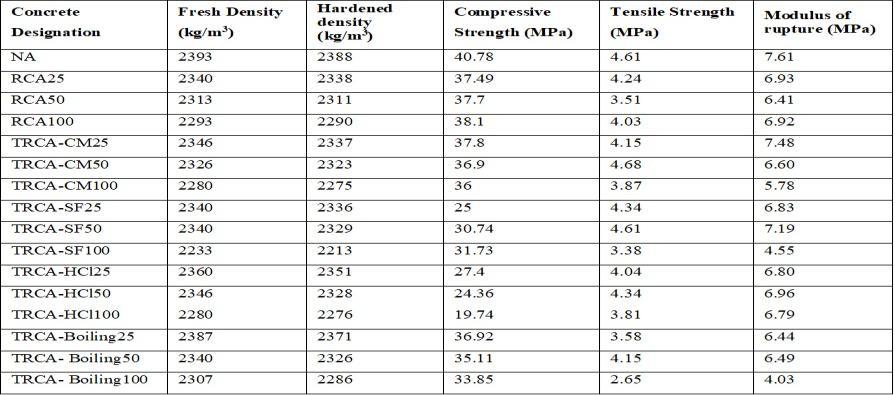
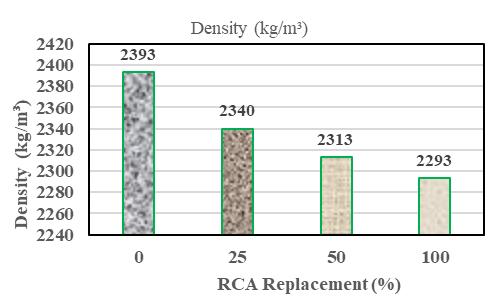
Figs.5-10presentthefreshdensityofthedifferentmethod of treatment the RCA concretes. Fig. 5 shows the fresh density vs RCA replacement ratio, the fresh density decreaseswhentheRCAincreasingupto4.2%(2293kg/m3) for RCA100 mixture. When RCA treated using cement mortar,silicafume,HCL,andboilingbywater,freshdensity also decreases up to 4.7%, 6.7%, 4.7%, and 3.6%, respectivelycomparewithNAmix,thisappearsintheFigs. 6-9.LessreductionisappearingintheSFtreatmentmethod, aspresentedinFig.10.Thisgoodresultforthesuggested method(boilingthewater).
International Research Journal of Engineering and Technology (IRJET) e-ISSN: 2395-0056
Volume: 13 Issue: 05 | May 2026 www.irjet.net p-ISSN: 2395-0072
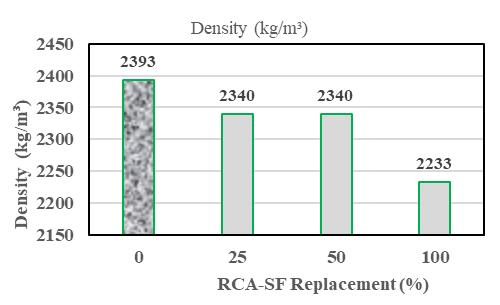
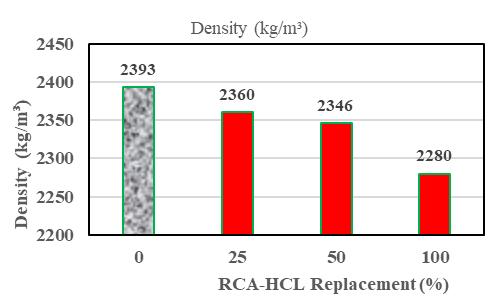
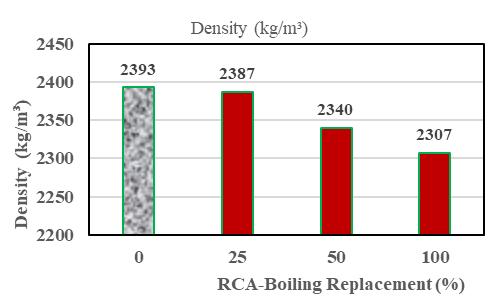
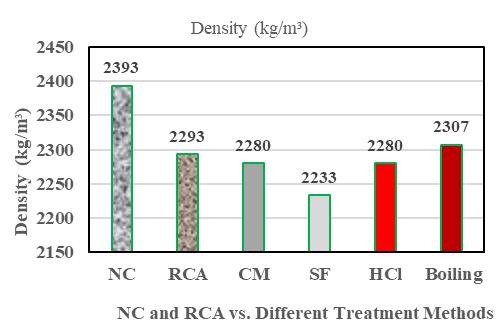
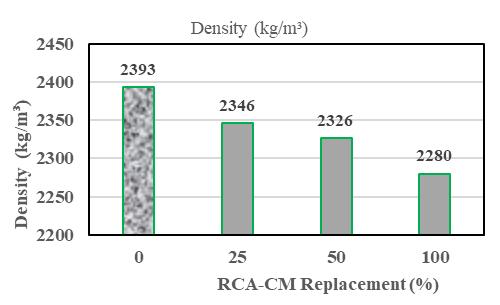
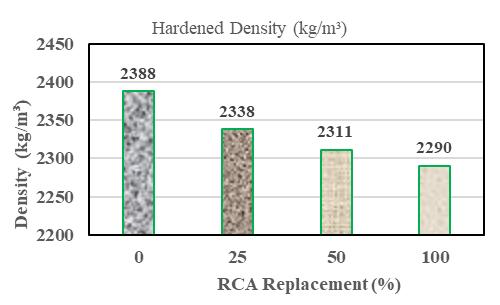
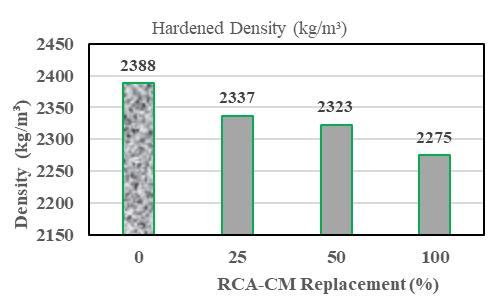
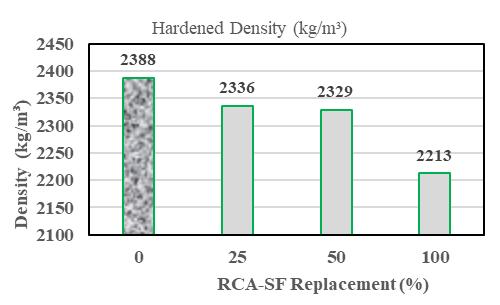
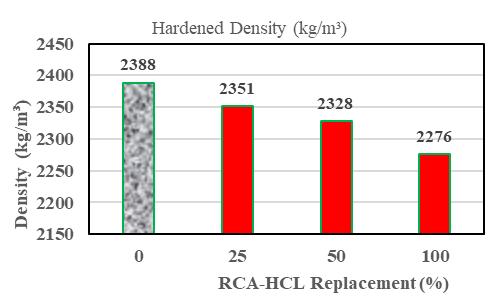
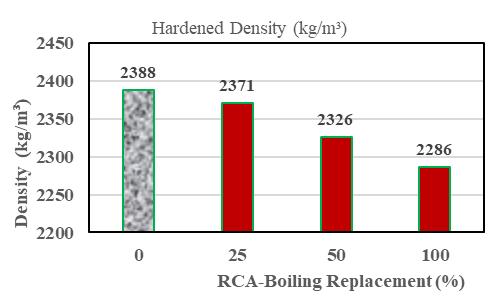
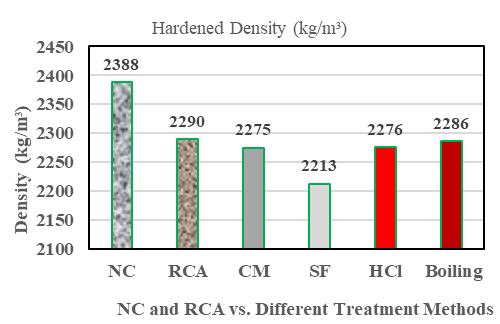
Same behaviour is appearing in the hardened density, as seeninFigs.11-16.Fig.11showsthehardeneddensityvs RCA replacement ratio, the hardened density decreases when the RCA increasing up to 4.1% (2290 kg/m3) for RCA100mixture.WhenRCAtreatedusingcementmortar, silicafume,HCL,andboilingbywater,hardeneddensityalso decreases up to 4.7%, 7.3%, 4.7%, and 4.3%, respectively comparewithNAmix,thisappearsintheFigs.12-15.Fewer decrease is appearing in the SF treatment method, as presented in Fig. 16. This good result for the proposed method(boilingthewater).
International Research Journal of Engineering and Technology (IRJET) e-ISSN: 2395-0056
Volume: 13 Issue: 05 | May 2026 www.irjet.net p-ISSN: 2395-0072
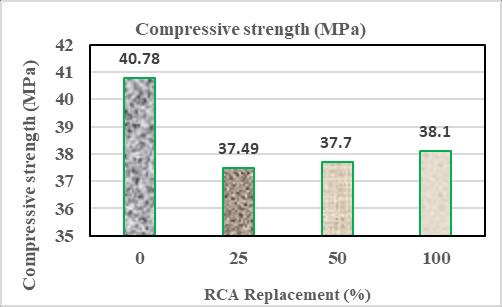
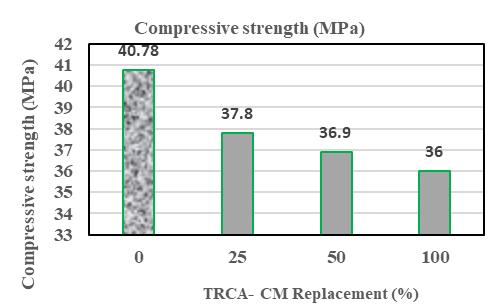
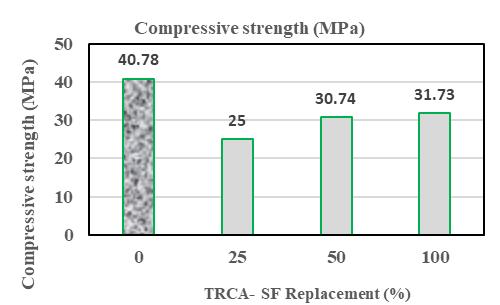
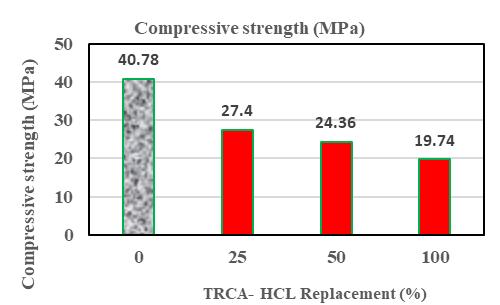
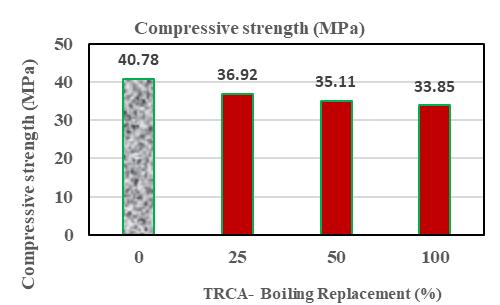
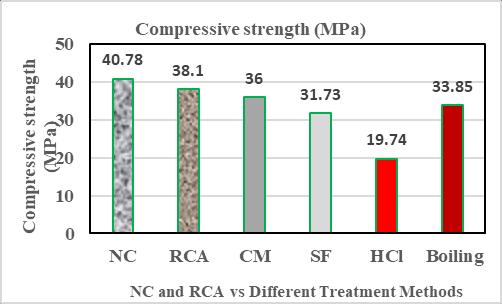
Figs. 17-22 present the compressive strength of the concreteswithdifferentoftreatmentmethods.HCLmethod gave the less value (reduction up to 51.6 %) of the compressivestrengthduetomaketheweakbondingforthe mixture than other methods. While the boiling of water methoddecreasesthecompressivestrengthupto17%,this resultgivesgoodindicationforthismethodcomparedtothe NCandothermethods.
2026, IRJET | Impact Factor value: 8.315 | ISO 9001:2008
International Research Journal of Engineering and Technology (IRJET) e-ISSN: 2395-0056
Volume: 13 Issue: 05 | May 2026 www.irjet.net p-ISSN: 2395-0072
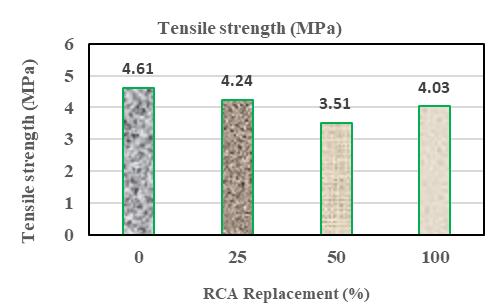
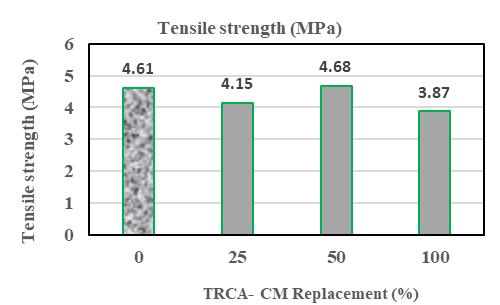
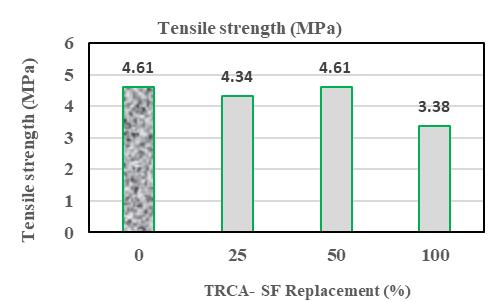
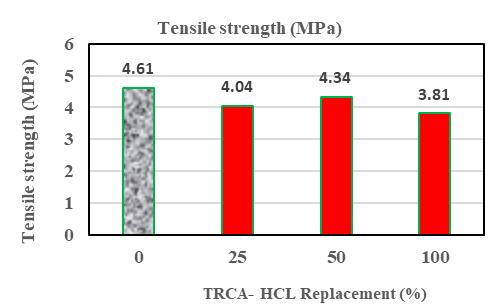
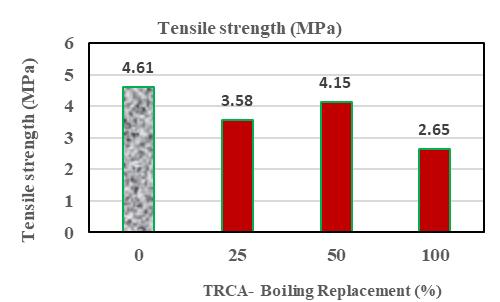
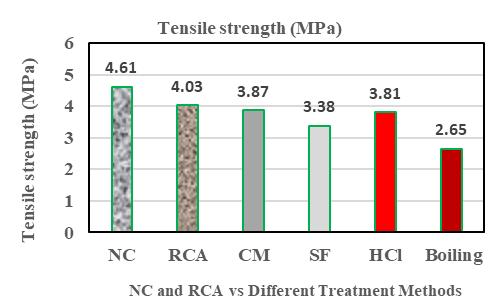
Figs.23-28presentthetensilestrengthoftheconcreteswith differentoftreatmentmethods.Boilingmethodgavetheless value(reductionupto42.5%)ofthetensilestrengthdueto maketheweakbondingforthemixturethanothermethods, asrevealinFig.28.
© 2026, IRJET | Impact Factor value: 8.315 | ISO 9001:2008 Certified Journal | Page7
International Research Journal of Engineering and Technology (IRJET) e-ISSN: 2395-0056
Volume: 13 Issue: 05 | May 2026 www.irjet.net p-ISSN: 2395-0072
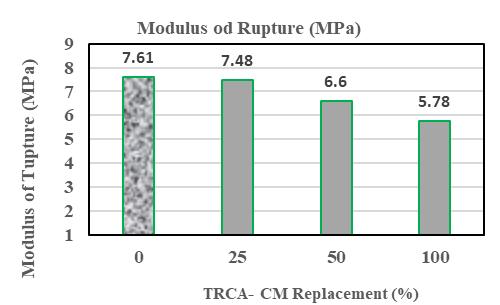
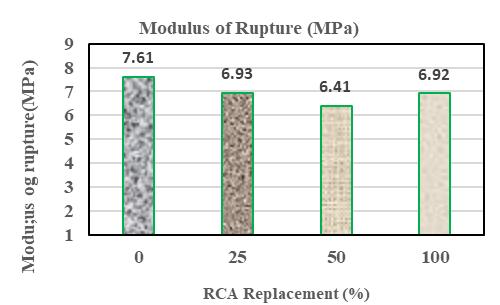
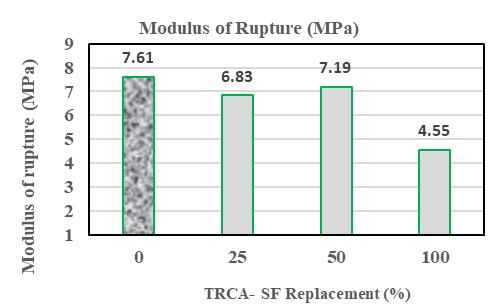
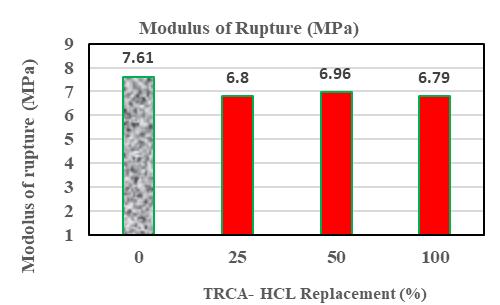
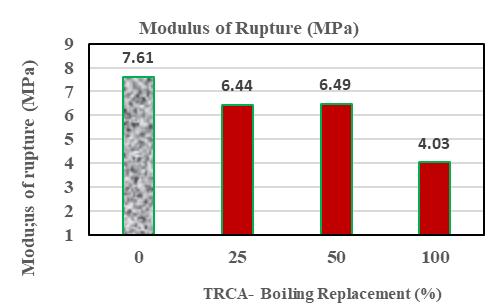
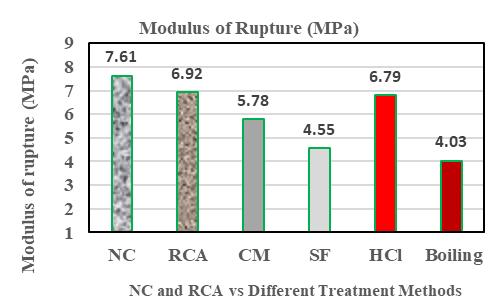
Figs.29-34presentthemodulusofruptureoftheconcretes with different of treatment methods.Boiling method gave the less value (decrease up to 53 %) of the modulus of ruptureduetomaketheweakbondingforthemixturethan othermethods,asshowedinFig.34.
International Research Journal of Engineering and Technology (IRJET) e-ISSN: 2395-0056
Volume: 13 Issue: 05 | May 2026 www.irjet.net p-ISSN: 2395-0072
8.
Themechanicalpropertiesofconcreteincorporatingtreated RCA with different methods are presented herein. Four surface treatment methods (three using before and one proposed here) were employed to improve the quality of RCA, which is (cement slurry coating, silica fume slurry coating,soakingRCAinHCLacid,boilingRCAinhotwater (100°C),thatproposedmethod.Eachtreatmentmethodwas evaluatedthroughfourreplacementratiosofRCA(0%,25%, 50%, and 100%) instead of natural aggregate (NA). As fellow,wecandrawseveralconclusions:-
1. Thefreshandhardeneddensitieswerereducedbyupto 6.7% and 7.3%, respectively, using the SF treatment method.
2. IncomparisontotheNC,theHCLtreatmentprocedure significantlyreducedtheconcrete'scompressivestrength byupto51.6%.
3. Theboilingmethodoftreatmentreducedtheconcrete's tensilestrengthandrupturemodulusbyupto42.5%and 53%,respectively.
4. Whencomparedtoothertreatmentmethods,theboiling technique yields a good result for the concrete's compressivestrength.
[1] A. Danish and M. A. Mosaberpanah “A review on recycled concrete aggregates (RCA) characteristics to promote RCA utilization in developing sustainable recycledaggregateconcrete(RAC)”EuropeanJournalof EnvironmentalandCivilEngineering,26(13),2022,pp. 6505–6539,doi:10.1080/19648189.2021.1946721.
[2] Feng,Z.,Zhao,Y.,Zeng,W.,Lu,Z.,andShah,S.P."Using microbial carbonate precipitation to improve the properties of recycled fine aggregate and mortar" ConstructionandBuildingMaterials,230,2020,116949. https://doi.org/10.1016/j.conbuildmat.2019.116949.
[3] A.Akbarnezhad,K.C.G.Ong,M.H.Zhang,C.T.Tam,and T. W. J. Foo, "Microwave-assisted beneficiation of recycledconcreteaggregates"ConstructionandBuilding Materials,25(8),2011,pp.3469–3479.
https://doi.org/10.1016/j.conbuildmat.2011.03.038
[4] L.EvangelistaandM.Guedes"Microstructuralstudies on recycled aggregate concrete" New Trends in EcoefficientandRecycledConcrete,2019,pp.425–451.
[5] K.Ouyang,C.Shi,H.Chu,H.Guo,B.Song,Y.Ding,Guan, X.,Zhu,J.,Zhang,H.,Wang,Y.,andZheng,J."Anoverview on the efficiency of differentpretreatment techniques for recycled concrete aggregate” Journal of Cleaner Production,263,2020,121264.
https://doi.org/10.1016/j.jclepro.2020.121264
[6] V.W.Y.Tam,M.Soomro,andA.C.J.Evangelista"Quality improvementofrecycledconcreteaggregatebyremoval of residual mortar: A comprehensive review of approaches adopted" Construction and Building Materials,288,2021,123066.
https://doi.org/10.1016/j.conbuildmat.2021.123066
[7] ASTMC150/C150M-19a "Standard Specification for PortlandCement"2019.
[8] ASTM, C778-17 "Standard Specification for Standard Sand"2017.
[9] ASTM, C33M-18 "standard specification forconcrete aggregates"2018.
[10]ASTMC1240-05"StandardSpecificationforSilicaFume UsedinCementitiousMixtures"2005.
[11]ACIPRC-211.1-22:"SelectingProportionsforNormalDensityandHighDensity-Concrete"2022.
[12]ASTMC29/C29M-17a"StandardTestMethodforBulk Density(“UnitWeight”)andVoidsinAggregate"2017.
[13]ASTMC138/C138M-17a"Standard Test Method for Density (Unit Weight), Yield, and Air Content (Gravimetric)ofConcrete"2017.
[14]BS 1881: Part 116 "Method for Determination of CompressiveStrengthofConcreteCubes"1983.
[15]ASTMC496/C496M-17 "Standard Test Method for Splitting Tensile Strength of Cylindrical Concrete Specimens"2017.
[16]ASTM C78-02 "Standard Test Method for Flexural Strength of Concrete (Using Simple Beam with ThirdPointLoading"2002.