
International Research Journal of Engineering and Technology (IRJET) e-ISSN: 2395-0056
Volume: 12 Issue: 03 | Mar 2025 www.irjet.net p-ISSN: 2395-0072
International Research Journal of Engineering and Technology (IRJET) e-ISSN: 2395-0056
Volume: 12 Issue: 03 | Mar 2025 www.irjet.net p-ISSN: 2395-0072
Shubhank Machhopuriya1*, Dr. J.K. Shrivastava2 , Dr. Lokendra Singh Thakur3
1M.Tech. Scholar, Department of Chemical Engineering, Ujjain Engineering College, Ujjain 2,3 Professor, Department of Chemical Engineering, Ujjain Engineering College, Ujjain
Abstract - The studyinvestigates the possibility of utilizingwasteteatogeneratebiocharandactivatedcarbonto remove methylenebluenumber (MBN) and iodine value (IV) from wastewater.Asaby-productofteaproduction,teawaste was transformed into activated carbon, and then the effectiveness of the activated carbon in removing dye was examined through batch studies. As a result of its porousstructure and large surfacearea, the results indicated thatteawaste-activatedcarbonhasahighadsorptioncapacity formethyleneblue. Itwasfoundthatthecontacttimeaffected the adsorption process. Without oxygen, tea waste samples were treated at a range of temperatures (400, 500, 600, and activated carbon), and the resulting changes in adsorption characteristics were investigated later. Consequently, dye removal systems that take advantage of adsorption are designed to be cost-effective. During the experiment, biochar and activated charcoal were utilized for the purpose of adsorbing methyleneblue dye and determining the iodine value. The effluent and wastewater significantly reduced methylene blue dye and iodine value. Within the scope of our experimental inquiry, it was demonstrated that activated charcoal could remove significantly higher amounts of methylene blue dye and iodine value. There is a correlation between the duration of the response (60, 120, and 180 minutes) and the amount of methylene blue that is absorbed. After180 minutes,atea waste-activatedsample was foundto have achieved the highest possible percentage of methylene blue dye removal, which was 98.22%. The measurement of iodinerevealsthatthehighestamountofadsorptionthatmay be achieved using ACTW is 1275.68 mg/g.
Key Words: Teawaste,Activatedcarbon,Methyleneblue, Iodine value, Wastewater treatment, Adsorption capacity, Sustainableadsorbent
In recent decades, the increasing industrialization and globalization of manufacturing processes have led to a substantialriseintheproductionandutilizationofsynthetic dyes and pigments across various industries worldwide. While these dyes contribute significantly to product aesthetics and functionality, their improper disposal and release into natural water bodies have become a growing environmentalconcern.Manysyntheticdyesarepersistent organic pollutants, resistant to conventional wastewater treatment methods. They can cause adverse impacts on
aquaticecosystemsandhumanhealthduetotheirtoxicand carcinogenic properties (Aboua K. N. et al., 2015), (AbuelnoorN.etal.,2021).
Exploringsustainable andalternativesources ofactivated carbon,likeagriculturalwasteproducts,forenvironmental remediationhasgainedattentioninrecentyears.Teawaste, a by-product of tea production, is abundant and rich in organic constituents, making it a potential candidate for producing activated carbon with favorable adsorption properties(Shrestha,L.K.etal.,(2019).Variousindustries, such as paper,food,plastics, and textiles, extensively use dyes, resulting in wastewater with distinctive characteristics. Organic substances in sewage, when discharged into natural water bodies, can be harmful to aquaticlife,necessitatingadditionalchemicalandbiological oxygen. Certain dyes can produce intense hues even at minimal concentrations. Techniques such as ozonation,oxidation, filtering, and coagulation with metalcompounds eliminate color from wastewater. However, these technologies often lead to high sludge production,harmingtheenvironment.Therefore,activated carbonadsorptionisrecognizedasa promisingtechnique foreffectivelyremovingcolorfromwastewaterwithminimal waste generation (Gowtham, B. 2021), (Hussain, S., et al., 2018).
The activated carbon, generated through hydrothermal carbonization and KOH activation, demonstrated a substantial surface area of 862.2 m²/g and efficiently eliminatedmethyleneblueof415.8mg/g(Tran,T.H.,etal., 2020). The specific surface area of the synthesized adsorbentsvariedfrom89to345m²/g,andtheadsorption capabilitiesofthecharcoaladsorbentsformethylredinan aqueoussolutionrangedfrom26to135mg/g(PaluchD.et al.,2023).MesoporousPALB,with816m/gsurfaceareaand 1nmradius,efficientlyremoves>98%MBdyefromaqueous solutionat303K,pH8,50mg/Linitialdyeconcentration, 0.2g/Ladsorptiondose,and30mincontacttime.PALBhas a high monolayer adsorption capacity (Qòmax) of 263.95 mg/g,outperformingotheradsorbentsforMBdyeremoval in aqueous solutions (Jabar, J. M. et al., 2022). The highestremovalof246.5mg/gwasattainedataninitialRBBR concentration,achievingarateof95.33%(Gembo,R.O.et al., 2024). Mesoporous magnetic biochar (MBC) with a surfaceareaof94.2m²/g,achievingamaximumadsorption capacity of 353.4 mg/g (Mortada, W. I., et al., (2024).
International Research Journal of Engineering and Technology (IRJET) e-ISSN: 2395-0056
Volume: 12 Issue: 03 | Mar 2025 www.irjet.net p-ISSN: 2395-0072
Granular activated carbon generated from sugarcane bagasse (SCBAC) was synthesized using steam activation, resulting in a 489 m²/g surface area, and exhibited adsorptioncapacitiesrangingfrom290to403mg/g,with efficiencies over 90% following seven regeneration cycles utilizingethanol(Sutthasupa,S.etal.,(2023). Co-pyrolysis generatedbiochar,exhibitingadsorptioncapacitiesof30.98 (20°C), 29.74 (30°C), and 31.45 (40°C) mg/g, respectively (Mei,M.,etal.,2022).Activatedcarbonsourcedfromdurian shelldebris,withasurfaceareaof348m²/gandaniodine adsorption value of 634 mg/g, and the most excellent adsorptioncapacitywas57.47mg/g(Tran,Q.T.etal.,2022).
Activatedcarbon(WT-AC)producedfromwastetea,withan iodine value of 593.41 mg/g, eliminates 89.2% of MB and completely removes Cd²⁺ (Mariah, M. A. A., Rovina, et al., 2023). Peanut hulls exhibited the highest adsorption effectiveness(>95%) amongnatural adsorbents, although activated carbon derived from sunflower shells demonstrated superior performance (Sawalha, H. et al., 2022). Biocharobtainedfromorange(Citrussinensis)peels (OPBC) activated with the adsorption, exhibiting a maximumcapacityof208.3mg/g(Jawad,A.L.I.,etal.,2019).
Activated carbon was synthesized utilizing ZnCl₂, H₃PO₄, H₂SO₄, NaOH, and KOH, with the ZnCl₂-derived activated carbonexhibitingthehighestiodinenumber(1519mg/g) andspecificsurfacearea(1029m²/g),efficientlyeliminated heavymetals(99.9%Hg,74.7%Cu(Bai,X.etal.,2023).The Langmuirisothermaccuratelycharacterizedtheadsorption process, with mason pine-derived hydrochar (MPHC) demonstrating the maximum methylene blue removal capacity(155.1mg/g)(Zhang,X.,etal.,2024). Greenalgae Ulvalactuca(GABS)biochar,theLangmuirisothermmodel most accurately characterizes adsorption, exhibiting a maximum capacity of 303.78 mg/g (Shoaib, A. G., et al., 2024). Eucheumacottoniiseaweedbiochar,resultingsurface areaof640m²/g,yieldingamaximumadsorptioncapacityof 133.33mg/g(Saeed,A.A.H.,etal.,2020). Luffavine(LVAC) porousbiochar,demonstratedasubstantialspecificsurface area(1075.17m²/g)andelevatedMBadsorptioncapacity (559.11 mg/g). LVAC exhibited 83% efficiency following eightcycles,indicatingsuperiorrecyclability(Xu,R., etal., 2024).Mugwort(Artemisiavulgaris)biocharandactivated biocarbon demonstrated a substantial surfacearea (974.4m²/g) and maximal adsorption capacities methyleneblue (164.14 mg/g) and iodine (948 mg/g) (Wiśniewska, M. et al., 2022). Activated carbon from pistachio with a maximum surface area attained of 1468 m²/g, with methylene blue (341mg/g) and iodine (1276mg/g)adsorptioncapabilities,respectively(Baytar,O. etal.,2018).
This study seeks to examine the viability of employing activatedcarbonobtainedfromteawastefortheadsorption ofmethylenebluedyefromaqueoussolutions.Theexplicit aimsaretotransformtea wastebiomassintobiocharand activatedcarbonfortheremovalofmethylenebluedyeand theassessmentofiodinevalue.Thisprojectaimstoutilize
teawasteasaprecursorforactivatedcarbonmanufacture and evaluate its effectiveness in dye removal, thereby contributing to sustainable and eco-friendly wastewater treatmentsolutionsandenvironmentalprotection.
The tea waste was collected from the tea-making stall in Ujjain. Then, tea waste was washed many times till all the impurities were removed and sun-dried, and then hot airovendryfor22hourstocompletelydry.Teawastebiomass wasthermallyprocessedbyplacingitina ziplock begfor furtheruse.
Thestainless-steelsamplecontainercontainednitrogen gasandpyrolysisproductinletsandoutlets.Aholeforthe thermocouplewasonthesamplecontainer'sside.Pyrolysis of tea waste for biochar. It's semi-batch. In each trial, Tea waste weighed 50 grams. In each experiment, the reactor was purged with nitrogen(N2) gas at 100 mL/min for 30 minutestoensureaninertenvironment;then,nitrogenflow was adjusted to the goal flow rate. The reactor's internal pressurewas0.1MPathroughouttheexperiment.Ineach experiment, the reactor was heated at 20°C/min from ambienttemperature(30 °C) tothe targettemperature of 400,500,and600°C.Afterthat,thereactorwaskeptatthe targettemperature(theresidencetime).Ifthisoccurs,the system should be allowed to cool before removing the biocharsamplefromthereactor.Thebiocharsamplesare designatedasTW400,TW500,andTW600.
Methylenebluedye,0.1NIodinesolution(12.700gofiodine and19.100gofpotassiumiodide(KI)in1LiterofDistilled Water),0.05N Sodium Thiosulphate solution (12.5 gm Na2S2O3.5H2O in 1 Liter Distilled water), 1% Starch solution,Activatedcarbon.
TW600hasbeentakenforfurtheractivationtreatment.The TW600wasblendedwithKOHina1:1ratio.Theresulting solution was oven-dried for 18 hours. Subsequently, the dried sample was placed in a ceramic boat and within a tubular muffle furnace for two hours of heating under an argon(Ar)inertatmosphereat800°C.Subsequently,vacuum filtrationwasemployedtorinsetheacquiredsamplewitha 0.1M HClsolution, followed by (DI)deionized water. Subsequently,oven-drytheacquiredsamplefor24hours. Subsequently, it was placed in a desiccator for the subsequentadsorptionanalysis.Methyleneblueandiodine adsorptionareutilizedtoevaluatetheheat-treatedteawaste chars and teawaste-activatedcarbon. The activatedcarbon
International Research Journal of Engineering and Technology (IRJET) e-ISSN: 2395-0056
Volume: 12 Issue: 03 | Mar 2025 www.irjet.net p-ISSN: 2395-0072
sample derived from tea waste biochar at 600°C is designatedTWAC.
Theiodinesolutionwasstandardizedbyaddingtwodropsof starchsolutionto10mlof0.1Niodinesolutioninaconical flask.Theiodinesolutionchangedfromalightyellowtoa dark blue color. The resultant solution was titrated with 0.05N sodium-thiosulfate until it turned colorless. The burettereading corresponds to a blank reading (B). Activatedcarbon wasaccuratelymeasured at0.2grams. It wasaddedtotheiodineflask,whichneededtobedry.Then, 40 cc of 0.1N iodine solutions were added. After a proper four-minuteshaking,theflaskwasfiltered.Thefiltratewas collectedinadryflask,andtenccofitwastitratedagainsta standard sodium-thiosulphate-solution using starch as an indicator(Jeyakumar,R.S.,etal.,2014).
IodineValue=C×conversionfactor, Conversionfactor= (127×Normalcyofiodine×40)/( Wt.ofSampleblankreading)
C=(B–A)
2.6 Methylene Blue Number / Methylene Value (MNV) -
0.05gramsofactivatedcarbonwasagitatedfor3hoursat 200 rpm with 100ml of MB solution to measure the methylene blue number of the carbons. The residual methylene blue concentration was then measured by measuring the absorbance at 664 nm using a UV/visiblespectrophotometerafterfilteringthesolutionwith theWhatman41filterpaper(Wu,Z.,etal.,2014).
Calculations-
M-massoftheadsorbentingrams,V-volumeofthesolution inliters,andMBN-MethyleneBlueNumber,CoandCe-initial andequilibriumconcentrationsofMB(mg/l),respectively.
3. Literature Survey
Table -1: Comparisonofmethyleneblueadsorptionusing activatedcarbon
4. Result and Discussion
Theiodineadsorptioncapacitypergramofcarbonincreased in pyrolyzed tea waste biomass, correlating with the observedchangesinbiomass.
Table -2: Iodinevalueatdifferenttemperaturestreated biomass,andactivatedcarbon-
Accordingtothecalibrationcurve,therelationbetweenthe concentrationversusabsorbanceandtheinitialabsorbance andfinalabsorbance:-
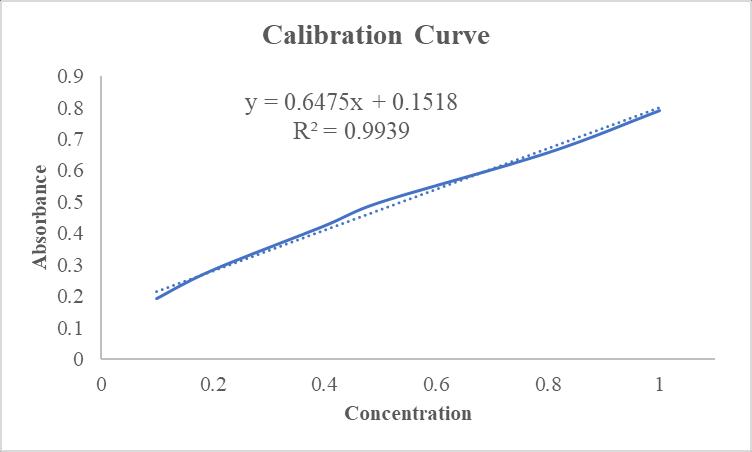
-1:CalibrationCurveforMBN
International Research Journal of Engineering and Technology (IRJET) e-ISSN: 2395-0056
Volume: 12 Issue: 03 | Mar 2025 www.irjet.net p-ISSN: 2395-0072
Table -3: Methylenebluenumberforbiomass,biochar andactivatedcarbon
S.No.
1.
2.
3.
4.
5.
After the pyrolysis process, as the temperature rises surfaceareaofthebiocharalsoincreases,andthemicropores ofthetreatedbiocharboosttheadsorption-capacityofiodine andmethylenebluedyefollowingincreasingorder,including thefollowing:
TWAC>600>500>400
Methyleneblueadsorptionincreaseswithincreasingreaction durations(60,120,and180minutes).Ateawaste-activated sample showed a maximum percentage elimination of 98.22%ofthemethylenebluedyeafter180minutes.
Using tea waste biochar and tea waste activated carbon (TWAC) for methylene blue dye adsorption has been extensivelystudiedandproventobeaviableandeffective method for wastewater treatment. TWAC exhibits a high adsorption capacity for methyleneblue dye due to its porousstructureandlargesurfacearea.ThismakesTWACan efficient adsorbent for removing dyes from aqueous solutions. The contact time parameter significantly influences the adsorption efficiency. Optimizing these parameters is crucial to maximize the dye removal performance of TWAC. The adsorption of methylene blue risesasthereactiondurations(60,120,and180minutes) increase. A tea waste-activated sample demonstrated a maximalremovalrateof98.22%ofmethylenebluedyeafter 180 minutes. The iodine evaluation indicates that the highestadsorptioncapacityofACTWis1275.68mg/g.
UtilizingTWACfordyeadsorptionoffersecologicalbenefits byrepurposingtea waste,reducing wastegeneration,and minimizingsyntheticadsorbents.Italsoprovideseconomic advantagesbyutilizingalow-costandrenewablebiomass resource.TWAChasdiverseapplicationpotentialintextiles, paper,leather,anddyemanufacturingindustries,wheredyecontaminatedwastewaterisaconcern.Itseffectivenessand affordabilitymakeitapracticalalternativetoconventional adsorbents.
[1] Aboua, K. N., Yobouet, Y. A., Yao, K. B., Goné, D. L., & Trokourey, A. (2015). Investigation of dye adsorption onto activated carbon from the shells of Macoré fruit. JournalofEnvironmentalManagement,156,10-14.
[2] Abuelnoor,N.,AlHajaj,A.,Khaleel,M.,Vega,L.F.,&AbuZahra, M. R. (2021). Activated carbons from biomassbased sources for CO2 capture applications. Chemosphere,282,131111.
[3] Bai,X.,Quan,B.,Kang,C.,Zhang,X.,Zheng,Y.,Song,J.,...& Wang,M.(2023).Activatedcarbonfromtearesidueas an efficient absorbent for environmental pollutant removal from wastewater. Biomass Conversion and Biorefinery,13(15),13433-13442.
[4] Baytar, O., Şahin, Ö., Saka, C., & Ağrak, S. (2018). Characterizationofmicrowaveandconventionalheating onthepyrolysisofpistachioshellsfortheadsorptionof methyleneblueandiodine. Analytical Letters,51(14), 2205-2220.
[5] Gembo,R.O.,Odisitse,S.,Msagati,T.A.,&King’ondu,C. K. (2024). Unlocking the valorization potential of Rooibos tea waste-derived activated carbon in the adsorptiveremovalofremazolbrilliantblueRdye.Next Sustainability,4,100054.
[6] Gowtham, B. (2021). Experimental study on performance assessment of Fenton and photo-Fenton oxidationprocessformethyleneblue.Proceedingsofthe International Academy of Ecology and Environmental Sciences,11(2),43.
[7] Hussain, S., Anjali, K. P., Hassan, S. T., & Dwivedi, P. B. (2018). Waste tea as a novel adsorbent: a review. AppliedWaterScience,8,1-16.
[8] Jabar, J. M., Odusote, Y. A., Ayinde, Y. T., & Yılmaz, M. (2022).African almond (Terminalia catappa L)leaves biochar prepared through pyrolysis using H3PO4 as chemicalactivatorforsequestrationofmethyleneblue dye.Resultsinengineering,14,100385.
[9] Jawad,A.L.I.,Al-Heetim,D.T.,&AbdRashid,R.(2019). Biochar from orange (Citrus sinensis) peels by acid activation for methylene blue adsorption. Iranian JournalofChemistryandChemicalEngineering,38(2), 91-105.
[10] Jeyakumar, R. S., & Chandrasekaran, V. (2014). PreparationandCharacterizationofActivatedCarbons DerivedfromMarineGreenAlgaeUlvafasciatasp.Asian JournalofChemistry,26(9).
[11] Mariah,M.A.A.,Rovina,K.,Vonnie,J.M.,&Erna,K.H. (2023).Characterizationofactivatedcarbonfromwaste
International Research Journal of Engineering and Technology (IRJET) e-ISSN: 2395-0056
Volume: 12 Issue: 03 | Mar 2025 www.irjet.net p-ISSN: 2395-0072
tea (Camellia sinensis) using chemical activation for removal of methylene blue and cadmium ions. South AfricanJournalofChemicalEngineering,44,113-122.
[12] Mei,M.,Liu,J.,Wang,T.,Chen,S.,Liu,D.,&Li,J.(2022). Co-pyrolysis of sewage sludge and grape dreg to produce efficient and low-cost biochar for methylene blue removal: adsorption performance and characteristics.DesalinationandWaterTreatment,248, 277-287.
[13] Mortada,W.I.,Ghaith,M.M.,Khedr,N.E.,Ellethy,M.I., Mohsen, A. W., & Shafik, A. L. (2024). Mesoporous magnetic biochar derived from common reed (Phragmitesaustralis)forrapidandefficientremovalof methylene blue from aqueous media. Environmental ScienceandPollutionResearch,31(29),42330-42341.
[14] Paluch, D., Bazan-Wozniak, A., Wolski, R., NosalWiercińska,A.,&Pietrzak,R.(2023).Removalofmethyl redfromaqueoussolutionusingbiocharderivedfrom fennelseeds.Molecules,28(23),7786.
[15] Saeed, A. A. H., Harun, N. Y., Sufian, S., Siyal, A. A., Zulfiqar, M., Bilad, M. R., ... & Almahbashi, N. (2020). Eucheuma cottonii seaweed-based biochar for adsorption of methylene blue dye. Sustainability, 12(24),10318.
[16] Sawalha,H.,Bader,A.,Sarsour,J.,Al-Jabari,M.,&Rene,E. R. (2022). Removal of dye (methylene blue) from wastewater using bio-char derived from agricultural residues in palestine: Performance and isotherm analysis.Processes,10(10),2039.
[17] Shoaib,A.G.,Van,H.T.,Tran,D.T.,ElSikaily,A.,Hassaan, M. A., & El Nemr, A. (2024). Green algae Ulva lactucaderived biochar-sulfur improves the adsorption of methylene blue from water. Scientific Reports, 14(1), 11583.
[18] Shrestha, L. K., Thapa, M., Shrestha, R. G., Maji, S., Pradhananga,R.R.,&Ariga,K.(2019).Ricehusk-derived high surface area nanoporous carbon materials with excellent iodine and methylene blue adsorption properties.C,5(1),10.
[19] Sutthasupa, S., Koo-Amornpattana, W., Worasuwannarak, N., Prachakittikul, P., Teachawachirasiri, P., Wanthong, W., ... & Chaiwat, W. (2023).Sugarcanebagasse-derivedgranularactivated carbonhybridizedwithashinbio-basedalginate/gelatin polymer matrix for methylene blue adsorption. InternationalJournalofBiologicalMacromolecules,253, 127464.
[20] Tran,Q.T.,Đo,T.H.,Ha,X.L.,Duong,T.T.A.,Chu,M.N., Vu, V. N., ... & Song, P. (2022). Experimental design,
equilibrium modeling and kinetic studies on the adsorption of methylene blue by adsorbent: activated carbonfromdurianshellwaste.Materials,15(23),8566.
[21] Tran,T.H.,Le,A.H.,Pham,T.H.,Nguyen,D.T.,Chang,S. W., Chung, W. J., & Nguyen, D. D. (2020). Adsorption isothermsandkineticmodelingofmethylenebluedye ontoacarbonaceoushydrocharadsorbentderivedfrom coffee husk waste. Science of the Total Environment, 725,138325.
[22] Wiśniewska, M., Rejer, K., Pietrzak, R., & Nowicki, P. (2022).Biocharsandactivatedbiocarbonspreparedvia conventional pyrolysis and chemical or physical activationofmugwortherbaspotentialadsorbentsand renewablefuels.Molecules,27(23),8597.
[23] Wu,Z.,Zhong,H.,Yuan,X.,Wang,H.,Wang,L.,Chen,X.,... &Wu,Y.(2014).Adsorptiveremovalofmethyleneblue by rhamnolipid-functionalized graphene oxide from wastewater.Waterresearch,67,330-344.
[24] Xu,R.,Wei,J.,Cheng,D.,Wang,W.,Hong,L.,Chen,Y.,& Guo,Y.(2024).Abundantporousbiocharderivedfrom luffa vine for removal of methylene blue: Selective adsorption and mechanistic studies. Industrial Crops andProducts,219,119114.
[25] Zhang,X.,Chen,F.,Liu,S.,Lou,J.,Liu,W.,Rousseau,D.P., &VanHulle,S.(2024).Synthesis,characterization,and methylene blue adsorption isotherms of hydrochars derivedfromforestrywasteandagro-residues.Biomass ConversionandBiorefinery,14(2),1809-1824.