
International Research Journal of Engineering and Technology (IRJET) e-ISSN: 2395-0056
Volume: 13 Issue: 05 | May 2026 www.irjet.net p-ISSN: 2395-0072
International Research Journal of Engineering and Technology (IRJET) e-ISSN: 2395-0056
Volume: 13 Issue: 05 | May 2026 www.irjet.net p-ISSN: 2395-0072
Sabiha Begum ¹, Shahad Salem Alshammari¹, Abrar Khaled Almutairi¹, Abrar Ahmed Altlasi¹, Shaden Faisal Almutairi¹, Aryam Fahad Samran¹, Lamia Ibrahim Alshammari¹
¹Department of Computer Science, College of Computer Science, University of Ha’il, Hail, Saudi Arabia ***
Abstract - Team formation in academia is still a challenging task due to differences in individual skills, limited availability and the lack of structured matching We present the Tawafuq platform, an AI-based platform for effective and coordinated team building. The system leverages structured person profiles, such as talents and availability, toevaluate the fit between people and project requirements. The platform is designed as a web-based application, utilizing HTML, CSS, and JavaScript for the front-end, PHP for back-end processing, and MySQL for data management. Initialexperimental testing with a small user group reveals that the strategy improves the relevancy of matches and enables faster team building. Keywords: AI Matching, Team Formation, Recommendation Systems, Skill Matching, Web Application.
KeyWords: AI Matching, Team Formation, Recommendation Systems, Skill Matching, Web Application.
Thesuccessofacademicandprofessionaleffortsisa keyaspectinteamcreation. However,traditionalteam building procedures are often based on manual selection, personal networks or random grouping, whichcanleadtomismatchedcompetencies,uneven workloaddistributionandlowprojectefficiency.These difficulties highlight the need for smart systems that can assess the abilities, interests and availability of userstoenablebettercollaboration. Totacklethese challenges, we introduce Tawafuq, an AI-powered matching platform for optimizing team formation in academia. The system is built on structured user profiles and similarity-based algorithms to calculate the degree of compatibility between each individual andeach project. Tawafuqautomates the matching process,hencereducingthetimeittakestoestablish teams while improving the relevance and quality of matches.Theplatformisawebapplicationdesigned utilizingmodernfrontendandbackendtechnologies, making it accessible and scalable for academic institutions.
In this study, we address the problem of students havingdifficultiesinfindingcompatiblecolleaguesand projects,whichoftenresultsintalentmismatchesand lower team performance. The suggested Tawafuq systemsolvesthischallengebyusingasystematicskill basedmatchingstrategy.Itgathersstudents’datasuch as abilities, academic aspirations, and availability, assesses the project requirements, and proposes the most suitable projects. The system is created with threetierwebarchitecture.Thefrontendiswrittenin HTML, CSS and JavaScript, and the backend is developed in PHP, storing the data in MySQL. IntegratestheOpenAIAPItoprovideAIdrivenproject recommendations. The system allows students to view projects, submit join requests and the system matchesthemtoprojectsaccordingtotheirtalentsand availability. System evaluation is performed by unit testing,integrationtestinganduserexperiencetesting toverifyreliabilityandusability.Theevaluationofthe performanceinvolvesthemeasurementoftheproject matchingprecisionandthecollectionofuserinputto verify the performance of the system. Future maintenance will involverepeated refinementof the recommendationalgorithm,aswellastheadditionof additionalfunctionalitiestomaintainsystemstability andongoingrelevance.
TheAIbasedsimilarityanalysisisthefoundationof the tawafuq system matching technique. First, the system takes user profile information, including abilities,freetime,andprojectgoalsessentialskillsare fetched.
Theuserprofileandtheprojectdataareconvertedto textformatandsenttothemodelfromtheOpenAI.The modelcalculatesasimilarityscoreintherangeof0to 100dependingonthesemanticsimilarityoftheuser
International Research Journal of Engineering and Technology (IRJET) e-ISSN: 2395-0056
Volume: 13 Issue: 05 | May 2026 www.irjet.net p-ISSN: 2395-0072
profileandtheprojectrequirements. Thenprojectsare appraisedusingthesimilarityscore.Theprojectswith thehighestscorearesuggestedtotheuser.
2.3 Proposed Algorithm for Matching
Tawafuq system uses similarity based matching algorithmstosuggestacceptableprojectstoindividuals based on their talents, availability and goals. The program calculates a score of compatibility between eachuserandtheprojectsaccessible.
2.3.1 Matching Score Formula
Score=w1*SkillMatch+w2*AvailabilityMatch+w3 *GoalMatch Where:
-SkillMatch:%ofskillsthatmatchbetweenuserand project
-AvailabilityMatch:Overlapofuserandprojecttiming
-GoalMatch:Usergoalsimilaritywithprojectgoalsw1,w2,w3areweights(e.g.0.5,0.3,0.2)
2.3.2 Skill Matching
SkillMatch = Total number of matching skills Total requiredskills×100
2.3.3 Matching Availability
Based on the overlaps between user availability and theprojecttimeline.
2.3.4 Goal Alignment
Calculated based on semantic similarity utilizing the APIofOpenAssistantbetweenusergoalsandproject description.
2.3.5 Algorithm Steps (Pseudo-code)
Ineachproject:
ComputeSkillMatch
ComputeAvailabilityMatch
ComputeGoalMatch
ComputeScoreSortprojectsbyScoreReturntop matches
Example 2.3.6
IfSkillMatch=80, AvailabilityMatch=70, GoalMatch=60:
Score=(0.5×80)+(0.3×70)+(0.2×60)=73
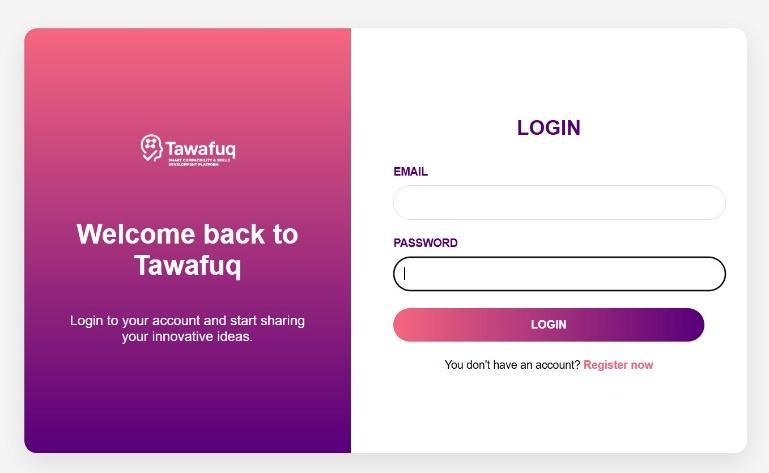
The Tawafuq system was successfully built to offer intelligentmatchingforusersandprojectsaccordingto their talents, goals and available time. Users could register, log in, and establish personal profiles with their specified skills, personal goals, and preferred workingtimes.Projectmakerscouldalsobuildprojects byidentifyingrequiredskills,projectgoalsanddesired workinghours."Toimprovethematchingprocess,we used Open AI to develop an AI-based matching functionality.Thesystemcomparestheuserabilities, goals and time preferences with the needs of the projects and recommends the suitable ones. The system functions such as user registration, project creating, AI-based matching, and join request were successfullytested.Thesystemcouldsaveuserdata, project data and matching results in database effectively.
Theresultsdemonstratedthatthesystemwasableto generate relevant matches when user attributes alignedwithprojectrequirements.
International Research Journal of Engineering and Technology (IRJET) e-ISSN: 2395-0056
Volume: 13 Issue: 05 | May 2026 www.irjet.net p-ISSN: 2395-0072
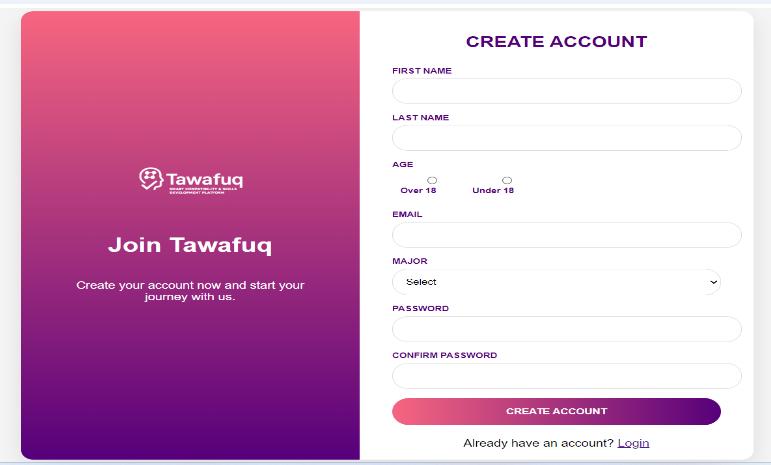
2. UsersignupUIforanewTawafuqaccount.
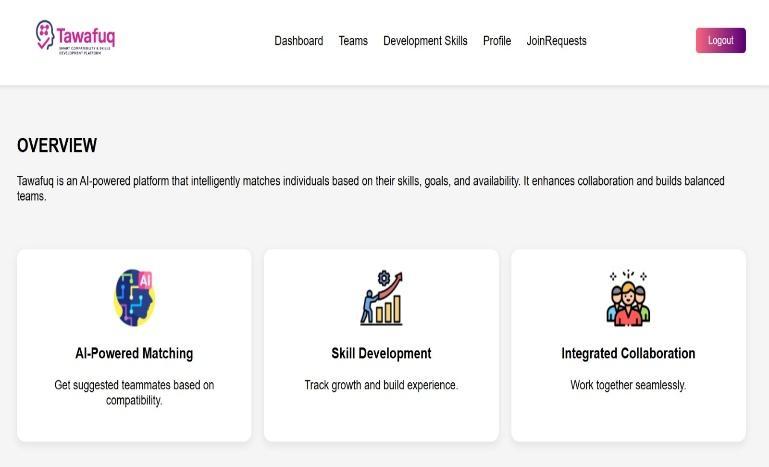
3. Dashboardpagewithsystemoverviewandkey features.
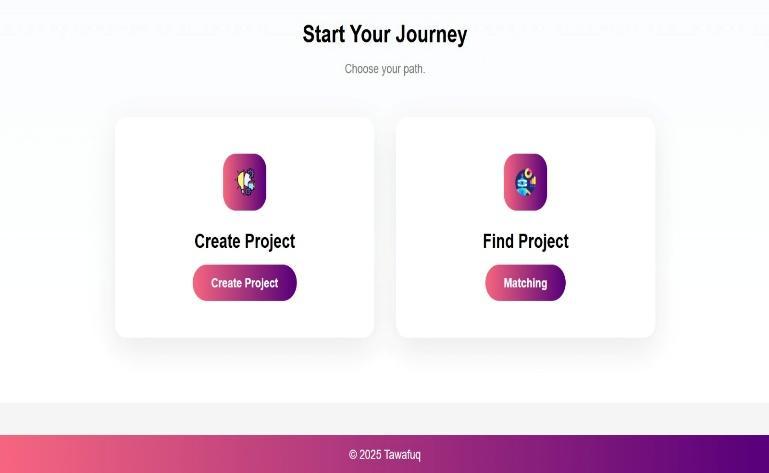
4. interfacedemonstratingprojectcreationand project.

Figure 5. Developmentskillspagewith3recommended coursesforusers.
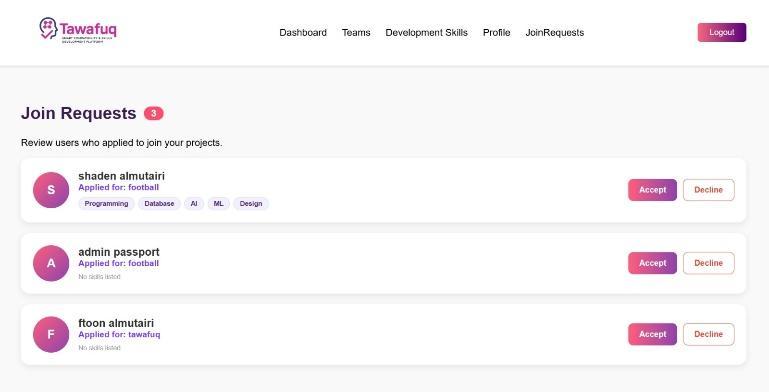
Figure 6. Userapplicationstoprojects(pageofjoining requests).
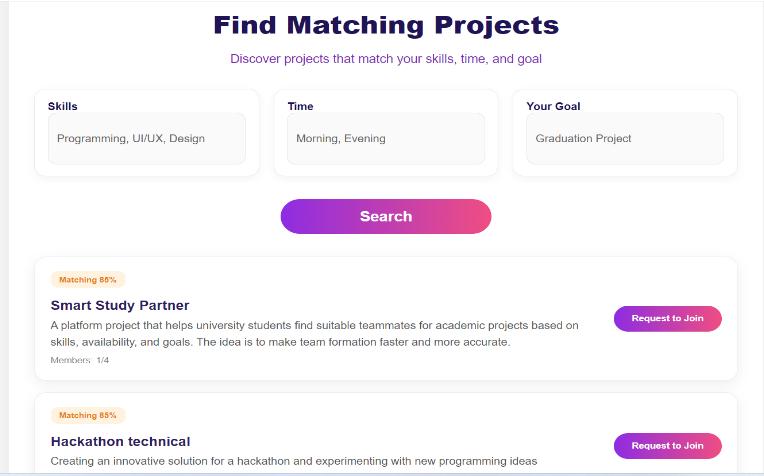
Figure 7. AI-basedmatchinginterfacewithrecommended projectsbasedonuserinput
2026, IRJET | Impact Factor value: 8.315 | ISO 9001:2008 Certified Journal | Page12
International
Volume: 13 Issue: 05 | May 2026 www.irjet.net
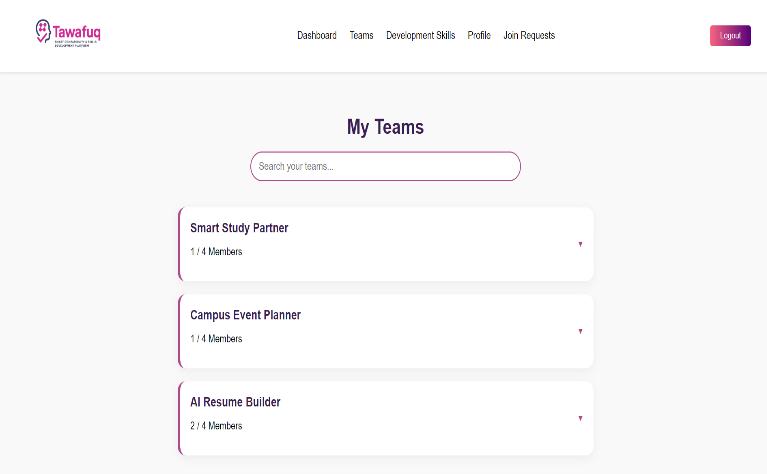
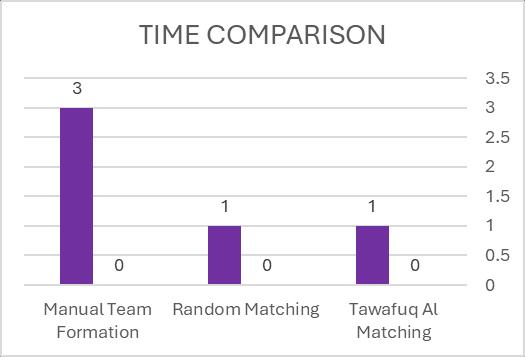
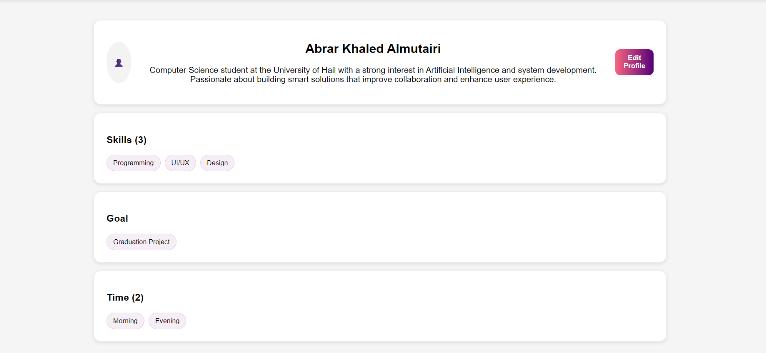
Figure 9. Userprofilepageshowingpersonalinformation, skills,ambitionsandavailability.
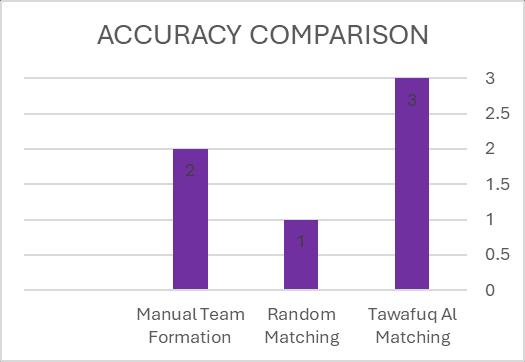
To assess the performance of the Tawafuq system, three techniques to form teams were examined: manualteamcreation,randommatching,andTawafuq AI-based matching. The comparison shows that Tawafuqenablesmoreappropriatematchingbasedon users'abilities,goalsandavailabilityandimprovesthe efficiency of team building compared to traditional techniques.
Table -1: ComparisonofTeamFormationMethods
3. Discussion
The experimental findings clearly indicate the effectiveness of the proposed Tawafuq system over manual and random team creation approaches. As regardsaccuracy,Tawafuqhadthehighestscore(3High)comparedtomanualformation(2-Medium)and random matching (1 - Low). This means that the systemproducesmorerelevantandcompatibleteam matches . Also, the time required for team creation using Tawafuq was minimal (1) as well as random matching, butmanualformationneeded quitea long time (3 - High). The results reveal that Tawafuq not only increases the quality of matching but also improvestheefficiencybyloweringthetimeneededto
International Research Journal of Engineering and Technology (IRJET) e-ISSN: 2395-0056
Volume: 13 Issue: 05 | May 2026 www.irjet.net p-ISSN: 2395-0072
buildteams. Althoughtheseresultsareintriguing,the systemwastestedatasmallscale,whichcouldhavean impact on the generalizability of the results. Future study will focus on assessing the system with larger datasetsandfurtherenhancingtheAImodelforeven higheraccuracyandperformance.
Inthisstudy,aweb-basedsystemcalled“Tawafuq”was introduced to improve the process of graduation projects selection and student teams formation. The methodtacklestheusualobstaclesfacedbystudents, such as difficulties in searching for acceptable colleaguesandabsenceofadefinedprojectselection procedure. The suggested solution has three-tier architecture and includes an AI-based matching mechanism that leverages the OpenAI API to assess student talents, availability, and project needs. The results indicate that the approach can successfully match students to suitable projects and improve compatibilitybetweenteammembers.Therealization of the system (frontend, backend, database) proves thattheplatformisfunctional,scalableandsuitablefor future deployment. Test results also proved the stability of important functions including user authentication, profile management and data processing, But there is still room for development. Futureworkmightbedirectedtowardsimprovingthe accuracyoftheAImatchingalgorithm,increasingthe dataset, improving the user interface and implementingthesystemonacloudplatformforrealworlduse.Toconclude,“Tawafuq”offersaneffective and intelligent solution that can assist students in making better project decisions and creating more compatibleandproductiveteams.
[1] L. Yu and S. Wang, “Team formation based on skill matchingusingAItechniques,”IEEEAccess,vol.8,pp. 11245–11256,2020.
[2] A.K.Sangaiah,“Intelligentrecommendationsystemsfor team formation,” IEEE Transactions onComputational SocialSystems,vol.7,no.3,pp.745–756,2020.
[3] J.Li,“Skill-basedteamrecommendationincollaborative platforms,”ACMComputingSurveys,vol.54,no.2,pp.1–28,2021.
[4] C. Aggarwal, Recommender Systems: The Textbook. Springer,2016.
[5] WorldEconomicForum,“FutureofJobsReport2023,” WEF, 2023. [Online]. Available: https://www.weforum.org
[6] McKinsey Global Institute, “The State of AI in 2024,” McKinsey, 2024. [Online]. Available: https://www.mckinsey.com
[7] X.Zhang,Y.Liu,andH.Chen,“AI-basedteamformation usingmachinelearningtechniques,”IEEEAccess,vol.10, pp.55678–55689,2022.
2026, IRJET | Impact Factor value: 8.315 | ISO 9001:2008