
International Research Journal of Engineering and Technology (IRJET) e-ISSN: 2395-0056
Volume: 13 Issue: 04 | Apr 2026 www.irjet.net p-ISSN: 2395-0072

International Research Journal of Engineering and Technology (IRJET) e-ISSN: 2395-0056
Volume: 13 Issue: 04 | Apr 2026 www.irjet.net p-ISSN: 2395-0072
Vidhi Jethva¹, Sanika Kudkar², Krisha Dave³, Payal Konde⁴, Yuvraj Deshmukh⁵, Vaishali Rane⁶
¹²³⁴⁵ Students, Department of Computer Engineering
⁶Assistant Professor, Department of Computer Engineering
Thakur Polytechnic, Kandivali East, Mumbai – 400101, India
Abstract -The Food Price Comparison App is designed to help users compare food prices across popular online delivery platforms such as Zomato and Swiggy. With the increasinguse oftheseplatforms,users often needtoswitch between multiple applications to find the best deals, which can be time-consuming and inconvenient. The proposed system addresses this issue by providing a unified platform where price comparison becomes quicker and more efficient.
The application is developed using a structured dataset containing information about food items and their corresponding prices. This allows users to view and comparedifferentoptionsinaclearandorganizedmanner.
The system includes key features such as a searchfunctionality,auser-friendlyinterface,andachatbot that assists users with queries and navigation. By integrating these features into a single platform, the application simplifies the decision-making process and enhancesuserconvenience.
Overall, the Food Price Comparison App demonstrates how mobile applications can be utilized to improve the food deliveryexperience. It also provides a foundationfor future enhancements, such as real-time data integration and advancedrecommendationfeatures.
Key Words:Food price comparison, Online food delivery, Zomato, Swiggy, Price transparency, Mobile application, Firebase, Chatbot, Artificial Intelligence, User experience, Costoptimization
The use of online food delivery services has increased significantlyinrecentyears,mainlyduetoplatformssuch asZomatoand Swiggy. These platforms have changed the way people order food by providing access to a wide varietyofrestaurants,menus,andpricingoptionsdirectly through mobile devices. While this has improved convenience, it has also introduced certain challenges for users.
One major issue is the difficulty in comparing prices for thesamefooditemacrossdifferentplatforms.Usersoften need to switch between multiple applications, search for the same item repeatedly, and manually compare prices. This process is time-consuming and inefficient, making it difficult for users to quickly identify the best available option.
To address this problem, the proposed Food Price Comparison App provides a unified platform where users cancomparefoodpricesfrommultipledeliveryservicesin one place.Thesystempresentsinformationina clearand structured format, allowing users to easily view and evaluate different options without the need to switch betweenapplications.Thissignificantlyreduceseffortand improvestheoveralldecision-makingprocess.
Theapplicationisdevelopedusingastructureddatasetof fooditemsandtheircorresponding prices.Itincludeskey features such as a search functionality, a user-friendly interface,andachatbotthatassistsusersinnavigatingthe systemandresolvingqueries.Additionally,theapplication allows users to manage their basic information and location, which helps in delivering a more personalized experience.
Overall, the Food Price Comparison App aims to simplify the process of comparing food prices by integrating all relevant information into a single platform. The system not only improves efficiency but also provides a scalable foundation for future enhancements, such as real-time dataintegrationandadvancedrecommendationfeatures.
Recent studies highlight the importance of comparison systems in improving user decision-making processes. These systems reduce the effort required to evaluate multiple options and present information in a clear and structured manner, thereby helping users make more informed choices [1]. Comparison-based platforms are widely used in domains such as travel, e-commerce, and service booking, where users benefit from quickly identifying the best available options. However, in the domain of online food delivery, there are limited systems that provide integrated price comparison across multiple platforms.
International
Volume: 13 Issue: 04 | Apr 2026 www.irjet.net p-ISSN: 2395-0072
This limitation creates challenges for users, as they are required to manually compare prices across different applications. Additionally, many existing systems lack intelligent assistance features, such as recommendations or guided suggestions. In the absence of such support, users often rely on habitual choices rather than exploring morecost-effectiveorsuitablealternatives.Thishighlights theneedforsystemsthatnotonlyprovidecomparisonbut alsoassistusersindecision-making.
In recent years, Artificial Intelligence (AI) has been increasingly integrated into modern applications to enhance user experience and personalization. Technologies such as chatbots, recommendation systems, and virtual assistants are widely adopted to provide realtime assistance and improve interaction [2]. These features enable applications to deliver more personalized and efficient services, making them easier and more engagingtouse.
Therefore, combining comparison systems with AI-based technologiespresentsa promising approach to improving food delivery services. By integrating price comparison, recommendation support, and chatbot assistance, the proposed system aims to provide a more efficient and user-friendly platform. This approach can reduce user effort, improve decision-making, and enhance the overall experienceofonlinefooddeliverysystems.
The Tastico Food Price Comparison App is designed to provide a reliable, scalable, and user-friendly platform for comparing food prices across multiple delivery services suchasZomatoandSwiggy.Thesystemfollowsamodular architecture, where each component is responsible for a specific function, ensuring better performance and maintainability.
Theapplicationconsistsofmultiplemodules,includingthe price comparison module, user management module, database module, and chatbot module. The price comparisonmoduleenablesuserstoviewfooditemsalong withtheircorrespondingpricesfromdifferentplatformsin a structured format. This allows users to easily compare optionsandselectthemostsuitableone.
The system uses a structured dataset to store food items andpricinginformation,whichensuresfastandconsistent data retrieval. For backend services and data storage, Firebase is utilized to manage user accounts, profile data, and chatbot interactions. This ensures that user information is securely stored and easily accessible when required.
The user management module handles registration, login, and profile management functionalities. It ensures that only authorized users can access their accounts, thereby maintaining data security. Additionally, users can update personal details such as name and location, enabling a morepersonalizedexperiencewithintheapplication.
To enhance user interaction, the system integrates a chatbot that assists users with navigation and basic queries.Thechatbotimprovesusabilitybyprovidingquick support and guidance, making the application more interactiveandaccessible.
Theoverallsystemisdesignedtobeflexibleandextensible, allowing new features to be added without affecting existing functionalities. The structured architecture and organizeddataflowensuresmoothperformanceevenwith increasingdataanduseractivity.
Insummary,theTasticoapplicationprovidesacentralized solution for food price comparison, reducing the need to switch between multiple platforms. By combining structured data, secure user management, and interactive features, the system enables users to make quick and informeddecisionsefficiently.
The Tastico Food Price Comparison App is designed to help users efficiently search, compare, and select food items from online delivery platforms such as Zomato and Swiggy. The application integrates multiple features that work together to provide a smooth and user-friendly experience.
One of the core functionalities of the system is user authentication. The application allows users to create an accountandsecurelyloginusingFirebaseAuthentication. Thisensuresthatuserdataisprotectedandthateachuser canhaveapersonalizedexperiencewithintheapplication. The system also provides an efficient search functionality that enables users to find specific food items by entering keywordsintoasearchbar.Theapplicationprocessesthe input and displays relevant results, saving time and improving usability. In addition to search, users can browse food items through categorized lists, allowing themtoexploreoptionswithoutrequiringspecificqueries. The primary functionality of the application is price comparison. The system displays prices of the same food item across multiple platforms in a structured format, enabling users to easily identify the most cost-effective option. The comparison is based on a pre-defined dataset of food items and prices, ensuring consistent and reliable results, even though real-time data integration is not currentlyimplemented.
The application also includes user profile management features, allowing users to update personal information suchasname,email, and location. Thishelps in providing a more customized experience and improves overall usability.
To further enhance interaction, the system integrates a chatbot that assists users with navigation and basic queries. The chatbot provides quick responses and guidance, making the application easier to use, especially forfirst-timeusers.
2395-0056
Volume: 13 Issue: 04 | Apr 2026 www.irjet.net p-ISSN: 2395-0072
Firebase is used as the backend service to manage user data,includingauthenticationdetails,profiles,andchatbot interactions.Sincetheapplicationreliesonastaticdataset for price comparison, Firebase is primarily used for handling user-related data rather than real-time pricing information.
Overall, the Tastico application combines these functionalities to provide a centralized platform for food pricecomparison.Byintegratingsearch,comparison,user management, and chatbot assistance, the system reduces usereffortandenablesfasterandmoreinformeddecisionmaking.
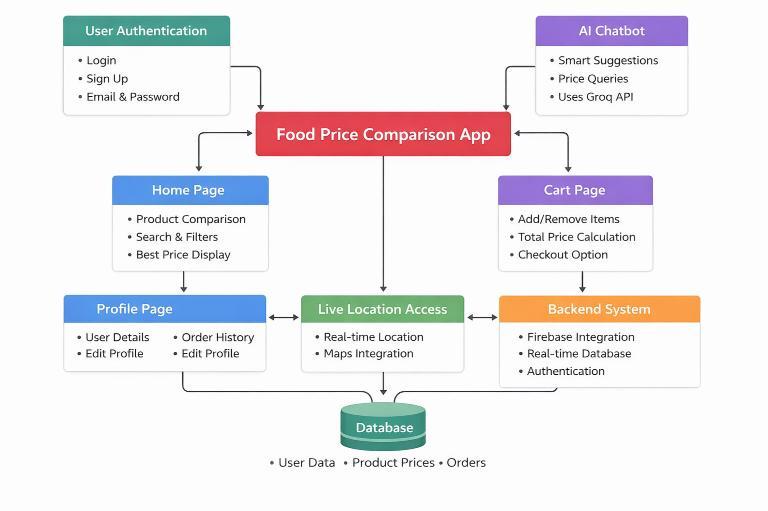
ThedatabasedesignoftheTasticoFoodPriceComparison Appisstructuredtoefficientlystoreandmanagebothuser data and food-related information. The system primarily uses a pre-defined dataset for food items and pricing insteadof relying on real-timeexternal data sources.This approach simplifies the system design and ensures consistent performance, while still providing meaningful comparisonstousers.
The application utilizes Firebase as the backend database for storing and managing user-related data. Firebase providesareliableandscalablesolutionforhandlinguser accounts, profile information, and chatbot interactions. The database is organized into multiple collections, allowing different types of data to be stored separately whilemaintaininglogicalrelationshipsbetweenthem.
One of the main componentsisthe UserCollection,which stores information about registered users. This includes fieldssuchasuserID,name,emailaddress,phonenumber, and location. Each user is assigned a unique identifier, which is used to manage authentication and link related dataacrossthesystem.FirebaseAuthenticationisusedto securelyhandleuserregistrationandloginprocesses.
Another important component is the Food Items Dataset, whichcontainsinformationaboutthefooditemsavailable intheapplication.Thisdatasetincludesattributessuchas
food ID, name, category, and description. Since the application uses a static dataset, this information is predefined and serves as the primary source for displaying andsearchingfooditems.
The Price Comparison Dataset stores pricing information for each food item across multiple platforms such as Zomato and Swiggy. Each entry links a food item to its respective prices on different platforms, enabling the systemtopresentside-by-sidecomparisonsefficiently.
Additionally, a User Profile Collection is maintained to allow users to manage and update their personal information. This includes details such as name and location, which can be used to enhance personalization withintheapplication.
The relationships between these collections are maintainedusinguniqueidentifiers.Forexample,theuser ID connects user account data with profile information, while the food ID links food items with their corresponding pricing data. This relational structure ensures dataconsistency and enables fast retrieval of information.
Overall, the database design is simple, efficient, and scalable.BycombiningFirebaseforuserdatamanagement withstructureddatasetsforfoodandpricinginformation, thesystemachievesreliableperformancewhileremaining easy to maintain. The design also allows for future enhancements, such as integrating real-time data sources or expanding support to additional food delivery platforms.
The increasing use of online food delivery platforms such asZomatoandSwiggyhasprovideduserswithaccesstoa wide variety of food options. However, it has also introduced a significant challenge in comparing prices for thesamefooditemsacrossdifferentplatforms.
Currently, users are required to open multiple applicationsandrepeatedlysearchforthesamefooditem in order to compare prices. This process is timeconsuming, inefficient, and inconvenient, especially when users want to make quick decisions while ordering food. The lack ofa unified system makesit difficult for users to identifythemostcost-effectiveoption.
Most existing food delivery platforms are designed primarilyfororderingratherthancomparison.Asaresult, users do not have access to a centralized platform where they can view and evaluate pricing information from multiple sources simultaneously. Additionally, many platforms lack intelligent assistance features, which furthercomplicatesthedecision-makingprocess.
Therefore, there is a need for a system that can integrate food price information from multiple platforms into a single interface. The proposed Tastico Food Price Comparison App addresses this issue by providing a
Volume: 13 Issue: 04 | Apr 2026 www.irjet.net
platform where users can search, browse, and compare fooditemsefficiently.The systemaimstoreducethetime andeffort required for price comparison while improving theoveralluserexperience.
The Tastico Food Price Comparison App offers several advantages that improve the overall user experience in online food ordering. One of the primary benefits is the reduction in time and effort required to compare food prices.Insteadofswitchingbetweenmultipleapplications such as Zomato and Swiggy, users can view all relevant price information in a single interface. This significantly simplifies the decision-making process and reduces user effort.
Another key advantage is improved price transparency. The system presents food prices from different platforms in a clear and structured format, allowing users to easily identifythe mostcost-effectiveoption. Thisisparticularly useful for students and budget-conscious users who want tomanagetheirexpensesmoreefficiently.
The integration of a chatbot enhances the usability of the application by providing basic assistance and guidance. Users can interact with the chatbot to navigate the app, ask simple queries, and understand available features. This makes the application more user-friendly, especially forfirst-timeusers.
Additionally, the application provides a personalized experiencebyallowinguserstomanagetheirprofilesand location information. This helps in presenting more relevantdataandimprovesoverallusability.
Fromatechnicalperspective,theuseoftechnologiessuch asReactNativeforthefrontendandFirebaseforbackend services ensures that the application is scalable, secure, and easy to maintain. The modular design of the system alsoallowsforfutureenhancements,suchasintegrationof real-time data sources and advanced recommendation systems.
Overall, the Tastico application improves efficiency, enhances user convenience, and provides a centralized platformforfoodpricecomparison,makingitausefultool formodernfooddeliveryusers.
In future, the Tastico application can be enhanced by integrating real-time APIs from platforms such as Zomato and Swiggy to fetch live food prices and availability. This would allow the system to provide more accurate and dynamic comparisons based on current data, including delivery charges and offers. Additionally, advanced featuressuchaspersonalizedrecommendations,real-time notifications, and improved AI-based assistance can be implemented to further enhance user experience and systemefficiency.
Firstpage
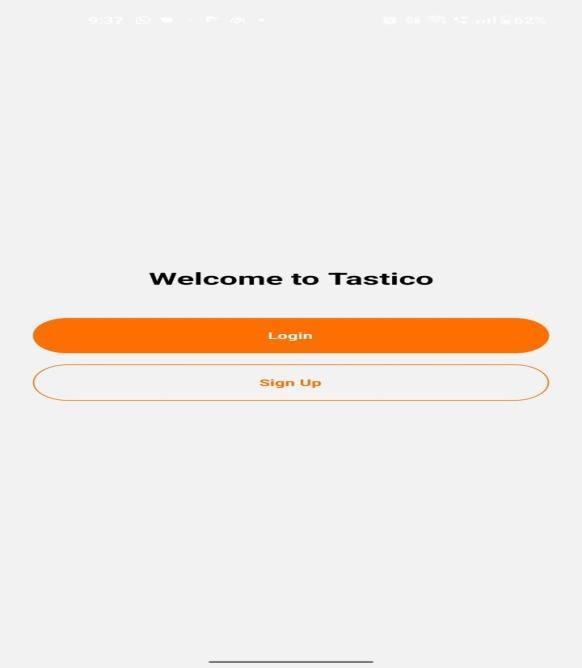
Welcomepage
International Research Journal of Engineering and Technology (IRJET) e-ISSN: 2395-0056
Volume: 13 Issue: 04 | Apr 2026 www.irjet.net p-ISSN: 2395-0072
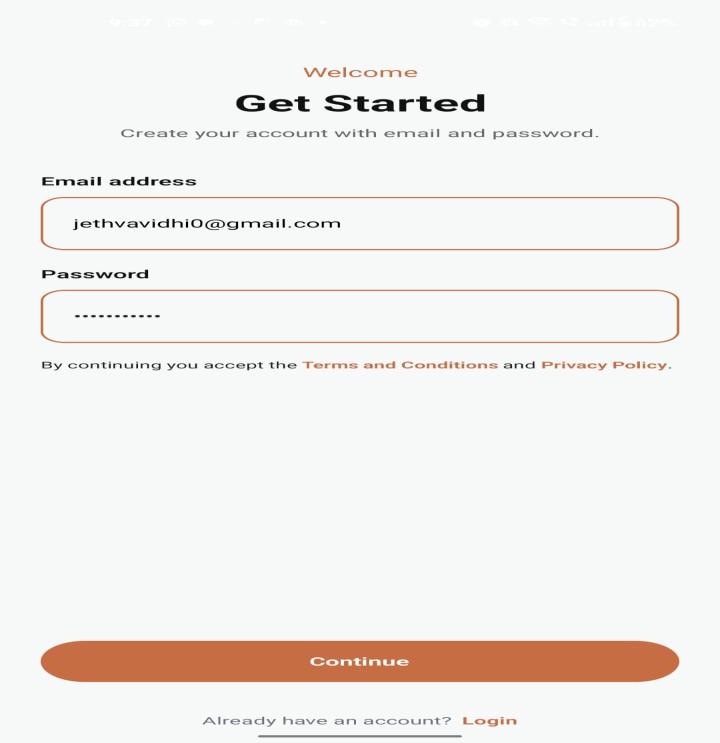
CreateAccount
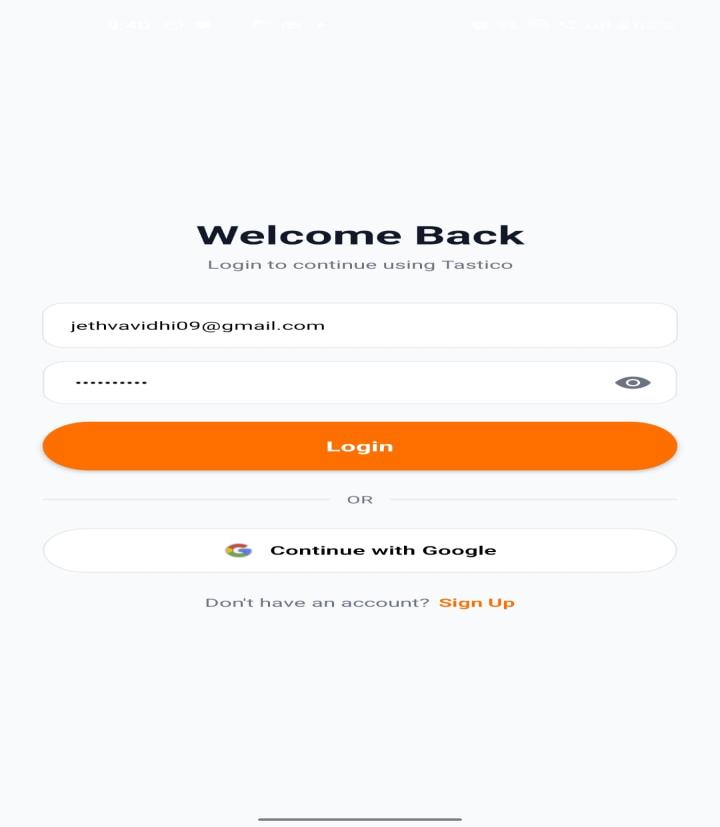
LoginForm
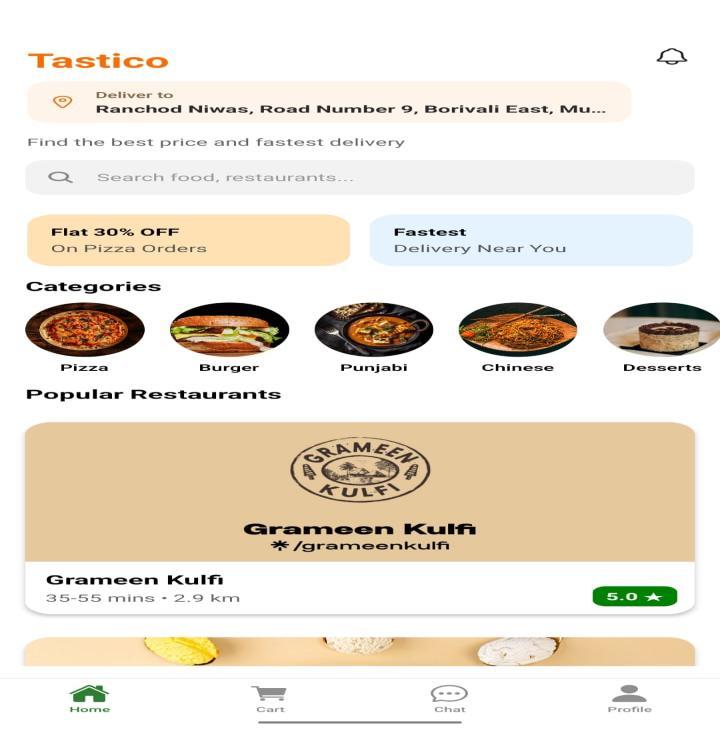
ProjectView
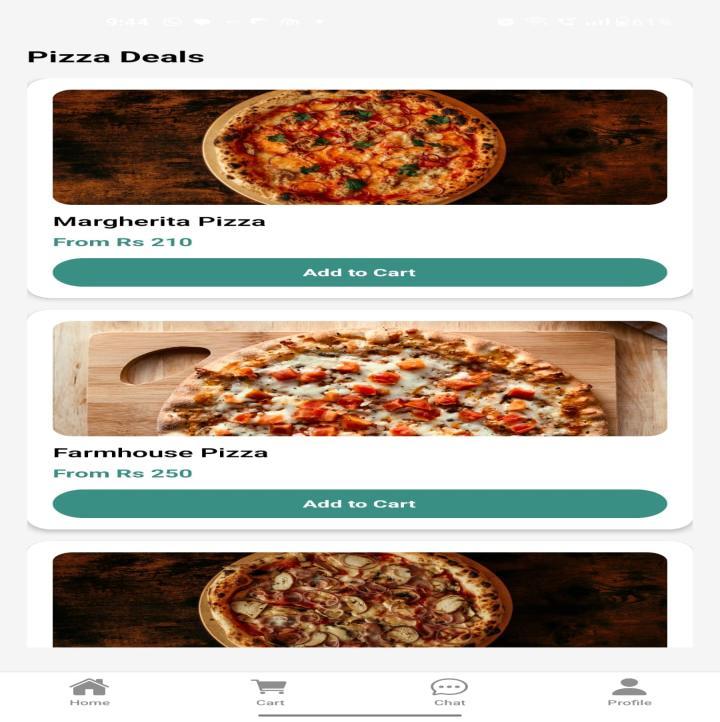
DishesView
International Research Journal of Engineering and Technology (IRJET) e-ISSN: 2395-0056
Volume: 13 Issue: 04 | Apr 2026 www.irjet.net p-ISSN: 2395-0072
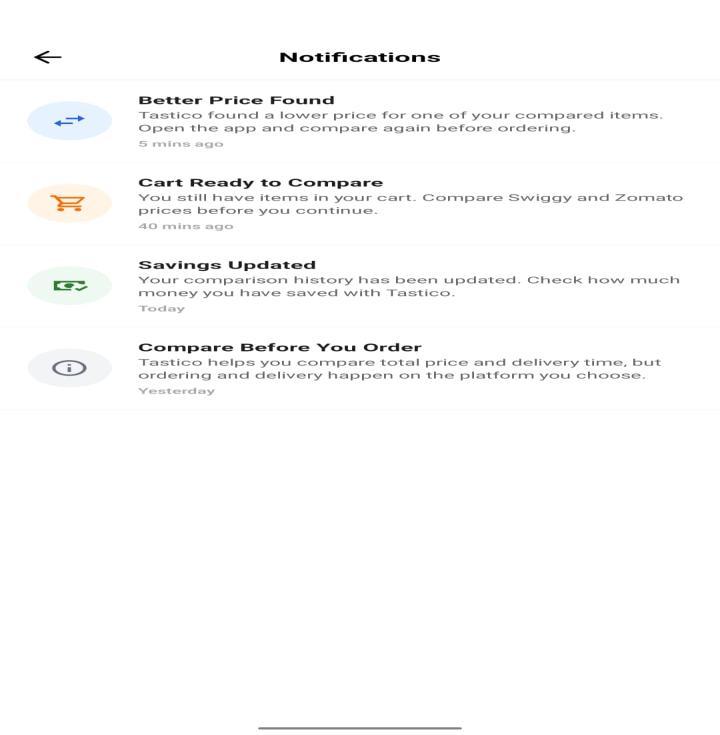
Fig-7.7: NotificationView
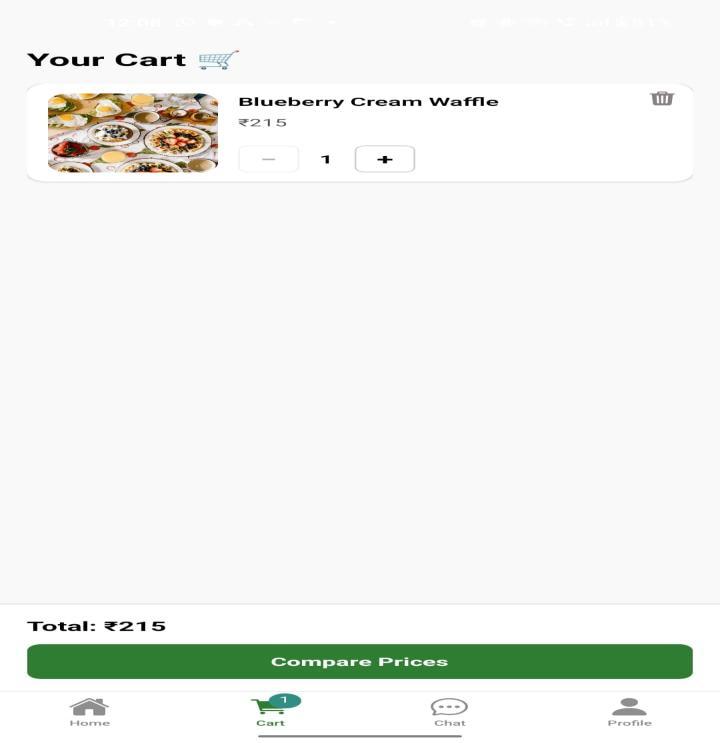
Fig-7.8: Cartviewpage
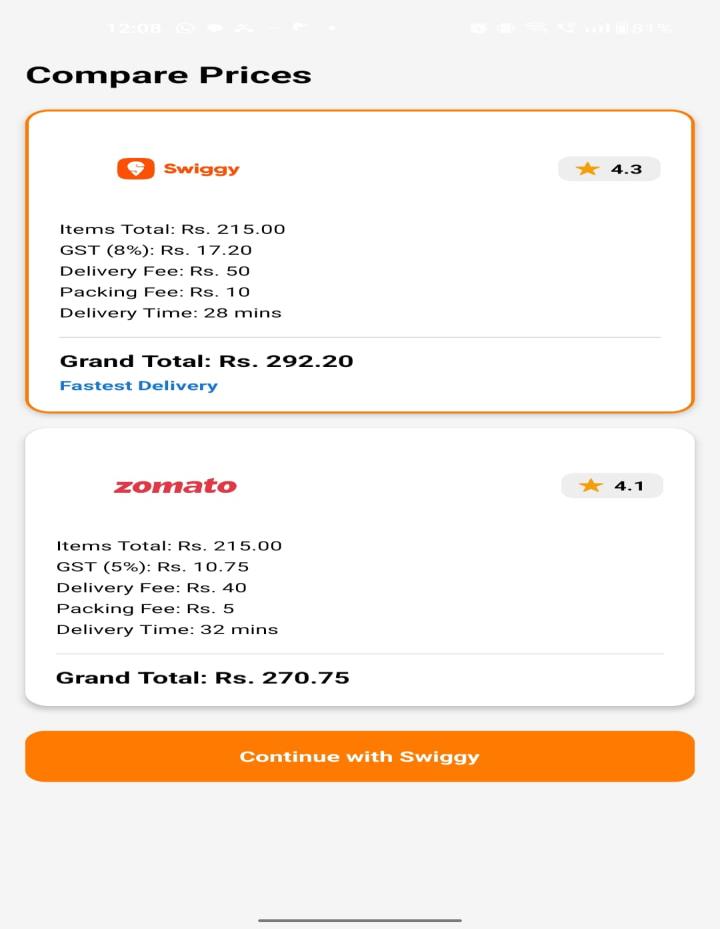
Fig-7.9: ComparePrices
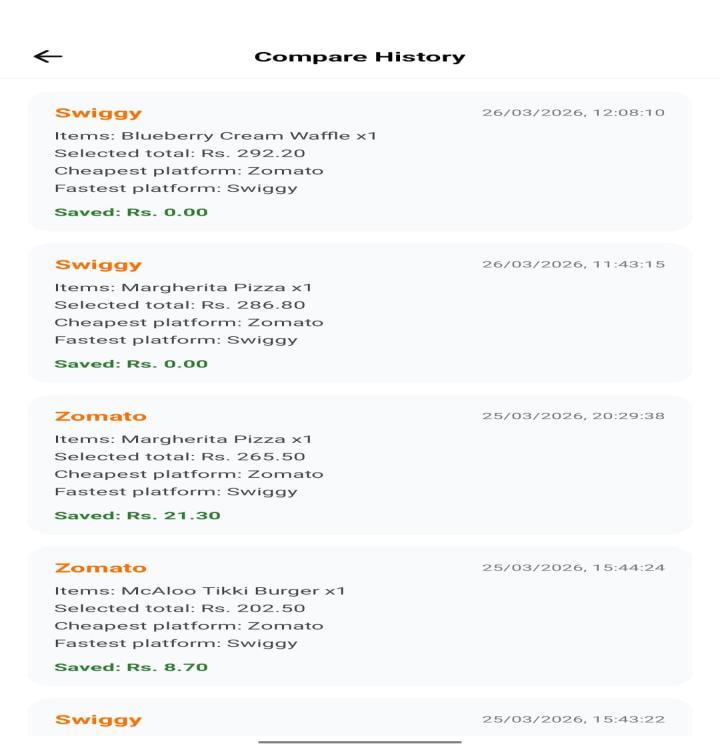
Fig-7.10: CompareHistory
© 2026, IRJET | Impact Factor value: 8.315 | ISO 9001:2008 Certified Journal | Page509
International Research Journal of Engineering and Technology (IRJET) e-ISSN: 2395-0056
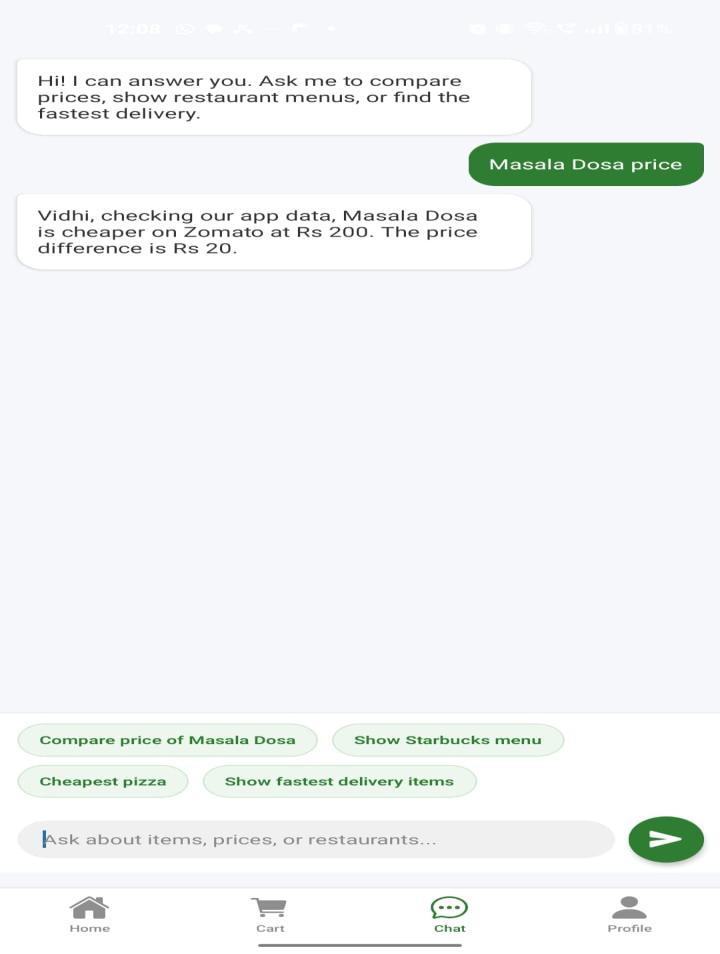
AIChatbot
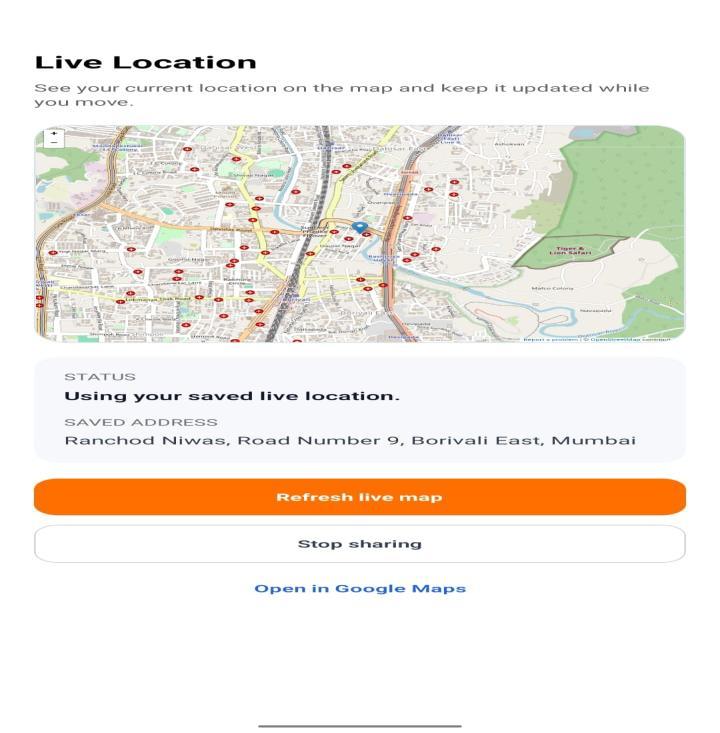
Fig-7.12: Locationview
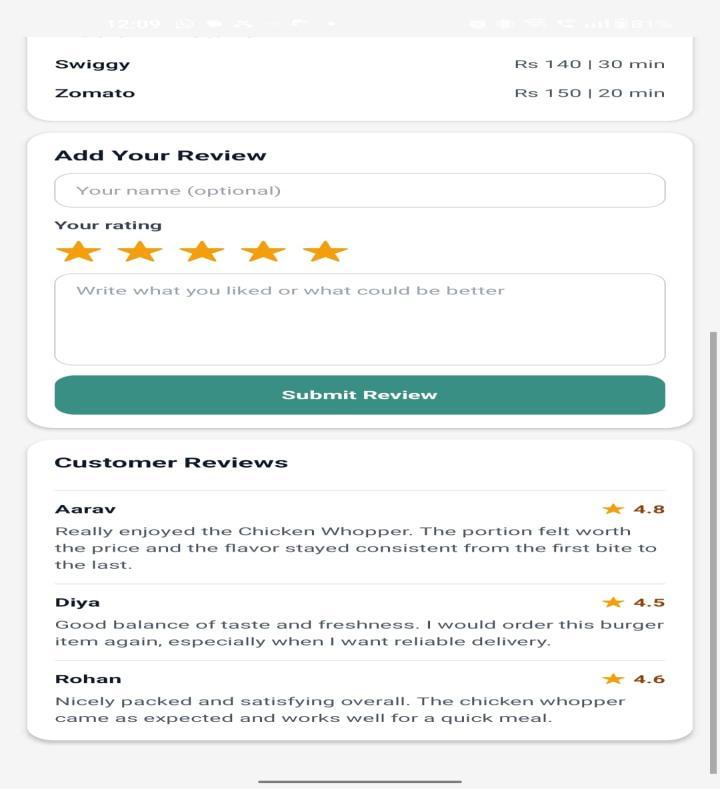
7.13: Review
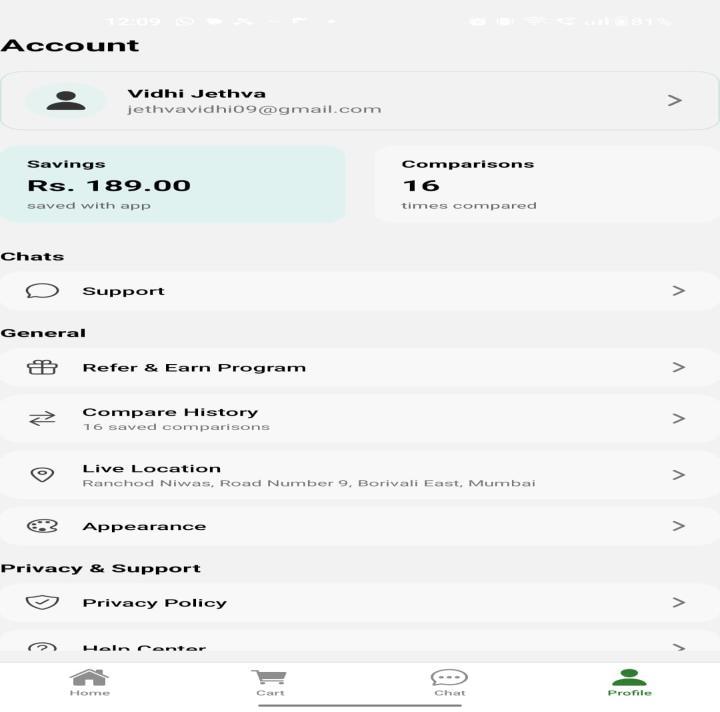
ProfileView
Volume: 13 Issue: 04 | Apr 2026 www.irjet.net p-ISSN: 2395-0072 © 2026, IRJET | Impact Factor value: 8.315 | ISO 9001:2008 Certified Journal |
International Research Journal of Engineering and Technology (IRJET) e-ISSN: 2395-0056
Volume: 13 Issue: 04 | Apr 2026 www.irjet.net p-ISSN: 2395-0072
The Tastico Food Price Comparison App is developed to addressthechallengefacedbyuserswhencomparingfood prices across multiple online delivery platforms such as ZomatoandSwiggy.Withthegrowingpopularityofonline foodordering,usersareoftenrequiredtoswitchbetween different applications to find the best price for the same food item. This process is time-consuming and inconvenient.
The proposed system provides a centralized platform whereuserscansearch,browse,andcompare food prices efficiently within a single application. The system uses a structured dataset containing information about food items and their prices, which simplifies the overall architecture and ensures consistent performance. This approach allows users to clearly view price comparisons and quickly identify the most suitable option based on theirpreferences.
The application includes key features such as user authentication, food search, price comparison, browsing options, and user profile management. Each feature is designed to enhance usability and provide a smooth user experience. Additionally, the integration of a chatbot improves interaction by assisting users with navigation andbasicqueries.
Firebase is used to securely manage user data, ensuring that personal information is stored safely. The modular design of the system allows different components to function independently while maintaining seamless integration.
Overall, the Tastico application demonstrates how mobile technology can simplify the process of comparing food prices and improve user convenience. By bringing all relevant information into a single platform, the system reduces user effort and supports faster decision-making. Furthermore, the current implementation provides a strong foundation for future enhancements, such as realtime data integration, expanded datasets, and support for additionalfooddeliveryplatforms.
[1] Meta Open Source, “React: A JavaScript Library for Building User Interfaces,” 2026. [Online]. Available: https://react.dev/(Accessed:Mar.2026).
[2] Vite Dev, “Vite: Next Generation Frontend Tooling,” 2026. [Online]. Available: https://vitejs.dev/ (Accessed:Mar.2026).
[3] A. Accomazzo, N. Murray, and A. Lerner, Fullstack React: The Complete Guide to ReactJS and Friends, Fullstack.io,2017.
[4] Google Firebase, “Cloud Firestore Documentation,” 2026. [Online]. Available: https://firebase.google.com/docs/firestore (Accessed: Mar.2026).
[5] Node.js Foundation, “Node.js API Documentation,” 2026. [Online]. Available: https://nodejs.org/en/docs (Accessed:Mar.2026).
[6] Meta Open Source, “React Documentation,” 2026. [Online]. Available: https://react.dev/learn (Accessed: Mar.2026).