
International Research Journal of Engineering and Technology (IRJET) e-ISSN:2395-0056
Volume: 12 Issue: 02 | Feb 2025 www.irjet.net p-ISSN:2395-0072
International Research Journal of Engineering and Technology (IRJET) e-ISSN:2395-0056
Volume: 12 Issue: 02 | Feb 2025 www.irjet.net p-ISSN:2395-0072
Arya M. Darade 1, Arya N. Zade 2 , Pankaj Wankhade 3
1, 2 Second Year Students, Shri Shivaji College of Agril Biotechnology, Amravati
3 Assistant Professor, Shri Shivaji College of Agril. Biotechnology, Amravati
The review article is focused on the double-edged nature of waste cooking oil (WCO). The waste cooking oil promotes health risks due to repeated use. However, it can be used potential feedstock for biofuel production. The repeated heating of cooking oil causes its oxidation and polymerization that increases the levels of triglycerides in body. The triglyceride is associated with cardiovascular diseases and metabolic disorders in human body. Improper disposal of WCO creates environmental pollution The waste cooking oil offers promising alternative as feedstock for biodiesel production and simultaneously minimizes waste, emissions, and reliance on fossil fuels. The value benefit of WCO lowers cost to that of virgin oils and ensures economic growth, job creation and sustainability. The WCO may become sustainable source and solution for renewable energy and waste management.
Key Words: Triglycerides, Biofuels, Waste cooking oil, Feedstock
The global movement towards sustainable energy has been pacing as an alternative for fossil fuels. Thewastecookingoilwhichisakitchenbyproductoften thrown away randomly rather than its proper disposal. Thewastecookingoilcontributesalottoenvironmental pollution and enhances health risk. The repeated use of WCO result in the generation of triglycerides in body after consumption. The triglyceride is associated with cardiovascular and metabolic disorders in human being. The waste cooking oil accelerates the degradation of ecosystems and affect on balance of nature. It can serve as feedstock for biodiesel production and renewable sourceofenergy.Properdisposalandutilizationofwaste cooking oil contributes in reduction of environmental pollution and greenhouse gas emission. The potential of waste cooking oil has promoted supports through variousinitiativesand programs for gaining benefit. The present review article gives emphasize on health issues raiseddueincreaseintheleveloftriglyceridesinhuman body. The focus is given on aspect of environmental pollution due to waste cooking oil. The significance of waste cooking oil is focused in terms of synthesis of biofuelwhichwouldbesustainablesourceforrenewable energy
Triglyceridesareoneofthemostcommontypes of fat in body. It is derived from oils, butter, and animal fats.Theoilisconvertedintotriglyceridesanddeposited for long time in body. The frequent consumption of oil especiallycookingoilincreasetheleveloftriglyceridesin the body. The fats provide us energy to carry on physiological and a metabolic activity in body. The increase in the levels of triglycerides affects and promotes heart diseases. The triglyceride can be converted into fuels by means of transesterification, pyrolysis,cracking,andemulsification.
1.1 Properties of triglycerides
• The ester linkages in triglycerides are susceptible to transesterification reaction in presence of alcohol, methanol and specific catalyst. The catalyst may be acid or base. The catalytic reaction yields Fatty Acid Methyl Esters (FAMEs) as a primary component for biodiesel synthesis.
•The basic source of Triglycerides is a fat obtained from variety of sources like plant seeds oil of Groundnut, Soybean,Castor,Cotton,Canola,Sunflower,Palmandalso fromanimalfats.
•Triglycerides are energy dense compound which containing bulk amount of energy per unit volume. energy dense compounds are useful for synthesis of biofuel.
•Thebiodieselobtainedbyesterificationoftriglycerides is biodegradable and also reduces environmental pollutiontothatoffossilfuels.
Triglycerides occur widely in animal fats, waste cooking oil, fishoil etc. have been usedas raw materials forbiofuel production. Thefatortriglycerides cannot be directlyusedforbiosynthesisoffuel Basically,vegetable oilscontainmoreunsaturatedfattyacids,withgoodlowtemperature fluidity, therefore making them lot suitablefor the production of biofuels. Among the various kinds of triglyceride sources, Palm oil is sustainable that is mainly produced in Southeast Asia whichmakesupthelargestshareofplantoilsaroundthe
International Research Journal of Engineering and Technology (IRJET) e-ISSN:2395-0056
Volume: 12 Issue: 02 | Feb 2025 www.irjet.net p-ISSN:2395-0072
world. It accounting for 34% production and 33% consumption of all other plant oils. Its low cost and highest yield per hectare, Palm oil has been chosen as a potentialfeedstockforproducingbiofuels [1].Thewaste cooking oil is considered as the best raw material for production of biofuels. Reheated cooking oil contains highamountoffats whichelevateslevelsoftriglycerides in human body which is harmful after consumption, howeveritcanbeusedinmanufacturingofbiofuels[2]
1.3 The chemical theory of reheated cooking oil
If cooking oil is heated then it undergoes oxidation,aprocessthatinvolvingthereactionofoxygen with the unsaturated fatty acids in the oil. This leads to the formation of free radicals which can further react with other molecules in the oil. As the oil is repeatedly heated then smaller triglyceride molecules can combine to form larger and more complex molecules which are called as polymers. These polymers contribute to the thickeninganddarkeningoftheoili.e.polymerization.If water molecules react with triglycerides, then it breaks down into glycerol and free fatty acids which is the process of hydrolysis. The hydrolysis accelerates the oxidation and polymerization reactions in reheated cookingoil.
1.4 Relation between reheated cooking oil and triglycerides
The oil is reused for domestic and commercial purpose. The repeated use causes the heated oil foamy, highlyviscous,emitsbadodorandbecomedarkcolored. Most of the times heated oil is never replaced at all and instead fresh oil is added to already heated, thick and highly viscous oil [2] The reheated cooking oil specifically contains higher levels of the formation of polymeric triglycerides and other oxidation products. Thefoods consumed which is drownedin heated oil can ultimately lead to increase level of triglyceride The consumption of oxidized fats from reheated oil disrupts the body's lipid metabolism system and increases thelevels of triglycerides in blood. The oxidized fats trigger inflammatory responses in the body and contribute to chronic diseases like heart disease and diabetes.The increased amount of triglycerides lead to acute Pancreatitis as a painful inflammation of the Pancreas.Thehypertriglyceridecontributessignificantly tometabolicsyndrome and a conditioncharacterized by abdominal obesity, hyperglycaemia, and hypertension, which tends to consequences of cardiovascular diseases [3] Oxidized fats from reheated oils are capable of disturbing of triglycerides in bloodstream. The excessively heated oil creates undesirable substances that causes prominent complicated health hazards after consumption[4]
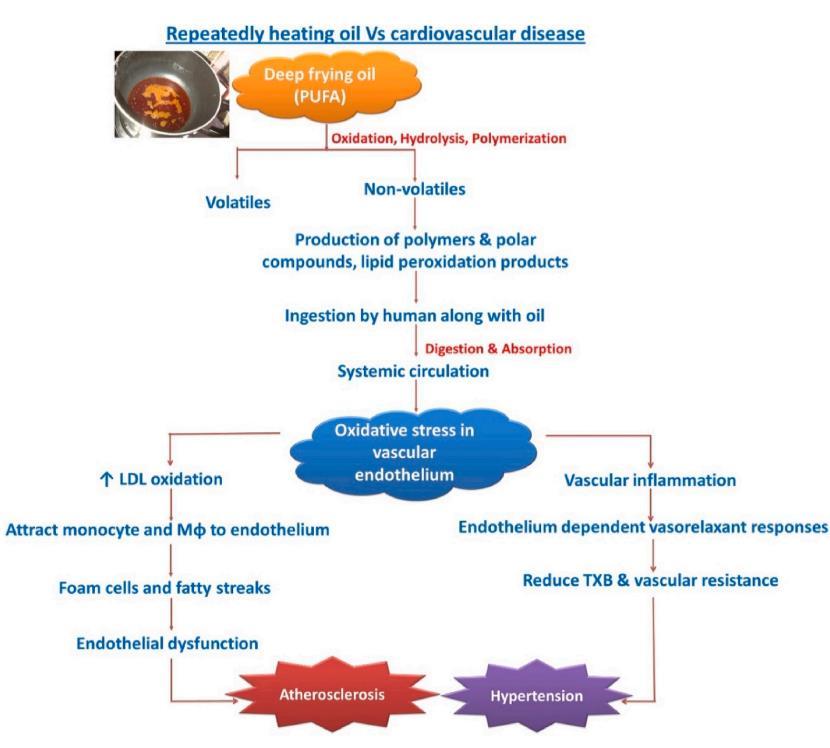
1. Relationship between repeatedly heated deep-frying oil and cardio vascular disease [17].
When waste cooking oils are discharged into sewers, they lead to the narrowing and blockage of sewagepipes,andimposingfinancialandenvironmental costs.Ifitisdumpedintolandfills,wastecookingoilcan still harm the environment through soil and water contamination. Waste cooking oil creates surface layers onaccountofitslowsolubilityinwaterwhichblocksthe penetration of sunlight and reduces dissolved oxygen concentrations in the water, both of which are detrimental totheaquaticecosystem Hence,conversion of WCO to bioenergy and biofuels not only prevent hazards but also contribute to enhance energy-security, food safety, and also promotes circular bioeconomy and sustainable development. About 50-71% reduction in negativeenvironmentalimpacts isseenbyconversionof waste cooking oil into biofuels instead of incineration [5].
Biodieselproducedbyusingwastecookingoilisthebest alternative to fossil fuels. It also reduces the amount of carbonemissionsascomparedtothatoffossilfuels.The WCO.biodieselcansave2270–2860kgCO2 eqpertonas compared to conventional diesel which rendering it as a great substitute to conventional fuels like diesel. The trans-esterification is one of the major emission sources in the biodiesel production process, it is more carbonefficient than first-generation biodiesel and fossil fuels
International Research Journal of Engineering and Technology (IRJET) e-ISSN:2395-0056
Volume: 12 Issue: 02 | Feb 2025 www.irjet.net p-ISSN:2395-0072
Theanalysis of data showed thatthecarbonfootprint of WCO. biodiesel was only about 553 kg CO2 eq per ton against that of petroleum-derived counterparts. The WCO biodiesel shows combustion benefits too, as it produces fewer harmful pollutants during combustion, includingparticulatematterandunburnedhydrocarbons that reduce environmental impacts. This is a contribution to a lower carbon footprint throughout its lifetime[5] ThelowestCO2 emissionwasrecordedwith blends of waste cooking oil-based biofuels as compared to that of biodiesel fuel which proves to be the environmental advantage of waste cooking oil-based biofuels[12]
2.3 Contribution in circular economy
Thewastecookingoilplaysasignificantroleinresource recovery. It can be classified as the sustainable and efficient feedstock in the circular economy maximizing biowasteutilizationanddisposalchallenges.TheWCOis most preferred raw material for biodiesel production andshowspotentialforproductionofvalue-addedgreen chemicals like bio-lubricants and biosurfactants. The industrial applications provide environmental and economic benefits by minimizing land use conflicts with thefoodsectorandpromotingsustainablealternativesin manufacturing[6].
2.4
The research on the costs of biodiesel production from waste cooking oils found that biodiesel production would be less than half the cost it takes for biofuelproductionusingvirginvegetableoils. Thewaste cooking oil is a raw material with high prospects for conversion into biodiesel as it is renewable, affordable andecologicallybenign.Thewastecookingoilcreatesno competition for food or land resources. Biofuel burns with less CO2 and damaging climate gases. The catalytic reactionsduringsynthesisofbiofuelbasedonthefactors like reaction duration, type, catalyst concentration and reaction temperature. The ratio of alcohol to oil and initial levels of FFAs in oil, influence the reaction. The waste cooking oils must be pretreated or esterified before the process of transesterification. The high FFAs maketransesterificationreactionverydifficult[7]
The biodiesel synthesis projects can create many job opportunities in society. The opportunities can be found in supply chain, processing, transportation, and collection. It spurs the establishment of organized collection systems in cities. The decentralization waste cooking oil projects allows empowerment of small and medium enterprises which help to urban and rural entrepreneurs to create sustainable businesses in meeting biodiesel demand and environmental concerns.
The biodiesel plants provides an alternative source of income in rural areas and also minimizing reliance of peoples on conventional fossil. The waste cooking oil plants will generate additional revenue streams for peoples. Thus, biodiesel will foster economic growth by adding valueand furthering circular economy objectives [8].
There are many countries in the world that have set biodiesel production benchmarks in conjunction with theirnationalclimateactionmeasures.Biodieseldemand has swelled mostly due to the EU mandate, stating that 10% of transport fuels should be derived from renewable energy. The prediction growth of 6.1 billion USDduring2022to8.9billionUSDby2028ataCAGRof 6.3% is quite possible in the global WCO market. IndustriesareencouragedtoadoptWCObasedbiodiesel production through tax credits and programs of carbon trading. Forthcoming generation biofuels obtained from WCO are qualified for incentives under the Renewable Energy Directive (RED) of Europe. The Geopolitical factors like war have peaked the price of conventional feedstock and hence the biodiesel producers turned to less expensive alternative of WCO from edible oils. The WCO biofuels now constitute 21% of the total biodiesel feedstock used in Europe. This bears testimony to the possible effects by both favourable policy and market changes[9]
2.7 Cost analysis of different biofuels feedstock
Table 1. Cost comparison of different biofuels feedstocks (as per year 2024)
Four types of feedstocks with respect to cost per metric ton is compared in Table 1. It is found that the costliest feedstock type is a Soyabean at approximately $1145.17/MT. Next in line is Palm oil at $982.83/MT. Then comes Methanol, valued at $832/MT, and the least expensive is waste cooking oil at approximately $775/MT.Fromthiscomparison,itisseenthatthewaste cooking oil is likely the cheapest feedstock type than others.
3.1 Advancements in conversion of waste cooking oil
Theheterogeneouscatalystsparticipateinreactiontasks without being completely consumed in the activity of transesterification and thus makes biodiesel manufacture simple. The nano catalysts have gained attention because of their better catalytic efficiency. Nano catalysts are has large surface area and therefore have intensified activity than normal catalysts in conversionofwastecookingoil[10].
International Research Journal of Engineering and Technology (IRJET) e-ISSN:2395-0056
Volume: 12 Issue: 02 | Feb 2025 www.irjet.net p-ISSN:2395-0072
Sr.No. Types of feedstocks Price (per metric ton) Sources
1. Methanol Approx. $832/MT [13]
2. Soyabean Approx. $114517/MT [14]
3. Palmoil Approx. $982.83/MT [15]
4. WasteCookingOil Approx. $775/MT [16]
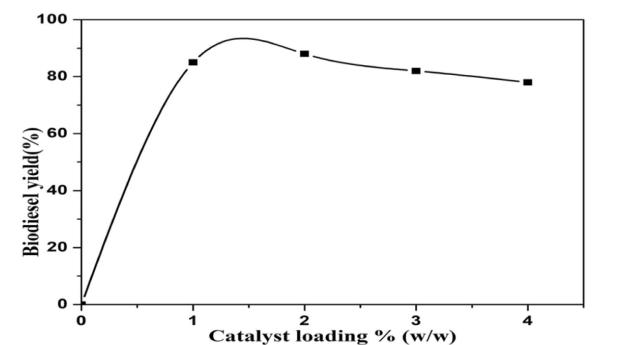
Figure 2: Effect of catalyst amount (wt.%) on biodiesel yield (%)
Catalyst loading effect over biodiesel yield is marked in figure 2. The graph shows that when MgO-SnO₂Nanocatalystloadingincreasedfrom1to 2wt.%ithasenhancedbiodieselyieldfrom85%to 88%, which emphasizes its efficiency in accelerating the transesterification reaction. Further exceeding catalyst loading than 2 wt.% reduces biodiesel yield due to active site blockage and aggregation which shows the need for optimal catalystconcentration[18].
3.2 Extension of catalytic actions using naturebased waste catalysts
The natural sources such as, such as egg shells, chicken bones, cow horns etc. are rich in calcium and potassium contents. It improved biodiesel production when calcinedandusedasheterogenouscatalyst.Thecatalysts are more useful because of their qualities of stability, reusability and saponification resistance in contrast to homogenous catalysts. The ultrasound-assisted transesterification as a mass transfer reaction allows better yield of biodiesel within shorter reaction period [11].
3.3 Integration with existing infrastructure
The physiochemical properties of biodiesel from waste cooking oil resemble those of high-performance diesel fuels. It can be effective to use as conventional diesel engineswithlittlemodifications.TheWCObasedbiofuel
in the form of hydrotreated vegetable oil (HVO) has remarkablepotentialasasustainableaviationfuel(SAF), which goes along with the goals of decarbonizing air travel in the aviation industry. The studies have shown that waste cooking oil generated biodiesel improves the performance of the engine and generates cleaner combustion with lower particulate, unburnt hydrocarbons, and carbon monoxide emissions as compared to that of traditional fossil fuel or diesel. The blends of fuels like B10 (10% biodiesel) and B20 (20% biodiesel) can be easily used with the existing fuel infrastructure to facilitate the transition to cleaner alternatives without making drastic modifications to engines[9]
There is an increasing demand for sustainable and renewable energy resources all over the world. The wastecookingoil basedbiofuel canbea bestalternative which is knocking at the doors as a substitute for conventional fossil fuels. The waste cooking oil is harmful to health after repeated heating and consumption.Theimproperdisposalofwastecookingoil causesenvironmentalpollution. However, wastecooking oilcanbeasustainablealternativeasarenewablesource of energy. The utilization of waste cooking oil lowers waste, less emission of green house gases and minimizingdependencyonfossilfuels.Theimprovement in catalytic technology and ultra sound-assisted transesterification has shown impetus to efficiency in producing biodiesel waste cooking oil. The projects on waste cooking oil help to create job opportunities and enhanceeconomyofpeoplesinsocietyanddevelopment of rural economy with the help of policy incentives by government and industrialist. In these initiatives continuousresearchandcollaborationofstakeholders is required. The adoption policy in terms of biofuel synthesis depend upon awareness campaigns, government support, and technology innovations Thus, conversion of waste cooking oil into biofuel vital option tocircularandsustainablebioeconomy.
[1] Long, Feng, Weiguo Liu, Xia Jiang, Qiaolong Zhai, Xincheng Cao, Jianchun Jiang,and Junming Xu."State-ofthe-art technologies for biofuel production from triglycerides: A review." Renewable and Sustainable Energy Reviews 148(2021):111269.
[2] Goswami, G., B. Rajni, and S. R. Mahipat. "Oxidation Of Cooking Oils Due To Repeated Frying And Human Health [Research] Department Of Applied Sciences." University Of Delhi (2015).
[3] Laufs, Ulrich, Klaus G. Parhofer, Henry N. Ginsberg, and Robert A. Hegele. "Clinical review on
International Research Journal of Engineering and Technology (IRJET) e-ISSN:2395-0056
Volume: 12 Issue: 02 | Feb 2025 www.irjet.net p-ISSN:2395-0072
triglycerides." European heart journal 41, no. 1 (2020): 99-109c.
[4] Aziz, Adriana Abdul, Saliza Mohd Elias, and Mohd Redzwan Sabran. "Repeatedly Heating Cooking Oil amongFoodPremiseOperatorsinBukitMertajam,Pulau Pinang and Determination of Peroxide in Cooking Oil." Malaysian Journal of Medicine & Health Sciences 14 (2018).
[5] Hosseinzadeh-Bandbafha, Homa, Abdul-Sattar Nizami, Soteris A. Kalogirou, Vijai Kumar Gupta, YoungKwon Park, Alireza Fallahi, Alawi Sulaiman et al. "Environmental life cycle assessment of biodiesel production from waste cooking oil: A systematic review." Renewable and Sustainable Energy Reviews 161 (2022):112411.
[6] De Feo, G.; Ferrara, C.; Giordano, L.; Osseo, L.S. Assessment of Three Recycling Pathways for Waste Cooking Oil as Feedstock in the Production of Biodiesel, Biolubricant,andBiosurfactant:AMulti-CriteriaDecision Analysis Approach. Recycling 2023, 8, 64. https://doi.org/10.3390/recycling8040064
[7] Banga, Sangita, and Vinayak V. Pathak. "Biodiesel production from waste cooking oil: a comprehensive review on the application of heterogenous catalysts." Energy Nexus 10(2023):100209.
[8] Nascimento, L.; Ribeiro, A.; Ferreira, A.; Valerio, N.; Pinheiro, V.; Araujo, J.; Vilarinho, C.; Carvalho, J. Turning Waste Cooking Oils into Biofuels Valorization Technologies: A Review. Energies 2022, 15, 116. https://doi.org/10.3390/en15010116
[9] Ceron Ferrusca, M.; Romero, R.; Martínez, S.L.; Ramírez-Serrano, A.; Natividad, R. Biodiesel Production from Waste Cooking Oil: A Perspective on Catalytic Processes. Processes 2023, 11, 1952. https://doi.org/10.3390/pr11071952
[10] Ghosh, Nabanita, Mehulee Patra, and Gopinath Halder. "Current advances and future outlook of heterogeneous catalytic transesterification towards biodieselproductionfromwastecookingoil." Sustainable Energy & Fuels (2024).
[11] Ashok, Chithra, Eniyaa Sankarrajan, P. Senthil Kumar, G. Janani, Ashwin Raj Suresh, Kirupa Sankar Muthuvelu, and Gayathri Rangasamy. "Ultrasoundassisted transesterification of waste cooking oil to biodiesel utilizing banana peel derived heterogeneous catalyst." Biotechnology for Sustainable Materials 1, no. 1 (2024):5.
[12] Azad, A. K., M. G. Rasul, Brady Giannangelo, and Rubayat Islam. "Comparative study of diesel engine
performance and emission with soybean and waste oil biodiesel fuels." International Journal of Automotive & Mechanical Engineering 12(2015).
[13] https://www.methanex.com/aboutmethanol/pricing/
[14]https://ycharts.com/indicators/soybean_oil_price
[15]https://www.statista.com/statistics/673385/month ly-prices-for-palm-oilworldwide/#:~:text=Published%20by,U.S.%20dollars% 20per%20metric%20ton
[16]https://uop.honeywell.com/en/industrysolutions/renewable-fuels/feedstock-price-vs-biofuelprice where-to-invest-your-project-capital
[17] Ganesan K, Sukalingam K, Xu B. Impact of consumption and cooking manners of vegetable oils on cardiovascular diseases-A critical review. Trends Food SciTechnol2018;71:132–54
[18] Velmurugan, Amirthavalli, and Anita R. Warrier. "Production of biodiesel from waste cooking oil using mesoporous MgO-SnO2 nanocomposite." Journal of EngineeringandAppliedScience69.1(2022):92.
© 2025, IRJET | Impact Factor value: 8.315 | ISO 9001:2008