
International Research Journal of Engineering and Technology (IRJET) e-ISSN: 2395-0056
Volume: 12 Issue: 07 | Jul 2025 www.irjet.net p-ISSN: 2395-0072
International Research Journal of Engineering and Technology (IRJET) e-ISSN: 2395-0056
Volume: 12 Issue: 07 | Jul 2025 www.irjet.net p-ISSN: 2395-0072
Shourya Gupta1 , Gargi Surse2
1Diploma Student, Department of Computer Engineering, Thakur Polytechnic, Kandivali East-400101
2 Diploma Student, Department of Computer Engineering, Thakur Polytechnic, Kandivali East-400101
Abstract - The collective activity of social insects like termites, ants, and bees has served as an inspiration for the developingdisciplineofswarmrobots.Swarmrobotsfunction by means of decentralized coordination among straightforward, reasonably priced agents, in contrast to conventional robotic systems that depend on centralized control and intricate individual designs. The fundamental design of swarm robotics, its main distinctions from traditional robotic systems, and its classification into homogeneous,heterogeneous,modular,aerial,undersea,and nano/micro types are all examined in this work. The paper also emphasizes the practical uses of swarm robots in fields including targeted drug delivery, urban trash management, military surveillance, disaster management, and wildfire detection. Swarm robots has several benefits because to its inherent scalability, fault tolerance, and adaptability; yet, issuessuchcoordinationcomplexityandrestrictedindividual capabilitiesstillexist.
Key Words: Swarm Robotics, Decentralized Systems, Multi-Agent Coordination, Aerial Drones, Biohybrid Microswimmers, Artificial Intelligence, Disaster Management, Autonomous Robots.
1.INTRODUCTION
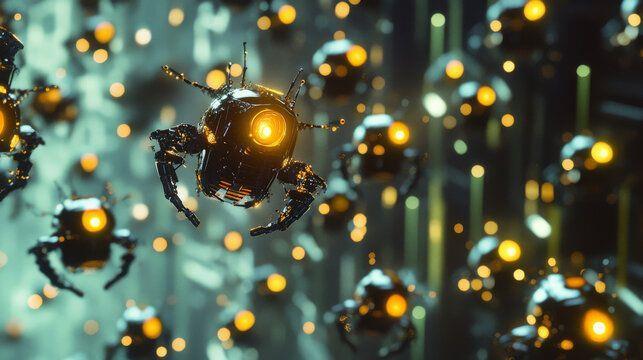
Swarm robots is a new kind of robot which is inspired by social insects organizations like ants, bees, termites and formationofbirdsinaflight.Thesearerobotsofdifferent types designed to work together more efficiently. This artificial intelligence study aims to develop new organizationalmethodsforanumberofsimple-structured robots. Robot technology, particularly Unmanned Aerial
Systems(UAS),isbecomingmoreaffordable,efficient,andis boostingthetransmissioncapacityofrobotsassolutionsto problems ranging from disaster relief to research mapping[2]Theyaimtobuildsystemsthataremorerobust, faulttolerantandflexiblethanasinglerobot.Thisconcept existssincethe1980s,thisbranchofroboticshasmanaged to move forward only at the enabling techniques which enforcedthisdevelopmentweretheevolutionofelectronic engineeringandinformationtechnology,withsmallerand morepowerfulelectroniccircuits,thefacilitiesofwireless communication,andtheassemblyofelectronicrobots.[3]
A single robot must have a complex structure and control modulesinordertodoacomplextask,whichraisesthecost ofdesign,manufacture,andmaintenance.Asinglerobotis fragile,particularlywhenalittlebrokenportionoftherobot affectstheentiresystem,makingitdifficulttoforecastwhat willhappen.Throughintergroupcollaboration,swarmrobots mayaccomplishthesamegoal.Italsobenefitsfromthelow cost of development and maintenance, as well as the reusabilityofsimpleagents.Swarmroboticsisparticularly well-suitedforlarge-scaleactivitiesandalsobenefitsfrom highparallelism.Bycontrastingthepertinentnaturalspecies ofdifferentresearchdomains,asinglerobotisinspiredby human behaviors, whereas swarm robotics is inspired by social animals. Because of the constraints of current technology,itischallengingtoreplicatehumaninteractions usingrobots orcomputers,even though theprocedures in animalgroupsareeasiertoimplement.Asa result,swarm robots has a promising future in solving intricate and significant issues.[8] Swarm robots emphasize the contributions of many individual robots, which sets them apartfromotherroboticsstudyfieldslikegeneraldistributed robotic systems. To provide efficient coordination, these robotsusewirelesstechnologiesincludingradioandinfrared for local communication. Swarm robots can accomplish complicated tasks that would be impossible for individual robotstocompletebyutilizingdistributedanddecentralized coordination among groups of simple, homogeneous robots.[9]
International Research Journal of Engineering and Technology (IRJET) e-ISSN: 2395-0056
Volume: 12 Issue: 07 | Jul 2025 www.irjet.net p-ISSN: 2395-0072
3.1.
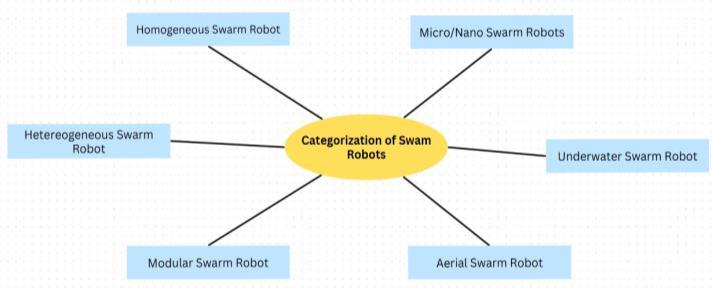
Homogeneousswarmrobotsaresystemsinwhichallrobots are physically identical and follow the same behavioral algorithms.Theserobotsrelyonsimplelocalinteractionsto achieve global objectives, making the system scalable and robust to individual failures. A popular example of this approach is the Kilobot system developed by Harvard University,whereover1,000identicalrobotsperformselforganization and collective behaviors such as shape formation. These types of swarms are suitable for applicationslikeenvironmentalmonitoring,coverage,and self-assemblytasks.[14]
3.2.
Heterogeneousswarmrobotsdifferfromthehomogeneous typeinthattherobotsmayhavedifferentcapabilities,suchas varied sensors, mobility types, or task assignments. This allows the swarm to perform more complex and complementary tasks simultaneously. For instance, in disaster scenarios, aerial drones can conduct wide-area surveyswhileground-basedrobotsnavigatedebristorescue victims.Thisdivisionoflabormakesheterogeneousswarms well-suited for search and rescue, exploration, and logistics.[15]
Modular swarm robots are designed with the ability to physically connect and disconnect from one another. This allows the swarm to reconfigure into different shapes or mechanical structures based on the task at hand. One prominentexampleisthe M-Blocks projectfromMIT,which usesmagneticallyactuatedcubesthatrollandattachtoone another to form useful configurations. These systems are especially beneficial for adaptive terrain exploration, construction,andself-repairapplications.[16]
Aerial swarm robots consist of Unmanned Aerial Vehicles (UAVs) that coordinate their flight patterns and task assignmentsthroughwirelesscommunicationandonboard
intelligence. These systems are capable of real-time mapping,areasurveillance,precisionagriculture,andeven artisticlightshows.Forexample,Intel’sdronelightshows andcoordinatedfirefightingdronesrepresentthisclass.The ability to maintain formation, divide regions, and operate autonomouslymakesaerialswarmshighlyeffectiveinopenspaceapplications.[17]
Underwater swarm robots are built to perform collective operationsinaquaticenvironments,oftenrelyingonsonar or light-based communication. These robots are ideal for oceanexploration,marinelifemonitoring,andunderwater pipeline inspections. Inspired by fish or aquatic insects, theseswarmscanoperatecollaborativelytomaptheocean floor or collect environmental data without human intervention. Their use is expanding rapidly in ecological researchandoffshoreindustries.[13]
Micro or nano-scale swarm robots are miniature devices ofteninspiredbybiologicalcellsormicroorganisms.These robots, also known as biohybrid microswimmers, can be poweredbybacteriaormagneticfieldsandarecapableof navigating inside the human body. Their key applications includetargeteddrugdelivery,non-invasivediagnostics,and microsurgery.For example, theycan travel through blood vessels to deliver medication directly to tumors, thereby improvingtreatmentefficiencyandreducingsideeffects.[17]
4. WHERE IS IT USED
International Research Journal of Engineering and Technology (IRJET) e-ISSN: 2395-0056
Volume: 12 Issue: 07 | Jul 2025 www.irjet.net p-ISSN: 2395-0072
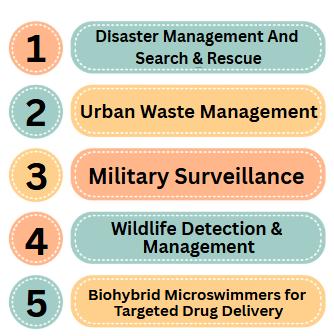
Swarmrobotshavebeenusedtohelpinsearchandrescue effortsindisaster-affectedareas.Theyarecrucialresources in emergency situations because of their capacity to coordinate efforts and traverse dangerous terrain. For example, a study that was published in the International Journal of Intelligent Systems and Applications in Engineering highlights the use of AI-powered robots in searchandrescueoperations,medicalsupplydelivery,and hazardous terrain navigation as part of disaster response andrecoveryefforts.[10]
Swarm robotics provides novel solutions for urban waste collectionbyallowingautonomousrobotstonavigatecity surroundings, collect rubbish, and adapt to changing conditionswithoutrequiringcentralizedsupervision.[12] Theviabilityofaswarmroboticssysteminanurbansetting isinvestigatedintheresearcharticle"UrbanSwarms:ANew Approach for Autonomous Waste Management". Through the use of bio-inspired foraging techniques including stigmergy-based navigation and multi-place foraging, the study shows how a swarm of robots can increase the autonomy and efficiency of urban trash management systems.[11]
4.3.
In defense, robot swarms can be used for patrolling, surveillance, or map generation in enemy territory. Their distributednaturemeansthefailureofafewunitsdoesn’t stop the overall task, making them resilient in missioncriticalsituations.
Swarm robotics can respond quickly, which improves situationalawareness,andworkindangerousenvironments thatarefrequentlyunreachablebyconventionalfirefighting techniques, it is being investigated for use in managing wildfires. Drones are being used more and more for both activesuppressionandearlywildfiredetectionbycombining sophisticated sensors, artificial intelligence (AI), and autonomousflightsystems. Thesesystemscandeployfire retardants,dropwaterpayloads,orperformlogisticaltasks such as equipment delivery in coordination with ground crewsandcrewedaircraft.[13]
Biohybridmicroswimmers, combining synthetic materials with biological components like bacteria, are being developedfortargeteddrugdeliverywithinthehumanbody. These microrobots can navigate to specific sites, such as
tumors,todelivertherapeuticagentsdirectly,overcoming challenges associated with conventional therapies. Their activelocomotion,targeting,andsteeringcapabilitiesmake thempromisingtoolsforprecisemedicalinterventions.[14]
Scalability and Robustness:Swarmsystemscan functionefficientlyevenwhenthenumberofrobots increases or decreases. If one robot fails, others continueworkingwithoutcentralfailure[8].
Low Cost and Simplicity: Swarm robots are typically made of low-cost components, reducing developmentandmaintenancecosts.Eachrobotis simple, making it easier to produce and replicate [9].
Decentralized Control: No central authority is required;decisionsaremadelocallybyindividual agents, which increases fault tolerance and flexibility[10].
Adaptability and Flexibility:Swarmsystemscan adapt to environmental changes and reconfigure themselvestoachievegoals[11].
Limited Individual Capability: Each robot has limitedsensingandcomputationpower,whichcan restrict the swarm's capabilities without sophisticatedcoordinationstrategies[12].
Communication Overhead:Maintainingeffective coordination among robots may cause communicationdelaysorinterference,especiallyin largeswarms[13].
Difficult Debugging and Control: Behavior emergesfrommanysimpleagents,whichmakesit hardtopredictordebugthesystemasawhole[8].
SecurityandVulnerability:Decentralizedsystems can be more vulnerable to malicious agents or hacking since there’s no centralized control to overseetrust[9].
Swarm robots has a bright future ahead of it, since developments are anticipated to greatly increase its capabilities and broaden its range of applications. Swarm robotswillbecomeincreasinglyintelligent,autonomous,and adaptiveasmachinelearning,artificialintelligence,andedge
International Research Journal of Engineering and Technology (IRJET) e-ISSN: 2395-0056
Volume: 12 Issue: 07 | Jul 2025 www.irjet.net p-ISSN: 2395-0072
computingadvance.Thefollowingmajorthemeswillshape swarmroboticsinthefuture:
ImprovedAutonomyandLearning: Swarmrobots of the future will use distributed AI and reinforcement learning to learn from their experiences and surroundings, enabling them to adjusttounpredictableandchangingcircumstances withoutcentralizedcontrol.
Scalability and Miniaturization: Smaller, more effectiverobotsthatcanworkingreaterquantities will be made possible by advancements in technology, allowing swarms to perform jobs in confined spaces, dangerous areas, or difficult-toreachplaceslikedeepoceans,collapsedstructures, orinsidethehumanbody.
Integration with IoT and 6G Networks: Futuregeneration networks that provide smooth communicationwillenablereal-timecoordination between cloud-based platforms and thousands of swarm agents, improving data interchange and responsiveness.
Multi-SwarmCollaboration: Inthefuture,studies may examine how various swarms, each with uniqueskills,cancooperatetoaccomplishintricate, multi-phase missions in fields like smart cities, disasterrelief,andspaceexploration.
Swarm robotics will essentially be crucial in determininghowautonomous systemsdevelopinthe future.Ithastheabilitytocompletelytransformhowwe handle challenging, large-scale activities in both the industrial and civilian sectors with ongoing multidisciplinaryresearchandinnovation
Swarm robotics is a paradigm shift in how we use autonomous systems to tackle large-scale, complicated challenges.Swarmrobotsprovideunparalleled benefitsin termsofscalability,faulttolerance,andflexibilitybyutilizing straightforward,decentralizedagentsthatcooperate.This articlehasshedlightonthedistinctdesignofswarmrobots, theirvarieties,andtheirexpandingapplicationsinavariety of fields, including defense, healthcare, environmental monitoring,anddisasterresponse.Rapiddevelopmentsin AI,networking,andminiaturizationaregraduallyremoving some of the remaining obstacles, such as communication overheadanddebuggingcomplexity.Swarmrobotics,which providesintelligent,adaptable,androbustsolutionstorealworld issues, is positioned to play a significant role in determining the direction of robotics as interdisciplinary researchdevelops.
[1] Dias,PollyannaG.Faria,MateusC.Silva,GeraldoP. RochaFilho,PatríciaA.Vargas,LucianoP.Cota,and Gustavo Pessin. 2021. "Swarm Robotics: A PerspectiveontheLatestReviewedConceptsand Applications" Sensors 21, no. 6: 2062. https://doi.org/10.3390/s21062062
[2] S hahzad, Muhammad Muzamal, Zubair Saeed, Asima Akhtar, Hammad Munawar, Muhammad Haroon Yousaf,Naveed KhanBaloach,andFawad Hussain. 2023. "A Review of Swarm Robotics in a NutShell" Drones 7, no. 4: 269. https://doi.org/10.3390/drones7040269
[3] Dias, Pollyanna G Faria et al. “Swarm Robotics: A PerspectiveontheLatestReviewedConceptsand Applications.” Sensors(Basel,Switzerland) vol.21,6 2062.15Mar.2021,doi:10.3390/s21062062
[4] MarcoDorigo,GuyTheraulaz,VitoTrianni.Swarm Robotics:Past,Present,andFuture.Proceedingsof the IEEE, 2021, 109 (7), pp.1152-1165. ff10.1109/JPROC.2021.3072740ff.ffhal-03362874
[5] M. Dorigo, G. Theraulaz and V. Trianni, "Swarm Robotics:Past,Present,andFuture[PointofView]," in ProceedingsoftheIEEE,vol.109,no.7,pp.11521165, July 2021, doi: 10.1109/JPROC.2021.3072740. keywords: {Robots;Swarm particle optimization;Design methodology;Robustness;Performance evaluation;Self-organizingnetworks},
[6] Cheraghi, A.R., Shahzad, S., Graffi, K. (2022). Past, Present,andFutureofSwarmRobotics.In:Arai,K. (eds) Intelligent Systems and Applications. IntelliSys 2021. Lecture Notes in Networks and Systems, vol 296. Springer, Cham. https://doi.org/10.1007/978-3-030-82199-9_13
[7] Jonas Kuckling, Rafael Passama, Nicolas Le FortPiat.“Recent Trends in Robot Learning and Evolution for Swarm Robotics.” FrontiersinRoboticsandAI, 2023, 10, Article 1134841. ff10.3389/frobt.2023.1134841ff.
[8] ScienceDirect. (n.d.). Swarm robotics. Retrieved from https://www.sciencedirect.com/topics/engineering /swarm-robotics
[9] AZoRobotics. (2021). What is swarm robotics? Retrieved from https://www.azorobotics.com/Article.aspx?ArticleI D=657
International Research Journal of Engineering and Technology (IRJET) e-ISSN: 2395-0056
Volume: 12 Issue: 07 | Jul 2025 www.irjet.net p-ISSN: 2395-0072
[10] Turgut, A. A. (2023). Artificial intelligence-based swarm robotics applications in disaster management. International Journal of Intelligent SystemsandApplicationsinEngineering,11(2).
[11] Mehmood, A. M. W., & Hasan, M. (2018). Urban swarms: A new approach for autonomous waste management (arXiv:1810.07910). arXiv. https://arxiv.org/abs/1810.07910
[12] Hamann, H. (2018). Swarm Robotics: A Formal Approach.Springer.https://doi.org/10.1007/9783-319-74528-2
[13] Bayındır,L.(2016). Areviewofswarmroboticstasks Neurocomputing, 172, 292–321. https://doi.org/10.1016/j.neucom.2015.05.116
[14] Brambilla,M.,Ferrante,E.,Birattari,M.,&Dorigo,M. (2013). Swarm robotics: A review from the swarm engineeringperspective.SwarmIntelligence,7(1),1–41.https://doi.org/10.1007/s11721-012-0075-2
[15] Chaimowicz,L.,Sugar,T.G.,Kumar,V.,&Campos,M. F. M. (2003). An architecture for tightly coupled multi-robot cooperation IEEE International Conference on Robotics and Automation. https://doi.org/10.1109/ROBOT.2003.1241792
[16] Yim, M., Shen, W. M., Salemi, B., Rus, D., Moll, M., Lipson, H., & Klavins, E. (2007). Modular selfreconfigurable robot systems IEEE Robotics & Automation Magazine, 14(1), 43–52. https://doi.org/10.1109/MRA.2007.339623
[17] Chung,S.J.,Paranjape,A.A.,Dames,P.,Shen,S.,& Kumar,V.(2018). Asurveyonaerialswarmrobotics IEEE Transactions on Robotics, 34(4), 837–855. https://doi.org/10.1109/TRO.2018.2857475
[18] Nelson,B.J.,Kaliakatsos,I.K.,&Abbott,J.J.(2010). Microrobotsforminimallyinvasivemedicine. Annual Review of Biomedical Engineering, 12, 55–85. https://doi.org/10.1146/annurev-bioeng-010510103409