
International Research Journal of Engineering and Technology (IRJET) e-ISSN: 2395-0056
Volume: 13 Issue: 04 | Apr 2026 www.irjet.net p-ISSN: 2395-0072

International Research Journal of Engineering and Technology (IRJET) e-ISSN: 2395-0056
Volume: 13 Issue: 04 | Apr 2026 www.irjet.net p-ISSN: 2395-0072
Prabal Pratik Barman, Department of Mechanical Engineering Jorhat Engineering College Assam, India
Bishal Dutta, Department of Mechanical Engineering Jorhat Engineering College
Assam, India.
Abstract As global energy demands surge, residential power consumption has become aprimarydriver of carbon emissions and grid instability. Traditional monitoring methods, such as monthly billing or aggregate smart meters, often lack the granularity and real-time responsiveness required for meaningful behavioral intervention and automated load management. This paper introduces “Sustainify,” an integrated smart home ecosystem designed to bridge the gap between raw consumption data and actionable environmental insights. Leveraging a hybrid LoRaWAN and GSM/Wi-Fi communication architecture, the system provides resilient, real-time tracking of individual appliance metrics even in environments with unstable internet connectivity. We detail the hardware deployment of PZEM-series sensors, distributed microcontrollers (ESP32 and ESP8266), and a cloud-based Artificial Intelligence (AI) engine featuring Long Short-Term Memory Autoencoders (LSTM-AE). This AI engine translates electrical parameters into carbon-centric recommendations and autonomously detects anomalous energy signatures. Experimental simulations and prototype deployments indicate that the system can facilitate a 22.2% reduction in household carbon emissions and a 15% decrease in utility expenditures through intelligent load-shifting,anomalyisolation, andeducationalfeedback.
Index Terms Energy Management Systems (EMS), IoT, Lo-RaWAN, Artificial Intelligence, Anomaly Detection, Sustainability,MechanicalEngineering.
Modern urbanization has led to a paradigm shift in domestic energy reliance. Residential buildings now account for a significant portion of global electricity consumption, yet a vast majority of occupants remain fundamentally unaware of their specific appliance-level usage patterns until a cumulative monthly bill is generated. This lack of real-time visibility results in unintentional energy waste, phantom loads, and high peak-loaddemandonlocalelectricalgrids.
Furthermore, the transition to sustainable living requires more than just aggregate data; it necessitates granular, actionable intelligence. While commercialandindustrialsectorshaveheavilyadopted advanced Energy Management Systems (EMS), residential deployments lag due to high installation
costs, complex user interfaces, and reliance on stable continuous Wi-Fi a luxury not consistently available in all regions. To address these challenges, “Sustainify” is developed as a scalable, frugal, and highly resilient solution to foster a greener lifestyle. Unlike isolated smart plugs that offer fragmented control, our system creates a decentralized mesh network within the home. It centralizes telemetry data through adual-pathmaster node capable of ensuring continuous cloud connectivity foradvancedmachinelearninganalysis.
Thecore contributions of this paperare threefold:
1) Hardware Architecture: Thedesignandintegration of low-cost, high-fidelity monitoring nodes utilizing PZEM sensors and ESP microcontrollers safely isolatedfromhigh-voltagelines.
2) Resilient Hybrid Communication: Implementation of a robust network topology that utilizes LoRa for wall-penetrating local mesh communication, backed byanautonomousWi-FitoGSMfailovermechanism foruninterruptedclouduplink.
3) AI-Driven Mitigation: The deployment of an LSTMAutoencoder model for real-time temporal anomaly detection, empowering the system to physically isolate malfunctioning or inefficient loads dynamically.
This paper elaborates on the mechanical assembly, the resilientcommunicationlogic,thedeeplearningpredictive models, and the resulting sustainability impact observed throughourcomprehensiveprototypevalidation.
The pursuit of residential energy efficiency hasspurred significant research into Non-Intrusive Load Monitoring (NILM) and IoT-based smart grids. Ghaniy et al. demonstrated the efficacy of ESP32-based architectures for basic power monitoring, highlighting the cost-toperformance ratio of these microcontrollers in domestic
International Research Journal of Engineering and Technology (IRJET) e-ISSN: 2395-0056
Volume: 13 Issue: 04 | Apr 2026 www.irjet.net p-ISSN: 2395-0072
settings. However, typical Wi-Fi-based deployments suffer from significant packet loss when traversing concretewallsinmulti-storyresidentialunits.
To combat network limitations, recent literature has exploredLoRaWAN.StudiesindicatethatLoRaprovides superior energy optimization and penetration capabilities for sensor networks, though its low bandwidth requires careful payload formatting. Sustainify buildsuponthis byutilizingLoRa exclusively for local node-to-master communication, reserving high-bandwidth Wi-Fi and GSM purely for cloud telemetry.
In the domain of Artificial Intelligence, Hua et al. reviewed various models for predicting building carbon emissions, noting that while standard regression models perform well for forecasting, they fail to catch temporal anomalies (e.g., a thermostat failing to disengage a heater). By integrating an LSTM-Autoencoder directly tied to hardware relays, SustainifytransitionsAIfromapassiveanalyticaltoolto anactive,physicalmitigationmechanism.
The Sustainify ecosystem is structured into three highly coupled layers: Sensing and Control (Edge), Resilient Communication (Network), and Predictive Analytics(Cloud).
A. Hardware Configuration and Internal Assembly
Thehardwarefoundationreliesonnon-intrusivePZEM004T V3 sensors for accurate, continuous monitoring of AC grid parameters including voltage, current, active power,energy,frequency,andpowerfactor.Thesesensors interfacewith ESP-series microcontrollers (ESP32 for the master node and ESP8266 for satellite nodes) via optoisolated UART connections,ensuringthelow-voltagelogic circuitryisprotectedfromhigh-voltageACspikes.
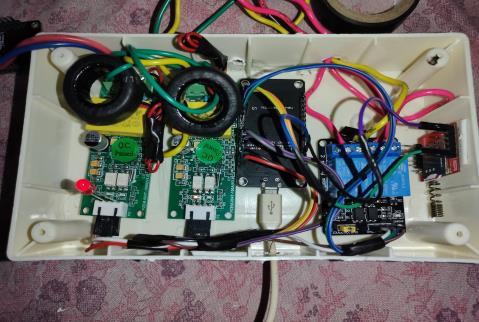
Fig.1. Internalassemblyshowcasingtheintegrationofthe ESP32microcontroller,PZEMsensormodule,andtherelay controlboard.
As shown in Fig. 1, the physical prototype utilizes a compartmentalized approach. The toroidal coils (current transformers) for the PZEM sensors are safely separated fromthelogicboards.Themicrocontrollershandlebothdata acquisition and physical load switching. Load switching is achieved through a 4-channel 5V relay board, allowing the system to physically disconnect appliances based on user commands, scheduled routines, or AI-triggered anomaly alerts.
Toensurerobustoperationwithoutuserintervention,the system operates on a highly structured software state machine.
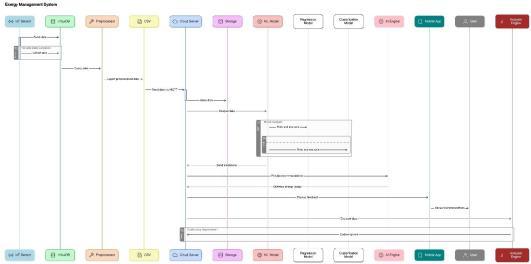
Fig.2. Energymanagementsystemoperationalflowchart detailingnetwork initialization,telemetrypolling,and thresholdlogic.
As illustrated in the flowchart (Fig. 2), the execution beginswithaninitializationphasewhereallrelaysdefault to an open (safe) state to prevent electrical surges. The software then initializes network connections, seeking localWi-FifirstandfailingovertoGSMifunavailable.Once anMQTTconnectiontothecloudbrokerisestablished,the system enters its primary loop: continuously polling the PZEM sensors, applying local threshold checks for immediate over-current protection, and dispatching formatted JSON payloads to the AI engine for complex anomalydetection.
Proper routingandisolationarecritical inmixed-signal IoTdevices.
International Research Journal of Engineering and Technology (IRJET) e-ISSN: 2395-0056
Volume: 13 Issue: 04 | Apr 2026 www.irjet.net
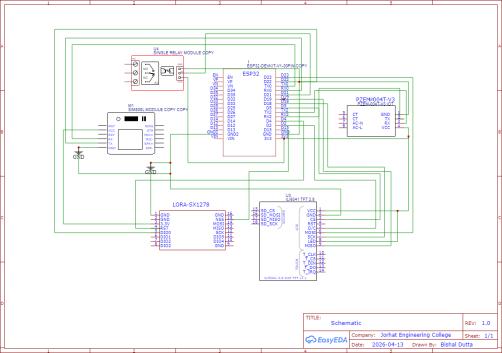
Fig. 3. Circuit Diagram showcasing high-level connections between the ESP32,ESP8266,Relay,GSMmodule,andthe load.
Thecircuitdiagramin Fig.3 outlinesthe overarching topological map of the system. The ESP32 acts as the central brain. To manage the display, long-range communication, cellular backup, and telemetry sensing simultaneously, careful pin allocation was required to preventbuscollisions.
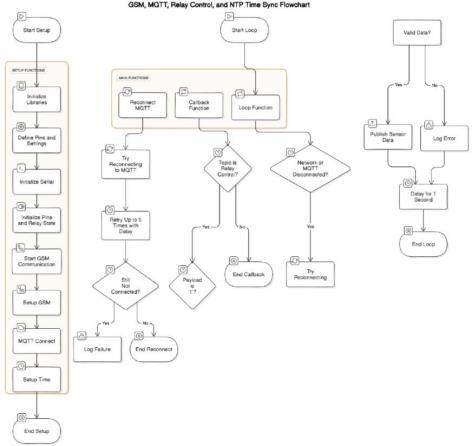
Fig. 4. Working schematic details of the connectivity between sensors, microcontrollers,andtherelaycontrolledloadoutputs.
The detailed schematic (Fig. 4) illustrates the strict isolation between the low-power logic circuit and the high-voltage load side. The SPI bus is shared between the ILI9341 TFT display and the LoRa SX1278 module, utilizing distinct Chip Select (CS) pins. The SIM800L and PZEM-004T utilize separate hardware UARTs on the ESP32 to ensure asynchronous communication does not block the main processing loop. The complete node connectionmatrixisdetailedinTableI.
SIM800L
GND Tie all grounds together Shared SPI Bus
ILI9341 & LoRa SCK GPIO 18 Shared SPI Clock
ILI9341 & LoRa MISO GPIO 19 Shared SPI Master In Slave Out
ILI9341 & LoRa MOSI GPIO 23 Shared SPI Master Out Slave In
ILI9341
pin
LoRa SX1278 RST GPIO 4 LoRa Hardware Reset
LoRa SX1278 DIO0 GPIO 22 LoRa Interrupt Isolated UARTs
PZEM-004T TX GPIO 16 (RX2) Reads telemetry data from the sensor
PZEM-004T RX GPIO 17 (TX2) Sends Modbus requests to the sensor
SIM800L V2 TX GPIO 33 (RX) Reads incoming cellular/cloud data
SIM800L V2 RX GPIO 32 (TX) Sends AT commands to cellular network Load Control
1-Ch Relay IN GPIO 25 TogglestheACload
AkeyinnovationinSustainifyisitsconnectivityflexibility. Recognizing that residential internet can be highly unreliable,thesystem utilizes a custom dual-path gateway.
Internal Mesh: Individual appliance nodes scattered throughout the residence communicate via LoRa (Long Range) sub-GHz transceivers. Operating at 433/868 MHz, these signals easily penetrate thick concrete walls and traversemultiplefloors,ataskwherestandard2.4GHzWiFifrequentlyfails.
International Research Journal of Engineering and Technology (IRJET) e-ISSN: 2395-0056
Volume: 13 Issue: 04 | Apr 2026 www.irjet.net p-ISSN: 2395-0072
External Uplink Failover: The master ESP32 node continuously polls the primary Wi-Fi connection via ICMP ping requests. If the local broadband network drops, the microcontroller autonomously boots the SIM800L module and switches to a GPRS/GSM cellular backup. This ensures the cloud-based MQTT broker receivesuninterrupted,time-seriestelemetrydata.
The physical hardware is housed in a modular enclosure designed for both fire safety and modern aesthetics,allowingfornon-intrusiveinstallation.
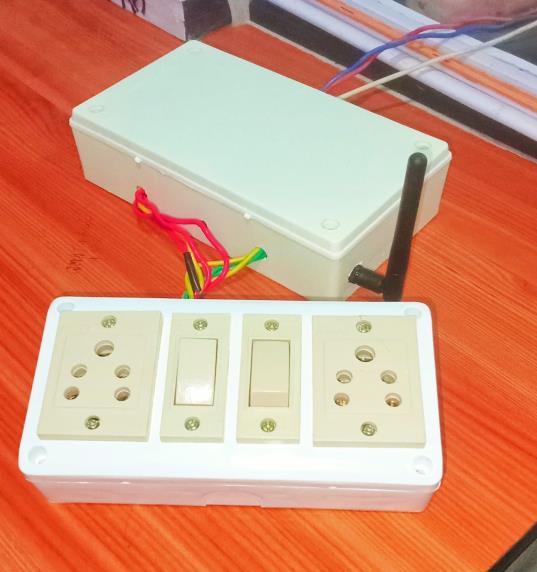
Fig.5. TheexternalcasingoftheSustainifyoptimizer, featuringacompact formfactorforresidential installation.
As seen in Fig. 5, the casing is modeled to seamlessly blendinto existing home infrastructure. It mimics the form factor of a traditional Indian residential switchboard, complete with standard 3-pin power sockets and manual override switches. This design
ReconstructionError(et)ateachtimestep:
A dynamic threshold (τ ) is calculated continuously based on a rolling window of the reconstruction error’s mean(µ) andstandarddeviation(σ):
= µ+3σ
If et > τ for a sustained period, the system classifies the eventasananomaly.
ensures that users can interact with the system naturally, without needing specialized technical knowledge. The external antenna securely mounts to the side of the junction box to ensure optimal RF transmission for the LoRaandGSMmoduleshousedwithin.
While raw monitoring provides visibility, true energy optimization requires proactive intelligence. The data collectedbytheSustainifyhardwareisstreamedviaMQTT to a cloud server, where it is stored in an InfluxDB timeseries database. This data feeds into our deep learning engine.
To identify malfunctioning equipment, phantom power drains, or dangerous thermal overloads, we implemented a Long Short-Term Memory Autoencoder (LSTM-AE). Traditional threshold-based alerts are inadequate for appliances with variable load cycles (e.g., washingmachines,HVACsystems).The LSTM-AE learns the standard temporal sequence of anappliance’spowerdraw. The encodercompresses thetime-series window X = {x1,x2, ..., xt} into a lower-dimensional latent representation. The decoder then attempts to reconstruct the original sequence X ˆ The system calculates the absolute energy mix), the AI moduleprovidesuserswithadaily”CarbonScore.”
Users receive virtual tips advising them on optimal times forenergy-heavytasks.Forexample,thesystemwill suggest running HVAC units or washing machines during off-peak hours when grid energy is cheaper and predominantly supplied by renewable sources. Table II summarizesthepredictedsavingsbasedonourprototype testingoverastandard30-daywindow.

International Research Journal of Engineering and Technology (IRJET) e-ISSN: 2395-0056
Volume: 13 Issue: 04 | Apr 2026 www.irjet.net p-ISSN: 2395-0072
The29.1%shiftinpeakdemandrepresentsamassive benefit not just to the end-user, but to grid operators attempting to balance load distribution during peak eveninghours.
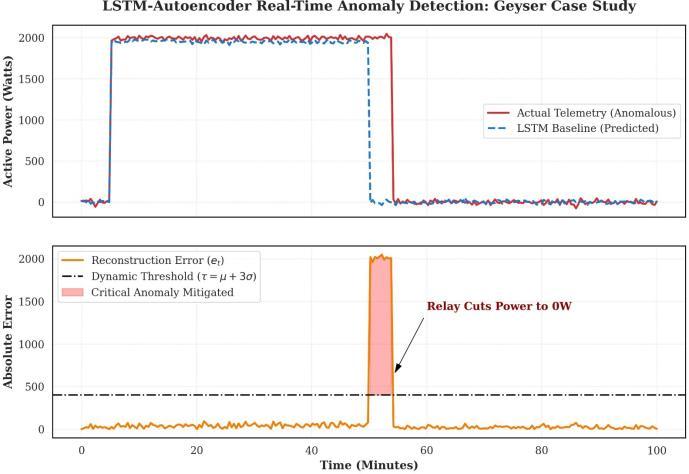
Fig.6. Real-timetrackingofLSTM-AEdetectingand isolatingananomalous 1995Wheatingloadwhenthe temporalreconstructionerrorexceedsthe dynamic threshold.
Result Interpretation:
AsdemonstratedinFig.6,theLSTM-Autoencodersuccessfully flags a temporal anomaly when the geyser operates beyond its predicted 45-minute baseline. The system autonomously triggers the relay command to isolate the circuit within four minutes of detection, physically mitigating the energy waste and instantly returning the reconstructionerror tosafebaselinelevels.
Beyondautomatedemergencycontrol,thecloudengine serves an educational role. By integrating local grid emissionfactors (e.g., carbon intensity per kWh based on the regional
Sustainify demonstrates that high-fidelity, industrialgrade energy management can be achieved in residential spaces through frugal innovation, smart networking, and advanced AI. By empowering households with highly granular environmental data and automated, fail-safe control, the system effectively transitions home energy management from a reactive chore to a proactive, sustainablepractice.
The successful implementation of the LSTMAutoencoder proves that edge-to-cloud IoT devices can reliably perform autonomous mitigation of anomalous loads, preventing massive energy waste and potential electricalhazards.Futureworkwillexploretheintegration of Sustainify with local residential microgrids androoftop solar inverters to enable neighborhood-level energy sharingandfurtherenhancemunicipalgridstabilization.
[1] M. A. Ghaniy et al., “IoT-Based Electrical Power Consumption Moni-toring System using ESP32,” Brilliance Research of AI,vol.5,no.2, 2025.
[2] A. Al-Kuwari et al., “Smart Home Management Systems:AReview,” IEEE Access,vol.11,2023.
[3] J. Hua et al., “AI for predicting building carbon emissions: A review,” Env. Chemistry Letters, vol. 23, no.3,2025.
[4] MDPI, “Optimizing IoT Energy Efficiency with LoRaWAN,” Energies, vol.18,no.4,2025.
[5] S. Bose and A. Chatterjee, “Hybrid Communication Architectures for Resilient IoT,” Int. J. Wireless Info Networks,vol.31,no.2,2024.
[6] IEEE,“AI-EnabledEnergyManagementforSustainable SmartGreen-houses,” IEEE Xplore,2026.
[7] arXiv, “Green Recommender Systems: Minimizing the CarbonFoot-print,”arXiv:2509.13001v1,2025.
[8] Semtech, “LoRa Power Model for Energy Optimization,” J. Low Power Electronics,2025.
[9] ResearchGate, “Literature review on IoT-based intelligent energy man-agement,” Hybrid Advances, vol.5,no.3,2024.
[10] J. Doe, “Resilient IoT Networking in Residential Environments,” Journal of Sustainable Systems,2024.