
International Research Journal of Engineering and Technology (IRJET) e-ISSN: 2395-0056
Volume: 13 Issue: 03 | Mar 2026 www.irjet.net p-ISSN: 2395-0072
International Research Journal of Engineering and Technology (IRJET) e-ISSN: 2395-0056
Volume: 13 Issue: 03 | Mar 2026 www.irjet.net p-ISSN: 2395-0072
Krushna Vasant Jaiswal1 , Prof. Snehal Vidhale2
1 Bachelor of Architecture Student, P.R.P.C.O.A., Amravati, Maharashtra, India
2Professor, Department of Architecture, P.R.P.C.O.A., Amravati, Maharashtra, India
Abstract - Religious institutions in India serve as major cultural and social centres, attracting thousands of visitors daily. Activities such as offering flowers, distributing prasad, and community cooking generate significant quantities of solid waste. A large portion of this waste is biodegradable, including flowers, coconuts, and food residues, while the remaining consists of plastic and paper waste. Improper disposal of such waste leads to environmental degradation and sanitation issues.
This study examines the potential for implementing a sustainable waste recycling system within the Ambadevi TemplecomplexinAmravati. Casestudiesofsuccessfulwaste management practices in major pilgrimage centers are analysedtounderstandeffectivestrategiesandbestpractices. Based on estimated waste generation and existing site conditions, a conceptual model is proposed that integrates waste segregation, composting, biogas generation, and dry waste management.
The research highlights that the integration of decentralized waste management systems into temple infrastructure can significantly reduce landfill waste, improve sanitation, and encourage sustainable practices within religious environments.
Key Words: Temple waste management, Sustainable infrastructure, Composting, Biogas, Pilgrimage architecture, Recycling systems
TemplesinIndiaareamongthemostactivepublicspaces, accommodating large numbers of devotees daily. These activitiesgeneratesubstantialwaste,primarilyfromritual offerings and food distribution. Organic waste such as flowers,leaves,coconuts,andfoodresiduesformsamajor component, while plastic packaging and paper waste contributetonon-biodegradablewaste.
With increasing visitor footfall, traditional waste disposal methodsarebecominginadequate.Accumulatedwasteleads to hygiene issues, unpleasant surroundings, and environmental damage.Therefore,integratingsustainable wastemanagementsystemsintotempleinfrastructurehas becomeessential.
This study focuses on the Ambadevi Temple in Amravati, aimingtodevelopasustainableandsite-responsivewaste recyclingsystem.
Previous studies indicate that temple waste is predominantly biodegradableandsuitable for sustainable processingmethods.
Composting convertsorganicwasteintonutrientrichfertilizerusedinlandscaping.
Biogas generation uses anaerobic digestion to produce methane from food waste, which can be usedasenergy.
Recycling systems handleplasticandpaperwaste efficiently.
Casestudiesshowsuccessfulimplementation:
Large temples have adopted segregation + composting systems
Flowerwasteisconvertedintoincenseproducts
Foodwasteisprocessedintobiogas
These approaches highlight the feasibility of integrating waste recycling systems within temple environments withoutaffectingreligiousactivities.
Thestudyfollowsacombinedqualitativeandquantitative approach.
The Ambadevi Temple experiences continuous footfall throughout the year, with peak numbers during festivals. Waste generation is directly linked to visitor volume and ritualactivities.
3.2 Waste Generation Estimation
Toestimatewastegeneration:
Average daily visitors (normal days): 10,000–15,000
International Research Journal of Engineering and Technology (IRJET) e-ISSN: 2395-0056
Peakdays:20,000+ Assumption:
Wastegeneratedperperson≈0.25kg
Estimatedtotalwaste:
Normal days: 10,000×0.25=2.5tons/day
Peak days: 20,000×0.25=5tons/day
3.3 Waste Composition Analysis
Nearly65%isbiodegradable
3.4 Design Approach
Adecentralizedwasterecyclingsystemisproposedwiththe followingcomponents:
Wastesegregationzone
Compostingunit
Biogasplant
Drywastestorage
Serviceaccessandmaintenancearea
Thesystemislocatedina servicezone,ensuringseparation fromsacredareas.
4.1 Integrated Waste Management Model
Theproposedsystemfollowsaclosed-loopapproach:
1. Wastecollectionfromtempleareas
2. Segregationintowetanddrywaste
3. Processing:
o Organic→Composting+Biogas
o Drywaste→Recyclingstorage
The proposed waste management processis illustrated in Fig.1.
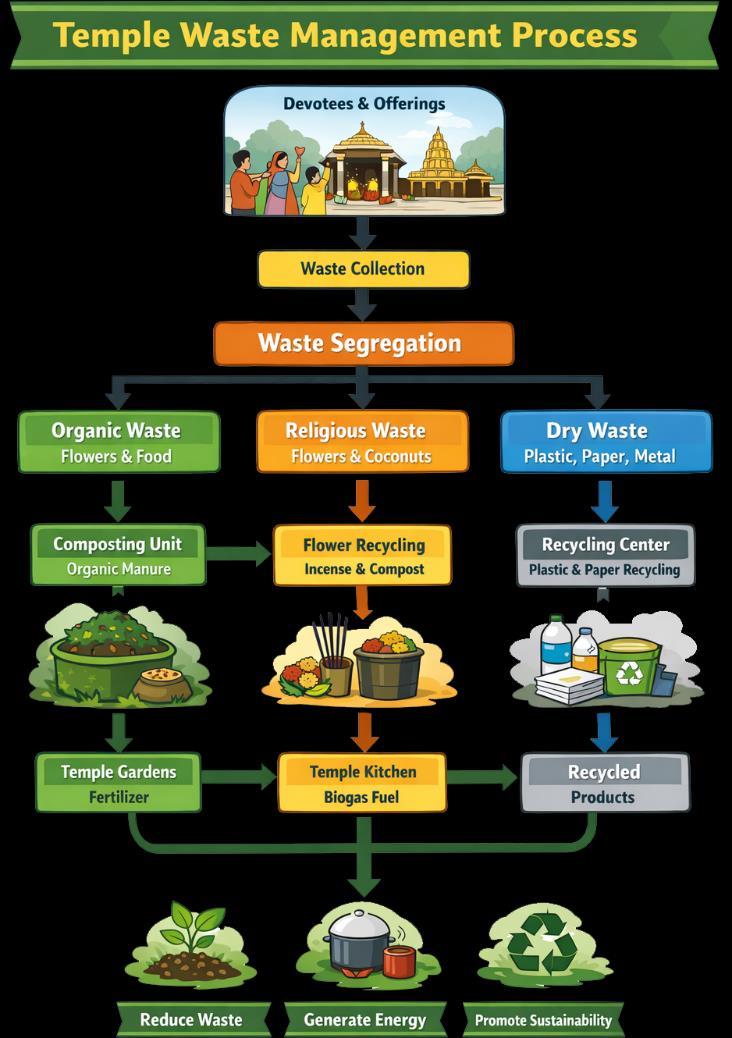
Fig -1:IntegratedTempleWasteManagementand RecyclingProcess
4.2 Key Innovations
Temple-specific waste zoning integrated into architecturalplanning
Decentralizedrecyclingunitwithincampus
Combinationofcomposting+biogassystem
Useofcompostintemplelandscapeareas
Energygenerationforkitchenuse(biogas)
4.3 Area Requirement
Totalrequiredarea:200–250sq.m
Volume: 13 Issue: 03 | Mar 2026 www.irjet.net p-ISSN: 2395-0072 © 2026, IRJET | Impact Factor value: 8.315 | ISO 9001:2008
International Research Journal of Engineering and Technology (IRJET) e-ISSN: 2395-0056
Volume: 13 Issue: 03 | Mar 2026 www.irjet.net p-ISSN: 2395-0072
Includes:
Compostpits
Biogasplant
Sortingplatform
Storagespace
5. Results and Analysis
Theproposedsystemcan:
Reducelandfillwasteby60–70%
Improvesanitationwithintemplepremises
Convertwasteintousefulresources:
o Compostforlandscaping
o Biogasforcooking
Italsoensures:
Betterwastehandlingduringpeakevents
Reducedenvironmentalimpact
Improvedvisitorexperience
6. Conclusion
Wastegenerationintemplecomplexesisunavoidabledueto religious practices and high visitor numbers. However, impropermanagementleadstoenvironmentalandhygiene issues.
This study demonstrates that sustainable waste recycling systems can be effectively integrated into temple infrastructure.Byadoptingsegregation,composting,biogas generation, and recycling, temple complexes can become self-sustainingandenvironmentallyresponsible.
The proposed model for Ambadevi Temple serves as a replicableframeworkforotherpilgrimagesitesinIndia.
[1] CentralPollutionControlBoard.(2021). MunicipalSolid Waste Management Guidelines.GovernmentofIndia.
[2] Government of India. (2022). Sustainable Waste Management Practices in Pilgrimage Centers R. Nicole, “Titleofpaperwithonlyfirstwordcapitalized,”J.Name Stand.Abbrev.,inpress.
[3] Sharma, R. (2020). Environmental sustainability in religious tourism. Journal of Sustainable Development, 12(3),45–52.
[4] Tirumala Tirupati Devasthanams. (2023). Waste Management Initiatives in Temple Towns
[5] Shirdi Sai Baba Sansthan Trust. (2022). Sustainable Waste Recycling Practices.
[6] Gupta,S.,&Arora,M.(2019).Solidwastemanagement in pilgrimage centers: A case study approach. International Journal of Environmental Science and Technology,16(5),2345–2356.
[7] Kumar,A.,&Agrawal,R.(2021).Decentralizedorganic waste management using composting and biogas technology. JournalofCleanerProduction,278,123456.