
International Research Journal of Engineering and Technology (IRJET) e-ISSN:2395-0056
Volume: 12 Issue: 08 | Aug 2025 www.irjet.net p-ISSN:2395-0072
International Research Journal of Engineering and Technology (IRJET) e-ISSN:2395-0056
Volume: 12 Issue: 08 | Aug 2025 www.irjet.net p-ISSN:2395-0072
1Mohadeb Dutta, 2*Sindhu J. Nair, 3Manish Kumar
1MTech. Scholar, Department of Civil Engineering, Bhilai Institute of Technology, Durg G.E. Road, Bhilai, Durg, 491001. 2*Department of Civil Engineering, Bhilai Institute of Technology, Durg G.E. Road, Bhilai, Durg, 491001.
3Department of Mechanical Engineering, Bhilai Institute of Technology, Durg G.E. Road, Bhilai, Durg, 491001.
Abstract: The steel industry, pivotal to global economic development, faces critical challenges in managing massive byproduct and waste generation. In India, steel plants generate approximately 600 kg of solid waste per tonne of crude steel, contributing significantly to environmental concerns (Ministry of Steel, 2023). This study examines the valorization of key steelmaking by-products, specifically those from Tata Steel's Jamshedpur facility, through cold briquetting technology. Experimental evaluation revealed that briquettes formulated from LD sludge, blast furnace dust, mill scale, and other fines achieved robust mechanical performance, with a tumbler index of 48% and an abrasion index of 3.63%, indicating excellent resistancetoimpactand wear.Chemically,these briquettes maintained Fe content above 40%, with controlled levelsof CaO, SiO₂, and other minor oxides. Thermal reduction tests between 1000°C and 1400°C confirmed a clear trend of decreasing swellingindex,from18%at1000°Cto4%at1400°C,ensuringdimensionalstabilitywithinblastfurnaceconditions.Notably, theintegrationofthesebriquettesintotheblastfurnaceburden(atsubstitutionlevelsof3%and5%)demonstratedenhanced reductionefficiencyandminimizedoperational swelling.Theseresultsunderscore thepotential forwaste-derivedbriquettes to reduce landfill demand, close resource loops, and improve operational efficiency, thereby supporting the steel sector’s sustainabilityandIndia’sambitioussteelproductiontargets.
Keywords: Steelindustry,coldbriquetting,solidwasteutilization,resourcerecovery,metallurgicalproperties,sustainability, TataSteel
The iron and steel industry remains a cornerstone of industrial growth and economic progress worldwide, despite a steady proliferationofadvancedmaterials(WorldSteelAssociation,2021).Sincethemid-20thcentury,globalsteeloutputhasrisen dramatically, from 200 million tonnes in 1950 to over 1.8 billion tonnes by 2020, with Asia, led by China, dominating productionlandscapes(Senguptaetal.,2019;WorldSteelAssociation,2021).However,alongsidethisgrowth,thesteelsector is facing mounting challenges posed by resource depletion, escalating energy costs, and, critically, the management of vast solidwastestreams(Singh&Prakash,2020).
Sustainable steel production necessitates not only process improvements but also comprehensive strategies for the valorizationofby-productsandwaste,asintegratedsteelplantsgenerateanarrayofsolid,liquid,andgaseous residues(Das etal.,2007).Ofthese,solidresiduesincludingblastfurnace(BF)andbasicoxygenfurnace(BOF)slags,sludges,millscales,flue dust, and spent refractories, represent both a significant challenge and a unique opportunity. While traditional disposal practiceshavehistoricallydominatedthesector,stricterregulationsandlandscarcityarepropellingindustriestowardzerowasteobjectives(Kumaretal.,2018).
Environmental data suggeststhatiron and steel production is responsible for 5–7%of global anthropogenic greenhouse gas emissions (IEA, 2022), urging the sector to adopt innovative waste reduction, recycling, and utilization techniques. Recent advancements in beneficiation, agglomeration, and resource recovery have allowed some plants to approach 95–97% waste recyclingrates,inlinewithbestpracticesobservedinEuropeandJapan(Yuanetal.,2017;Duttaetal.,2019).
India's steel industry, the world's second largest, is similarly evolving. Major steel plants produce upwards of 100 million tonnes of crude steel per year, accompanied by an estimated 60 million tonnes of solid waste annually. The National Steel Policy (2017) has set ambitious production and sustainability targets, including the aim for 100% by-product utilization
International Research Journal of Engineering and Technology (IRJET) e-ISSN:2395-0056
Volume: 12 Issue: 08 | Aug 2025 www.irjet.net
2395-0072
(MinistryofSteel,2017).Yet,sluggishadoptionofadvancedwasteprocessingtechniqueshas,untilrecently,limitedthescale of recycling and reuse in Indian operations, with siloed management approaches leading to resource inefficiency and increasedenvironmentalrisk(Ghosh&Chatterjee,2008).
The research objective of this study aligns closely with the pressing need to develop sustainable and efficient waste management practices within the steel industry, particularly focusing on the utilization of iron and steel plant by-products. This research aims to evaluate the feasibility of producing high-strength cold briquettes from a blend of steelmaking solid wastessuchasblastfurnacedust, sludge, mill scale,andotheriron-richresidues,usingappropriatebindersandcompaction techniques. The objective is to transform these fine particulate wastes, which are otherwise difficult to reuse directly in the ironmakingprocess,intoagglomeratedfeedmaterialssuitableforblastfurnaceoperations.
2. Data and Materials Used
2.1 Raw Material Composition
The study utilizes a blend of iron-rich industrial residues generated at Tata Steel, as shown in Table 1, ensuring a representativecompositionforpilot-scalebriquettefabrication.
2.2 Chemical and Physical Attributes
Detailed characterization, as in Table 2, highlights consistent iron levels with manageable proportions of other oxides and carbon.
2. ExampleChemicalProfileofColdBriquettes(MonthlySampling)
International Research Journal of Engineering and Technology (IRJET) e-ISSN:2395-0056
Volume: 12 Issue: 08 | Aug 2025 www.irjet.net p-ISSN:2395-0072
3.1 Process Overview
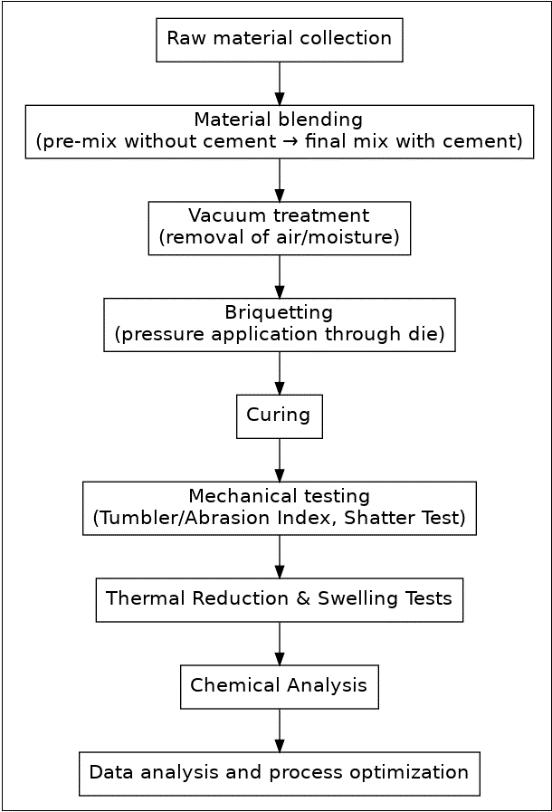
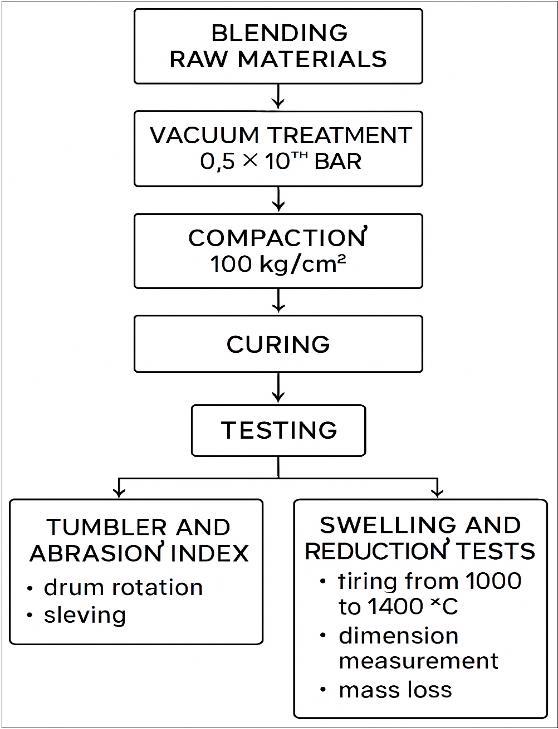
Theresearchemploys coldbriquettingto agglomerate steel plantfines.Themethodologyincludesprecisematerial blending, vacuum treatment, compaction, and post-processing mechanical/metallurgical testing. The steps are illustrated in the methodologyflowchart(Figure1).
Blending: Rawmaterialsarethoroughlymixedforhomogeneity.
Vacuum Treatment: The mixture is subjected to a vacuum (0.5 × 10⁻³ bar) to enhance density and binder dispersion.
Compaction: Apressureof100kg/cm²isusedtoformbriquettesofregularsizeandshape.
Curing: Briquettesarecuredundercontrolledconditionstoreachoperationalstrength.
Theflowchartoutlinesthecomprehensiveprocessofbriquettemanufactureandtesting.Itbeginswithathoroughblendingof raw materials, followed by vacuum treatment to enhance density and binder dispersion. Next, compaction forms briquettes under 100 kg/cm² pressure, succeeded by curing to achieve strength. The process includes mechanical and metallurgical testing: tumbler and abrasion indices assess material durability through simulated handling and particle size analysis; swelling and reduction tests fire briquettes at 1000–1400°C to evaluate dimensional stability and reduction efficiency; and chemicalcompositionanalysisisperformedperiodicallyvialaboratorytechniquesforqualityverification.
International Research Journal of Engineering and Technology (IRJET) e-ISSN:2395-0056
Volume: 12 Issue: 08 | Aug 2025 www.irjet.net p-ISSN:2395-0072
4. Results and Discussion
Thecoldbriquettesdevelopedinthisstudyshowednotablemechanicalresilience,asreflectedbyatumblerindexof48% and a low abrasion index of 3.63%. The high tumble index illustrates the capacity of the briquettes to withstand impacts during charging and descent within the blast furnace, minimizing fines generation. Table 3 shows that shatter index values for >10 mm particles reached over 90% after only 14 days of curing, stabilizing thereafter, indicating rapid consolidation and aging stability. The briquettes attained a Tumbler Index of up to 51.5% and a high shatter index, illustrating resistance to fragmentationandwearduringblastfurnacechargingandtransport.
Swelling of iron-bearing agglomerates is critical to blast furnace operability. Results (Table 4, below) show a systematic decrease in swelling index from 18% at 1000°C to just 4% at 1400°C, linked to progressive reduction reactions and microstructuralevolution(hematitetomagnetitetowüstitetometalliciron).Theformationofcracksandgrainfragmentation atlowertemperaturesisprogressivelyreplacedbystablemetallicirongrainsathighertemperatures.
International Research Journal of Engineering and Technology (IRJET) e-ISSN:2395-0056
Volume: 12 Issue: 08 | Aug 2025 www.irjet.net p-ISSN:2395-0072
Table 4. Swelling Index at Elevated Temperatures
The swelling index showed a marked decrease at higher temperatures, suggesting phase transitions from hematite to magnetite and subsequent shrinkage after metallic iron forms. Lower swelling at elevated temperature ensures stable performanceduringsmeltingandlimitsoperationaldisruptions.
Consistentparticlesizingisanindicatorofcontrolledagglomeration.Over95%ofbriquettesconsistentlyexceeded50mmin diameter, supporting efficient blast furnace burden distribution and reducing dusting and spillage Table 5. The majority of samplesretainedhighproportionsofcoarseparticles,ensuringgoodpermeabilityandmechanicalcompatibility.
Table 5. ParticleSizeandMoistureContentofBriquettes.
Thecoldbriquettingprocess,comparedtosinteringand palletization,consumeslessenergyandgeneratesminimalNOx,SOx, and particulates. The substitution of 3–5% of the blast furnace burden with cold briquettes led to visible improvements in throughputandareductionindustemissions,therebysupportingenvironmentalcomplianceefforts.Briquettesdemonstrated effective reduction efficiency, achieving increased metallization as the charged temperature was raised from 1000°C to 1400°C.Highironrecoverywasachieved,indicatingsuitabilityasblastfurnacefeed.
Regular chemical assessments confirmed that Fe content remained above 42% for all analyzed briquette batches, with controlledlevelsofCaO(16–18%),SiO₂(~6–8%),andotherminorconstituents.Thisensurescompatibilitywithblastfurnace smeltingandsupportsefficientironreductionandhighmetallizationrates,asdetailedinTable6.Thehighironandmoderate fluxcontentsignifyalignmentwithblastfurnacechargerequirementsandpotentialforefficientsmelting(TataSteel,2023)
Table 6. AverageChemicalCompositionofColdBriquettes.
International Research Journal of Engineering and Technology (IRJET) e-ISSN:2395-0056
Volume: 12 Issue: 08 | Aug 2025 www.irjet.net p-ISSN:2395-0072
The present investigation underscores the viability and significance of utilizing steel plant by-products via cold briquetting. Mechanicaltestingdemonstratedtheachievementofa48%tumblerindexand3.63%abrasionindex,certifyingthebriquettes for blast furnace charging. Swelling indices decreased significantly at higher temperatures, mitigating the risk of disintegration. Statistically,over 95% of samples retained particle size above 50 mm,and moisturecontent wasconsistently under 12%, ensuring both handling and reduction performance. Chemical analysis confirmed Fe content above industry thresholds, supporting efficient reduction reactions and high metallization yields. These findings validate the use of cold briquettesasanalternativefeedstock,offeringoperational,environmental,andeconomicbenefits.
The steel industry is moving rapidly toward sustainability, with future waste management advancing through digitalization, automation,andcirculareconomypractices.EmergingtrendssuchasAI-optimizedsorting,smartresourcerecovery,andrealtime waste tracking promise to enhance operational efficiency and environmental performance. Increasing integration of advancedslagprocessing,waterpurificationtechniques,androboticswillimprovematerialrecoveryratesandreducelandfill dependency.InIndia,growthingreensteel initiativesandstricterenvironmental policiesissettoacceleratetheadoptionof cleaner,resource-efficienttechnologies.Broadercollaborationbetweenindustry,researchers,andpolicymakersisanticipated, fostering innovation and knowledge-sharing for more sustainable steel production. Despite these prospects, challenges remain.
References
1. Biswas,A.K.,&Davenport,W.G.(2011).ExtractiveMetallurgyofCopper(5thed.).Elsevier.
2. Das, B., Prakash, S., Reddy, P. S. R., & Misra, V. N. (2007). An overview of utilization of slag and sludge from steel industries.Resources,ConservationandRecycling,50(1),40-57.https://doi.org/10.1016/j.resconrec.2006.05.008
3. Dutta,S.,etal.(2019).Wastemanagementinsteelindustry.Ironmaking&Steelmaking,46(3),215-225.
4. Ghosh,A.,&Chatterjee,A.(2008).IronmakingandSteelmaking:TheoryandPractice.PHILearning.
5. IEA.(2022).IronandSteelTechnologyRoadmap.InternationalEnergyAgency.
6. Kumar,A.,Singh,D.D.N.,&Singh,J.P.(2018).Wasteminimizationinintegratedsteelplants.InternationalJournalof EnvironmentalResearchandPublicHealth,15(9),2023.
7. MinistryofSteel.(2017).NationalSteelPolicy2017.GovernmentofIndia.
8. Sengupta,S.,Saha,R.,&Ray,A.(2019).CurrentstatusofsteelsectorinIndiaandfutureprospects.JournalofMaterials MetallurgicalEngineering,9(2),23-35.
9. Singh, J., & Prakash, N. (2020). Sustainability in the Indian steel industry. Clean Technologies and Environmental Policy,22(3),601-612.
10. TataSteel.(2022).SustainabilityReport.TataSteelIndia.
11. U.S. Environmental Protection Agency (EPA). (2015). Beneficial Use of Industrial Byproducts. Report EPA/530-F-15007.
12. WorldSteelAssociation.(2021).WorldSteelinFigures2017