
International Research Journal of Engineering and Technology (IRJET) e-ISSN: 2395-0056
Volume: 12 Issue: 05 | May 2025 www.irjet.net p-ISSN: 2395-0072
International Research Journal of Engineering and Technology (IRJET) e-ISSN: 2395-0056
Volume: 12 Issue: 05 | May 2025 www.irjet.net p-ISSN: 2395-0072
Monimoy Das1
1Technical Officer, Indian Jute Industries’ Research Association (IJIRA), Kolkata, West Bengal, India, ***
Abstract - The application of paving fabric as an interlayer in road construction has proven to be an effective method for mitigating cracks and potholes, thereby enhancing pavement durability. This study examines the effectiveness of Jute Geotextiles (JGT) as a paving fabric in mitigating cracks and potholes in rural roads. The case study focuses on the "Thansara to Bhandarkona Road" in Haringhata Block, Kalyani, Nadia, West Bengal, where JGT was applied under the PMGSY program in association with the West Bengal State Rural Development Agency (WBSRDA). JGT, a biodegradable and eco-friendly material, was used to reinforce the pavement structure, improve bonding between layers, and prevent moisture infiltration. The methodology involvedpreparing the damaged road surface, applying bitumen coats, and layering JGT before the final asphalt overlay. Results indicate that after 1.5 years, the treated road remains in good condition with no significant distress, demonstrating that JGT effectively arrests reflection cracks and potholes while enhancing pavement durability and reducing maintenance costs. This research highlights the potential of JGT as a sustainable alternative to synthetic geotextiles for rural road rehabilitation.
Key Words: Jute Geotextiles, Road Rehabilitation, Crack Prevention,PotholeMitigation,FlexiblePavement,Bitumen Impregnation,MoistureRetention,ReflectiveCracking,Stress AbsorbingLayer,PMGSYRoadConstruction
ThePradhanMantriGramSadakYojana(PMGSY)isaflagship initiativebytheGovernmentofIndiaaimedatprovidingallweatherruralroadconnectivitytounconnectedhabitations, therebyfacilitatingsocio-economicdevelopmentinremote regions.Whiletheprogramhassuccessfullyexpandedrural infrastructure,manyoftheconstructedroadsaresusceptible toprematuredeteriorationduetofactorssuchasincreasing traffic loads, adverse climatic conditions, inadequate drainage,andweaksubgradesoils.Commonformsofdistress includereflectivecracking,fatigue-inducedrutting,pothole formation,andsurfaceerosion,particularlyinhigh-rainfall areas.
Flexiblepavements,whicharetypicallycomposedofmultiple layers of compacted granular material topped with a bituminoussurface,relyheavilyontheintegrityofthebond betweenlayersandtheflexuralstrengthofthetoplayersfor durability. However, over time, structural deficiencies, especially in the form of cracks can propagate from the
underlying layers to the surface, leading to progressive surface failure. This necessitates cost-effective and sustainable rehabilitation techniques to extend service life andreducemaintenancecosts.
Onepromisingtechniqueforpavementreinforcementisthe use of paving fabrics, also known as asphalt overlay geotextiles. These engineered materials serve as a stressabsorbing interlayer (SAI) that inhibits crack propagation, improves interlayer bonding, and functions as a moisture barrier. When impregnated with bitumen, they form a cohesive layer that reduces reflective cracking and surface distresswhileenhancingthestructural performanceof the pavement.
JGT,derivedfromnaturalplantfibers,offersseveraltechnical and ecological advantages: it is biodegradable, thermally compatible with bitumen, and cost-effective, making it especiallysuitableforruralroadapplicationsindeveloping countries.However,despiteitspotential,field-leveldataon the long-term performance of JGT in high-rainfall rural settingsremainlimited.
Thisstudyaddressesthisknowledgegapthroughacasestudy onthe"ThansaratoBhandarkonaRoad"inHaringhataBlock, KalyaniSubdivision,NadiaDistrict,WestBengal,wherea292 gsmopen-weaveJGTwasusedasapavingfabricunderthe PMGSYprogram.Theobjectiveistoassessthesuitabilityof JGTasasustainablesolutionforcrackandpotholemitigation inruralpavements.
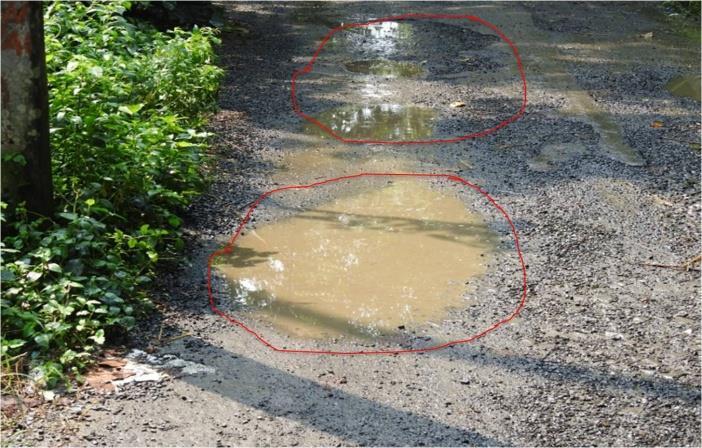
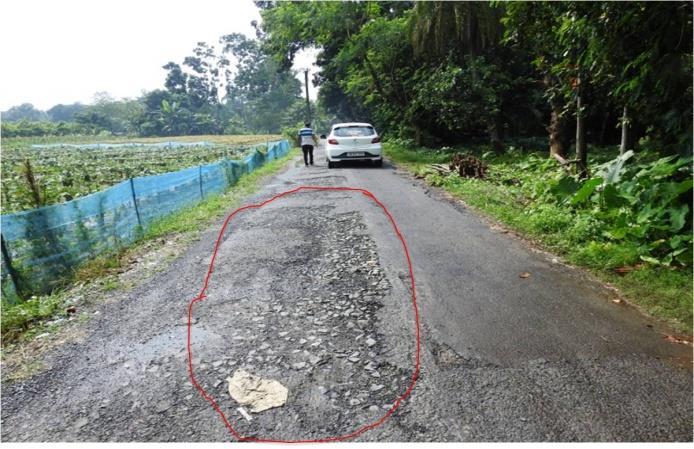
Apreliminaryvisualassessmentofthestudyarearevealed significantsurfacedeteriorationalongmultiplesegmentsof thePMGSYroadbetweenThansaraandBhandarkona.Fig.1 and Fig. 2 document representative sections exhibiting variousformsofpavementfailure.
Fig 1 illustrates a stretchofrural road exhibiting multiple potholes filled with standing water. The damaged zones, highlightedinred,reflectthecumulativeeffectsofinadequate drainage, poor slope design, and surface wear. The surface layer, composed of gravel and bituminous material, had disintegratedinseveralareas,exposinglooseaggregates.The accumulation of water in depressions suggests insufficient cross-fall and poor lateral drainage, conditions that exacerbate moisture infiltration into the subgrade and accelerateprogressivefailuremechanisms.
International Research Journal of Engineering and Technology (IRJET) e-ISSN: 2395-0056
Volume: 12 Issue: 05 | May 2025 www.irjet.net p-ISSN: 2395-0072
Fig. 2 capturesa severelydeterioratedsectionof thesame road, characterized by widespread reflective and fatigue cracking, loss of bituminous surfacing, and substantial aggregatedisplacement.Thesesymptomsindicateadvanced pavement degradation, likely driven by a combination of heavy vehicular loading, subgrade instability, and a lack of timelypreventivemaintenance.
Suchdamagepatternsarecommonlyobservedonruralroads constructedunderthePMGSYscheme,especiallyinregions with high rainfall and suboptimal drainage systems. If left unaddressed, these issues can lead to further structural weakening,increasedmaintenancecosts,andcompromised road safety. Therefore, comprehensive rehabilitation includingcracksealing,potholepatching,drainagecorrection, andstructuralreinforcementusinggeotextilesiscriticalfor restoringfunctionalperformanceandprolongingpavement life.
Pavement surface failures in flexible road structures commonly manifest as potholes and reflective cracking, amongotherdistresstypes.Theseformsofdegradationoften originate from structural weaknesses in the existing pavement layers and are exacerbated by environmental exposure, repetitive traffic loads, and poor drainage conditions.
Reflective cracks typically develop when a new asphalt overlayisplacedoverajointedorseverelycrackedpavement. Over time, existing discontinuities in the underlying layers propagateupwardintotheoverlayduetomovementatthe joints,thermalexpansion,andtraffic-inducedstresscycles.If not properly treated, these cracks become pathways for waterinfiltration,whichcompromisesthestructuralintegrity ofthepavementsystembyweakeningthebondbetweenthe overlayandthebaselayers.
Potholesareoftentheresultofprogressivefailureinitiated by localized surface cracking, followed by material dislodgement. The process begins with minor cracks or surfacefatigue,allowingwatertoinfiltratethepavement.In areaswithinadequatedrainage,thismoistureweakensthe subgradeandbase,acceleratingdisintegrationofthesurface layer.Repeated loading eventuallycausesfragmentsof the top layer to break loose, forming depressions that expand overtimeintofull-fledgedpotholes.
Thesetwomechanismsareinterrelatedandself-reinforcing; reflective cracking facilitates water ingress, which leads to potholing,andthepresenceofpotholesintroducesnewstress points that propagate further cracking. Without timely intervention,thiscycleresultsinwidespreaddeterioration andreducedservicelifeofthepavement.
The selected project site for this case study is the PMGSY ruralroadconnectingThansaratoBhandarkona,situatedin the Haringhata Block, Kalyani Subdivision, Nadia District, West Bengal, India. The rehabilitation intervention was carried out in April 2023 under the technical and administrative supervision of the West Bengal State Rural Development Agency (WBSRDA). The initiative aimed to demonstrate the effectiveness of Jute Geotextile (JGT) as a sustainable paving fabric solution for improving pavement performanceunderadverseclimaticandsoilconditions.
Prior to intervention, the road exhibited extensive signs of pavementfailure,including:
Frequentpotholesandsurfacecracking(bothfatigue andreflectivetypes),
Progressivestructuraldistressinbituminouslayers,
Erosion of road flanks and shoulders, particularly afterheavyrainfallevents.
To address these issues, a 292 gsm open-weave jute geotextile(JGT)wasselectedasthereinforcingpavingfabric. Thetotallengthofroadtreatedunderthisinterventionwas 2.76kilometers.
International Research Journal of Engineering and Technology (IRJET) e-ISSN: 2395-0056
Volume: 12 Issue: 05 | May 2025 www.irjet.net p-ISSN: 2395-0072
The site is located in a region with high annual rainfall, averaging approximately 3600 mm, which significantly influences pavement durability and drainage performance. TheapplicationofJGTwasparticularlysuitedforthisclimatic zone due to its dual role in crack mitigation and moisture control, making it an ideal choice for enhancing road longevityinmonsoonproneruralareas.
TheincorporationofJuteGeotextiles(JGT)asapavingfabric in flexible pavement structures offers a multifaceted approach to enhancing road durability, sustainability, and cost-efficiency, particularly in the context of rural infrastructure development in resource constrained environments. As a natural, biodegradable material, jute providesbothengineeringfunctionalityandenvironmental compatibility.
The primary objectives for using JGT as a paving fabric in ruralroadrehabilitationincludethefollowing:
5.1
JGTfunctionsasastress-absorbinginterlayer(SAI)that distributes vehicular loads more uniformly across the pavementstructure.Thisredistributionofstresshelpsreduce the initiation and propagation of reflective cracking and fatigue-related distress, thereby improving the structural integrityandservicelifeofthepavement.
5.2 Moisture Management and Subgrade Protection:
Byactingasamoisture-retentivelayer,JGThelpsmaintain optimal subgrade moisture conditions, particularly in dry seasons. This minimizes shrinkage-induced cracking and prevents the weakening of the subgrade layer, which is criticalforthelong-termstabilityofruralpavements.
5.3
When saturated with bitumen during installation, JGT formsacohesivebondbetweensuccessivepavementlayers. Thisimprovedinterfacialadhesionreducestheriskoflayer debonding and surface failures such as slippage, delamination,andraveling.
5.4 Environmental Sustainability:
Unlikesyntheticgeotextilesmadefrompetroleum-based polymers, jute is fully biodegradable and decomposes naturallyafterfulfillingitsfunctionalrole.Itsusereducesthe environmentalfootprintofroadconstructionandalignswith globaltrendstowardsustainableinfrastructuresolutions.
5.5 Cost-Effectiveness and Local Availability:
JuteisanabundantlyavailablenaturalfiberinIndia.Its affordability and compatibility with local labor and supply chainsmakeitaneconomicallyviableoptionforlarge-scale application in rural road projects under schemes such as PMGSY.
6. METHODOLOGY:
The paving fabric reinforcement system comprises three essential components: the paving fabric itself, a bitumen binder,andthedefinedinstallationprocedure.Thefollowing methodology was adopted during the rehabilitation of the "ThansaratoBhandarkonaRoad"underthePMGSYprogram, locatedinHaringhataBlock,Kalyani,Nadia,WestBengal.
6.1
Toensurethestructuralreliabilityandperformanceof therehabilitatedpavement,carefullyselectedmaterialswere utilized.Allmaterialswerechosenbasedontheirsuitability for rural flexiblepavement systems,compatibilitywith the overlaytechnique.Thekeymaterialsusedareasfollows:
Paving Fabric: 292gsmopen-weaveJuteGeotextile (JGT)
Bituminous Binder: Viscosity Grade (VG) 30 bitumen,suitableforflexiblepavementconstruction.
Asphalt Mix: 20 mm nominal size aggregate with 6%bitumencontent.
Compaction Equipment: 10MTtandemrollers.
Temperature for Laying Premix: Approx.110°Cat thetimeofplacement.
Thecross-sectionallayoutofthepavementreinforcedwith JGTisdepictedin Figure 3.
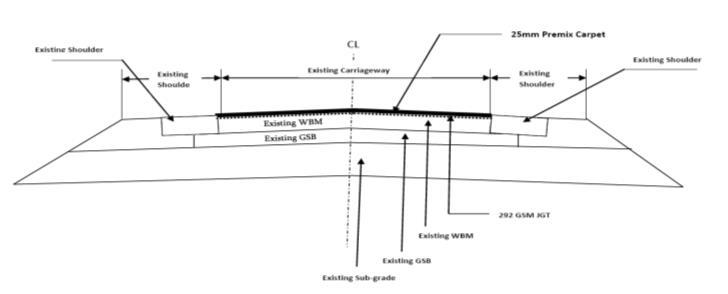
Figure 3 Cross section of pavement
6.2 Installation Procedure:
Astepwiseandmethodicalapproachwasfollowed for the installation of the paving system to ensure quality
International Research Journal of Engineering and Technology (IRJET) e-ISSN: 2395-0056
Volume: 12 Issue: 05 | May 2025 www.irjet.net p-ISSN: 2395-0072
control and performance consistency. Each phase of the construction process was carried out under standard engineering supervision, maintaining field conditions conducivetodurablepavementconstruction.Theinstallation procedureisdetailedbelow:
6.2.1 Surface Preparation
Existingpotholeswereexcavated,cleaned,andfilled withcompactedcoarsestonematerialtorestorethe roadbase.
Earth was used to rebuild and compact damaged shoulders,restoringfullpavementwidth.
Theexistingpavementsurfacewascleanedofdust, debris, and loose particles using high-pressure air jetstoensureproperbondingofsubsequentlayers.
6.2.2 Application of Bitumen Coats
Aprimecoatwasappliedatarateof0.250kg/m²to penetrateandsealthegranularsurface.
Atackcoatwassubsequentlyappliedat0.225kg/m² to promote adhesion with the paving fabric and overlay.
6.2.3 Laying of Jute Geotextile (JGT)
JGTsheets(132cmwidth)werelaidlongitudinally alongthecarriageway.
Eachsubsequentstripoverlappedtheadjacentone by10cm,ensuringseamlesscoverage.
The fabric was mechanically fastened to the base using 2-inch iron nails at 1-meter intervals, both longitudinallyandtransversely.
6.2.4. Reapplication of Bitumen Coats over JGT
Asecondroundofprimeandtackcoatswasapplied overthelaidJGTatthesameratestofullysaturate thefabricandenhancebondingwiththeoverlay.
6.2.5 Laying of Premix Carpet (PMC)
A hot mix bituminous premix was placed directly over the treated surface to achieve a 20 mm compactedthickness
The temperature of the mix was maintained at approximately 110°C during laying to ensure effectivecompactionandbonding.
6.2.6 Compaction and Finishing
Thenewlylaidsurfacewascompactedusinga10MT tandem roller to achieve the required pavement density.
A final surface treatment with hot stone grits was carried out to improve surface texture, skid resistance,anddurability
The selection of an appropriate geotextile is critical to the performance of any reinforced pavement system. For this study,anopen-weaveJuteGeotextile(JGT)waschosendueto itsprovenfieldperformance,eco-friendlycomposition,and compatibilitywithbituminousmaterials.TheJGTusedinthe rehabilitationofthePMGSYroadwassourcedandtestedin accordancewithestablishedASTMandIndianStandard(IS) testmethodstoensurecompliancewithqualitybenchmarks.
The selected JGT exhibited adequate tensile strength, aperture size, and elongation characteristics suitable for actingasa stress-reliefand moisture-barrierinterlayer. Its biodegradable nature further adds value in rural infrastructuredevelopment,wherelowenvironmentalimpact and cost efficiency are crucial. The key physical and mechanical properties of the JGT used in the project are summarizedinthe Table 1
Table 1 Properties of Jute Geotextile (paving fabric)
TypeofJGT OpenweaveJGT TestMethod
Weight(g/m2)at20%
M.R. 292 ASTMD5261
EndsxPicks/dm(MD xCD) 12x12 IS1963:1981
Thickness(mm) 3 ASTMD5199
Width(cm)(site specific) 132 IS1954:1990
Aperturesize(mm) 8x7 IS2405(Part1 &2):1980
TensileStrength,min. (kN/m)[MDxCD] 10x10 ASTMD459
Elongationatbreak, max.(%)[MDxCD] 12x12 IS1969:1985
Weight(g/m2)at20% M.R. 292 IS2387:1969
The primary function of a paving fabric, particularly when impregnated with bitumen, is to act as an impermeable interlayerthatmitigatesmoistureinfiltrationandreflective
International Research Journal of Engineering and Technology (IRJET) e-ISSN: 2395-0056
Volume: 12 Issue: 05 | May 2025 www.irjet.net p-ISSN: 2395-0072
cracking within flexible pavements. This layer performs multiple critical roles that collectively enhance pavement performanceandlifespan:
8.1 Moisture Barrier Protection
Bitumen-saturated paving fabric serves as an effective waterproofingmembranethatpreventssurfacewateringress into the underlying base and subgrade layers. Moisture infiltration can significantly reduce the shear strength of granular base materials, leading to deformation such as rutting,stripping,andeventualstructuralfailure.
8.2 Stress Absorption and Crack Mitigation
Pavingfabricfunctionsasastress-absorbinginterlayer (SAI).Itreducestensilestressconcentrationsattheinterface between existing pavement and the new overlay, thereby delayingorpreventingtheupwardpropagationofreflective cracks originating from joints or fatigue in the underlying layers.
8.3 Reinforcement of Pavement Layers
Jute Geotextile provides a reinforcing effect by distributingtrafficloadsmoreuniformlyacrossthepavement structure.Thishelpsenhancetheoverallstiffnessandtensile strengthofthebituminousoverlay,improvingitsresistance tocrackingandrutting.
8.4
Unlike synthetic alternatives, jute geotextiles exhibit superiorthermalcompatibilitywithbituminousbinders.This ensuresoptimaladhesionanduniformimpregnationduring installation, leading to a better-integrated composite layer that resists delamination under thermal cycling and traffic loading.
Whilesyntheticfabricspersistintheenvironment,JGT offersabiodegradableandsustainablealternative.Duringits functional lifespan, it effectively performs its mechanical roles,afterwhichitdecomposesharmlessly,leavingnolongtermenvironmentalburden.
Oneofitskeyadvantagesisitsabilitytopreventcracksand enhance pavement durability by reinforcing the road structure and evenly distributing loads. This significantly reducesreflectiveandfatiguecracking,whicharecommon issues in asphalt pavements. Additionally, it improves bondingbetweenlayers,ensuringbetteradhesionofasphalt layersandreducingthechancesofsurfacefailure.
Jutepavingfabricplaysacrucialroleinmoistureretention andregulation,preventingexcessivedryingandshrinkageof the subgrade, which could otherwise lead to structural
instability.Italsocontributestoerosioncontrol,particularly in areas prone to heavy rainfall and water logging, by stabilizing the pavement edges and preventing soil displacement.
Bymitigatingearly-stagecracksandreducingsurfacefailures, jutegeotextileslowerlong-termmaintenancecosts,making them an economically viable choice. Their lightweight and easy-to-install nature further adds to their practicality, simplifyingtransportationandhandlingduringconstruction.
Anothersignificantadvantageofjuteisitssustainabilityand local availability. As a widely grown crop in many regions, jute supports local industries, reduces dependence on importedsyntheticmaterials,andpromotesenvironmentally responsibleinfrastructuredevelopment.
Jutepavingfabricoffersarangeofbenefitsthatmakeitan excellent choice for sustainable road construction and maintenance.Asaneco-friendlyandbiodegradablematerial, jutenaturallydecomposesovertime,reducingenvironmental impact compared to synthetic alternatives. Its costeffectivenessmakesitanaffordablesolution,particularlyin developingregionswherebudgetconstraintsareaconcern.
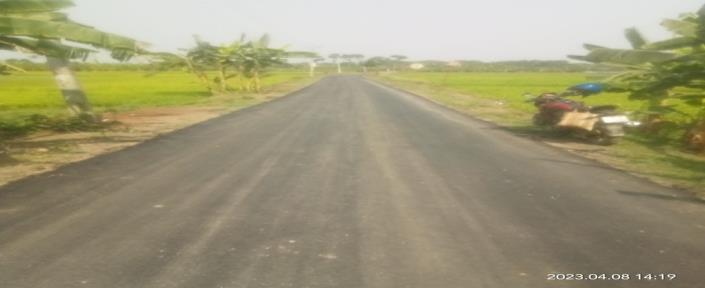
Thefollowingimages(Fig 4to8)illustratekeystagesofthe road rehabilitation process using Jute Geotextile (JGT) and highlightthephysicaltransformationofthePMGSYroadfrom adistressedstatetoawell-compacted,finishedsurface.These fieldvisualsservetoreinforcethepracticalfeasibility,proper installation methodology, and performance outcome of the adoptedtechnique.
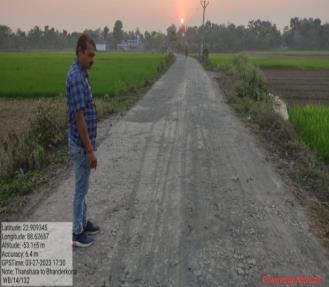
Fig. 4 showcases the initial phase of surface preparation, wherevisiblepotholesandcrackshavebeenpatchedusing appropriate granular and bituminous materials. The photo demonstrateshowlocalizeddistresswasaddressedpriorto layingthepavingfabric,ensuringauniformbaseforeffective JGTintegration.
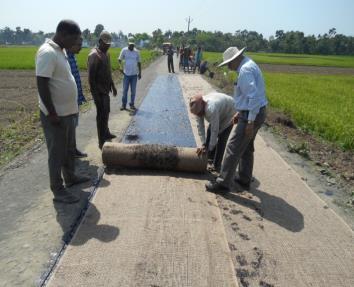
Fig. 5 workers are shown placing the 132 cm-wide openweaveJGTfabricacrossthecarriagewaywithanoverlapof approximately 10 cm between successive strips. Proper alignmentandmanualpeggingusing2-inchironnailsat1m intervalsensurethatthefabricremainssecurelypositioned duringsubsequentpavingsteps.
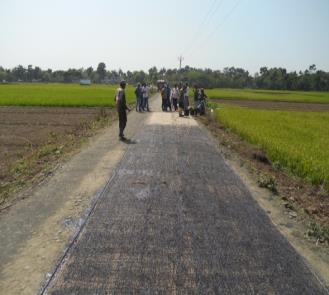
Fig. 6 capturestheapplicationofbitumen-basedprimecoat and tack coat directly over the laid JGT fabric. This step is criticalforsaturatingthefabricandensuringoptimalbonding with the bituminous overlay. The even spread of emulsion signifies controlled application, essential for cohesive layering.
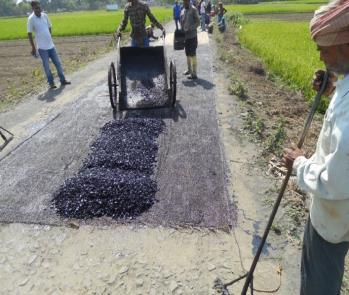
Fig 7 depictsthehotmixbituminouscarpetbeinglaidonone lane, directly over the treated surface. With material temperaturemaintainedaround110°C,thepavingensures
International Research Journal of Engineering and Technology (IRJET) e-ISSN: 2395-0056
Volume: 12 Issue: 05 | May 2025 www.irjet.net p-ISSN: 2395-0072
proper adhesion to the JGT and desired compaction. This imagemarksatransitionfrombasepreparationtostructural overlay.
Fig 8 image illustrates the fully rehabilitated PMGSY road post-compaction and surface finishing. The even texture, absence of visible cracks, and compacted shoulders reflect high-quality workmanship. The visual outcome strongly supports the performance claim of JGT in reducing surface distressandextendingpavementlife.
These field visuals not only document each step of the methodology but also validate the field applicability, durability,andaestheticimprovementresultingfromtheuse ofjutegeotextilesinruralroadrehabilitation.
13. RESULTS AND CONCLUSIONS:
Field evaluations conducted 1.5 years after construction demonstrate that the pavement section rehabilitated using open-weave Jute Geotextile (JGT) has remained in stable condition,exhibitingnosignificantsignsofreflectivecracking, potholing, or rutting. These observations confirm the
structural efficacy and functional longevity of JGT as a reinforcing and moisture-controlling interlayer in flexible pavementsystems.
The incorporation of JGT has proven beneficial in multiple ways:
Mitigation of reflective cracking, achieved by absorbingandredistributingtensilestressesatthe interface between the existing pavement and the overlay,
Reduction in surface deformation and rutting, attributed to the additional tensile reinforcement providedbythejutefabric,
Improving bonding between pavement layers, enhancingthedurabilityandcohesionoftheoverlay
Decreasedmaintenancefrequencyandcost,thereby extending the pavement'sservicelifeand reducing lifecycleexpenditure.
Functionally,theJGTlayerservedadualroleasbothastressrelieving interlayer and a moisture barrier, protecting the subgrade and base layers from water ingress, one of the primarycausesofpavementfailureinruralroads.
The successful outcome of this field implementation underscoresthetechnicalandeconomicviabilityofusingJGT forruralroadrehabilitation,particularlyunderprogramssuch asPMGSY,wheresustainability,localmaterialutilization,and budget efficiency are paramount. The study provides compelling evidence to support the broader adoption of natural fibre-based geotextiles in road infrastructure, especiallyinhigh-rainfallanderosion-proneregions.
TheauthorwouldliketosincerelyexpresshisgratitudetoDr. A.K.Sharma,Director,IJIRAforhiskindsupport,inspiration, andpermissionforpublicationofthispaper.Theauthoralso gratefullyacknowledgestheassistanceandsupportextended bytheNationalJuteBoard,MinistryofTextiles,Governmentof India,andtheWestBengalStateRuralDevelopmentAgency (WBSRDA),GovernmentofWestBengal.
[1] MarcusC.J.J.,PangS.N.,LohW.C(2012).-PavingFabrics forRoadRehabilitation,AsiaExperience-Geosynthetics Asia 2012, 5th Asian Regional Conference on Geosynthetics, 13 to 15 December 2012 | Bangkok, Thailand
[2] CurtisJ.C.(1997)–AssessmentandControlofCracking in Bituminous Surfaces. (Geohorizon – State of Art in GeosyntheticTechnology Oxford&IBHPublishingPvt. Ltd,NewDelhi/Calcutta).
International Research Journal of Engineering and Technology (IRJET) e-ISSN: 2395-0056
Volume: 12 Issue: 05 | May 2025 www.irjet.net p-ISSN: 2395-0072
[3] Maxim Technologies, Inc., Nonwoven Paving Fabric Study, Final Report, submitted to Industrial Fabrics AssociationInternational,1997.
[4] Mark L. Marienfeld and Thomas L. Baker (1999)- As a PavementMoistureBarrierPavingFabricInterlayer-TRB CircularNumberEC006,1999.
[5] WenKejunandAminiFarshad(2020)-EffectofPaving FabriconReductionofReflectiveCracking-Geo-Congress 2020GSP31
[6] LiPeng,LiuJenny,ASCEM.,SamueloffMike,JonesDavid (2014)-PerformanceofPavingFabricReinforcedAsphalt Mixture, ASCE-Climatic Effects on Pavement and GeotechnicalInfrastructure
[7] Amini, F, Turnquest, B., and Ahlrich, R. (2012). “ConstructionMonitoringof PavingFabricsSystemsto Reduce Reflective Cracking.” International Journal of EmergingTechnologyandAdvancedEngineering,Vol.2, No.6,pp.413-420.
[8] Marienfield,M.L.andBaker,T.L.(1999)PavingFabric InterlayerasaPavementMoistureBarrier.TRBCircular No.E-C006,1-13.
[9] Kidd, S. Q. (1990) Paving Fabric and Asphalt Stress AbsorbingMembraneInterlayers(SAMI).FinalReport, Report No. MSHD- RD-90-67-6, Mississippi State Highway Department Research and Development Division,JacksonMS.
BIOGRAPHIES

MonimoyDasisaTechnicalOfficer at the Indian Jute Industries’ Research Association (IJIRA), Kolkata. He holds a B.E. in Civil Engineering from Jadavpur University. With over 12 years of experience, his expertise lies in geotechnical research, natural geotextiles, and sustainable infrastructuredevelopment.