
International Research Journal of Engineering and Technology (IRJET) e-ISSN: 2395-0056
Volume: 13 Issue: 02 | Feb 2026 www.irjet.net p-ISSN: 2395-0072
International Research Journal of Engineering and Technology (IRJET) e-ISSN: 2395-0056
Volume: 13 Issue: 02 | Feb 2026 www.irjet.net p-ISSN: 2395-0072
Mr. V.Murugan1 , Ujvala.M2 , RAVI.P3 , Noorein Fatima4 , Nithin.N5
1Assistant Professor, Department of IT, TKR College of Engineering and Technology, Telangana, India 2,3,4,5B.Tech Students, Department of IT, TKR College of Engineering and Technology, Telangana, India ***
Abstract - Agriculturalproductivityis highlyinfluencedby soilnutrients,climatic conditions,andfarmingpracticessuch as fertilizer usage and crop rotation. However, many farmers still rely on traditional knowledge and intuition for crop selection and fertilizer application, which often leads to reduced yield, higher input costs, and long-term soil degradation. To address this issue, this paper proposes a Sustainable Fertilizer Usage Optimizer for Higher Yield, an intelligent web-based agriculture recommendation system thatusesmachinelearningandensemblelearningtechniques. Thesystempredictssoilcharacteristics,recommendsthemost suitable crop, estimates expected yield, and suggests the optimal fertilizer type and quantity based on soil parameters such as Nitrogen (N), Phosphorus (P), Potassium (K), pH, moisture, andweather conditions includingtemperature and rainfall. Advanced models such as LightGBM, XGBoost, AdaBoost,ExtraTrees,andGradientBoostingareutilized,and their performance is enhanced using ensemble strategies like bagging, boosting, and stacking. Cross-validation and hyperparameter tuning are applied to improve accuracy and reduce overfitting. The proposedsystemsupports sustainable farming by minimizing excessive fertilizer usage, improving crop yield, and enabling farmers to make data-driven decisions. This approach enhances productivity, reduces environmental impact, and increases long-term profitability for farmers.
KEYWORDS:PrecisionAgriculture,Crop ecommendation, Fertilizer Optimization, Yield Prediction, Soil Nutrient Analysis
Agriculture plays a vital role in ensuring food security and supporting the economy of developing countriessuchasIndia.Amajorportionofthepopulation depends on farming as their primary source of income. However,agriculturalproductivityisinfluencedbymultiple factors such as soil nutrient levels, climatic variations, irrigation availability, crop rotation, and fertilizer management. In many cases, farmers rely on traditional knowledgeandexperienceforselectingcropsandapplying fertilizers.Althoughthesepracticesareuseful,theyoftenfail toprovideaccuratedecisionsunderchangingenvironmental conditionsandleadtolowyield,increasedproductioncost, andsoilfertilitydegradation.
Recent advancements in precision agriculture and datadriven farming have enabled the use of machine learning (ML)techniquestoimprovecropproductivity.MLmodels
can analyze soil parameters such as Nitrogen (N), Phosphorus(P),Potassium(K),pH,moisture,andclimatic conditionssuchasrainfallandtemperaturetorecommend suitable crops, predict yield, and suggest fertilizer requirements [1]. Studies show that ensemble learning methods such as Gradient Boosting, Random Forest, and XGBoost provide better performance compared to traditional ML models due to their ability to handle nonlinear agricultural datasets and improve prediction accuracy[2].
Fertilizer usage is another major concern in modern agriculture. Excessive and improper fertilizer application results in nutrient imbalance, groundwater pollution, reducedsoilquality,andenvironmentaldamage.Sustainable fertilizer recommendation systems can help in reducing theseissuesbyprovidingoptimalfertilizertypeandquantity basedonsoilnutrientdeficiencyandcroprequirement[3]. Similarly, yield prediction plays a crucial role in planning harvestingstrategies,supplychainmanagement,andmarket decision-making for farmers. Yield prediction using historicalyieldrecords,soilhealthparameters,andweather conditionshasbeenwidelyresearchedandisconsideredan effectiveapproachforimprovingprofitability[4].
This project proposes a Sustainable Fertilizer Usage Optimizer for Higher Yield, a web-based intelligent recommendation system that integrates multiple machine learningalgorithmssuchasLightGBM,XGBoost,AdaBoost, Extra Trees, and Gradient Boosting. The system supports fourmajorfunctions:SoilPrediction,CropRecommendation, Fertilizer Suggestion, and Yield Prediction. Ensemble learningtechniqueslikebagging,boosting,andstackingare applied along with cross-validation and hyperparameter tuningtoenhancemodelaccuracyandgeneralization.The proposedsystemprovidesfarmerswithreliable,real-time recommendationstoincreaseyield,reduceinputcost,and promotesustainableagriculturalpractices.
Themotivationbehindthis work istosupportfarmers by providing an intelligent decision-making system for crop selection and fertilizer optimization. Farmers often face uncertainty due to unpredictable climate, soil nutrient imbalance, and lack of scientific recommendations. By integrating soil and weather parameters with machine learningmodels,thissystemaimstoimproveproductivity, reducefertilizermisuse,andenhancesustainability.
International Research Journal of Engineering and Technology (IRJET) e-ISSN: 2395-0056
Volume: 13 Issue: 02 | Feb 2026 www.irjet.net p-ISSN: 2395-0072
Farmersoftenmakecropandfertilizerdecisionsbasedon intuition or traditional methods rather than data-driven analysis.Thisresultsinlowyield,increasedcultivationcost, excessive fertilizer usage, and long-term damage to soil quality.Therefore,thereisaneedforanintelligentsystem thatcan:
Recommend the best crop based on soil conditions and climate.Predictexpectedyieldusinghistoricalandreal-time parameters.Suggestoptimalfertilizertypeandquantitywith sustainability.
Pproposed Hybrid Multi-Modal Deep Learning The proposed system is a web-based intelligent agriculture recommendation platform designed to assist farmers in selecting suitable crops, predicting yield, and optimizing fertilizerusageinasustainablemanner.Thesystemutilizes soil parameters such as Nitrogen (N), Phosphorus (P), Potassium(K),andpHalongwithclimaticparameterssuch astemperature,rainfall,andhumiditytogenerateaccurate predictions. Unlike traditional approaches, this system integratesmultiplemachinelearningmodelsandensemble learning techniques to improve reliability and prediction accuracy. The core objective is to provide a complete decision-support system that reduces excessive fertilizer usage, improves crop yield, and enhances long-term soil health.Theproposedplatformincludesfourmainfunctional modules:SoilPrediction,CropRecommendation,Fertilizer Suggestion,andYieldPrediction.
The soil prediction module is responsible for analysing soil fertility and classifying the soil condition based on essential nutrient parameters. The system takes soilinputvaluessuchasNitrogen,Phosphorus,Potassium, andpHlevel,andprocessesthemusingtree-basedmachine learning classifiers. These models learn patterns from historical soil datasets and predict the soil category or fertilitylevel.Thismoduleplaysafoundationalrolebecause accurate soil classification directly improves the performance of crop recommendation and fertilizer optimization. The output of this module provides a clear understandingofsoilnutrientdeficiencyandsoilsuitability fordifferentcrops.
The crop recommendation module predicts the most suitable crop for cultivation based on the current soil condition and weather environment. It uses advanced machine learning algorithms such as LightGBM, XGBoost, AdaBoost, Extra Trees, and Gradient Boosting to generate
croprecommendations.Ensemblelearningstrategiessuchas bagging,boosting,andstackingareappliedtoenhancethe model’s accuracy and stability. The system ensures better generalization by applying cross-validation and hyperparametertuningduringtraining.Thismodulehelps farmerschoosecropsthathavehighersurvivalprobability, betteryieldpotential,andmaximumprofitabilityunderthe givenenvironmentalconditions.
Thefertilizersuggestionmodulerecommendsthe most suitable fertilizer type and quantity required for the selectedcropbasedonsoilnutrientdeficiency.Thismodule focuses on sustainable farming by preventing overuse of fertilizers and maintaining soil nutrient balance. The predictionmodelcomparesthecurrentNPKlevelswiththe idealnutrientrequirementfortherecommendedcropand identifieswhichnutrientisdeficientorexcessive.Basedon this analysis, the system suggests appropriate fertilizer inputs that can restore soil fertility without harming the environment.Thisapproachreducesinputcostforfarmers and also minimizes soil degradation and groundwater pollutioncausedbyimproperfertilizerapplication.
Theyieldpredictionmoduleestimatestheexpectedcrop yield based on soil nutrients, weather parameters, and historicalyieldrecords.Thismoduleisimplementedusing regression-based ensemble learning algorithms that can handlenonlinearrelationshipsbetweenagriculturalfeatures and yield output. By analysing patterns from past yield datasets,thesystempredictsyieldintermsofquintalsper hectare. Yield prediction is useful for farmers to plan harvesting strategies, manage resources effectively, and estimate future profit margins. The module also supports scalabilityandcanbeimprovedfurtherbyintegratingrealtime weather updates and market datasets for economic planning.
TheimplementationoftheproposedSustainableFertilizer UsageOptimizerforHigherYieldiscarriedoutasamodular machine learning based web application. The system is designed to collect agricultural datasets, preprocess and normalizethedata,trainmultiplemachinelearningmodels, and generate predictions through an interactive user interface.Thecompleteimplementationisdividedintofour major stages: data collection, data preprocessing, model trainingandevaluation,andsystemdeployment.Eachstage is carefully designed to ensure accuracy, scalability, and usabilityforfarmers.
Volume: 13 Issue: 02 | Feb 2026 www.irjet.net p-ISSN: 2395-0072
The first stage of implementation involves collecting agricultural datasets from reliable sources. The collected data includes soil nutrient parameters such as Nitrogen, Phosphorus,Potassium,andpH,alongwithenvironmental parameterssuchastemperature,humidity,andrainfall.In addition,historicalcropyielddataisalsoincludedtosupport yieldprediction.Thedataiscollectedfrommultipleformats such as CSV files, spreadsheets, and public agricultural repositories. The collected datasets are then stored and organized to ensure compatibility with machine learning workflows.Thisstageisimportantbecausetheperformance ofthesystemdependsheavilyonthequalityanddiversityof thedatasetused.
Aftercollectingthedataset,preprocessingisperformedto clean and prepare the data for machine learning training. This stage includes removing missing values, handling duplicate records, correcting inconsistent values, and formattingdataintoastructuredform.Featurescalingand normalization techniques are applied where required, especiallyforalgorithmsthataresensitivetofeatureranges. Unwanted columns are removed, and only relevant attributes such as NPK, pH, temperature, rainfall, and humidityareretained.Thedatasetisthensplitintotraining and testing sets. This preprocessing step ensures that the model learns meaningful patterns and improves overall predictionaccuracy.
Inthisstage,multiplemachinelearningmodelsaretrained foreachpredictionmodule.Forcroprecommendationand soil prediction, classification models such as LightGBM, XGBoost,AdaBoost,ExtraTrees,andGradientBoostingare trained using labeled datasets. For yield prediction, regression-based models are trained to estimate yield output. Ensemble learning techniques such as bagging, boosting, and stacking are applied to enhance robustness andreducevariance.Cross-validationisusedduringtraining topreventoverfittingandensurethatthemodels perform wellonunseendata.Hyperparametertuningisperformedto selectthebestmodelconfiguration.Thetrainedmodelsare evaluatedusingaccuracy,precision,recall,andF1-scorefor classification tasks, and MAE, RMSE, and R² score for regressiontasks.
After model training, the best-performing models are integrated into a web-based platform. The system allows farmers to enter soil nutrient values and weather parametersthroughauser-friendlyinterface.Oncetheinput
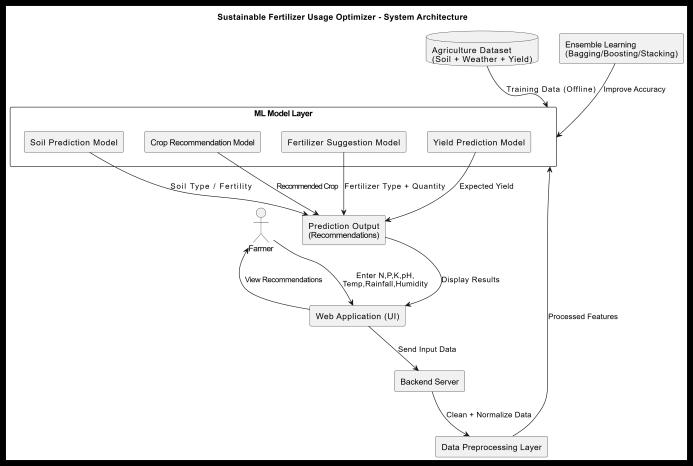
is provided, the backend loads the trained models and generates outputs such as soil type prediction, recommendedcrop,fertilizersuggestion,andexpectedyield. The results are displayed instantly to the user in a clear format. The proposed system architecture is integrated at this stage to show the flow of data from user input to predictionoutput.Thisarchitecturediagramrepresentsthe interactionbetweentheuserinterface,preprocessinglayer, machine learning models, ensemble module, and the final recommendationoutput.
Thissectiondiscussestheperformanceoftheproposed Sustainable Fertilizer Usage Optimizer for Higher Yield system. The system was evaluated based on its ability to predictsoiltype,recommendthemostsuitablecrop,suggest fertilizer requirements, and estimate crop yield. Multiple machine learning models such as LightGBM, XGBoost, AdaBoost,ExtraTrees,andGradientBoostingweretrained and tested using agricultural datasets containing soil nutrient parameters and weather conditions. The models wereevaluatedusingstandardclassificationandregression metricstoensurereliabilityandgeneralization.
Forsoilpredictionandcroprecommendation,classification modelswereevaluatedusingaccuracy,precision,recall,and F1-score.Theresultsshowthatensemble-basedalgorithms performedbettercomparedtosingletraditionalmodelsdue totheirabilitytohandlenonlinearrelationshipsandfeature interactions. Among the tested models, LightGBM and XGBoostachievedhigheraccuracyandstableperformance across cross-validation folds. The use of bagging and boosting helped reduce variance and improve overall robustness. The stacking approach further enhanced predictiveperformancebycombiningtheoutputsofmultiple baselearners.
For yield prediction, regression-based ensemble models were evaluated using Mean Absolute Error (MAE), Root
International Research Journal of Engineering and Technology (IRJET) e-ISSN: 2395-0056
Volume: 13 Issue: 02 | Feb 2026 www.irjet.net p-ISSN: 2395-0072
Mean Square Error (RMSE), and R² score. The results indicatethatGradientBoostingandExtraTreesregression models produced lower error values and better yield estimationaccuracy.Thisconfirmsthatensemblelearning techniquesareeffectiveforyieldpredictiontaskswherethe relationshipbetweensoil,climate,andyieldiscomplexand highlynonlinear.
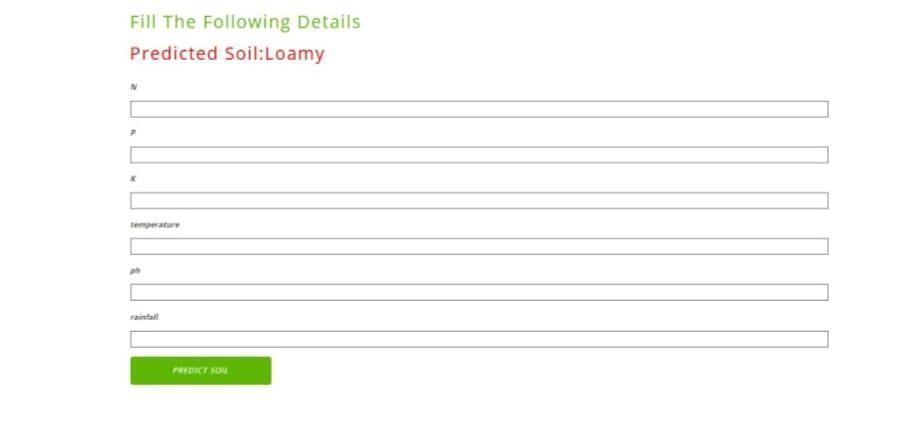
The system outputs are displayed through a user-friendly webinterface.Whenthefarmerenterssoilnutrientvalues andclimaticparameters,thesystemgeneratespredictions such as soil type (example: Loamy), recommended crop, fertilizer suggestion, and expected yield. The result page demonstratesthattheproposedplatformprovidesaccurate andreal-timerecommendations,makingitpracticalforrealworldusage.
Theoverallexperimentalresultsvalidatethattheproposed system can support farmers in making data-driven agriculturaldecisions.Bycombiningsoilandclimateanalysis with advanced ensemble learning methods, the system improvespredictionaccuracy,reducesfertilizermisuse,and increasesproductivity. The integrationof multiple models andtuningtechniquesensuresconsistentperformanceand scalabilityfordifferentregionsandcrops.
5.
This paper presented a Sustainable Fertilizer Usage Optimizer for Higher Yield, an intelligent web-based agriculture recommendation system designed to support farmers in making accurate and sustainable farming decisions. The proposed system integrates advanced machine learning models such as LightGBM, XGBoost, AdaBoost,ExtraTrees,andGradientBoostingtoperformsoil prediction,croprecommendation,fertilizersuggestion,and yieldprediction.Byapplyingensemblelearningtechniques including bagging, boosting, and stacking, the system achievesimprovedaccuracy,robustness,andgeneralization comparedtotraditionalapproaches.
The implementation demonstrates that the system can effectively analyze soil nutrient parameters and climatic conditions to provide real-time recommendations. The fertilizer optimization module helps reduce excessive fertilizer usage, thereby lowering cultivation cost and
minimizing environmental impact. The yield prediction module further supports farmers by estimating expected production, enabling better planning and profitability analysis. Overall, the proposed system contributes to precisionagriculturebyenhancingproductivity,maintaining soilhealth,andpromotingsustainablefarmingpractices.
Theproposedsystemcanbefurtherenhancedinseveral waystoimproveitsreal-worldapplicabilityandscalability. Infuture,real-timedatacollectioncanbeintegratedusing IoT sensors to automatically capture soil moisture, temperature,andnutrientlevelswithoutmanualinput.The system can also be extended by incorporating satellite imagery and remote sensing data for large-scale farm monitoringandcrophealthassessment.Additionally,market price prediction and demand forecasting modules can be included to help farmers make more profitable decisions based on both yield and economic conditions. Support for regional languages and a mobile application version can increaseaccessibilityforruralfarmers.Finally,thesystem can be trained with larger region-specific datasets to improve accuracy across different soil types, crops, and climaticzones.
[1]AyeshaKhaliq,AtifKhan,SalmanJan,MuhammadUmair, AsadGulshair,AhmadAli,UsmanAliShahAI-DrivenSmart Agriculture: An Integrated Approach for Soil Analysis, Irrigation, and Crop-Fertilizer Recommendations Digital ObjectIdentifier10.1109/ACCESS.2024.DoiNumber
[2]R.Gandhi,S.Nimbalkar,N.Yelamanchili,andS.Ponkshe, “Croprecommendationsystemusingmachinelearning,”in Proc. IEEE Int. Conf. on Computing, Communication and Automation(ICCCA),2016,pp.1–5.
[3] M. M. Rahman, M. S. Islam, M. A. Rahman, and M. S. Hossain, “A machine learning approach for crop yield predictionusingclimaticandsoilparameters,”International Journal of Advanced Computer Science and Applications (IJACSA),vol.11,no.9,pp.1–7,2020.
[4]A.KamilarisandF.X.Prenafeta-Boldú,“Deeplearningin agriculture: A survey,” Computers and Electronics in Agriculture,vol.147,pp.70–90,2018.
[5]S.Jeong,S.M.Jang,andS.Kim,“Acropyieldprediction method based on machine learning and climate data,” AppliedSciences,vol.10,no.21,pp.1–15,2020.
[6] T. Chen and C. Guestrin, “XGBoost: A scalable tree boostingsystem,”inProc.22ndACMSIGKDDInt.Conf.on KnowledgeDiscoveryandDataMining,2016,pp.785–794.
International Research Journal of Engineering and Technology (IRJET) e-ISSN: 2395-0056
Volume: 13 Issue: 02 | Feb 2026 www.irjet.net p-ISSN: 2395-0072
[7]G.Ke,Q.Meng,T.Finley,T.Wang,W.Chen,W.Ma,Q.Ye, andT.Y.Liu,“LightGBM:Ahighlyefficientgradientboosting decisiontree,”inProc.31stInt.Conf.onNeuralInformation ProcessingSystems(NeurIPS),2017,pp.3146–3154.
[8]L.Breiman,“Randomforests,”MachineLearning,vol.45, no.1,pp.5–32,2001.
[9] J. H. Friedman, “Greedy function approximation: A gradientboostingmachine,”AnnalsofStatistics,vol.29,no. 5,pp.1189–1232,2001.
[10] P. Geurts, D. Ernst, and L. Wehenkel, “Extremely randomizedtrees,”MachineLearning,vol.63,no.1,pp.3–42,2006.
2026, IRJET | Impact Factor value: 8.315 | ISO 9001:2008