
International Research Journal of Engineering and Technology (IRJET) e-ISSN: 2395-0056
Volume: 12 Issue: 10 | OCT 2025 www.irjet.net p-ISSN: 2395-0072
International Research Journal of Engineering and Technology (IRJET) e-ISSN: 2395-0056
Volume: 12 Issue: 10 | OCT 2025 www.irjet.net p-ISSN: 2395-0072
Gutturthi Sohita1 , Samaanta R2 , Fathima Aliyar3, Divya S4
1 Student, Department of Naval Architecture and Ship Building Engineering, Sree Narayana Gurukulam College of Engineering, Ernakulam, Kerala, India
2 Student, Department of Electronics and Communication Engineering, Sree Narayana Gurukulam College of Engineering, Ernakulam, Kerala, India
3 Assistant Professor, Department of Naval Architecture and Ship Building Engineering, Sree Narayana Gurukulam College of Engineering, Ernakulam, Kerala, India
4 Assistant Professor, Department of Electronics and Communication Engineering, Sree Narayana Gurukulam College of Engineering, Ernakulam, Kerala, India
Abstract - The potential of photolysis-driven bioelectricity generation using algae and succulents, offering a novel, sustainable, and scalable approach to renewable energy production. Through bio-electrochemical systems, algae and succulents exhibit high photolysis efficiency, generating potentialelectricityoutputs.Themainobjectiveofthisstudyis to explore how Microbial Fuel Cells (MFCs) present in algae and succulents can be utilized to generate electricity. Optimized photolysis conditions and electrode materials further enhance electricity generation, providing a viable alternative to fossil fuels and reducing greenhouse gas emissions.Thisstudyemphasizestoshowtheenhancedpower density and stability, paving the way for further research and development of scalable bioelectricity systems. A preliminary cost analysis indicates the economic viability of bioelectricity production.Keyfindingshighlightthepotentialforlarge-scale implementation, underscoring the significance of biophotolysiselectricitygenerationinthepursuitofalow-carbon economy
Key Words: Sustainability, Electrolysis, Renewable energy, MFCs, Electricity, Amplification.
The global energy consumption is anticipated to increase 36%by2030,whichwillcauseamassiveglobalshortageof conventionalfuelinthenearfuture.Therefore,theshiftto renewable energy is imperative to mitigate the unprecedented energycrisis driven by escalating demands, depleting fossil fuels and climate change. The relevance of leveraging local resources to generate clean energy is a predominant factor for sustainable development. Algae and succulents particularly, abundant, fast growing and rich in organic matter has the potential to harness electricity. The studyfocusesontheelectrochemicalconversionofalgaeand succulents into electricity, utilizing their photosynthetic propertiestogeneratepower
Whilepreviousresearchhasdemonstratedthatalgae-based photolysiscangeneratepowerdensitiesrangingfrom10-500 microwatts/cm2 and aloe vera could produce 200-800
microwatts per plant, this research aims to optimize these conditionstoahigherefficiency.
Underidealconditions,therawmaterialsof103algaeculture and2,000aloeveraplantscouldgenerate1Wofpower.To make this bio electricity viable for practical applications, amplifierscanbeusedtoenhancetheoutput. Althoughthis is an ongoing study and the concept is yet to be fully validated through experimental trials, such that the main objectiveistodevelopanefficientsystemthatcancontribute toalow-carboneconomy.
Algae are photosynthetic organisms capable of converting sunlightintochemicalenergy.Withover40,000knownalgal species,selectingtheoptimalvarietyiscrucialforefficient energyharvesting.Varioustypesofalgaeandtheirpotential forharnessingelectricity,particularlythroughelectrolysisare summarizedintable1
Succulents, with their CrassulaceanAcid Metabolism (CAM) produces a photosynthetic pathway which allows it to perform gas exchange and store organic acidssuchasmalateatnightthatpotentiallygenerates electrons during both light and dark phases could provideamoreconsistentbioelectricoutputcompared to other plants. Succulents, adapted to arid environments, store water in their leaves, stems, or roots. This water storage capacity enhances their electrochemicalproperties,makingthemidealforbioelectrochemicalenergyharvesting.
Evaluating the electrochemical properties, water storagecapacities,andharvestingcomplexitiesofAloe vera,Echeveriaelegans,Crassulaovata,andKalanchoe daigremontianinetc.,itisfoundthatAloeveracouldbe the most suitable species for bio-electrochemical energy harvesting due to its high electrochemical activity,robustwaterstorage,andeaseofelectrolysis.
International Research Journal of Engineering and Technology (IRJET) e-ISSN: 2395-0056
Volume: 12 Issue: 10 | OCT 2025 www.irjet.net p-ISSN: 2395-0072
Typeof algae Characteristics Potentialfor Electricity generation
Green Algae
High growth rate, richinchlorophyll Can produce biofuels;used in bioelectrochemic alsystems
Brown Algae Containsalginates; often found in marine environments Can be converted into biofuels; somespecies showpromise in microbial fuelcells
Red Algae Contains phycoerythrin; often found in warmerwaters
Limiteddirect use in electricity generation; potential in bioprocessing
Cyanob acteria Photosynthetic bacteria; fastgrowing Cangenerate hydrogen through photofermentation
Diatom s Silica cell walls; diversespecies Potential for biofuel production and bioprocessing
Ease of harvesting energy via electrolysis
Moderate; easier to culturebutmay require optimization forefficiency
Moderate; harvesting can be labourintensive, but species are abundant
Low; typically, not optimized for electrolysis butcanbeused in biochemical pathways
High; efficient hydrogen production, relatively easy toculture
Moderate; extraction of oils can be challenging,but effective in somesystems
The review [15] outlines the principles of algae mediated bioelectricity in MFCs, emphasizing the photosynthetic electrongenerationviawatersplittinginPhotosystemII.It provides a theoretical basis for algae bio-photovoltaics (BPVs) and supports the sustainability narratives of the system. The study highlights the power densities in the bacteria-algaecoupledsystemsunderscoringthechallenges likehowpoweroutputandelectrodeefficiency,relevantto optimizingthealgaesystem
The research [16] demonstrates a BPV system specifically designedCladophorasp.withPOME,achievingahigh-power densityof619.1mW/m2.Itexplainselectrontransferfrom algal photolysis to carbon electrodes and 90% Chemical OxygenDemand(COD)removal,unveilingdualenergyand environmental benefits. The study focuses on combining energy generation with wastewater treatment, guiding anothersustainablewayofgeneratingelectricity.
The comprehensive research [17] explores bioelectrochemicalsystemsthatfocusonharnessingelectricity from plant rhizospheres and photosynthetic tissues. It
reportsa powerdensityof10-100mW/m2 forplantMFCs anddiscussestheirroleinpollutantremovalandsustainable energy. Thepaperprovidesa framework forextrapolating bioelectricityfromphotosyntheticplants.
The study [18] reviews CMOS-based power amplifiers for low-powerapplicationsincludingIoTdevicesandbiosensing. Thepapersupportsthefeasibilityofusingamplifiersforhigh input impedance and low-noise characteristics suitable for amplifyingsmallbiologicalsignals.
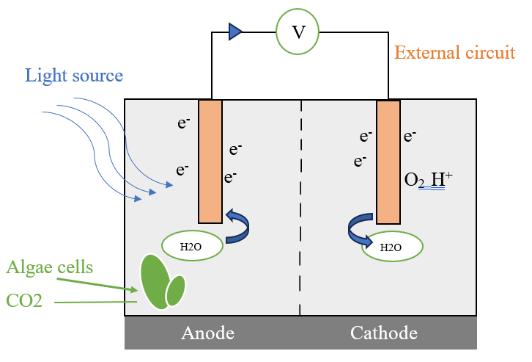
Harnessingelectricityfrom algaeisanexcitingavenuefor sustainable energy. Algae-based photolysis for electricity generation involves several key steps. Fig 1. shows the processbywhichsimpleelectrolysistakesplacetoproduce thepower.Itgenerateselectricitybyharnessinglightenergy tosplitwatermoleculesintohydrogenions,electrons,and oxygengas.Theelectronsflowthroughanexternalcircuit, producingelectricity,whileoxygenisreleased.
During the process, initial measurements shows that an open-circuitvoltageofupto993millivoltsandapeakpower of175.37microwatts.Theelectrochemicalreactionsinalgaebased photolysis require efficient electrodes to facilitate electron transfer. Anode (oxidation) electrodes, such as graphite, carbon nanotube (CNT), titanium dioxide (TiO2), andtungstenoxide(WO3),offerhighconductivity,stability, and electrocatalytic activity. Cathode (reduction) electrodes, including platinum (Pt), palladium (Pd), silver (Ag), and nickel(Ni),providehighelectrocatalyticactivity,conductivity, and corrosion resistance. Additionally, biocompatible electrodeslikeconductivepolymers,bio-inspiredelectrodes, and nanoporous gold could be used for their sustainability andbiodegradability.
Theprocessinvolvesaseriesofelectrochemicalreactions. Initially,algaeabsorblightenergy,triggeringthephotolysis reaction[6]:
6H2O+lightenergy→6H+6e- +3O2
Attheanode,wateroxidationoccurs:
2H2O→4H+4e- +O2
Atthecathode,hydrogenionsandelectronscombine: 2H+2e- →H2
Overallreaction: Algae+lightenergy+6H2O→6H2 +3O2 +biomass
Theelectrolytesolutionplaysacrucialroleinfacilitatingion transport between the anode and cathode. Common electrolyte solutions include phosphate buffer solution (PBS),sodiumchloride(NaCl)solution,potassiumchloride (KCl)solution,algaegrowthmedium,andnaturalseawater. The ideal electrolyte solution should have high ionic conductivity,pHbufferingcapacity,compatibilitywithalgae andmicroorganisms,lowtoxicity,andcost-effectiveness.
International Research Journal of Engineering and Technology (IRJET) e-ISSN: 2395-0056
Volume: 12 Issue: 10 | OCT 2025 www.irjet.net p-ISSN: 2395-0072
Amongwidevarietiesofsucculents,aloeverahasaunique combination of properties that could make it an ideal candidateforbioelectricitygeneration.Withawatercontent of 95-98% and a rich composition of electrolytes, polysaccharides,andglycoproteins,itcanpromoteefficient electrolysis.Duetoitsabundantavailability,lowcost,easeof cultivation, and non-toxic nature makes aloe vera an appealingoptionforbio-electrochemicalenergyharvesting.
Bioelectricityonaloeveraisgeneratedthroughphotolysis duringphotosynthesis,wherelightenergysplitsthewater moleculesinPhotosystemIItoproduceelectrons,whichare transferred to electrodes. CAM metabolism may also contribute electrons via organic acid breakdown in dark phase.Inbioelectrochemicalsystemwithaloevera,anode andcathodeelectrodesareinsertedintotheplantcreatinga plant-basedmicrobialfuelcell(PMFC)orBPVlikesystem. Theprocessesinvolvetheoxidationofpolysaccharidesand glycoproteinsattheanode,oxygenreductionatthecathode withaloeveragelitselfactsasanaturalelectrolyteduetoits high amount of water content and ionic compounds like potassium, magnesium and organic acids. However, Phosphate Buffer Solution could be used as an external electrolytesolutiontoenhancetheconductivityandelectron transferattheelectrode-tissueinterface.ReducedGraphene Oxideorasimplebamboocharcoalcanbeusedaselectrodes astheybalanceefficiencyandpracticality.Inamicrobialfuel cellusingaloevera,themainchemicalreactionsinvolve[6]:
a) Glucosebreakdownattheanode:
C6H12O6→2C2H5OH+2CO2+2e- +4H
b) Reductionatthecathode:
O2 +4e- +4H→2H2O
c) Theoverallreactioncanberepresentedas:
C6H12O6 +O2 →C2H5OH+2H2O
Thesereactionsdepicttheconversionofglucosetoethanol andcarbondioxidewhilegeneratingelectronsforelectricity.
Amplificationmethodsareusedtoincreasetheintensityor signal strength of a weak signal. In the field of bioelectrochemistry,amplificationtechniquesaremainlyused toenhancetheelectricalsignalsgeneratedbythealgaeand succulents.Belowarethemethods/techniquesthatcanbe usedtoamplifytheelectricaloutputfromthesources:
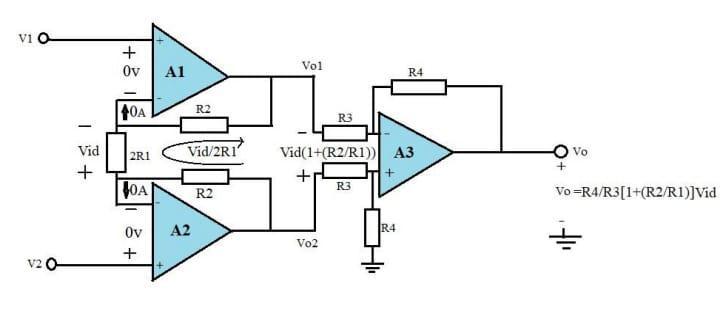
Instrumentation amplifiers (in-amps) are designed for applications requiring high input impedance, which is critical when dealing with low current, high-impedence biologicalsourceslikealgaeandsucculents.Thisalongwith thecommon-moderejectionofthecircuitmakesiteffective incapturinglow-levelsignalsfromplants.
-2:StandardOp-AmpbasedInstrumentationAmplifier [13]
Aninstrumentationamplifierisaspecifictypeofdifferential amplifier engineered to boost low-level signals while effectivelyminimizingnoiseandinterference.Itcomprises three operational amplifiers that deliver high input impedance, reducing the load on high-impedance sources. Theamplifieremphasizesthedifferencebetweentwoinput signals and provides excellent common-mode rejection, essentialforpreservingsignalintegrity.Itsdesignalsoallows foreasygainadjustmentswithexternalresistors,makingit adaptableforarangeofapplications[14].AD620andINA128 arewidelyusedprecisioninstrumentationamplifierwhich are suitable for low power applications and ease of integrationinprototypecircuits.
An instrumentation amplifier can be used to sum up and amplify the electrical output from algae and aloe vera by capturingthesmallvoltagesignalsgeneratedfromCurrentVoltage Converter connected to the electrodes [14]. Connecting these signals to the input terminals of the OpAmpinstrumentationamplifier,whichisdesignedtoprovide highinputimpedanceandexcellentcommon-moderejection, couldbecrucialforaccuratelymeasuringlow-levelsignals.
A Current-to-Voltage (I-V) converter transforms the small current generated by algae and the succulent into a measurable voltage signal. These converters amplify the currentwhileminimizingnoiseandensuringhighaccuracy
International Research Journal of Engineering and Technology (IRJET) e-ISSN: 2395-0056
Volume: 12 Issue: 10 | OCT 2025 www.irjet.net p-ISSN: 2395-0072
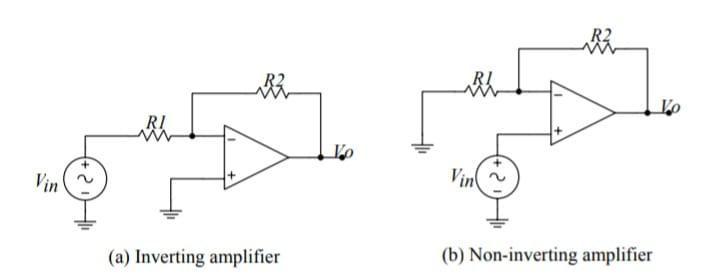
Anoperationalamplifierisahighgainelectronicamplifier, widely used in analog electronics for signal amplification. The amplifier consists of resistors and capacitors, which worktogethertoprovidehighgain,lownoise,andhighinput impedance[12].TheOp-Ampcanbeclassifiedasinverting, non-inverting,ordifferentialamplifiersinaccordancewith theapplication.Withthehighgainandlownoise,Op-Amps are ideal for amplifying weak signals, making them a fundamentalcomponentinmanyelectronicsystems[12].
Op-Ampcouldbeusedtoamplifytheweakelectricalsignals generatedbybothalgaeandaloevera,combiningthesignals to increase their strength and stability. Op-amps also facilitate power conversion, transforming the electrical signals into a format suitable for electricity generation. Furthermore, they enable monitoring and control of the electricity generation process, allowing for real-time adjustments to optimize energy output. By leveraging the capabilitiesofop-amps,theelectricalpotentialofalgaeand succulents can be harnessed, that might pave the way for innovativeandsustainableenergysolutions.
The cost analysis of harnessing electricity from algae and succulentsrevealsapromisingeconomicviability.Theinitial investment for setting up these systems is significant, but operationalcostsaresubstantiallylower.Maintenancecosts are also minimal, making these systems an attractive alternative to traditional renewable energy sources. As research and development continue to advance, costs are expected to decrease further, making algae and succulentbasedelectricitygenerationacost-effectiveandsustainable solution.Thecapitalexpenditures(CAPEX)forestablishing analgaeandsucculent-basedelectricitygenerationsystem, includeselectrodes,powerconversionsystems,andelectrical connections. Ongoing operating expenditures (OPEX) are expected to be relatively low, comprising algae/succulent maintenance,waterandnutrientsupply,labourandtraining. Theinitialinvestmentcoststhatincludetheequipmentcosts, land acquisition costs, labour costs etc is the CAPEX. The ongoingoperatingcostscanbethemaintenancecosts,energy costs, etc. is the OPEX, also the break-even analysis for a system is to be considered. Further, there could be opportunities to earn carbon credits or other incentives,
whichcanalsoenhancetherevenuestreams.Therefore,fora goodproductionyieldofoutputandcollaboratingwiththe various industries, it is mandatory to ensure the cost dependency
Specific storage conditions are necessary for algae and succulentstopreservetheirelectrochemicalcharacteristics. Like this, to guarantee a steady supply of energy, the producedelectricityneedstobestoredeffectively.Foralgae, storage methods include refrigeration at 4°C to 10°C with 80%humidity,freeze-dryingforextendedpreservation,and lyophilizationtoremovewatercontentandenhancestability. Inordertopreservetheirwatercontent,succulentsneedto bekeptincontrolledconditionswithtemperaturesbetween 15°Cand25°Candhumiditylevelsbetween50%and70%. Lead-acid, lithium-ion, or flow batteries provide effective energy storage, while supercapacitors allow for quick charging and discharging of the produced electricity. Bioelectrochemicalenergyharvestingcandevelopintoareliable and effective renewable energy source by implementing thesestorageoptionsintopractice.
Transportation plays a vital role in the generation of electricity using algae and succulents. The different transportation techniques of algae and succulents for electricity generation requires careful consideration to ensurethemaintenanceoftheirviabilityandintegrity.The transportationoftheseorganismsfromcultivationsitesto power generation facilities can significantly impact the overall cost and efficiency of the process. For algae, photobioreactorsorclosedsystemscanbeusedtotransport the microorganisms while maintaining optimal growing conditions. These systems can be designed to regulate temperature, pH, and light exposure, thereby minimizing stressonthealgae.Forsucculents,transportationtechniques focus on maintaining the plant’s water balance and preventing the physical damage. This can be achieved by using specialized containers or packaging materials that retainmoistureandprovidecushioning.Succulentscanalso be transported in a dormant state, which can help reduce water loss and improve their survival rate during transportation.Varioustransportationmethodssuchasroad, rail,andpipelinetransportcanbeemployed,eachwithits ownadvantagesandchallenges.Also,theuseofrefrigerated transportation or insulated containers can help regulate temperatureandhumiditylevels,furtherreducingstresson thesucculents.
Overall,thechoiceoftransportationtechniquewilldepend onfactorssuchasthedistanceanddurationoftransport,the typeandquantityofalgaeorsucculentsbeingtransported, andthespecificrequirementsformaintainingtheirviability. Maintaining optimal temperature conditions during transportationiscrucialforpreservingtheviabilityofalgae and succulents. Additionally, ensuring the safe and secure
International Research Journal of Engineering and Technology (IRJET) e-ISSN: 2395-0056
Volume: 12 Issue: 10 | OCT 2025 www.irjet.net p-ISSN: 2395-0072
transportation of these organisms is essential to prevent contaminationandmaintaintheirintegrity.Astheindustry continues to grow, developing specialized transportation infrastructure, integrating with existing transportation networks,andinvestinginnewtransportationtechnologies willbeessentialforimprovingefficiency,reducingcosts,and scaling up the production of electricity from algae and succulents. Overall, a reliable and efficient transportation systemiscrucialforthesuccessfulgenerationofelectricity fromalgaeandsucculents.
The study demonstrates the feasibility of producing electricity from algae and succulents through electrolysis, providinganovelandsustainablerenewableenergysolution. The high electrochemical property ofthese organismsand theimportanceofefficientstoragesolutionsarepredominant factors. Future research should focus on scaling up electrolysis systems, genetic engineering, and use of novel electrode materials. This technology has significant implications for addressing the global energy crisis, promotingruralenergydevelopment,andensuringenergy independence. This approach not only harnesses natural resourcesbutalsosupportsbiodiversityandcarboncapture, underscoringitspotentialsignificanceinthetransitiontoa greener economy. With further collaboration and development, bio-electrochemical energy harvesting from algae and succulents can become a viable and sustainable energysourceforthefuture
Harnessingtheelectricityfromalgaeandsucculentsunfolds a vast array of opportunities and avenues for future exploration. As research and development continue to advance, we can anticipate significant breakthroughs in efficiency,scalability,andcost-effectiveness.Oneofthemost promising opportunities lies in integrating these systems withexistingrenewableenergyinfrastructure.Bycombining algaeorsucculent-basedpowergenerationwithsolar,wind, orhydroelectricpower,whichcancreatehybridsystemsthat optimize energy production and reduce reliance on fossil fuels.Algaeandsucculent-basedsystemscanbedesignedfor off-grid applications, providing energy access to remote communitiesandunderservedpopulation.Thiscanhavea transformative impact on socio-economic development, enabling communities to power their homes, schools, and businesses sustainably. As part of the future initiatives, integratingthebioelectricitythatisgeneratedfromalgaeand succulents can be used for the recharging purpose in the batteriesatindustries.Alsomaximisingtheoutputcurrent thatisgeneratedasahugeamountcanbeusedtopoweror runthemachinesforcommercialandindustrialpurposes.
[1] Jorg Ullmann, Daniel Grimm, 2021, “Algae and their potentialforafuturebioeconomy,landlessfoodproduction, andthesocio-economicimpactofanalgaeindustry.”,Journal oftheInternationalSocietyofOrganicAgricultureResearch, Volume11,261-267
[2] Yaniv Shlosberg, Gadi Schuster, Noam Adir, 2022, “Harnessing photosynthesis to produce electricity using cyanobacteria,greenalgae,seaweedsandplants.”,Frontiers inPlantScience,Volume13-2022
[3]YuHanGuo,2023,“BioelectricBatteries:UsingAlgaeto Make the Battery Renewable.”, Canadian Science Fair Journal,Volume5.
[4]NethraaKannan,PhilipDonnellan,2021,“Algae-assisted microbial fuel cells: A practical overview.”, Bioresource TechnologyReports,Volume15,100747
[5]VenkateshChaturvedi,2016,PradeepVerma,“Microbial fuelcell:agreenapproachfortheutilizationofwasteforthe generationofbioelectricity.”,BioresoucesandBioprocessing 3,Article-38
[6]NationalCouncilofEducationalResearchandTraining (NCERT). (2006). "Photosynthesis in Higher Plants." In Biology(pp.216-217).NewDelhi:NCERT.
[7] Iwona Gajda, John Greenman, Chris Melhuish, Ioannis Ieropoulos, “Self-sustainable electricity production from algaegrowninamicrobialfuelcellsystem.”
[8]AlperBender,“CostandBenefitAnalysisofImplementing Photobioreactor System for Self-Sustainable Electricity ProductionfromAlgae.”
[9]NimishBiloria,YashkumarThakkar,“Integratingalgae building technology in the built environment: A cost and benefitperspective.”
[10]SiminTazikeh,SohrabZendehboudi,SamiraGhafoori, AliLohi,NaderMahinpey,“Algalbioenergyproductionand utilization:Technologies,challenges,andprospects.”
[11]NationalCouncilofEducationalResearchandTraining (NCERT). (2006). "Respiration in Plants." In Biology (pp. 226-227).NewDelhi:NCERT.
[12] Chaniotakis, A., & Cory, K. (2006). Operational Amplifiers & Linear Integrated Circuits (6.071 – Spring 2006).MITOpenCourseWare.
[13]O.Saluri,"Op-AmpNon-InvertingAmplifier,"Wikimedia Commons,Sep.2009.
[14] N. Çek, A. Tuna, A. Çelik, A. Orhan, and S. Sezer, "Exploring a new clean technology in renewable energy production: The system design of Aloe vera-based plant microbial fuel cells," Scientific Reports, vol. 13, Art. no. 12345,2023.
[15]Saba,B.,etal.(2019).Photosyntheticmicroorganisms (Algae)mediatedbioelectricitygenerationinmicrobialfuel cell: Concise review. Environmental Technology Reviews, 8(1),119-130.
International Research Journal of Engineering and Technology (IRJET) e-ISSN: 2395-0056
[16] Ng, F. L., et al. (2020). Integration of bioelectricity generationfromalgalbio-photovoltaic(BPV)deviceswith remediationofpalmoilmill effluent(POME)assubstrate. Chemosphere,255,126833.
[17]Shlosberg,Y.,etal.(2022)."ProgressinPlant-BasedBioelectrochemical Systems and Their Connection with Sustainable Development Goals." Carbon Resources Conversion,5(3),189-199.
[18]Mishra,S.,etal.(2020)."CMOSPowerAmplifierDesign andApplications."Electronics,9(11),1845
Volume: 12 Issue: 10 | OCT 2025 www.irjet.net p-ISSN: 2395-0072 © 2025, IRJET | Impact Factor value: 8.315 | ISO 9001:2008