
International Research Journal of Engineering and Technology (IRJET) e-ISSN: 2395-0056
Volume: 13 Issue: 04 | Apr 2026 www.irjet.net p-ISSN: 2395-0072

International Research Journal of Engineering and Technology (IRJET) e-ISSN: 2395-0056
Volume: 13 Issue: 04 | Apr 2026 www.irjet.net p-ISSN: 2395-0072
M.
Gowri1 , B. Srikanth2 , K. Sandhya3 , P. Uday Kiran4 , R. Naveen 5
1Assistant Professor, Department of Civil Engineering, Sanketika Vidya Parishad Engineering College, Andhra Pradesh, India
2,3,4,5B. Tech Students, Department of Civil Engineering, Sanketika Vidya Parishad Engineering College, Andhra Pradesh, India
***
Abstract - This study investigates the use of burnt brick debris as a partial replacement for fine aggregate inconcrete. Due to the depletion of natural sand and increasing construction waste, alternative materials are required. Concrete mixes were prepared with 0%, 10%, 20%, and 30% replacement levels. Tests such as slump, compressivestrength, density, and water absorption were conducted. Results show that workability decreases with increase in brick content, while compressive strength improves up to an optimum level and then decreases. The study concludes that burnt brick debris can be used as a sustainable material in concrete.
Key Words: Sustainable Concrete, Burnt Brick Debris, Fine Aggregate Replacement, Workability, Compressive Strength, Density, Water Absorption, Construction Waste Utilization, Eco-Friendly Materials, M25 Concrete.
Concrete is a widely used construction material made of cement,fineaggregate,coarseaggregate,andwater.Natural river sand is commonly used as fine aggregate, but its excessiveusehasledtoscarcityandenvironmentalissues such as riverbed degradation. At the same time, large quantities of burnt brick debris are generated from construction activities and are To determine the compressivestrengthofconcreteat7,14,21,and28days.
To study the density and water absorption of hardened concrete.oftendisposedofaswaste.
Burnt brick debrishasgood bonding propertiesduetoits rough texture, but its porous nature and higher water absorption may influence the performance of concrete. Hence,itisnecessarytoevaluateitssuitabilityasapartial replacementforsand.
This study aims to use burnt brick debris as a partial replacement of fine aggregate in concrete to promote sustainable construction and reduce the use of natural resources.
• Thisstudyfocusesonusingburntbrickdebris as a partial replacement for fine aggregate in concrete.
• The replacement levels considered are 0%, 10%,20%,and30%.
• Cement, coarse aggregate, and water content arekeptconstantforallmixes.
• Burntbrickdebrisiscrushedandsievedtopass througha4.75mmsieve.
• The study is carried out under controlled laboratoryconditions.
• Workabilityoffreshconcreteisevaluatedusing theslumptest.
• Compressivestrengthistestedat7,14,21,and 28days.
• Density and water absorption of hardened concretearealsoanalyzed.
• The project aims to determine the optimum replacementpercentageofburntbrickdebris.
• Durabilityandlong-termperformancestudies arenotincludedinthisproject.
• To study the suitability of burnt brick debris as a partialreplacementforfineaggregateinconcrete.
• Todeterminethephysicalpropertiesofburntbrick debrissuchasspecific gravity,sieveanalysis,and waterabsorption.
• To compare the properties of natural sand and burntbrickdebris.
• To prepare concrete mixes with different replacementlevels(0%,10%,20%,and30%).
• Toevaluatetheworkability ofconcreteusingthe slumptest.
• Toidentifytheoptimumpercentageofburntbrick debris that gives good strength and acceptable workability.
• To promote the use of construction waste and reducedependenceonnaturalriversand.
Keerthi Narayana et al. (2010): Investigated the use of crushedfirebricksasapartialreplacementforfineaggregate inconcrete.Replacementlevelsof20%,25%,and30%were considered.Thestudyfoundthatcrushedbrickparticlesare rough and angular in shape, which improved bonding betweencementpasteandaggregates.Asaresult,tensileand
International Research Journal of Engineering and Technology (IRJET) e-ISSN: 2395-0056
Volume: 13 Issue: 04 | Apr 2026 www.irjet.net p-ISSN: 2395-0072
flexuralstrengthincreaseduptoabout25–30%replacement. Thestudyconcludedthatcrushedfirebrickscaneffectively replacenaturalsanduptoapproximately25–30%without significantlossinstrength.
Nishka Devi et al. (2016): Studiedbrickpowderasafine aggregatereplacementatlevelsof10%,15%,20%,and25%. Theresultsshowedimprovementincompressiveandsplit tensilestrengthupto20%replacement.Beyondthislevel, strength decreased due to higher water absorption. The optimumreplacementlevelwasfoundtobeapproximately 20%.
Siva et al. (2017): Investigatedpartialreplacementoffine aggregatewithcrushedfirebricksat10%,15%,20%,and 25%.Workabilitydecreasedasbrickcontentincreaseddue toitsporousnature.Compressivestrengthincreasedupto 20% replacement and decreased beyond that. The study concluded that 20% replacement is optimum.
P. Patel (2019): Studiedburntbrickdebrisasareplacement for natural sandatlevels of5%, 10%, 15%, and20%. The studyfoundthatdurabilitypropertiessuchasacidresistance improved at moderate replacement levels. The optimum replacement percentage was approximately 15%.
Sriharsha and Murthy (2014):Utilizeddemolitiondebris along with blast furnace slag to prepare concrete samples using53gradecement.Variousmixproportionsweretested toevaluatecompressivestrengthandwaterabsorption.The resultsshowedthatdemolitionwastecanbeeffectivelyused inmanufacturingconcreteblockswhenpropermixdesignis adopted.
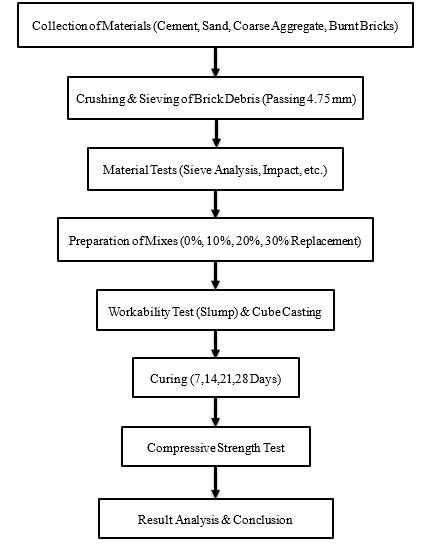
Flow Chart -1: MethodologyoftheProject
3.1 Materials used:
• Cement–Bindingmaterialusedforstrength.
• FineAggregate(Sand)–Usedasfiller;partially replaced.
• Coarse Aggregate – Provides strength and stability(10mm&20mm).
• Burnt Brick Debris – Used as partial replacementforsand.
• Water–Requiredformixingandcuring
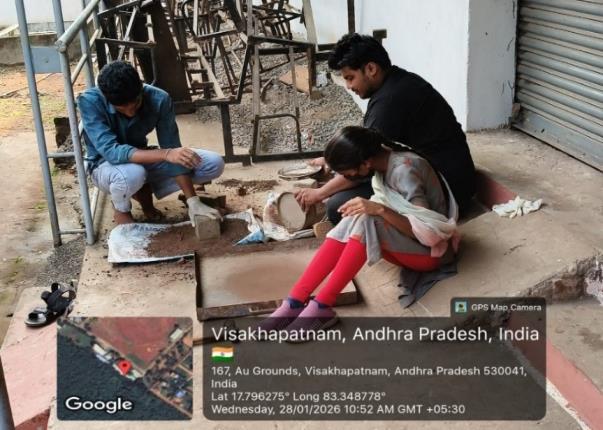
3.2 Tests on Materials:
Cement:
-FinenessTest
-StandardConsistencyTest
Fine Aggregate (Sand):
-SpecificGravityTest
-SieveAnalysis
-MoistureContentTest
-WaterAbsorptionTest
Coarse Aggregate:
-SpecificGravityTest
-SieveAnalysis
-AggregateImpactValueTest
Burnt Brick Debris:
-SpecificGravityTest
-SieveAnalysis
-WaterAbsorptionTest
3.3 Mix Proportion:
Concrete mixes were prepared by partially replacing fine aggregate (sand) with burnt brick debris at different percentagesof0%,10%,20%,and30%.Thequantitiesof cement,coarseaggregate,andwaterwerekeptconstantfor all mixes to ensure proper comparison. Materials were weighed accurately and mixed uniformly before casting concretespecimens.
Theresultsofthestudyarecategorizedtoprovideaclear understandingoftheperformanceofconcretewithpartial replacement of fine aggregate by burnt brick debris. The observationsarebasedonvariousexperimentalevaluations
International Research Journal of Engineering and Technology (IRJET) e-ISSN: 2395-0056
Volume: 13 Issue: 04 | Apr 2026 www.irjet.net p-ISSN: 2395-0072
carriedoutduringthestudy.Theseresultshelpinanalyzing thebehaviorofconcreteintermsofstrength,workability, anddurability.Theyalsoassistinidentifyingtheoptimum replacementpercentageforeffectiveandsustainableusein construction.
Thematerialtestswereconductedtodeterminethephysical propertiesofcement,fineaggregate,coarseaggregate,and burnt brick debris before use in concrete. Tests such as fineness and standard consistency for cement, specific gravity and sieve analysis for aggregates, and water absorption for all materials were carried out. These tests helpinensuringthatthematerialsaresuitableandmeetthe requiredstandardsforconcreteproduction.
Table -1:ResultsofMaterialsTests Material
Fresh concrete tests were performed to evaluate the workability and consistency of the concrete mixes. The slumptestwasconductedfordifferentreplacementlevelsto understandtheeaseofmixing,placing,andcompactionof concrete.Theresultsindicatetheeffectofburntbrickdebris ontheworkabilityoffreshconcrete.
Table -2:SlumpTestResults
Chart -1:WorkabilityofConcreteMixes
4.3
Hardened concrete tests were carried out to study the strength and performance of concrete after curing. Compressive strength tests were conducted at different curing periods, along with density and water absorption tests.Thesetestshelpinevaluatingthestrength,quality,and durability characteristics of concrete with partial replacementoffineaggregate
1)CompressiveStrengthTest:
Hardened concrete tests were carried out to study the strength and performance of concrete after curing. Compressive strength tests were conducted at different curing periods, along with density and water absorption tests.Thesetestshelpinevaluatingthestrength,quality,and durability characteristics of concrete with partial replacementoffineaggregate.
International Research Journal of Engineering and Technology (IRJET) e-ISSN: 2395-0056
Volume: 13 Issue: 04 | Apr 2026 www.irjet.net p-ISSN: 2395-0072
Table -3:CompressiveStrengthResults
2)DensityTest:
Thedensityofconcretedecreasesgraduallywithanincrease inburntbrick debriscontent.Thisisbecausebrick debris has lower specific gravity compared to natural sand. However, the density values of all mixes are within acceptablelimitsfornormalconcrete.
Table -4:DensityTestResults
-3:DensityofConcreteMixes
3)WaterAbsorptionTestResults:
The water absorption of concrete increases with higher replacementlevelsofburntbrickdebris.Thevaluesincrease from 0.43% for the control mix to 0.61% at 30% replacement. This is due to the porous nature and higher waterabsorptioncapacityofburntbrickdebris.
Table -5:WaterAbsorptionTestResults
Water Absorption (%)
Chart -4: WaterAbsorptionofConcreteMixes
5. CONCLUSION
Fromtheexperimentalstudy,itcanbeconcludedthatburnt brickdebriscanbeeffectivelyusedasapartialreplacement
International Research Journal of Engineering and Technology (IRJET) e-ISSN: 2395-0056
Volume: 13 Issue: 04 | Apr 2026 www.irjet.net p-ISSN: 2395-0072
forfineaggregateinconcrete.Theworkabilityofconcrete decreaseswithanincreaseinbrickdebrisduetoitshigher waterabsorption.Thecompressivestrengthincreasesupto 20% replacement and then slightly decreases at higher percentages. The density of concrete shows a slight reduction, while water absorption increases with higher replacementlevels.Theoptimumreplacementlevelisfound tobe20%,whichprovidesagoodbalancebetweenstrength and workability. Thus, the use of burnt brick debris promotessustainableconstruction byreducingwasteand conservingnaturalsand.
6. FUTURE SCOPE
• Further studies can be carried out with higher replacementpercentagesbeyond30%todetermine themaximumusablelimitofburntbrickdebris.
• Durabilitytestssuchaspermeability,shrinkage,and long-termstrengthcanbeevaluated.
• The study can be extended to high-strength concreteanddifferentmixdesignmethods.
• Combinationofburntbrickdebriswithotherwaste materialscanbeexploredforbetterperformance.
• The use of brick debris in real construction applicationscanbestudiedforpracticalfeasibility.
1.KeerthiNarayana,K.,etal.(2010).Crushedbrickasfine aggregate
2.Neville,A.M.(2011).PropertiesofConcrete.
3.TariqAli(2013).Over-burntbrickinconcrete.
4. Sriharsha, K. & Murthy, A. (2014). Demolition waste in concrete.
5. Patil, G. S. & Autade, P. B. (2015). Brick aggregate in concrete.
6.NishkaDevi,etal.(2016).Brickpowderasfineaggregate.
7.Siva,A.,etal.(2017).Crushedbrickreplacementstudy.
8.P.Patel(2019).Brickdebrisassandreplacement