
International Research Journal of Engineering and Technology (IRJET) e-ISSN: 2395-0056
Volume: 12 Issue: 04 | Apr 2025 www.irjet.net p-ISSN: 2395-0072
International Research Journal of Engineering and Technology (IRJET) e-ISSN: 2395-0056
Volume: 12 Issue: 04 | Apr 2025 www.irjet.net p-ISSN: 2395-0072
V Santhosh kumar1 , N Sai vijay2 , V Viswanadh3 , N G V Siva4
1,2,3,4Student, Department of Civil Engineering, SRGEC ,Gudlavalleru, Andhra Pradesh, India ***
Abstract - Cement production, a cornerstone of global construction and infrastructure, is among the largest contributors to carbon emissions, accounting for approximately 8% of global CO₂ output. Each stage of its production generates significant greenhouse gases, underscoringtheneedforsustainablepracticestomitigateits environmental impact. This study explores the potential of supplementary cementitious materials (SCMs) such as alccofine and lime sludge to partially replace traditional cement and reduce its carbon footprint. Lime sludge is a residual substance came from the paper sector. Initially, alccofinewasincorporatedatreplacementlevelsof10%,20%, and 30% by weight of cement to determine the optimal proportion. Subsequently, using the optimal alccofine percentagelimesludgewasreplacedatvaryingreplacement levels5%,10%,and15%.Themechanicalpropertiesofthese concrete mixtures, including workability, compressive strength, split tensile strength, and flexural strength, were systematically assessedand compared with conventional concrete, highlighting the viability of these SCMs in sustainable concrete production. Results indicate that mix consisting 20% alccofine and 10% lime sludge performed betterwhencomparedtoconventionalconcrete.
Key Words: Alccofine,Lime Sludge
The construction industry had long relied on cement as a fundamentalmaterialinthedevelopmentofinfrastructure such as buildings, roads, and bridges. However, cement productionhadbecomeasignificantenvironmentalconcern duetoitshighenergyconsumptionandsubstantialcarbon dioxide (CO₂) emissions. It had been estimated that the cement industry contributed nearly 8% of global CO₂ emissions,makingitoneofthelargestindustrialsourcesof greenhousegases.
Toaddressthisissue,variousstrategieshadbeenexplored tomakeconcretemoresustainable.Oneeffectiveapproach involved the use of supplementary cementitiousmaterials (SCMs),whichareindustrialby-productscapableofpartially replacingcementinconcrete.Thesematerialshelpedreduce the carbon footprint of concrete while also improving or maintainingitsperformance.
In this study, two SCMs were selected for investigation: alccofine,ahighlyreactive,finelygroundslag-basedmaterial known for enhancing strength and durability; and lime
sludge, a waste product generated by the paper industry. Theuseoflimesludgeaimedtoreducecementconsumption andpromotetherecyclingofindustrialwaste,contributing tosustainableconstructionpractices.
The experimental work was conducted in two phases. Initially,alccofinewasusedtoreplacecementat10%,20%, and 30% by weight to determine the optimal proportion basedonmechanicalperformance.Afteridentifyingthebestperformingalccofinepercentage,limesludgewasaddedto the mix at 5%, 10%, and 15% replacement levels. The resulting concrete specimens were tested for mechanical propertiessuchasworkability,compressivestrength,split tensile strength, and flexural strength. Furthermore, This projectaimedtodemonstratethepotentialofalccofineand lime sludge as effective and sustainable alternatives to traditionalcement,withthegoalofreducingenvironmental impact while maintaining the quality and strength of concrete.
1P.R.K.ChakravarthyandR.Rathanraj,(2017)analyzedthe compressivestrengthofconcretebypartialreplacementof cementwithalccofine.Theyreplacedcementwithalccofine at a percentage 0%, 4%, 8%, 16%, 25%, 50%, 75%, 100%.They conducted tests such as setting time , split tensilestrength,flexuralstrength,impacttest,compressive strength.Theyconcludedthat16%replacementofalccofine can give maximum compressive strength and resistance againstchlorideattacks.
2R.BalamuraliKrishnan&J.Saravanan,(2021)investigated that replacement for cement to enhance environmental sustainability and improve the mechanical properties of concrete. Several industrial by-products,includingflyash, silicafume,GGBS,metakaolin,andquartzpowder,havebeen widelystudied.ThefocusisonAlccofine-1203,anultrafine material derived from glass waste, which has shown promisingresultsinimprovingthecompressivestrengthof cement mortar cubes. Studies indicate that a 10% replacement of cement with alccofine provides optimal strength gains, making it a viable supplementary cementitiousmaterial.
3R. Pranamika& S. Thirugnanasambandam, (2024) investigated the potential of Alccofine 1203 as a cement replacementinconcretetoenhancestrength,durability,and sustainability. Researchers explored how varying
International Research Journal of Engineering and Technology (IRJET) e-ISSN: 2395-0056
Volume: 12 Issue: 04 | Apr 2025 www.irjet.net p-ISSN: 2395-0072
proportionsofAlccofine(rangingfrom0%to50%)affected the mechanical properties of M20-grade concrete. They conductedtestssuchascompressivestrength,modulusof elasticity,flexuralstrength.Theyconcludedthatadditionof alccofineexhibitshighercompressivestrengthcomparedto conventionalconcrete.
4B. Venkatesan et al., (2020) studied the use of supplementarymaterialstoimproveconcrete.Materialslike fly ash, silica fume, and GGBS were commonly used, but Alccofine,anewermaterial,showedbetterperformancein termsofstrengthandworkability.Ithadveryfineparticles andreactedwellwithcement,whichhelpedincreaseearly andlong-termstrength. Somestudiesalsolookedatusing wastematerialslikeironpowderfromsteelindustriesasa partialreplacementforsand.Replacingfineaggregateswith ironpowderimprovedthedensityandstrengthofconcrete. It also helped concrete resist damage from harmful chemicals like acids and sulphates. A few researchers combinedbothAlccofineandironpowderinconcrete.They foundthatthismiximprovedbothstrengthanddurability compared to normal concrete. Tests like compressive and splittensilestrengthweredoneafter7,14,and28daysof curing, and the concrete was also tested in chemical solutionstocheckitsdurability.
5B.L.N. Sai Srinath et al., (2021) studied that Concrete productionhadheavilyreliedoncement,whichcontributed significantlytogreenhousegasemissionsduetotherelease of CO₂ during the clinkering process. To reduce this environmental impact, researchers had explored various Supplementary Cementitious Materials (SCMs) such as fly ash,GroundGranulatedBlastFurnaceSlag(GGBS),ricehusk ash, silica fume, phosphogypsum, and metakaolin. These materialshadshownpozzolanicpropertiesthatenhanced the performance of concrete. Alccofine 1203, a newer microfineSCM,hadrecentlygainedattentionforitsabilityto improvethefresh,mechanical,anddurabilitypropertiesof concrete when used as a partial replacement for cement. Several studies had reported improved strength, better workability, and higher resistance to chemical attack in concretemixturescontainingalccofine.However,itseffects onmicrostructureandfireresistancehadnotbeenwidely studied.
6Ansari U.S et al.,(2020) studied that Fly ash had been widely used for many years as a partial replacement for cement in concrete, typically in low replacement levels ranging from 10% to 20%. It had been recognized for its pozzolanicproperties,contributingtoimprovedworkability andlong-termstrength.However,itseffectivenessinhighperformanceconcrete(HPC)wasoftenlimitedwhenused aloneatlowdosages.Recentstudieshadintroducedtheuse ofalccofine,a microfinematerial withhighreactivity,asa supplementary cementitious material. Researchers had explored its combined use with fly ash to enhance the mechanicalpropertiesofhigh-gradeconcretemixes.When appliedtohigher-strengthconcrete,suchasM70grade,the
inclusionofalccofinehadshownsignificantimprovementsin compressivestrength.
Comparative studies had indicated that concrete mixes incorporating both alccofine and fly ash exhibited better performancethanordinaryPortlandcement(OPC)concrete. Inparticular,a20%increaseincompressivestrengthhad beenobservedwhenalccofinepartiallyreplacedcement.
7N. Raghavendra et al., (2019) examined the influence of alccofine1203asasupplementarycementitiousmaterialon theperformanceofconcrete.Thestudyinvolvedreplacing cement with alccofine in varying proportions (5%, 10%, 15%)inM30gradeconcrete.Testresultsshowedthatthe addition of alccofine significantly improved workability, compressive strength, and resistance to sulphate and chlorideattack.Theultrafineparticlesizeofalccofinewas credited for enhancing particle packing and reducing porosity.Thestudyconcludedthatalccofinewasaneffective high-performanceSCMforimprovingconcretestrengthand durability.
2.1 Cement
Cement isafine,graypowder thatactsasabindingmaterial when mixed with water. It is one of the most important componentsinconstructionandplaysakeyroleinmaking concrete and mortar. When water is added to cement, a chemical reaction called hydration occurs, causing the mixturetohardenandgainstrengthovertime
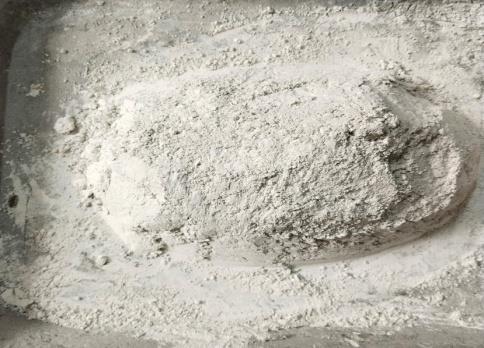
Alccofine 1203 is a high-performance, ultrafine mineral admixtureprimarilycomposedofgranulatedblastfurnace slag.Itisprocessedthroughacontrolledgrindingtechnique toachieveaveryfineparticlesize,evensmallerthanthatof silica fume. Alccofine 1203 is used in high-performance concrete (HPC) to enhance strength, durability, and workability. It is particularly effective in improving early strengthdevelopmentandreducingpermeability,makingit suitableforcriticalinfrastructureandprecastelements.’
International Research Journal of Engineering and Technology (IRJET) e-ISSN: 2395-0056
Volume: 12 Issue: 04 | Apr 2025 www.irjet.net p-ISSN: 2395-0072
Thepresenceofcalcium(CaO)andsilica(SiO2)inalccofine1203improvedthemechanicalanddurabilitypropertiesof concrete better than the other SCMs. From the literature review,theoptimumdosageofalccofine-1203isobtained between 8% to 12%, and at these percentages, the improvementinmechanicalanddurabilitypropertiesofthe concrete is highest. The table.2.1 shows the physical propertiesofalccofine.
Table2.1:PhysicalPropertiesof
S
1 ParticleSize 5micron
2 SpecificSurfaceArea 12000cm2/g
3 SpecificGravity 285
4 Colour GeryWhite
5 Form Powder
Lime sludge is a by-product generated mainly from industriessuchaspapermills,sugarmills,watertreatment plants, and chemical plants. It is primarily composed of calciumcarbonate(CaCO₃)alongwithsomeimpuritieslike lime(CaO),silica,alumina,andmagnesium.Limesludgeis produced when lime is used in processes like water softening orchemical recovery. Over time, the limereacts withimpuritiesandsettlesassludge.
Fineaggregateisakeycomponentofconcreteandmortar, providingbulk,strength,andresistancetowear.Itconsists of naturally occurring or manufactured mineral particles thataresmallerthan4.75mmindiameter.Commonsources includeriversand,crushed stonesand,andmanufactured sand. Fine aggregates fill the voids between coarse aggregates and contribute to the overall density and workabilityofthemix.Theyinfluenceimportantproperties like setting time, strength, shrinkage, and durability of concreteormortar.Propergradingoffineaggregateensures bettercompactionandminimizesvoids,leadingtoimproved mechanicalperformanceofthefinalproduct.
Coarse aggregate is a key ingredient in concrete and constructionmaterials,consistingofnaturallyoccurringor artificially crushed stones such as gravel or crushed rock. Theseaggregatesaretypicallyretainedona4.75mmsieve andrangeinsizeupto80mm.Theirprimaryfunctionisto provide bulk, strength, and stability to the concrete mix. Coarseaggregatescanbeeitherangular,whichcomefrom crushed rocks and offer better interlocking properties,
or rounded,whicharesmootherandeasiertomixbutmay reducetheoverallstrengthofconcrete.
Waterisacrucialcomponentinconstruction,especiallyin concreteandmortarproduction.Itplaysavitalroleinthe hydration of cement, workability of mixes, and overall strength and durability of concrete. The quality of water usedinconstructionsignificantlyaffectstheperformanceof thefinalstructure.
2.7
1.Workability
Thisisthemostwidelyadoptedmethodduetoitssimplicity and quick results. The test is conducted using a metallic slumpcone,whichis300mmhighwithadiameterof100 mmatthetopand200mmatthebase.Theconeisplacedon anon-absorbent,flatsurfaceandfilledwithfreshconcretein threeequallayers.Eachlayeriscompactedbytampingit25 timeswithastandardtampingrodtoeliminateairpockets andensureconsistency.Oncetheconeisfilledandleveledat thetop,itiscarefullyliftedvertically,allowingtheconcrete tosubsideor"slump."Theverticaldistancebetweenthetop oftheconeandthehighestpointoftheslumpedconcreteis measured,whichisreferredtoastheslumpvalue.
The compressive strength test is one of the most fundamentalandwidelyusedteststoassessthequalityand performanceofconcrete.Itmeasurestheabilityofconcrete to withstand axial loads and provides critical information aboutitsstructuralintegrity.Thetestistypicallyconducted on concrete cubes or cylinders that have been cured for specificdurations,mostcommonlyat7,14,and28days.In India,thestandardsizeusedisacubeof150mm×150mm ×150mm,whilecylindersof150mmdiameterand300mm heightaremorecommonin someothercountrieslikethe U.S.Thespecimensarecastandcompactedproperly,then cured in water at controlled temperatures. On the day of testing,theconcretespecimenisremovedfromthecuring tank, surface dried, and placed in a compression testing machine(CTM).Theloadisappliedgraduallyanduniformly at a specific rate, usually around 140 kg/cm² per minute, untilthespecimenfails.Themaximumloadcarriedbythe specimen before failure is recorded, and the compressive strength is calculated by dividing this load by the crosssectionalareaofthespecimen.
Thesplittensilestrengthtestisconductedtodeterminethe tensilestrengthofconcrete,whichisanimportantproperty affecting the cracking behavior and overall durability of concrete structures. Since concrete is relatively weak in tension,thistestprovidesvaluableinsightintoitsresistance
International Research Journal of Engineering and Technology (IRJET) e-ISSN: 2395-0056
Volume: 12 Issue: 04 | Apr 2025 www.irjet.net p-ISSN: 2395-0072
to tensile stresses. The test is typically performed on a cylindricalconcretespecimen,usuallyof150mmdiameter and300mmheight,aftercuringforstandardperiodssuchas 7, 14, or 28 days. In this method, the cylinder is placed horizontallybetweentheplatensofacompressiontesting machine,andacompressiveloadisappliedalongitsvertical diameter.Astheloadisapplied,itinducesa tensilestress alongthehorizontalplaneofthecylinder,ultimatelycausing thespecimentosplitvertically.Themaximumloadatfailure isrecorded,andthesplittensilestrengthiscalculatedusing formula: T=2P/(πDL),
where P isthemaximumappliedload,
D isthediameter,and L isthelengthofthecylinder.
Theflexuralstrengthtestmeasurestheabilityofconcreteto resist bending or flexural stress and is essential for structureslikebeams,pavements,andslabs.Itistypically
conductedonaconcreteprismofsize100mm×100mm× 500mmusingathree-pointortwo-pointloadingsetupina flexuraltestingmachine.Inthetest,thespecimenisplaced on two support rollers, and load is applied at one or two points along the span until the beam fails. The maximum load applied before failure is recorded, and the flexural strength (also known as the modulus of rupture) is calculatedusingaspecificformuladependingontheloading method.
The table 2.2 presents various concrete mix proportions designed to evaluate the effects of incorporating alccofine and lime sludge as supplementary cementitious materials (SCMs) on concrete performance. All mixes maintain a constantwater-to-cementratio(W/C)of0.45andconsistent quantitiesoffineaggregate,coarseaggregate,andwater.The controlmix(Mix1)usesonlytraditionalcement,whileMixes 2 to 4 progressively replace cement with 10%, 20%, and 30%alccofinebyweight.Amongthese,Mix3(AF20)offersa balancedreductionincementcontent(307.2kg/m³)witha notable increase in alccofine (76.8 kg/m³), suggesting a potentiallyoptimalblendforstrengthandsustainability.
Volume: 12 Issue: 04 | Apr 2025 www.irjet.net p-ISSN: 2395-0072
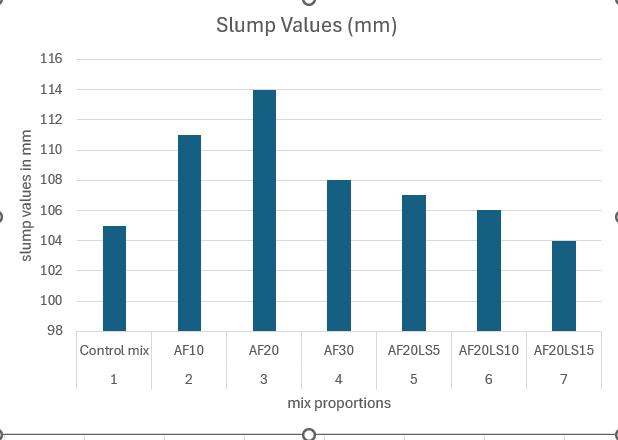
Figure 3.1 illustrates the results of the workability test conductedonvariousconcretemixes,measuredintermsof slumpvalues.TheControlmixrecordedaslumpof105mm. With the inclusion of AF (assumed as Ash Fraction), the slump increased, indicating improved workability. Specifically,AF10showeda5.7%increase,AF20showedthe maximum increase of 8.6%, and AF30 resulted in a 2.9% increasecomparedtotheControlmix.However,whenlime sludge(LS)wasincorporatedwithAF20atvaryingdosages, theslumpvaluesbegantodecline.AF20LS5exhibiteda1.9% increase,AF20LS10hada0.95%increase,whileAF20LS15 showeda0.95%decreaseinslumprelativetotheControl mix. These results indicate that while the addition of AF enhancestheworkabilityofconcrete,theinclusionoflime sludgereducesthiseffectprogressivelywithhigherdosages.
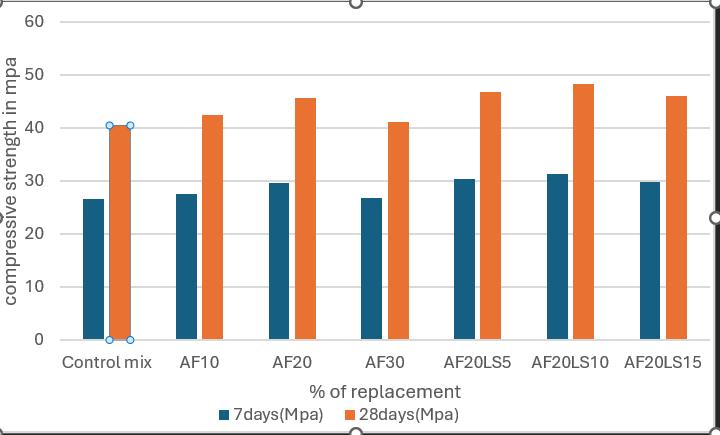
The compressive strength results from Fig 3.2 indicate a consistenttrend.At28days,mixesAF10andAF20exhibit no noticeable variation in compressive strength when compared to the control mix. However, mixes AF30, AF20LS5, AF20LS10, and AF20LS15 show a significant improvement,witheachdemonstratingan11.1%increasein compressive strength. This suggests that these mixes outperformthecontrolmix,showcasingenhanceddurability andstrengthproperties.Theuniformimprovementacross AF30 and the AF20LS variations highlights their effectivenessinpotentiallyachievingsuperiorperformance instructuralapplications.
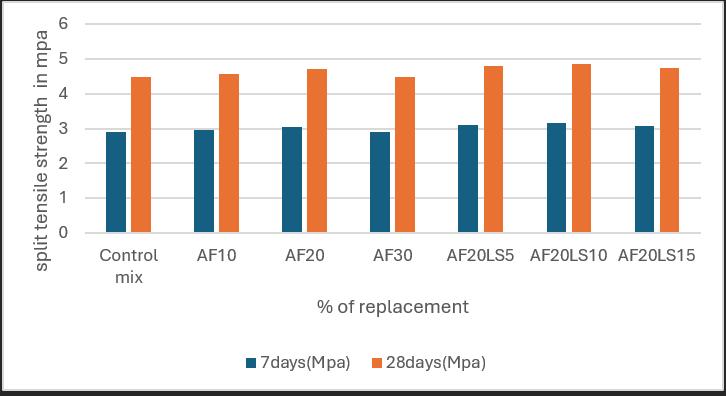
The split tensile strength results showed in the fig.3.3 indicates the improvement with the addition of Alccofine andlimesludge.Thecontrolmixhadstrengthsof1.93MPa at7daysand2.98MPaat28days.WithAlccofine,strength increased,reachingapeakat20%replacement(AF20)with 2.04 MPa at 7 days and 3.15 MPa at 28 days. Further addition to 30% (AF30) caused a slight drop. When lime sludge was added along with 20% Alccofine, the strength further improved. The highest value was recorded for AF20LS10with2.10MPaat7daysand3.24MPaat28days, indicating this mix as the most effective combination. Beyond this, a slight reduction was observed at 15% lime sludge.
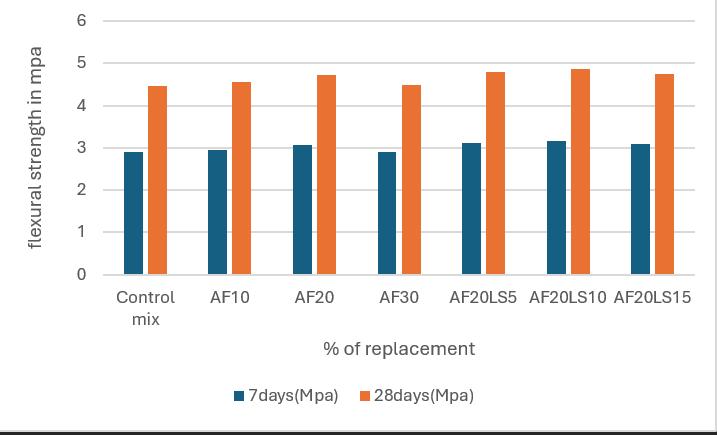
The flexural strength results showed in the fig.3.4 gives consistentimprovementwiththeadditionofAlccofineand lime sludge. The control mix had values of 2.90 MPa at 7 daysand4.47MPaat28days.Replacingcementwith20% Alccofine(AF20)gavethebestresultsamongAlccofine-only mixes,reaching3.06MPaat7daysand4.72MPaat28days. Aslightdropwasnotedat30%replacement(AF30).When lime sludge was combined with 20% Alccofine, strength further increased, with AF20LS10 achieving the highest
International Research Journal of Engineering and Technology (IRJET) e-ISSN: 2395-0056
Volume: 12 Issue: 04 | Apr 2025 www.irjet.net p-ISSN: 2395-0072
flexural strength 3.15MPa at7daysand4.86MPaat28 days.Beyondthis,aminorreductionwasseenat15%lime sludge,indicatingthat10%limesludgewastheoptimaldose forimprovingflexuralstrength.
4.
The AF20 mix showed the highest slump value of 114mm,indicatingimprovedworkabilitywith20% Alccofinereplacement.
CompressivestrengthimprovedwithAlccofineup to20%(AF20),showinga29.65MPa(7days)and 45.62MPa(28days),comparedtothecontrolmix.
The AF20LS10 mix achieved the highest compressive strength of 48.25 MPa at 28 days, provingittobethemosteffectivemixforstrength enhancement.
Themaximumsplittensilestrengthof3.24MPaat 28 days was recorded for the AF20LS10 mix, showingbettercrackresistance.
The AF20LS10 mix recorded the highest flexural strength of 4.86 MPa at 28 days, indicating enhancedbendingresistance.
Theincreasedflexuralperformanceindicatesthat the modified concrete matrix with Alccofine and lime sludge offers better resistance to bending forces,makingitsuitableforstructuralapplications like beams and slabs where flexural stresses are critical.
1. P. R. K. Chakravarthy and R. Rathan Raj, “An experimental investigation on concrete by partial replacement of cement with Alccofine,” International Journal of Civil Engineering and Technology (IJCIET), vol. 8, no. 4, pp. 1679–1685, 2017.
2. R. Balamurali Krishnan and J. Saravanan, “Sustainable development in concrete technology using supplementary cementitious materials,”
Materials Today: Proceedings, vol. 46, pp. 7322–7326,2021.ScienceDirect.
3. R. Pranamika and S. Thirugnanasambandam, “Experimental study on partial replacement of cement by Alccofine in concrete,” International Journal of Engineering Research & Technology (IJERT),vol.13,no.1,pp.76–82,2024.
4. B. Venkatesan, R. Kavitha, and R. Vijai, “Study on strength and durability of concrete by partial replacementoffineaggregatewithironpowderand cement with Alccofine,” Materials Today: Proceedings, vol. 33, pp. 824–829, 2020. ScienceDirect.
5. B.L.N.SaiSrinath,K.SivaKrishna,andM.Ravindra, “Effect of Alccofine on fresh and hardened properties of concrete,” Materials Today: Proceedings, vol. 45, pp. 7129–7133, 2021. ScienceDirect.
6. U. S. Ansari, A. Ankit, and S. K. Sharma, “Comparativestudyofconcretemixesusingflyash and Alccofine in high performance concrete,” International Research Journal of Engineering and Technology (IRJET), vol. 7, no. 6, pp. 2218–2223, 2020.
7. N. Raghavendra, M. Harsha, and A. Ramesh, “Performanceofconcretebypartialreplacementof cement with Alccofine,” International Journal of Innovative Research in Science, Engineering and Technology,vol.8,no.1,pp.1325–1331,2019.