
International Research Journal of Engineering and Technology (IRJET) e-ISSN:2395-0056
Volume: 12 Issue: 05 | May 2025 www.irjet.net p-ISSN:2395-0072
International Research Journal of Engineering and Technology (IRJET) e-ISSN:2395-0056
Volume: 12 Issue: 05 | May 2025 www.irjet.net p-ISSN:2395-0072
V. SeshiDeepak , Y.V. Tanishq,G. Sai Nihal Kumar andDr. Y. Aparna*
Department of Microbiology, Bhavan’s Vivekananda College of Science, Humanities and Commerce, Sainikpuri, Secunderabad– 500094, Telangana (India)
Abstract
Energy conservation in Higher Education Institutions (HEIs)iscrucialnotonlyforreducingoperationalcostsbut also for promoting sustainability and environmental responsibility. This study presents a comprehensive energy audit conducted at a HEI to assess its energy consumption patterns, identify inefficiencies, and propose corrective measures. The audit encompassed key components including electrical load analysis, lighting system evaluation, and power quality assessment. Data collection was carried out through a combination of electricity bill analysis, onsite equipment inspections, and phase-wisecurrentmeasurements.Resultsrevealedatotal connected load of 48.93 kW, with air conditioners contributing the highest share (64%). The lighting inventory comprised mainly tube lights and CFLs, indicatingsubstantialpotentialforenergysavingsthrough retrofitting with LED lighting. Phase-wise current analysis showedsignificantimbalance,suggestingtheneedforload redistribution. The study highlights actionable recommendations such as phased LED replacement, balanced phase loading, scheduled AC usage, and the integration of smart monitoring systems. Implementing thesemeasuresisexpectedtoyieldupto20%reductionin energy consumption and align the institution with sustainable development goals. This case study demonstrates how targeted energy audits can serve as a foundation for long-term energy efficiency in academic campuses.
Key Words: EnergyAudit,LoadAnalysis,Sustainable Campus,LEDRetrofitting
Energy consumption in Higher Education Institutions (HEIs) plays a significant role in determining the operational efficiency and environmental impact of educational infrastructure. HEIs consist of multiple energy-intensive facilities including lecture halls, laboratories, libraries, computer centers, and hostels. These institutions function almost year-round and host a
largepopulation,leadingtocontinuousanddiverseenergy demands.Withtheglobalmovementtowardsustainability, HEIs have emerged as pioneers for implementing green energy practices and promoting energy awareness among studentsandstaff(Rathod&Gohil,2022).
TheroleofHEIsinenergyconservationisdual-pronged theynotonlyconsumeenergybutalsoactasincubatorsof innovation and behavior change. HEIs are uniquely positioned to drive energy transformation through a combinationofinfrastructuralmodifications,technological adoption, and curriculum integration. Establishing smart energypolicies,incorporatingrenewablesourceslikesolar PV, deploying Internet of Things (IoT)-based monitoring systems, and encouraging sustainable behavior among stakeholders are key strategies being adopted globally (Sharma&Gupta,2022).
This paper presents an energy audit conducted at a HEI with the aim of assessing its current energy usage and recommending actionable strategies for energy efficiency. The study further discusses practical solutions aligned with cost-effectiveness, long-term sustainability, and compliance with national and global energy efficiency goals.
2.1. Data Collection Energy consumption data were collected from the institution's electricity bills over a oneyear period. Additionally, onsite inspections were conducted to record the types and numbers of electrical equipment,lightingsystems,andpowerquality.
2.2. Load Analysis The total connected load was calculated based on the rated power and number of devices used across departments. Particular focus was given to high-energy-consuming devices such as air conditioners,computers,fans,andlighting.
2.3. Power Quality and Load Balancing Phase-wise current and voltage readings were recorded to evaluate load balance across the three-phase system. Imbalance in
International Research Journal of Engineering and Technology (IRJET) e-ISSN:2395-0056
Volume: 12 Issue: 05 | May 2025 www.irjet.net p-ISSN:2395-0072
current distribution was assessed, and harmonic distortions were reviewed as part of power quality analysis.
2.4. Lighting Survey The institution's lighting inventory was analyzed to determine the mix of conventional and energy-efficient lighting (e.g., CFL vs. LED). Recommendations were made based on lux levels, operationalhours,andenergyratings.
3.1. Electrical Load Distribution Thetotalconnectedload wasestimatedtobe48.93kW.Abreakdownofequipment and associated power ratings is presented in the table below.
Table 1: Connected Load Analysis
Name
Air conditioners account for nearly 64% of the total connected load, indicating an area with high conservation potential.
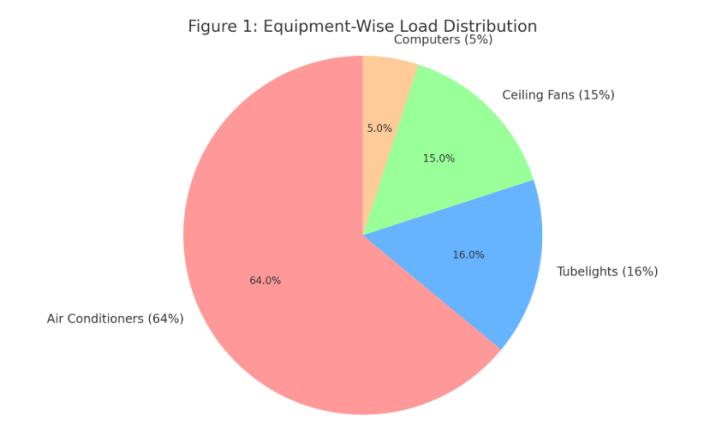
3.2. Lighting Inventory Alightingauditwascarriedoutin key blocks. The findings showed a mix of tube lights and CFLs, with recommendations to replace all with LED fittings.
Table 2: Lighting Audit Summary
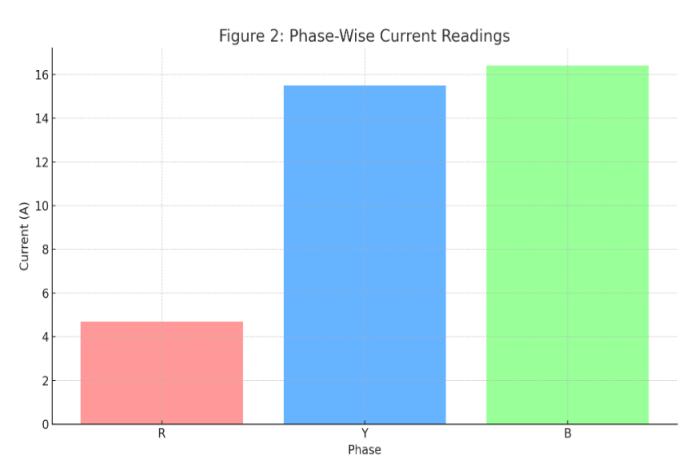
3.3. Power Quality and Load Balancing Load unbalance was observed in the three-phase system. The current readingsperphasearepresentedbelow:
Table 3: Phase Current Measurements
Phase Current(A)
This data reveals a high level of imbalance with R Phase beingsignificantlyunderloaded.Suchimbalancecancause transformer overloading on Y and B phases, leading to systeminefficiency.
Figure 2: Bar Chart of Phase-Wise Current Readings
3.4. Energy Consumption Profile Analysis of electricity bills revealed that monthly energy consumption ranged from 1,800 to 2,000 kWh. This resulted in a monthly expenseofapproximatelyINR 16,000to INR 17,000.Peak usage was recorded during summer due to extensive air conditioning.
International Research Journal of Engineering and Technology (IRJET) e-ISSN:2395-0056
Volume: 12 Issue: 05 | May 2025 www.irjet.net p-ISSN:2395-0072
The audit highlighted substantial energy-saving opportunities in the HEI. Retrofitting conventional tube lightsandCFLswithLEDscanresultinupto40%savings in lighting energy costs (Patil et al., 2020). A phased replacement plan with high-lumen LED lamps would enhance both efficiency and visual comfort in academic blocks.
Phase imbalance in electrical systems has been associated withincreasedlossesandreducedtransformerlife(Kumar et al., 2023). Load redistribution, as recommended by standards such as IEEE 141, can bring current values closer to equilibrium, ensuring optimal operation of distributiontransformersandreducingsystemlosses.
As HEIs are typically tech-centric environments, the adoption of energy-efficient computers, smart power management systems, and scheduled AC operation during working hours can bring cumulative benefits. Behavioral strategies like energy-saving pledges, visual reminders, and energy dashboards can lead to sustained reduction in usage(Kauretal.,2021).
Emerging studies have validated the use of IoT-based systemsforreal-timemonitoringandcontrol,significantly boosting energy savings. Sharma and Gupta (2022) demonstrated a 22% improvement in energy efficiency throughsmartcampusinitiativesinIndia.
Lastly, future audits should include an assessment for renewable integration solar power systems on rooftops and net metering can further reduce dependency on the grid(Das&Singh,2021).
This energy audit of an HEI revealed a connected load of approximately 49 kW, with significant consumption from air conditioning and computer systems. The lighting system, largely dependent on conventional fixtures, provides scope for a shift to LED-based infrastructure. Phase load imbalance and outdated equipment further emphasize the need for strategic upgrades. By implementing the recommended energy conservation measures,theinstitutioncanachieveupto20%reduction in energy expenses while aligning with sustainable developmentgoals.
The authors thank the Principal and Management of the Bhavan’sVivekananda College of Science,Humanities, and Commercefortheirconstantsupportandencouragement.
Das, A., & Singh, P. (2021). Impact of LED retrofitting in institutional buildings: A case study. InternationalJournal of Energy Research, 45(4), 5672–5681. https://doi.org/10.1002/er.5910
Kaur, G., Mehta, R., & Chawla, A. (2021). Energy auditing and conservation techniques in Indian academic institutions. JournalofCleanerProduction,291, 125889. https://doi.org/10.1016/j.jclepro.2020.125889
Kumar, S., Jain, M., & Thakur, R. (2023). Power quality improvement through load balancing and harmonics reduction. Energy Reports, 9, 323–330. https://doi.org/10.1016/j.egyr.2022.11.003
Patil, P., Kale, S., & More, V. (2020). Energy audit and LED lighting retrofit analysis in academic campus. Energy Efficiency Journal, 13(2), 351–359. https://doi.org/10.1007/s12053-019-09812-y
Rathod, R., & Gohil, M. (2022). Role of energy audits in sustainable campus development: A review. Renewable and Sustainable Energy Reviews, 158, 112131. https://doi.org/10.1016/j.rser.2022.112131
Sharma, R., & Gupta, A. (2022). Smart energy monitoring systemsineducationalinstitutions:IoT-basedcasestudies. Sustainable Energy Technologies and Assessments, 51, 101958.https://doi.org/10.1016/j.seta.2022.101958