
International Research Journal of Engineering and Technology (IRJET) e-ISSN: 2395-0056
Volume: 12 Issue: 05 | May 2025 www.irjet.net p-ISSN: 2395-0072
International Research Journal of Engineering and Technology (IRJET) e-ISSN: 2395-0056
Volume: 12 Issue: 05 | May 2025 www.irjet.net p-ISSN: 2395-0072
Navdeep Singh Phougat1 and Nitu2
Civil Engineering Department, Matu Ram Institute of Engineering & Management, Model Town, Rohtak, Haryana 124001
Abstract - The environmental impact of conventional concrete production, primarily due to high cement consumption and CO₂ emissions, has driven the search for sustainablealternatives.Thisstudyexplorestheintegrationof variousindustrialandconstructionbyproducts suchasIron Ore Sludge, Fly Ash, Ground Granulated Blast Furnace Slag (GGBFS), Brick and Mortar Waste, and Ceramic Waste as partial replacements for cement, fine aggregates, and coarse aggregates in concrete. These replacements not only reduce the reliance on natural resources but also enhance the mechanical properties and durability of concrete. A detailed analysis was conducted on the physical, chemical, and structuralcontributionsofeachbyproduct.Theresearchalso examinestheuseofadvancedoptimizationtoolslikeResponse Surface Methodology (RSM) and predictive modeling techniques,includingmachinelearning,toimprovemixdesign andperformanceforecasting.Thefindingsconfirmthatusing these waste-derived materials can significantly contribute to environmental conservation, cost reduction, and structural efficiency in modern construction. However, the successful adoption of such materials requires further standardization and validation under varying environmental and loading conditions. This study contributes valuable insights for the development of eco-efficient concrete mixes, supporting sustainable infrastructure development.
Keywords: Sustainable concrete, Cement replacement, Industrial byproducts, Aggregates, Waste recycling, Fly ash, GGBFS, Optimization, Machine learning, Response Surface Methodology.
ThisConcreteisthemostwidelyusedconstructionmaterial globally, with its production reaching billions of tons annually. However, the high demand for conventional concrete has significant environmental consequences, includingexcessiveenergyconsumptionandCO₂emissions, primarily due to the production of cement. The cement industryisresponsibleforapproximately5-7%ofglobalCO₂ emissions,makingitamajorcontributortoenvironmental degradation.Thechallengeofreducingthecarbonfootprint of concrete production while meeting the growing global demandforinfrastructureisattheforefrontofresearchinto sustainableconstructionmaterials.
Theneedforreplacementoftraditionalmaterialsinconcrete production stems from several environmental, economic, and resource-related challenges. Firstly, the construction industryreliesheavilyonnaturalresources,suchascement, sand, and aggregates, which are finite and often sourced from environmentally sensitive areas. The extraction of theserawmaterialsleadstohabitatdestruction,soilerosion, and depletion of natural reserves. Moreover, cement productionisamajorcontributortoglobalCO₂emissions, responsible for approximately 7-8% of total emissions worldwide.Thiscallsfortheadoptionofmoresustainable alternatives to reduce the environmental footprint of concrete manufacturing. Secondly, the rapid growth of industrial activities generates large quantities of waste byproducts, such as iron ore sludge, fly ash, and plastic waste,which,ifleftunmanaged,contributetolandfillsand pollution.
By replacing conventional concrete materials with these byproducts,theconstructionindustrycannotonlyreduce waste and promote recycling but also lower production costs.Thisfigure1reflectstheannualcementproductionin milliontonsfromFY16toFY23.
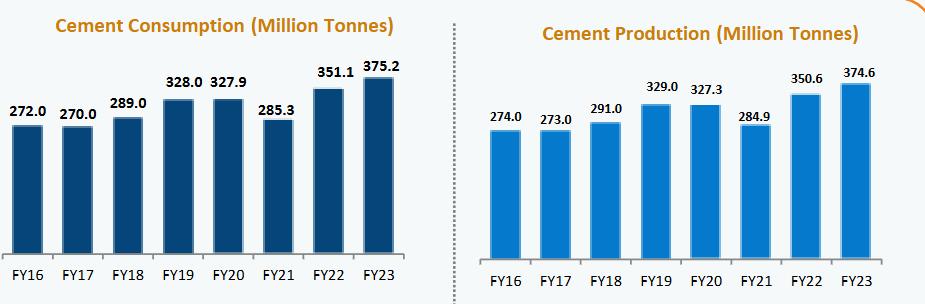
Figure1: Consuptionandproductionofcementinlastyears
1.2
Several byproducts, such as Iron Ore Sludge, Fly Ash, and Ground Granulated Blast Furnace Slag (GGBFS), can effectivelyreplacecementinconcrete.Thesematerialsnot
International Research Journal of Engineering and Technology (IRJET) e-ISSN: 2395-0056
Volume: 12 Issue: 05 | May 2025 www.irjet.net
onlyreducetheenvironmentalimpactofcementproduction byloweringCO₂emissionsbutalsoenhancetheconcrete’s workability,strength,anddurability.TheuseofRiceHusk Ash and Wood Ash further supports sustainability goals whileimprovinglong-termstrengthandreducingreliance onconventionalcement.Thepotentialreplacementrangefor cementvariesfrom5%to50%,dependingonthespecific byproduct.
Variouswastematerials,suchasBrickandMortarWaste, Plastic Waste, and Spent Foundry Sand, offer viable alternativestoconventionalsandinconcretemixes.These byproductshelpreducewastegeneration,lowerdependence on natural sand, and contribute to improved concrete durabilityandstrength.Additionally,materialslikeCrushed GlassandQuarryDustenhanceworkabilityandresistanceto chemical attacks, offering a sustainable solution for fine aggregate replacement. The replacement range for fine aggregates can vary from 0% to 50%, depending on the byproductandthedesiredpropertiesoftheconcrete.
Table1:CementReplacementByproducts
Byproduct Use in Concrete Replacement Range Potential Benefits
Iron Ore Sludge
Partial replacement forcement 0-20% Improves workability, Enhances compressive strength,Reduces cement consumption, lowering CO₂ emissions
FlyAsh Partial replacement forcement 15-30% Improves longterm strength, Enhances durability, Reduces heat of hydration,Lowers environmental impact
Ground Granulated Blast Furnace Slag (GGBFS) Partial replacement forcement 30-50% Increases durability, Reduces permeability, Improves resistance to chemicalattacks
p-ISSN: 2395-0072
Rice Husk Ash Partial replacement forcement 5-15% Improves strength, Enhances workability, Reduces environmental impact
WoodAsh Partial replacement forcement 5-15% Improves workability, Enhances longterm strength, Reduces environmental impact
1.4 Coarse Aggregate Replacement Byproducts:
A range of byproducts can replace coarse aggregates, including Ceramic Waste, Construction and Demolition Waste, and Rubber Waste. These materials offer sustainability benefits by diverting waste from landfills while improving specific concrete properties, such as durability and shock absorption. Other alternatives like RecycledConcreteAggregate(RCA)andCoal Ashcanalso improve the concrete’s mechanical properties, reduce environmental impact, and support circular economy initiatives.Thereplacementrangeforcoarseaggregatesis highlyvariable,from0%to100%,dependingonthetypeof byproductusedanditsimpactonthefinalmix.
Table2: Sand(FineAggregate)ReplacementByproducts
Byproduct Use in Concrete Replacement Range Potential Benefits
Brick and Mortar Waste
Partial replacement for fine aggregates (sand)
Plastic Waste
Spent Foundry Sand
Partial replacement for fine aggregates
Partial replacement for fine aggregates
Crushed Glass
Quarry Dust
Partial replacement for fine aggregates
0-50% Reduces waste generation, Lowers reliance onnaturalsand, Enhances durability and resistance to cracking
0-10% Reduces plastic waste,Improves workability, Lightweight concrete
0-50% Reduces waste from foundry industries, Lowers demand fornaturalsand, Improves durability
0-30% Enhances workability, Improves resistance to chemicalattacks, Recycles glass waste
Partial replacement 0-40% Reduces dependence on
International Research Journal of Engineering and Technology (IRJET) e-ISSN: 2395-0056
Volume: 12 Issue: 05 | May 2025 www.irjet.net p-ISSN: 2395-0072
for fine aggregates
SeaShells
Partial replacement for fine aggregates
natural sand, Enhances strength, Improves workability
0-30% Reduces environmental waste,Improves durability, Lightweight
One promising strategy to mitigate the environmental impact of concrete production is the incorporation of industrialbyproductsaspartialreplacementsfortraditional concretecomponents.Theuseofwastematerials,notonly helps divert them from landfills but can also improve the sustainability of concrete by reducing the demand for naturalresources.
Thethreetablespresentedabovehighlightvariousindustrial byproductsthatcanbeusedassubstitutesforcement,fine aggregates (sand), and coarse aggregates in concrete production.
Table3:CoarseAggregateReplacementByproducts
Byproduct Use in Concrete Replaceme ntRange Potential Benefits
Ceramic Waste
Partial replacement for coarse aggregates
Constructio n and
Demolition Waste
Rubber Waste (Tires)
Recycled Concrete Aggregate (RCA)
Partial replacement for coarse aggregates
Partial replacement for coarse aggregates
Partial replacement for coarse aggregates
CoalAsh Partial replacement for coarse aggregates
0-100% Enhances concrete’s durability, Reduces landfill waste, Improves workability
0-50% Reduces construction waste, Reduces demandforvirgin aggregates, Increases sustainability
0-10% Increases shock absorption, Lightweight, Reduces rubber wasteinlandfills
0-100% Reduces construction waste, Enhances sustainability, Reducesdemand for natural aggregates
PalmKernel Shells Partial replacement for coarse aggregates
WoodWaste (Chips/Sawd ust)
0-30% Increases durability, Reduces environmental impact,Improves workability
Partial replacement for coarse aggregates
0-50% Lightweight, Improvesthermal insulation, Reduces waste from palm oil production
0-20% Lightweight, Improves workability, Reduces waste from timber industries
Awiderangeofindustrialbyproducts,suchasflyash,slag, ricehuskash,andotherwastematerials,havebeenexplored in recent years. In this context, three specific industrial byproducts Iron Ore Sludge, Brick and Mortar Waste, and CeramicWaste areofparticularinterestfortheirpotential toreplacetraditionalconcreteconstituents.
Iron Ore Sludge is a byproduct of the iron and steel manufacturing process, and its disposal poses environmentalchallenges.Thissludgecontainsvaluable mineralsthatcanpartiallyreplacecementinconcrete. Researchhasshownthatironoresludgecanimprove theworkabilityandstrengthofconcretewhenusedasa partialsubstituteforcement.
Brick and Mortar Waste is generated during the demolitionofbuildingsandinfrastructure.Thiswaste consists of crushed bricks and mortar, which can be used as a substitute for fine aggregates (sand) in concrete.Reusingthiswastehelpsreducelandfillusage and offers a more sustainable alternative to conventionalsand.
Ceramic Waste is the byproduct of ceramic manufacturing processes, including broken tiles, pottery,andbricks.Whenusedasapartialreplacement for coarse aggregates in concrete, ceramic waste can enhanceconcrete'sdurabilityandreduceenvironmental impact, as the ceramic materials are rich in silica and alumina.
The integration of these byproducts into concrete offersa significant opportunity to develop more sustainable construction practices by reducing the consumption of natural resources and minimizing waste. However, the propertiesofconcretemadewiththesealternativematerials needtobecarefullyevaluatedtoensurethatperformance standardsaremet.
The use of industrial byproducts as replacements for conventionalmaterialsinconcretehasgarneredincreasing
International Research Journal of Engineering and Technology (IRJET) e-ISSN: 2395-0056
Volume: 12 Issue: 05 | May 2025 www.irjet.net p-ISSN: 2395-0072
attention in recent years due to its potential to reduce environmentalimpact,lowerproductioncosts,andpromote sustainabilityintheconstructionindustry.Withtheglobal construction sector being one of the largest consumers of natural resources, there is a growing need to explore alternative materials that can reduce the dependence on non-renewableresourceslikecement,sand,andaggregates. These byproducts not only help mitigate environmental challenges but also offer practical solutions to waste managementissuesassociatedwithindustrialprocesses.
Adamu and Ibrahim (2024) explored the environmental sustainabilityandcost-benefitanalysisofusingDatePalm Ash (DPA) blended with Eggshell Powder (ESP) as supplementary cementitious materials (SCM) in concrete. ThecementindustrycontributessignificantlytoglobalCO2 emissions,andthisstudyfocusedonreducingtheembodied CO2inconcrete.Byblending21.3%DPAand2.3%ESP,the researchers achieved a substantial reduction in CO2 emissionswhileenhancingtheconcrete'sperformance.The study used Response Surface Methodology (RSM) for experimental design and optimization of the mix, which showed a marked reduction in both the environmental impact and cost of the concrete. DPA proved to be a costeffective,environmentallysustainablematerialthat,when combined with ESP, further improved the eco-strength efficiencyoftheconcrete.Mathematicalmodelsdeveloped during the study accurately predicted both the concrete propertiesandthecostreductions.Theresultsdemonstrate the significant potential of DPA and ESP as sustainable alternativestotraditionalconcretematerials,offeringboth environmentalandeconomicbenefits 1)
Adamuetal.(2021)investigatedtheimpactofplasticwaste (PW)andgraphenenanoplatelets(GNP)onthemechanical performance and optimization of high-volume fly ash (HVFA) concrete. The study employed response surface methodologyforexperimentaldesignandmixoptimization, focusing on the effects of these materials on concrete’s compressivestrength,tensilestrength,flexuralstrength,and waterabsorptioncapacity.Thefindingsrevealedthatwhile plastic waste and HVFA contributed to a reduction in concrete’sstrengthandabsorption,theadditionofgraphene nanoplatelets significantly enhanced its mechanical properties.Specifically,compressivestrengthshowedahigh correlationwithexperimentalresults,andsplittingtensile strength improved with GNP inclusion. Flexural strength remained consistent across different curing ages, while waterabsorptioncapacitywasreducedwiththeoptimized mix.Theworkabilityoftheconcretewasfoundtoincrease with higher fly ash content, and higher plastic waste also enhancedtheworkabilityofthemixture.Theoptimizedmix, which incorporated specific percentages of plastic waste, HVFA, and GNP, achieved a balanced performance, with models showing high correlation and low standard deviation, indicating the reliability of the optimization process. 2)
Adamuetal.(2024)explorestheuseofdatepalmash(DPA) and eggshell powder (ESP) as sustainable alternatives in concreteproduction.TheresearchutilizesResponseSurface Methodology(RSM)tooptimizetheblendofthesematerials, aiming to enhance the mechanical properties of concrete while reducing water absorption. The study finds that substitutingcementwithDPAinvariousdosages,combined with ESP to promote pozzolanic reactions, significantly improvesconcreteproperties.Theoptimalblendwasfound to be 14.77% DPA and 2.2% ESP, achieving a desirability valueof91.1%.TheincorporationofDPAandESPreduced waterabsorptionandenhancedcompressivestrength,with a 28-day compressive strength model showing minimal error of 3.74%. However, the study also indicates that excessiveDPAcontentnegativelyimpactstheslumpvalues and increases water absorption. The findings suggest that DPA and ESP are promising sustainable materials for concrete, offering improved mechanical properties and a lower environmental impact, making them suitable for futuregreenconstruction practices.Additionally,the RSM modelsdemonstratedhighaccuracy,withpredictionerrors below6%,confirmingtheeffectivenessofthesematerialsin optimizingconcreteperformance 3)
Aghajanzadeh et al. (2024) utilized the response surface methodtooptimizethemix designofalkali-activatedslag concrete (AASC) by evaluating its mechanical, durability, economic,andenvironmentalproperties.Thestudyaimedto finda balancebetween performanceandsustainability by exploring the effects of recycled aggregates, including recycledcoarseaggregates(RCA),recycledfineaggregates (RFA),andsilicafume(SF)invariousmixes.Theoptimum mixwasidentifiedascontaining0%RCA,0%RFA,and8.1% SF,whichmaximizedmechanicalpropertiessuchasstrength andelectricalresistivitywhileminimizingwaterabsorption, weight,andstrengthloss in acidicenvironments.Notably, the inclusion of recycled aggregates did not significantly impactthefinalpriceoftheconcretenoralterCO2emissions, suggesting that these materials could be used without compromisingenvironmentaloreconomicconsiderations. Thedesirabilityscorefortheoptimalmixwas100(D100), indicatingitssuperiorperformance.Additionally,thestudy foundthattherelativepriceofalkali-activatedconcretewas lowerthanthatofordinaryPortlandcement(OPC)concrete. The study's findings, supported by a high coefficient of determination(R²>90)forallequations,suggestthatalkaliactivatedslagconcretewithspecificeco-friendlyingredients can be a viable alternative for sustainable construction withoutsignificantcostorenvironmentaldrawbacks 4)
Ahmed et al. (2022) explores the use of waste glass and condensedmilkcanfiber(CMCF)asreplacementsforfine aggregate in concrete, aiming to address the depletion of natural sand. The study investigates the effects of these materialsontheworkability,density,compressivestrength, and tensile strength of concrete. Using Response Surface Methodology (RSM), the researchers optimized the mix,
International Research Journal of Engineering and Technology (IRJET) e-ISSN: 2395-0056
Volume: 12 Issue: 05 | May 2025 www.irjet.net p-ISSN: 2395-0072
identifying the optimal replacement percentages for both glass and fiber reinforcement. The study found that workability deteriorated as the percentages of glass fine aggregate (GFA) and CMCF increased, while fresh density increased with CMCF but decreased with GFA. The compressivestrengthwasmaximizedat20%GFAand1% CMCF,whilesplittingtensilestrengthdecreasedwithhigher contentofbothmaterials.Theoptimalmixwasfoundtobe 20.436% GFA and 0.843% CMCF, with the models closely matchingexperimentalresultsandshowinghighR²values, indicatingstrongmodel accuracy.Thestudysuggeststhat whiletheincorporationofwastematerialsinconcretecan improvecertainproperties,futureresearchshouldfocuson enhancingworkabilityandstrengthtofurtheroptimizethe material’sperformanceforpracticalapplications 5) .
Amiri et al. (2022) investigates the potential of using coal waste as a partial replacement for cement in concrete production, aiming to enhance sustainability while optimizingtheconcrete’smechanicalproperties.Thestudy employs response surface methodology (RSM) and desirability function to determine the optimal mix proportions for improving compressive strength and reducing water absorption. The results indicate that the optimal mix consists of a water-to-cement (W/C) ratio of 0.44,cementcontentof304kg/m³,andgravelvolumeof954 kg/m³,leadingtoacompressivestrengthof46.30MPaanda waterabsorptionof7.41%.Additionally,coalwastecanbe used to replace up to 36.95 kg/m³ of cement in the mix, which significantly contributes to reducing the environmental impact of cement production. The study highlights the feasibility of incorporating coal waste into concrete formulations, suggesting that this approach not onlyimprovesthematerialpropertiesofconcretebutalso addresses sustainability concerns in the construction industry.Overall,theresearchprovidesapromisingmethod forutilizingcoalwasteinconcrete,offeringaneco-friendly alternativethatcouldreducerelianceontraditionalcement whileimprovingtheperformanceofthematerial 6) .
Awolusietal.(2019)conductedastudyontheuseofwaste tyresteelfibreinreinforcedconcreteandappliedResponse Surface Methodology (RSM) to predict various concrete properties. The study focused on three independent variables: aspect ratio, water-cement ratio, and cement content, with limestone powder kept constant at 5% by weight.RSMwasusedtodeveloppredictiveequationsfor keyconcreteproperties,andtheresultsdemonstratedhigh predictive efficiency for most properties. The optimal conditionsforconcreteperformancewereidentifiedthrough themodel,withexperimentalandpredictedvaluesshowing good correlation. Under the optimal mix conditions an aspectratioof140,awater-cementratioof0.26,andcement contentof40% theconcreteachievedimpressiveresults, including compressive strength of 42.69 N/mm², flexural strength of 7.97 N/mm², and split tensile strength of 5.23 N/mm².Theslumpvaluewasrecordedat7.65cm.Thestudy
highlights the potential of waste tyre steel fibre as a reinforcement material in concrete, offering improved mechanical properties. Additionally, the RSM model's accuracyinpredictingconcretebehaviordemonstratesits utility for optimizing mix designs, contributing to the sustainabilityofconstructionmaterials 7)
Azeez et al. (2023) explored the use of steel slag (SS) and waste glass (WG) in concrete production to create costeffectiveandenvironmentallysustainablematerials.Their study assessed the effects of replacing conventional aggregates with steel slag and waste glass on concrete's workability, density, compressive strength, and splitting strength. The authors employed a design of experiments methodology to analyze various binary binder blends, revealing a strong correlation with a second-order polynomial model. The inclusion of waste glass notably improved the concrete's rheological properties and enhancedstrength,withcompressivestrengthincreasingby 58%when100%ofthesteelslagwasusedasareplacement. Additionally,splittingstrengthimprovedby33%withthe inclusionofwasteglass.Higherwater-to-binderratioswere foundtoreducecompressivestrengthandincreaseslump, whilemixtureswithmoresteelslagshowedhigherdensity andimprovedmechanicalstrength.Thestudydemonstrated that steel slag and waste glass can significantly enhance concrete’smechanicalproperties,makingthemvaluablefor sustainableconstructionpractices.Itwasalsofoundthatthe control mixture exhibited the lowest compressive and splittingstrengths,highlightingthebenefitsofusingrecycled materials for improving concrete's overall performance. These findings suggest that steel slag and waste glass are effectivealternativesforoptimizingconcretemixturedesign whilepromotingenvironmentalsustainability 8)
Chashm Khavari et al. (2023) investigated the mechanical properties and optimization of sulfur concrete (SC) reinforced with steel fibers. The study applied Response SurfaceMethodology(RSM)tooptimizevariablesaffecting compressivestrength,findingthattheadditionofsteelfibers increased compressive strength by approximately 15%. Notably, the SC with fiber reinforcement exhibited significantimprovements,withstrengthincreasesof70%at 7 days and 205% at 28 days. The recyclability of sulfur concretewasalsoexplored,revealinga19.2%decreasein strengthwhenSCwasrecycled.Thestudyfurthercompared theperformanceofmacrofibersversus microfibers,with macro fibers showing superior strength enhancement. Factors such as sulfur content, plasticizer use, and fiber inclusionwerefoundtoinfluencecompressivestrength,with sulfurandthespecificmixdesignhavinga greaterimpact thanthefibersalone.Thestudydemonstratedthatmixing speed and temperature had no significant effect on SC properties.Statisticalanalysisconfirmedthereliabilityofthe optimizationmodel,withanF-valueof13.83andanR²value greaterthan0.93,indicatinghighmodelaccuracy 9) .
International Research Journal of Engineering and Technology (IRJET) e-ISSN: 2395-0056
Volume: 12 Issue: 05 | May 2025 www.irjet.net p-ISSN: 2395-0072
DahishandAlmutairi(2023)exploretheimpactofelevated temperaturesonthecompressivestrengthofnano-modified concrete, using nano-silica (NS) and nano-clay (NC) as cement substitutes. The study employs Response Surface Methodology (RSM) to develop predictive models and optimizethecompressivestrengthof concreteexposed to hightemperatures.Theanalysisofexperimentaldatafrom 208 cubic specimens revealed significant correlations between compressive strength and the dosages of NS and NC. The optimal replacement levels for maximizing compressivestrengthwereidentifiedas1%NSand4%NC. Thestudyshowsthatwhiletheadditionofnano-materials improvesconcretestrength,elevatedtemperaturestendto reduce its structural performance, highlighting the importance of material composition for temperature resilience. The models were assessed for significance and adequacy using ANOVA, with quadratic models demonstratingthehighestpredictiveaccuracy.Theresults alignwellwiththeexperimentaldata,confirmingthevalidity ofthemodels.Notably,thestudyalsoemphasizesthathigh adequateprecisionvaluesabovefourconfirmthereliability ofthepredictivemodels,makingRSManeffectivetoolfor optimizing concrete strength outcomes under varying conditions.Overall,theresearchprovidesvaluableinsights intothepotentialofnano-modifiedconcreteforimproved performanceinhigh-temperatureenvironments,offeringa pathtowardsmoreresilientconstructionmaterials 10) .
Divya and Praveenkumar (2024) conducted an integrated evaluation of graphene-based concrete mixtures incorporating copper slag (CS) and quarry dust (QD), utilizingResponseSurfaceMethodology(RSM)tooptimize concrete performance. The study aimed to explore the effects of Graphene Nanoplatelets (GNP) on concrete propertiesandhowalternativeaggregateslikecopperslag and quarry dust influence the material’s behavior. Key findings showed that copper slag improved compressive strength, with a 40% replacement leading to enhanced performance,whilequarrydusthadaminimalimpact.The slumpvaluewasinfluencedbysurfacetextureandporosity, with copper slag reducing the slump and quarry dust increasingit.TheinteractionbetweenGNP,copperslag,and quarry dust significantly enhanced the mechanical properties, particularly in terms of compressive strength. The optimized mix achieved high desirability values for concrete strength, with the optimal ratio of 0.2485 GNP, 59.98% copper slag, and 40.72% quarry dust yielding the bestresults.Thestudy’sresponsesurfacemodelsuccessfully predicted the slump, compressive strength, split tensile strength,andflexuralstrength,demonstratingtheaccuracy andeffectivenessoftheoptimizationprocess.Thisresearch highlightsthe potential forimprovingconcreteproperties usinginnovativematerialsandsustainableaggregates 11) .
Hafiz et al. (2023) investigated the effects of graphene nanoplatelets (GNPs) on the engineering properties of geopolymerconcrete(GPC)thatalsoincludedcrumbrubber
(CR) as an additive. A total of twenty mix designs were tested, varying the amounts of CR and GNPs, with experiments evaluating mechanical properties and microstructuralcharacteristics.ThestudyfoundthatGNPs significantlyenhancedtheperformanceofthegeopolymer concrete,despitethegenerallynegativeimpactofCRonthe properties. The optimal addition of GNPs was found to be 0.3%, which notably improved the compressive strength, elastic modulus, splitting tensile strength, and flexural strengthoftheconcrete.Additionally,GNPscontributedto improvedimpactresistance,thoughitwaslesspronounced than the effects of CR. The study also noted a decrease in slumpflowwiththereplacementofCRandtheadditionof GNPs,indicatingareducedworkability.Furthermore,water absorptionandporositywereminimizedwiththeoptimal GNPaddition,enhancingthedurabilityoftheconcrete.The microhardness tests indicated improved matrix compactness,whichsupportstheimprovementintheoverall performance of GPC. These findings suggest that GNPs, particularly at 0.3%, can significantly enhance the mechanical and durability properties of geopolymer concrete, making it a promising material for sustainable construction 12)
Haqueetal.(2024)investigatestheuseofgranitedust(GD) andscrappedcopperwire(SCW)assustainablealternatives to fine aggregates in concrete. The research employs Response Surface Methodology (RSM) to predict and optimizethehardenedpropertiesofconcrete,focusing on theeffectsofvaryingpercentagesofGDandSCWinthemix. Thestudyfindsastrongcorrelationbetweenthepredicted andactualresults,demonstratingthatincorporatingwaste materials into concrete can significantly enhance its mechanicalproperties.Theoptimizedmix,with30%GDand 0.3%SCW,achievedacompressivestrengthof16.90MPaat 7daysand25.37MPaat28days,whilethesplittingtensile strengthat7and28daysreached1.924MPaand3.321MPa, respectively, with 20% GD and 0.5% SCW. However, the studyalsonotesthatwhilethecompressivestrengthinitially increases with higher GD and SCW content, it begins to declineafteracertainpoint.Theresearchhighlightsthatthe optimal mix for both compressive and tensile strength is achievedwith20%GDand0.5%SCW.Thisstudysupports sustainable construction practices by demonstrating that waste materials can be effectively used in concrete productionwithoutcompromisingitsstrength,providinga promisingalternativeforurbangrowthanddevelopment13)
Ja’e et al. (2024) investigates the use of Basalt Fibre ReinforcedConcrete(BFRC)combinedwithsilicafume(SF) toenhancethemechanicalpropertiesandimpactresistance of concrete. The research demonstrates that BFRC significantly improves compressive strength, split tensile strength, flexural strength, and impact resistance. Specifically, the addition of basalt fibers resulted in an improvementincompressivestrengthby28%to65%,split tensilestrengthby35%to107%,andflexuralstrengthby
International Research Journal of Engineering and Technology (IRJET) e-ISSN: 2395-0056
Volume: 12 Issue: 05 | May 2025 www.irjet.net
11%to46%.Moreover,theimpactresistanceincreasedby 117%to150%.Theoptimalcombinationofbasaltfiberand silica fume resulted in a concrete mix with superior mechanicalperformance,highlightingbothmaterialsasecofriendlyalternativesforreinforcingconcrete.Silicafumewas found to improve the flexural strength and energy absorption,whileincreasingthebasaltfibercontentfurther enhancedtheductilityoftheconcrete.Thestudyalsonoted thatBFRC-1.0exhibitedasuperiorloadingdurationbefore microcracksappeared,makingitmoredurableunderstress. The use of regression models provided an effective prediction of the concrete’s performance, aiding in the optimizationoftheBFRCandSFproportions.Thisresearch supports the potential of BFRC and SF as sustainable materialsforimprovingconcrete’smechanicalandimpact resistancepropertiesinconstruction 14) .
Kaliyavaradhan et al. (2022) explored the CO2 uptake potentialofwasteconcretepowder(WCP)usingResponse Surface Methodology (RSM) to optimize the carbonation process.Thestudyexaminedtheeffectsofcarbonationtime and water-to-solid (w/s) ratio on CO2 absorption. The optimal CO2 uptake, reaching 2.81%, was achieved with a carbonation time of 90 hours and a w/s ratio of 0.4. The carbonationprocessalsoledtoadecreaseinpHfrom11.75 tobelow9,suggestingasignificantchemicaltransformation. The actual density of WCP increased from 2.527 g/cm³ to 2.535g/cm³aftercarbonation.Theregressionmodelusedin thestudyshowedstrongsignificance(F-value=33.29)and goodmodelfit,withanadjustedR²of0.88.Theexperimental results closely aligned with the predicted values from the model,confirmingtheaccuracyoftheoptimizationprocess. Furthermore,thecarbonatedWCPdemonstratedastrength activity index of over 75, indicating its potential as a supplementary cementitious material. This research highlightsthepromisingroleofWCPincontributingtoboth CO2 sequestration and sustainable construction practices, offeringaninnovativeapproachforutilizingwastematerials inconcreteproduction 15) .
Kareemetal.(2025)investigatedtheuseofwastesteeland tyre rubber fibers as concrete reinforcement to enhance sustainability in construction. Using Response Surface Methodology (RSM), the study optimized concrete properties and evaluated the environmental impact of modified concrete. The results demonstrated significant improvements in mechanical properties, with a 48.85% increase in 28-day compressive strength and a 28.33% increase in split tensile strength. The maximum slump observedwas25mm,andthemaximumdensitywas2633 kg/m³,withawaterabsorptionrateof5%.Thestudyalso highlightedthebenefitsofusingalowerwater-cementratio, whichimprovedcompressivestrength.Whilethemodified concreteshowedslightlyhigherembodiedenergyandcost compared to conventional concrete, it exhibited lower embodiedCO2emissions,makingitmoreenvironmentally friendly. The research suggests that incorporating waste
p-ISSN: 2395-0072
steelandtyrerubberfibersinconcretenotonlyenhancesits mechanical properties but also contributes to sustainable construction practices by reducing carbon emissions. Additionally, the study explored how different mix ratios influencedconcreteflowability,withincreasedwastesteel fibervolumereducingslump,whileahigherwater-cement ratioimprovedflowability.Thisapproachalignswithglobal efforts to incorporate waste materials into construction, promotingeco-friendlysolutions 16)
Maaze and Shrivastava (2023) focus on optimizing the designofeco-friendlybricksmadefromrecycledconcrete waste.Thestudyinvestigatesthreeindependentvariables: NaOHmolarity,activatormaterialratio(AMR),andcuring temperature,usingResponseSurfaceMethodology(RSM)to develop a regression model for predicting brick performance.Theresearchidentifiesoptimalconditionsfor brick production: 12 M NaOH molarity, 2.32 AMR, and a curingtemperatureof50°C.Theseconditionssignificantly enhancethebricks'physicalandmechanicalproperties.The resultsshowacompressivestrengthof13.95MPa,flexural strength of 3.45 MPa, and water absorption of 12.32%, indicating the bricks' durability and resistance to water penetration.Additionally,dryingshrinkagewasminimalat 0.105%, and efflorescence was slight to moderate. Microstructuralanalysisrevealsthepresenceofzeolitesand calcium-silicate-hydrate gels, which contribute to the enhanced strength and durability of the bricks. The study emphasizes the potential of recycled concrete waste in producingsustainableconstructionmaterialsandhighlights the importance of NaOH molarity in optimizing the performanceofeco-friendlybricks.Thisresearchprovides valuableinsightsintotheuseofrecycledconcretewastefor producing sustainable, high-performance bricks, contributingtotheadvancementofgreenbuildingpractices.
Mita et al. (2023) explores the use of Crushed Stone Dust (CSD) and Nylon Fiber (NF) in producing sustainable concrete..Thisresearchdemonstratesthepotentialofusing wastematerialslikeCSDinconcrete,whilealsohighlighting theimportanceofoptimizingfiberreinforcementtoimprove mechanical properties and achieve sustainable concrete solutions 17) .
PandaandPanigrahi(2024)investigatedtheproductionof sustainable Self-Compacting Geopolymer Concrete (SCGC) usingGroundGranulatedBlastFurnaceSlag(GGBFS)andewaste materials as partial replacements for natural aggregates. The study aims to enhance the environmental friendlinessofconcretebyreducingthecarbonfootprintand promoting e-waste management. Eleven different mix designs,includingacontrolmix,werepreparedwithvarying levels of e-waste replacement. The results indicated that replacingnaturalfineaggregates(NFA)with30%e-wasteor naturalcoarseaggregates(NCA)with10%e-wasteoffered optimal performance in terms of workability, mechanical strength,anddurability.TheSCGCmixesexhibitedimproved
International Research Journal of Engineering and Technology (IRJET) e-ISSN: 2395-0056
Volume: 12 Issue: 05 | May 2025 www.irjet.net p-ISSN: 2395-0072
chemical resistance compared to the control mixes, with highere-wastecontentenhancingtheconcrete'sresistance toacidattack.Thestudyalsoexaminedthefreshconcrete properties such as flow, passing ability, and segregation resistance,confirmingthatSCGCwithe-wastereplacements maintained favorable workability. Additionally, the incorporationofe-wasteshowedminimallossinmassand strengthduringdurabilitytests.Thisresearchhighlightsthe potentialofSCGCasasustainablealternativetoconventional concrete,offeringasolutionforbothwastemanagementand thereductionofenvironmentalimpactintheconstruction industry 18)
Patil et al. (2024) evaluated sisal fiber-reinforced fly ash concrete, focusing on sustainable construction materials suitablefortropicalregions.Thestudyalsoexploredtherole of laterite as an aggregate to enhance concrete strength, employing Response Surface Methodology (RSM) for optimization. The results demonstrated that sisal fibers significantlyenhancedtensilestrength,withtheoptimalmix comprising25%laterite,10.52%flyash,and1%sisalfiber. Thismixachievedacompressivestrengthof47.35MPa,split tensile strength of 4.76 MPa, and flexural strength of 5.19 MPaafter28daysofcuring.Thecompressivestrengthmodel showed an R² value of 0.9893, indicating a high degree of accuracyinthepredictions,andasignificantF-valuefurther confirmedthemodel'sreliability.However,theworkability of the concrete decreased as the proportion of laterite aggregateincreased,andasimilarreductioninworkability was observed with higher sisal fiber content. Overall, the study highlighted the potential of using locally available materials like sisal fiber and laterite for producing sustainable, high-performance concrete, especially in tropical climates, offering a promising alternative for ecofriendlyconstructionpractices 19)
Patiletal.(2024)focusesonoptimizingtherheologicaland mechanical properties of sustainable lateritic selfcompacting concrete (LSCC) using Response Surface Methodology(RSM).Thirteendifferentmixesweretested, with six responses evaluated, including rheological and strength characteristics. The study found that the optimal mix was achieved with 0.76% sisal fiber (SF) and 26.8% laterite (LA). The multi-objective optimization model provided accurate predictions of the concrete’s fresh and hardenedproperties,withexperimentalvalidationshowing less than 5% error. The optimized LSCC mix exhibited a viscosity time (VT) of 9.06 seconds, a T500 time of 2.26 seconds, and a slump flow (SF) of 795.63 mm for fresh properties. For hardened properties, the optimized mix showed compressive strength (CS) of 49.24 MPa, flexural strength(FS)of5.21MPa,andsplittensilestrength(STS)of 4.54 MPa, closely matching the experimental results. The researchhighlightsthattheadditionof26.8%lateriteand 0.76% sisal fiber significantly improved the material’s performance, achieving both strong rheological and mechanical characteristics. The results also indicated a
strong correlation between compressive and flexural strengths, making LSCC an effective and sustainable construction material with optimized properties for improvedperformanceanddurability 20)
Peng et al. (2023) investigated the use of steel-waste PET hybridfibersinrecycledaggregateconcrete(RAC),aimingto improve its mechanical properties while offering a more sustainable alternative. The study employed hybrid fiber reinforcedconcrete(HFRAC)withvaryingfibercontentsto analyze their effects on concrete properties. Response Surface Methodology (RSM) was used to examine the interactionsbetweenfibercontentandperformanceindices. Theresultsindicatedthatwhileworkabilitydecreasedwith increased fiber content, the mechanical strength of the concreteimproved.Specifically,theinclusionofsteelfibers increased compressive and flexural strengths, though the additionofPETfibersreducedflexuralstrengthwhenthey replaced steel fibers. Notably, the compressive strength remained largely unaffected by PET fiber content alone, suggesting that steel fibers were more impactful in enhancing mechanical properties. The optimal fiber contents, predicted by RSM, yielded the highest strength indices.Thisstudyhighlightsthepotentialofhybridfibers, particularly steel-waste PET, as a sustainable and costeffective reinforcement material for concrete, improving both its mechanical properties and environmental performance.Thefindingssuggestthatthesehybridfibers could offer an eco-friendly alternative to traditional reinforcementmaterialswhilemaintainingorenhancingthe structuralintegrityofconcrete 21)
Raveendran and Vasugi (2024) explored the synergistic effects of Nano Silica (NS) and Metakaolin (MK) on the mechanicalpropertiesofconcrete,usingResponseSurface Methodology(RSM)tooptimizethemixdesign.Thestudy focusedontheenhancementofcompressiveandsplittensile strengths with varying proportions of NS and MK. The optimalmixwasidentifiedas2%NSand12.5%MKwitha Water-to-Binder Ratio (WBR) of 0.4. Significant improvements in concrete strength were observed, with compressivestrengthincreasingby35.75%andsplittensile strengthimprovingby26.56%onthe7thdayofhydration. The study also highlighted that these enhancements continuedover90daysofhydration,withmicrostructural analysis revealing a dense structure and early hydration effects. The RSM technique demonstrated high predictive accuracy, with less than 5% mean error, confirming the validityoftheoptimizationmodel.Theresultsindicatethat NSandMKsignificantlyimprovethemechanicalproperties ofconcrete,makingitsuitableforhigh-strengthapplications and promoting sustainable construction practices. This researchprovidesvaluableinsightsintohowNSandMKcan becombinedtoenhanceconcreteperformance,contributing tomoreefficientandsustainableconstructionmaterials 22)
Ray et al. (2023) compare the performance of Artificial NeuralNetworks(ANN)andResponseSurfaceMethodology
International Research Journal of Engineering and Technology (IRJET) e-ISSN: 2395-0056
Volume: 12 Issue: 05 | May 2025 www.irjet.net p-ISSN: 2395-0072
(RSM)inpredictingconcretestrength,focusingontheuseof glass waste and tin can fiber as partial replacements in concrete mixes. The study evaluates compressive and splitting tensile strength at different curing ages, showing that both variables significantly affect the concrete's performance.Resultsindicatethattheadditionofglassfiber aggregate(GFA)andcellulosemicro-fiber(CMCF)enhances the compressive strength, with peak strength achieved at 20% GFA and 1% CMCF. However, the splitting tensile strength decreased with higher levels of GFA and CMCF, reaching its maximum at 10% GFA and 0.5% CMCF. The studyhighlightsthatRSMmodelsprovidedmoreaccurate predictionsofconcretestrengththanANNmodels.Statistical analysis(p<0.01)confirmedthesignificanceofthemodels, further reinforcing RSM’s superiority in this context. This research offers valuable insights into the use of waste materials in concrete and emphasizes the importance of selecting appropriate predictive models for optimizing concrete mix designs. Additionally, the study underscores thepotentialofusingwaste-derivedmaterialsinsustainable construction while improving concrete's mechanical properties 23)
Sinkhonde (2022) focused on sustainable construction by utilizing waste materials, specifically waste clay brick powder(WCBP)andwastetirerubber(WTR),tooptimize concrete properties and reduce CO2 emissions. The study employedResponseSurfaceMethodology(RSM)andcentral composite design to model the effects of these waste materialsonconcrete’sproperties,includingCO2emissions, drydensity,andcompressivestrength.Theresultsindicated that the incorporation of waste materials significantly reduced CO2 emissions without adversely affecting the mechanical properties of the concrete. The optimum mix designwasidentifiedwith5%WCBPand0%WTR,where thewastematerialsshowedalinearrelationshipwithboth wet and dry densities. The compressive strength was evaluated at both 7 and 28 days of curing, with high R² values (over 0.8) indicating the model’s accuracy in predicting the concrete’s response. Notably, WCBP had a lesserinfluenceondrydensitycomparedtoWTR,andthe linear models effectively predicted the concrete's performance. Overall, the study highlighted that the inclusion of waste materials not only improves concrete propertiesbutalsooffersa sustainablesolutionto reduce CO2emissionsintheconstructionindustry,emphasizingthe potentialforeco-friendlyconcretemixturesinreducingthe environmentalimpactofconstructionactivities 24)
Sinkhonde et al. (2021) conducted a study on the optimizationofcostandcompressivestrengthofmodified concreteusingwastematerials,specificallyBurntClayBrick Powder(BCBP)andWasteTireRubber(WTR).Theaimwas tobalancecostreductionwithenhancedperformance,using Response Surface Methodology (RSM) to determine the optimalcontentsforbothstrengthandcostefficiency.The resultsshowedthatsubstitutingBCBPforOrdinaryPortland
Cement and WTR for natural coarse aggregates led to a significant reduction in production costs up to 4.23% lowerthanconventionalconcrete.Thestudyidentifiedthe optimalmixforcompressivestrength,achievingamaximum 7-day compressive strength of 27.607 MPa and a 28-day strengthof33.970MPa.Thesestrengthswerereachedwith 5% BCBP and 6.875% WTR for 7 days, and 5% BCBP and 5.844%WTRfor28days.Themodelsdevelopedinthestudy explained the variability of the results with coefficients of determination greater than 0.85, indicating strong model reliability. Experimental testing of six cubic samples confirmed the accuracy of the model's predictions. This researchhighlightsthepotentialforusingwastematerialsin concrete production, offering an eco-friendly and costeffectivealternativetotraditionalconcrete 25) .
To-On et al. (2023) introduced a novel optimization approachcombiningtheTOPSISlinearprogrammingmodel withResponseSurfaceMethodology(RSM)toimprovethe propertiesoflightweightconcreteusingsugarcanebagasse ash (SBA). The study aimed to enhance key concrete properties,includingcompressivestrength,drydensity,and waterabsorption,throughtheoptimizationofthemixture ratio. Experimental results demonstrated significant improvements in the concrete's performance, with compressivestrengthincreasingby7.22%,drydensityrising by9.19%,andwaterabsorptiondecreasingby16.83%.The optimalmixtureratiowasdeterminedtobe6:1:0.05(SBAto cement to water by weight). The research also employed regression models for predicting concrete behavior, developedusingMinitabsoftware,whichfurthervalidated the optimization process. This study contributes to sustainableconstructionmaterialsbyincorporatingwaste materialslikeSBA,offeringbothenvironmentalandpractical benefits in concrete production. The TOPSIS linear programmingmodel,combinedwithRSM,provedeffective in optimizing concrete properties and could be applied to other material optimization challenges, advancing both materialperformanceandwasterecyclingsolutionsinthe constructionindustry 26) .
Wagheetal.(2023)exploredthepotentialofenhancingecoconcreteperformancethroughthesynergisticintegrationof sugarcanebagasseash(SCBA),metakaolin(MK),andcrumb rubber(CR)asalternativematerialsinconcrete.Thestudy aimed to reduce the carbon footprint of construction by incorporating industrial wastes and agricultural byproducts. The research focused on evaluating the density, workability, and strength properties of the resulting ecoconcrete.Theresultsdemonstratedthattheintegrationof SCBA,MK,andCRsignificantlyimprovedthecompressive, flexural,andsplittingtensilestrengthscomparedtocontrol concrete. Specifically, the compressive strength reached 45.44 MPa, and the flexural strength achieved 4.758 MPa with the optimal mix. The study also found that density decreased with the inclusion of crumb rubber, while workabilitywaspositivelyimpactedbySCBAbutnegatively
International Research Journal of Engineering and Technology (IRJET) e-ISSN: 2395-0056
Volume: 12 Issue: 05 | May 2025 www.irjet.net p-ISSN: 2395-0072
affected by MK. The optimal mix, composed of 10% MK, SCBA, and CR, yielded the best performance. Response SurfaceMethodology(RSM)wasemployedforoptimization, and the analysis showed a strong correlation with experimental results, further validated by ANOVA, which confirmedsignificantdifferencesinthestrengthproperties. ThefindingssuggestthatthecombinationofSCBA,MK,and CR offers a promising, sustainable approach to improving concreteperformance 27)
Waqaretal.(2023)exploretheuseofCoirFibreAsh(CFA) as a supplementary cementitious material to reduce the environmentalimpactofconcrete.Thestudyinvestigatesthe effects of CFA on concrete's compressive, flexural, and tensilestrengths,aswellasitsmodulusofelasticity.CFAwas testedatvaryingpercentagesfrom3%to18%,withafocus on optimizing its incorporation to enhance concrete properties.Theresearchdemonstratesthattheadditionof CFA up to 9% improves compressive strength, with the highest recorded strength of 35.89 MPa at this level Similarly, both flexural and splitting tensile strengths showed positive results with CFA incorporation. The modulusofelasticitywasalsoenhanceduptothe9%CFA threshold.Notably,thestudyhighlightsthatincreasingCFA contentleadstoareductioninembodiedcarbon,makingthe concretemoresustainable.TheresearchutilizesResponse SurfaceMethodology(RSM)todeveloppredictivemodelsfor the concrete properties, which were validated with experimentaldatashowinglessthana5%marginoferror. Overall, this study provides valuable insights into CFA's potential as a sustainable alternative to conventional cement, contributing to both improved concrete performanceandareductioninenvironmentalimpact 28)
The growing environmental concerns associated with traditional concrete production particularly due to high CO₂emissionsandthedepletionofnaturalresources have intensifiedtheneedforsustainablealternatives.Thisstudy comprehensively reviewed the potential of industrial and agricultural byproducts such as Iron Ore Sludge, Fly Ash, GGBFS, Brick and Mortar Waste, and Ceramic Waste as partialreplacementsforcement,fineaggregates,andcoarse aggregates in concrete. These materials not only mitigate waste disposal issues but also enhance key properties of concrete,includingstrength,durability,andworkability.The incorporation of supplementary cementitious materials (SCMs),recycledaggregates, andfiberreinforcementshas beenshownacrossmultiplestudiestoimprovemechanical performancewhilesupportingenvironmentalsustainability. Response Surface Methodology (RSM) and advanced machinelearning techniqueshaveproven instrumental in optimizingmixdesignsandpredictingconcreteproperties with high accuracy. However, challenges remain in standardizing mix proportions, ensuring long-term durability,andaddressingvariabilityinbyproductquality.
Future work should focus on developing composite mixes that exploit the synergistic effects of multiple waste materials, refining predictive modeling techniques, and promoting real-world application through policy support andindustrycollaboration.Overall,integratingwaste-based materials into concrete production is a promising step towardgreenerandmoreresilientconstructionpractices.
1) M. Adamu, and Y.E. Ibrahim, “Environmental sustainabilityand cost-benefitanalysisofconcrete containing date palm ash and eggshell powder: a responsesurfacemethodologyapproach,” CaseStud. Chem. Environ. Eng., 9 (December 2023) 100636 (2024).doi:10.1016/j.cscee.2024.100636.
2) M. Adamu, P. Trabanpruek, P. Jongvivatsakul, S. Likitlersuang, and M. Iwanami, “Mechanical performanceandoptimizationofhigh-volumeflyash concrete containing plastic wastes and graphene nanoplateletsusingresponsesurfacemethodology,” Constr. Build. Mater., 308 (May) 125085 (2021). doi:10.1016/j.conbuildmat.2021.125085.
3) M. Adamu, Y.E. Ibrahim, and H. Alanazi, “Optimization of sustainable concrete properties modifiedwithblendsofdatepalmashandeggshell powderusingresponsesurfacemethodology.,” Dev. Built Environ., 17 (January) 100359 (2024). doi:10.1016/j.dibe.2024.100359.
4) I. Aghajanzadeh, A.M. Ramezanianpour, A. Amani, and A. Habibi, “Mixture optimization of alkali activatedslagconcretecontainingrecycledconcrete aggregates and silica fume using response surface method,” Constr.Build.Mater., 425 (November2023) 135928 (2024). doi:10.1016/j.conbuildmat.2024.135928.
5) T.Ahmed,S.Ray,M.Haque,T.TasnimNahin,andA. Ferdous Mita, “Optimization of properties of concrete prepared with waste glass aggregate and condensed milk can fiber using response surface methodology,” Clean. Eng. Technol., 8 (August 2021) 100478(2022).doi:10.1016/j.clet.2022.100478.
6) H. Amiri, S. Azadi, M. Karimaei, H. Sadeghi, and FarshadDabbaghi,“Multi-objectiveoptimizationof coal waste recycling in concrete using response surface methodology,” J. Build. Eng., 45 (October 2021) 103472 (2022). doi:10.1016/j.jobe.2021.103472.
7) T.F. Awolusi, O.L. Oke, O.O. Akinkurolere, and A.O. Sojobi, “Application of response surface methodology: predicting and optimizing the properties of concrete containing steel fibre
International Research Journal of Engineering and Technology (IRJET) e-ISSN: 2395-0056
Volume: 12 Issue: 05 | May 2025 www.irjet.net p-ISSN: 2395-0072
extractedfromwastetireswithlimestonepowderas filler,” Case Stud. Constr. Mater., 10 e00212(2019). doi:10.1016/j.cscm.2018.e00212.
8) A.T. Azeez, M.S. Hassan, and A.A.H. Attiyah, “Modelling the complementary role of inert slag aggregate and waste glass on concrete mechanical strengthsusingtheresponsesurfaceanddesign-ofexperiment approach,” Constr. Build. Mater., 409 (November) 134199 (2023). doi:10.1016/j.conbuildmat.2023.134199.
9) B. Chashm Khavari, M. Shekarriz, B. Aminnejad, A. Lork, and S. Vahdani, “Laboratory evaluation and optimization of mechanical properties of sulfur concrete reinforced with micro and macro steel fibers via response surface methodology,” Constr. Build. Mater., 384 (March) 131434 (2023). doi:10.1016/j.conbuildmat.2023.131434.
10) H.A. Dahish, and A.D. Almutairi, “Effect of elevated temperaturesonthecompressivestrengthofnanosilica and nano-clay modified concretes using response surface methodology,” Case Stud. Constr. Mater., 18 (January) e02032 (2023). doi:10.1016/j.cscm.2023.e02032.
11) S. Divya, and S. Praveenkumar, “An integrated evaluationofgraphene-basedconcretemixturewith copperslagandquarrydustusingresponsesurface methodology,” J. Build. Eng., 86 (December 2023) 108876(2024).doi:10.1016/j.jobe.2024.108876.
12) H.W. Iqbal, K. Hamcumpai, P. Nuaklong, P. Jongvivatsakul,S.Likitlersuang,C.Chintanapakdee, and A.C. Wijeyewickrema, “Effect of graphene nanoplateletsonengineeringpropertiesofflyashbasedgeopolymerconcretecontainingcrumbrubber and its optimization using response surface methodology,” J. Build. Eng., 75 (March) 107024 (2023).doi:10.1016/j.jobe.2023.107024.
13) M. Haque, S. Ray, A.F. Mita, A. Mozumder, T. Karmaker,andS.Akter,“Predictionandoptimization of hardened properties of concrete prepared with granite dust and scrapped copper wire using response surface methodology,” Heliyon, 10 (2) e24705(2024).doi:10.1016/j.heliyon.2024.e24705.
14) I.A.Ja’e,R.A.N.binRajaSazrin,A.Syamsir,N.Bheel, C.V. Amaechi, T.H. Min, and V. Anggraini, “Optimisationofmechanicalpropertiesandimpact resistance of basalt fibre reinforced concrete containing silica fume: experimental and response surface assessment,” Dev. Built Environ., 17 (February) 100368 (2024). doi:10.1016/j.dibe.2024.100368.
15) S.K.Kaliyavaradhan,L.Li,andT.C.Ling,“Response surface methodology for the optimization of co2 uptakeusingwasteconcretepowder,” Constr. Build. Mater., 340 (May) 127758 (2022). doi:10.1016/j.conbuildmat.2022.127758.
16) M.A.Kareem,E.O.Ajadi,O.O.Fadipe,K.Ishola,O.A. Olawuyi, S.A. Ayanlere, O.J. Olatoyan, J.O. Adeosun, A.A. Adefajo, A.T. Oyewo, S.O.A. Olawale, and W.A. Lamidi, “Sustainability-driven application of waste steel and tyre rubber fibres as reinforcement in concrete: an optimization study using response surface methodology,” Next Mater., 7 (May 2024) 100345(2025).doi:10.1016/j.nxmate.2024.100345.
17) M.R.Maaze,andS.Shrivastava,“Designoptimization of a recycled concrete waste-based brick through alkali activation using box- behnken design methodology,” J. Build. Eng., 75 (May) 106863 (2023).doi:10.1016/j.jobe.2023.106863.
18) P.Pradhan,S.Panda,S.KumarParhi,andS.Kumar Panigrahi, “Variation in fresh and mechanical properties of ggbfs based self-compacting geopolymerconcreteinthepresenceofncaandrca,” Mater. Today Proc., 62 (P12) 6348–6358 (2022). doi:10.1016/j.matpr.2022.03.337.
19) S. Patil, R. Bhaskar, J.R. Xavier, and R. Raja, “Experimentalevaluationandstatisticalmodelingof sustainable sisal fiber-reinforced fly ash-based lateritic concrete using response surface methodology,” J. Build. Eng., 84 (December 2023) 108498(2024).doi:10.1016/j.jobe.2024.108498.
20) S.Patil,R.Bhaskar,andJ.R.Xavier,“Optimizationof rheologicalandmechanicalpropertiesofsustainable lateritic self-compacting concrete containing sisal fiberusingresponsesurfacemethodology,” J. Build. Eng., 84 (January) 108574 (2024). doi:10.1016/j.jobe.2024.108574.
21) Q. Peng, B. Chen, Q. Lu, K. Li, and W. Jin, “Effect of steel-wastepethybridfiberonpropertiesofrecycled aggregate concrete based on response surface methodology,” Constr.Build.Mater., 397 (26)132448 (2023).doi:10.1016/j.conbuildmat.2023.132448.
22) N.Raveendran,andV.K,“Synergisticeffectofnano silica and metakaolin on mechanical and microstructuralpropertiesofconcrete:anapproach ofresponsesurfacemethodology,” CaseStud.Constr. Mater., 20 (March) e03196 (2024). doi:10.1016/j.cscm.2024.e03196.
23) S. Ray, M. Haque, T. Ahmed, and T.T. Nahin, “Comparisonofartificialneuralnetwork(ann)and response surface methodology (rsm) in predicting
International Research Journal of Engineering and Technology (IRJET) e-ISSN: 2395-0056
Volume: 12 Issue: 05 | May 2025 www.irjet.net p-ISSN: 2395-0072
the compressive and splitting tensile strength of concretepreparedwithglasswasteandtin(sn)can fiber,” J. King Saud Univ. - Eng. Sci., 35 (3)185–199 (2021).doi:10.1016/j.jksues.2021.03.006.
24) D.Sinkhonde,“Generatingresponsesurfacemodels for optimisation of co2 emission and properties of concrete modified with waste materials,” Clean. Mater., 6 (June) 100146 (2022). doi:10.1016/j.clema.2022.100146.
25) D. Sinkhonde, R.O. Onchiri, W.O. Oyawa, and J.N. Mwero, “Response surface methodology-based optimisation of cost and compressive strength of rubberisedconcreteincorporatingburntclaybrick powder,” Heliyon, 7 (12) e08565 (2021). doi:10.1016/j.heliyon.2021.e08565.
26) P. To-on, N. Wichapa, and W. Khanthirat, “A novel topsislinearprogrammingmodelbasedonresponse surface methodology for determining optimal mixtureproportionsoflightweightconcreteblocks containing sugarcane bagasse ash,” Heliyon, 9 (7) e17755(2023).doi:10.1016/j.heliyon.2023.e17755.
27) U.Waghe,D.Agrawal,K.Ansari,M.Wagh,M.Amran, B.T. Alsulami, H.M. Maqbool, and Y. Gamil, “Enhancing eco-concrete performance through synergisticintegrationofsugarcane,metakaolin,and crumb rubber: experimental investigation and response surface optimization,” J. Eng. Res., (June) (2024).doi:10.1016/j.jer.2023.09.009.
28) A.Waqar,N.Bheel,H.R.Almujibah,O.Benjeddou,M. Alwetaishi, M. Ahmad, and M.M.S. Sabri, “Effect of coir fibre ash (cfa) on the strengths, modulus of elasticity and embodied carbon of concrete using response surface methodology (rsm) and optimization,” Results Eng., 17 (November 2022) 100883(2023).doi:10.1016/j.rineng.2023.100883.