
International Research Journal of Engineering and Technology (IRJET) e-ISSN: 2395-0056
Volume: 13 Issue: 04 | Apr 2026 www.irjet.net p-ISSN: 2395-0072

International Research Journal of Engineering and Technology (IRJET) e-ISSN: 2395-0056
Volume: 13 Issue: 04 | Apr 2026 www.irjet.net p-ISSN: 2395-0072
Pavan Kale1 , Anirudh Iyengar2 , Ashirwad Borkar3,Prof.Sachin Chavan4
1,2,3Student at Mahatma Gandhi Missions College of Engineering and Technology, Mumbai, Maharashtra, India. 4Professor at Mahatma Gandhi Missions College of Engineering and Technology, Mumbai, Maharashtra, India. ***
Abstract - In police work, getting a face sketch of a suspect takes a lot of time. A trained artist must sit with the witness and slowly draw the face. This can delay the investigation by many hours. Our project, called NeuralSketch, solves this problem by using modern Artificial Intelligence tools. The system uses OpenAI Whisper to convert the witness's spoken words into text. Then, a Stable Diffusion v1.5 model turns that text into a black-and-white pencil sketch. We added special style words like monochrome and pencil sketch in our prompts. We also used negative prompts to stop the AI from making a colour photo. The whole system is built using Python and Flask and runs on a simple website. The user can speak, see the sketch, and improve it step by step using sliders. The model works in a compressed space, so it is fast and can run on a regular computer without a costly server. Our tests show that this system can make a usable face sketch much faster than traditional drawing. This makes NeuralSketch a helpful tool for law enforcement teams.
Key Words: Diffusion models; latent diffusion; Stable Diffusion; forensic sketch; face sketch synthesis; text-toimage; Flask; CUDA; ControlNet; web-based AI
When there is no photo of a suspect, the police have to depend on what a witness remembers. A trained artist is called, and the witness describes the face. The artist then drawsitbyhand.Thisprocessisslowandcostly.Also,the final sketch depends on how well the witness remembers and how skilled the artist is. Because of these problems, researchers started working on computer-based sketch generation systems. But old methods used simple feature matchingandworkedonlyineasyconditions[5][6].
Later, deep learning changed everything. Generative AdversarialNetworks,orGANs,becamepopularformaking imagesfromtextandforphoto-to-sketchconversion.These modelskeptfacialfeaturesbetterandlookedmorerealthan oldermethods.ButGANsarehardtotrainandsometimes giveunstableresults[7][8].
Now,diffusionmodelshavebecomethebestchoiceforhighquality image generation. These models work by slowly removingnoisefromarandomimage.TheLatentDiffusion Model,orLDM,isevenbetterbecauseitworksinasmaller, compressed space. This saves memory and makes the process faster [1][2]. Text-to-image systems use language
models to understand the user's description and then generatethecorrectimagefromit[4].
Oursystem,NeuralSketch,combinesallthesetechnologies intoonesimplewebtool.Investigatorscanspeakortypea description,andthesystemwillgenerateaforensicsketchin seconds.Thetoolrunsinabrowser,sonospecialsetupis needed[3][11].
Oneoftheearlierworksinfacesketchgenerationshowed that computers can convert a face photo into a sketch automatically.However,theresultsdidnotlookverynatural and the system had trouble with different lighting or face angles [5]. A later study tried to improve the matching between hand-drawn sketches and digital faces. Their methodworkedbetterbutstillgaveerrorswhentheinput sketchwasunclearorincomplete[6].
2.2
With the growth of deep learning, GAN models became widely used for generating face sketches. One study used GANsinanend-to-endwaytogeneratehumanfacesketches with better visual quality and preserved facial details [7]. Another study used a hybrid CNN-Mamba framework for face sketch-photo synthesis that focused on keeping the identity of the person intact. This was a more recent and stronger approach, but it still required large amounts of trainingdata[14].
Atransformer-basedadversarialnetworkwasalsoproposed forfacesketchsynthesisinasemi-supervisedsetting.This methodusedlesslabelleddatabutstillgavegoodresultsin preserving sketch style [6]. However, GAN models are generally hard to train and often show unstable outputs duringthegenerationprocess
2.3
DiffusionmodelshavenowshownbetterresultsthanGANbased methods in image generation tasks [9]. The use of ControlNethasmadeitpossibletogivestructuralcontrolto the generation process, which is very useful for forensic sketchingwherespecificfacialfeaturesmustbepreserved [1].AunifiedcontrollablediffusionmodelcalledUniControl
International Research Journal of Engineering and Technology (IRJET) e-ISSN: 2395-0056
further showed that one model can handle many types of imagecontrolatthesametime[13].
For face generation from text, a method using Stable DiffusionandBanglaBERTshowedthattextdescriptionscan be converted into realistic face images even in regional languages [11]. Another study on collaborative diffusion showedhowdifferentinputtypesliketextandimagescanbe combinedforbetterfacegeneration[3].High-resolutionface generation from text descriptions was also shown to be possibleusingrecent3Dfacesynthesismethods[4].
Alargedatasetfordiffusion-basedfacegenerationwasalso released to support research in this area [12]. Studies on syntheticimageshaveshownthatdiffusionmodelsproduce much sharper and more consistent outputs compared to GANs, which supports our choice of diffusion-based approach[9].
AI has been used increasingly in forensic investigation. A recent review paper covered AI-powered forensic face drawingsystemsfrom2010to2024andfoundthatmodern deeplearningsystemshavegreatlyimprovedaccuracy[8]. Another close work used GANs specifically for criminal identification in forensic settings and showed that AI can reducethetimeandeffortneededforsuspectidentification [7].
A broader study on AI in digital forensics and incident responseshowedthatAItoolscanassistinmanypartsofan investigation,notjustsketching[10].Thesefindingssupport ourmotivationtobuildapractical,AI-basedtoolthatpolice investigatorscanactuallyuseinthefield[15].
2.5
Earliermethodswerelimitedbysimplefeaturesandsmall datasets. GAN-based systems improved quality but were hardtocontrolandsometimesgaveinconsistentresults[7]. Diffusion-based systems give the best quality but need powerfulhardware.Also,mostexistingsystemsarenotweb-
based,sotheyarenoteasy touseforpoliceofficersinthe field[1][9].
Whenacrimetakesplace,thefirstandmostimportantthing policeneedistofindoutwhodidit.Butmanytimes,thereis nophotoorvideoofthesuspect.Insuchsituations,theonly waytoidentifythesuspectisbyaskingtheeyewitnesswhat thepersonlookedlike.Theeyewitnessthenhastositwitha trainedforensicartistformanyhoursanddescribeeachpart oftheface theeyes,nose,lips,hair,andsoon.Theartist slowlydrawsthefacebasedonwhatthewitnessissaying.
Thiswholeprocesshasmanyproblems.First,ittakesavery longtime.Sometimesittakes3to4hoursjusttomakeone sketch. In urgent cases where quick action is needed, this delaycancosta lot. Second, the qualityof the sketchfully dependsonhowskilledtheartistis.Iftheartistisnotvery experienced,thesketchmaynotlookaccurateatall.Third, the witness also has limitations. Human memory is not perfect. After a crime, a witness is usually scared and stressed. Because of this, they may not remember every detail of the face correctly. So the final sketch sometimes doesnotmatchtherealsuspect.
Apart from this, not every police station has a trained forensicartistavailableallthetime.Insmalltownsorrural areas, getting a forensic artist can take days. This further slowsdowntheinvestigationandthechancesofcatchingthe suspectbecomelower.
Earlier,somecomputer-basedtoolsweredevelopedtohelp with this problem. But those tools were either too complicatedtouse,neededverypowerfulcomputers,orthe qualityofthesketchestheyproducedwasnotgoodenough tobeusefulinrealinvestigations.GAN-basedsystemsalso tried to solve this but they were unstable and hard to control.Theoutputwasoftenblurryorinconsistent.
Sotherewasa clearneedfora systemthatisfast,easyto use,worksonanormalcomputer,andcangenerateagood quality forensic sketch just from a simple voice or text description given by the witness. The system should not require any special skill or training to operate. Any police officershouldbeabletouseitdirectly.
This is exactly the problem our project NeuralSketch is trying to solve. We wanted to build something that is practical, simple, and actually useful for real law enforcementwork notjustaresearchexperiment.
Volume: 13 Issue: 04 | Apr 2026 www.irjet.net p-ISSN: 2395-0072 © 2026, IRJET | Impact Factor value: 8.315 | ISO 9001:2008 Certified Journal | Page540
Volume: 13 Issue: 04 | Apr 2026 www.irjet.net p-ISSN: 2395-0072
4.1 System Architecture
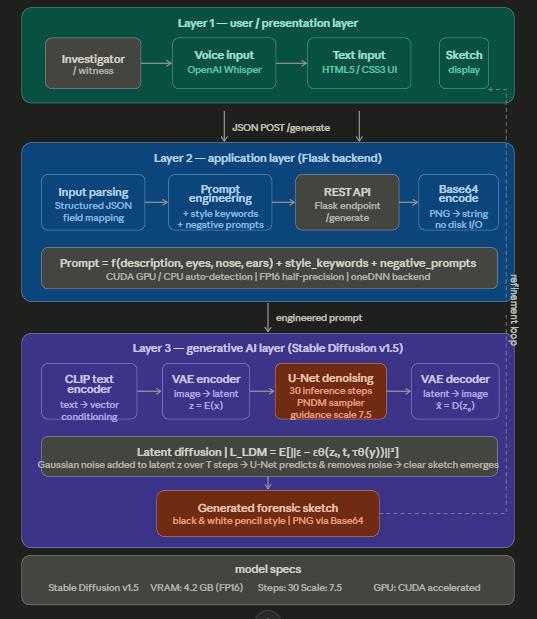
The goal of NeuralSketch is to automatically generate a suspect sketch from a spoken or typed description. The architecturehasthreelayers:
1.PresentationLayer:Thisistheuserinterface built with HTML5andCSS3.Itshowstextfieldswheretheinvestigator canenterdetailsaboutthesuspect'sface eyes,nose,ears, andoveralldescription.
2. Application Layer (Flask): This is the main backend written in Python. When the user submits the details, the Flask server collects all the information and builds a structured prompt. It also manages the communication betweenthefrontendandtheAImodel.
3.GenerativeAILayer:ThislayerusestheStableDiffusion v1.5model.Themodelworksinlatentspace,whichmeansit compresses the image data before processing. This saves memoryandmakesthesystemfast[1][2].
Fig. 3.1 shows the full system architecture with all three layersconnected.
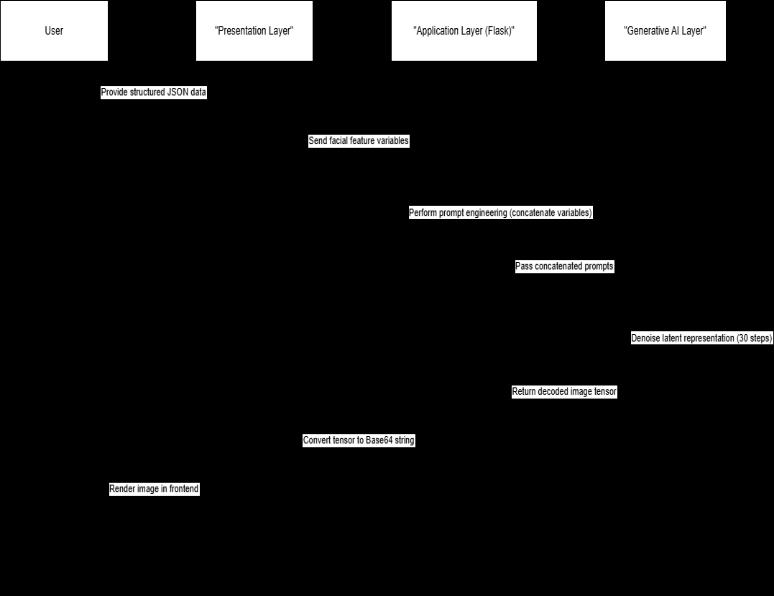
Thesystemfollowsasimplestep-by-stepflowasshownin theDataFlowDiagram(Fig.3.2):
Input Parsing: The user enters facial details. The system readseachfieldclearly eyes,nose,ears,anddescription. PromptEngineering:Thesystemcombinestheuser'sinputs intoonecompletesentence.Itthenaddsstylekeywordslike 'pencilsketch'and'blackandwhite'.Negativepromptsare alsoaddedtostoptheAIfrommakingacolourphotograph. Thisstepisveryimportantforgettingtherightforensiclook [13].
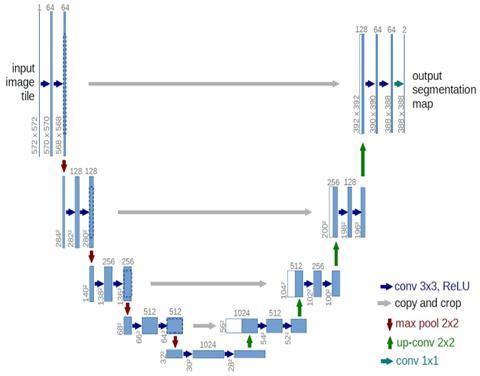
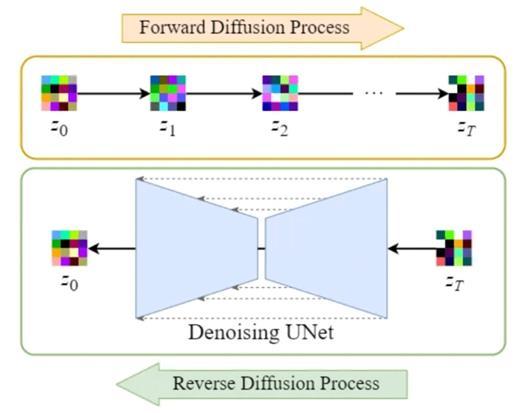
DenoisingPipeline:Thelatentrepresentationisprocessed through 30 denoising steps using a U-Net. At each step, a small amount of noise is removed until a clean sketch appears[2].
Serialization:ThefinalimageisconvertedtoaBase64string and sent directly to the browser. This avoids any delay causedbysavingtheimagetodiskfirst.
4.3
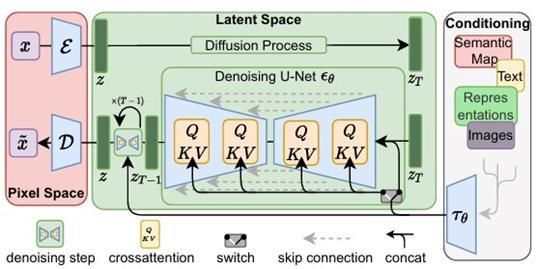
ThecoreofoursystemistheLatentDiffusionModel(LDM) whichworksintwomainstages[1]:
1. Perceptual Compression: A pretrained autoencoder compresses the input image x into a small latent representationz.Thisremovesfinepixel-levelnoisewhile keepingtheimportantstructure.
2. Denoising with U-Net: The U-Net model then slowly removesGaussiannoiseaddedtoz.Sincethisisdoneina low-dimensional space, the training is faster and the memoryuseislower.
Fig.3.3,3.4,and3.5showtheU-Netarchitecture,theLatent Diffusion Model structure, and the Latent Diffusion Mechanismrespectively.
International Research Journal of Engineering and Technology (IRJET) e-ISSN: 2395-0056
Volume: 13 Issue: 04 | Apr 2026 www.irjet.net p-ISSN: 2395-0072
5. METHODOLOGY
OursystemusesaLatentDiffusionModeltoconvertatext descriptionintoapencilsketch.Mostoldermodelsprocess the full image directly, which needs a lot of computing power.Oursystemfirstcompressestheimageintoasmaller form (latent space), so it needs less memory and works fasteronaregularcomputer[1][2].
When the sketch is being created, the process does not happeninasinglestep.TheAIstartswithacompletelynoisy image and slowly removes the noise in 30 steps. At each step,theU-Netmodelremovesasmallpartofthenoise.By the30thstep,aclearpencil-stylefacesketchisready[2][3].
5.1 System Implementation
ThebackendisbuiltusingPythonandFlask.Whentheuser clickssubmit,thesystemcollectsallfacialdetailsandjoins themintoonestructuredprompt.Thepromptisthengiven totheAImodelforsketchgeneration.
5.2 Prompt Construction
Prompt=description+eyes+nose+ears+StyleKeywords (pencil sketch, B/W, line art) + Negative Prompt (photo, colour,watermark).
5.3 Hardware Acceleration
ThesystemusesFP16precisionandCUDAsupportforfaster processing.IfaGPUisnotfound,thesystemautomatically switchestoCPU.
5.4 Image Delivery
ThefinalsketchisdecodedbytheVAEDecoderandsentto thefrontendasaBase64string.Thismakestheprocessrealtimewithnowaitingdelay.
Table 1: Model Performance Metrics
Volume: 13 Issue: 04 | Apr 2026 www.irjet.net
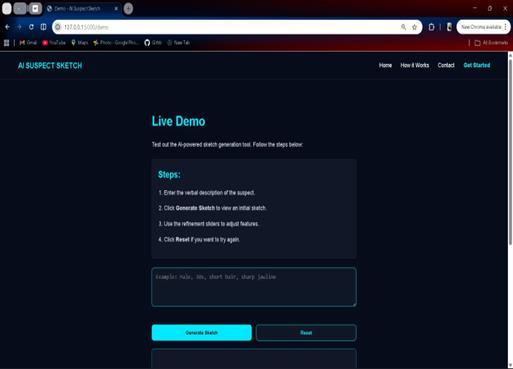
6.1 Experimental Environment and Interface
We tested the NeuralSketch system on a local computer usingtheFlaskdevelopmentserver.Thewebsiteissimple and easy to use. Even a police officer with no technical backgroundcanuseitwithouttraining.Thesystemhasfour steps: enter the description, generate the initial sketch, refinethefacefeatures,anddownloadthefinalsketch.
6.2 Prompt-to-Sketch Synthesis
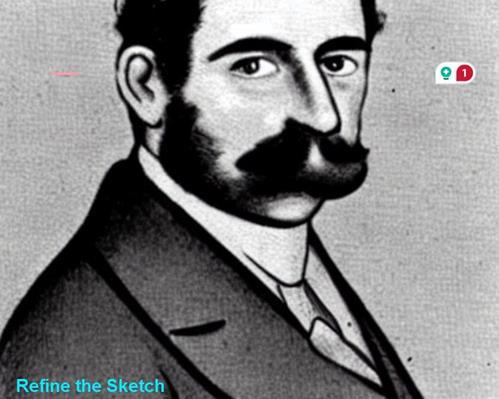
Wetestedthesystembygivingitafullfacedescriptionto checkifitcouldaccuratelycreatethesketch.Forexample, wedescribedamanwithdarksharpeyes,abigmoustache, and a formal blazer. The AI generated a clear black-andwhitepencilsketchthatmatchedthedescription.Theoutput looked like a hand-drawn sketch from an old newspaper, exactlyaswewanted.
6.3 Qualitative Analysis
The sketches generated by the system had the following goodqualities:
Correct Face Shapes: Thejaw,eyes,nose,andmoustache were all placed correctly by the U-Net model. The face lookednaturalandmatchedthedescribedfeaturesclosely.
Sketch Style: The output stayed in black and white and looked like a real pencil drawing. Negative prompts successfullystoppedtheAIfrommakingacolourphoto.
Fine Details: Smalldetailslikehairstrandsinthemoustache and the expression in the eyes were clearly visible in the sketch.Thisshowsthatthesystemcanturnwrittenwords intodetailedfaceimages.
Table 2: System Testing and Validation
Connectivity
Detection
We built the NeuralSketch system to help police and forensic teams create suspect sketches quickly using AI. Normally, drawing a face takes many hours and needs a trainedartist.Withoursystem,aninvestigatoronlyneedsto describethefaceinsimplewordsorspokenlanguage.The
International Research Journal of Engineering and Technology (IRJET) e-ISSN: 2395-0056
Volume: 13 Issue: 04 | Apr 2026 www.irjet.net p-ISSN: 2395-0072
system then creates a clear black-and-white pencil sketch automaticallyinafewseconds.
ThesystemcombinesStableDiffusionwithControlNet-style prompt engineering, Flask-based deployment, and CUDA acceleration. It runs on a simple website and needs no specialinstallation.Inthefuture,weplantoaddControlNet directlyformorestructuralcontrol,supportformultipleface angles,andreal-timevoiceinputusingWhisper. AI tools like NeuralSketch can become a regular part of policeinvestigations.Theycanturnawitness'smemoryinto a clear sketch much faster and more accurately than traditional methods. This can help investigators identify suspectssoonerandsolvecasesfaster
[1]L.Zhang,A.Rao,andM.Agrawala,"AddingConditional Control to Text-to-Image Diffusion Models (ControlNet),"inProc.IEEE/CVFInt.Conf.Comput.Vis. (ICCV),Paris,France,2023,pp.3836–3847.
[2]D.Podelletal.,"SDXL:ImprovingLatentDiffusionModels for High-Resolution Image Synthesis," arXiv preprint arXiv:2307.01952,2023.
[3]Z.Huangetal.,"CollaborativeDiffusionforMulti-Modal FaceGenerationandEditing,"inProc.IEEE/CVFCVPR, Vancouver,Canada,2023,pp.6080–6090.
[4] M. Wu et al., "High-Fidelity 3D Face Generation from Natural Language Descriptions," in Proc. IEEE/CVF CVPR,Vancouver,Canada,2023,pp.5479–5489.
[5] Y. Choi, K. Sohn, and I.-J. Kim, "Face Photo-Sketch SynthesisviaDomain-InvariantFeatureEmbedding,"in Proc.IEEEICIP,KualaLumpur,2023,pp.66–70.
[6] Z. Shi and W. Wan, "Transformer-Based Adversarial Network for Semi-Supervised Face Sketch Synthesis," Journal of Visual Communication and Image Representation,vol.102,p.104204,2024.
[7]S.MaheshKumaretal.,"AI-PoweredFaceSketchingfor CriminalIdentification,"inProc.ICICC2024,LNNSvol. 1241,Springer,2025,pp.35–44.
[8] Kannan et al., "AI-Powered Forensic Face Drawing: A SystematicReview,"CETI,ReaPress,2024.
[9]R.Corvietal.,"IntriguingPropertiesofSyntheticImages: From GANs to Diffusion Models," in Proc. IEEE/CVF CVPR,Vancouver,2023,pp.973–982.
[10]D.Dunsinetal.,"AComprehensiveAnalysisoftheRole of AI and ML in Modern Digital Forensics," Forensic Science International: Digital Investigation, vol. 48, p. 301675,2024.
[11] A. K. Saha et al., "Mukh-Oboyob: Stable Diffusion and BanglaBERTEnhancedBanglaText-to-FaceSynthesis," IJACSA,2023.
[12]Z.Chenetal.,"DiffusionFace:TowardsaComprehensive Dataset for Diffusion-Based Face Forgery Analysis," arXiv:2403.18471,2024.
[13]F.Qinetal.,"UniControl:AUnifiedDiffusionModelfor Controllable Visual Generation In the Wild," in Proc. NeurIPS,NewOrleans,2023.
[14] Y. Wang, X. Li, and Z. Cui, "FaceMamba: Identity Preserving in Face Sketch-Photo Synthesis Using a HybridCNN-MambaFramework,"ScientificReports,vol. 14,Sep.2024.
[15]M.Arjamandetal.,"TheRoleofAIinForensicScience: Transforming Investigations through Technology," IJMRAP,vol.7,no.5,pp.67–70,2024.
PAVANKALE
Student,ComputerEngineering
MGM College of Engineering and Technology,NaviMumbai,Maharashtra
ANIRUDHIYENGAR
Student,ComputerEngineering, MGM College of Engineering and Technology,NaviMumbai,Maharashtra
ASHIRWADBORKAR
Student,ComputerEngineering, MGM College of Engineering and Technology,NaviMumbai,Maharashtra
PROF.SACHINCHAVAN
Professor,ComputerEngineering, MGM College of Engineering and Technology,NaviMumbai,Maharashtra