
International Research Journal of Engineering and Technology (IRJET) e-ISSN: 2395-0056
Volume: 13 Issue: 02 | Feb 2026 www.irjet.net p-ISSN: 2395-0072
International Research Journal of Engineering and Technology (IRJET) e-ISSN: 2395-0056
Volume: 13 Issue: 02 | Feb 2026 www.irjet.net p-ISSN: 2395-0072
Maheep Kumar Ravi1*, Ankit Goyal1, Priyavrat Kumar1
1Department of Mechanical Engineering, Technocrats Institute of Technology and Science Anand Nagar, BHEL Opposite Hathaikheda Dam, Bhopal, Madhya Pradesh 462021
Abstract - Liquid desiccant cooling (LDC) systems have become an energy-efficient and eco-friendly substitute to traditional vapor compression air conditioning technologies, especially those with high loads in the latent component. The efficiency of the LDC systems is closely related to the efficiency of heat and mass exchange between the liquid desiccant and the process air, which is regulated bythe wettabilityofcontact surfaces. Cast nylon plates are also the material that is now being viewed as structured fallingfilmtower packingmaterial because of their low cost, corrosion resistance, mechanical durability, and fabrication ability. Nevertheless, the unruly character of their surface nature, which is largely hydrophobic, does not allow uniform coverage of the liquid films, thus creating dry spots, mal-distributed flows, and diminished system efficiency. This review is a critical analysis of experimental methods that have been used to improve the surface wettability of cast nylon plates in vertical falling film towers that are utilized in liquid desiccant cooling operations. Different methods of surface modification, such as mechanical texturing, chemical treatment, andothers, as wellas, the use of plasma activation and coating methods are discussed with references to their effects on contact angle, film stability, heat and mass transfer coefficients, and the overall cooling performance. The main experimental results of recent literature are summarizedto define the trends ofperformance, real life challenges, and gaps in the research. The review gives useful information to the researcher and designers who are seeking to maximize the output of the falling film tower by enhancing the wettability control.
Keywords: Liquid desiccant cooling; Vertical falling film tower; Surface wettability; Cast nylon plates
1. Introduction
Over the last twenty years, the demand of energy-saving low-emissioncoolingtechnologiesintheworldhasgrown significantlybecauseofthe highratesofurbanization,the improvement of living standards, and the inevitable apprehension of the climate change. Although the most commonly used, conventional vapor compression airconditioning(VCAC)systemsconsumea lotofenergyand are highly reliant on fossil fuel-produced electricity. In addition,refrigerantsthatarealsousedinVCACsystemsare also major contributors of global warming and ozone
depletion. In this regard, other cooling technologies that wouldhavetheabilitytolowertheuseofelectricalenergy but still note thermal comfort have received significant research and industrial attention. Of these, one promising option has been liquid desiccant cooling (LDC) systems which so far have found applications where high latent coolingloadsaretypicallypresent[13].
Liquid desiccant cooling systems work in the principle of dehumidification with the hygroscopic liquid solutions which may be lithium chloride, lithium bromide, calcium chlorideortriethyleneglycol.Thesesolutionsdirectlytake in moisture in humid air hence decoupling the latent and sensible cooling mechanisms. The separation allows LDC systemstobemoreefficientandwithhighindoorairquality thantheirtraditionalcounterparts[4,5].LDCsystemsalso have the potential to be recycled with low-grade thermal energy produced by renewable energy sources like solar collectors,geothermalenergy,orindustrialwasteheat,and thismakesthemevenmoresustainable[6,7].Nevertheless, issuesofcompactnessinthesystem,heatandmasstransfer, compatibility with materials and long-term stability in operationremainbarrierstotheextensiveimplementation ofLDCtechnology.
Out of all the elements of an LDC system, the absorber in which the moisture transfer between air and the liquid desiccanttakesplace,isoneoftheprimaryconcernsofthe system performance. Vertical falling film towers are frequentlyusedasanabsorberbecauseoftheircapabilityto offerhighinterfacialareabetweenliquidandairandatthe sametime,theconstructionisfairlyeasyandthepressure drop is less [8,9]. In such towers, a thin desiccant film of liquidtricklesdownwardsoverstructuredorflatsurfacesby gravity,withhumidairflowingeitherinthesamedirection ortheopposite.Theexcellentheatandmasstransferinthis kindofconfigurationsishighlyreliantontheestablishment of a continuous, stable, uniformly spread liquid film [10]. Anymotionthatinterruptstheflowofthefilm,e.g.formation ofrivulets,dryareas,etc.,maygreatlydecreasetheeffective contactarea,and,therefore,therateofmoistureuptake.
International Research Journal of Engineering and Technology (IRJET) e-ISSN: 2395-0056
Volume: 13 Issue: 02 | Feb 2026 www.irjet.net p-ISSN: 2395-0072
InFigure1.Thebasicbenefitoftheliquiddesiccantcoolingis that it can independently regulate the humidity and temperature.Inhotandmoistenvironments(wherelatent loadsarehighrelativetocoolingdemand)thetraditionalairconditioningsystemstendtoworkpoorlybecausetheymust remove an excessively high amount of moisture. LDC systemsovercomethislimitationbycompletelyeliminating moistureintheairstreamthroughdirectmeans,typically aheadoforinparallelwithsensiblecooling,whichleadsto low compressor loads and a lower power use [11,12]. Moreover,liquiddesiccantsallowoperationwithoutfrosting problemsthatareusuallywitnessedinthesoliddesiccant systems.
SomethermodynamicconsiderationsregardingLDCsystems arethatthecoupledheatandmasstransferprocessestaking placeontheairliquidinterfacegoverntheperformanceof LDC systems. Water vapor absorption of the desiccant is exothermicinnatureanditincreasesdesiccanttemperature and decreases the absorption capacity of the desiccant unless heat is efficiently eliminated. The design of the absorbershouldthereforenotonlybesuchthatithashigh masstransferratebutalsogoodheatdissipation[13].Such configurations,inparticularfallingfilm,arehighlydesirable inthisrespect,sincethethinliquidfilmallowsrapidremoval ofheatandreducesdiffusionresistance.Nonetheless,itcan stillposeasignificantdesignchallengeinsofarasreaching and sustaining an ideal film thickness and distribution is concerned.
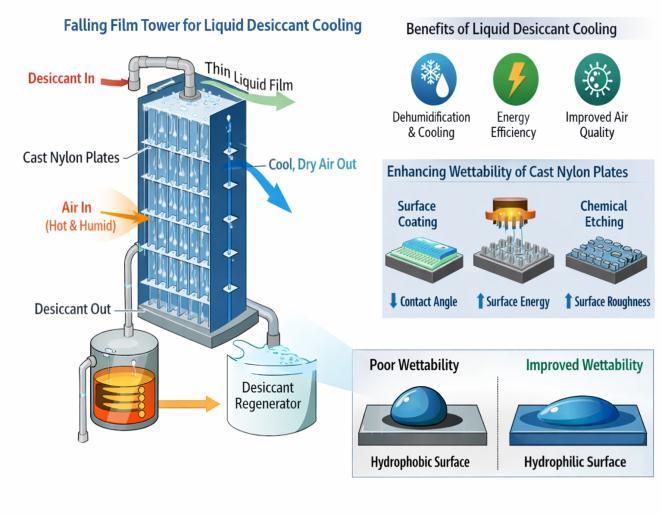
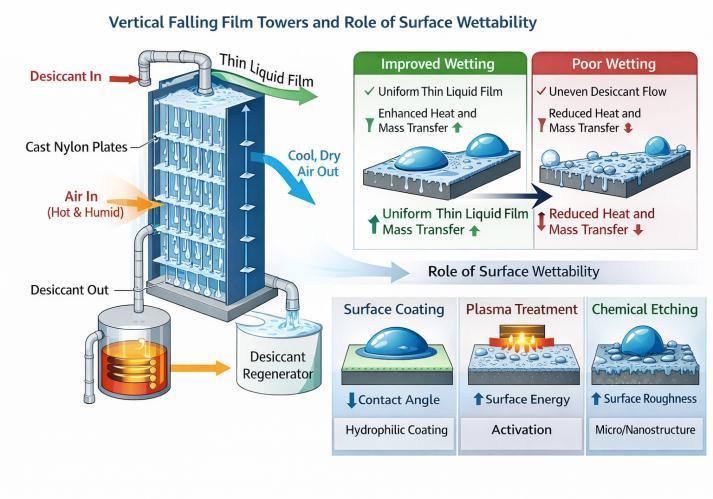
Figure2 has Surface wettability as a parameter that determines the liquid film behavior in falling film towers. Wettabilityisdefinedasapropertyofaliquidtobeableto spreadoverthesurfaceofasolid,whichisusuallymeasured asthestaticcontactangle.Whenthecontactangleislow,the wettabilityofthesurfaceisgood,anduniformfilmspreading isachievedand,conversely,whenthecontactangleishigh, thesurfacewillbepartiallywettedandproducerivuletsas well as flow instabilities [14]. Bad wettability may cause channeling of the liquid desiccant in vertical falling film deliveryandleavelargeareasofsurfacedryandinactiveto heatandmasstransfer.
Anumberofstudieshavealsoproventhatthereisimproved wettability of the surface resulting in thinner and more stableliquidfilm,increasedinterinterfaceareaandagreater heat and mass transfer coefficient [15,16]. This effect of wettabilityisevengreaterwithlowliquidflowrates,which arecommonlydesiredwithLDCsystemstoreducepumping energy and solution carryover. In this case, hydrophobic surfaces are highly susceptible to the film breakup, which drasticallyimpairstheperformanceoftheabsorber.Thishas ledtosurfaceengineeringsolutionstoenhancewettability ranks among the research topics in the falling film technology.
1.3
Thechoiceofmaterialsusedtoconstructfallingfilmtower surfaces is controlled by various factors that can be categorized as corrosion resistance, mechanical strength, manufacturability, cost, and compatibility with the textile used as a desiccant of the liquid. Aluminum alloys and stainless steel are also good thermal conductors that are
International Research Journal of Engineering and Technology (IRJET) e-ISSN: 2395-0056
Volume: 13 Issue: 02 | Feb 2026 www.irjet.net p-ISSN: 2395-0072
affected by corrosion problems when subjected to concentrated desiccant solutions, especially the chlorides and bromides [17]. Glass and ceramic materials are very goodinchemicalresistancebutarefragileandvery costly hencetheirusabilityinlargesystemislimited.
Polymeric materials and particularly engineering plastics includingcastnylon,polypropylene,andpolyvinylchloride have become the interesting alternatives because of their lowdensity,goodresistancetocorrosion,andsimplicityto fabricate [18]. Cast nylon, specifically, is good in terms of mechanical properties, dimensional stability and long servicelifeeveninwetoperatingconditions.Thesearethe benefitsthatcastnylonplatescanbeutilizedasstructured packing or flat contact surfaces in the vertical falling film towers. The fact that cast nylon, however, is highly hydrophobic on its inherent surface, thus giving it a relatively low contact angles with aqueous desiccant solutions [19], is a huge deficiency to this material. It is a naturalhydrophobicitythatsuppressesthespreadofnatural filmsandrequiresexternalinterventiontoincreasesurface wettability.
1.4 The review requires a need to be wetted and the extent of its scope.
Numerous improvement measures of enhancing the wettabilityofcastnylonsurfaceshavebeeninvestigatedin experimental works.Among themost frequentlyexplored methodsaremechanicalsurfacetexturing,chemicaletching, plasma and corona treatments and hydrophilic coatings [2022].Thewaystoachievethisarethroughalteringsurface chemistry,increasingsurfaceenergyorcreatingmicro-and nano-scale roughness which facilitates capillary-mediated spreading.Althoughmajoradvancementshavebeenmadein the reduction of the contact angle and control of the uniformityofthefilms,ithasbeenrevealedthattheefficacy andstabilityofthesetreatmentsarequiteinconsistentand depend on the operating conditions and the desiccant chemistry.
However,inspiteoftheincreasingnumberofexperimental data,thecurrentliteratureisusuallydisjointedduetoalack ofacomprehensivecomparisonofstudiesthatconcentrate onaparticulartreatmentoroperatingconditions.Also,the long-termstability,scalabilityandeconomicsofwettability enhancement methods in cast nylon plates are not adequatelytakencareof.Thus,suchareviewistimelyand needed, whichactivelyevaluatesexperimental wettability improvement solutions to cast nylon surfaces in vertical falling film towers. The review summarizes the literature availabletopresentimportantfindings,gapsintheresearch, and offer suggestions to further streamline and build the high-performanceliquiddesiccantcoolingsystems.
This is a review that is premised on an extensive examination of experimental literature published in peer reviewed material, conference papers and dissertations writingonliquiddesiccantcooling,fallingfilmtowersand theenhancementofsurfacesofpolymers.Thecriteriaused to select them were: (i) the use of cast nylon or related polymeric materials in falling film configurations, (ii) experimental assessment of wettability parameters including contact angle, film thickness, or spreading behavior,and(iii)applicabilitytoperformanceinheatand mass transfer in LDC systems. The studies were divided based on the kind of wettability enhancement method. Observedimprovementswerecomparedtokeyperformance indicators, experimental setups and identified dominant trendsandlimitations.
Thewettabilityonthesurfaceisthedeterminingfactorin the application of vertical falling film towers in liquid desiccantcoolingsystems.Castnylonplatesareappealingin terms of mechanical and chemical benefits but they need intentional surface accessibility to enable consistent and steady flow of liquids in a film. This review indicates that experimental wettability improvement methods including mechanical texturing, chemical treatments, plasma activationandhydrophiliccoatingcanplayamajorrolein decreasingcontactangleandenhancingthecontinuityofthe filmthroughcastnylonsurfaces.Increasedwettabilityhas been shown to result in an increase in the heat and mass transfercoefficients,increaseintherateofmoistureremoval and increased stability of the absorber operation. Nevertheless, it has issues as far as long term durability, scalabilityoftreatment,and compatibilitywithaggressive desiccant solutions are concerned. Further studies are neededonhybridsurfacemodificationmethods,longterm performancetestingandtechnoeconomictestingtoenable the practical application of the wettability enhanced cast nylonplatesintheliquiddesiccantcoolingsystemsusedin commercialapplications.
[1]A.Lowenstein,“Reviewofliquiddesiccanttechnologyfor HVAC applications,” HVAC&R Research, vol. 14, no. 6, pp. 819–839,2008.
[2] Y. Yin, X. Zhang, and Y. Li, “Liquid desiccant airconditioningsystems:Areview,”RenewableandSustainable EnergyReviews,vol.38,pp.354–366,2014.
[3]M.A.Islam,K.Sopian,andM.Y.H.Othman,“Energyand exergy analysis of liquid desiccant cooling systems: A review,”EnergyandBuildings,vol.158,pp.679–695,2018.
International Research Journal of Engineering and Technology (IRJET) e-ISSN: 2395-0056
Volume: 13 Issue: 02 | Feb 2026 www.irjet.net p-ISSN: 2395-0072
[4]J.R.MehtaandR.Kumar,“Performancecharacteristicsof liquid desiccant dehumidification systems,” International JournalofRefrigeration,vol.33,no.2,pp.369–378,2010.
[5]H.Ge,X.Xiao,andR.Wang,“Recentprogressonliquid desiccant cooling systems,” Applied Thermal Engineering, vol.125,pp.816–828,2017.
[6]A.FumoandD.Goswami,“Studyofanaqueouslithium chloride desiccant system: Air dehumidification and desiccantregeneration,”SolarEnergy,vol.72,no.4,pp.351–361,2002.
[7]S.JainandP.K.Bansal,“Performanceanalysisofliquid desiccant cooling systems,” International Journal of Refrigeration,vol.30,no.5,pp.861–872,2007.
[8] J. Mu, L. Zhang, and Y. Jiang, “Heat and mass transfer characteristicsoffallingfilmliquiddesiccantdehumidifiers,” InternationalJournalofHeatandMassTransfer,vol.55,no. 1–3,pp.146–156,2012.
[9]S.M.AliandM.A.Khan,“Experimentalinvestigationof verticalfallingfilmabsorbersforliquiddesiccantcooling,” EnergyConversionandManagement,vol.105,pp.324–334, 2015.
[10]R.J.GoldsteinandA.I.Behbahani,“Fallingfilmheatand masstransfer:Areview,”JournalofHeatTransfer,vol.134, no.3,pp.031801-1–031801-12,2012.
[11] X.Zhang and Z.Chen, “Independenthumidity control usingliquiddesiccantsystems,”EnergyandBuildings,vol. 41,no.6,pp.577–584,2009.
[12] K. Gommed and G. Grossman, “Experimental investigationofaliquiddesiccantsystemforsolarcooling,” SolarEnergy,vol.84,no.6,pp.1039–1050,2010.
[13]A.H.Abdel-SalamandA.M.Fathalah,“Heatandmass transfer analysis of liquid desiccant absorbers,” Applied Energy,vol.113,pp.1658–1666,2014.
[14] P.-G. de Gennes, F. Brochard-Wyart, and D. Quéré, CapillarityandWettingPhenomena:Drops,Bubbles,Pearls, Waves.NewYork,NY,USA:Springer,2004.
[15]S.Leu,C.Wu,andC.Jang,“Effectofsurfacewettability onfallingfilmheattransfer,” InternationalJournalofHeat andMassTransfer,vol.53,no.21–22,pp.4696–4704,2010.
[16]M.Al-Shannaq,A.Farid,andA.Al-Dadah,“Enhancement of falling film absorption using surface modification,” AppliedThermalEngineering,vol.89,pp.438–447,2015.
[17] D. J. Kukulka and R. Smith, “Corrosion behavior of metalsinliquiddesiccantenvironments,”CorrosionScience, vol.52,no.2,pp.424–432,2010.
[18]S.R.PatilandR.K.Sahu,“Polymericmaterialsforheat andmasstransferequipment:Areview,” MaterialsToday: Proceedings,vol.5,no.2,pp.5678–5685,2018.
[19] J. Bico, U. Thiele, and D. Quéré, “Wetting of textured surfaces,” Colloids and Surfaces A: Physicochemical and EngineeringAspects,vol.206,no.1–3,pp.41–46,2002.
[20]M.Strobel,C.S.Lyons,andK.L.Mittal,PlasmaSurface ModificationofPolymers:RelevancetoAdhesion.Utrecht, TheNetherlands:VSP,1994.
[21] Y. Wu, L. Chen, and J. Wang, “Surface modification of polymer materials for enhanced wettability: A review,” Surface and Coatings Technology, vol. 307, pp. 291–303, 2016.
[22] R. Darbandi, M. S. Sadeghi, and A. Zare, “Hydrophilic coating strategies for polymer heat transfer surfaces,” ProgressinOrganicCoatings,vol.123,pp.341–352,2018.